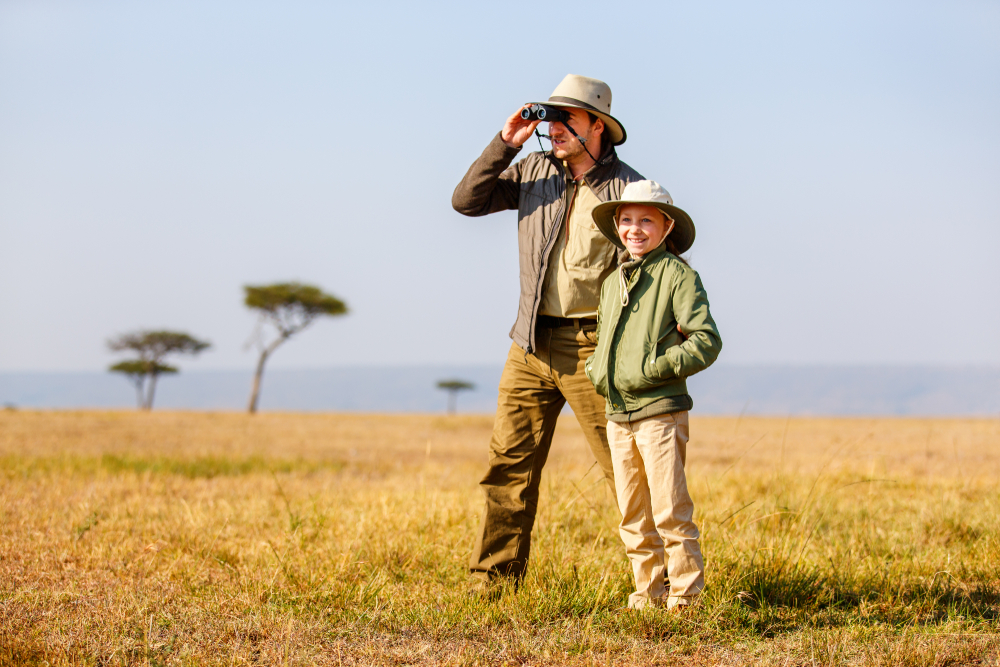
A Family Safari in Namibia & South Africa, by Age

Marlene Azeez
Director of Travel
The best family safari in Southern Africa is planned around your youngest child, not the map. With children under six, start in South Africa: Cape Town, the Winelands, and a malaria-free private reserve with family suites and a private vehicle. From about six to eleven, Namibia opens up — red dunes, a cool Atlantic coast, and lodges built around family units — paired with a few nights of classic big-game viewing. Tweens and teenagers are ready for the full circuit: Sossusvlei, the Skeleton Coast, Etosha’s waterholes, and South Africa’s leopard country, with the long drives that make Namibia feel like an expedition.
This guide is the family chapter of two journeys we already design: our Namibia Desert Drive and South African Wonders, which pairs Cape Town and Stellenbosch with the Sabi Sand. If this is your first time in Africa, read Your First African Safari before you decide on countries. Here we answer the question parents actually ask: what works at my children’s ages, and when can we go?
A family safari is not a smaller version of an adult safari. It is a different trip — shorter drives, private vehicles, more pool time, and one big moment a day that every age will remember.
THE SHORT ANSWER
Namibia, South Africa, or Both?
South Africa is the easier first safari for families. Flights are simpler, Cape Town and the Winelands give everyone a soft landing after a long-haul flight, and the country has private reserves outside the malaria areas — a real advantage with toddlers and preschoolers. When you want the densest big-game viewing, the Sabi Sand on the edge of Kruger National Park is the benchmark, with lodges that offer family suites, private vehicles, and children’s programming.
Namibia is the adventure. It is less about chasing sightings and more about space: the Namib Sand Sea, the fog-bound Skeleton Coast, desert-adapted elephants in Damaraland, and the floodlit waterholes of Etosha. It rewards children who can handle early starts, gravel-road days, and long horizons — usually from about six upward, and best of all with tweens and teens who will hike a dune at sunrise without being carried.
Combining the two is the strongest family itinerary we build. Cape Town is a natural gateway to Windhoek, and the contrast — city and vineyards, then desert and coast, then big game — keeps every age engaged across ten to fourteen nights. For reserve and lodge styles, see our South Africa luxury safari lodges guide; for the dunes, our Namib sand dunes guide.
TIMING
When to Go: School Holidays vs. the Safari Calendar
The classic safari season lines up with Northern Hemisphere summer holidays; the trade-off is that the Cape is in its cool, wetter winter. Choose the window that serves the half of the trip that matters most.
June to August: Summer Break, Dry Season
This is the strongest window for game viewing in both countries. In Namibia, May to October is the dry season: clear skies, cold desert nights in June through August, and animals concentrating around Etosha’s waterholes. In the Sabi Sand, the dry winter (roughly May through September) thins the bush and draws animals to water. Pack real layers — early drives in open vehicles are genuinely cold for small children. Cape Town will be cooler and changeable, so keep the city chapter short or hold Table Mountain for a clear morning.
Late March and April: Spring Break
Spring break falls at the tail of the green season: lush landscapes, young animals, and usually pleasant Cape weather. Game viewing is good but less concentrated than in the dry months. It suits a South Africa-led trip with a shorter Namibia extension.
December Holidays
December is Cape summer, the best month for the city and Winelands. In the bush it is green season — afternoon storms, superb birding, thicker vegetation. Namibia is hot inland, though the coast stays cool. Festive dates book earliest; plan a year ahead.
September and October: The Shoulder Sweet Spot
If your school calendar allows a fall break, September and October bring some of Etosha’s most intense waterhole action, warmer Namibian days, and good Sabi Sand conditions before the rains, with the Cape moving into spring. It is often the best balance of the region.
BY AGE
What Works at Every Age
Child policies are set lodge by lodge, often activity by activity: some lodges welcome all ages, others set minimums for the lodge, shared drives, or walks. Policies change, so we confirm each property’s current rules for your children’s exact ages before any deposit.
Under 6: Malaria-Free First, Private Everything
For toddlers and preschoolers, the shape of the trip matters more than the destination. We build around a malaria-free private reserve, a family suite or exclusive-use house, and a private vehicle so drives can be cut short the moment interest fades. In the Eastern Cape, Kwandwe Private Game Reserve — which describes itself as malaria-free — welcomes children of all ages at its family-oriented lodges and villas and offers complimentary child-minding by arrangement. Madikwe, in North West Province, is the other malaria-free reserve families most often consider. Keep drives to an hour or two, plan pool time every afternoon, and give Cape Town three nights so jet lag doesn’t land on safari days.
Namibia is possible with very young children, but it is not where we would start: distances are long, activities are early and physical, and some lodges set minimum ages.
Ages 6 to 11: The Sweet Spot
This is when a safari becomes a story children tell for life: old enough to sit through a morning drive and stay up for a floodlit waterhole, young enough to be thrilled by all of it. In South Africa, Singita’s Sabi Sand lodges list a Mini Game Rangers’ course that teaches tracking, bird and tree identification, and stargazing. In Namibia, a short dune climb at Sossusvlei, a boat morning on Walvis Bay, and a sleep-out under the stars give every day a single headline moment.
For this age group we nearly always book a private vehicle. Some lodges require one for families with younger children, and it lets a guide pitch the same sighting two ways — a short stop for the eight-year-old, a long wait for the photographer.
Tweens and Teens: The Full Circuit
Teenagers are ready for Namibia at full scale: the drive from the dunes to the coast, the remote Skeleton Coast, desert-adapted elephants in Damaraland’s dry riverbeds, and three nights on a private reserve bordering Etosha. In South Africa, older teens can join guided walking safaris where lodges allow — at Singita Ebony Lodge, walks are for guests 16 and older. This is also the age when a teenager with a camera, a sketchbook, or a conservation interest can be paired with a guide who shares it.
HEALTH
Malaria: Where It Matters, and Who Decides
Malaria is the single biggest planning variable for families in Southern Africa, and it is a medical decision, not a travel one. Book a travel-medicine appointment for the whole family six to eight weeks before departure, and bring the exact itinerary — region by region — to that appointment. What follows is a planning orientation from the U.S. Centers for Disease Control and Prevention (CDC), not medical advice.
Namibia
CDC lists malaria transmission in Namibia’s northern regions — Kavango East and West, Kunene, Ohangwena, Omaheke, Omusati, Oshana, Oshikoto, Otjozondjupa, and Zambezi — and recommends preventive medication for travelers to those regions. That takes in the area around Etosha, and Kunene also covers much of Damaraland and the Skeleton Coast park. Elsewhere, CDC describes malaria as rare and recommends mosquito-bite precautions only; Windhoek has no transmission. Sossusvlei and Swakopmund lie outside the listed regions. Because CDC guidance is set by region rather than by habitat, ask your doctor how it applies to a dry desert or coastal stay inside Kunene.
South Africa
Cape Town, the Winelands, and most of the country have no malaria transmission. CDC lists malaria along the borders with Zimbabwe and Mozambique — the Mopani and Vhembe districts of Limpopo, the Ehlanzeni district of Mpumalanga, the uMkhanyakude district of KwaZulu-Natal — and in Kruger National Park, which it describes as endemic with seasonal transmission. The Sabi Sand shares an unfenced boundary with Kruger, so treat it as a malaria area. CDC also notes occasional cases in a few neighboring districts, including Limpopo’s Waterberg, where it recommends bite precautions rather than tablets. The Eastern Cape and Madikwe sit outside the listed areas.
Children and Antimalarials
CDC notes that children’s doses are calculated by body weight and that some options — doxycycline, for example — are not used for children under eight. Your pediatrician or travel clinic will choose what is right for each child, or may steer you toward a malaria-free itinerary for the youngest. Whatever is prescribed, lodges in malaria areas add the second layer: screened or air-conditioned rooms, nets, and repellent at dusk.
ITINERARY
A Sample 12-Night Family Itinerary
The shape we most often build for children six and older — shorter and malaria-free for little ones, longer and more remote for teens.
Days 1–3: Cape Town Soft Landing
Arrive into Cape Town and give the first day to rest. Hold Table Mountain for the first clear morning, then take a private half-day down the Cape Peninsula to Cape Point and the African penguins at Boulders Beach. Base yourselves at One&Only Cape Town on the V&A Waterfront or at Ellerman House; with extra time, add Winelands nights at Delaire Graff Estate above Stellenbosch.
Days 4–6: Sossusvlei
Fly to Windhoek and on toward the dunes. Little Kulala, on the private Kulala Wilderness Reserve, has a family unit and an exclusive-use gate that gets you into Sossusvlei early, before the heat and the crowds. Climb a red dune at first light, walk into Dead Vlei, and give the afternoons to the plunge pool. Older children love a rooftop sleep-out; a dawn balloon flight is a highlight for families who meet the operator’s requirements.
Days 7–8: The Atlantic Coast
Drive or fly to Swakopmund for a change of air: a morning on Walvis Bay’s lagoon among flamingos and seals, and a private 4x4 trip to Sandwich Harbour, where the dunes meet the ocean. One important note from CDC: there is a rabies outbreak in Cape fur seals in Namibia and South Africa, so keep children well back and never let anyone touch a seal, whatever a tour operator says. With teens, swap the coast for two nights at Shipwreck Lodge inside Skeleton Coast National Park, which has two family cabins.
Days 9–12: The Big-Game Finale
Choose by age and medical advice. For the Namibia-only version, spend three nights on a private reserve bordering Etosha, with drives inside the park and an evening at a floodlit waterhole. For the biggest density of game, fly back to South Africa for the Sabi Sand: Singita Ebony Lodge has two family suites, and booking both together becomes the Ebony Villa, with its own vehicle, guide, chef, and pool. For a malaria-free finale, end in the Eastern Cape at Kwandwe or in Madikwe instead.
The Under-6 Version
Keep it to South Africa: three nights in Cape Town, two in the Winelands, and four or five in a malaria-free reserve with a private vehicle and child-minding. No gravel-road days, and pool time every afternoon.
ACCOMMODATION
Where to Stay: The Style of Stay Matters More Than the Name
Family Units with a Private Vehicle
A family suite keeps everyone together; a private vehicle lets you set the pace. On these routes that means Little Kulala at Sossusvlei, Shipwreck Lodge on the Skeleton Coast, and Singita Ebony Lodge in the Sabi Sand. Ask how family rooms connect — some share a deck rather than an internal door, which matters with younger children.
Exclusive-Use Villas and Homesteads
For multigenerational groups, an exclusive-use house — your own vehicle, guide, chef, and pool — removes every worry about noise at dinner. Singita’s Ebony Villa and Kwandwe’s exclusive-use villas are the models.
Etosha, Damaraland, and Madikwe
In these regions we match the lodge to your children’s ages, your dates, and your doctor’s advice rather than publishing a single pick. Child policies, family rooms, and private-vehicle rules differ sharply from one lodge to the next, and the right answer for a family with a seven-year-old is rarely the right answer for a family with two teenagers.
ON THE ROAD
Self-Drive vs. Guided with Kids
Namibia is one of Africa’s great self-drive countries, but with children we usually recommend a hybrid. Roads are largely gravel, distances long, and traffic drives on the left; CDC advises avoiding night driving. We plan every day to arrive well before dark, add satellite communication, and recommend an international driving permit. A private guide-driver on the longest legs, plus light-aircraft hops (strict soft-bag limits apply), keeps parents present instead of navigating.
In South Africa, self-driving inside private reserves isn’t the model: game drives are guided by a ranger and tracker, and you fly or are driven in. The city and Winelands chapter works best with a private driver-guide.
INSIDER INTELLIGENCE
Haute Intel for a Family Safari
HAUTE INTEL — BOOK THE FAMILY ROOMS FIRST. Many lodges have only one or two family units. Lock those for school-holiday dates before you buy flights, often 12 months ahead or more.
HAUTE INTEL — PAY FOR THE PRIVATE VEHICLE. It is the single best upgrade on a family safari. Your children set the pace, and nobody else’s game drive is cut short by a restless five-year-old.
HAUTE INTEL — DECIDE MALARIA BEFORE YOU DECIDE LODGES. Take the region-by-region route to your doctor first. It may change which reserve you book.
HAUTE INTEL — ONE BIG MOMENT A DAY. A dune at sunrise, a leopard in the afternoon, or a waterhole after dark — not all three. Protect wonder by protecting downtime.
HAUTE INTEL — CHECK DOCUMENTS FOR MINORS. Entry rules change. Namibia has required visas for many nationalities, including U.S. and U.K. passport holders, since April 2025, and families should confirm current requirements for traveling with children for both countries well before departure.
For how Haute Black approaches extraordinary family trips more broadly, see our family travel page and 7 Best Family Adventure Vacations. Packing for open vehicles and cold dawns is covered in our luxury safari packing guide.
MEMBER ACCESS
Plan Your Family Safari with Haute Black
Tell us your children’s ages, your school-holiday window, and whether malaria-free is a must. We match each lodge to your family, confirm child policies and private-vehicle rules in writing, and sequence the flights, guides, and drives so the trip runs at your youngest child’s pace. Start at Plan My Journey.
Keep reading: Namibia Desert Drive, South African Wonders, Botswana’s Okavango Delta, Galápagos with Kids, and Patagonia with Kids.
A Family Safari in Namibia & South Africa, by Age — Frequently Asked Questions
Six to eleven is the sweet spot: children are old enough for morning drives and young enough to be thrilled by everything. Under six, a malaria-free South African reserve with a private vehicle works best. Tweens and teens are ready for Namibia’s full circuit. Lodge child policies vary, so we confirm each one for your children’s exact ages.
Yes. CDC lists malaria mainly in parts of Limpopo, Mpumalanga, and KwaZulu-Natal and in Kruger National Park. Reserves outside those areas, such as Kwandwe in the Eastern Cape and Madikwe in North West Province, are what families with young children usually choose. The Sabi Sand, next to Kruger, is a malaria area. Your doctor makes the final call.
Namibia is a popular self-drive country, but roads are mostly gravel, distances are long, and traffic drives on the left. With children we recommend a hybrid: arrive before dark every day, carry satellite communication, and use a private guide-driver or light-aircraft hops on the longest legs.
June to August lines up with summer school holidays and the dry season, the strongest window for game viewing in Etosha and the Sabi Sand, though the Cape is cooler. December suits Cape Town best, with green-season safari. September and October are an excellent shoulder if your school calendar allows.
Twelve nights covers Cape Town, Sossusvlei, the Atlantic coast, and a big-game finale without rushing. Under-6 families do well with nine or ten nights in South Africa only. Teens can stretch to fourteen nights and add the Skeleton Coast and Damaraland.
Related Reading


Related Experiences

From the Journal
Your Journey Starts Here
Ready to Experience This
the Haute Black Way?
Our travel concierge team can arrange every recommendation in this guide — from priority reservations to private experiences and preferred room upgrades.
Begin Your Journey