Haute Black Journal
A Luxury Guide to the Namib Sand Dunes

Marlene Azeez
Director, HauteBlack
View all articles →
# A Luxury Guide to the Namib Sand Dunes
May 29, 2026
Visitors often arrive at the Namib expecting a photograph. What truly surprises is that the dune system refuses to stay still. NASA satellite observations found dunes in this region migrating at an average of 7 to 32 metres per year, with some smaller dunes moving as fast as 83 metres per year over the observation period, which makes the Namib one of the world's most active dune systems according to NASA's dune study in Namibia.
That matters because the finest experience of the Namib sand dunes isn't about ticking off a famous viewpoint. It's about entering a living system on its own terms. Timing, light, access, guiding, and where you sleep all change what the desert reveals. Get those choices right and the Namib feels vast, private, and almost orchestral. Get them wrong and it can become a rushed sequence of gate times, hot climbs, and crowded photo stops.
An Ocean of Sand A Journey to the Namib
The first luxury the Namib offers is not comfort. It's scale.
Travelers often reduce the Namib sand dunes to a handful of iconic images, usually sunrise on a red ridge or the stark trees of a clay pan. That's understandable, but incomplete. UNESCO identifies the Namib Sand Sea as the only coastal desert in the world with extensive dune fields influenced by fog, spanning 3,077,700 hectares with an additional 899,500-hectare buffer zone, as noted on the UNESCO listing for the Namib Sand Sea.
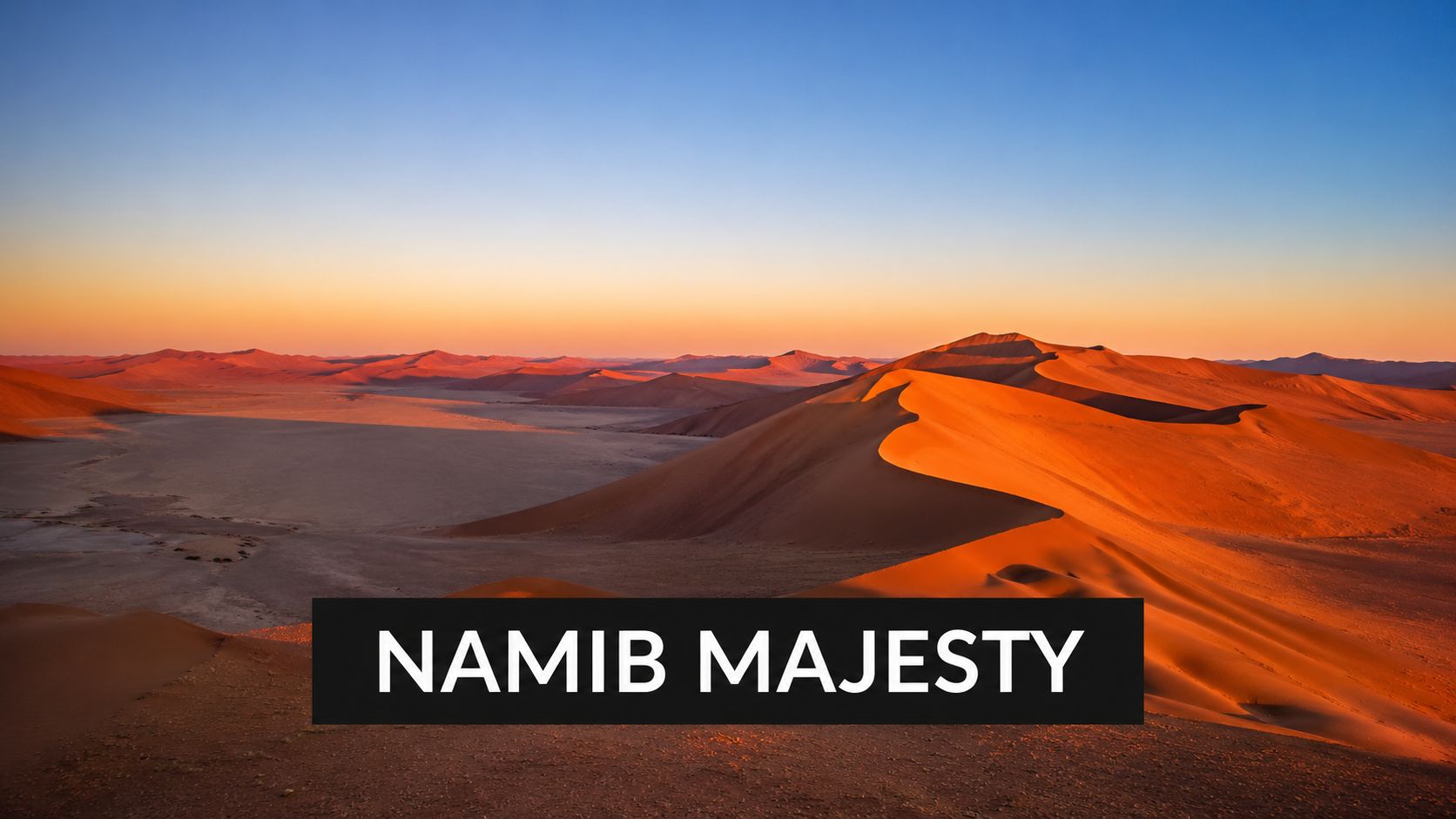
That fog changes everything. It softens horizons, feeds life where rainfall alone would never be enough, and gives the desert an atmosphere that many first-time visitors don't anticipate. On some mornings the dunes feel almost marine. The air hangs differently. Distances blur. The silence deepens.
The Namib rewards travelers who treat it less like a sightseeing stop and more like a carefully staged immersion.
That is why rushed itineraries rarely work here. The desert asks for room. Room to arrive without fatigue. Room to watch the light change twice in one day. Room to move beyond the obvious viewpoints and understand that dunes are only one expression of a broader environment that also includes rocky areas, gravel plains, wetlands, lagoons, riparian forests, and springs.
For a well-curated journey, the Namib becomes less about “seeing the dunes” and more about experiencing contrast. Dawn chill against noon heat. Silence against wind. Aerial grandeur against the intimacy of tracks, beetles, and the grain of sand underfoot. That's when the destination starts to feel profound rather than merely beautiful.
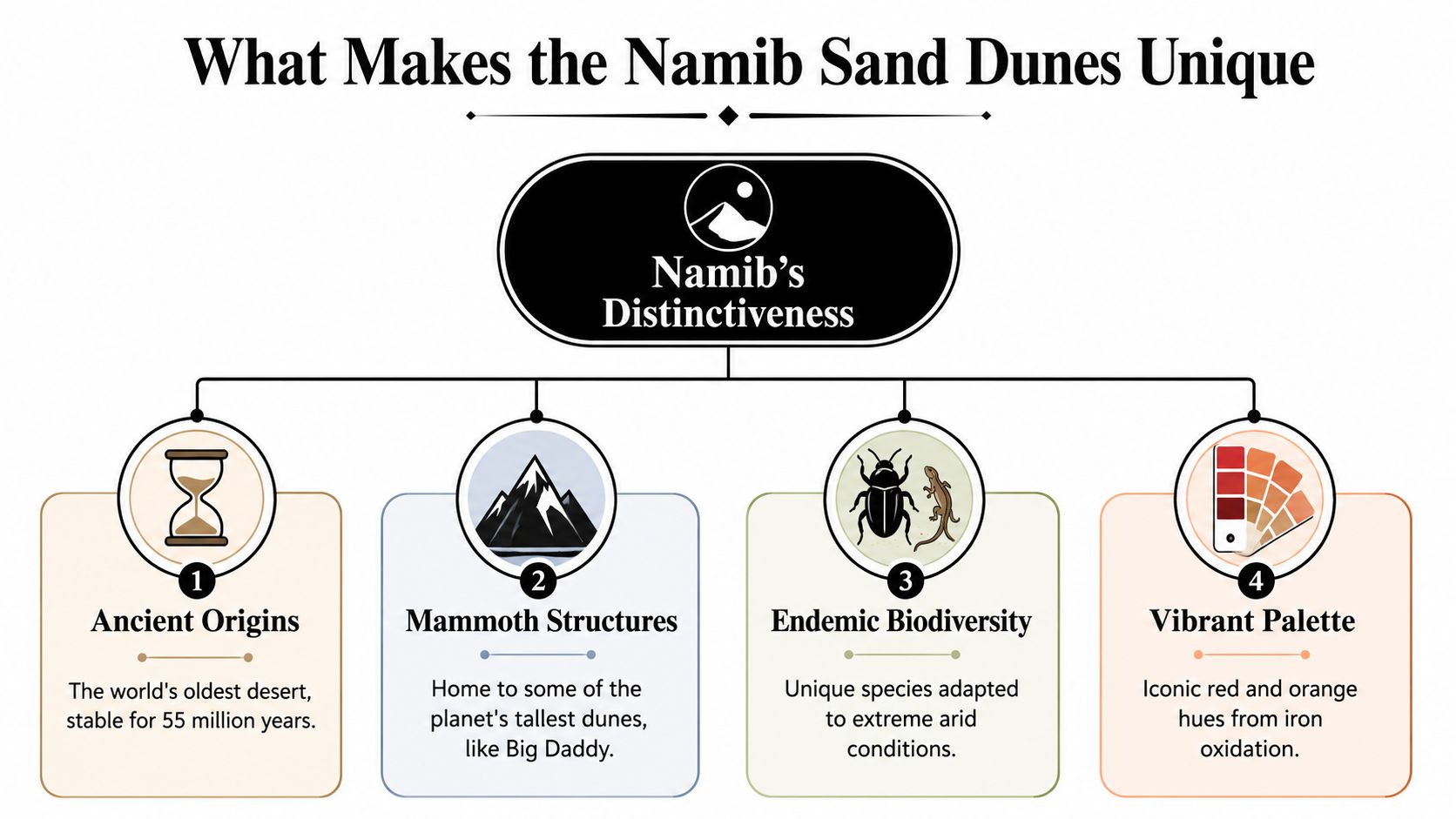
What Makes the Namib Sand Dunes Unique
The Namib sand dunes are impressive at first glance. They become far more interesting when you understand how they were built, why they take different forms, and how much life depends on what looks, from a distance, like emptiness.
Scale and deep time
The Namib Sand Sea sits within Namibia's Namib-Naukluft Park and covers 3,077,700 hectares, with a further 899,500-hectare buffer zone. UNESCO's data sheet also notes that the dunes were created by a long-distance sediment “conveyor system” carrying material over thousands of kilometres through river erosion, ocean currents, and wind, and that the highest dunes rise to about 350 m above their base, according to the UNEP-WCMC World Heritage data sheet for the Namib Sand Sea.
NASA adds another dimension. The sand sea has been evolving for about 1 million years. That's useful context because the Namib doesn't feel ancient in a static, fossilized sense. It feels ancient and active at the same time, which is rarer and more compelling.
A desert with specialists, not emptiness
The untrained eye sees absence. The informed traveler sees specialization.
Within the Sand Sea, the documented endemic fauna includes 12 mammals, 9 birds, 18 reptiles, 44 arachnids, and 207 insects. Those figures matter because they challenge the usual idea of dunes as simple wasteland. This is a highly selective ecosystem, one in which survival depends on precision adaptation rather than abundance.
A strong guide changes the experience completely here. Instead of presenting the Namib as scenery, they read it as evidence. Tracks in a slipface. A beetle's movement at first light. The way fog and wind shape where life can persist. For travelers who usually gravitate toward East Africa for classic game viewing, this is a very different pleasure. It is quieter, more forensic, and often more memorable.
Practical rule: If your only plan is to climb a dune and leave, you'll miss the intellectual and ecological richness that makes the Namib world-class.
The language of dune shapes
Not all dunes are the same, and in the Namib their forms are a readable record of wind and sand supply. Visit Namibia's explanation of dune morphology gives the clearest practical framework:
- Barchan dunes form under unidirectional winds with low sand supply. They migrate relatively quickly and often look clean, crescent-shaped, and highly mobile.
- Transverse dunes appear where the wind remains largely one-directional but sand becomes more abundant.
- Linear, or seif, dunes develop under bidirectional winds. They often read as disciplined, elongated ridges running through the terrain.
- Star dunes form where winds arrive from multiple directions and sand is abundant. These grow vertically rather than laterally, which is one reason they appear so monumental and sculptural.
For travelers, this isn't academic detail. It changes what you're looking at from a scenic backdrop into a legible expanse. The Namib starts to make sense once you stop seeing “sand dunes” as one category.
What that means on the ground
The most expertly planned itineraries build around variety, not repetition. One morning might focus on broad aerial perspective, where dune fields reveal their geometry. Another might be a ground-level exploration of texture, tracks, and the subtle difference between one dune system and another.
A useful way to think about the Namib is this:
| Element | What it changes |
|---|---|
| Wind regime | The dune form you see and how dynamic that section feels |
| Sand supply | Whether dunes stay lean and mobile or build into larger structures |
| Fog influence | The mood, visibility, and ecological character of the experience |
| Guiding quality | Whether the desert reads as empty scenery or a complex living system |
That is the difference between a standard desert visit and a properly curated one. The best Namib journeys turn observation into understanding.
Planning Your Visit The Best Times and Windows
The right time to visit depends less on a generic “best season” and more on what kind of desert you want to experience. Light, temperature, airborne conditions, and your tolerance for unpredictability all matter.
For clean light and crisp logistics
Many seasoned travelers prefer the cooler part of the year because mornings are more comfortable, the air often feels clearer, and long dune walks are more pleasant. This is the period when the desert's sculptural qualities come forward. Edges look sharper. Shadows hold longer. Early flights and scenic operations tend to feel more straightforward when atmospheric instability is lower.
If your priority is photography, the best strategy is simple. Build your day around first light and late afternoon. Midday flattens relief and drains drama from the ridgelines.
- Choose dawn for dune texture. Low light reveals contours and long shadows.
- Use late afternoon for warmth. The color palette turns richer and the desert feels less severe.
- Protect the middle of the day. That's the right time for rest, spa time, a long lunch, or a slow return to camp.
For mood, weather drama, and fewer predictable patterns
Other travelers prefer a more atmospheric desert. That usually means accepting variability. Skies can feel more theatrical, the light can soften in beautiful ways, and the sense of a living ecosystem becomes stronger. The trade-off is that operations that depend on ideal visibility or calm conditions can require flexibility.
Fog is a particular consideration in a fog-influenced coastal desert. It can create extraordinary mornings, especially for travelers who like muted palettes and atmospheric photography, but it can also affect aviation timing and change the rhythm of a day.
If you're combining scenic flying, ballooning, and fixed dining times, leave slack in the schedule. The Namib is elegant, but it doesn't perform on command.
How experienced planners build a better window
The strongest itineraries don't overschedule the dunes. They create buffers.
A practical framework looks like this:
1. Arrive with recovery time. Don't land and immediately attempt your signature experience.
2. Place your priority activity early. If ballooning or a private flight matters most, schedule it before lower-priority excursions.
3. Keep one flexible slot. This protects the itinerary if fog, wind, or simple fatigue reshapes the day.
4. Stay at least long enough to see the dunes in different light. One drive-in, one sunrise, and one hurried departure is rarely enough.
The Namib is at its best when the itinerary leaves room for conditions to become part of the experience rather than a disruption to it.
Arriving in Style Charter Flights vs Self-Drive
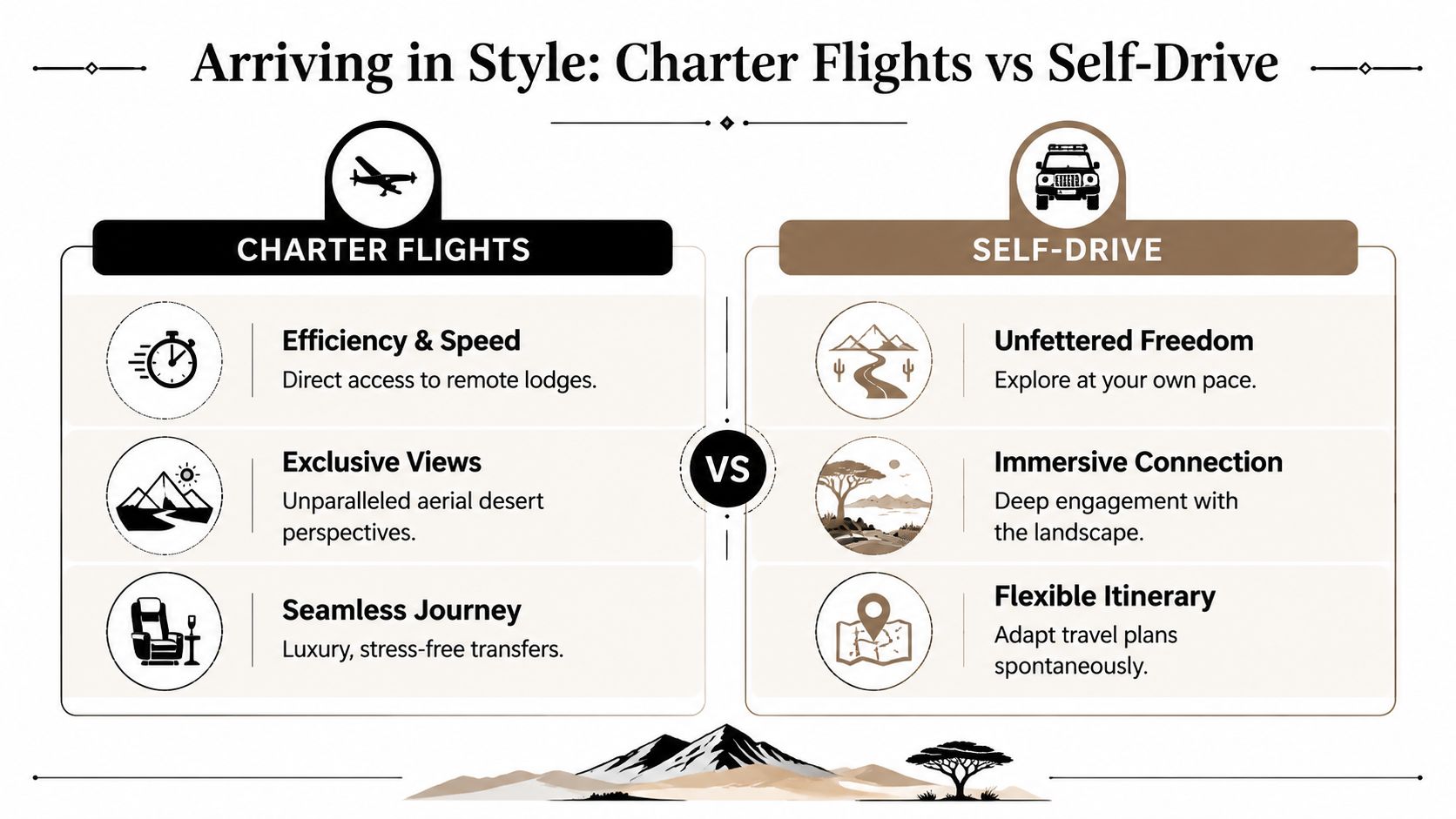
How you reach the Namib shapes the trip as much as where you stay. For some travelers, the point is absolute ease. For others, it's controlled freedom. Both can work well. The mistake is choosing an access style that conflicts with the pace and tone you want once you're there.
When charter flights are the right answer
Private air access is the cleanest solution for travelers who value time, privacy, and direct routing. It removes the fatigue of long road sectors and replaces them with one of the region's great visual experiences. Seeing dune systems from the air changes your understanding of the Namib immediately. Patterns that feel abstract on the ground become legible within minutes of takeoff.
This option also pairs well with multi-stop itineraries. If you're combining the dunes with the Skeleton Coast or another remote camp, aviation makes the journey feel coherent rather than fragmented. Travelers considering that route often benefit from specialist coordination such as private air travel planning through Haute Black.
Charter is usually the strongest fit for:
- Time-sensitive travelers who don't want to spend valuable daylight on transfers
- Multi-generational groups where ease matters more than adventure driving
- Honeymooners and celebratory trips where the journey should feel smooth from the outset
When self-drive is the better luxury
Self-drive is often misunderstood. In the Namib, it doesn't have to mean roughing it. Done well, it offers a different kind of sophistication.
A high-spec 4x4, a precise route, properly handled logistics, and smart lodge sequencing can make a self-drive journey highly satisfying. You control the pauses. You stop when the light hits a gravel plain in a way no one expected. You spend longer in the transitions, which are often some of the most beautiful parts of Namibia.
That freedom comes with responsibility. Distances can feel longer than they look on a map. The desert is unforgiving of casual planning. Fuel strategy, tire confidence, route quality, and arrival timing all matter. Self-drive works best for travelers who enjoy active participation in the journey and don't mind that the transfer itself becomes part of the day.
Charter removes friction. Self-drive converts friction into experience. The right answer depends on your temperament.
A practical comparison
| Consideration | Charter flights | Self-drive |
|---|---|---|
| Time use | Maximizes time at lodge and on activities | Gives more time in the landscape itself |
| Privacy | Very high, especially point-to-point | High, but with more public road exposure |
| Access | Best for remote combinations | Best for travelers focusing on overland immersion |
| Fatigue level | Low | Moderate, depending on route and pacing |
| Sense of control | Highest once airborne logistics are set | Highest on the ground, moment to moment |
For many experienced travelers, the most elegant answer is hybrid. Fly one direction for efficiency, drive another for texture. That gives you aerial scale and overland intimacy without forcing the entire journey into one mode.
Exclusive Lodges of the Namib Desert
The finest lodges in the Namib don't compete on excess. They compete on placement, privacy, and how intelligently they frame the desert. In an environment this strong, bad design feels intrusive and good design disappears.
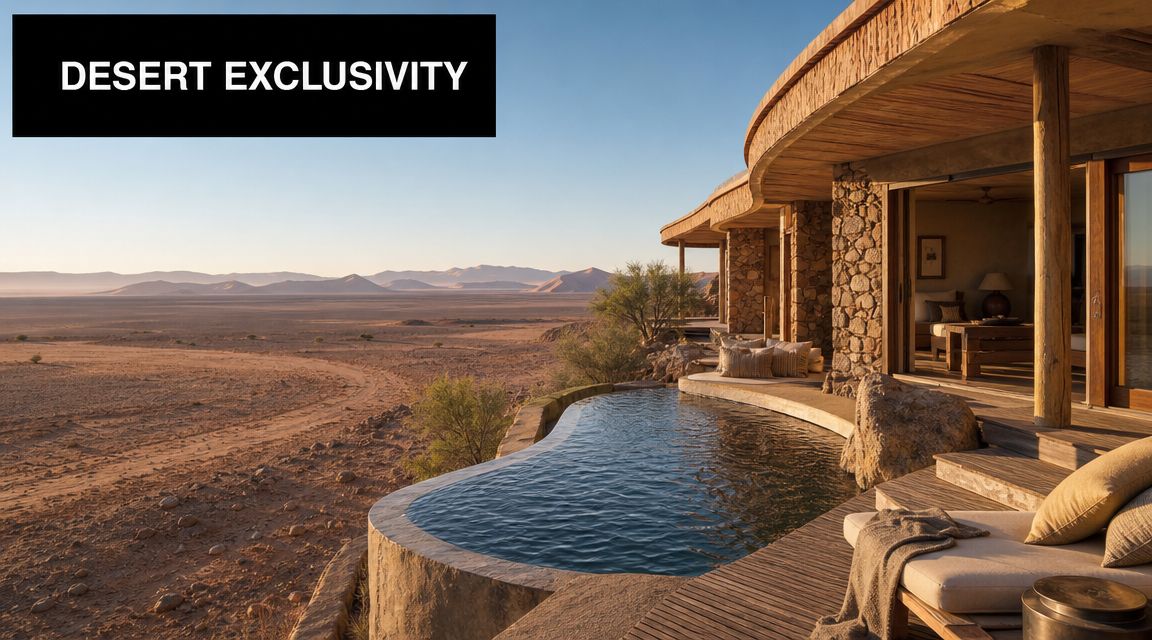
That matters even more because the Namib is dynamic. Dunes in the region continue to move, and the most thoughtful properties are positioned to capture enduring views while respecting the force of the environment around them. For travelers comparing options, curated lodge access such as Haute Black hotel planning is most useful when availability is tight and room category matters as much as the booking itself.
&Beyond Sossusvlei Desert Lodge
This is one of the strongest choices for travelers who want architecture to heighten, not soften, the desert. The experience is polished, contemporary, and intentionally spacious. Rooms are designed for stillness. The desert does the visual heavy lifting.
Its appeal lies in restraint. You return from the dunes, settle into a suite that feels open to sky and horizon, and the silence becomes part of the luxury. This is an excellent fit for couples, privacy-focused travelers, and anyone who values design as much as access.
Little Kulala
Little Kulala works especially well for travelers who want proximity to iconic dune country while maintaining a soft, highly comfortable base. The tone is more intimate than theatrical. Service tends to feel warm rather than performative, which suits guests who prefer understated luxury.
The advantage here is rhythm. Early starts feel manageable, returns from the dunes feel restorative, and the property supports a pace that blends activity with recovery. That is not a small detail in the Namib, where badly sequenced days can leave even seasoned travelers depleted.
Hoanib Skeleton Coast Camp
Strictly speaking, this camp speaks to a broader Namibia circuit rather than a pure dunes stay, but it belongs in the conversation for travelers building a richer desert narrative. If your vision of Namibia includes the contrast between inland sand systems and the haunted drama of the coast, this kind of property becomes strategically important.
It introduces another register entirely. The mood shifts from sculptural red dunes to harder, more remote terrain. For clients who don't want a one-note desert trip, that contrast often becomes the emotional high point.
A short visual sense of place helps:
What separates a good lodge from the right lodge
The answer usually comes down to four filters:
- Positioning
Some properties deliver immediate access to headline sights. Others trade that for deeper privacy and broader wilderness feel. Neither is necessarily better.
- Guide quality
In the Namib, a superb guide can transform the trip. This destination rewards interpretation more than spectacle.
- Architectural temperament
Some travelers want dramatic design and wide-glass immersion. Others want something quieter, almost monastic.
- Circuit logic
A lodge may be excellent on its own and wrong for your route. Namibia rewards sequencing. The best property is the one that fits the journey around it.
The smartest lodge choice is not the most famous one. It's the one that matches how you want to feel in the desert at the beginning and end of each day.
Bespoke Experiences in the Sea of Sand
The Namib becomes unforgettable when experiences are arranged as a sequence rather than a menu. One activity should deepen the next. A flight should sharpen what you notice on the ground. A guided walk should make a sunset drive more legible. That's how the desert moves from impressive to intimate.
Travelers who want that level of narrative often start with a framework similar to a Namibia desert drive journey, then tailor it around pace, privacy, and appetite for adventure.
For the traveler who wants scale
A sunrise balloon flight remains one of the most graceful ways to enter dune country. It strips away road noise and replaces it with drift, shadow, and quiet altitude. For some travelers, this is the ideal opening experience because it establishes the geometry of the desert before they engage it on foot or by vehicle.
Scenic helicopter or fixed-wing flights serve a different purpose. They widen the story. Instead of focusing on one valley or one set of ridges, they show how the sand sea interacts with mountains, gravel plains, and distant coast.
For the traveler who wants detail
Private guided walks are often more valuable than people expect. The Namib rewards slow looking. The shape of a ridge, the texture of a slipface, the faint trace of nocturnal movement in the sand. These details don't compete with the grand views. They anchor them.
This is also where specialist guiding matters most. A desert ecologist or seasoned naturalist can reveal the logic of survival in a place that many visitors initially read as bare. Once you've seen that layer, the dunes stop being abstract.
If you only experience the Namib from scenic viewpoints, you'll understand its beauty but not its intelligence.
For the traveler who wants privacy and occasion
Some of the most successful desert moments are almost ceremonial in their simplicity. A private breakfast set after an early activity. Sundowners placed far from other vehicles. A lantern-lit dinner on a dune crest with enough distance from camp to feel separate from ordinary lodge life.
The strongest versions of these experiences avoid overproduction. In the Namib, understatement usually plays better than spectacle. The environment already provides the drama. The role of planning is to remove intrusion.
A few experiences combine especially well:
- Ballooning and a quiet late afternoon if you want one signature memory without making the day exhausting
- Aerial scenic flight and specialist walk if you prefer a high-low contrast between scale and detail
- Private vehicle use and a remote dinner setup if privacy matters more than packed activity
For the traveler who wants adrenaline
The Namib can deliver pace as well as stillness. Some guests want more motion in the itinerary, whether through dynamic driving, more ambitious dune exploration, or an aviation-led day that links multiple desert environments. This works best when balanced against recovery time and not stacked on consecutive days.
The common mistake is to treat the desert like an adventure park. It isn't. The highest level of execution comes from modulating energy. One bold morning. One slower afternoon. One evening that lets the scale settle in.
That rhythm is what turns a luxury desert trip into a finely judged one.
Curating Your Namib Journey with Haute Black
The Namib looks simple from afar. Sand, sky, a few iconic stops. In practice, it is one of those destinations where quality depends on orchestration.
Timing matters because light changes the entire emotional tone of the dunes. Access matters because a chartered arrival, a long overland transfer, and a hybrid routing all produce different journeys. Lodge choice matters because some properties are designed for romance, some for privacy, some for serious guiding, and some for wider circuit logic across Namibia. Activities matter because too many “must-dos” can flatten the experience into logistics.
That complexity is exactly why the destination rewards expert planning. The difference isn't only convenience. It's coherence. The right room, the right guide, the right aircraft, the right pacing, and enough flexibility for fog or wind to reshape the day without stress.
What seasoned travelers get right
They pack for range, not for fashion alone. The desert asks for lightweight layers, proper sun protection, good footwear for sand, and quality optics if you care about wildlife or scenery detail. A refined traveler can absolutely dress well here, but practicality improves the experience.
They also resist overbuilding the itinerary. One of the greatest luxuries in the Namib is unclaimed time. Time to sit on a deck and watch the light leave a dune line. Time to recover after an early start. Time to let silence do some of the work.
Why curation matters more here than in easier destinations
In urban luxury travel, many errors can be corrected on the fly. In the Namib, poor sequencing compounds. A badly timed transfer can erase your best light. The wrong lodge pairing can create unnecessary road time. A flight plan with no buffer can turn minor weather into avoidable frustration.
That is why the best journeys into the Namib are designed backward from the experience you want. Solitude. Romance. Aerial drama. Ecological depth. Family ease. Once that intention is clear, everything else can be aligned around it.
The Namib doesn't reward improvisation as generously as it rewards precision.
For travelers who want the desert at its best, curation is not about adding more. It's about editing ruthlessly, protecting the right moments, and ensuring the experience feels effortless even when the logistics behind it are not.
Haute Black designs Namib journeys with that exact discipline. From securing the right lodge and preferred room category to arranging private air, specialist guides, and smooth ground logistics, Haute Black turns one of Africa's most complex and rewarding environments into a trip that feels calm, elegant, and precisely your own.


