Haute Black Journal
South Africa Luxury Safari Lodges: The UHNW Insider Guide

Marlene Azeez
Director, HauteBlack
View all articles →
# South Africa Luxury Safari Lodges: The UHNW Insider Guide
Published August 9, 2026 by Marlene Azeez
You've already done the first safari, so you know the difference between a lodge that looks good on paper and one that feels private, paced, and worth the spend. The next trip shouldn't be a catalogue of “top ten” names, it should be a deliberate choice about reserve character, vehicle density, suite layout, and how much control you want over the day. That's the lens I'd use for South Africa luxury safari lodges, because the right answer depends less on star rating and more on fit, especially for honeymooners, multigenerational families, and repeat travelers who want the second safari to feel sharper than the first.
Why the Right Safari Lodge Is a Fit Decision, Not a Ranking
A charter drops onto a red-earth airstrip, the heat is already sitting low on the horizon, and a butler is waiting with cold towels and a drink you didn't have to ask for. That arrival can feel perfect, or it can feel slightly off if the lodge, the reserve, and the pace of service aren't aligned with the trip you wanted. That's why I don't start with a ranking. I start with the question: what kind of privacy, movement, and wildlife rhythm do you want to buy?
Two lodges can sit at the same luxury tier and still deliver completely different experiences. One may be built for social energy and high vehicle turnover, another for slow mornings, exclusive-use pacing, and a guest profile that values silence more than scene-setting. If you're comparing south africa luxury safari lodges for a honeymoon, a three-generation family trip, or a return visit, the best property is the one that matches the trip's emotional brief, not the one with the loudest marketing.
Practical rule: if your last safari felt over-programmed, the fix isn't “more luxury.” It's lower density, better guide matching, and a reserve with the right movement patterns.
The right advisor doesn't push the same lodge at every client. They separate the choices by who's travelling, how much privacy matters, and whether the trip is about wildlife intensity, room design, or total control. If you're still building your safari vocabulary, Haute Black's first-timer safari guide is the right baseline before you start narrowing properties.
Choosing Your Reserve Across South Africa
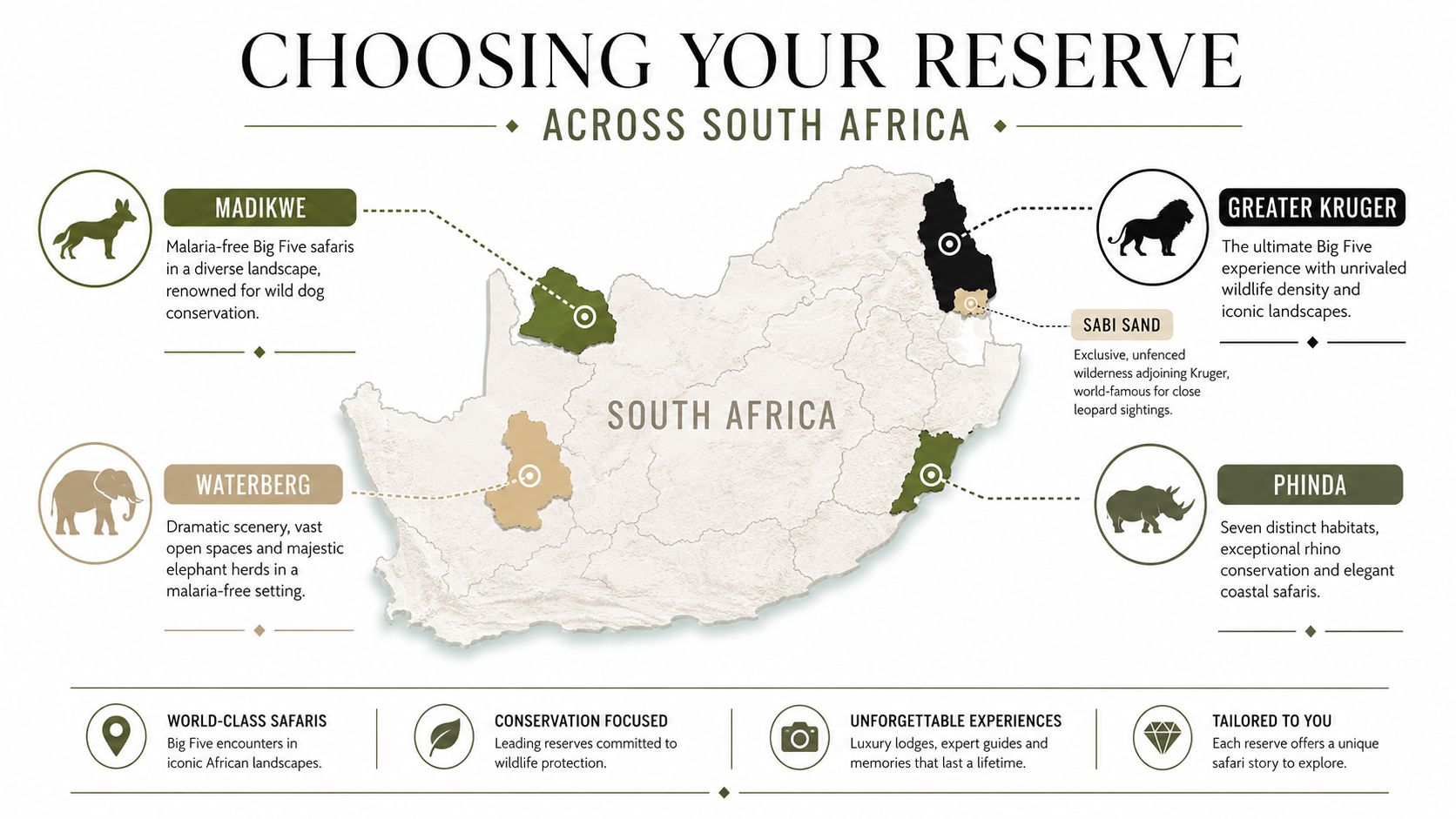
South Africa's luxury safari geography is concentrated, but the differences matter. Greater Kruger, especially the Sabi Sand nucleus, is the country's benchmark for dense wildlife viewing and lodge-heavy private reserve travel. Madikwe pulls in clients who want a malaria-free safari with a more remote feel, while Phinda and parts of the Eastern Cape appeal to travelers who want more than morning and afternoon drives.
Greater Kruger and Sabi Sand
This is the obvious choice if the brief is leopard, lion, and consistently strong Big Five viewing. The area sits alongside Kruger National Park, and the private reserves inside the ecosystem, especially Sabi Sand, are where the luxury market has clustered most aggressively. Published coverage describes Sabi Sand as a reserve where lodges are discreetly scattered, which is exactly why the experience can feel more contained than a conventional safari circuit. Haute Black's South Africa travel coverage is useful here because it keeps the planning logic on one page instead of turning the conversation into a generic lodge list.
Madikwe
Madikwe is the cleaner answer for families and cautious planners who want a premium safari without malaria risk. It's also the reserve I'd look at when a client wants space, calmer logistics, and a less obvious luxury footprint. The wildlife experience is serious, but the emotional tone is different from Sabi Sand. It feels more intentionally remote.
Phinda and the Eastern Cape
If you want a lodge that can support more than game drives, I'd look first at Phinda-style planning, which works well for travelers who want varied terrain and a broader activity mix, while the Eastern Cape is strong for accessibility and family convenience. The malaria-free angle is especially relevant for parents traveling with younger children or anyone who wants to remove one layer of trip planning.
The simplest decision matrix is this. If you want the most reliable classic safari tension, go to Greater Kruger. If you want privacy with less health friction, choose Madikwe or the Eastern Cape. If you want a more layered safari with land, water, or coastal extensions, Phinda makes the most sense.
Lodge Typologies and Which Traveler They Fit
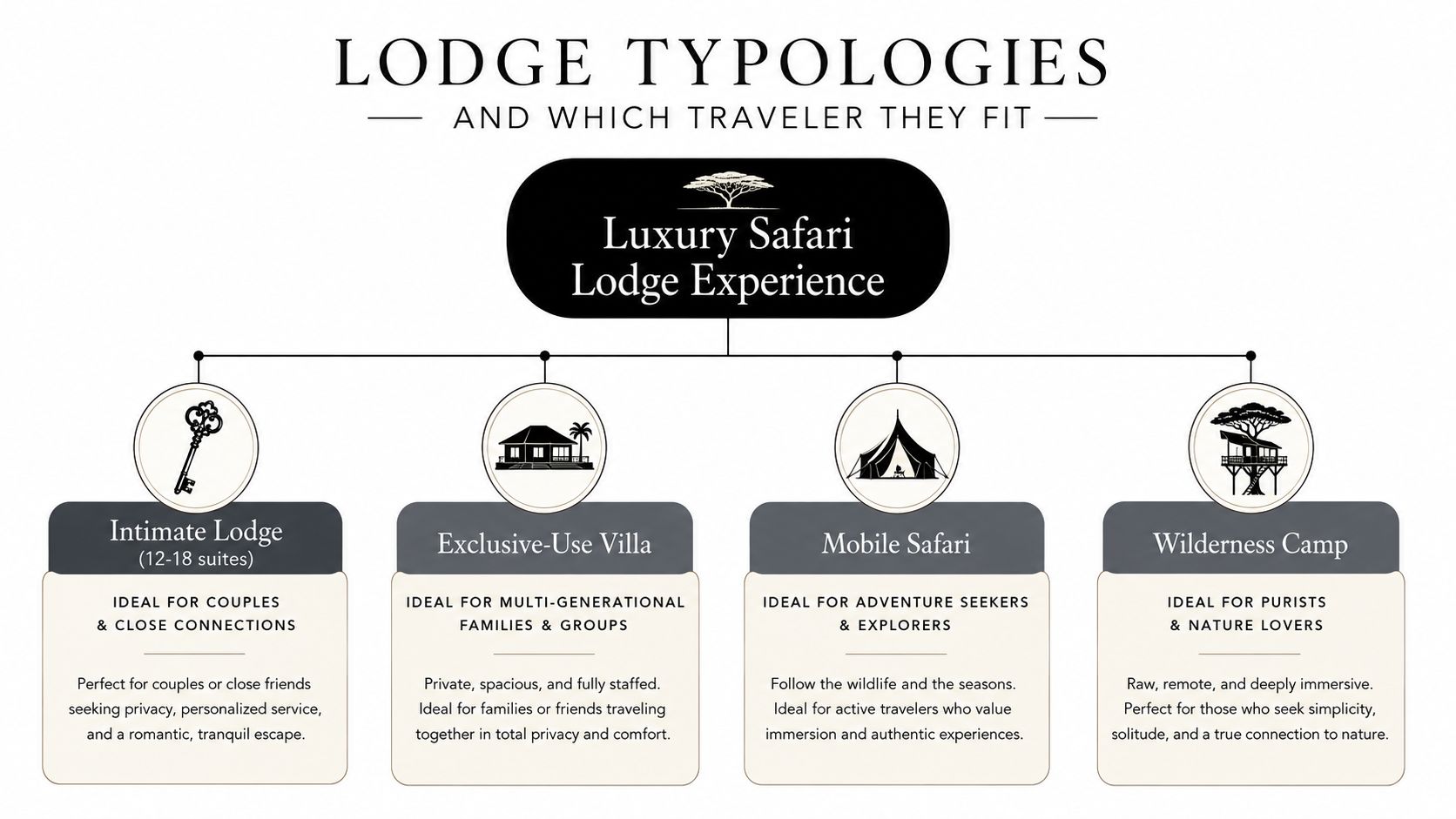
The room count matters, but the typology matters more. A lodge with 12 suites and a lodge with 18 suites can both be intimate, yet only one may give you the privacy threshold you want. Think in product shapes, not just price bands.
Intimate lodge
This is the safest fit for couples who want strong service, nightly dining, and a small social footprint. It usually works best when the guest wants to see other people at dinner, but not feel managed by a crowd. A lodge of this type can be elegant without being performative, which is exactly why it often wins for anniversaries and honeymoons.
Exclusive-use villa
This is the right structure for multigenerational families or close groups of friends who want to run their own schedule. The appeal is not only the space, it's the private vehicle, guide, tracker, butler, and chef dynamic that removes friction from the day. For clients designing a house style or interior identity around this format, a partner for hospitality design can be useful if they're thinking beyond the booking and into the feel of the property itself.
Mobile safari and wilderness camp
These work for purists and travelers who want a stronger sense of movement, canvas, and wilderness texture. They're still luxury, but the emotional appeal is different. You're paying for intimacy with the natural environment, not polished permanence.
Family compound
This is the version I'd recommend when children are part of the trip and mealtimes need to flex. Connected suites and private arrangements matter more here than decorative detail. The family compound keeps the group together without making every interaction feel public.
The most expensive room isn't always the right room. The best fit is the one that matches the way your group actually moves through a day.
Signature Properties Worth Booking
A proper shortlist should feel edited, not scraped from a brochure. Three names tell you more than twenty, if you read them as examples of how the market behaves.
Royal Malewane for high-control privacy
Royal Malewane sits in the category of properties that sell privacy as a specification, not a slogan. It is one of the three properties reported at the Five Star Premium level in the Greater Kruger ecosystem, alongside Camp Jabulani and Lion Sands Ivory Lodge, and that placement matters because this tier sits above the standard Five Star benchmark of roughly $757 to $1,100 per person sharing per night, while Five Star Premium ranges from about $1,392 to $2,057 per person sharing per night in the same market Greater Kruger lodge benchmarks. That pricing usually includes meals, drinks, and twice-daily game drives, so the question is how well the lodge delivers the experience once you are on property.
Madikwe for malaria-free family strategy
Madikwe is the sensible luxury choice when a client wants to keep the safari premium but remove malaria from the equation. That makes it especially strong for families, grandparents, and guests who are already managing a complex travel calendar. The reserve's appeal is also practical. It gives the planner a cleaner brief, because the lodge conversation can focus on space, guiding, and sightings instead of health anxiety.
Phinda-style planning for variety
Phinda works for clients who do not want the trip to be defined by drives alone. The broader appeal is in multi-activity design, where the day can include wildlife, scenery, and a more varied pace. If your traveler wants to feel that the itinerary was built rather than booked, this is the kind of reserve that can deliver it.
What I would avoid is choosing only on room glamour. The right lodge is the one where the reserve, the typology, and the guest profile line up cleanly.
Seasons, Wildlife, and How to Time the Trip
Timing changes the safari more than most first-time planners expect. The dry season, roughly May through September, concentrates wildlife around water and usually gives the most dependable Big Five viewing. The green season, October through April, gives you richer skies, baby animals, bird activity, and a softer crowd profile.
Start with the wildlife brief
If the trip is about classic density, schedule around the dry months. If the trip is about photography, birding, or a more private feel, the greener months can be smarter. A lodge that feels fully booked in peak season can feel beautifully spacious when the calendar turns.
Match the reserve to the season
Sabi Sand is a strong all-rounder, and it rewards off-peak travel when you want fewer people in the system without giving up serious wildlife potential. Madikwe and the Eastern Cape are often easier to plan around because the safari doesn't depend as heavily on one narrow seasonal window. That matters for families who don't have the luxury of choosing dates purely around ecology.
Use season as a strategy, not a preference. If you want the best sighting odds, plan one way. If you want space and softer pricing pressure, plan another.
The wrong question is “what's the best time to go.” The better question is “what kind of safari do I want the weather to support.” Once you answer that, the reservation list gets much shorter.
Logistics, Charters, and Getting There Smoothly
The trip gets easier when the airport plan is treated as part of the safari, not a separate headache. Private charter can make sense for bush airstrips, especially when the lodge sits farther from a commercial gateway and the client values time over seat count. The main virtue is simple. You land closer, transfer less, and arrive with less drag on the first day.
What planners should sort early
For many itineraries, the decision is between a private connection and a commercial hop plus road transfer. Bush airstrips reduce friction, while road transfers can still be the smarter call when the reserve is relatively accessible. Madikwe and the Eastern Cape are also the cleaner health choice for travelers who want to avoid malaria zones, while Greater Kruger sits in a low-to-moderate risk area, so the planner should address that before flights are ticketed.
Visa and entry checks should be handled alongside flights, not after the lodge is confirmed. That applies to feeder markets like the United States, United Kingdom, and Schengen area travelers. Fast-track service, pre-cleared arrivals, and a clean handoff to charter or road transfer save more stress than any room upgrade ever will.
Where the right advisor still matters
If your travel team wants a single operational reference, Haute Black's private jet charter guide fits naturally into the planning stack because it sits alongside the lodge decision rather than outside it. That's how these trips should be built, with the air, the road, and the lodge working as one itinerary.
The smooth safari is usually decided before the guest ever steps into the vehicle. Once transfer timing is wrong, everything else feels slightly harder.
Conservation, Off-Grid Engineering, and What Exclusivity Really Buys
The best lodges in South Africa aren't just pretty. They're engineered. A remote property may run on 80 to 150 kW of solar capacity with 400 to 800 kWh of lithium battery storage, and use a generator only when battery levels drop below a threshold off-grid lodge engineering. That setup keeps suites, kitchens, pools, and lighting running through the night, while satellite internet typically delivers 20 to 100 Mbps of shared bandwidth for property-wide connectivity.
Why that matters to the guest
The practical result is quieter nights, fewer visible disruptions, and a lower-carbon operating model than many guests expect from a remote luxury camp. It also means the property has to manage load carefully, which is why the very best operators think like engineers as much as hoteliers. The comfort you feel is not accidental, it's the product of battery sizing, occupancy planning, and remote monitoring.
Conservation sits inside that same operating logic. Lodge fees help fund reserve management, anti-poaching work, community employment, and the infrastructure that keeps a private reserve viable over time. Exclusivity, in other words, isn't just a suite category. It's the financial structure that supports the whole ecosystem.
What exclusivity actually buys
A small inventory of large suites, or an exclusive-use villa with a private vehicle, guide, tracker, butler, and chef, lowers guest density and changes the rhythm of the day. Sightings feel less crowded, meals feel less staged, and scheduling becomes personal instead of procedural. That's what wealthy travelers are buying when they pay top-tier rates. They're buying reduced density, cleaner control, and a lodge that can disappear into the background while still running at a high standard.
The modern luxury safari is no longer just about decor. It's about whether the property can deliver privacy, purpose, and reliable comfort in the middle of the bush.
How Haute Black Books the Right Lodge Differently
A strong safari booking needs more than a nice name and a rate sheet. Haute Black works as a travel advisor layer, with Virtuoso affiliation through Andavo Travel and preferred partner status at more than 500 properties, including Four Seasons, Aman, Rosewood, Belmond, and Ritz-Carlton. That matters because it's the combination of access and sequencing that gets the right suite, the right arrival, and the right treatment before the guest lands at the bush airstrip.
For clients thinking about the room plan as carefully as the route, a wedding seating chart creator is a useful analogy. Good safari planning works the same way. The right pairing, the right placement, and the right adjacencies change the whole experience.
Haute Black members also get a dedicated advisor, waived planning fees, and the benefit of long supplier relationships that can translate into upgrades when available, resort credits, flexible benefits, and true VIP arrivals. For a South Africa safari, that can be the difference between a nice trip and a tightly choreographed one.
If you want this trip built like a real private itinerary, not a search result, book a conversation with Haute Black and use the advisor layer to match the right reserve, lodge typology, and arrival plan to your exact travel style. For South Africa luxury safari lodges, that's how you turn a good safari into one that feels unmistakably yours.
Explore Our Guides
Signature Experiences