Haute Black Journal
Private Jet Charter Services: Definitive Guide 2026

Marlene Azeez
Director, HauteBlack
View all articles →
# Private Jet Charter Services: Definitive Guide 2026
June 25, 2026
Your assistant has the commercial itinerary open. The connection has just slipped. The only airline alternative lands too late for the board meeting, and the return no longer works for the family schedule. Worse, the route pushes you through a crowded terminal when discretion matters as much as punctuality.
That's usually the moment private aviation stops looking indulgent and starts looking rational.
For a new UHNW traveler, the mistake is focusing first on headline price. The better question is simpler: what mission are you flying, how often, with whom, and how much failure can your schedule tolerate? That's how experienced clients choose private jet charter services. They buy control, privacy, speed, and recovery options. Cost matters, but cost without context is amateur analysis.
Why Private Aviation Is an Essential Business Tool
A founder flying to close financing, a CEO moving between two plants in one day, or a principal traveling with children and security detail all face the same reality. Commercial travel is built for volume. Your calendar is not.
Private aviation works because it compresses wasted time around the flight, not just time in the air. It lets you leave closer to the actual meeting, use smaller airports, hold confidential calls onboard, and keep control when plans change. If your day has real economic value, that matters more than the fare line item.
The market reflects that shift. The global private jet charter market has roughly 23,000 active private jets in operation, and 5 million private flights were taken in 2023, a 15% rise since the pandemic began. Just as important, 58% of flights are now booked within 7 days of departure, which tells you what serious travelers are buying: responsiveness, not just luxury, according to Lucintel's private jet charter service market analysis.
What executives are really paying for
A private aircraft is the visible asset. The primary product is time protection.
- Schedule control: You move around your agenda instead of around an airline's network.
- Discretion: Sensitive conversations, recognizable passengers, and family travel stay away from crowded terminals.
- Operational reach: Smaller airports often put you closer to the meeting, residence, yacht, or estate.
- Recovery power: If one plan changes, private aviation can often adapt the same day.
Practical rule: If missing the trip would cost more than the charter, stop debating the stereotype and treat the flight as an operating decision.
For clients building a broader mobility strategy, Haute Black private aviation access sits in the right category. It's not about replacing every commercial seat. It's about using private lift when the mission justifies precision.
Decoding the Four Private Jet Charter Models
Most first-time clients assume chartering is one thing. It isn't. There are four common access models, and each suits a different pattern of flying. Choose the wrong one and you'll either overcommit capital or overpay for flexibility you don't use.
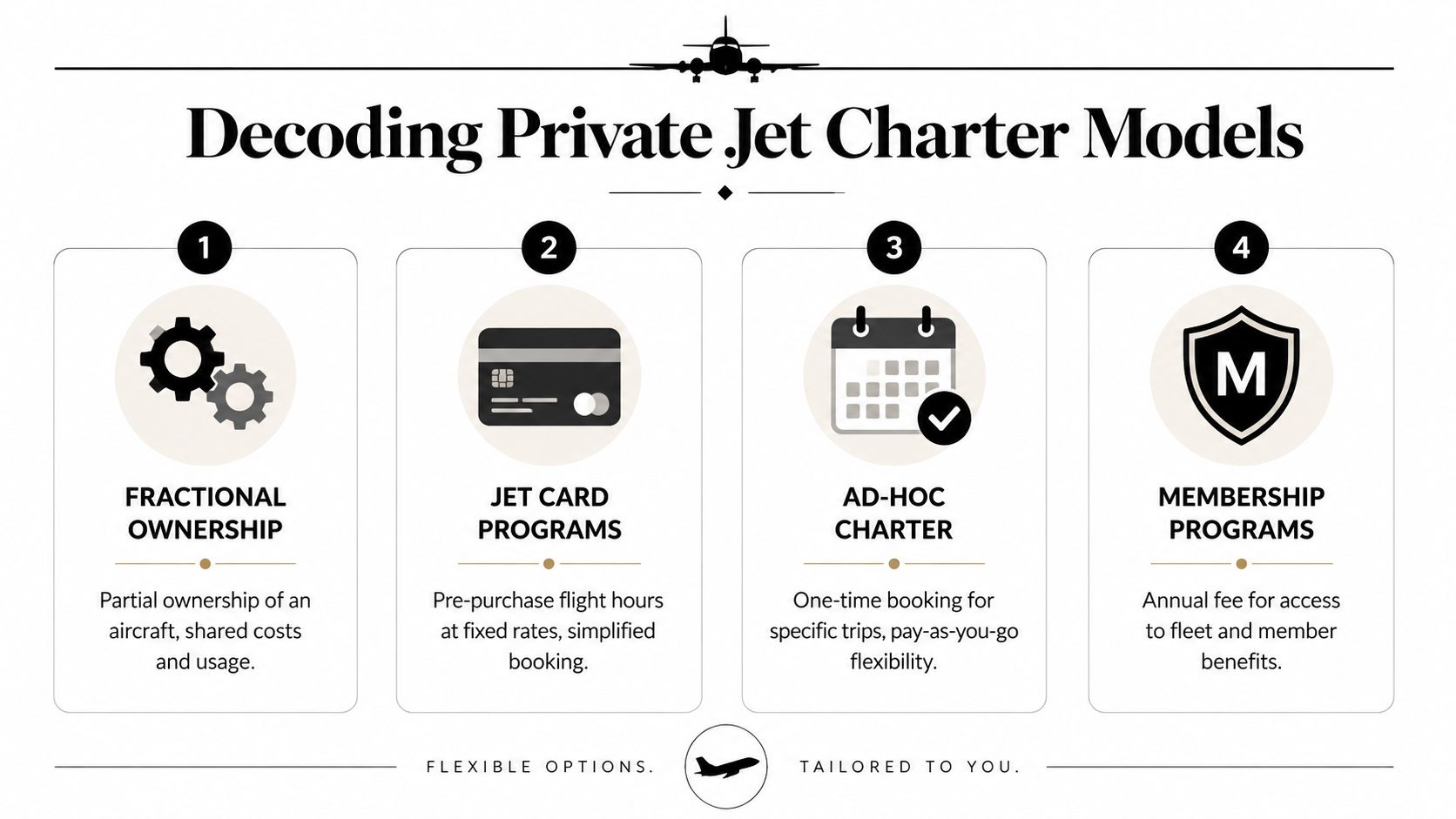
Private jet charter services sit in a premium band. Hourly rates range from $1,500 to $15,000 depending on aircraft, with North America holding 31% of the global market share in 2023. Demand for on-demand charter in Asia-Pacific also rose 12% from 2022 to 2023, based on Jettly's private jet market trends overview. That matters because the market has matured around flexibility, not ownership alone.
On-demand charter
This is the cleanest place to start. You book trip by trip, aircraft by aircraft.
It suits clients who fly irregularly, need different cabins for different missions, or don't want money trapped in a prepaid program. If you need a light jet for a short business hop this month and a long-range aircraft for a family holiday next month, on-demand gives you range without long commitment.
Its weakness is inconsistency. Pricing and availability depend on market conditions, the airport pair, seasonality, and aircraft positioning. Good for flexibility. Poor for predictability.
Jet cards
A jet card usually means pre-purchasing hours at set terms. For frequent flyers, that can reduce friction.
Jet cards work well when your usage is steady enough that speed and pricing structure matter more than open-market shopping. They're useful for executives who don't want to renegotiate every mission. They can also impose rules on peak days, service areas, or cabin categories, so the fine print matters more than the brand deck.
Membership programs
Memberships often promise access, service perks, and concierge treatment rather than pure ownership economics. Some are excellent. Some are mostly packaging.
The critical question is whether the membership improves your actual booking experience. If it gives you easier availability, cleaner service standards, and a single point of accountability, it has value. If it mostly adds an annual fee and vague “preferred access,” skip it.
Memberships are only worthwhile when they remove complexity. If they add another layer of contracts, they're solving the wrong problem.
Fractional ownership
Fractional ownership gives you a defined share of an aircraft or fleet with corresponding access rights and ongoing obligations. It's not charter in the casual sense. It's a capital commitment.
This model fits clients with repeatable flying patterns, high annual usage, and a strong preference for structured access. It can work well for families or companies that know their demand. It's the wrong answer for someone still learning their mission profile.
Private Aviation Models at a Glance
| Model | Best For | Cost Structure | Commitment Level |
|---|---|---|---|
| On-Demand Charter | Irregular flyers, mixed trip types, clients testing the market | Pay per trip, variable pricing | Low |
| Jet Card Programs | Frequent flyers who want clearer pricing and simpler booking | Prepaid hours or fixed terms | Moderate |
| Membership Programs | Clients who value service access and concierge support | Annual fee plus trip costs or program terms | Moderate |
| Fractional Ownership | High-usage travelers with predictable needs | Capital investment plus operating obligations | High |
My recommendation for a new UHNW client
Don't start with ownership. Don't sign a membership because the brochure is polished. Start by auditing your actual travel behavior.
Use this framework:
1. If your travel is sporadic, use on-demand charter.
2. If you fly often and hate renegotiating, evaluate a jet card.
3. If service consistency matters as much as lift, review membership terms carefully.
4. If your annual demand is high and stable, then fractional becomes worth the conversation.
The right model is the one that matches your mission profile, not the one with the loudest branding.
Understanding Charter Costs and Key Price Drivers
Most new clients ask, “What does it cost to charter a jet?” That's too broad. A better question is, “What drives this specific quote, and is the aircraft right for the mission?”
The pricing logic is straightforward. Aircraft class drives the base rate. According to BlackJet's overview of top private jet charter companies in the USA, hourly rates run from about $2,500 for light jets to more than $15,000 for ultra-long-range aircraft such as a Gulfstream G650. Larger aircraft cost more because they burn more fuel, require more maintenance, and often need expanded crew support.
Start with the aircraft, not the route
Clients often overspend by choosing cabin prestige before mission suitability.
- Light jets: Best for shorter regional trips with a smaller passenger count.
- Midsize jets: The balance point for many business missions. Better cabin comfort, better range.
- Long-range and ultra-long-range jets: Necessary when nonstop international capability matters, or when you want a full stand-up cabin and serious baggage capacity.
The aircraft should match four things: passenger count, baggage, distance, and whether you want nonstop capability. Anything else is vanity pricing.
What a quote is really telling you
A serious quote isn't just an hourly number. It reflects the full operating reality of the trip.
Look for these elements:
- Aircraft category: This is the main cost driver.
- Flight time: Billable time reflects the actual mission profile.
- Crew complexity: Larger aircraft usually mean higher crew costs and stricter duty planning.
- Operational specifics: International permits, routing, and special handling can change the economics.
- Terminal experience: FBO access is part of the value proposition, not a decorative extra.
A useful way to assess value is to ask whether the aircraft is oversized, whether the routing is clean, and whether the operator has explained the operational assumptions clearly.
Where inexperienced buyers get caught
The cheapest quote can be expensive if it creates avoidable problems. I tell clients to watch for three errors.
1. Buying too much airplane. If a light or midsize aircraft can safely and comfortably do the mission, don't pay for intercontinental hardware.
2. Ignoring mission flexibility. A route may be simple now, but luggage changes, extra passengers, or a same-day revision can alter the right aircraft choice.
3. Treating service as cosmetic. Ground coordination, catering accuracy, and schedule responsiveness are operational quality, not fluff.
For a quick visual primer on how charter pricing is commonly discussed, this overview is useful:
Don't shop charter the way you'd shop a hotel room. The aircraft is only one part of the product. The operator's execution is the rest.
Prioritizing Safety and Regulatory Standards
If you remember one thing from this guide, remember this: safety standards are not a marketing detail. They are the entire foundation of the decision.
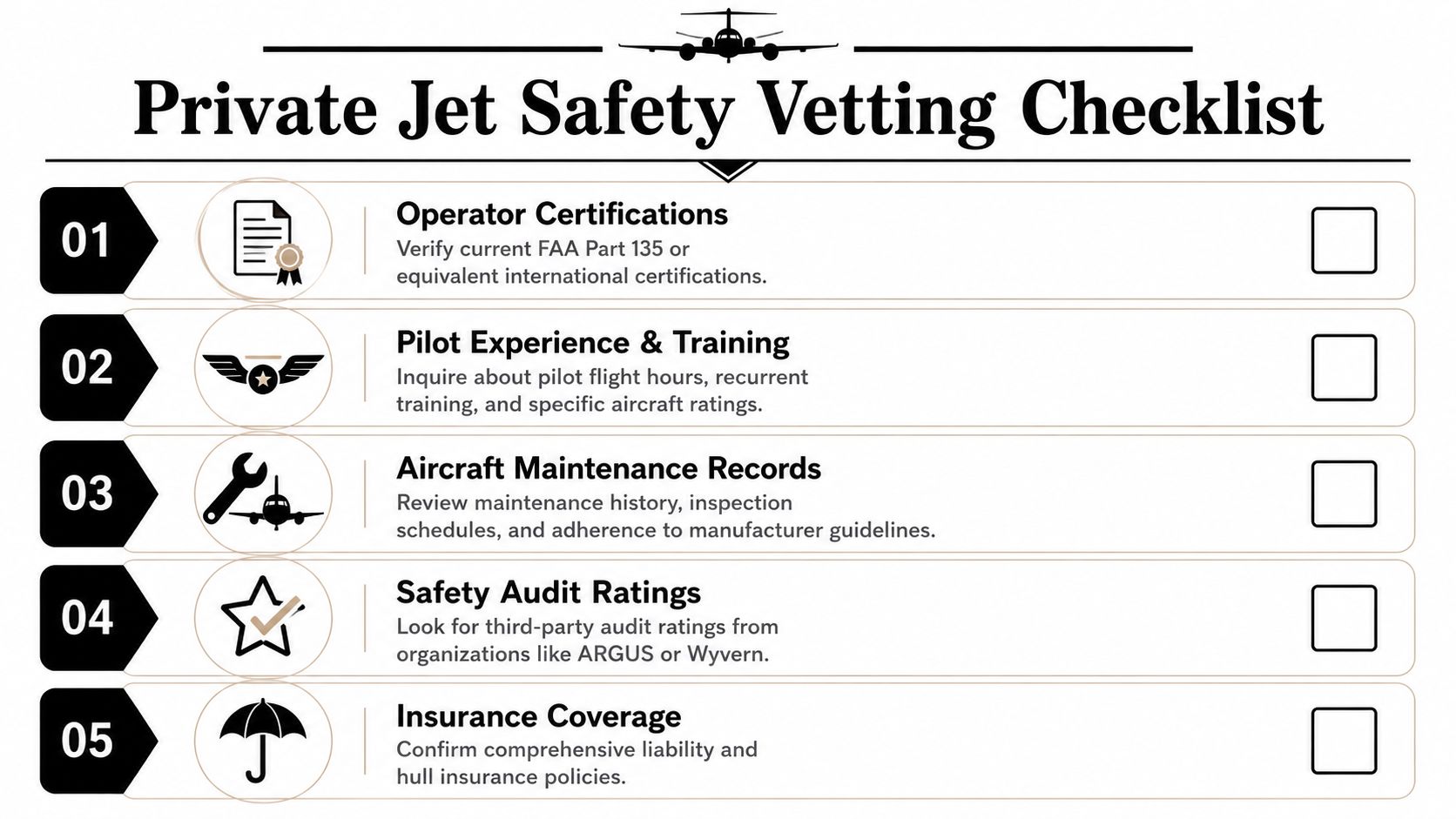
All legitimate charter flights operate under FAA Part 135 rules. That's the baseline for commercial charter, and it covers pilot qualifications, maintenance standards, and operating procedures. A standard charter quote also includes the aircraft, professional flight crew, operating costs, and access to private FBO terminals, which can move passengers from curb to aircraft in under 15 minutes, as outlined in this guide to what's included in a private jet charter.
Part 135 is the minimum, not the finish line
Part 135 matters because it separates commercial charter from casual private flying. But discerning clients shouldn't stop there.
I strongly recommend asking whether the operator also carries third-party safety credentials such as ARGUS, Wyvern, or IS-BAO. Those ratings indicate the operator has opened its procedures to independent scrutiny. That's exactly what you want when family members, board members, or public figures are onboard.
If you want a plain-English external reference on crew qualifications, this part 135 pilot minimums guide is worth reviewing before you approve any provider.
What to ask before you book
A polished sales desk means nothing if the safety culture is thin. Ask direct questions.
- Who is the actual operator? Brokers and brands may market the trip, but a certificate holder operates the flight.
- What third-party audits do they maintain? If they can't answer clearly, move on.
- Who is flying the aircraft? Ask about training, recency, and aircraft-specific qualification.
- What's the maintenance standard? You want a disciplined operator, not a reactive one.
- What happens if the aircraft goes mechanical? Recovery planning reveals whether the provider is operationally serious.
Non-negotiable: If an operator is vague about certification, maintenance, or crew standards, don't rationalize it away because the quote is attractive.
Why top clients insist on third-party ratings
Government compliance tells you the operator can legally fly the mission. Independent safety ratings tell you how seriously that operator runs the business.
That distinction matters. UHNW travelers don't need plausible assurances. They need verifiable standards, redundant oversight, and a provider that won't cut corners under schedule pressure.
The Seamless Booking Process and In-Flight Experience
A strong charter experience should feel calm, not theatrical. If the booking process is chaotic, the flight usually won't improve it.
The best private jet charter services run on clean communication. You provide the mission, the provider clarifies the constraints, and the trip is built around precision. The process should be fast, but never vague.
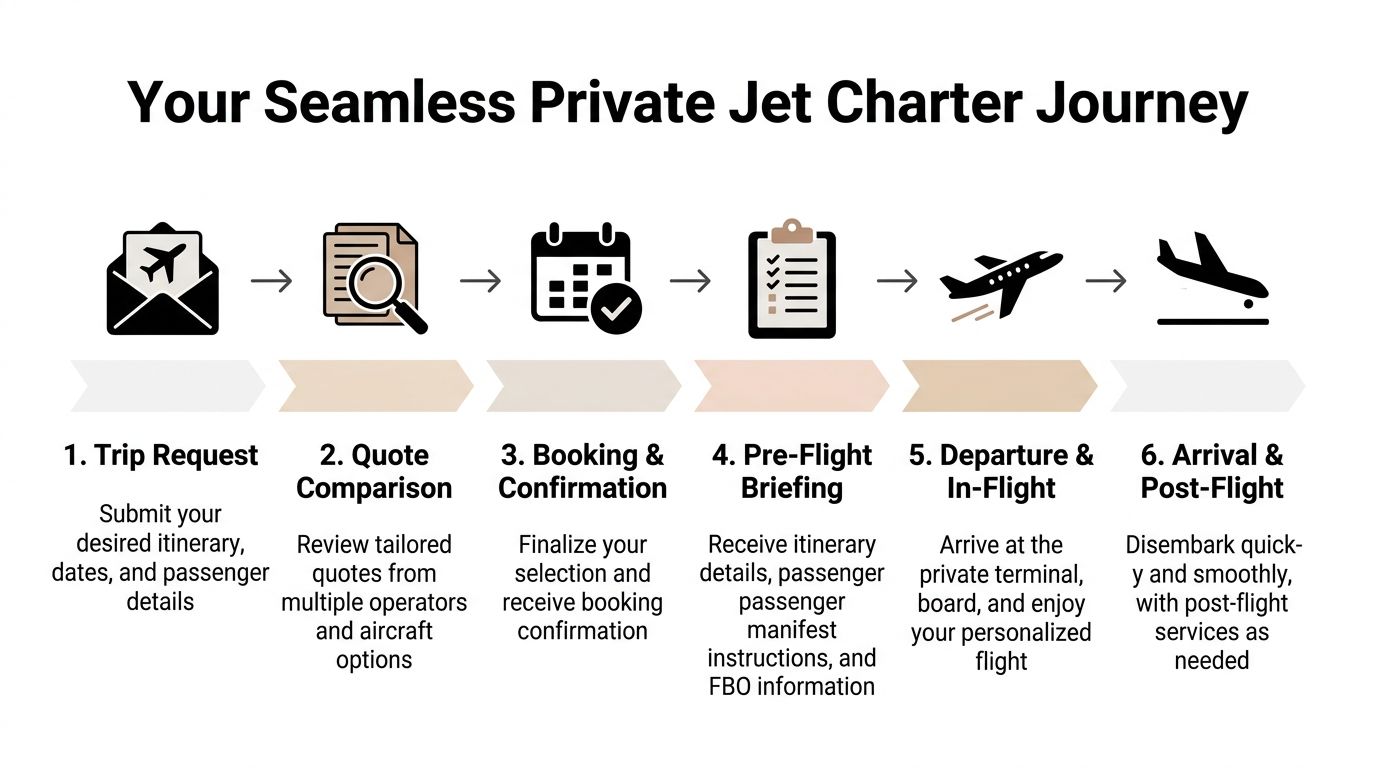
How the booking should unfold
A proper booking sequence usually looks like this:
1. Initial request
Share the route, dates, passenger count, baggage profile, pets if any, and whether discretion or security requires anything special.
2. Aircraft selection
The advisor should present options that fit the mission, not just the most photogenic cabin.
3. Quote review Here, you compare not only price, but operator quality, cancellation terms, and service assumptions.
4. Manifest and logistics
Names, identification details, catering preferences, ground transfers, and FBO instructions should be handled cleanly.
5. Day-of-travel execution
You arrive at the private terminal, board quickly, and leave without the standard terminal theatre.
For a more detailed look at that flow, this executive guide to private jet flight booking is a useful reference.
What the ground experience should feel like
The FBO experience is one of the clearest reasons people stick with private aviation after the first well-run trip. You're not standing in a crowd defending your time against airport process.
Expect a quieter terminal, direct coordination, and a short path from vehicle to aircraft. If you're continuing to a villa, yacht, or resort destination, ground handling matters just as much as the flight. For readers moving through southern Portugal, this ultimate guide to Faro transfers is a practical example of the kind of onward planning that keeps the journey coherent.
In-flight service should reflect the mission
A business flight needs privacy, connectivity, and timing discipline. A family holiday departure needs flexibility, luggage planning, and calm cabin service. Those are different products.
Here's what to specify early:
- Catering: Keep it simple and exact. The best orders are precise, not performative.
- Cabin setup: Working meeting, rest, family seating, or mixed use.
- Ground transport: Confirm who meets the aircraft and how baggage is handled.
- Special requirements: Pets, security personnel, medical considerations, or last-minute document changes.
One option in this category is Haute Black, which coordinates private aviation alongside broader travel planning, including ground transport and destination logistics. That's useful when the flight is only one moving part in a more complex itinerary.
A seamless charter isn't defined by champagne. It's defined by the absence of friction.
Your Decisive Checklist for Choosing a Provider
By the time you're evaluating providers, the aircraft list matters less than the operator discipline behind it. The market is growing, and private jets saw the largest revenue growth within private aviation, rising 19.1% in 2024, a trend tied to expanding membership and fractional models for UHNW travelers, according to Air Charter Service's 2025 revenue report. That growth creates more options. It also creates more noise.
Your job is to cut through it quickly.
Ask these questions in every provider conversation
- Who operates the aircraft?
You want the actual certificate holder identified, not buried.
- What safety credentials do they maintain beyond legal minimums?
If there's no third-party audit culture, that's a warning.
- Is this aircraft right-sized for my mission?
A good advisor explains why the cabin fits. A weak one just sells the larger tail.
- How do you handle mechanical recovery or last-minute schedule changes?
This answer tells you whether they solve problems or merely relay them.
- What exactly is included in the quote?
Ambiguity is where disappointment starts.
- Who owns the communication on the day of travel?
One accountable point of contact is better than a chain of people forwarding messages.
My short list for decision-making
When I advise a new client, I narrow the field fast.
Use this order of priority:
1. Safety culture
2. Operational transparency
3. Mission fit
4. Service consistency
5. Price
That order is deliberate. Price should be the last filter, not the first. If a provider can't prove standards, explain the mission logic, and execute quietly, the cheaper quote is irrelevant.
For clients who'd rather have a specialist screen operators and match missions to aircraft, speak to a private aviation specialist. That conversation should focus on how you travel, not on selling you a generic program.
Haute Black serves travelers who want one advisor across private aviation, hotels, villas, transfers, and high-touch itinerary design. If your flights are part of a larger lifestyle or business travel strategy, explore Haute Black for discreet trip planning and private access support.
Explore Our Guides


Signature Experiences


