Haute Black Journal
Private Jet Flight Booking: An Executive Guide to Flying

Marlene Azeez
Director, HauteBlack
View all articles →

# Private Jet Flight Booking: An Executive Guide to Flying
June 22, 2026
A board meeting moves forward by half a day. Your principal needs to be in New York for lunch, in Dallas that evening, and back in Palm Beach before the school concert. Or a family office is trying to move three generations to a ski destination with oversized luggage, dietary requirements, and zero appetite for missed connections. In those moments, commercial travel stops being inconvenient and starts becoming operationally unworkable.
That's where private jet flight booking matters. Not as a symbol, but as a control system for time, privacy, routing, and execution. The aircraft is only one part of the equation. The key decision is how to secure the right access, at the right level of certainty, with the fewest points of failure.
The New Calculus of Private Aviation
Private aviation now sits inside a much larger and more established travel market than many people assume. The global private jet charter services market was valued at USD 16.38 billion in 2025 and is projected to reach USD 25.79 billion by 2031, while on-demand charter accounted for over half of market revenue in 2025, according to private jet charter market research from Mordor Intelligence.
That matters because it changes how discerning travelers should think about booking. This is no longer an edge case reserved for rare exceptions. It's a functioning access layer for executives, family offices, and travelers whose schedules can't absorb airline friction.
The mistake I see most often is treating private jet flight booking as a search for a plane. It's a search for the right booking model for the mission. A last-minute same-day meeting, a school-holiday departure, and a multi-stop leisure itinerary may all require private aviation. They do not require the same buying logic.
For readers weighing whether private travel is justified at all, this private jet vs commercial travel guide for modern travelers is a useful companion to that decision.
The question that actually matters
The right first question isn't “What's the cheapest option?”
It's this: What failure can't this trip afford?
If the answer is a missed board vote, a broken family itinerary, a privacy concern, or a nonrefundable event sequence, then certainty rises to the top. If the trip is opportunistic and timing is loose, flexibility can matter more than guaranteed availability.
Practical rule: The higher the consequence of delay or disruption, the less useful bargain-first booking becomes.
What private aviation solves well
Private aviation works best when travelers need to control variables that airlines can't realistically customize:
- Schedule control: Departure around your agenda, not the carrier's timetable.
- Routing efficiency: Access to airports closer to the actual destination.
- Privacy: Confidential conversations stay inside your own cabin environment.
- Executional simplicity: Families, assistants, and security teams manage fewer moving parts.
For high-stakes travel, the winning move is rarely the lowest visible quote. It's the structure that protects the trip.
Choosing Your Access Model Charter vs Cards vs Membership
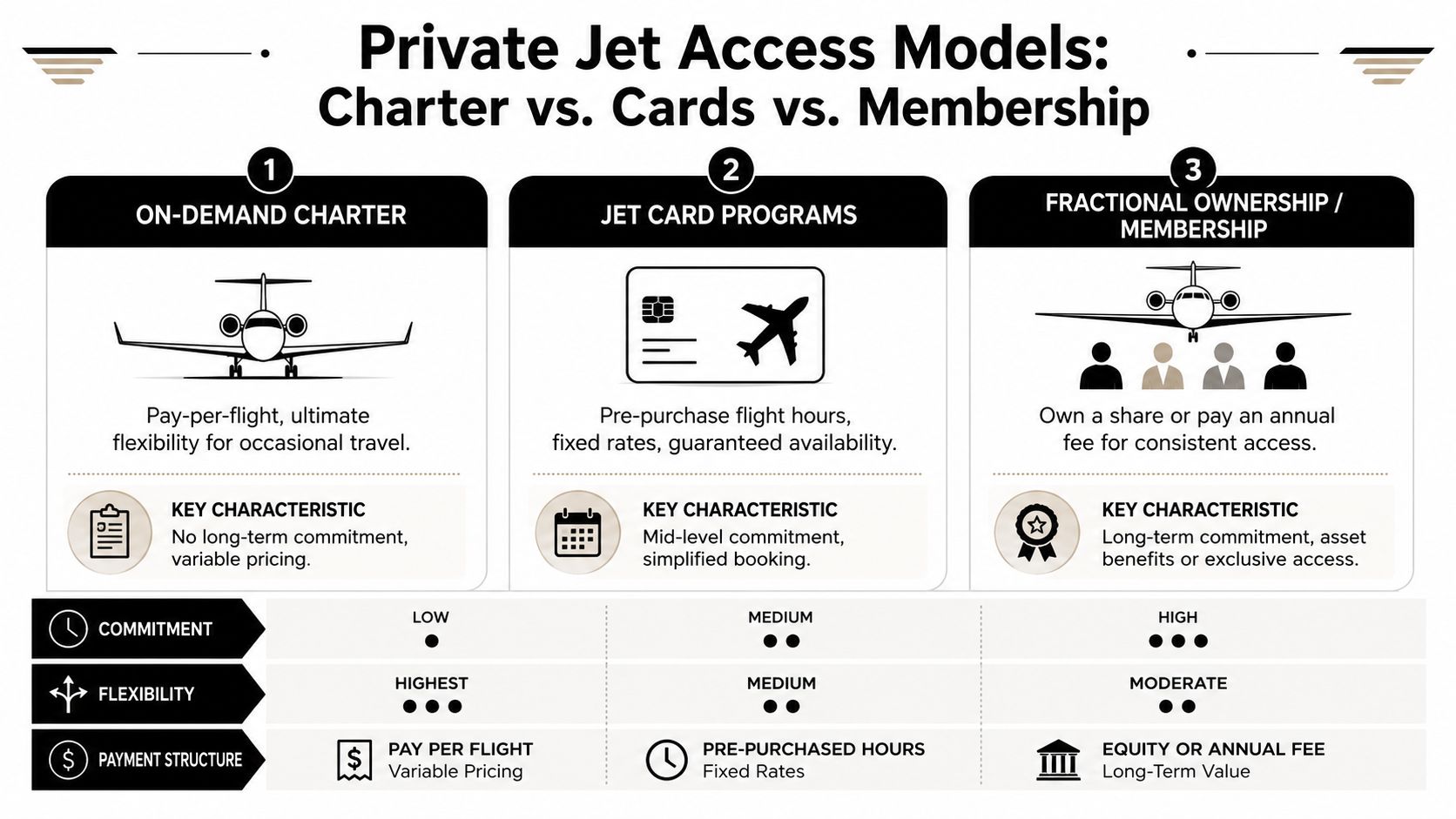
On-demand charter remains the default choice for many travelers because it offers flexibility without a long-term obligation. But flexible doesn't always mean optimal. The best model depends on how often you fly, how much certainty you need, and whether you want to manage trip-by-trip decisions each time.
A quick visual helps frame the trade-offs.
On-demand charter
For occasional travel, on-demand charter is usually the cleanest entry point. You book per mission, choose the aircraft that suits that specific trip, and avoid tying up capital in unused hours or ownership structures.
That freedom has a cost. Pricing can move with aircraft positioning, demand patterns, airport constraints, and timing. Service quality also depends heavily on who is sourcing the aircraft and how carefully the operator is vetted.
Many people get distracted by empty legs. According to BlackJet's overview of lower-cost private flying options, empty-leg flights can offer discounts up to 50%, but they're route-specific and time-sensitive, which makes them unreliable for fixed schedules. For a flexible leisure hop, that may be acceptable. For a board meeting, it usually isn't.
Jet cards
Jet cards suit travelers who fly regularly enough to value consistency, but not so much that ownership economics become relevant. You pre-purchase access, usually in hours or deposits, and in return you often get more predictable pricing and simpler booking terms.
The appeal is administrative as much as financial. Executive assistants and family office teams often prefer cards because they reduce the need to renegotiate every trip. The trade-off is that you may be locked into a narrower fleet category or provider ecosystem than on-demand charter would allow.
If your calendar is dense and your routes are repetitive, a jet card can reduce decision fatigue more than it reduces cost.
Fractional ownership and membership
Fractional ownership enters the conversation when travel volume is high, consistency is essential, and a traveler wants something closer to ownership without taking on a whole aircraft. The benefits can include stronger access predictability and a more defined service standard. The drawbacks are obvious. Longer commitment, more structure, and less agility if your travel profile changes.
Membership models sit in a different lane. Some are little more than preferred access schemes. Others are broader advisory platforms that combine aviation, logistics, and destination planning into one operating relationship. For travelers who care as much about the rest of the journey as the aircraft, that distinction matters.
Readers comparing providers may also find this guide to private jet travel useful because it lays out the context in a way that helps separate access style from marketing language.
Here's the practical filter:
| Model | Best fit | Main strength | Main weakness |
|---|---|---|---|
| On-demand charter | Infrequent or varied travel | Maximum flexibility | Variable pricing and availability |
| Jet card | Regular domestic or repeat-route travel | Predictability and simplified booking | Less flexibility across providers |
| Fractional ownership | High annual flying volume | Consistency and structured access | Commitment and complexity |
| Membership | Travelers wanting advisory support and broader service coordination | Integrated planning and relationship continuity | Value depends on how much support you actually use |
A curated option such as Haute Black membership fits best when the client isn't only solving for aircraft access, but also for advisor continuity, trip orchestration, and less internal coordination burden.
Later in the decision process, I tell clients to pressure-test any model against three questions:
1. How often will you fly?
2. How damaging is a compromise on timing or aircraft choice?
3. Who inside your team is absorbing the complexity today?
The right answer often becomes obvious once those are answered accurately.
A short overview can also help if you're discussing options internally with stakeholders who aren't immersed in private aviation every day.
The Booking Workflow From Quote to Takeoff
Most failed private jet bookings don't fail at the airport. They fail at the first email. The trip request is vague, the passenger details arrive late, the luggage turns out to be unusual, or the chosen airport has operational constraints no one raised early enough.
The underlying workflow is straightforward. A standard private jet booking follows request → aircraft shortlisting → charter agreement → payment → operational prep, and late or missing trip details at the request stage are a frequent failure point, as outlined in Paramount Business Jets' explanation of the booking process.
What to send in the first request
A strong first request does two things. It accelerates aircraft matching, and it reduces downstream surprises.
Include:
- Exact routing: Preferred departure airport, destination airport, and whether alternates are acceptable.
- Passenger profile: Full count, any children, pets, or security personnel.
- Timing reality: Hard departure deadline versus preferred departure window.
- Baggage specifics: Ski gear, garment bags, golf clubs, medical equipment, or oversized cases.
- Cabin priorities: Wi-Fi, enclosed lavatory, sleeping configuration, or flight attendant preference.
- Ground considerations: Whether cars, tarmac transfer, or onward helicopter coordination will be needed.
If a team member sends “Need a jet from South Florida to Aspen Friday morning for six,” expect wasted time. There are too many variables hidden inside that sentence.
Where the real operational work begins
Clients often think booking is finished once the agreement is signed. In reality, the most sensitive stage begins after that point. Operators still need to confirm crew and aircraft availability, secure slots and permits where required, and verify airport restrictions before departure.
The contract closes the commercial side. It does not eliminate operational complexity.
That's why experienced bookers keep one person accountable for manifest accuracy, document collection, and last-minute changes. Split responsibility across an assistant, a family office manager, and a traveler who keeps changing plans, and details get lost.
A clean execution checklist
For day-of-travel reliability, this short checklist is what works:
1. Lock the passenger list early. Name changes and late additions can slow final preparations.
2. Confirm luggage in plain language. “Eight bags” is less helpful than “eight soft cases plus two ski bags.”
3. Verify the departure point precisely. Private terminals and commercial terminals aren't interchangeable.
4. Reconfirm ground transfer timing. A flawless flight can still be spoiled by a poor handoff on the ground.
For travelers who want support beyond the aircraft itself, Haute Black air travel services sit in the part of the process where aviation, ground logistics, and itinerary timing need to operate as one plan.
Decoding the Price An All-In Cost Breakdown
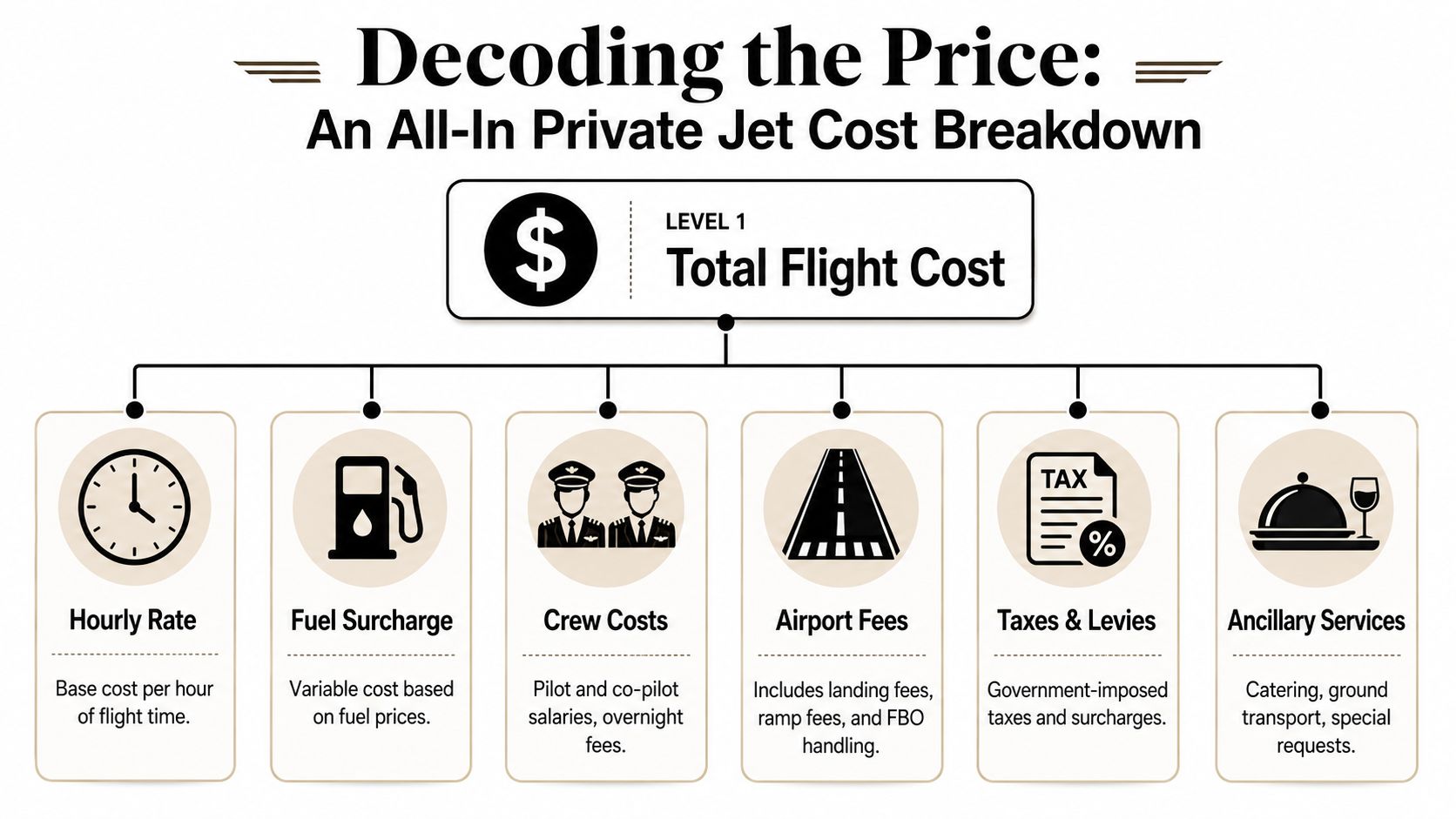
The headline hourly rate is where most private jet conversations begin, and where many first-time clients get misled. The aircraft may look attractively priced, but the true question is what the trip costs when every operational and trip-specific line item is included.
Independent charter guidance from Stratos Jets on hiring a private jet notes that published hourly rates can range from about $4,900 for turboprops to over $15,000 for ultra-long-range jets, and that those figures don't include major ancillary charges such as repositioning, taxes, de-icing, and crew costs.
What the hourly rate doesn't tell you
The base aircraft rate is only the beginning. The final invoice can move materially depending on how the aircraft is sourced and what the trip demands operationally.
The usual pressure points include:
- Repositioning: If the aircraft has to move to pick you up, that positioning can affect the total.
- Airport and handling charges: Some airports are straightforward. Others are not.
- Crew expenses: Overnight stays and duty-related logistics may be part of the trip.
- Weather-driven services: Winter flying can introduce de-icing and related timing costs.
- Ancillary requests: Catering, premium ground transfers, and specialized onboard needs all add up.
How to compare two quotes properly
Two quotes can describe the same route and still represent very different value. One may appear lower because key assumptions haven't been surfaced yet. Another may look higher because more of the trip has been priced accurately from the start.
Ask these questions before comparing numbers:
| Question | Why it matters |
|---|---|
| Is repositioning included or still estimated? | This can shift the real total materially |
| Are airport and handling fees already built in? | Some quotes separate them later |
| What happens if the trip runs late or changes slightly? | Flexibility terms matter |
| Are catering and ground arrangements included? | Service expectations differ by provider |
| Are there weather-related or peak-period caveats? | Seasonal realities affect final billing |
Booking advice: If a quote looks unusually lean, ask what has been excluded, not just what has been discounted.
For travelers booking across jurisdictions, this hiring a private jet in UK overview is useful as a comparison point because it highlights how regional pricing conversations often frame costs differently.
What disciplined buyers do differently
Discerning clients don't chase the lowest starting number. They ask for the all-in expectation, the assumptions behind it, and the change-order risks if plans evolve.
That's the standard worth applying to any private jet flight booking. A quote is only as useful as its transparency.
The Pillars of a Flawless Journey Safety and Service
A private jet can still produce a poor travel experience if the safety review is casual and the service layer ends at the aircraft door. The travelers who get this right treat private aviation as one component inside a larger chain of custody.
That discipline matters in a market of real scale. With over 22,000 active business jets worldwide completing over 5.2 million flights annually, and with North America accounting for 81.93% of global charter revenue, operator vetting is not a ceremonial step. It's central to the booking decision, according to Sherpa Report's 2025 private jet flight market coverage.

Safety first means operator scrutiny
The first question is not whether the cabin looks polished. It's who is operating the aircraft, under what certification, with what record of compliance and oversight.
A prudent review usually covers:
- Operator certification: Confirm the flight is being performed by a properly certificated charter operator.
- Safety documentation: Ask for current compliance and safety materials, not generic reassurance.
- Crew suitability: The right crew for the route, conditions, and mission profile matters.
- Operational credibility: Look at the operator's ability to execute the specific trip, not just any trip.
Many clients assume their broker or advisor has already handled this in depth. Sometimes that's true. Sometimes it isn't. Ask anyway.
A beautiful aircraft interior is not evidence of a strong operator.
Service is logistics, not decoration
At the UHNW level, service quality is less about champagne labels and more about whether the entire journey runs without forcing the client to think about logistics.
That means the flight should connect cleanly with:
- Private ground transport
- Airport meet-and-greet handling
- Villa, hotel, or estate arrival timing
- Restaurant and event access
- Helicopter or yacht transfers where needed
If those elements are managed by separate parties with no central coordinator, friction appears quickly. Cars arrive at the wrong terminal. Staff don't know the principal's timing. The property isn't ready after an adjusted departure. None of those failures are aviation failures, but all of them damage the trip.
The real luxury test
The cleanest private journeys feel almost invisible to the traveler. No repeated requests for information. No uncertainty around arrival flow. No mismatch between the standard in the air and the standard on the ground.
That's what discreet service looks like in practice. The aircraft is important. The orchestration is what clients remember.
The Haute Black Membership A Seamless Solution
Most of the friction in private jet flight booking comes from fragmentation. One provider handles the aircraft. Another handles hotels. A separate assistant chases ground transfers. Someone else is trying to secure a dinner table or event credential. The principal experiences that fragmentation as delay, repetition, and avoidable noise.
A membership model becomes useful when it removes that administrative sprawl. The value isn't abstract. It shows up in fewer handoffs, more continuity, and a single advisor who understands how the traveler moves.
Where curated support changes the outcome
The strongest membership relationships solve problems before the client notices them. They already know whether a traveler prefers a quiet FBO arrival, whether a family needs child-specific catering, whether a villa check-in should be synchronized with a late departure, and whether the return should stay flexible.
That continuity helps in three common scenarios:
- The Aspen ski weekend
A family departs after school on short notice with skis, soft luggage, and changing weather in the destination. The aircraft choice, baggage profile, ground transport, and mountain arrival timing all need to work as one plan.
- The multi-city European business tour
An executive needs efficient movement between several cities, privacy for onboard work, and hotels that can handle schedule changes gracefully. The flight is only one layer of a larger business mission.
- The event-driven leisure itinerary
A client is traveling around a fixed social calendar. Dinner reservations, property access, and return flexibility matter as much as departure time.
Why this model fits high-stakes travelers
In this category, travelers rarely need “more options.” They need better filtration, clearer pricing, and someone accountable for the details across the entire journey.
That's where a dedicated advisory structure earns its place. It reduces repeated decision-making. It cuts down on quote-chasing. It creates continuity between air, ground, and destination arrangements. For executive assistants and family office teams, that often matters as much as the flight itself.
The most valuable booking partner is usually the one who prevents the trip from becoming a series of separate bookings.
Haute Black fits this model by combining dedicated advisor support, waived planning fees for members, private aviation access through Haute Jets, and a wider travel and lifestyle network shaped around discreet execution rather than standalone transactions.
If your travel requires more than an aircraft, and most high-stakes travel does, Haute Black offers a structured way to align private aviation, destination planning, and on-the-ground logistics under one relationship. For executives, families, and family offices who value certainty over noise, that's often the difference between a booked flight and a well-run journey.
Explore Our Guides


Signature Experiences


