Haute Black Journal
Private Jet vs Commercial: A Guide for Modern Travelers

Marlene Azeez
Director, HauteBlack
View all articles →
# Private Jet vs Commercial: A Guide for Modern Travelers
June 4, 2026
You're probably making this decision in the least theoretical moment possible. A board meeting moved. A child's school calendar changed. A villa stay was extended by a day and now the return routing no longer works cleanly through a hub. At that point, the private jet vs commercial question stops being about luxury and starts being about whether the trip still works.
Many frame it badly. They compare a private cabin to first class, glance at the fare difference, and call it a day. That's amateur math. Serious travelers evaluate the mission. How much time are you losing before takeoff, after landing, and in the dead space around connections, queues, and rigid airline schedules? How much control do you need? How much privacy do you absolutely need?
The answer isn't that private is always better. It isn't. The answer is that commercial and private aviation are different tools. If you choose the wrong one, you pay for it somewhere. Sometimes in cash. More often in lost time, reduced flexibility, avoidable stress, or a trip that underperforms.
A useful starting point is understanding how high-end travel is already shifting away from generic luxury and toward control, access, and efficiency, which is also reflected in this look at luxury travel in 2026.
Beyond First Class The Real Private Aviation Question
A client wants to leave New York after breakfast, handle two meetings in different cities, and be home for dinner. Commercial makes that kind of day difficult fast. The flight itself may look manageable on paper, but the schedule around it usually breaks the plan. You're working around airline timing, airport friction, and the possibility that one delay ruins the entire sequence.
That's why comparing private aviation to first class misses the point. First class improves the seat. Private aviation changes the operating model of the day.
The mission matters more than the cabin
If the trip is a simple nonstop route between major cities, commercial may be perfectly rational. If the trip involves multiple stops, a remote destination, sensitive conversations, family complexity, or a narrow timing window, private becomes a strategic option.
Here's the blunt version:
| Decision Factor | Commercial Flight | Private Jet |
|---|---|---|
| Best use case | Simple routes, flexible timing | Time-critical, complex, high-control travel |
| Primary advantage | Lower upfront price | Better control of the entire journey |
| Main constraint | Fixed schedules and public infrastructure | Higher acquisition cost |
| Ideal traveler mindset | Price-aware, schedule-tolerant | Outcome-driven, time-aware |
Commercial is transportation. Private aviation is schedule control.
What sophisticated travelers actually buy
They're not buying bragging rights. They're buying a different travel equation.
That equation includes:
- Less wasted ground time
- More direct airport options
- Privacy for conversations and family travel
- A schedule built around the traveler, not the carrier
That's the private jet vs commercial debate. Not whether the champagne is better. Whether the journey serves the reason you're flying in the first place.
The True Calculus of Time and Cost
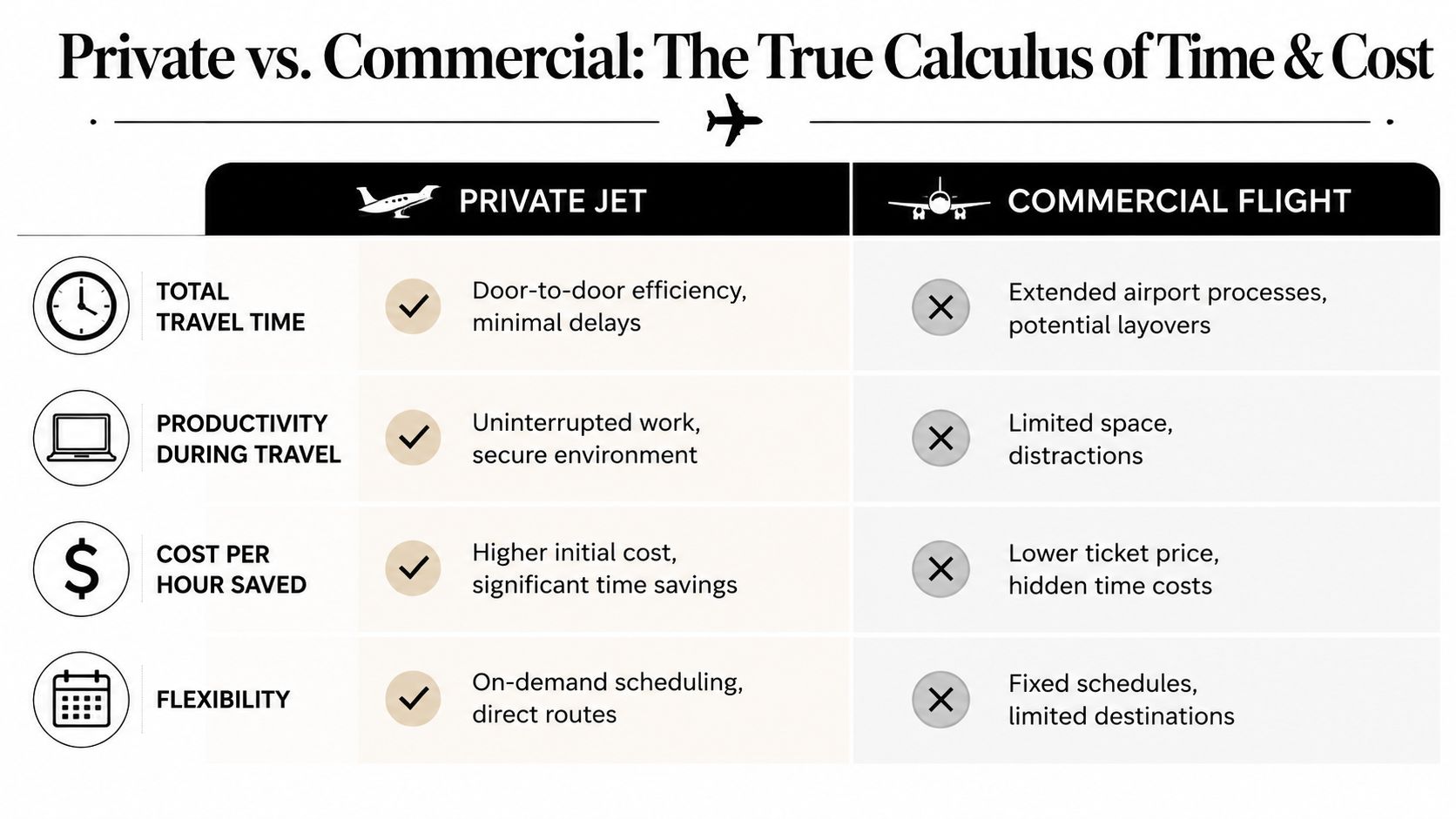
If you only compare ticket price to charter price, you'll reach the wrong conclusion. The relevant metric is door-to-door time. That includes the drive to the airport, security and boarding, the flight itself, deplaning, baggage, and the final transfer.
Independent analysis found that private jet travelers save an average of 127 minutes per flight, and that the biggest gains come from ground-side efficiency and access to roughly 5,000 U.S. airports versus about 500 for commercial airlines, as outlined in this private jet versus commercial time analysis. That's the statistic that matters.
Where private aviation actually saves time
It is often assumed that the aircraft is the whole story. It isn't. In many cases, the biggest advantage happens before the engines start and after they shut down.
Private aviation strips out much of the friction that commercial travelers accept as normal:
- Airport access: Smaller, more convenient airports often sit closer to the actual destination.
- Departure process: No standard commercial terminal flow, no mass boarding ritual, far less idle waiting.
- Arrival flow: You land, leave, and move on. The travel day keeps moving.
- Routing flexibility: The trip can be designed around your destination rather than the airline network.
Cost should be measured against the day, not the seat
If you're a solo leisure traveler heading on a simple route with flexible timing, commercial usually wins on value. That's obvious.
But if a flight decision affects a deal day, a family schedule, or a multi-stop itinerary, the true cost isn't the fare. It's the value of the hours you give away to inflexible infrastructure. In those cases, private aviation often performs better because it protects the rest of the calendar.
A more intelligent way to evaluate private jet vs commercial is to ask:
1. How long is the total trip, not just the flight?
2. How close can each option get you to your final destination?
3. What does a lost half-day cost you?
4. Is this a one-leg trip or part of a larger schedule?
Practical rule: If the day around the flight matters as much as the flight itself, don't price the seat. Price the time.
For a more route-specific look at where that advantage is real and where it's overstated, this breakdown of private jet flight time versus commercial data is worth reading.
Comparing the Journey Privacy Service and Control
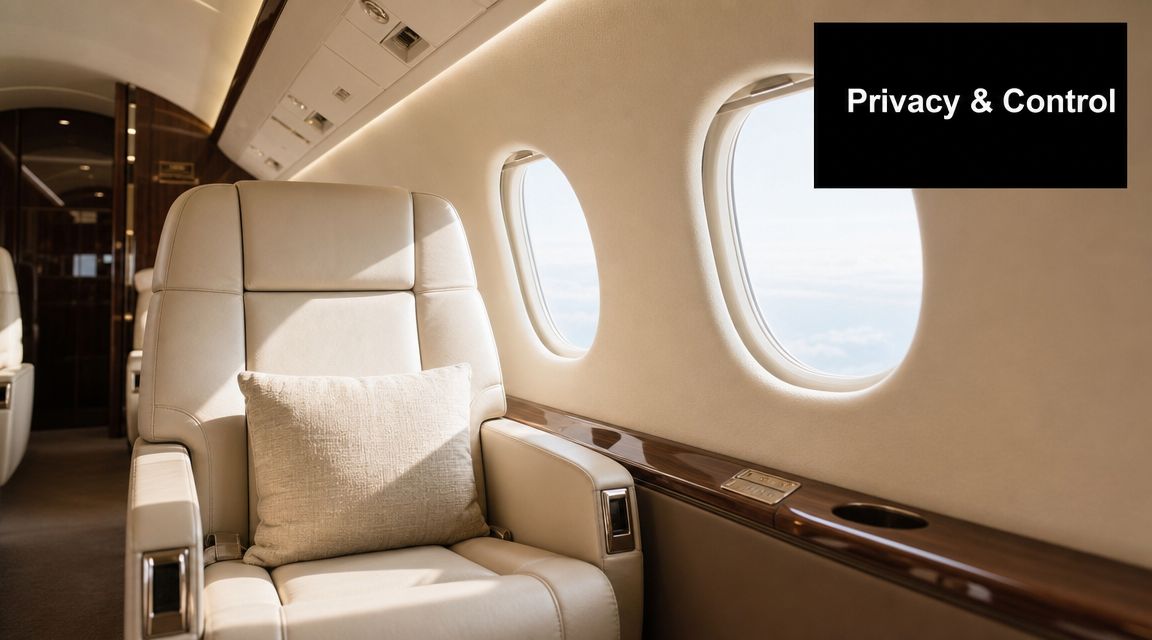
The onboard seat is only one piece of the experience. The primary divide in private jet vs commercial comes from what happens around you, who controls the environment, and how much of the journey is yours.
Airport experience
Commercial terminals are designed for throughput. That's not a criticism. It's their job. But even in premium cabins, you're still moving through a public system with public timing and public exposure.
Private aviation offers something very different: a controlled handoff from ground to air. Fewer touchpoints. Fewer unknowns. Far less noise.
If privacy matters before you board, commercial rarely solves the problem, regardless of cabin class.
For high-profile travelers, executives handling confidential matters, and families who value discretion, this matters as much as the aircraft itself.
Onboard environment
Commercial first class can be excellent. On the best carriers, it's polished, refined, and comfortable. But it's still a premium product inside a shared operation.
Private aviation gives you command of the cabin environment. You choose the company, the pace, the conversation level, the meal style, and whether the flight is for work, rest, or family time.
That changes the function of the trip:
- For executives: the cabin becomes a secure meeting space.
- For couples or families: the trip begins when you board, not when you finally reach the resort.
- For public figures: the environment stays insulated from the start.
Service personalization
Commercial premium service is structured. Good crews execute a known service standard. That consistency has value.
Private service is different because it's not standardized in the same way. It can be shaped around the traveler, the itinerary, and the purpose of the flight. That's the upside. The caution is that quality depends heavily on operator standards and planning quality. Not every private experience is automatically elegant. The best ones are tightly coordinated.
Many first-time clients often find this surprising. True luxury isn't excess. It's precision.
To get a feel for how private aviation is typically presented to the market, this overview is useful:
Flexibility and control
This is the category where private decisively pulls ahead.
Commercial works on fixed schedules, fixed airport pairs, and standardized contingencies. If your meeting runs late or your plans change mid-trip, the system won't bend much.
Private aviation can adapt far more gracefully. That doesn't mean infinitely. Aircraft, crew duty, weather, and airport rules still apply. But the trip starts from your needs rather than from a published timetable.
The best reason to fly private isn't glamour. It's that your day remains yours.
Safety and Sustainability A Clear-Eyed View
This subject deserves honesty, not brochure language.
On safety, commercial aviation remains the benchmark. The National Safety Council reported 0.133 accidents per 100,000 flight hours for commercial airlines in 2021, with a fatal accident rate of zero. The International Air Transport Association also reported an all-accident rate of 0.8 per million flights for commercial airlines in 2023, again with no fatal accidents. By comparison, on-demand air taxi flights were about 0.76 accidents per 100,000 hours with a fatal accident rate of 0.2, and executive or corporate jets were cited at about 0.26 accidents per 100,000 hours in 2021, according to the safety comparison compiled in this private jet and commercial airline safety review.
That doesn't mean private aviation is unsafe. It means you should stop repeating the lazy line that private is automatically safer because it feels more exclusive. It isn't statistically safer than commercial flying. It is, however, generally safe when you use reputable operators and hold them to serious standards.
What a sensible traveler should do
Treat operator quality as paramount. Ask who operates the aircraft, who crews it, and how the trip is being managed. In private aviation, discernment matters more because the market is less uniform than scheduled airline travel.
Here's the practical takeaway:
- Commercial sets the statistical gold standard
- Private can still be very safe
- The quality gap between operators matters
- You should choose with scrutiny, not assumption
Sustainability needs the same honesty
Private aviation has a higher per-passenger environmental burden than a full commercial aircraft. Anyone pretending otherwise is insulting your intelligence.
The more useful conversation is about whether the trip justifies private access and whether the mission can be planned more responsibly. Travelers can make better choices through aircraft selection, direct routings, and programs that address impact. None of that erases the trade-off. It means responsible planning is part of modern luxury, not an optional afterthought.
Sophisticated travelers don't need virtue signaling. They need a clear view of the trade-offs.
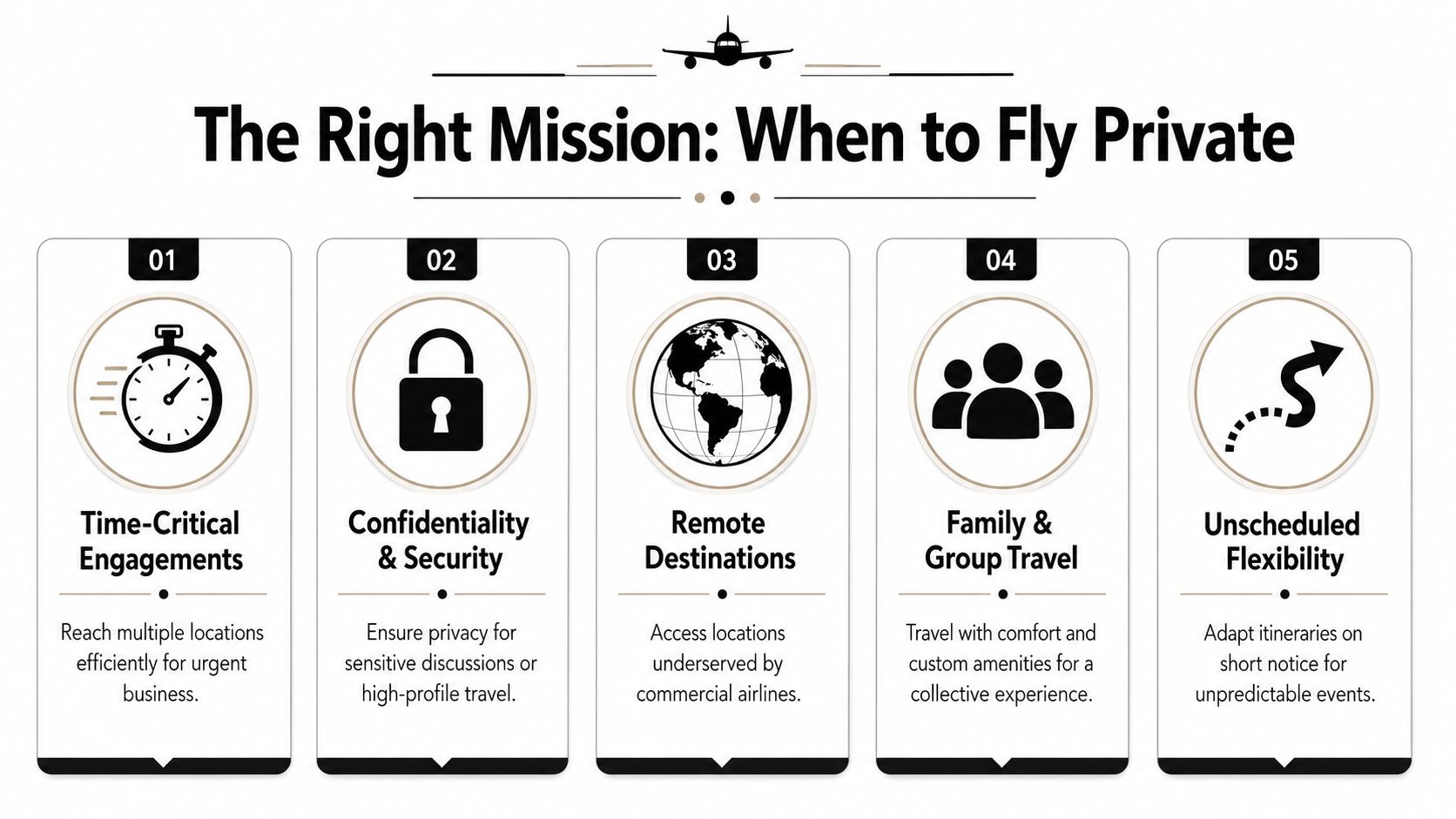
The Right Mission Deciding When to Fly Private
Private aviation earns its keep on specific missions. Use it selectively and it's powerful. Use it indiscriminately and you're just overspending.
The executive mission
If the trip involves multiple meetings in different cities, private often makes operational sense. Commercial travel struggles when a single day depends on precision. Connections, terminal time, and schedule rigidity chip away at the usefulness of the day.
Private aviation thus shifts from indulgence to tool. You preserve meeting windows, keep decision-makers together, and reduce the risk that one disruption cascades across the itinerary.
The family journey
Family travel exposes every weakness in commercial logistics. Bags, children, grandparents, timing issues, dietary preferences, and the general fatigue of public terminals all stack up quickly.
Private doesn't just improve comfort. It simplifies coordination.
For families, the advantages usually look like this:
- Pace control: You travel on a schedule that suits the group.
- Reduced exposure: Less waiting, less crowd management, less friction.
- Better arrival quality: You land closer to the actual vacation rather than at the start of another transfer problem.
The milestone trip
Some journeys aren't about efficiency alone. Honeymoons, anniversaries, celebratory weekends, and once-in-a-lifetime itineraries deserve a cleaner experience from the start.
In those cases, the value is emotional as much as practical. No compromised departure. No chaotic terminal. No deflating layover wedged into a trip that was meant to feel exceptional.
The wrong reasons to fly private
Not every trip benefits enough to justify it. If you're flying alone on a simple nonstop route between major commercial hubs and your schedule is forgiving, commercial may be the smarter choice.
That's the discipline affluent travelers sometimes forget. Wealth should buy judgment, not reflex.
Choose private when the mission needs control, compression, privacy, or access. Choose commercial when the route is simple and the system already works.
How to Access Private Aviation The Haute Black Way
Most first-time clients assume there's one standard way to fly private. There isn't. Access models differ, and each suits a different pattern of travel.
The main options
On-demand charter works well for occasional private flyers. You book trip by trip. It offers flexibility, but quality can vary depending on who is sourcing the aircraft and managing the details.
Jet cards appeal to travelers who want more predictability. They can simplify booking and create a more repeatable experience, though terms vary and the fine print matters.
Fractional ownership suits travelers with frequent, recurring needs and a desire for a more embedded aviation solution. It can make sense at scale, but it's a serious commitment and not the right fit for many clients.
The problem isn't a lack of options. It's complexity. Most UHNW travelers don't want to become amateur aviation managers just to move efficiently.
What clients actually need
They need someone to translate the mission into the right aircraft, routing, and ground coordination. They need continuity. They need someone who understands that the flight is one component of a broader journey.
That's the appeal of a curated solution tied into a wider travel ecosystem rather than a stand-alone booking transaction.

A high-touch model works better because it removes fragmentation. The air segment, ground transfer, hotel arrival, villa access, and schedule changes can be treated as one continuum rather than separate bookings handled by disconnected vendors.
For travelers who want that level of coordination, Haute Black Private Aviation presents the private aviation side inside a broader luxury travel framework.
My recommendation
If you fly private occasionally, start with managed charter support and judge the experience on responsiveness, operator quality, and consistency. If you fly often, evaluate whether a more structured program gives you cleaner access and less decision fatigue.
Don't buy private aviation the way you buy a commodity. Buy it the way you hire top legal counsel or a family office advisor. Competence matters. Judgment matters more.
Your Decision Framework Choosing Your Flight Path
If you want a clean decision, use this checklist.
Choose commercial when
- The route is simple: Major city pair, nonstop service, easy timing.
- Your schedule has room: A delay or longer terminal process won't damage the trip.
- You're optimizing for spend: The lower acquisition cost is the correct priority.
- You don't need special access or discretion: The public travel environment is acceptable.
Choose private when
- Time compression matters: The day around the flight is more valuable than the savings on the fare.
- The itinerary is complex: Multiple stops, difficult airport access, or a remote end point.
- Privacy is essential: Business confidentiality, public visibility, or family discretion.
- Flexibility has real value: The trip may shift, extend, or need tighter control.
Keep one comfort myth in check
A lot of new buyers assume private always means a smoother ride. Not necessarily. Private jets can encounter more turbulence because they often operate at varied altitudes and conditions, even though they can also climb above rough weather faster. Comfort depends on aircraft size, route, and weather, not only on the fact that the cabin is private, as explained in this look at turbulence on private jets versus commercial airlines.
That point matters because it sharpens the whole decision. Private is not magic. It's a better tool for certain missions.
If the trip is straightforward, fly commercial and move on. If the journey needs privacy, control, and calendar protection, private usually wins.
If you want a travel partner that can handle private aviation as part of a fully coordinated luxury itinerary, explore Haute Black. The value isn't just access to aircraft. It's having a team that can align flights, villas, hotels, transfers, and VIP details into one integrated journey.
Explore Our Guides


Signature Experiences