Haute Black Journal
Private Jet Flight Time vs Commercial: A Data Analysis

Marlene Azeez
Director, HauteBlack
View all articles →
# Private Jet Flight Time vs Commercial: A Data Analysis
May 26, 2026
You're not comparing cabins. You're comparing calendars.
A founder needs to be in one city for a financing meeting, another for a site visit, and home that night for a family commitment. A principal wants a long weekend that starts when the house car leaves the driveway, not when the gate agent finally calls boarding group two. In both cases, the right question isn't whether a private jet is “faster” in the abstract. It's how much total time the trip consumes from front door to final destination.
That distinction changes the economics of the decision. Commercial aviation can offer an excellent onboard product, and for some routes it remains perfectly rational. Travelers who prize premium airline cabins sometimes even look for unusual options such as affordable Etihad Residence seats when privacy and comfort matter more than schedule control. But once the itinerary becomes time-sensitive, multi-stop, or operationally fragile, the commercial model starts charging in a different currency. Waiting. Buffer time. Connection risk. Surface transfer inefficiency. Lost working hours.
For high-value travelers, time is the asset under pressure. Private aviation earns its place when it reduces not just airborne minutes, but friction across the whole travel chain.
The True Cost of a Commercial Itinerary
A commercial itinerary often looks efficient on the booking screen. Departure time is clear. Flight duration is clear. Fare classes are neatly tiered. The hidden cost appears only after the day starts moving.
Consider a common executive pattern. Morning departure, midday meeting, evening return. On paper, a nonstop airline schedule seems workable. In practice, the day absorbs a sequence of fixed obligations: leave early for a major airport, arrive with buffer, clear security, wait at the gate, board by zone, taxi with everyone else, land at a hub, deplane in sequence, collect bags if needed, and then drive from an airport chosen for the airline's network rather than your destination.
The result is a trip that behaves like a full-day operation even when the meeting itself lasts only a few hours.
Where the friction really lives
Commercial inefficiency usually isn't one dramatic delay. It's the accumulation of small, mandatory pauses:
- Airport dependency: You travel when the airline schedule works, not when your agenda does.
- Terminal overhead: Security, boarding queues, and gate waiting consume attention before the aircraft even moves.
- Hub logic: Airlines optimize for network flow. Travelers optimize for arrival relevance.
- Arrival drag: Deplaning and onward transfer often erase the illusion of a short flight.
The most expensive hour in travel is often the one spent on the ground, not in the air.
That matters more as stakes rise. If the trip concerns a live transaction, sensitive negotiation, family office review, board attendance, or a hard-stop personal event, the clock isn't a convenience metric. It's part of the outcome.
Why the comparison is usually framed incorrectly
A common starting point is aircraft speed. That's understandable, but incomplete. The better lens is door-to-door control. A commercial business-class seat can be luxurious. It still doesn't let you compress the day around your own timing, your own airport choice, and your own post-landing proximity.
Private jet flight time vs commercial isn't just a question of minutes aloft. It's a question of how many parts of the trip you can remove, shorten, or make irrelevant.
The Three Phases of Travel Time
The cleanest way to compare private jet flight time vs commercial is to divide the journey into three phases: pre-flight, in-flight, and post-flight. That's where the main difference appears.
| Phase | Commercial travel pattern | Private travel pattern | Where time is won or lost |
|---|---|---|---|
| Pre-flight | Early airport arrival, security, gate waiting | Arrival at private terminal close to departure | Queue removal and schedule precision |
| In-flight | Fixed routes, hub logic, possible connection structure | More direct routing based on the traveler's itinerary | Routing and airport selection |
| Post-flight | Sequential deplaning, baggage process, longer transfer from large airports | Quick exit from aircraft and shorter onward drive when using a closer airport | Faster release and destination proximity |
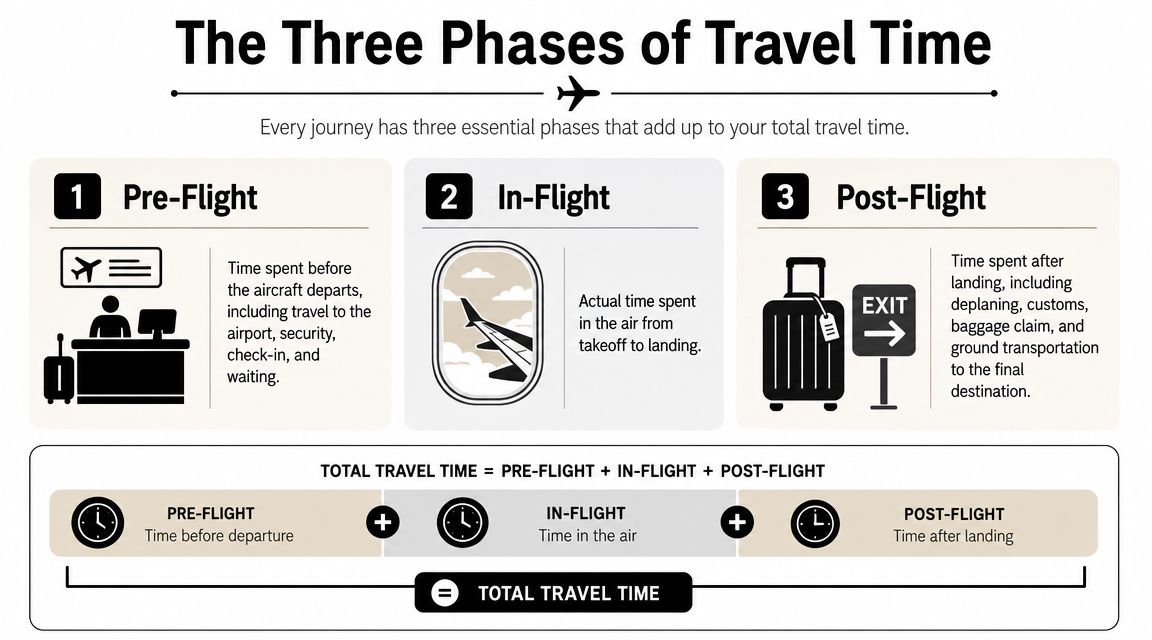
Pre-flight
In commercial travel, time charges begin immediately. Even on straightforward routes, a traveler has to budget for the airport before the airport. Road traffic to a major hub, terminal access, check-in contingencies, security screening, and gate waiting all happen before wheels-up.
Private aviation strips away much of that sequence. The traveler goes to a private terminal rather than a mass-passenger environment. There's far less process between arrival and boarding.
A widely cited benchmark from the European Business Aviation Association states that private jet travelers save an average of 2 hours, or 127 minutes, per flight versus commercial, and attributes that advantage to reduced airport processing time plus access to more than 5,000 public airports in the United States versus roughly 500 served by commercial airlines (European business aviation benchmark).
Operational reality: If you only compare airborne time, you miss the part of the trip where private aviation does most of its work.
For travelers evaluating charter strategy, private aviation options through Haute Black are best understood through that lens. The aircraft matters, but the terminal process and airport choice often matter more.
In-flight
This phase is where many travelers make the wrong assumption. They assume private jets save time because they fly materially faster than airliners. Sometimes a private aircraft can perform very well, but raw speed isn't usually the primary driver of time saved.
In practical terms, the in-flight edge tends to come from route efficiency and operational fit. A private itinerary may avoid a hub structure, eliminate a connection, and land closer to the actual destination. That often beats a nominally faster airline cruise when measured from origin to arrival point that matters.
Post-flight
Commercial travel doesn't end at touchdown. You still have to wait to deplane, move through the terminal, recover luggage if applicable, and then cover the ground distance from a major airport to the true destination.
Private arrivals are materially cleaner. Travelers usually leave the aircraft quickly, step through a much lighter terminal environment, and get into ground transport without the same crowd mechanics.
A better way to measure time ROI
Use this three-part lens when reviewing any itinerary:
1. Count the dead time before departure
2. Check whether the air segment is direct or network-shaped
3. Measure the last-mile transfer from arrival airport to final destination
That's how experienced travelers decide whether the upgrade is indulgent or strategic. Very often, it's the latter.
Real-World Itinerary Comparison
The theory becomes clearer when you apply it to actual trip design. One useful contrast is a simple business route. The other is a complex multi-stop journey where commercial logistics stop being merely inconvenient and become structurally inefficient.
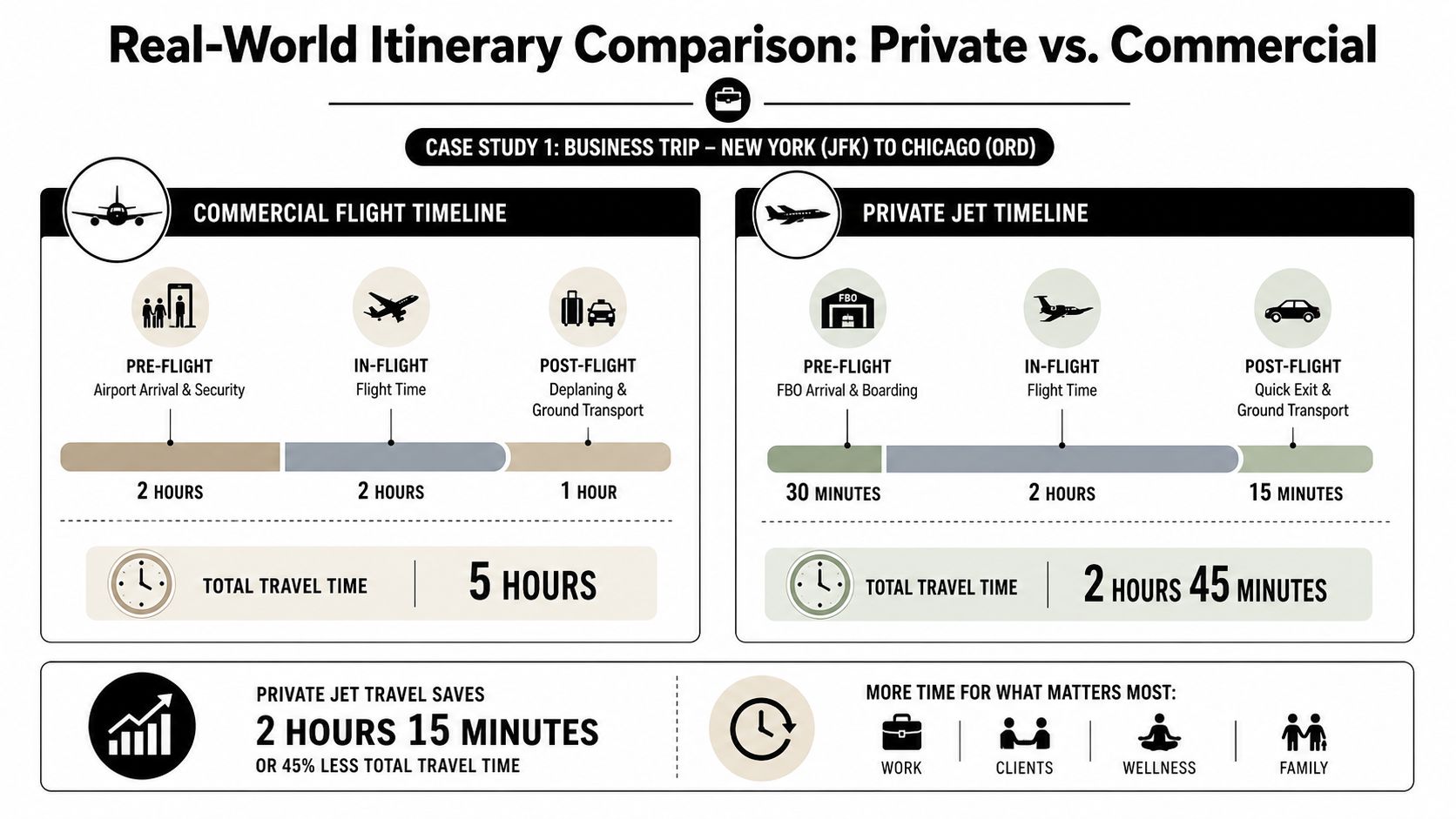
Short-haul business day
Take a familiar use case. A principal departs from the New York area for a meeting in South Florida and wants to preserve the day around the meeting, not sacrifice the day to transport.
With commercial travel, the traveler usually starts by aligning with the airline's schedule and the realities of a major airport. That means committing to a departure window shaped by terminal overhead. At the other end, arrival often means a longer surface transfer from a large airport to the true meeting location.
With private travel, the trip can be designed around airports that serve the traveler instead of the network. A New York departure through Teterboro and an arrival through Opa-locka is a very different operating model than JFK to a major commercial field, even before discussing the cabin.
Here's the practical difference:
- Commercial pattern: The traveler protects the airline schedule with buffer time, loses flexibility if the meeting runs long, and often turns a moderate flight into a nearly full-day commitment.
- Private pattern: The traveler preserves the morning, keeps the pre-flight process compact, and can often hold the day together with far less calendar damage.
A private jet doesn't just shorten transit. It can preserve the shape of the business day.
Multi-city travel is where private aviation separates sharply
The strongest case for private aviation appears when one trip includes multiple destinations or a tightly sequenced global itinerary. In such scenarios, airline networks impose connection logic, layover exposure, and dead hours that can't be negotiated away.
A concrete example comes from TCS World Travel's around-the-world comparison. Its private-jet itinerary is completed in 25 days, while replicating the same journey commercially takes 34 days. Total travel time rises from 73 hours to 112 hours, and airport waiting time increases from 9 hours to 84 hours (around-the-world itinerary comparison).
That comparison matters because it captures the compounding effect of friction. One airport wait is annoying. Repeating that pattern across a long itinerary changes the trip's structure.
On complex itineraries, private aviation isn't a premium version of the same plan. It's often a fundamentally different plan.
A related perspective appears in this private jet luxury travel guide, which is useful for travelers thinking beyond a single city pair and toward integrated journey design.
What works and what doesn't
What works for commercial
- Single-destination travel: One nonstop route between major cities can remain perfectly rational.
- Flexible timing: If arrival time is soft and the day can absorb drift, the airline model may be sufficient.
- Low consequence trips: When no meeting, event, or personal obligation depends on precision, commercial friction is less costly.
What doesn't
- Two cities in one day: The margin for delay collapses quickly.
- Remote or secondary destinations: Surface transfer time starts dominating the itinerary.
- High-value presence windows: If being late changes the outcome, the system is too rigid.
For most discerning travelers, this is the point where private jet flight time vs commercial stops being an abstract luxury comparison and becomes a scheduling discipline.
The Strategic Value of Saved Time
Saved time only matters if it becomes usable time. That's the key distinction.

An hour recovered from a trip can be deployed in several ways. It can become protected work time, family time, recovery time, or optionality. The strategic value depends on who the traveler is and what the schedule is carrying, but the principle is consistent. Private aviation doesn't just reduce elapsed time. It often upgrades the quality of the remaining day.
Productive time versus degraded time
Commercial premium cabins can be comfortable. They are still public environments. Calls are limited. Documents remain visible. Conversations are overheard. The traveler also has to modulate behavior around boarding, service cadence, nearby passengers, and inconsistent continuity.
A private cabin changes the function of travel time. It can be used for confidential discussion, uninterrupted review, or actual decompression. For a CEO, investor, athlete, principal, or family office executive, that distinction has operational value.
Consider the difference between these two outcomes:
- Arriving with inbox triage incomplete, mentally fragmented by terminal interruptions
- Arriving with decisions made, files reviewed, and the next move already aligned
Those aren't luxury distinctions. They're performance distinctions.
The myth of raw aircraft speed
Private aviation is often described as faster in the air. That's not the most accurate way to frame it. According to BlackJet's speed comparison, many private jets cruise at 500 to 700 km/h and the fastest models top out near Mach 0.94, while major commercial airliners typically cruise at 850 to 900 km/h and peak around Mach 0.9. The practical takeaway is clear. Time savings usually come from direct routing, faster boarding, and access to smaller airports, not dramatically higher cruise speed.
Faster travel doesn't always mean a faster airplane. It usually means a shorter process.
That's an important correction because it leads to better decision-making. If a traveler expects private aviation to outperform commercial purely through airborne speed, the value proposition may seem overstated. If the traveler understands that the benefit comes from removing nonessential process, the economics become much more credible.
A short visual explanation helps clarify that point:
Flexibility is part of the return
The strategic value of private travel also lies in what can change after departure is scheduled. Meetings move. Weather shifts. A family decision overrides the original plan. A final signature requires one more stop.
Commercial systems resist change because they're built for scale and standardization. Private systems can absorb change more intelligently. That flexibility often protects more value than the original time saving.
Fatigue has a cost too
Discerning travelers already know this, even if they don't formalize it. Two itineraries with the same nominal duration can produce completely different human outcomes. One leaves the traveler depleted, reactive, and off-rhythm. The other preserves clarity.
That difference matters in negotiations, presentations, medical travel, milestone family events, and any situation where a traveler's condition on arrival affects what happens next.
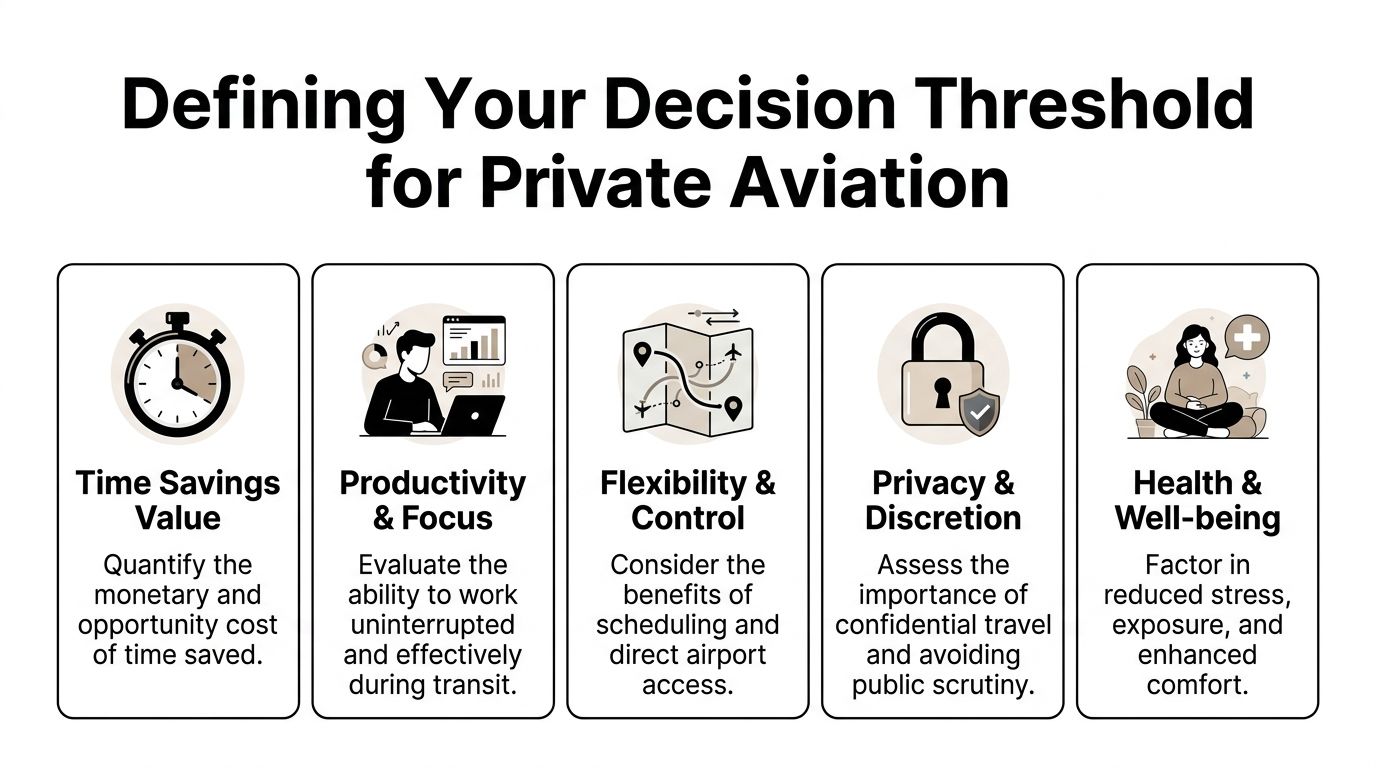
Defining Your Decision Threshold
The right question isn't “Is private aviation worth it?” The right question is “At what point does commercial travel stop supporting the objective of the trip?”
That threshold differs by traveler. A principal moving between board meetings has a different calculus than a family flying to a villa with children, luggage, and a tight holiday window. But the decision can still be made rationally.
The executive threshold
For business travelers, private aviation becomes strategically sensible when delay, rigidity, or fatigue threatens the value of the meeting itself.
Use these markers:
- One day, multiple commitments: If the day requires more than one city or a very narrow arrival window, commercial travel usually introduces too many failure points.
- Confidential work in transit: If the flight time needs to function as meeting time, a public cabin is the wrong setting.
- High-consequence presence: If arriving late materially changes a negotiation, site decision, or board outcome, schedule control starts to outweigh fare logic.
Decision test: If the agenda is more valuable than the ticket, optimize the agenda.
The leisure threshold
For leisure travelers, the threshold is less about billing rates and more about protecting scarce discretionary time.
A long weekend can disappear into commercial process. So can the first and last day of a family holiday. In those cases, private aviation may be justified not because the cabin is luxurious, but because it preserves the trip you intended to have.
This becomes especially relevant when the destination requires coordinated ground movement. Travelers heading into the Algarve, for example, often pay close attention to transfer reliability after landing, which is why practical planning resources such as reliable Faro Airport transfers can be useful even for those comparing private and commercial options.
A practical self-assessment
Ask these questions before choosing:
1. How much of the day is fixed
If the answer is “most of it,” rigid airline timing is already a problem.
2. Does the trip involve more than one meaningful stop
Multi-stop days are where commercial efficiency drops quickly.
3. Is privacy part of the mission
If calls, documents, or sensitive discussion matter, cabin exclusivity isn't cosmetic.
4. Will the trip be judged by the quality of arrival
Some journeys end when you reach the hotel. Others begin the moment you step off the aircraft.
When commercial still makes sense
A disciplined advisor should say this plainly. Not every trip merits a private aircraft.
Commercial remains sensible when the route is simple, the timing is flexible, the destination is well-served, and the traveler doesn't need privacy, schedule agility, or a same-day multi-city structure. There's no reason to force private aviation into a use case where it doesn't solve a real problem.
The strongest private aviation decisions are not aspirational. They're precise.
Maximizing Time Efficiency with Haute Black
Once the decision to fly private is made, the next variable is execution. Many travelers still lose time at this stage. They may choose the correct mode but handle the trip as a simple aircraft booking rather than a full door-to-door operation.
The efficient approach starts with aircraft fit. Range, airport compatibility, passenger count, baggage profile, and cabin use all need to match the mission. Over-specifying the aircraft can create unnecessary complexity. Under-specifying it can force fuel stops, baggage constraints, or operational compromises that undercut the original reason for flying private.
What efficient execution looks like
A strong private aviation workflow usually follows a disciplined sequence:
1. Define the final destination
Not the city name on the calendar. The actual estate, office, marina, resort, plant, or event location.
2. Select airports by ground-time impact
The nearest practical airport often creates more value than a marginal difference in airborne time.
3. Build the surface plan with the flight
Chauffeur timing, terminal access, and arrival coordination should be part of one operating plan, not handled as separate bookings.
4. Protect optionality
If the day may move, the itinerary should be structured to absorb changes without reintroducing stress.
Where travelers usually lose the benefit
The most common mistake is focusing on the aircraft and ignoring the chain around it. Another is treating every private flight as interchangeable. They aren't. The right operator, routing logic, and ground coordination all influence whether the saved time becomes frictionless time.
That's why execution quality matters as much as mode choice. A well-run private itinerary feels quiet. There's very little visible effort. The schedule runs smoothly.
Travelers who want that level of orchestration can review Haute Jets as part of a broader private travel strategy, especially when the objective is to align air, ground, and destination planning around time efficiency rather than cabin prestige alone.
Haute Black serves travelers who expect their schedule to be protected as carefully as their privacy. If your trips demand precision, discretion, and a fully coordinated door-to-door experience, explore Haute Black for bespoke private aviation, customized journeys, and high-touch travel planning built around time well spent.
Explore Our Guides


Signature Experiences


