Haute Black Journal
Private Jet Luxury Travel: Your 2026 Ultimate Guide

Marlene Azeez
Director, HauteBlack
View all articles →

# Private Jet Luxury Travel: Your 2026 Ultimate Guide
May 24, 2026
Most advice on private aviation is backwards. It starts with veneer: seat finishes, champagne lists, branded cashmere, the theater of exclusivity. That's the least interesting part of the decision.
For serious travelers, private jet luxury travel is valuable when it changes the shape of the itinerary itself. It lets a principal leave after a board meeting instead of missing it. It lets a family land closer to a ski estate, island villa, or safari connection instead of losing a day in transfers. It gives an executive assistant one accountable team instead of five loosely connected vendors.
The cabin matters. The aircraft matters. But the ultimate test is simpler. Does this trip become faster, quieter, more private, and easier to control from door to destination? If the answer is no, private aviation may be an indulgence. If the answer is yes, it becomes a strategic tool.
The Real Currency of Private Aviation
The common mistake is assuming the premium is mainly about onboard luxury. In practice, high-net-worth travelers often focus too heavily on cabin aesthetics and not enough on door-to-door efficiency, even though the premium is often justified by itinerary control and access to smaller airports closer to the final destination, especially when commercial travel would require multiple connections, as noted in Jetnexa's view on private jet charter value.
That distinction changes how smart buyers evaluate a trip.
What actually creates value
A private flight earns its keep when it removes friction that commercial travel can't. That usually means:
- Schedule control: You depart when the day allows, not when the airline publishes a slot.
- Closer airport access: Smaller regional airports can place you nearer to an estate, yacht transfer, factory site, or resort.
- Privacy in motion: Conversations continue in the car, at the terminal, and onboard without the usual exposure.
- Recovery of productive time: Teams can work in transit instead of losing hours to airport choreography.
Practical rule: If private aviation doesn't materially improve timing, access, or discretion for a specific trip, you're paying for atmosphere more than utility.
Where clients often misjudge the decision
The most expensive mistake isn't choosing the wrong champagne. It's choosing the wrong mission profile.
A beautifully appointed aircraft that still requires awkward ground repositioning, a fuel stop, or an inconvenient airport may be less useful than a simpler aircraft matched to the right routing. Likewise, a glamorous nonstop aspiration can be inferior to a more practical plan if runway, weather, baggage, or onward helicopter coordination make the itinerary brittle.
This is why principals and family offices should think less like shoppers and more like operators. Ask what the aircraft enables. Ask which airport pair makes the day easier. Ask who is handling the final fifty miles after wheels down.
Luxury is control
At the top end of the market, luxury isn't excess. It's the absence of disruption.
That's why the best private aviation experiences often feel understated. The transfer is waiting. The FBO handoff is smooth. The crew already knows dietary restrictions, security preferences, and whether the principal wants silence or a conference setup. Nothing dramatic happens, which is exactly the point.
Understanding Private Jet Travel as an Ecosystem
Private aviation is no longer a fringe category for occasional vanity travel. The market is projected at $49.9 billion in 2025 and forecast to reach $97.4 billion by 2033, with private flying already 32.1% above 2019 levels by mid-2024, according to private flight market data summarized by Stratos Jets. That scale matters because it has expanded the service expectations around the flight itself.

The aircraft is only one node in a larger chain. Discerning clients are buying an ecosystem.
The trip starts before the airport
A well-run private itinerary begins at the residence, hotel, or office. Ground transport is timed to the minute. Security preferences are handled discreetly. Passport details, catering notes, pet documentation, and baggage assumptions are resolved before anyone gets in the car.
At the airport, the relevant term is FBO, or fixed-base operator. That's the private terminal environment used for most departures and arrivals. It matters because the quality of the FBO experience affects everything from privacy to speed to how easily staff can manage luggage, children, security, and special requests.
A strong provider also thinks past touchdown. If the final destination is a yacht, lodge, private estate, or remote resort, onward movement has to be synchronized. That's where an integrated travel team is more useful than an aircraft broker alone. For broader context on that service layer, Haute Black's private aviation offering shows how air travel often sits inside a larger luxury travel framework.
How to evaluate the full chain
When reviewing a provider, the fleet list tells only part of the story. Look at the operational discipline behind it.
- Pre-departure planning: Are manifests, dietary preferences, ground transport, and arrival logistics handled in one thread?
- In-flight continuity: Can the team arrange connectivity, catering, sleep setup, and meeting configuration properly for the mission?
- Arrival execution: Is there a clear handoff from aircraft to vehicle, helicopter, hotel, or local host?
- Accountability: If weather, crew duty limits, or airport constraints force a change, do you have one decision-maker coordinating the fix?
A private flight feels luxurious when the client barely sees the machinery behind it.
That's the benchmark. Not the jet in isolation, but the continuity of service around it.
Choosing Your Access Model
Private aviation gets expensive fastest when the access model is wrong. The aircraft can be perfect and the experience can still feel inefficient if the structure behind it does not match how the principal travels.
The decision is less about taste than pattern. Frequency matters. Route consistency matters. So does how often plans change, how much notice you usually have, and whether the trip is a simple city pair or part of a larger movement involving estates, yachts, ski transfers, security teams, or family staff. A good advisor starts there, then builds the access strategy around the mission profile. Private air travel planning services are most useful at this stage, before a client commits to a program that looks polished on paper and performs poorly in practice.

| Model | Best For | Cost Structure | Commitment |
|---|---|---|---|
| On-Demand Charter | Infrequent flyers, varied mission profiles, one-off leisure or business trips | Pay per trip | Low |
| Jet Cards | Travelers who want prearranged terms and simpler booking | Prepaid hours or deposits | Medium |
| Fractional Ownership | Flyers with regular usage who want stronger access assurance without full ownership | Capital purchase plus ongoing fees | High |
| Whole Ownership | Principals with highly specific needs, heavy usage, or desire for total control | Full asset ownership plus operating costs | Very high |
On-demand charter
On-demand charter suits clients who value optionality. It works well when the annual pattern is uneven, the group size changes, or the mission shifts between short regional hops and long-haul crossings.
That flexibility has real strategic value. A family flying to St. Moritz in February, Athens by yacht in June, and Riyadh for meetings in October should not be forced into the same aircraft category each time. Charter lets you match range, baggage, runway performance, and cabin setup to the trip instead of paying year-round for a fixed structure.
The trade-off is inconsistency if the buying is handled poorly. Pricing moves with the market. Availability tightens around major events and holiday periods. The advantage goes to clients with informed buying support, because the right question is not "What is available?" It is "Which aircraft and operator best fit this exact mission?"
Jet cards and membership structures
Jet cards can reduce booking friction for travelers who want standardized terms, faster confirmations, and fewer trip-by-trip negotiations. For some households and executive offices, that convenience is worth paying for.
The details decide whether a card helps or hinders. Peak day exclusions, interchange fees, service areas, callout times, de-icing charges, and guaranteed category language all affect the actual value. Many buyers focus on the hourly rate and miss the operating rules that shape how useful the program will be in August, over Christmas, or during a last-minute aircraft swap. Air Trek's private jet membership guide is a useful outside reference for comparing how these programs are structured.
Some memberships are excellent for predictable regional flying. Others create a false sense of certainty. If your schedule changes often, if you need access to multiple aircraft classes, or if your travel includes smaller airports and international sectors, the fine print matters more than the branding.
A short visual overview can help frame the differences.
Fractional ownership
Fractional ownership fits clients with repeatable usage and a genuine need for stronger access assurance. It can make sense for a principal flying the same domestic circuits each month, or for a family with consistent annual volume and clear preferences around cabin class.
It is a middle ground, but not a casual one. Owners buy into a program with capital exposure, monthly management fees, occupied and ferry hour charges, and structured notice requirements. There is often better predictability than ad hoc charter, but there is also less freedom to improvise outside the program rules.
I usually advise clients to examine fractional only after mapping at least a year of real travel behavior. Estimated usage is often optimistic. Actual patterns tend to be messier.
Whole ownership
Whole ownership serves a narrow group well. It is appropriate when usage is high, dispatch priorities are strict, and the principal wants direct control over aircraft configuration, crew standards, branding, and scheduling.
It also creates an operating business. Even with strong aviation management, ownership brings maintenance planning, staffing, insurance, hangar decisions, repositioning, regulatory oversight, and replacement lift when the aircraft is down. Clients sometimes assume ownership eliminates friction. In reality, it shifts the friction into administration and cost management.
Buy the structure that protects time and access. Buy the asset only if control justifies the overhead.
For many UHNW travelers, the best answer is not permanent commitment to one model. It is a disciplined mix. Charter for varied leisure flying, a card for repeated regional use, or ownership only where the schedule supports it. The point is to build private aviation around how the client moves, not around the romance of having a jet attached to the name.
The Logistics of a Seamless Journey
The booking process should feel simple to the client. Behind the scenes, it isn't. That's why process quality matters.
What the request should include
A proper booking brief is more than city pairs and dates. The essentials usually include:
1. Passenger profile: number of travelers, any children, security needs, pets, passport requirements.
2. Mission details: departure window, destination, return flexibility, preferred airports if known.
3. Cabin requirements: sleep needs, baggage volume, work setup, Wi-Fi importance, catering preferences.
4. Ground context: pickup address, arrival handoff, hotel, villa, yacht, or event schedule.
If an executive assistant sends only “Need a jet from New York to Europe next Thursday,” the quotes may come back technically correct and strategically wrong.
How to read the options
When proposals arrive, don't compare only by aircraft name. Compare by mission fit.
A midsize jet may look attractive until baggage becomes an issue. A larger cabin may seem excessive until the principal wants a proper sleep setup before meetings. An airport closer to the destination may appear convenient until customs, tarmac access, or vehicle transfer logistics make another airport faster in practice.
At this stage, the right question is: what problem is each option solving?
- Airport selection: Which arrival point reduces final transfer friction?
- Timing: Is the departure realistic for crew, runway, and connection needs?
- Cabin suitability: Can passengers work, sleep, dine, and travel with luggage comfortably?
- Operational resilience: What happens if weather, slot issues, or schedule changes intervene?
What a strong process feels like
The client shouldn't have to chase answers. A capable air team should explain trade-offs, confirm catering and transport, align all documents, and monitor the trip until final arrival. For clients coordinating broader itineraries, Haute Black's air travel services are an example of how private flights can be managed alongside first-class bookings and helicopter transfers within one planning relationship.
The best private aviation logistics are almost invisible. You notice them only when they're missing.
Terms worth understanding
A few operational terms matter because they affect the experience:
- FBO: The private terminal used for departure and arrival.
- Tarmac access: Controlled vehicle or escorted access closer to the aircraft, where permitted.
- Repositioning: When the aircraft must move empty before or after your flight.
- Diversion: A change in airport because of weather, operational limits, or airport constraints.
Clients don't need to speak dispatcher language fluently. They do need a team that can translate those realities into clear choices without drama.
The Haute Black Difference
At the top of the market, aircraft are more interchangeable than many clients think. Service is where the differentiation lives.
A Global, a Gulfstream, or a well-appointed Challenger can all perform beautifully when matched correctly. What clients remember later is whether the entire journey felt personally understood. That includes the transfer to the airport, the handling of a last-minute dinner reservation after landing, the villa arrival, and whether the hotel already knew to prepare the suite exactly as requested.

Where a service partner changes the experience
The aircraft gets you from one point to another. A high-touch advisor makes the trip coherent.
That can mean synchronizing private aviation with a preferred suite at a Four Seasons, Aman, Rosewood, Belmond, or Ritz-Carlton property. It can mean arranging a car-side arrival that protects privacy. It can mean ensuring the family's ski equipment, nanny logistics, dietary preferences, and security requests are all carried through one operating file rather than repeated to multiple vendors.
For travelers who use Haute Jets through Haute Black, the aviation piece sits inside that wider world of bespoke travel planning, preferred partner relationships, and coordinated concierge support. That matters because private flying on its own doesn't automatically produce a refined trip. It only shortens one segment of it.
What works and what doesn't
What works is one accountable relationship that knows the client well enough to make subtle decisions without constant prompting.
What doesn't work is a fragmented stack. One broker books the jet. Another company handles the villa. A hotel advisor manages the stay. A local concierge tries to solve the rest on arrival. That model can still function, but it rarely feels effortless.
A strong partner also understands restraint. Not every trip needs theatrical “luxury touches.” Sometimes the most intelligent service is a silent cabin, a fast departure, and a vehicle waiting in exactly the right place. On other trips, value comes from securing a difficult suite, arranging a chef, or setting up a cultural access point the family couldn't have obtained independently.
Clients rarely ask for complexity. They ask for certainty, privacy, and the feeling that every moving part has already been handled.
That is the difference between booking a private jet and delivering a private travel experience.
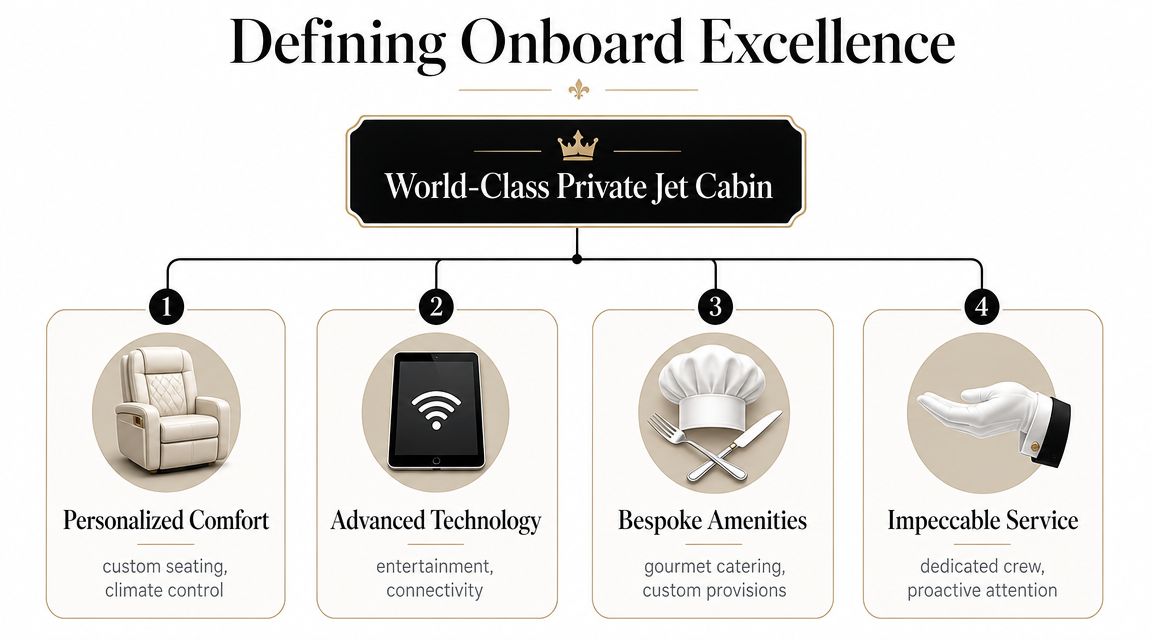
Inside the World of Onboard Excellence
A top-tier cabin isn't defined by glossy wood veneer or a famous champagne label. It's defined by how well it supports the mission once the door closes.
On a short regional sector, that may mean quiet, fast boarding and good luggage flexibility. On an overnight intercontinental flight, the standard rises. Sleep quality, layout, connectivity, cabin pressure, and crew judgment start to matter more than visual design.
Cabin architecture that changes the flight
The best flagship jets function like discrete environments, not one long room. Aircraft such as the Bombardier Global 7500 and Gulfstream G700 can be configured with genuine multi-zone living spaces and maintain a lower cabin altitude of 2,900 to 4,500 feet, compared with the 6,000 to 8,000 feet typical on commercial airliners, according to BlackJet's guide to luxury personal jets.
That has practical consequences. Lower cabin altitude helps reduce fatigue and dehydration on long sectors. Multiple zones let one passenger sleep while another works, dines, or holds a meeting without turning the entire cabin into a compromise.
For family travel, this separation is often the difference between a pleasant journey and an exhausting one. For corporate use, it allows the cabin to function as a moving office without sacrificing privacy for the principal.
What to assess beyond aesthetics
When reviewing an aircraft or operator, pay attention to factors that marketing materials often underplay:
- Layout integrity: Does the cabin support sleep, dining, and work at the same time?
- Connectivity: Is onboard internet good enough for the traveler's actual expectations?
- Galley capability: Can the aircraft support proper meal service or only light catering?
- Baggage practicality: Can it handle skis, golf bags, trunks, garment bags, or family volume without compromise?
A refined interior is welcome. A functional cabin is essential.
Crew, safety, and judgment
Even a spectacular aircraft underperforms with a mediocre crew pairing.
The crew sets the rhythm of the cabin. They decide whether service feels anticipatory or intrusive, whether children are handled gracefully, whether a late departure is managed calmly, and whether the principal can rest without unnecessary interruption. Safety oversight matters just as much, of course, but clients often underestimate how much the soft side of crew quality shapes the flight.
Sustainability and discretion
Many clients now ask about sustainability in private aviation. That usually shows up in two forms: Sustainable Aviation Fuel availability where possible, and carbon offset programs tied to the itinerary. These aren't perfect substitutes for lower-emission transport, but they're part of the modern conversation and should be discussed openly.
Discretion also belongs in the definition of onboard excellence. The best private flights don't feel performative. They feel protected. Names aren't repeated loudly. Preferences aren't mishandled. The cabin remains a private environment in every sense.
Private Jet Itineraries in Practice
The easiest way to understand private jet luxury travel is to look at how it performs in different mission types.
Multi-city business circuit in Europe
A principal needs meetings in London, Paris, and Milan inside two days. Commercial schedules can do it, but only by forcing early departures, exposed airport time, and dead hours between cities.
A private itinerary turns the aircraft into a moving office. The team can depart after the first meeting, work en route, land closer to the next appointment, and preserve evening time for a private dinner or reset at the hotel. For a mission like this, a super-midsize or large-cabin aircraft is often the sweet spot, depending on team size and baggage.
Private aviation clearly proves its value. Not because it looks glamorous, but because it compresses time without compressing performance.
Family trip to a remote destination
A family heading to a remote lodge or island property has a different set of priorities. They need easier luggage handling, privacy for children, less exposure to crowded terminals, and simpler coordination with onward transfers.
The market now includes all-inclusive jet expeditions and customized itineraries to remote destinations, not just straightforward point-to-point flying. Aircraft choice matters. TCS World Travel's coverage of luxury jet expeditions notes that an Embraer Praetor 600 at around $21 million is suited to continental trips, while an ultra-long-range jet is the right tool for transoceanic expeditions.
The elegant solution isn't always the biggest aircraft. It's the aircraft that matches the route, the runway, and the family's actual rhythm.
Cultural journey with timed access
Consider a connoisseur itinerary built around private tastings, estate access, or a narrow event window. Timing is less forgiving here. The traveler may need to arrive within a specific afternoon slot, continue to a countryside property, then reposition for a second destination the next day.
For these trips, private aviation works best when paired with local knowledge. The flight is only the spine. Around it, there may be chauffeured transfers, estate hosts, security preferences, and dining logistics that need to click without visible strain.
In this category, flexibility is often more valuable than maximal range. The ideal setup is the one that protects the experience from delay, overexposure, and avoidable handling.
Frequently Asked Questions
How are last-minute schedule changes handled
Good private aviation teams build for movement. Departure times can often be adjusted within operational limits, but the practicality depends on crew duty time, airport restrictions, aircraft positioning, and ground handling. The key is using a provider that manages the full chain quickly, not one that restricts its activity to passing messages between departments.
Are luggage limits still an issue on private jets
Yes. Private aviation is more flexible than commercial travel, but baggage is still governed by aircraft type, passenger count, and mission length. Hard cases, skis, golf clubs, large strollers, and extended-stay wardrobes can all affect aircraft selection. This is one reason the booking brief needs to be detailed from the start.
How is privacy protected for high-profile travelers
Discretion comes from process. That includes private terminals, reduced public exposure, careful manifest handling, controlled ground transfers, and staff who understand that names, routines, and destinations are confidential. The right provider also limits how many parties need access to the client's information.
Is private aviation mainly a U.S. market
The United States is still the anchor market. It accounts for roughly 63% to 75% of the world's approximately 23,000 private jets, with major activity concentrated around hubs such as New York, Los Angeles, and South Florida, according to the VistaJet Jet Traveler report.
When is private aviation worth it
It's worth it when it improves the trip in ways commercial travel can't. That usually means tighter time control, better airport access, stronger privacy, or a smoother path to a hard-to-reach final destination. If the route is simple, the schedule is forgiving, and privacy isn't a concern, commercial first or business class may be the more rational choice.
What should an executive assistant prioritize first
Clarity. Send complete trip details early, especially passenger count, baggage profile, airport flexibility, and any security or family requirements. A detailed brief usually produces better aircraft matches and fewer costly revisions later.
If you want private aviation handled as part of a complete luxury travel strategy, not as an isolated flight booking, Haute Black can coordinate the aircraft, ground movement, hotel relationships, and on-the-ground details that turn a private flight into a smooth journey.
Explore Our Guides


Signature Experiences


