Haute Black Journal
Luxury Travel to South Africa: An Insider's Guide

Marlene Azeez
Director, HauteBlack
View all articles →

# Luxury Travel to South Africa: An Insider's Guide
June 13, 2026
Most advice on luxury travel to South Africa gets the hierarchy wrong. It starts with the postcard sequence. Safari. Cape Town. Wine country. Perhaps the Garden Route if there's time. That itinerary can work, but for travelers who value privacy, pacing, and quiet control, it's not enough to know where to go. The defining question is how the trip moves.
A well-designed South Africa journey doesn't feel like a chain of bookings. It feels like a protected rhythm. Arrival after a long-haul flight is handled correctly. Transfers are timed around energy, not just airline schedules. A city stay is placed where it adds pleasure rather than fatigue. Safari is given enough nights to settle into the wilderness. Coastal or vineyard time comes when guests are ready for ease, not more transit.
The difference becomes obvious on the ground. One traveler lands in Johannesburg, waits on a domestic connection, drives too long to a lodge, and loses the first evening to logistics. Another lands, clears formalities smoothly, transitions privately, and wakes the next morning already in the bush with no sense of strain. Both technically went to the same country. Only one experienced it at the level South Africa deserves.
That's the art of it. South Africa isn't a single luxury destination in the way a private island or one-resort escape is. It's a layered, multi-node country with serious range. Private reserves, dramatic coastlines, design-forward city hotels, wine estates, villas, conservation access, and helicopter-worthy topography all sit within one trip architecture. The reward is exceptional, but only if the journey is curated with discipline.
Introduction The Art of Travel in South Africa
The usual South Africa itinerary is easy to recognize and easy to get wrong. Safari, Cape Town, the Winelands, home. It looks polished in a proposal and often feels fragmented in practice.
For travelers used to private aviation, well-paced touring, and discreet service, the standard question is not where to go. It is how each element connects. South Africa is unusually rewarding for guests who travel well, but it is unforgiving of casual routing. The finest lodges, villas, and reserves are spread across different regions, with different air access points, transfer standards, and operating rhythms. A trip can involve an overnight international arrival, meet-and-greet assistance airside, a private air transfer or scheduled hop inland, a road move into a reserve, then a later shift to the coast, the Winelands, or Cape Town. If those handoffs are poorly timed, even excellent properties cannot protect the experience.
Demand adds another layer. South Africa is a leisure-led market, and that creates pressure on the same premium rooms, private-use options, lodge categories, and festive-period access that affluent travelers tend to want. The effect is that availability alone is not a planning strategy. Timing, routing, and hold strategy matter just as much as hotel choice.
South Africa feels most luxurious when the guest notices the place itself and almost none of the machinery behind it.
That is why the strongest itineraries are usually more disciplined than expansive. Fewer moves. Better flight pairings. Correct arrival nights. Ground teams who know when to expedite and when to disappear. In South Africa, luxury is rarely about adding more. It comes from arranging the country with enough intelligence that every transition feels easy and every destination arrives at the right moment.
Defining True Luxury in a South African Context
Luxury in South Africa isn't merely a larger suite or a lodge with a stronger wine list. It's the ability to turn a complex destination into something that feels private, coherent, and profoundly personal. That requires looking beyond star ratings and asking a harder question. What type of control does the traveler want?
South Africa supports that conversation because it's not a niche market. It is a substantial luxury ecosystem. The IMARC Group outlook for South Africa luxury travel values the market at USD 15.61 billion in 2024 and projects USD 19.23 billion by 2033, with growth tied to high-end safari experiences, wellness travel, and bespoke journeys. In practical terms, that means the market is no longer built around one archetype of affluent traveler. There is room for the villa client, the conservation-minded safari couple, the multi-generational family, and the executive who wants very high service with very low visibility.
Privacy is not the same as luxury branding
A famous hotel can still feel public. A celebrated lodge can still feel social in a way some guests don't want. The South African question is often whether the traveler prefers:
- A classic luxury hotel with atmosphere, restaurant energy, and a central address
- A private-use villa with dedicated staff, controlled access, and family-friendly flexibility
- A safari lodge with communal rituals, shared game drive cadence, and a curated bush culture
- An exclusive-use safari residence that gives the bush experience without social overlap
These aren't status differences. They are behavioral differences. A honeymoon couple may want the romance of a lodge with a strong central firepit and polished communal dining. A principal traveling with children, security considerations, or household staff may be far better served by an exclusive-use house where the day runs on their clock.
The real luxury is friction removal
In South Africa, the highest-value planning often happens before any property is chosen. It starts with sequencing.
A trip can be architected to protect sleep after an overnight arrival. It can be structured so city exposure is reduced at the start, when jet lag is highest and judgment is lowest. It can place a reserve before the Winelands, or the reverse, depending on energy, season, and the guest's appetite for movement. It can also limit one-night stays, which almost always dilute luxury in a country where transfers matter.
Practical rule: If an itinerary looks exciting because it includes everything, it's usually overbuilt.
Bespoke means more than customized
“Customized” is often used loosely. In the South African context, bespoke should mean the trip reflects actual priorities, not just selected upgrades.
A bespoke itinerary might include private conservation access rather than standard game drives because the travelers care about purpose as much as comfort. It might replace a hotel in town with a discreet residence because anonymity matters more than being seen. It might include wellness time after safari rather than before it, because the body responds differently once early wake-ups are over.
A concise comparison helps clarify the difference:
| Style of trip | What it looks like | What it feels like |
|---|---|---|
| Standard luxury | Premium hotels, known lodges, fixed routing | Comfortable, but somewhat generic |
| High-touch bespoke | Tailored pacing, vetted transfers, selective private access | Controlled, calm, personalized |
| Ultra-luxury | Exclusive-use stays, aviation integration, privacy-first sequencing | Effortless, shielded, highly individual |
That's the standard worth using for luxury travel to South Africa. Not excess. Not volume. Precision.
The Four Pillars of a Perfect Itinerary
South Africa works best when the trip is built from four complementary pillars rather than a checklist of famous names. Each pillar answers a different need. Together they create balance.
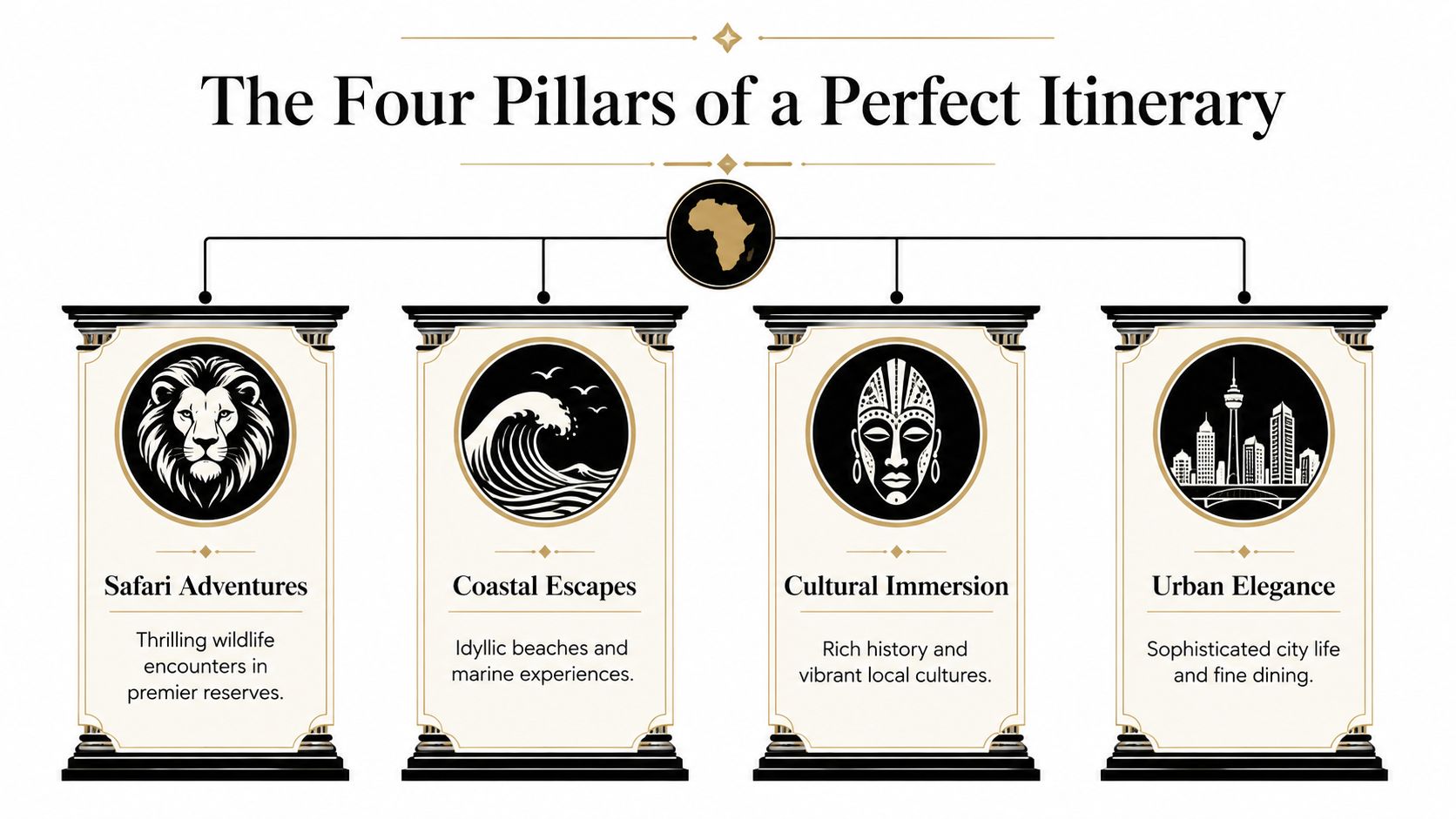
The most useful routing framework is grounded in how experts build these journeys. The Luxury Travel Expert's South Africa itinerary guide commonly combines Johannesburg or Hoedspruit for safari access, Sabi Sands for premier game-viewing, then the Garden Route, and finishes in Cape Town. It also recommends at least 4 nights in a private reserve. That allocation matters. Safari improves with continuity.
Pillar one Safari and private reserves
Safari is rarely the place to economize on time. Four nights in a strong private reserve allows the rhythm of early drives, rest periods, and evening sightings to become restorative rather than rushed. It also gives guides enough time to understand guest interests. Some travelers care most about tracking predators. Others want birdlife, photography position, or conservation depth.
For first-time visitors who want polished wildlife viewing with minimal compromise, Sabi Sands remains one of the strongest foundations. It works especially well for couples, milestone trips, and families who want game density without a rough-edged experience.
Pillar two Cape Town and the Winelands
Cape Town is the urban counterweight. It adds design, dining, coastline, and cultural range. The nearby Winelands bring space, food, and a slower cadence. Together, they create the civilized side of South Africa.
This pillar suits travelers who want:
- Culinary depth with private tastings, chef-led meals, and cellar access
- Scenic variety from city, mountain, coast, and vineyard settings
- Flexible pacing that works for both energetic days and soft recovery time
Cape Town often works best at the end of the trip, when guests can absorb it without the pressure of onward bush transfers.
Pillar three The Garden Route and coast
The Garden Route is not mandatory. It is useful when the traveler wants scenery, private estates, marine experiences, or a self-contained coastal chapter between bush and city. For some families, it adds breadth. For some couples, it interrupts the cleanest flow.
That is the key trade-off. The coast can enrich a trip, but only if the traveler enjoys movement and doesn't need every stop to be iconic. South Africa is strongest when each addition earns its place.
Pillar four KwaZulu-Natal and the wilder east
KwaZulu-Natal appeals to travelers who want a different register of South Africa. The draw is less about the expected safari-and-wine pairing and more about wild shoreline, conservation-minded reserves, and cultural texture. For repeat visitors, it can be the chapter that makes the country feel new again.
A sophisticated itinerary doesn't ask which places are famous. It asks which combination creates the right emotional tempo.
How to combine them well
A useful planning lens is below:
| Traveler type | Strongest pairing | Why it works |
|---|---|---|
| Honeymooners | Private reserve plus Cape Town and Winelands | Contrast between intimacy, drama, and ease |
| Families | Reserve plus coast or villa time | Space, privacy, and activity variety |
| Repeat South Africa guests | Sabi Sands plus KwaZulu-Natal or selective coast | Moves beyond the expected template |
| Executive travelers | Short reserve stay plus Cape Town | High impact with controlled downtime |
The mistake is trying to include all four pillars in one compact journey. The stronger approach is to choose two anchors and one optional extension.
Seamless Logistics Private Jets and Ground Transfers
Luxury in South Africa is defined less by what the guest sees than by what the guest never has to solve. Missed handoffs, ambiguous transfer points, unnecessary self-driving, and poorly timed domestic connections are the mistakes that flatten an otherwise excellent trip.

That's why safety-by-itinerary design matters. Travel + Leisure's South Africa luxury planning piece notes that this is a critical but underexplained part of trip design, even as tourism recovered to 8.92 million arrivals in 2024 and spending rose to ZAR 400.3 billion. The practical concern for affluent travelers is not whether South Africa is worth visiting. It's how to move through it securely and smoothly.
When private aviation changes the trip
Private air isn't always necessary. Sometimes it is profoundly impactful.
If the guest is visiting one reserve and one city, premium scheduled flights with vetted meet-and-greet support can be enough. But once the trip includes multiple nodes, private aviation begins to solve real problems. It compresses transit. It reduces commercial airport dwell time. It gives more control over departure windows. It can also make combinations viable that would otherwise feel too fragmented.
For travelers exploring aviation options, Haute Black air travel services can be used to coordinate private aviation as one part of a broader itinerary. That matters because the aircraft decision shouldn't be made in isolation. It has to align with lodge access, baggage realities, and ground timing on either side.
Ground movement is where many trips lose their polish
The most common planning error is underestimating what happens after landing. South Africa is not a destination where every elegant itinerary should default to self-drive. There are moments when a scenic drive works well, especially for travelers who enjoy autonomy and have the right routing. There are also many moments when chauffeured movement is the more intelligent choice.
Consider the trade-offs:
- Self-drive works when the route is scenic, the traveler is comfortable with local road conditions, and there's no pressure around arrival timing.
- Chauffeured transfers work better when the itinerary includes long-haul fatigue, children, security sensitivity, wine tasting days, or high-value luggage and equipment.
- Airside-to-lodge coordination matters most when guests are moving directly into safari and need the day to remain calm rather than procedural.
A polished South Africa itinerary often uses both. The difference is that each mode is chosen intentionally.
Build a protected travel envelope
The strongest itineraries create a travel bubble from touchdown to takeoff. That doesn't mean excess. It means reducing points of uncertainty.
A sensible planning checklist looks like this:
1. Match arrival city to first experience. Don't force an awkward entry if a different gateway shortens the next move.
2. Avoid ambitious same-day connections after long-haul flights. If there is any doubt, protect the first night.
3. Use vetted chauffeurs for city and Winelands movement. This is comfort, efficiency, and judgment.
4. Treat lodge transfer timing as part of the guest experience. A rushed bush arrival weakens the first impression.
5. Plan for contingencies. Travelers with complex medical needs or a desire for added reassurance may also want to review private medical transport services before departure.
The smoothest luxury trips are often the most conservative behind the scenes. They leave room for disruption so the guest never feels it.
Elite Stays Premier Villas and Safari Lodges
Accommodation choice in South Africa isn't just about quality. At the top end, quality is assumed. The actual decision is format. Do you want a lodge with social energy, a villa with controlled privacy, or an urban retreat that anchors city life without spectacle?
For travelers pairing bush, wine country, and city, a Cape Town, Winelands, and safari journey gives the right frame. The nuance lies in matching the stay type to the guest's style of travel.
The classic safari lodge
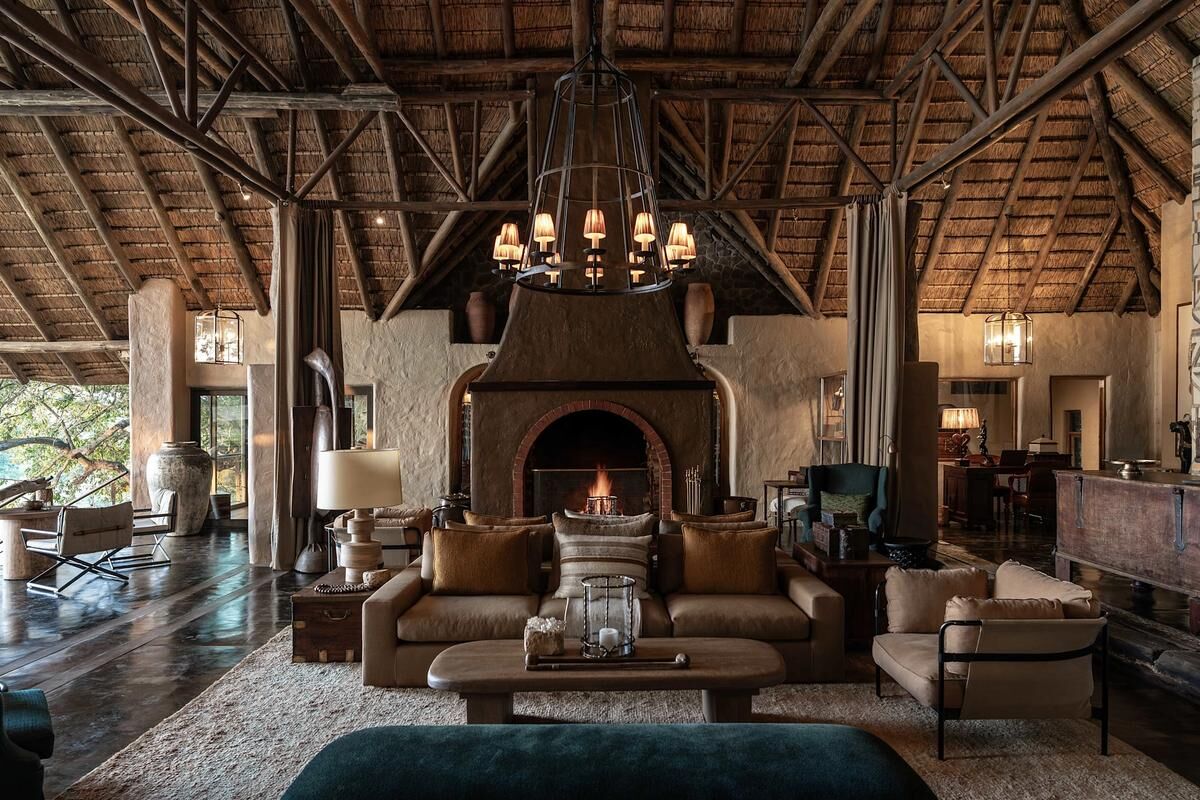
A great safari lodge gives you more than a room. It gives you atmosphere, ritual, and a strong sense of place. The best versions make shared moments feel elegant rather than performative. Morning coffee before the drive, a guide who reads the vehicle well, lunch that doesn't overcomplicate the day, and a return to a suite that feels calm rather than themed.
This format usually suits:
- Couples on first safari who want immersion and expert guiding
- Travelers who enjoy a little social texture at meals or around the fire
- Guests who want a fully held experience with minimal daily decision-making
It is less ideal for clients who need complete privacy or want their day structured independently of lodge routines.
The exclusive-use villa
A South African villa can be the most luxurious choice in the right circumstances. Not because it is larger, though it often is. Because it lets the trip breathe according to the household, not the property.
For multigenerational families, villas solve practical issues elegantly. Children can keep their own rhythm. Grandparents have space. Staff can coordinate meals and downtime discreetly. Security-sensitive travelers also tend to prefer the discretion and perimeter control that a private residence offers.
The trade-off is that villas demand stronger pre-arrival planning. The experience only sings if provisioning, staffing, transport, and activity timing have been thought through in advance.
Here's a useful comparison:
| Stay type | Best for | Watch for |
|---|---|---|
| Safari lodge | Couples, first-timers, immersive wildlife trips | Less privacy, fixed daily rhythm |
| Private villa | Families, UHNW travelers, security-sensitive guests | Needs detailed operational planning |
| Urban retreat | City-focused travelers, short stylish stays | Can feel public if privacy matters |
The contemporary urban retreat
In Cape Town, the strongest urban properties act as platforms. They are the base from which the city opens. The room matters, but access matters more. A good city hotel should support private art appointments, culinary reservations, coastal departures, and smooth movement in and out of town.
That is where design-forward, service-heavy hotels outperform charming but looser boutique options. At this level, reliability is part of aesthetics.
A short visual pause can help capture the mood of this style of travel:
What works and what doesn't
What works is choosing one dominant accommodation language for each chapter of the trip. A sociable bush lodge, then a private Winelands residence, then a polished Cape Town hotel. Each stop has a role.
What doesn't work is stacking too many properties that all ask the traveler to recalibrate. Three short stays in different styles can make a luxury journey feel busy. Two or three well-matched bases usually create a more refined result.
The accommodation should support the itinerary's rhythm, not compete with it.
Crafting Your Journey Bespoke Experiences and Itineraries
The old South Africa script was simple. Big Five safari, Cape Town, wine tasting. It remains attractive, but it no longer defines the top end of the market. Undiscovered Sunsets' South Africa guide points to the shift among UHNW travelers toward private villas, bespoke helicopter charters, and curated cultural access, well beyond the standard “Big Five plus wine” template. That shift is the opening for better itinerary design.

The question isn't whether bespoke experiences exist. They do. The question is which ones are worth the time, and how they're placed inside the trip so they feel organic rather than inserted.
Experiences that justify their place
The strongest private experiences in South Africa usually do one of three things. They deepen access, improve perspective, or protect privacy.
Examples that tend to work well include:
- Private helicopter routing when the flight itself adds value through scenery or time savings
- Curated culinary access that goes beyond public tastings into chef-led or estate-led experiences
- Conservation participation for travelers who want meaning alongside indulgence
- Private cultural appointments that avoid generic touring and emphasize real expertise
- Exclusive villa-based hosting for families or groups who prefer experiences brought to them
What tends not to work is over-programming. A private experience is not improved merely because it is private. It has to answer a real preference.
Three itinerary models that hold together
Below are three examples of how luxury travel to South Africa can be assembled with discipline.
The honeymoon escape
A honeymoon should favor atmosphere over mileage. Start with a private reserve where the couple can settle quickly, then move to the Winelands or Cape Town for beauty, food, and softer mornings. Private dining, a scenic helicopter element, and one carefully considered cultural or culinary experience can be enough.
What works:
- Longer bush stay first so the couple decompresses immediately
- One romantic second chapter rather than multiple short stops
- Minimal public touring in favor of privacy and fluid days
What doesn't:
- Changing hotels too often
- Trying to “see it all”
- Putting difficult logistics at the very start
The family journey
Families need space and flexibility more than formal luxury cues. Exclusive-use accommodation is often the turning point. It allows adult interests and child rhythms to coexist without tension.
A good family design often combines safari with a villa or estate chapter. That can mean wildlife first, then coast or Winelands, where there's room for recovery and private hosting.
A concise planning view:
| Family priority | Better choice | Reason |
|---|---|---|
| Privacy | Villa or exclusive-use residence | Shared space without public overlap |
| High engagement | Safari chapter with skilled guides | Strong educational value and excitement |
| Rest between activities | Estate or coastal base | Softer days and easier mealtime flow |
The executive retreat
An executive itinerary should feel decisive. Short, high-impact, and tightly controlled. For this traveler, South Africa can deliver a bush reset and an urban finish without wasting time.
A strong version includes a compact safari chapter, then Cape Town for meetings, dining, or decompression. Ground handling becomes critical because every avoidable delay will be felt.
For travelers considering more personalized planning models, customized package tours are useful in principle when they remain flexible enough to support the guest's actual priorities rather than forcing a set route.
The hidden discipline behind bespoke work
The best itineraries often look simple when finalized. That simplicity is deceptive. It comes from rejecting attractive but disruptive additions.
Bespoke planning is often an editing exercise. The advisor removes the experiences that sound impressive but weaken the journey.
South Africa rewards that discipline. A helicopter should be used because it reframes the geography or saves an awkward transfer. A private gallery visit should be chosen because the traveler cares about art, not because “private” sounds expensive. Conservation access should be included because the guest wants substance, not because every trip needs a philanthropic note.
That is how bespoke becomes meaningful rather than decorative.
The Final Detail Securing Access and VIP Recognition
At the top end of South African travel, access is the product.
A rate can buy a suite. It does not always secure the right suite, the right guide, the right arrival protocol, or the flexibility to adjust the stay once the guest is in motion. In a high-demand market, especially over peak safari and Cape Town dates, those distinctions shape the trip more than the published tariff.
As noted earlier, South Africa's premium travel market is busy again. The practical consequence is simple. Strong inventory is often committed long before the season begins, and the best options are rarely interchangeable. A corner suite with better wind protection, a villa with cleaner service flow, or a lodge team that handles privacy well can matter more than a headline brand name.
Why relationships matter
The finest South African journeys often depend on details that never appear on a booking engine. Which room has the shortest walk and the least exposure to other guests. Which ranger suits a family with older children versus a couple who wants a more technical wildlife conversation. Whether a property will note preferred pillows, a standing in-room bar setup, or a low-visibility arrival for a high-profile guest.
This is quiet work. It is also where a trip either holds its standard or slips.
I have found that VIP recognition is rarely about theatrics. It is about whether the reservation arrives with enough context for the property to act intelligently before check-in. Good advisors do not merely request “special treatment.” They specify what would improve the stay, what should be avoided, and which details deserve attention on arrival versus during the second night, once the guest has settled in.
VIP treatment is operational, not performative
The useful version of VIP handling in South Africa usually includes:
- Priority consideration for scarce inventory during prime travel periods
- A room or suite matched to how the guest travels, not just the highest category still available
- Preferred partner benefits such as upgrades when available or property credits where applicable
- Pre-arrival coordination for dietary requirements, celebrations, family preferences, security, staffing, and privacy protocols
The best recognition feels natural because it has been prepared properly. The guest is not repeating the same preferences at the airstrip, at reception, and again at dinner. The file is already clear. The right people have already read it.
That is the final layer many travelers underestimate. In South Africa, luxury becomes convincing when the access is in place, the staff are briefed, and each handoff is handled without friction.
If you're planning luxury travel to South Africa and want the journey shaped around privacy, logistics, and meaningful access rather than generic routing, Haute Black can help curate a trip that fits the way you travel.
Explore Our Guides

Signature Experiences