Haute Black Journal
What Does a Concierge Service Do? A Clear 2026 Guide

Marlene Azeez
Director, HauteBlack
View all articles →

A concierge service handles personalized requests on someone else's behalf, coordinating transport, lodging, dining, entertainment, shopping, and problem-solving. When a London-to-Geneva flight is grounded, that can mean rebuilding a multi-country itinerary in one afternoon instead of leaving the traveler or executive assistant to manage a chain of urgent calls.
You're not paying for a person to know a restaurant's phone number. You're paying for someone to take ownership when the reservation, transfer, flight, or access request becomes complicated. The distinction matters most in luxury travel, where a printed itinerary is only the beginning and the test arrives when weather, availability, security, health, or timing disrupts the plan.
The U.S. Bureau of Labor Statistics defines concierges as workers who assist patrons at hotels, apartments, or office buildings with personal services such as taking messages, arranging transportation, and advising on business services or entertainment. The occupation was estimated at 37,600 employed workers in May 2022, with a mean annual wage of $38,270 and a median wage of $35,560, according to the BLS-based concierge industry data. Concierge work is therefore a recognized service role, not merely an informal hotel amenity.
A Concierge in Action Before We Define the Role
At 4:00 a.m., a private travel advisor learns that a client's London-to-Geneva flight has been grounded. The party is due in Switzerland that morning, the hotel night is already paid, and dinner in Montreux is tied to a narrow reservation window.
The advisor doesn't forward the airline's cancellation notice and ask the client what they'd like to do. They start calling the network. Within three hours, the party is rerouted through Zürich, a chauffeured transfer is arranged, the hotel booking is adjusted, and the Montreux dinner is moved by two hours. The travelers wake to a revised plan rather than a list of problems.
That example captures the practical answer to what does a concierge service do. It acts on the client's behalf, but the value lies in more than placing requests. A reservation-taker completes an isolated transaction. An orchestrator checks whether every part of the plan still works together, confirms suppliers, monitors changes, and manages the consequences when one piece fails.
Practical rule: Judge a concierge by what happens after the original plan breaks, not by how polished the first itinerary looks.
A concierge may coordinate a private transfer with a hotel arrival, align a yacht embarkation with an aircraft landing, find a replacement restaurant after a closure, or arrange a medical referral in an unfamiliar city. The work is part logistics, part relationship management, and part calm decision-making under pressure.
The printed itinerary is only the visible layer. Follow-through, supplier coordination, and disruption recovery are the operating system underneath it.
From Hotel Desk to Private Advisor and Beyond
The classic hotel concierge begins with a defined property and a defined stay. A guest asks for a taxi, a restaurant booking, theater tickets, flowers, or a recommendation for a local guide. The concierge uses local knowledge and established supplier relationships to make the request happen.
That model remains useful when the need is local and immediate. A hotel team knows its neighborhood, understands the property's standards, and can often solve small requests quickly because the guest is already in front of them.
The private model expands the territory
A private concierge isn't tied to one lobby. The advisor may coordinate a multi-stop itinerary across several countries, arrange transfers between villas and airports, source a hard-to-find gift, or manage details that continue after the guest leaves a hotel.
HauteBlack provides a useful worked example of this private-and-lifestyle approach. Its service model covers bespoke travel planning, hotels, experiences, dining, transfers, and related trip details, while its broader offering includes private aviation, villas, estates, and concierge dining and transport. The important distinction is structural: one relationship can remain responsible for the full journey instead of handing the client from hotel desk to transport company to restaurant contact.
Corporate support creates a workflow layer
Corporate concierge services often support executive assistants, employees, or high-value clients through a more structured channel. Requests may include executive travel coordination, dining for a client meeting, event access, or personal logistics that sit beside a demanding work schedule.
Lifestyle concierge goes further still. It can absorb travel, events, gifting, shopping, household coordination, and other personal tasks. The client isn't buying isolated help. They're outsourcing a portion of the calendar to a team expected to remember preferences and act with discretion.
The global market outlook reflects this widening role. One estimate places the market at $647.3 million in 2022, with a projection of $1.1 billion by 2032 at a 5.8% CAGR, while another estimates $773.3 million in 2025 rising to $1.3752 billion by 2033 at a 7.6% CAGR. These projections use different methodologies, but both point toward sustained demand for personalized assistance across hospitality, travel, and lifestyle management, as outlined by Business Research Insights.
What a Concierge Service Actually Handles Day to Day
The easiest way to understand the role is to examine the requests arriving in a concierge inbox. They usually fall into several connected categories, and the strongest providers manage the handoffs between them.
Logistics and movement
A request might read: “Move six guests from a private terminal to a villa, arrange luggage handling, and make sure the vehicle can accommodate the equipment.”
That involves more than booking a car. The concierge checks arrival timing, vehicle type, driver instructions, luggage volume, access rules, and what happens if the flight lands late. For complex itineraries, the same team may coordinate private transfers, helicopter legs, jet-card usage, or multi-city routing.
HauteBlack's VIP airport concierge services illustrate the broader principle. Airport assistance is valuable when it connects the aircraft, terminal, luggage, immigration process, and waiting vehicle into one controlled arrival or departure.
Dining and access
“Find a last-minute table for eight, preferably somewhere discreet, and arrange a chef's table if the first choice cannot accommodate us.”
A booking platform can show availability. A concierge evaluates the request against timing, location, privacy, dietary needs, guest profile, and the next activity. The work may involve a restaurant, private club, cultural venue, or event organizer, with the advisor communicating context that a generic booking form cannot convey.
Events and hospitality
For a wedding, sporting event, or cultural evening, the task can include tickets, hospitality suites, transfers, seating requirements, guest lists, and timing between venues. The concierge protects the experience from small operational failures, such as a vehicle arriving at the wrong entrance or a guest missing a reception because the schedule was too tightly packed.
Personal requests and sourcing
A client may need a rare gift located, a wardrobe alteration handled, a child's activity arranged, or an errand completed while the family travels. These requests are personal by nature, so the advisor needs preferences, discretion, and a clear understanding of what the client considers acceptable.
Recovery when plans fail
Recovery is the category that separates orchestration from simple booking. A concierge may need to respond to weather rerouting, lost luggage, a medical referral, a canceled dinner, or a supplier who can no longer fulfill an agreed service.
The travel concierge services market analysis describes the segment as a personalized orchestration layer covering transport, lodging, dining, entertainment, shopping, bespoke itinerary design, and 24/7 on-call support. The projection places the segment at $2.18 billion by 2034 at a 10.4% CAGR, which reinforces the shift from occasional booking help toward always-available fulfillment.
Hotel, Private, Corporate, and Lifestyle Compared
Choose the model by looking at scope, continuity, and accountability. A hotel concierge is excellent for local requests during one stay. A private advisor is better for complex travel that crosses properties and borders. Corporate and lifestyle services make sense when requests recur and need a repeatable operating channel.
| Tier | Scope and Coverage | Request Channel | Best For |
|---|---|---|---|
| Hotel | One property, local dining, transport, tickets, and stay-related arrangements | Lobby, phone, or hotel messaging | Guests needing immediate local assistance |
| Private | Multi-city travel, villas, aviation, access, transfers, and itinerary recovery | Dedicated advisor, phone, or secure messaging | Travelers with complex or recurring itineraries |
| Corporate | Employee or client support through structured workflows and approved service channels | Portal, assistant workflow, email, or dedicated desk | Companies supporting executives, teams, or high-value clients |
| Lifestyle | Travel, dining, events, gifting, shopping, household logistics, and ongoing personal requests | Dedicated relationship and membership channel | Clients wanting one relationship across personal and travel needs |
Hotel concierge
The hotel desk is request-bounded and property-centered. Its strength is local knowledge and immediate access to hotel resources. Its limitation is that the team typically doesn't own the traveler's entire journey across multiple countries.
A hotel concierge can make a restaurant suggestion and arrange a car. A private advisor can also decide whether that restaurant still fits after a delayed arrival, move the car, update the hotel, and revise the next day's itinerary.
Private concierge
The private model carries the relationship beyond one roof. It can coordinate a villa, private aircraft, yacht, transfer network, and several hotels under one plan. HauteBlack's explanation of the distinction between a five-star hotel concierge and a travel curator is useful here: the hotel team is local to one property, while the curator can operate across countries and manage complex choreography such as private jet logistics, as described in this HauteBlack travel comparison.
Corporate and lifestyle concierge
Corporate support prioritizes process, permissions, data handling, and predictable escalation. Lifestyle support prioritizes breadth, discretion, and continuity. For teams managing employment paperwork alongside executive travel in Dubai, a practical Goodhand employment documentation guide can sit beside the travel workflow as a useful operational reference.
Real Problems a Concierge Solves in the Wild
The following examples show why the word orchestration matters. Each request contains several suppliers, changing conditions, and people who expect the outcome to feel effortless.
A yacht handoff in the Mediterranean
A charter party is moving between islands when the route changes because of weather. The concierge coordinates fueling, provisioning, customs requirements, tender pickups, and a surprise anniversary dinner ashore. The dinner location must work with the revised anchorage, the tender timing, and the guests' preference for privacy.
The result isn't merely a new restaurant booking. The yacht crew receives the updated sequence, the transport provider knows where and when to collect the guests, provisioning arrives at the correct port, and the anniversary plan survives the route change.
HauteBlack describes concierge work in this setting as a pre-boarding operating layer that aligns private aviation arrival times with embarkation windows, coordinates villa or hotel transfers, and ensures luggage, provisioning requests, and guest preferences reach the right people in the right order. Its private voyage planning guidance makes the handoff visible.
A Tokyo schedule that suddenly opens up
A summit ends earlier than expected. The executive now has several free hours before an evening flight and wants a kaiseki lunch, a private tea ceremony, and an unplanned detour to Hakone.
The concierge reworks the route rather than adding disconnected bookings. Lunch is rebooked, the tea ceremony is secured, a driver is assigned for the detour, and the timing is checked against the return to the airport. The executive gets a worthwhile afternoon without turning the assistant's day into a live dispatch operation.
A multi-generational Bali birthday
Three generations are staying across three villas. Grandparents need a slower pace, parents want organized excursions, and teenagers need independent activities. Dietary plans must reach the kitchens, a birthday surprise must remain confidential, and the event touches two hotels, a villa manager, and a private chef.
The concierge builds one coordinated schedule with staggered activities, confirms dietary details, and keeps the birthday sequence private from the guest of honor. The family experiences one celebration, even though several properties and suppliers are involved.
Why UHNW Travelers and Executive Assistants Care
Executives and their assistants usually judge concierge value through three outcomes: time saved, problems avoided, and access obtained.
Time saved isn't just the duration of a phone call. It's the removal of fragmented work. One message can replace multiple vendor conversations, itinerary edits, confirmation checks, and follow-up reminders. For an executive assistant, that means less time maintaining travel administration and more time protecting the executive's priorities.
The practical meaning of recovered capacity is explored clearly in what getting time back looks like. Concierge support works best when it removes recurring coordination rather than creating another inbox to monitor.
Problems avoided before departure
A capable advisor builds alternatives into the plan. That may mean identifying backup drivers in a city with protest risk, checking alternate airfields when weather threatens the primary airport, or confirming what a hotel can do if arrival moves by a day.
This preparation doesn't eliminate disruption. It reduces the number of decisions the traveler must make while tired, rushed, or dealing with incomplete information.
Access that isn't searchable
Access can mean an off-menu restaurant table, an after-hours viewing, a private club introduction, or a supplier willing to accommodate an unusual request. The advisor's network matters because a public search can identify options, but it rarely supplies context, advocacy, or accountability.
Executive assistants can see the difference in this guide to executive assistant travel planning. The strongest relationship becomes more useful over time because each completed request teaches the advisor the executive's preferences, tolerances, and priorities.
For an executive assistant: The right concierge should reduce follow-up, not generate a new project-management layer.
Misconceptions Worth Leaving Behind in 2026
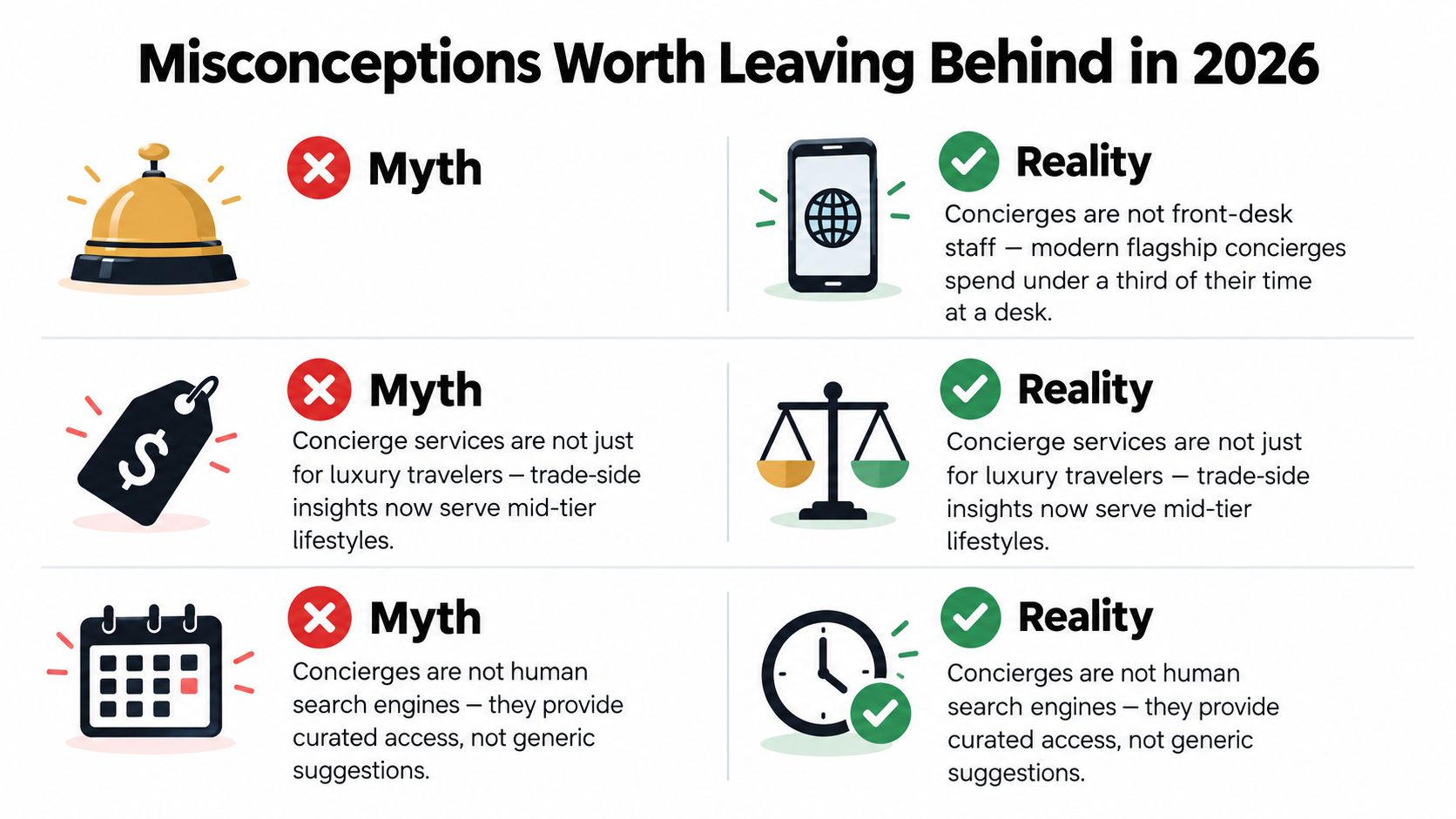
The first misconception is that a concierge is hotel front-desk staff. A hotel concierge is one version of the role, but private and lifestyle advisors work across properties, countries, suppliers, and personal requests. HauteBlack also distinguishes a concierge from a VIP travel agency, with the agency owning itinerary design, supplier coordination, partner advocacy, and disruption management, as explained in this HauteBlack comparison.
The second misconception is that automation has made human concierges unnecessary. Automation can speed up routing, surface availability, organize information, and support quick responses. It can't independently judge whether a substitute hotel preserves privacy, whether a replacement driver is trustworthy, or how to explain a sensitive change to a family without causing unnecessary alarm.
Market research describes a hybrid direction, with one 2026 industry report claiming that 82% of concierge providers use AI chatbots and 65% report 30% faster response speed. Those figures are presented in the Time4Diamonds concierge overview. They point toward automation supporting human service, not replacing judgment, advocacy, and recovery ownership.
The third misconception is that concierge and travel agent mean the same thing. A travel agent typically sells and books travel inventory. A concierge acts on the client's behalf across booked and non-booked logistics, personal requests, supplier follow-up, access, and last-minute recovery.
The models overlap, but the accountability differs. No concierge model suits every traveler, which is why the right choice depends on the pattern of requests, the importance of continuity, and the cost of leaving disruptions unmanaged.
Choosing the Right Concierge Relationship
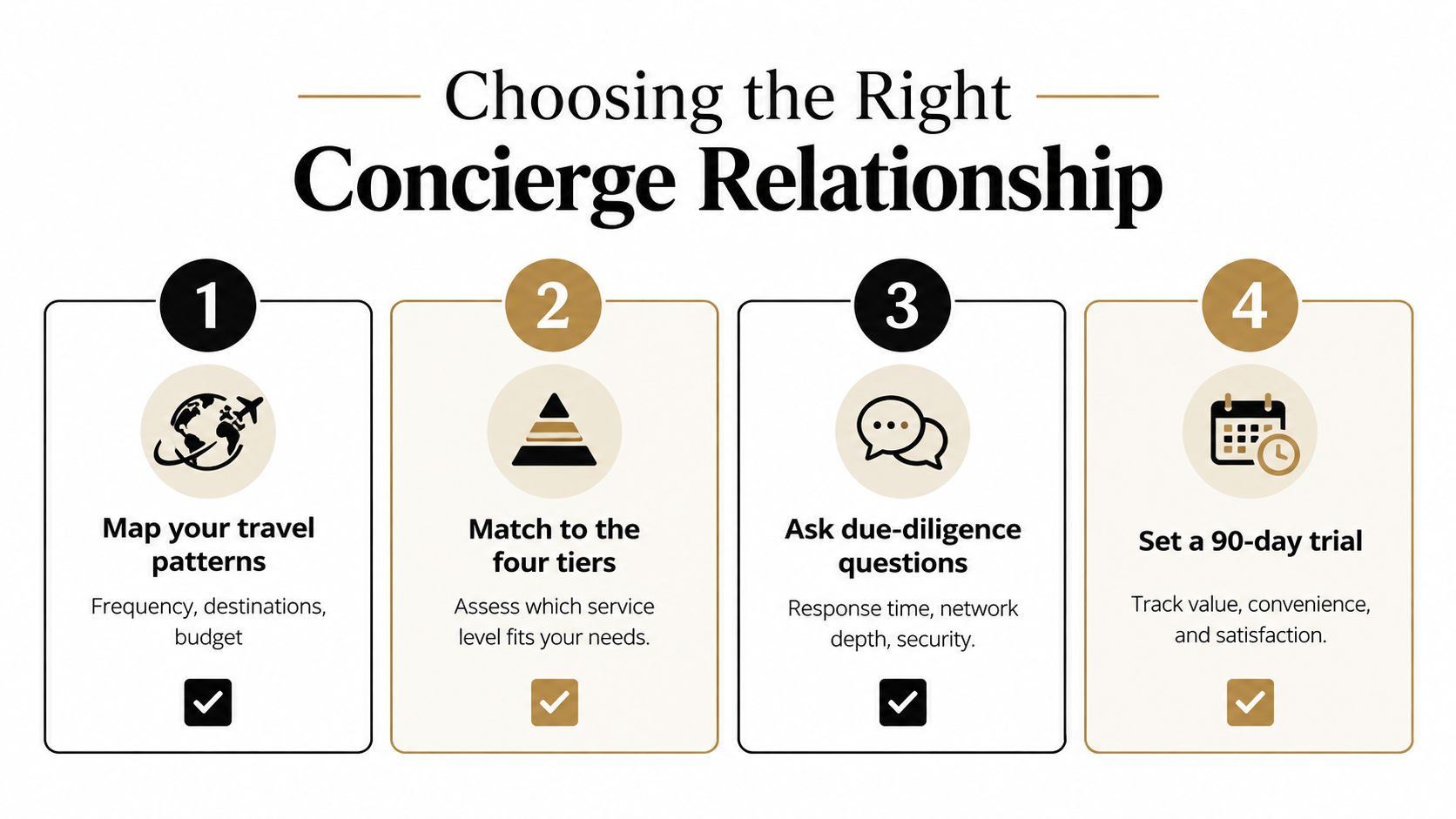
Start with a travel pattern audit. Review where you travel, how often plans change, how far ahead requests arrive, and whether your main need is access or recovery. An executive who takes occasional trips and needs local restaurant help may only need a hotel desk. An assistant coordinating multi-city travel, private aviation, villas, and family logistics needs a private or lifestyle relationship.
Match the need to the tier
Use a simple decision prompt:
- One property and one stay: Choose hotel concierge support.
- Several cities or countries: Choose a private travel advisor.
- Recurring executive or employee requests: Evaluate a corporate concierge workflow.
- Travel plus personal logistics: Consider a lifestyle model.
Before signing, ask direct questions about:
- Response standards: What response time applies to urgent, routine, and overnight requests?
- Escalation: Who takes ownership when the primary advisor is unavailable?
- Commercial model: Is pricing based on a retainer, membership, planning fee, pay-per-use request, or a combination?
- Network depth: Which destinations and service categories can the team handle directly?
- Data handling: How are passport details, preferences, payment information, and family information protected?
- Continuity: What happens if the main contact is sick, traveling, or handling another emergency?
- Recovery ownership: Will the provider monitor changes and resolve disruptions, or only place the original bookings?
A 90-day trial gives both sides enough time to test ordinary requests and at least one complicated change. Track recovery time, accepted-request rate, communication clarity, and whether the same preferences are remembered without repeated explanations. For a deeper look at the financial side, this guide to concierge service cost and luxury pricing models helps frame the difference between access, planning, and ongoing support.
The right relationship disappears into your workflow. Your assistant sends one clear message, the advisor understands the priorities, and the client receives a resolved outcome rather than a progress report.
HauteBlack coordinates bespoke itineraries, VIP arrivals, hotels, experiences, dining, transfers, private aviation, villas, and ongoing travel support through a dedicated advisor relationship. If your team needs concierge service that owns the details and the recovery plan, visit HauteBlack to discuss the travel workflow you want off your desk.