Haute Black Journal
What Is a VIP Travel Agency & How to Choose One in 2026

Marlene Azeez
Director, HauteBlack
View all articles →

# What Is a VIP Travel Agency & How to Choose One in 2026
June 21, 2026
A trip rarely falls apart because of one dramatic failure. It unravels through small points of friction that compound fast. A flight delay breaks a tight connection. The hotel has no record of the early arrival request. The driver is waiting at the wrong terminal. A family member needs a different room setup. An executive assistant is suddenly coordinating three countries, two time zones, and one impatient principal from a phone at midnight.
That's the gap a real VIP travel agency is built to close.
For discerning travelers, the value isn't “luxury” in the marketing sense. It's operational control. It's having someone who knows which details matter before they become visible problems. It's the difference between buying travel and having it managed.
That distinction matters more now because this isn't a fringe category. The VIP Travel Management Solutions Market is projected at USD 63,046.0 million in 2026 and forecast to reach USD 104,596.3 million by 2033, growing at a 7.5% CAGR over that period, according to market projections on VIP travel management solutions. That kind of expansion tells you something important. High-touch travel is no longer treated as an indulgence for a tiny circle. It's becoming professional infrastructure for people whose schedules, privacy needs, and expectations leave very little room for error.
Introduction The Art of Seamless Travel
The hardest part of premium travel usually isn't choosing the destination. It's managing everything that sits behind the visible itinerary. The flights may look confirmed, the suite may look reserved, and the dinner may appear booked. But high-stakes travel asks different questions.
Who's monitoring the inbound aircraft when weather starts moving across the route? Who notices that a “guaranteed” transfer turned out to be a request? Who calls the hotel before arrival to make sure the connecting rooms are physically adjacent, not merely in the same category? Who fixes a passport or visa issue before it reaches the client?
Online platforms are efficient at selling inventory. They're not designed to take responsibility.
A real VIP travel agency works from the opposite premise. The booking is only one line item inside a larger operating system that includes preference management, partner relationships, timing control, escalation paths, and human judgment. The best agencies aren't selling rooms and flights. They're selling reduced exposure to friction.
Where standard booking breaks down
Most travelers don't need a human advisor for every simple overnight stay. But once a trip becomes layered, several weaknesses appear quickly:
- Complex routing creates hidden failure points: Multi-city schedules, private aviation, yachts, rail, chauffeurs, and security require one person or team to own the sequence.
- Special requests need influence, not just notation: A note in a booking file isn't the same as a relationship-based confirmation from a partner who knows the advisor.
- High-value time changes the math: If a missed transfer disrupts a board meeting, family celebration, or tightly timed arrival, the cost is rarely the room rate. It's the consequence.
The practical test is simple. If something changes two hours before departure, who acts, and how fast?
Why this category keeps growing
The projected growth of the VIP travel management sector reflects a broader shift in how affluent travelers think. They don't just want luxury products. They want effortless execution, discretion, and access that can't be replicated by searching harder.
For ultra-high-net-worth travelers, that means bespoke itineraries and exclusive access. For executive assistants, it means less chaos. For families, it means fewer avoidable mistakes. For founders and principals, it often means staying focused on the reason for the trip instead of the mechanics around it.
What a VIP Travel Agency Truly Is
A VIP travel agency isn't defined by whether it can get breakfast, a room upgrade, or a resort credit. Those benefits matter, but they're not the point. The fundamental difference is structural.
A booking site is a marketplace. A traditional travel agent may still work transaction by transaction. A VIP travel agency operates more like a private office for travel. It learns the client, maintains context, anticipates preferences, and uses relationships to improve both outcome and recovery when plans shift.
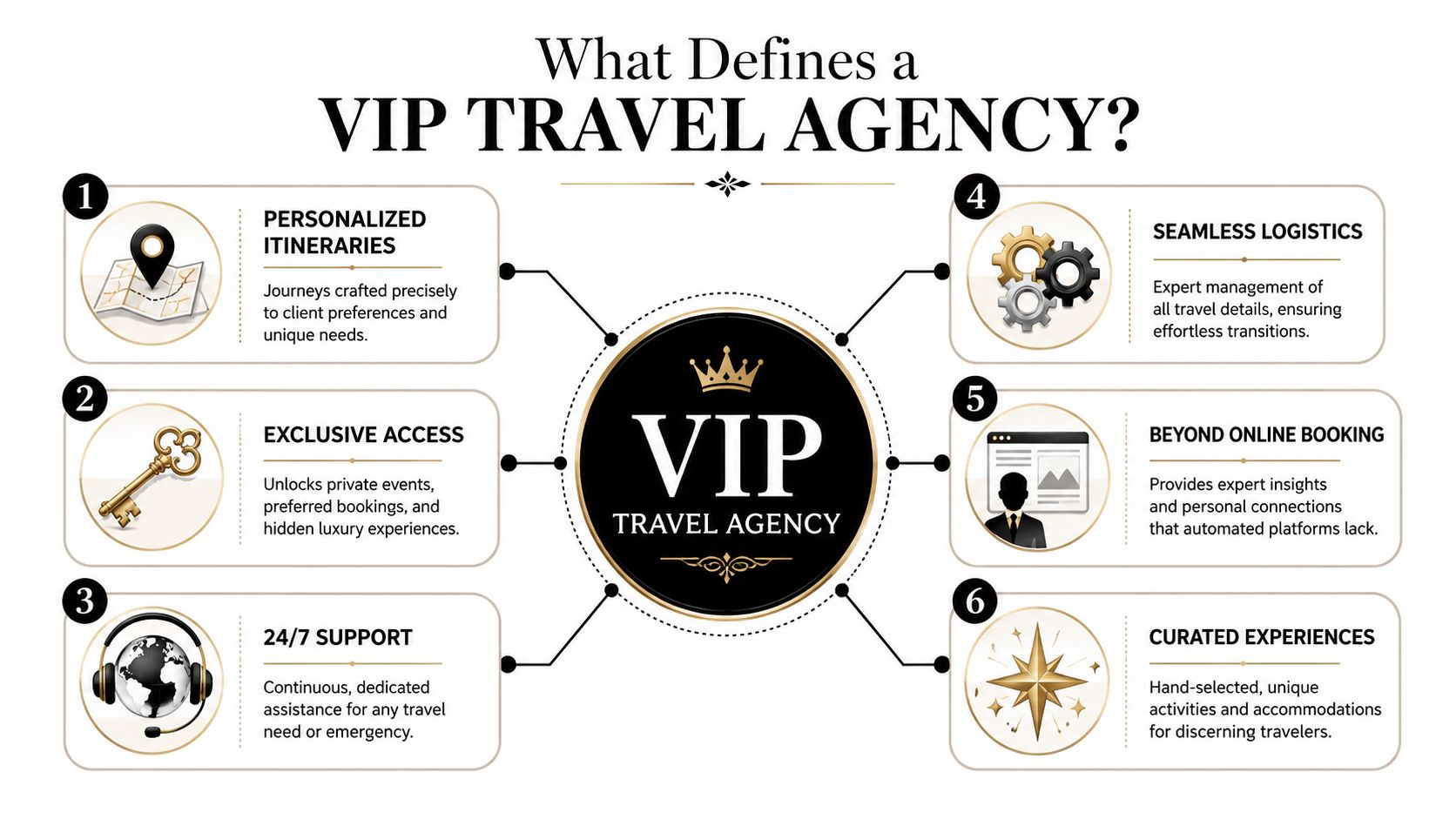
Transactional booking versus managed travel
This is the clearest way to think about it.
| Approach | What you get | What you don't get |
|---|---|---|
| Booking site | Speed, broad inventory, self-service comparison | Advocacy, partner leverage, accountability |
| Standard agent | Help with reservations, basic itinerary support | Deep preference memory, operational monitoring, strong access pathways |
| VIP travel agency | Curated planning, relationship-based benefits, problem ownership, layered logistics management | Lowest-price-first shopping as the main objective |
A discerning client doesn't hire a VIP advisor because they can't book a hotel online. They hire one because online tools can't interpret nuance well. They can't tell when the “best room” on paper is wrong for a light sleeper. They can't weigh whether a private transfer should depart later because immigration queues are unusually slow that week. They can't sense when a resort is the wrong fit even though the photographs are beautiful.
The real product is access and judgment
The phrase “VIP” gets used too loosely. In practice, it should mean a few specific things:
- Someone knows your travel profile: Not just your passport name. Your pacing, privacy threshold, dining style, family requirements, and critical preferences.
- Someone can influence the experience: Through preferred partner channels, direct hotel relationships, and on-the-ground coordination.
- Someone stays responsible after payment: The duty doesn't end once the booking confirmation arrives.
That's also why niche support matters. If a trip includes a pet, for example, the travel plan may need coordination outside standard hotel and air arrangements. A specialized resource on expert pet transport solutions is useful because pet movement involves separate logistics, documentation, and timing that can disrupt an otherwise well-built itinerary if treated casually.
A perk is a nice extra. A relationship is what gets something done when the situation stops being routine.
What this means for clients who aren't buying a palace suite every time
One of the biggest misunderstandings about a VIP travel agency is that it only serves people already living at the top end of the market every day. In reality, many clients use this model selectively. They bring in high-touch help when meticulous planning is essential.
That might be a honeymoon with no margin for mistakes. It might be a family trip with grandparents, children, and multiple arrival times. It might be a founder traveling around investor meetings who needs speed and discretion, not glamour.
The practical question isn't “Am I wealthy enough for a VIP travel agency?” It's “Is this trip important enough that I want a professional to own the moving parts?”
The Hallmarks of True VIP Service
When people talk about VIP travel, they often focus on visible benefits. Better rooms. Welcome amenities. Special recognition on arrival. Those are pleasant outcomes, but they are downstream results of something less visible and more important. The service architecture has to be strong enough to produce them consistently.

Response speed is a real benchmark
One useful benchmark comes from the elite end of the category. Top VIP agencies operate a 24/7 “White-Glove” command line with sub-5-minute response latency and use human agents for real-time flight monitoring, which is associated with a 40% reduction in unresolved travel anomalies compared with automated systems, according to this review of VIP luxury travel agency operations.
That standard tells you what serious service looks like. Not “we're always here if you need us,” but a defined response protocol and a human being watching the trip in motion.
What good operations look like behind the scenes
A strong VIP travel agency usually does several things that clients rarely see directly:
- Builds a live traveler profile: Seat preferences, preferred arrival cadence, allergies, privacy concerns, celebration details, payment structure, known dislikes.
- Owns sequence management: Flights, rail, villa check-ins, private transfers, dining, local guides, security, and edge cases all have to connect cleanly.
- Monitors disruption actively: A delayed inbound aircraft should trigger a human review of onward effects, not just an automated email.
- Uses escalation paths intelligently: When plans shift, the question is who can intervene fastest with real authority.
If you want a broader view of how that support model works in practice, this guide to luxury travel concierge services covers the overlap between concierge thinking and high-touch trip management.
The difference between a note and a confirmed outcome
A weak agency records requests. A strong one verifies them.
That sounds minor until you've seen how often “please note” items remain untouched until arrival. The best advisors don't stop at entering preferences into a file. They pressure-test them. Is the airport meet-and-greet confirmed with nameboard details? Has the hotel agreed to hold the preferred bedding arrangement? Does the property understand that a late arrival should still receive the full welcome setup?
Practical rule: Ask how the agency confirms critical requests. If the answer is “we add notes,” keep asking.
Human monitoring still matters
Automation is useful for speed, inventory, and alerts. It isn't enough for edge cases. A flight change can affect airport assistance, transfer timing, lounge access, security arrangements, helicopter slots, and dinner reservations in one chain reaction. A human agent can weigh priorities and act in the right order.
That matters especially on itineraries involving several categories of supplier. Private aviation operators, yacht crews, luxury hotels, destination management companies, and chauffeurs do not all communicate on the same platform. Someone has to coordinate across those silos.
What doesn't qualify as VIP service
It helps to say this plainly. A polished website doesn't make an agency high-touch. Neither does having access to luxury hotel inventory. Many firms can book premium travel. Fewer can operate it under pressure.
Be cautious if the service sounds impressive but lacks specifics around:
- After-hours support
- Named point of contact
- Flight disruption protocol
- Hotel relationship depth
- Complex itinerary ownership
If those answers are vague, the service will likely be reactive when you need it most.
Signature VIP Experiences in Action
The easiest way to understand a VIP travel agency is to look at the outputs it creates. Not in abstract terms, but in the shape of a real trip.

When access matters more than spend
A common mistake in luxury travel is assuming that a larger budget automatically ensures the best experiences. It doesn't. Many of the moments clients value most come through timing, trust, and the right introductions.
A museum visit, for instance, can be the difference between entering with the public and walking through after hours with a private guide who can shape the experience around the family. A celebratory dinner can be the difference between securing a table and having the evening designed around a specific milestone, dietary profile, pacing preference, and setting.
The same logic applies to villa stays, private estates, resort buyouts, and closed-door cultural access. Money helps. Relationships decide whether the request is treated as plausible, urgent, and worth accommodating.
Three situations where the agency earns its keep
One is the multi-generational trip. Grandparents want comfort and rhythm. Parents want reliability. Children need flexibility and age-appropriate pacing. On paper, it's one booking. In reality, it's multiple travelers with conflicting needs that have to be harmonized quietly.
Another is executive travel with very little notice. A principal may need direct routing, discretion at arrival, secure ground handling, and backup options already identified if a meeting shifts. That's where the air strategy can matter as much as the hotel. This private jet luxury travel guide for 2026 is useful for understanding where private aviation fits, and where it doesn't, inside a broader VIP itinerary.
A third is the milestone trip that has no room for visible friction. Honeymoons, anniversaries, proposals, and major family celebrations don't fail because the room wasn't expensive enough. They fail because the sequence felt mechanical. The right agency builds emotional timing into the logistics.
This kind of travel also benefits from seeing how high-touch experiences are staged visually and operationally. The short film below captures the mood clients are often trying to buy, even though the actual work sits behind the scenes.
Good VIP travel feels effortless to the client because someone else handled the effort early.
The invisible craft behind memorable moments
The most successful VIP experiences often look simple. A smooth arrival. A suite that feels correctly chosen. A dinner that unfolds at the right pace. A guide who understands when to talk and when to give space.
None of that happens by accident. It comes from careful briefing, supplier selection, and someone who understands that luxury is often the removal of friction, not the addition of spectacle.
How to Select the Right VIP Travel Partner
Most clients ask the wrong first question. They ask, “What perks do you get?” A better question is, “How do you operate when something changes?”
Perks are easy to advertise. Operational competence is harder to fake.
Questions worth asking before you commit
Start with the people, not the brochure.
- Who will handle my travel? Ask whether you'll have a designated counselor or be routed through a general desk.
- How are emergencies handled after hours? You want a concrete process, not a vague assurance.
- What kind of partner relationships do you maintain? Preferred partner access matters because requests carry more weight when there's an active relationship behind them.
- How do you manage profile data? If assistants or family offices repeat the same preferences every trip, the system isn't mature.
- What kinds of trips are you strongest at? Some agencies excel at celebratory leisure. Others are better with board travel, family logistics, or private aviation.
One operational marker is the use of formal service standards. Top agencies have SLAs that mandate “enhanced travel reservation services” from designated travel counselors, and those counselors use preferred partner status to achieve a 95% success rate in securing complimentary upgrades and resort credits at ultra-luxury properties such as Four Seasons and Aman, according to Fox World Travel's overview of VIP traveler services. The important takeaway isn't just the upgrades. It's that named specialists and formal service commitments tend to produce better outcomes than generic support desks.
Membership versus ad hoc service
Not every client needs the same commercial model. Some travel often enough to benefit from a structured membership relationship. Others only need high-touch support for select trips.
Here's the practical difference.
| Feature | Membership Model (e.g., Haute Black) | Non-Member / Ad-Hoc Model |
|---|---|---|
| Advisor continuity | Ongoing relationship with persistent context | May vary by trip or request |
| Planning fees | Often reduced or waived depending on structure | Common on complex custom itineraries |
| Preference retention | Deeper and more cumulative | Can be lighter or trip-specific |
| Access model | Broader lifestyle and relationship ecosystem | Usually focused on the immediate booking |
| Best for | Frequent travelers, family offices, executive support | Occasional milestone trips or one-off needs |
If you evaluate luxury service in other categories, the pattern is similar. The reason collectors care about a guide to luxury watch customer service isn't the product alone. It's the after-sale relationship, trust, and handling when something needs attention. Travel works the same way, except the consequences tend to surface faster.
Signs that the fit is wrong
A few red flags appear early if you know where to look.
- Everything sounds interchangeable: If the agency can't articulate why one hotel, route, or destination partner fits you better than another, it's selling inventory.
- No one asks detailed questions: Good advisors are curious in a precise way. They want to know how you travel, not just where.
- They rely on supplier promises without verification: That usually leads to disappointment at arrival.
- Support is framed as “we'll try”: Strong agencies speak in terms of process, escalation, and ownership.
The right partner should make you feel less busy before the trip starts, not more informed but equally burdened.
The Haute Black Advantage
Some agencies focus narrowly on travel reservations. Others sit at the intersection of travel, access, and relationship capital. That broader model matters because premium travel increasingly depends on combining digital infrastructure with trusted human networks.

Where the model is headed
The online travel ecosystem is vast, but scale alone doesn't create discernment. The global online travel market sits at USD 702 billion, and elite agencies such as Haute Black use that infrastructure not for mass-market booking, but to support a high-touch, AI-enhanced network that delivers bespoke service and connects verified leaders, as outlined in this market context on digital travel infrastructure.
That points to a more modern definition of a VIP travel agency. Technology handles inventory, speed, and data flow. Human operators handle judgment, curation, negotiation, and context. The strongest firms combine both.
What that looks like in practice
For clients comparing models, Haute Black membership is an example of a structured approach that pairs travel planning with a wider private network. The membership format is designed around ongoing advisor access, waived planning fees for members, and the weight of established relationships across luxury travel and lifestyle touchpoints.
The difference isn't just hotel recognition. It's that travel can sit inside a larger ecosystem that includes private events, curated introductions, and cross-category concierge support. For some clients, especially founders, executives, investors, and highly scheduled families, that integrated model is more useful than treating each trip as an isolated purchase.
This is also where agency selection becomes strategic. If your travel life includes private aviation, elite hospitality partners, cultural access, dining, and business introductions, a fragmented approach creates more management burden. A single platform with travel capability and relationship depth can reduce that drag.
Frequently Asked Questions
Is a VIP travel agency the same as a concierge service
Not exactly. A concierge service may help with restaurants, local arrangements, and lifestyle requests. A VIP travel agency owns the travel architecture itself. That includes itinerary design, supplier coordination, partner advocacy, and disruption management. The best providers overlap in practice, but the travel agency function is more operational.
Is this only for leisure travel
No. It's often just as valuable for business travel, especially when the traveler is senior, the schedule is compressed, or the assistant needs one accountable point of contact. VIP support is useful anywhere timing, privacy, and reliability matter more than broad choice.
What does insider access actually mean
In practical terms, it usually means relationship-based advantages. Better room prioritization, preferred-partner amenities, stronger handling of special requests, and access to experiences that aren't always visible through public booking channels. It does not mean every request is automatic or guaranteed.
How do I know whether a VIP travel agency is worth it for my trip
Ask how expensive failure would be. If a mistake would create stress, lost time, reputational issues, or a diminished once-in-a-lifetime experience, professional management is usually worth considering.
What if I still have destination-specific questions
Destination specialists can be helpful for narrower planning questions after you've chosen your broader travel model. For example, if you're vetting regional details, these answers about your luxury trip offer a good example of the kind of practical destination FAQ that helps clarify local expectations.
If you want a travel partner that can coordinate bespoke itineraries, VIP hotel recognition, private access, and a membership-based support model, explore Haute Black.
Explore Our Guides


Signature Experiences


