Haute Black Journal
Executive Assistant Travel Planning: A 2026 Guide

Marlene Azeez
Director, HauteBlack
View all articles →

August 28, 2026
You're halfway through a Tuesday morning when the CEO's red-eye moves from early morning to late afternoon. At 7:45 a.m., a board-prep meeting shifts from New York to Boston. The principal's spouse is now booked on an overlapping flight, three vendors are waiting for confirmation, and the driver is circling LaGuardia without a clear handoff.
This is the part of executive assistant travel planning that booking platforms don't solve. A missed keynote, a rearranged investor dinner, and an embarrassed principal rarely come from bad luck alone. They usually trace back to a missing assumption, an unrecorded preference, or an escalation decision nobody had agreed to make.
Your standard is simple: protect the principal's time, preserve the visible outcome of the trip, and remain the person who makes complex movement look effortless. That requires more than confirmations. It requires a documented intake, one source-of-truth itinerary, clear vendor ownership, and pre-agreed thresholds for acting without a call.
The Tuesday Morning That Makes or Breaks the Trip
By 8:10 a.m., the original itinerary is already obsolete. The CEO's flight change affects the Boston board-prep meeting. The meeting change affects the transfer plan. The overlapping spouse itinerary affects the driver assignment, baggage timing, and hotel arrival. The vendors on hold are not separate problems. They're one network of dependencies waiting for someone to take control.
The first visible failure is usually small. The driver doesn't know whether to wait at the original terminal. The hotel hasn't received the revised arrival time. The restaurant is holding a table that no longer fits the investor dinner schedule. Then the costs become public: the principal misses the keynote, arrives rushed to the board meeting, and walks into an investor dinner with no preparation time.
Operating rule: If a change affects a flight, meeting, security condition, companion, or transfer, treat it as a trip-wide change.
The difference between scrambling and steering is rarely a heroic rebooking. It's the quality of the handoff before the disruption. The EA who has a live itinerary, a backup route, vendor contacts, and a decision record can move quickly without creating a second crisis. The EA who keeps confirmations in email must rediscover the trip while the clock is running.
A strong transfer brief should identify the terminal, meeting point, driver contact protocol, passenger details, and the assistant's escalation channel. For high-touch arrivals, a reference such as this guide to seamless VIP airport transfers belongs in the vendor research folder, not buried in a personal browser tab.
The broader business context explains why this work has become so consequential. Executive travel management became a defined corporate discipline during the 1990s. American-based corporations spent $175 billion on business travel in 1997, compared with $70 billion in 1982, according to the history of executive travel workload and support. In 1999, 76% of corporate travel programs reduced the number of employees sent on business trips, pushing companies toward tighter approval and more deliberate trip selection.
The system that prevents the Tuesday morning disaster has three parts: capture the trip properly, centralize the itinerary, and decide in advance when you'll spend more, reroute, or escalate. The next decisions begin before anyone searches for a seat.
The Intake Call That Sets Every Other Decision
Don't open an airline site before you've completed the intake. A structured conversation prevents the most expensive form of rework, booking a technically valid itinerary that fails the principal's actual objective.
Run the call through eight questions. Record the answers in the principal's own words whenever possible. Paraphrase creates ambiguity, especially around phrases such as “early,” “comfortable,” “near the office,” or “avoid connections.”
Ask these questions before booking
1. What's the purpose of the trip, and what outcome must it produce?
This tells you whether the priority is a keynote, negotiation, board decision, relationship meeting, site visit, or private recovery time.
2. Which dates and events are hard deadlines, and which dates are flexible?
A fixed arrival for a board meeting deserves different routing than a preferred arrival before an informal dinner.
3. What are the comfort preferences?
Capture preferred airlines, cabin, seat position, connection tolerance, lounge requirements, sleep preferences, and willingness to use a daytime connection.
4. Who's traveling with the principal?
Include a spouse, child, colleague, security professional, assistant, or guest. Companion movement can change aircraft, vehicle, room, and dining requirements.
5. What health, dietary, or accessibility needs must suppliers know?
Record dietary restrictions, mobility requirements, medication timing, privacy needs, and any assistance that must be arranged in advance.
6. What security posture applies to this trip?
Ask about public exposure, route sensitivity, local contacts, protective support, preferred entrances, and whether the itinerary should limit unnecessary disclosure.
7. What's the budget ceiling, and which exceptions are pre-approved?
Establish the approval path for premium cabins, flexible fares, suites, private aviation, alternate airports, additional vehicles, and last-minute changes.
8. Which trade-offs are acceptable?
Ask directly about a red-eye versus a daytime connection, lounge access, a suite upgrade, a longer transfer, or a higher fare that protects a critical meeting.
Copy this into the trip workspace
- Purpose and required outcome:
- Hard deadlines and must-attend events:
- Soft preferences:
- Travel companions:
- Dietary, health, or accessibility needs:
- Security considerations:
- Budget and approval limits:
- Accepted trade-offs:
- Principal's exact wording:
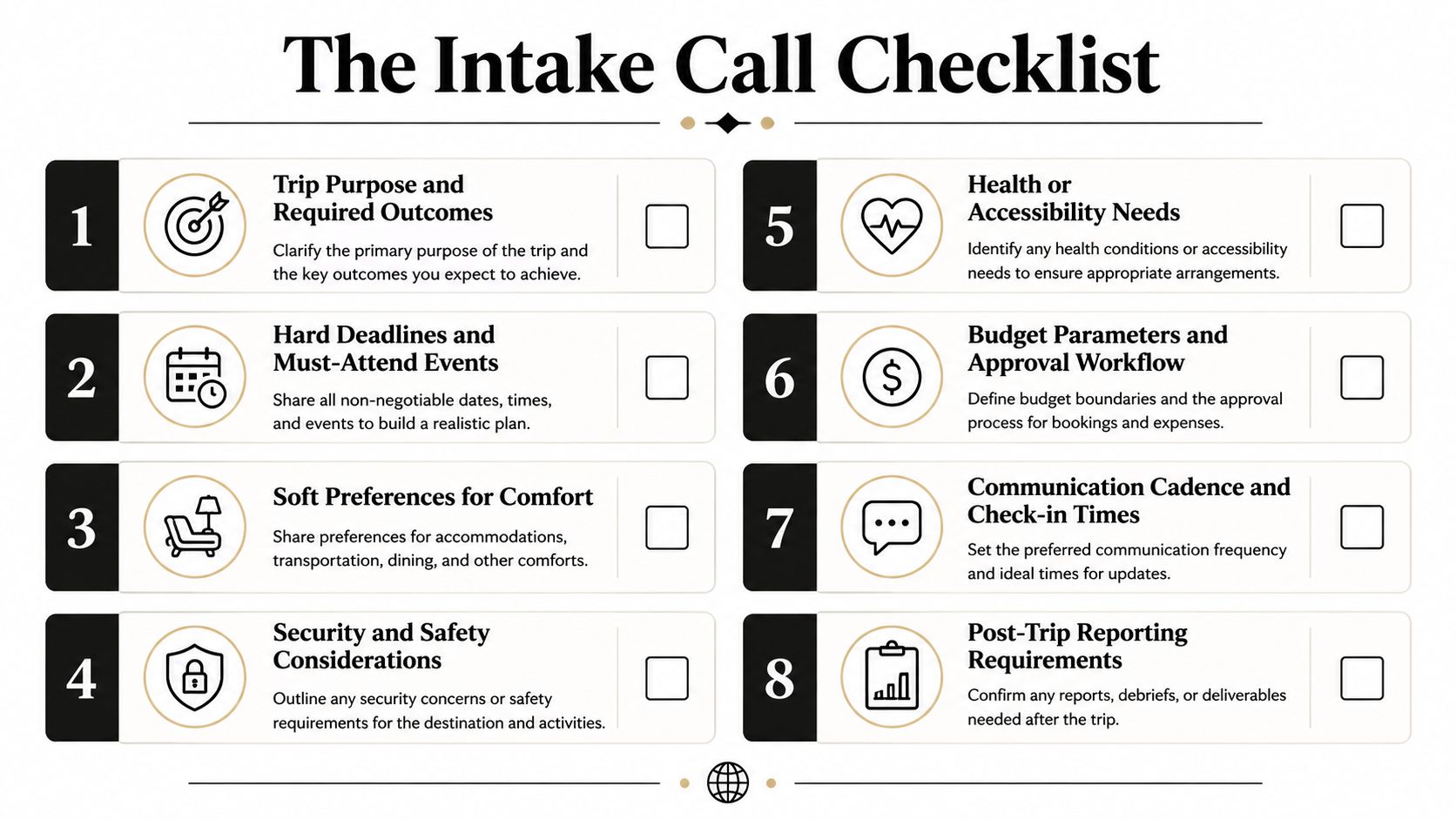
The intake also gives you a defensible basis for rejecting a poor option. If the principal says the trip's purpose is a negotiation and the arrival must allow preparation time, the cheapest late connection isn't a saving. It's a threat to the outcome.
Industry research estimates that travel coordination can consume 2 to 4 hours per week without dedicated support, compared with roughly 0.25 to 0.5 hours with skilled EA support, reclaiming approximately 1.75 to 3.5 hours weekly. Those figures appear in executive assistant productivity research, and they reinforce a practical point: disciplined intake is a productivity control, not administrative ceremony.
Building the Briefing Pack the Principal Actually Reads
The briefing pack should be one living document, not a pile of PDFs and confirmation emails. The principal needs one place to see where to be, why it matters, how to get there, and what happens if the plan changes.
Use five sections. Keep the document readable on a phone at an airport gate, where the principal may have limited attention and unreliable connectivity.
1. Trip at a glance
Put the dates, destinations, purpose, required outcomes, and the three most important risks on the first screen. Use a short “top of mind” summary with three bullets:
- Outcome: What the trip must accomplish.
- Constraint: The timing, security, or travel issue most likely to affect execution.
- Action: What the principal needs to decide or carry.
That summary separates a useful pack from a wall of text. A principal should understand the trip's operating logic before opening the detailed schedule.
2. Day-by-day timeline
List every movement with local time and time zone. Include full street addresses, terminal or fixed-base operator details where relevant, estimated transfer duration, buffer time, and the name of the person responsible for each handoff.
Hyperlink reservation confirmations instead of pasting long reference strings into the body. Label the principal's local-cell number clearly, and distinguish it from the assistant's number, driver contact, hotel contact, and security contact.
3. Meeting briefs
Each meeting needs attendees, location, objective, required materials, dress expectations, and the preparation window. Flag talking points that you've pulled from the principal's calendar, prior notes, or chief of staff guidance.
Don't force the principal to search for context. Put the decision or relationship risk beside the meeting, then link to the deeper briefing material.
4. Logistics cover
Add flights, rooms, transfers, lounge passes, dining reservations, vehicle instructions, and supplier contacts. A useful logistics entry answers three questions immediately: who is responsible, where does the handoff happen, and what happens if the scheduled movement fails?
For complex itineraries, bespoke planning references such as this complete luxury travel itinerary guide can help shape the level of detail expected for customized travel, but your internal document remains the operational authority.
5. Contingency notes
List weather concerns, local news, airport or transport risks, embassy alerts, and backup options. Don't write “monitor conditions.” Name the trigger and the action, such as “If the airport issues a closure notice, move the departure to the alternate airport and notify the chief of staff.”
The document should have an owner and a visible last-updated time. If a vendor changes a pickup or a meeting moves cities, update the live pack first, then distribute the change through the agreed channel.
Vendor Shortlists and the Quiet Power of Preferred Partners
A vendor list is useful only when it helps you make a decision under pressure. Build it by category, then assign each supplier a role instead of collecting names without context.
The five categories are air, ground, hotel, villa or long-stay, and dining or private dining. For air, record preferred carriers, fare flexibility, upgrade paths, and after-hours support. For ground, track airport coverage, vehicle types, driver continuity, wait policy, and emergency dispatch. Hotels need more than a rate. Capture the general manager or VIP contact, room preferences, cancellation terms, upgrade history, and response speed.
For villas and long stays, verify local management, maintenance response, security arrangements, provisioning, and transfer coordination. For dining, note private-room availability, dietary capability, cancellation rules, and whether the venue can handle a schedule that shifts.
Give every supplier a tier
| Category | Tier 1 Anchor | Tier 2 Backup | Tier 3 Emergency |
|---|---|---|---|
| Air | Preferred carrier or advisor with flexible rebooking and escalation access | Alternate carrier on the same route | Any policy-compliant route that protects the meeting |
| Ground | Vetted provider with named dispatch contact and driver continuity | Secondary provider with local coverage | Hotel desk, airport service, or trusted on-demand option |
| Hotel | Preferred property with VIP contact and documented benefits | Comparable property near the primary venue | Safe, available property that meets essential requirements |
| Villa or long-stay | Vetted residence with local management | Established local agency | Hotel suite or serviced residence |
| Dining or private dining | Relationship venue with flexible reservation support | Trusted alternative near the meeting | Secure, suitable venue with immediate availability |
Tier 1 should give you upgrade priority, after-hours contact, and rebooking grace. Tier 2 protects continuity when the anchor is unavailable. Tier 3 exists for emergencies, not preference.
Preferred status creates value that often never appears as a line-item discount. Ask for late checkout, a suite upgrade, driver holds, flexible cancellation, included breakfast, preferred tables, luggage assistance, private check-in, and small arrival amenities that affect the principal's perception of control.
Use a direct hotel note:
Subject: Executive stay, preferred terms and operational support Hello [Name], I'm arranging [Principal]’s stay for [dates] around [purpose]. Please confirm your best available rate with late checkout, upgrade priority, breakfast, flexible cancellation, and a direct contact for any arrival change. We'll prioritize the property that can protect the schedule and respond quickly. Best, [EA]
If a vendor slips, don't send a vague complaint. State the failure, consequence, remedy, and future decision:
“The vehicle arrived after the agreed pickup window, which compressed the principal's preparation time. Please confirm the corrective action and the named dispatch contact for the remainder of the trip. If this can't be guaranteed, I'll move the remaining transfers to the backup provider.”
For complex air arrangements, keep the air travel service reference in your approved supplier file alongside your internal air policy and escalation contacts.
Every vendor relationship should produce one documented favor you can call in within sixty seconds. If you can't name that favor, the relationship isn't operationally ready.
Contingency Thresholds and Rebooking Authority
Disruption planning fails when the EA has to ask, “Am I allowed to fix this?” during the incident. Set the authority before departure, and tie it to the principal's time, safety, and reputation.
A 2025 survey found that approximately 89% of business travelers experienced a disruption, while separate reporting found that 89% globally and 87% in the United States had at least one trip that didn't go as planned in the prior 12 months. Among impacted travelers, 77% had to rebook, at an average 27% higher company cost. These figures are documented in business travel disruption reporting.
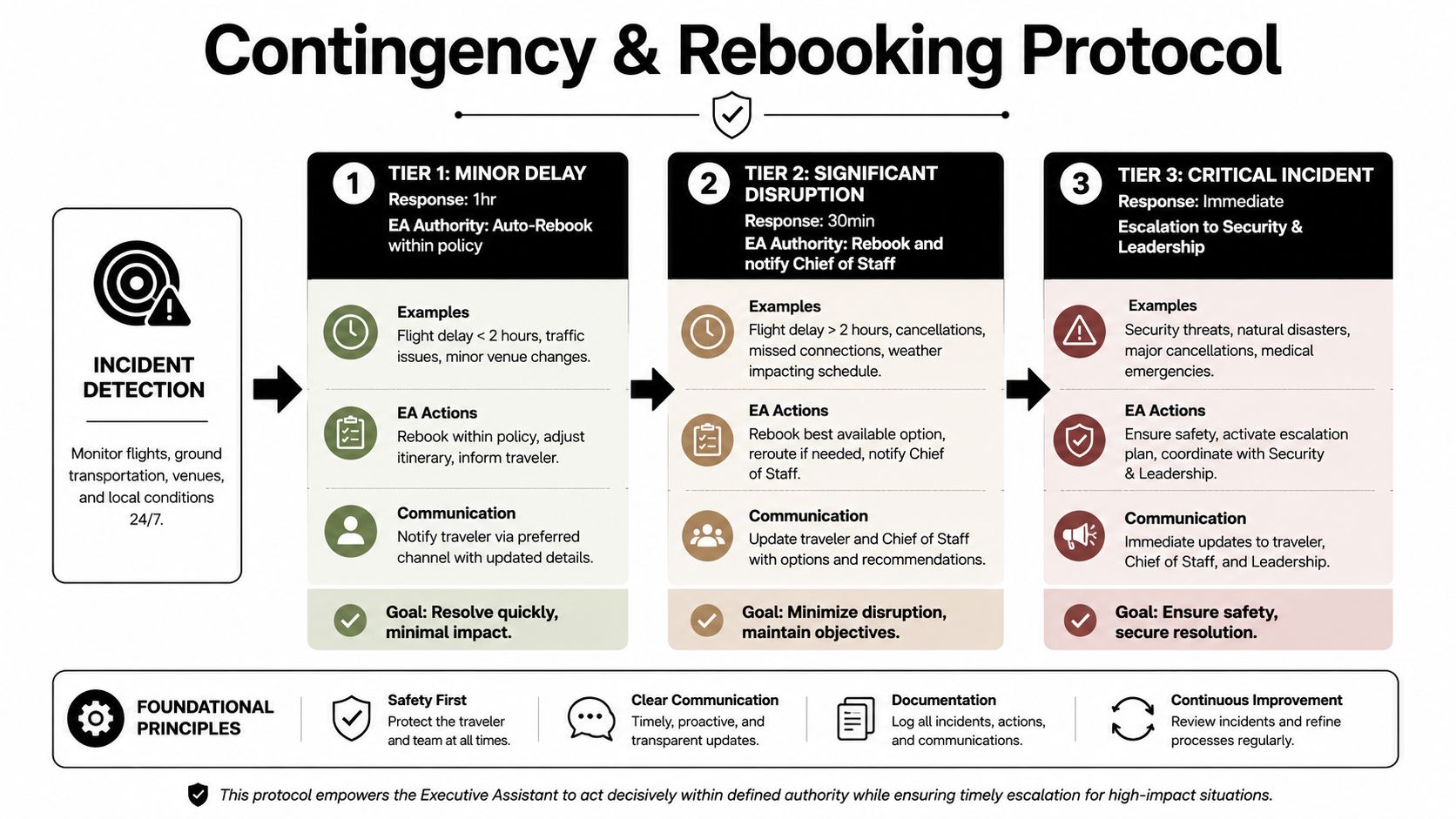
Use three operating tiers
Green, minor disruption. A manageable delay, seat issue, routine schedule adjustment, or ground delay belongs here. The EA acts within policy, protects the next fixed commitment, and updates the itinerary without waking the principal.
Amber, material disruption. A cancellation, missed connection, hotel overbooking, weather shutdown, ground failure, or principal schedule change belongs here when the trip's outcome is at risk. Rebook within the agreed policy and authority, then notify the chief of staff. If the change affects security, public visibility, or a must-attend meeting, escalate immediately.
Red, critical incident. A medical event, political unrest, serious security concern, airport closure, or inability to locate the traveler requires immediate escalation to security and leadership. Don't optimize comfort or cost before establishing safety and contact.
The exact authority must be written into the trip record. Set the dollar ceiling, permitted cabin latitude, alternate-airport rule, hotel substitution rule, and whether the EA can approve a vehicle hold or an extra night without a call. If those values vary by principal, keep a separate profile for each executive.
The principal's update should be two lines:
“Your original route is no longer reliable for the [meeting]. I'm holding [alternative] and protecting arrival by [time]. I'll confirm the booking now unless you want me to prioritize a different trade-off.”
Keep a wallet-sized disruption card with the incident tiers, vendor rota, security channel, traveler details, policy exceptions, and approval limits. The card prevents memory from becoming the decision-maker.
This protocol also protects against hidden costs. TravelPerk estimated disrupted U.S. business traveler costs of $502 for accommodation, $371 for local transport, $356 for meals, and $497 for overtime in the cited reporting. A fast, authorized decision can prevent a small delay from becoming an unplanned operating bill.
Duty of Care, Policy, and Emissions in One Decision Frame
Duty of care, travel policy, and emissions reporting shouldn't sit in separate folders. They compete for the same decision: whether this traveler should take this route, in this cabin, through this supplier, under these conditions.
Run a five-minute pre-trip filter using four inputs:
- Destination advisory: Review current safety, health, transport, and civil-event conditions.
- Traveler profile: Consider role, visibility, medical or accessibility needs, companions, and security posture.
- Trip duration: A short critical trip may justify a different routing choice than an extended schedule with recovery time.
- Local event calendar: Check weather exposure, strikes, major events, airport pressure, and civil activity.
Classify the trip green, amber, or red. Green means standard policy and routine monitoring. Amber means documented review, named escalation ownership, and possibly a preferred supplier or routing adjustment. Red means security or leadership approval before movement, unless immediate action is required to protect the traveler.
The same filter should expose policy exceptions. Flag a preferred-carrier deviation, a class upgrade, a non-preferred hotel, a private transfer, or a flexible fare. Draft the approval note automatically:
“Requested exception: [choice]. Operational reason: [meeting, safety, recovery, or reliability]. Policy impact: [category]. Alternatives considered: [options]. Approval required from: [owner].”
That format keeps preference separate from necessity. It also gives the chief of staff a decision they can approve quickly.
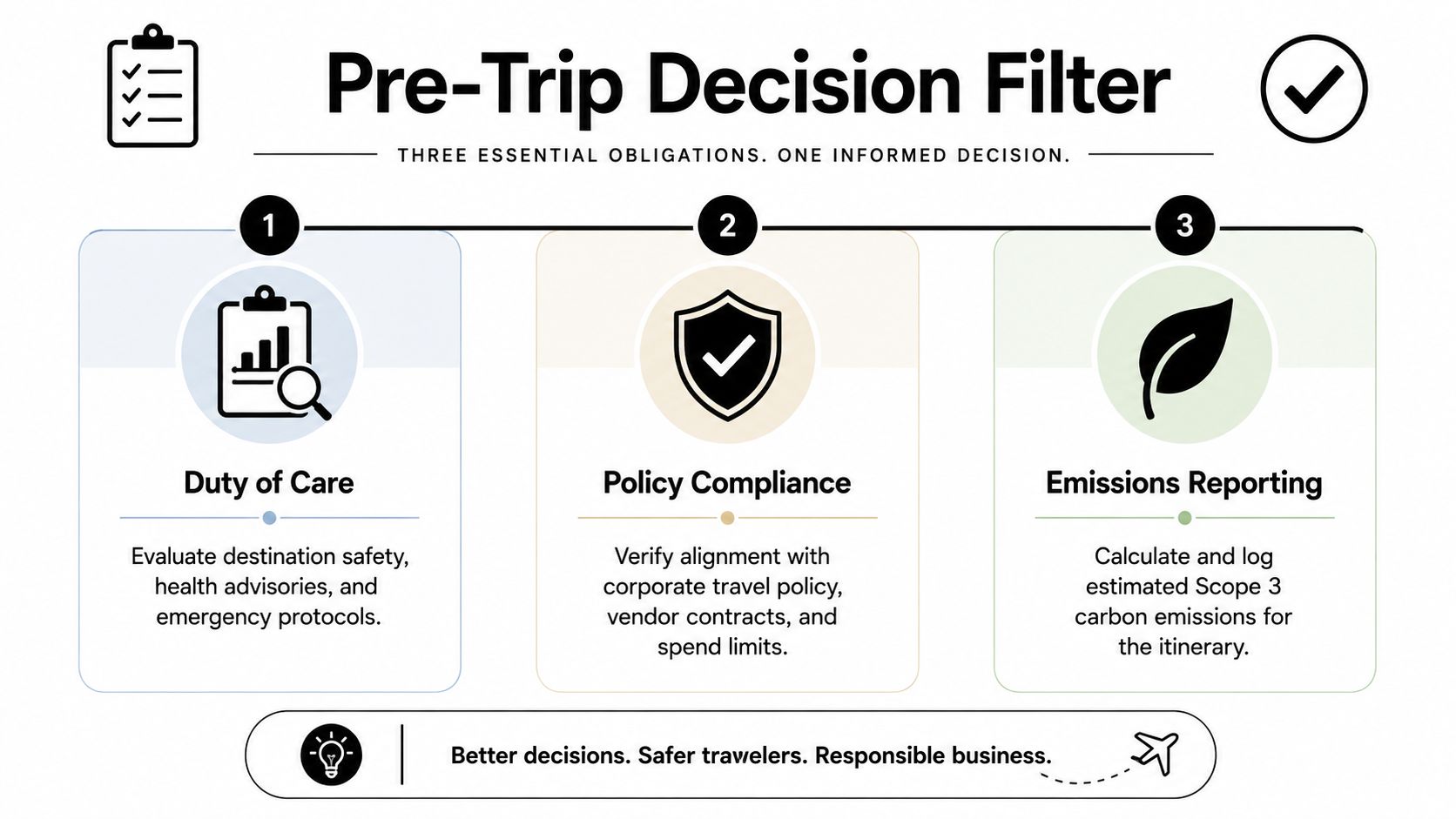
Duty of care deserves particular discipline. 64% of companies have a formal duty-of-care policy, but only 12% had implemented a centralized emergency contact resource in one industry survey, as reported by Travelweek's duty-of-care coverage. Build one escalation channel for air, hotel, ground, security, and leadership. Record the destination contacts and check-in triggers in the trip file.
The emissions component is operational, not ideological. Record cabin class, route, surface versus air movement, and approved alternatives. Government material in the Business Travel Survey 2025 tracks trip types, travel modes, and future decarbonisation plans, which makes clean itinerary data increasingly useful to the organization.
You don't have to slow last-minute travel to capture this information. Make the fields mandatory at booking, then export the record rather than reconstructing it during quarterly reporting.
The Wrap-Up Protocol That Makes the Next Trip Easier
The trip isn't finished when the principal lands. Your next itinerary begins with what you record after this one.
Run the wrap-up within 48 hours of arrival. Start with the money, then capture the operating lessons while they're still accurate.
Reconcile the trip against the plan
Compare receipts with the pre-trip estimate. Code expenses by policy category, and annotate exceptions with the reason and approver. Separate unavoidable disruption costs from preventable supplier charges. This gives the chief of staff a clean view of what happened without making them reconstruct the itinerary from card statements.
Send vendor thank-you notes while the relationship is warm. Mention the specific action that helped, such as holding a vehicle, protecting a room upgrade, or reworking a dinner reservation. A useful thank-you preserves negotiating power better than a generic compliment.
Write the principal's debrief
Keep the memo short and practical:
- What worked: The choices that protected time or reduced friction.
- What failed: The missed handoff, weak supplier, or unrealistic buffer.
- What changes next time: One recommendation tied to time, safety, comfort, cost, or reputation.
Ask the principal for direct feedback, but don't make them produce the whole audit. Your job is to convert a passing comment into a durable preference.
Update the living trip profile with seating preferences, hotel floor, transfer type, dietary patterns, communication style, and incident history. Note what the principal rejected as carefully as what they accepted. “Prefers no red-eye” is less useful than “will accept a red-eye only when it protects a fixed morning commitment.”
The ten-minute audit is the habit that separates a good EA from a great one.
After every trip, write down the single change that would have saved time, money, or reputation. Add it to the playbook before the next request arrives. That small loop turns reactive coordination into institutional knowledge, so the next briefing starts ahead of the last one.
HauteBlack offers dedicated travel planning, bespoke itineraries, VIP arrivals, private aviation, luxury hotel access, and coordinated ground transportation for executive trips with complex preferences and schedules. Visit HauteBlack to discuss a trip where your team needs stronger supplier coordination, last-minute support, and a carefully managed arrival experience.
Explore Our Guides


Signature Experiences


