Haute Black Journal
Seamless VIP Airport Transfers: A Premium Guide

Marlene Azeez
Director, HauteBlack
View all articles →
# Seamless VIP Airport Transfers: A Premium Guide
June 3, 2026
You land after an overnight flight. The cabin door opens late, the gate changes, baggage takes longer than it should, and your phone fills with messages before you've even cleared the terminal. At that moment, the difference between a car service and a properly run VIP transfer becomes obvious.
Many still associate VIP airport transfers with leather seats, bottled water, and the optics of arriving well. That's the least interesting part of the service. For executives, public figures, family offices, and anyone moving on a tight schedule, the primary value is operational control when travel stops behaving predictably.
Beyond the First Class Seat
A polished sedan is easy to book. A resilient airport transfer is much harder to build.
That distinction matters because disruption isn't occasional background noise. It is part of modern air travel. FlightAware data cited by VIP Global Transport Services shows that U.S. airlines delayed 24.4% of flights in 2024, which changes how a serious traveler should evaluate ground transport in the first place (VIP airport disruption context). If nearly a quarter of flights are delayed, then a beautiful vehicle without live monitoring, dispatch oversight, and airport-side contingency planning is just an expensive guess.
Comfort is the visible layer
Comfort still matters. After a long-haul arrival, a quiet cabin, a composed chauffeur, and no need to negotiate with drivers outside the terminal all make a difference. But comfort is the visible layer, not the operational core.
The stronger question is simpler: when your flight is late, your gate changes, customs runs long, or the baggage belt stalls, does the transfer system absorb the problem for you?
Practical rule: Judge VIP airport transfers by how they perform on bad travel days, not perfect ones.
A standard black car booking often assumes the itinerary will hold. A VIP transfer assumes it may not. That changes everything behind the scenes. Dispatch watches the flight. The pickup window shifts. The chauffeur is repositioned. If airport access becomes congested, the team adjusts the meeting point before the passenger starts texting in frustration.
Time loss is the hidden cost
Executives rarely lose money because a ride was uncomfortable. They lose money because an arrival becomes messy, late, visible, or distracting. The cost sits in missed calls, compressed meeting prep, unnecessary exposure, and friction passed downstream to assistants, security staff, and hosts.
What works in practice is a transfer designed like an extension of the travel itinerary, not as a separate booking. That means the ground team treats the airport as an active operating environment with changing variables, not a fixed pickup address.
A proper VIP transfer should reduce three things at once:
- Decision fatigue: You shouldn't have to figure out where to go, whom to call, or whether the car is still waiting.
- Exposure: High-profile travelers often need less visibility, not more, at the curb and in the arrivals hall.
- Delay spillover: One disrupted leg shouldn't unravel the rest of the day.
That is why VIP airport transfers belong in the risk-management conversation. They are not indulgent add-ons. They are ground logistics built for people whose time, privacy, and schedule integrity carry real value.
What Defines a VIP Airport Transfer
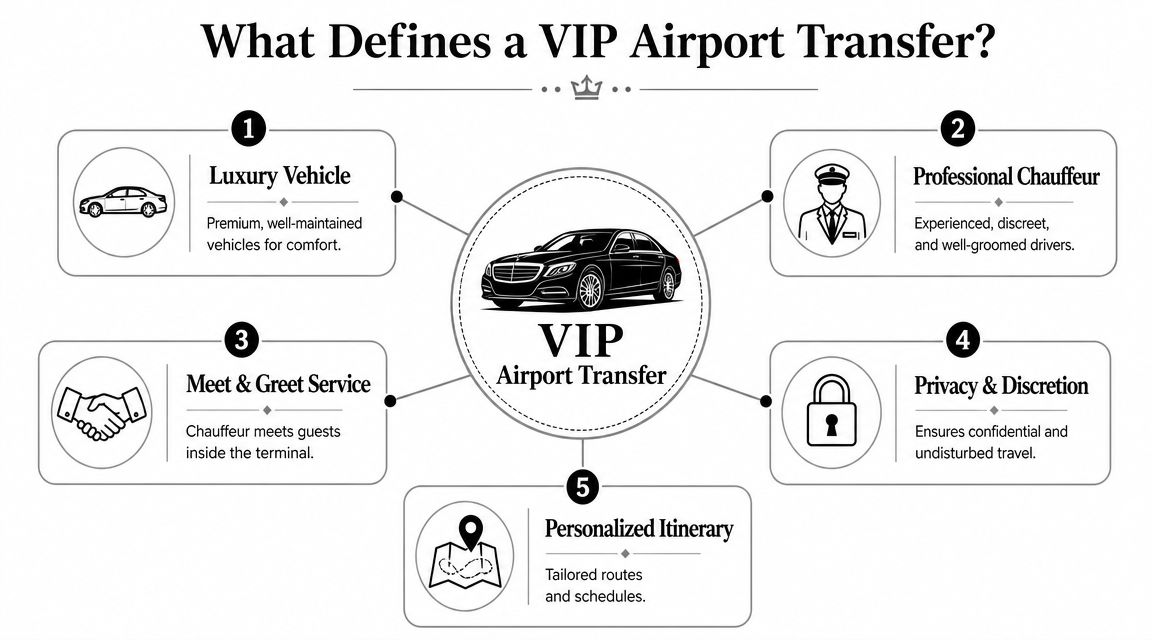
The cleanest definition is this. A VIP airport transfer is a pre-arranged ground operation built to control handoffs, protect privacy, and keep the traveler moving with minimal intervention from the traveler.
It isn't just a chauffeur in a nice suit. It is closer to having a personal ground-side controller who already knows your flight, your routing, your pickup protocol, your vehicle requirements, and what to do if the day goes sideways.
The service is an ecosystem
The strongest VIP airport transfers combine several moving parts into one managed chain:
- Pre-booked routing: The reservation isn't just date and time. It includes airline details, terminal logic, contact protocol, and often destination-level notes.
- Meet and greet: Someone is ready to intercept uncertainty inside the airport environment, not merely wait somewhere outside it.
- Baggage coordination: Even where formal porter arrangements vary by airport, the best operators plan for luggage friction instead of pretending it doesn't exist.
- Vehicle fit: The right sedan, SUV, or van is assigned according to party size, baggage profile, and the required degree of discretion.
- Communication discipline: The client receives only what's useful. The team handles the noise.
This is one reason private, pre-booked service dominates the category. In the pre-book airport transfer market, private transportation held a 78.3% share in 2025, and international travelers were projected to account for 61.5% of revenue, according to Market.us analysis of pre-book airport transfers. That tells you where demand concentrates. Travelers crossing borders and working to fixed schedules usually don't want improvisation at the curb.
Privacy isn't only about tinted glass
Discretion is often misunderstood. People think it means a darker vehicle or a quieter chauffeur. Those things help, but discretion is mainly procedural.
A discreet transfer avoids unnecessary name-calling in public areas, avoids confused roadside waiting, minimizes standing around with luggage, and limits who knows the client's movements. The best teams also align ground transport with household staff, assistants, hotel concierges, close protection personnel, or corporate security when needed.
That is where operational discipline starts to overlap with security practice. For readers who think about arrival management through a security lens, GM GROUP Services' security expertise offers a useful view of how concierge-facing personnel and protective awareness can complement each other in high-touch environments.
The more visible the confusion, the less premium the service is.
The difference from an ordinary black car
An ordinary premium car booking answers one question: what vehicle is coming?
A VIP transfer answers several others before you ask them.
Will anyone adapt if the flight moves? Who controls the airport handoff? What happens if the principal is traveling with family, assistants, or security? Can the route or destination change on the fly? How much information does the chauffeur receive, and how much stays compartmentalized?
Those are the details that separate a ride from a managed movement.
The Seamless Arrival and Departure Journey
A well-run airport transfer should feel uneventful to the passenger. That calm result usually comes from a great deal of coordination that stays out of sight.
Arrival under real conditions
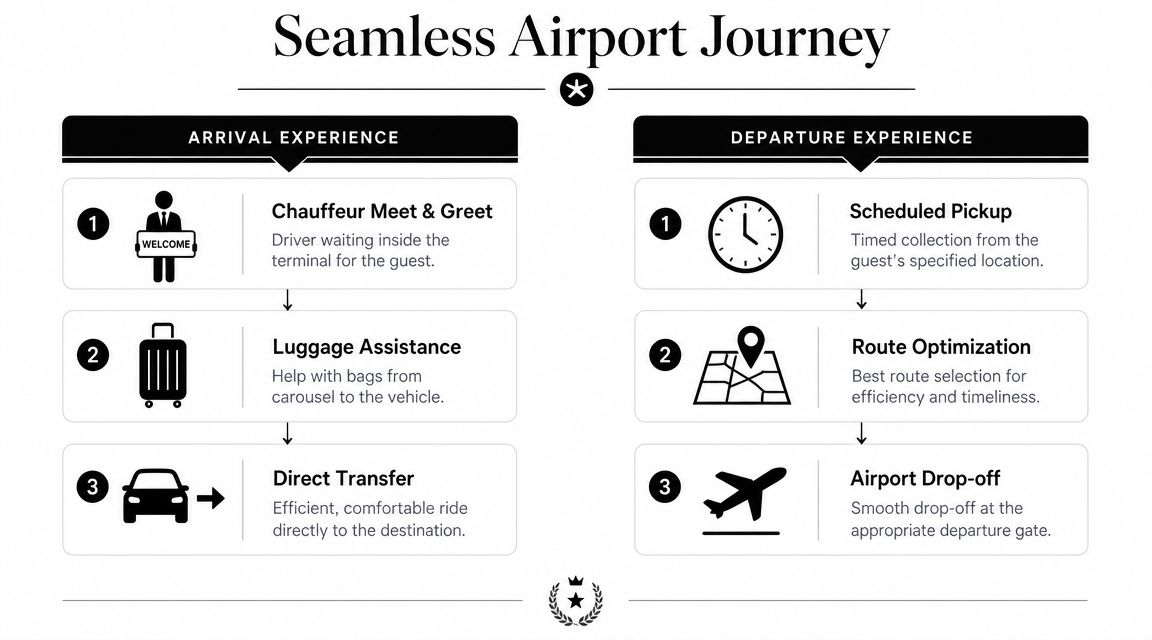
On arrival, the strongest experience starts before touchdown. The ground team has already monitored the flight and adjusted the pickup logic if the aircraft is early, delayed, or reassigned to a different stand. That flight-tracking integration is the operational backbone of a superior transfer service, because it allows dispatch to monitor status in real time and automatically adjust pickup timing (industry explanation of airport transfer flight tracking).
Once the traveler lands, the sequence should be simple. A greeter or chauffeur is positioned where the handoff makes sense for that airport. The client isn't trying to decode text messages while walking through a crowded corridor. If baggage assistance is part of the local operating model, it's already coordinated. If customs is slow, the vehicle timing adjusts in the background.
What the traveler experiences is much narrower:
1. Recognition at the right point: Not too early, not too late, and not in a chaotic location.
2. Quiet escort through the terminal flow: Fewer pauses, fewer calls, less public uncertainty.
3. A vehicle already aligned to the updated arrival reality: No scramble outside the terminal.
For busy travelers connecting airport movements to a larger city schedule, even station-level or intermodal planning can matter. This practical guide for busy professionals is a good example of how route logic and transit handoffs affect executive travel in dense urban environments.
Departure without avoidable friction
Departure is a different discipline. The risk is not post-flight uncertainty but pre-flight compression. Traffic hardens, airport curb access changes, and a small delay at pickup can ripple into check-in, security, and lounge time.
The better operators don't dispatch a car for the requested time. They build the pickup around airline timing, terminal conditions, known congestion patterns, and how much buffer the client wants. Some travelers prefer to arrive early and work in a lounge. Others want tight timing and minimal dwell.
A coordinated ground leg also needs to fit the wider air itinerary. If the airport transfer is supporting a charter, first-class itinerary, or a more complex aviation movement, it helps to treat the road segment as part of a single travel chain rather than a stand-alone booking. That is exactly why many travelers pair transfers with dedicated air travel coordination.
A seamless departure isn't the fastest possible drive. It's the drive timed correctly for everything that happens after the car stops.
Where weak operators fail
Failures usually show up in small but telling ways:
- Static pickup assumptions: The chauffeur waits based on the original schedule even though the flight has moved.
- Poor terminal literacy: The driver knows the city but not the airport.
- Overcommunication to the client: The passenger becomes the dispatcher.
- No fallback logic: A gate change, customs delay, or curbside restriction causes visible confusion.
The best VIP airport transfers remove the need for the traveler to manage any of that personally.
Vehicle Classes and Chauffeur Standards
The right vehicle isn't always the most expensive one in the fleet. It is the one that fits the trip profile without creating baggage problems, visibility problems, or boarding delays.
A poor match usually reveals itself at the least convenient moment. Too much luggage for a sedan. Too many passengers for a single SUV. A van that handles volume well but feels too conspicuous for a discreet city arrival. Good operators ask those questions before dispatch.
Matching the vehicle to the movement
For solo travelers and couples, a luxury sedan often remains the cleanest choice. It is discreet, easy to stage, and efficient for airport curb work. Executive SUVs help when the luggage profile is heavier or the route conditions are less predictable. Vans and Sprinter-class vehicles are the answer for family groups, entourages, or executives traveling with assistants and security.
The main mistake is planning by seat count alone. When coordinating group transfers, optimizing for both passenger and luggage capacity is critical. Executive vans can carry up to 15 passengers, and luxury transfer fleets commonly range from 2 to 14 passengers depending on vehicle type, but oversized luggage can still force a split transfer or a change in vehicle strategy (vehicle capacity guidance for airport transportation)).
| VIP Vehicle Class Comparison | Passengers | Luggage Capacity | Best For |
|---|---|---|---|
| Luxury Sedan | 2 to 3 comfortably, depending on luggage profile | Best for standard cases and modest baggage | Solo executives, couples, discreet city arrivals |
| Executive SUV | Small groups or travelers with bulkier bags | Better for larger suitcases and mixed carry-on loads | Families, road-heavy itineraries, winter destinations |
| Sprinter or Executive Van | Larger parties, up to the operator's stated limit | Strongest for combined people and baggage volume | Corporate groups, entourages, multi-generational travel |
If a party is traveling with garment bags, golf clubs, ski equipment, oversized cases, or heavy retail purchases, book around luggage first and seats second.
For broader itinerary planning that includes city transfers beyond the airport leg, dedicated ground transportation arrangements make more sense than piecing together separate bookings.
What a VIP chauffeur should actually do
People often focus on the car and ignore the driver. In practice, the chauffeur determines whether the experience feels composed or amateur.
A proper VIP chauffeur should bring:
- Airport fluency: Terminal layouts, pickup restrictions, and the difference between a textbook route and a usable route.
- Discretion: No unnecessary conversation, no personal questions, no visible curiosity.
- Calm under change: Flight movements, reroutes, or destination changes shouldn't create theater.
- Presentation: Grooming matters, but so does disciplined behavior.
- Coordination: The chauffeur should fit into a larger service chain involving assistants, hotels, households, or security teams.
The EV and hybrid question
Many clients now ask for lower-emission vehicles, and that is a reasonable request. The answer isn't always straightforward.
Electric or hybrid vehicles can work very well for airport transfers in dense urban markets, especially when the route is predictable and charging logistics are stable. But airport work has practical constraints. Long waits, multi-stop itineraries, winter performance, luggage space, and longer repositioning distances can make a conventional luxury vehicle the more reliable option on some days.
The premium choice is not automatically the largest combustion sedan, and it isn't automatically the newest EV either. It is the vehicle that best balances discretion, operational certainty, and the client's own preferences.
Booking Guidance and Cost Considerations
The market for airport transfers is no longer a cottage service built around informal driver networks. It is a scaled, professional category. The global airport transfer services market was valued at USD 38 billion in 2025 and is projected to reach USD 90 billion by 2033, reflecting an 11% CAGR, according to Future Data Stats' airport transfer services market analysis. That scale matters because it explains why serious providers price around logistics, technology, staffing, and service depth, not only miles on the road.

What to provide when booking
The cleanest bookings are information-rich from the start. If an assistant or traveler sends only the arrival time and hotel name, the operator has to fill in too many blanks.
A strong transfer brief should include:
- Flight specifics: Airline, flight number, arrival or departure details, and whether the itinerary is still fluid.
- Passenger profile: Number of travelers, children, elderly passengers, staff, security personnel, or VIP handling sensitivities.
- Baggage notes: Standard luggage, oversized items, strollers, sports equipment, or shopping-heavy return legs.
- Contact protocol: Who receives updates, who should not be contacted directly, and which messaging channel is preferred.
- Destination logic: Final address, intermediate stops, residence access restrictions, hotel entrance preferences, or private terminal instructions.
If you're comparing service models more broadly, this editorial guide to luxury travel concierge services gives helpful context on how high-touch providers structure planning and support.
How to read a quote properly
The cheapest quote often omits the very things that keep the day smooth. Rather than asking only for the rate, ask what the rate is built to absorb.
Focus on these points:
1. Waiting policy
Airport work isn't point-to-point city driving. You need to know how the operator handles flight-related waiting, customs delays, and terminal-side timing adjustments.
2. Meet-and-greet scope
Clarify whether the chauffeur waits curbside, inside arrivals, or through a managed greeting process.
3. Vehicle substitution rules
Ask what happens if luggage expands or the booked class becomes impractical on the day.
4. After-hours and access charges
Some airports, terminals, or special handling arrangements add operational costs.
5. Amendment flexibility
Schedules change. The real question is how gracefully the booking can change with them.
Good pricing is transparent. Great pricing is transparent and operationally honest.
When to book earlier
Simple airport-city transfers can often be arranged without drama. Complex movements should be booked as early as practical.
That includes arrivals involving multiple vehicles, family groups, high-profile passengers, unusual baggage, security requirements, or journeys timed against events, charters, or fixed meeting schedules. Early booking gives the operator more room to assign the right vehicle, brief the chauffeur properly, and pressure-test the airport handoff.
Cost matters. But for this category, the more useful lens is risk. You're paying to reduce the odds of confusion, exposure, wasted time, and avoidable failure.
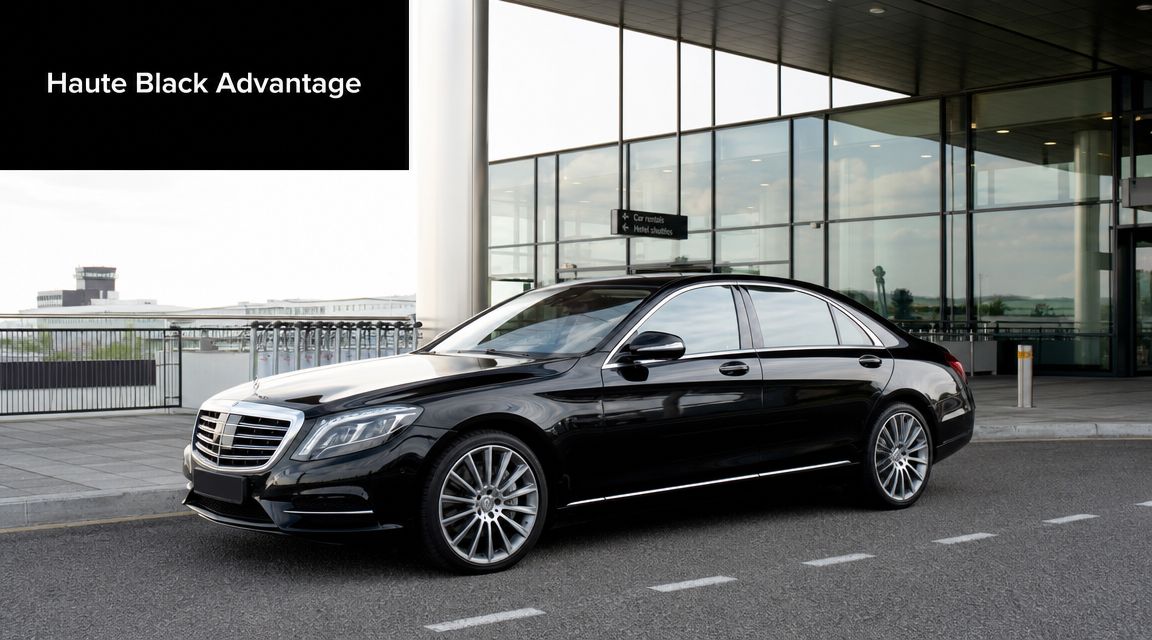
The Haute Black Advantage
Some travelers book airport transfers one leg at a time. That works until the trip becomes layered. Multiple cities, changing schedules, hotel coordination, preferred arrival protocols, family preferences, close-in restaurant reservations, private aviation, or last-minute rerouting all make isolated bookings feel fragmented very quickly.
What discerning travelers usually want is continuity. One advisor who understands how you travel. One network that can source the right local partner. One standard for discretion and timing across the entire journey.
Why integrated planning changes the experience
That is where Haute Black stands apart. Rather than treating VIP airport transfers as an isolated car booking, Haute Black can place them inside a wider, relationship-driven itinerary. A dedicated advisor understands preferences that don't show up in a booking form. Which entrances you prefer. How much communication you want in transit. Whether you need a low-visibility arrival, family-friendly pacing, or immediate onward movement to a yacht, villa, hotel, or private terminal.
Because Haute Black operates within a wider luxury travel ecosystem, the airport transfer can be aligned with air bookings, preferred hotel partners, concierge logistics, and destination support. That creates something travelers notice immediately: fewer handoff failures.
This short video gives a sense of that high-touch travel mindset in motion:
A quieter standard of service
The strongest luxury travel brands don't confuse visibility with quality. They focus on execution. Haute Black's value sits in curation, trusted relationships, and the ability to facilitate privileged access without making the process feel theatrical.
That matters for ultra-high-net-worth travelers, couples on milestone trips, family principals moving with children and staff, and executives whose calendars don't leave room for airport friction. It also matters when the itinerary changes midstream and somebody competent needs to solve it without turning the traveler into the operations desk.
VIP airport transfers are at their best when they disappear into the journey. The arrival feels easy. The departure feels clean. The traveler stays focused on the reason for the trip, not the mechanics of getting from aircraft to destination.
If you'd like that level of coordination across airport transfers, hotels, private aviation, dining, and tailor-made itineraries, explore HauteBlack. Non-members can book bespoke journeys, and members gain a dedicated advisor, waived planning fees, and access to a global network built for smooth, discreet travel.
Explore Our Guides


Signature Experiences


