Haute Black Journal
Luxury Travel Itinerary: The Complete Bespoke Planning Guide

Marlene Azeez
Director, HauteBlack
View all articles →

Published August 23, 2026 by Marlene Azeez
The most popular luxury travel advice is wrong. A luxury travel itinerary isn't a catalogue of five-star hotels, first-class seats, and famous restaurants. Those bookings are easy to make. The difficult work is arranging them so that scarce access, weather, transfers, energy levels, privacy, and personal priorities reinforce one another.
A well-designed journey feels unhurried because someone has solved the problems before they reach you. It knows which reservation must come first, where a buffer belongs, when a family needs a quieter day, and how to preserve the character of a destination without forcing every celebrated attraction into the schedule. That hidden architecture is what turns an expensive holiday into a personal one.
Why Most Luxury Travel Itineraries Fall Short
The costliest mistake in luxury travel is confusing premium components with a premium journey. A suite at Aman, a first-class flight, and a table at a celebrated restaurant can still produce an awkward trip if the sequence is wrong. The hotel may be across the city from the next appointment, the transfer may leave no margin for a delayed arrival, or the restaurant booking may land after an exhausting touring day.
Luxury itinerary design is a discipline of dependencies. One decision changes several others. A private temple viewing might determine the Kyoto hotel, the arrival day, the guide's schedule, and the time reserved for dinner. A remote villa may require a helicopter or boat transfer, which then affects luggage handling, weather flexibility, and the amount of activity that can sensibly follow.
Practical rule: Build around what can't easily be replaced. Let ordinary logistics serve the rare experience, never the other way around.
The difference between a list and a sequence
Most online itineraries rank destinations and properties. They rarely explain how to move through them without friction. A list can tell you where to sleep. A bespoke plan decides whether you should change hotels at all, whether a private transfer is worth the time saved, and whether the arrival day should contain anything beyond a discreet dinner.
The benchmark research behind personalized planning makes this distinction clear. TripTailor contains over 500,000 real-world points of interest and nearly 4,000 actual itineraries, reflecting the complexity of matching destinations, preferences, timing, and feasible combinations. WorldTravel evaluates plans across 150 real-world scenarios, each averaging 15 or more interdependent temporal and logical constraints. These sources support a practical conclusion: itinerary quality depends on constraint handling, not attraction volume.
Why affluent travelers still experience friction
Money removes many ordinary limitations, but it doesn't automatically create operational coherence. A private aircraft can still arrive before a villa is ready. A sold-out dining room can still be unavailable. A celebrated excursion can still feel generic if the guide hasn't understood whether you want scholarship, photography, family participation, or complete privacy.
The strongest itineraries protect your attention. They limit unnecessary packing, avoid decorative detours, and create deliberate contrast, perhaps a private cultural morning followed by an unstructured afternoon, or a demanding expedition followed by a restorative stay. Exclusivity means little if the journey exhausts you.
The Five Pillars of a Bespoke Luxury Itinerary
A luxury travel itinerary rests on five connected pillars. Accommodation, transfers, access, concierge support, and wellness or sustainability choices must work as one system. Remove one, and the journey may still look impressive, but it loses its precision.
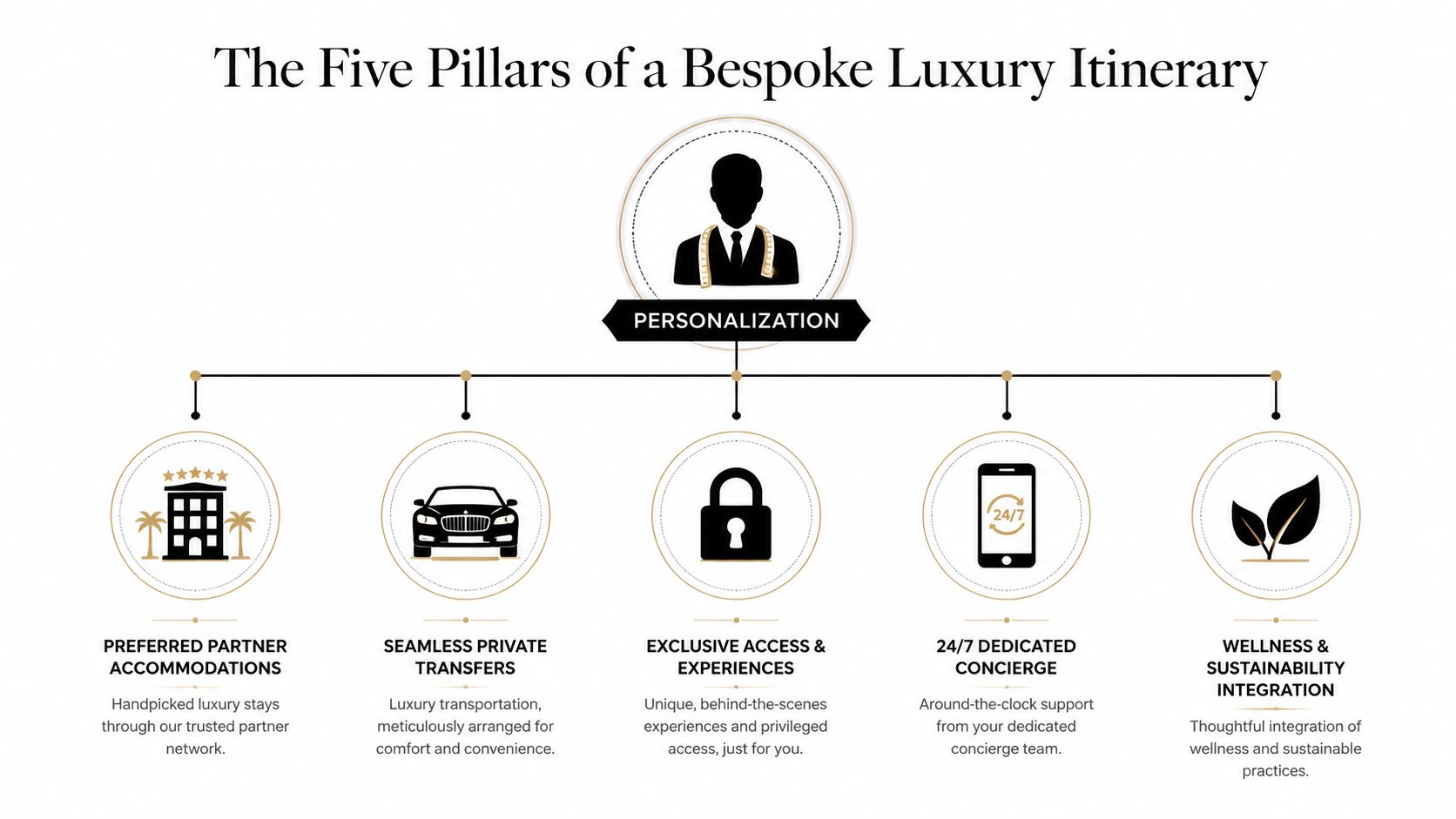
Preferred partner accommodations
The right hotel isn't merely the one with the highest room rate. It should suit your purpose, your preferred rhythm, and the structure of the route. Preferred partner status can add value through benefits such as upgrades when available, resort credits, flexible privileges, and enhanced arrival recognition. HauteBlack's Virtuoso affiliation and relationships with properties including Aman, Four Seasons, and Belmond are relevant because a direct booking may not carry the same partner benefits.
A remote villa becomes more compelling when the rest of the journey supports it. A private helicopter transfer can replace a long road journey, while the villa's seclusion creates the setting for a private chef dinner. The accommodation is no longer an isolated booking. It's the centre of an experience architecture.
Seamless private transfers
Transfers should be judged by continuity, not merely vehicle quality. A private car waiting at the correct terminal, a luggage team briefed on fragile items, and a helicopter timed around the property's arrival procedure can preserve an entire day.
Private aviation, first-class rail, helicopters, boats, and discreet ground transport each solve different problems. The best choice depends on geography, weather exposure, luggage, mobility, and the value of your time. A luxury transfer that creates a new timing risk isn't an upgrade.
Exclusive access and experiences
A private guide doesn't automatically create private access. The experience should have a reason to be exclusive, whether that's a closed-door cultural visit, a conversation with a specialist, a private culinary session, or access arranged outside normal public hours.
The strongest requests are personal rather than performative. Tell the advisor whether you want an intellectual deep dive, a family-friendly interpretation, a photographic perspective, or a quiet encounter without an audience. Access becomes memorable when it reflects your curiosity.
Dedicated concierge support
Concierge service matters most when the itinerary changes. A restaurant request, room move, late checkout, medical consideration, or last-minute adjustment requires context. A dedicated advisor who already knows the route can act faster than a sequence of disconnected suppliers.
That support should begin before departure. Share dietary preferences, sleep patterns, preferred room orientation, celebration details, and dislikes early. Vague preferences produce generic arrangements.
Wellness and sustainability integration
Wellness shouldn't be added as a spa appointment at the end of a busy itinerary. It belongs in the pacing. Build recovery after long-haul travel, choose properties that make nature accessible without excessive transit, and consider how a slower rail or sea segment might improve the journey.
Sustainability also requires practical design. Fewer hotel changes, longer stays, local specialists, and carefully selected transfers can create a more meaningful trip while reducing unnecessary movement. Luxury is not maximal consumption. It's control over what deserves your time.
Sample Itineraries for Distinct Traveler Personas
The same destination can produce completely different journeys depending on the traveler. A honeymoon, a family cultural trip, an executive schedule, and a private member's leisure escape should never share the same template.

The honeymoon built around seclusion
For a couple travelling to the Maldives, the villa is only the beginning. I'd place privacy, water access, and uninterrupted service at the centre, then design the journey around arrival ease rather than a crowded sequence of island activities.
A preferred overwater villa with a private slide and dedicated butler creates the base. The first full day should stay intentionally light, with breakfast delivered privately, time on the water, and a sunset dinner arranged at the couple's preferred level of seclusion. A private sandbank experience can follow on a separate day, with the option to return early rather than forcing a fixed programme.
The departure should also feel considered. A final spa treatment, a private meal, and a transfer timed with generous airport margin are more valuable than one last excursion. Romance depends on space, not volume.
The multi-generational Japan journey
A family travelling through Japan needs more than connected rooms and a list of temples. Grandparents may prefer shorter walking segments, parents may want design, food, and cultural depth, while younger travellers need active participation.
I'd use Tokyo as an energetic opening, followed by Kyoto for private temple access, craft encounters, and a Michelin-starred kaiseki dinner. The schedule should alternate structured mornings with open afternoons. Private vehicles reduce friction, but the plan should still use carefully selected rail where it adds cultural value and avoids road congestion.
The family should stay longer in fewer bases. That creates room for accessibility, rest, and spontaneous discoveries. A private guide can adjust the tone for each generation, turning a formal cultural visit into a conversation rather than a lecture.
The C-suite European blend
A C-suite executive doesn't need a holiday disguised as a business trip. They need reliable movement, privacy, and a clear boundary between obligations and recovery.
A London, Paris, and Geneva route can work when meetings anchor the itinerary rather than interrupt it. Private aviation or carefully coordinated first-class connections can protect working time, while hotels should be selected for location, meeting privacy, reliable connectivity, and discreet service. The leisure element might be a private gallery appointment in Paris or a restorative lakeside extension in Geneva.
Keep the arrival day light. Place business meetings in concentrated blocks, then protect a genuine decompression window before the return flight. A schedule that appears full on paper often performs badly in practice.
The private member pursuing taste and sport
For a private member, the journey may revolve around a culinary appointment, a major sporting event, or a cultural evening unavailable through public channels. The route should begin with the fixed access point, then build outward.
A private chef dinner, a premium sporting experience, and a highly personal dining progression might span several cities, but each move must earn its place. The advisor can coordinate transport, preferred tables, private hosting, and post-event access without making the itinerary feel transactional.
The final layer is community. HauteBlack's AI-powered network connects verified founders, executives, investors, athletes, and creators for introductions and private roundtables. For the right traveler, that can turn a destination stay into a meaningful professional and social exchange.
Planning Timeline and Pre-Trip Checklist
A luxury travel itinerary should start with the experience that has the fewest alternatives. Don't begin with flights because they're familiar. Begin with the private museum viewing, the small omakase counter, the villa, the expedition departure, or the sporting event that defines the trip.
Six to twelve months out
Set the purpose before selecting destinations. Decide whether the journey is about restoration, cultural immersion, family connection, celebration, business efficiency, or a deliberate combination. Establish the essential requirements, the acceptable compromises, and the travelers' mobility, dietary, privacy, and wellness requirements.
At this stage, confirm passport validity, visa requirements, school calendars, business commitments, and preferred travel windows. Shortlist the rare experiences first, then test whether the route works around them.
Four to six months out
Secure the core bookings. That includes the anchor accommodation, private aviation or premium transport where relevant, scarce dining, guides, and access arrangements. Confirm the room configuration rather than leaving connecting rooms or villas to chance.
Descriptions also matter when comparing properties. A useful resource on writing tips for hotel descriptions can help travelers and assistants distinguish meaningful hotel details, such as layout, setting, service style, and atmosphere, from empty luxury language.
Two to three months out
Refine the experience layer. Confirm guides, menus, spa treatments, children's activities, celebration details, transfers, and contingency options. Build buffers around international arrivals, weather-sensitive activities, and any connection that could compromise a high-value booking.
The HauteBlack journey planning service can be used to consolidate these moving parts into a custom plan rather than a collection of separate confirmations.
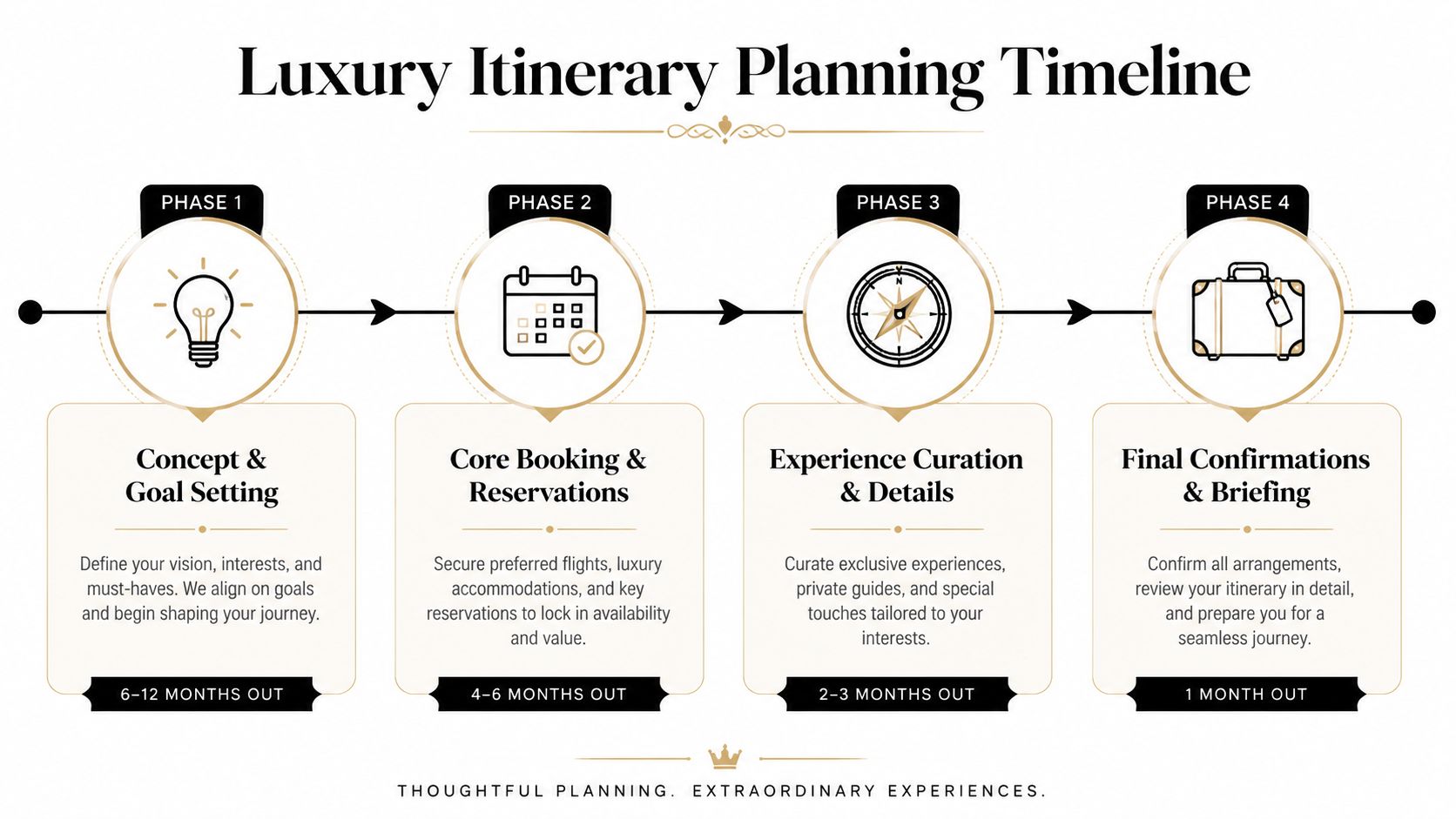
The final month
Review the itinerary as an operating document. Confirm names, passport details, dietary requirements, health considerations, luggage, flight schedules, room preferences, arrival procedures, transfer contacts, and emergency escalation. Ask the advisor to reconfirm resort credits, upgrade notes, late checkout requests, and celebration arrangements.
A useful final checklist includes:
- Documents: Verify passports, visas, insurance, permits, and required medical documentation.
- Transport: Recheck flight, rail, helicopter, boat, and private aviation timings.
- Rooms: Confirm bed configuration, adjoining requirements, views, accessibility, and arrival preferences.
- Dining: Reconfirm dietary needs, preferred seating, dress expectations, and cancellation terms.
- Pacing: Identify every demanding day and place recovery time after it.
- Contingencies: Decide in advance what happens if weather, delays, or illness disrupts the sequence.
- Briefing: Give the advisor a final note covering last-minute preferences, privacy requirements, and communication channels.
A beautiful itinerary is not finished when the PDF looks elegant. It's finished when every dependency has an owner.
The Value of Working with a Bespoke Agency
Independent booking works well for simple journeys. It becomes less effective when the trip depends on scarce access, multiple suppliers, complex transfers, or benefits that aren't visible during a public booking.
A Virtuoso-affiliated bespoke agency can bring preferred partner status at over 500 properties, including Four Seasons, Aman, Rosewood, Belmond, and Ritz-Carlton. The practical value may include complimentary upgrades when available, resort credits, flexible benefits, and VIP arrival recognition, subject to each property's terms and availability.
Relationships matter more than room categories
The decisive difference often sits outside the booking engine. An advisor's relationship with a hotel can influence how a preference is understood, how a problem is escalated, or whether a special request reaches the right person. That matters when the itinerary includes private chef dinners with Nobu, Daniel Boulud, or Thomas Keller, cultural evenings, sporting access, or a villa that requires careful operational coordination.
Members receive a dedicated advisor, waived planning fees, and access to Haute Jets private aviation, first-class and helicopter transfers, private villas, and concierge dining. Non-members can still book signature journeys and tailor-made trips, but the service model should be assessed against the complexity of the journey rather than the glamour of the destination.
For travelers evaluating an advisor, this guide to choosing a VIP travel agency offers a useful framework. Ask who will manage the itinerary, which benefits are available, how disruption is handled, and whether the advisor understands your travel style.
Beyond travel logistics
Some journeys include wellness as a central purpose. If you're comparing destination-based health programmes, examine the clinical model, diagnostic approach, privacy, and follow-up rather than relying on resort branding. A resource on a data-driven longevity clinic in Los Cabos is useful context for that evaluation.
The agency's real value is judgment under pressure. Hotels can be found online. Coherent sequencing, informed access, and calm intervention when plans change are harder to purchase at the last minute.
Designing for Climate Volatility and Shoulder Seasons
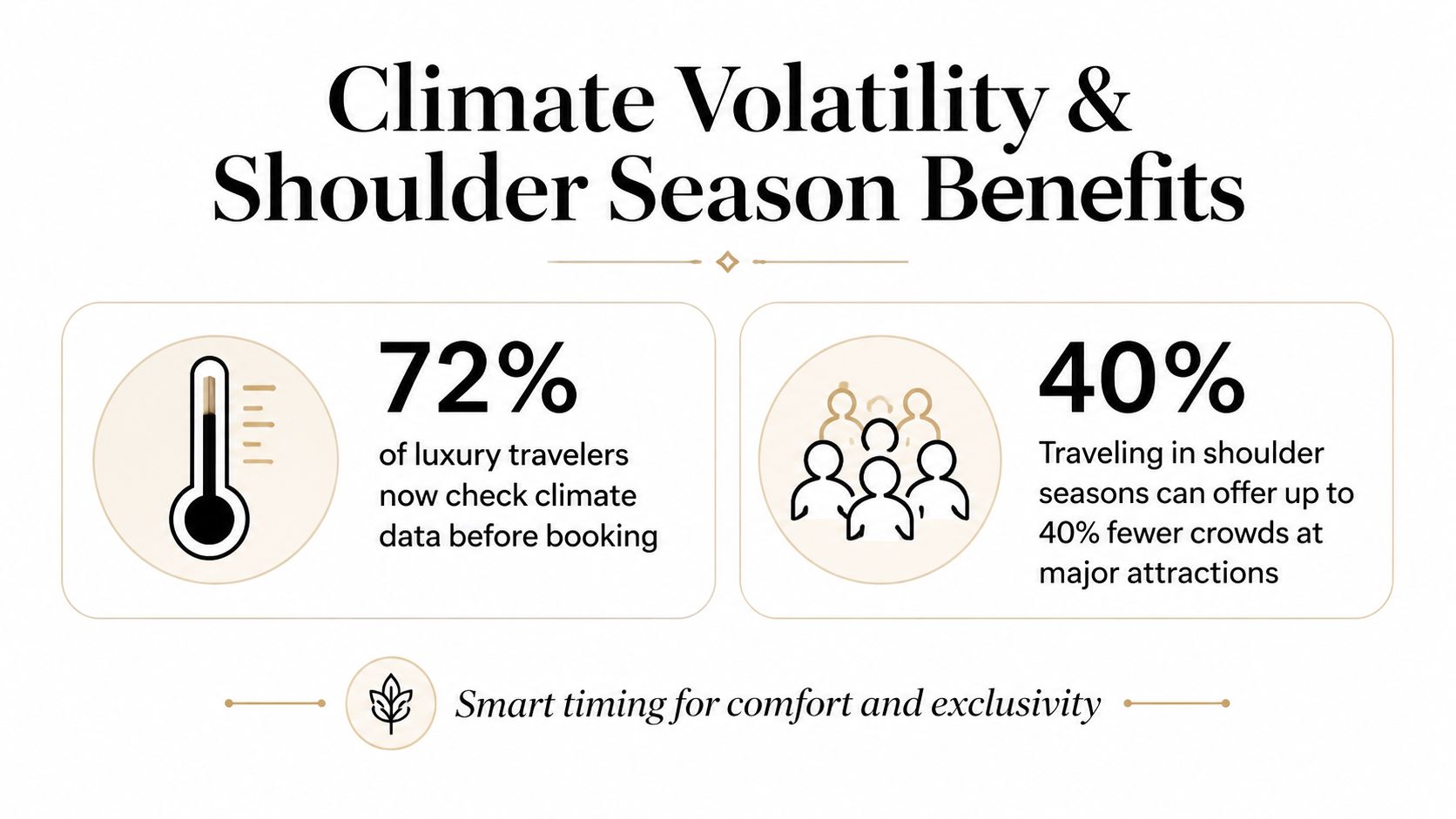
Peak season is no longer an automatic mark of quality. Luxury travelers increasingly want comfortable conditions, lighter crowds, and access that feels personal rather than processed through a famous destination at its busiest.
Industry coverage reports that nearly half of luxury clients are changing plans because of climate disruptions, while 78% of advisors say clients are moving toward shoulder or off-peak travel and 76% favor milder-weather destinations. TravelMole's coverage of Virtuoso's luxury travel trends provides that context. Zicasso also reports that spring represented 49.3% of global luxury bookings for 2025, with May the most requested month worldwide.
Build a weather-resilient route
Start with the climate risk, not the postcard. Identify which experiences depend on clear skies, comfortable temperatures, calm water, or reliable road access. Place those activities early enough to allow a replacement day, and keep indoor alternatives that still feel distinctive.
A shoulder-season itinerary should also protect exclusivity. Choose private access, smaller properties, local specialists, and experiences that don't depend on a single iconic viewpoint. If rain affects a garden visit, move the day toward architecture, craft, cuisine, or a private collection rather than cancelling.
Climate-aware planning is especially important for families. Different generations tolerate heat, cold, and long touring days differently, so milder timing can improve both comfort and participation. If a route includes a cruise or expedition segment, use a specialist resource to compare cruise ships by vessel style, itinerary, accommodation, and onboard experience before committing.
The objective isn't to avoid uncertainty completely. It is to ensure that a change in weather doesn't remove the reason you travelled.
Maximizing VIP Benefits and Insider Access
VIP benefits are most valuable when requested with timing and precision. Tell the advisor about room preferences, celebrations, dietary needs, preferred arrival rituals, and late checkout requirements before suppliers finalize the operational notes. Last-minute requests can work, but early information gives the property room to act.
Use resort credits deliberately. Apply them to experiences that would otherwise require additional coordination, such as a treatment, a private meal, or a guided activity. Ask whether credits are flexible, whether they apply per stay or per day, and whether advance reservations are necessary.
Request an upgrade based on the room you need, not the category you imagine. If privacy, a separate workspace, or a particular view matters more than additional space, say so. For practical guidance on partner privileges, consult Four Seasons preferred partner benefits.
Finally, ask the advisor to monitor sold-out experiences, room moves, and late availability throughout the journey. A trusted relationship can also connect the right members through HauteBlack's verified network of founders, executives, investors, athletes, and creators, particularly when a private roundtable or cultural introduction adds genuine value.
HauteBlack designs bespoke luxury travel itineraries around rare access, intelligent sequencing, VIP recognition, private aviation, villas, concierge dining, and dedicated advisory support. Visit HauteBlack to discuss the experience you want protected, the compromises you won't accept, and the journey that should be built around your priorities.
Frequently Asked Questions
Explore Our Guides


Signature Experiences


