Haute Black Journal
VIP Airport Concierge Services: Seamless Travel in 2026

Marlene Azeez
Director, HauteBlack
View all articles →
# VIP Airport Concierge Services: Seamless Travel in 2026
June 8, 2026
You're likely reading this with a calendar full of meetings, a departure time that can't move, and no patience for the usual airport theater. The driver arrives on time. The flight is confirmed. The hotel is waiting. And yet the weakest link in the entire itinerary is still the airport itself.
That's the mistake most travelers make. They optimize the aircraft, the suite, the ground transport, and the dinner reservation, then surrender the most chaotic part of the journey to chance. If your time is valuable and your privacy matters, that's poor planning.
VIP airport concierge services fix that. Not because they feel indulgent, but because they remove friction from a system built on queues, handoffs, and public exposure. For the right traveler, this isn't a nice extra. It's operational discipline.
The End of the Airport as You Know It
Your standard airport experience is a sequence of small inefficiencies that compound fast. Curbside confusion. A line at check-in. A bottleneck at security. An unclear escort to a lounge or gate. On arrival, the same mess in reverse, just with less patience and more fatigue.
Now compare that with a properly handled journey. Your car pulls up. A trained representative is already waiting. Documents are checked before they become a problem. Bags move when they should. You're guided through the airport instead of reacting to it. Nobody leaves anything to improvisation.
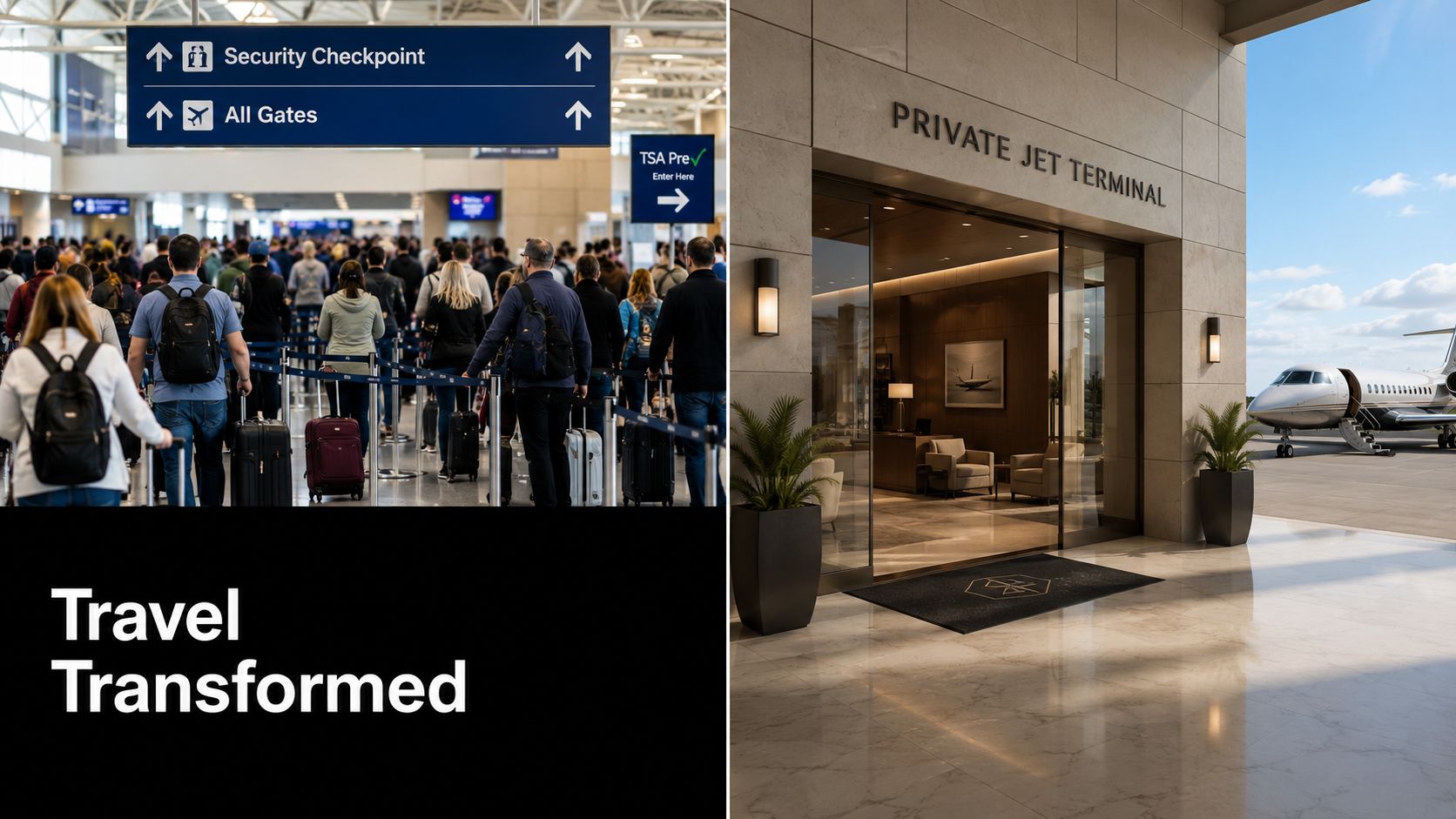
Airports are public. Your movement doesn't have to be
For high-profile travelers, founders, principals, family offices, and anyone moving with security awareness, the airport creates unnecessary exposure. You're visible at the curb, visible in line, visible at retail, visible at the gate. That may be acceptable for ordinary travel. It's not acceptable when discretion is part of the brief.
The best VIP airport concierge services replace randomness with choreography. They create continuity between transport, terminal procedures, and boarding or arrival transfer. That continuity is what changes the day.
Airports don't become less crowded because you booked a premium cabin. They become manageable because someone competent is controlling the process.
Comfort is the least interesting benefit
Soft seating and a calmer environment are pleasant. They're also beside the point. A key advantage is that a travel day stops hijacking your schedule and your attention. You can stay on calls longer before departure. You can move through formalities without wasting mental bandwidth. You can land and get out without standing under fluorescent lights waiting for the system to notice you exist.
That's why I advise clients to stop treating airport assistance as a luxury add-on. In a high-stakes itinerary, it belongs in the same category as a vetted driver, a reliable aircraft operator, and a hotel that understands profile handling.
Defining the Tiers of Airport Service
Not all VIP airport concierge services are equal. Some are simple escort services. Some are process-management tools. A select few deliver genuine privacy from curb to aircraft. If you don't understand the difference, you'll overpay for the wrong product or underbook the one you need.
Start with the problem you need solved
Most travelers don't need the highest tier every time. They need the right tier for the airport, the route, the visibility risk, and the complexity of the day.
Use this framework.
| VIP Airport Service Tiers Compared | |||
|---|---|---|---|
| Service Tier | Key Features | Level of Privacy | Ideal For |
| Meet and Greet | Personal escort, help with navigation, check-in guidance, assistance through airport touchpoints | Moderate | Travelers using unfamiliar airports, families, older travelers, executives who want smoother flow |
| Fast Track Support | Priority-style handling through security or immigration where available, escorted transitions, reduced queuing | Moderate to high | Tight timelines, short connections, business travel with low tolerance for delay |
| Full Departure or Arrival Handling | Coordinated assistance for baggage, check-in, security, immigration, and escorting as one managed service | High | C-suite travelers, principals, assistants managing complex itineraries, travelers arriving after long-haul flights |
| Private Terminal or Suite Access | Separate facility, private screening, dedicated waiting space, direct movement to aircraft | Very high | Public figures, UHNW travelers, families requiring total discretion, security-sensitive movements |
Meet and Greet is the entry point
This is the baseline tier. A representative meets you at an agreed point and guides you through the airport. Done well, it removes confusion and prevents wasted movement. Done poorly, it's little more than someone walking beside you.
The value here is situational. It's useful in large international hubs, on family trips, and when a principal wants an executive assistant to know the traveler is being handed from one controlled point to the next. It's also useful when the airport itself is the problem, not necessarily the traveler profile.
Fast Track matters when the airport is the threat
Some airports aren't difficult because they're complicated. They're difficult because they're clogged. In those cases, expedited handling becomes less about pampering and more about protecting the schedule.
A strong fast track service should sit inside a broader handling plan. If it exists in isolation, it can still leave you exposed to check-in delays, baggage issues, or disjointed transfers between formalities. That's why I prefer integrated handling over piecemeal upgrades.
Practical rule: If your connection is tight, or the airport is known for long control points, don't book “help.” Book full process management.
Full handling is where the service becomes serious
This is the tier many discerning travelers want, even if they think they're asking for something simpler. You're not buying a greeter. You're buying continuity. The check-in, baggage handoff, security assistance, and immigration support operate as one service, not as separate favors.
That's the difference between feeling assisted and being protected from disruption.
Private suites are the top end for a reason
At the highest tier, the airport can become almost unrecognizable. A leading example is the Private Suite at Los Angeles International Airport, where members and non-members can pay between $2,700 and $4,000 for access to a facility with 10 individual suites, private TSA screening, and direct transportation to the aircraft, as described by Airport Technology's coverage of private terminal airport services.
That model is the clearest expression of what top-tier airport handling should deliver. Not a better place to wait. A different operating environment entirely.
My recommendation
Book by stakes, not by ego.
- Choose Meet and Greet if the airport is unfamiliar and you want confidence.
- Choose Fast Track with escorting if timing is the pressure point.
- Choose full-service handling if you care about smooth execution from first contact to final handoff.
- Choose private terminal access when privacy is an absolute priority.
If you're a frequent premium traveler and you're still piecing together airport movement on the fly, you're leaving too much to chance.
The Seamless Journey on Arrival and Departure
The easiest way to understand VIP airport concierge services is to stop thinking about amenities and start thinking about sequence. Good airport handling is a controlled sequence with no weak handoffs.
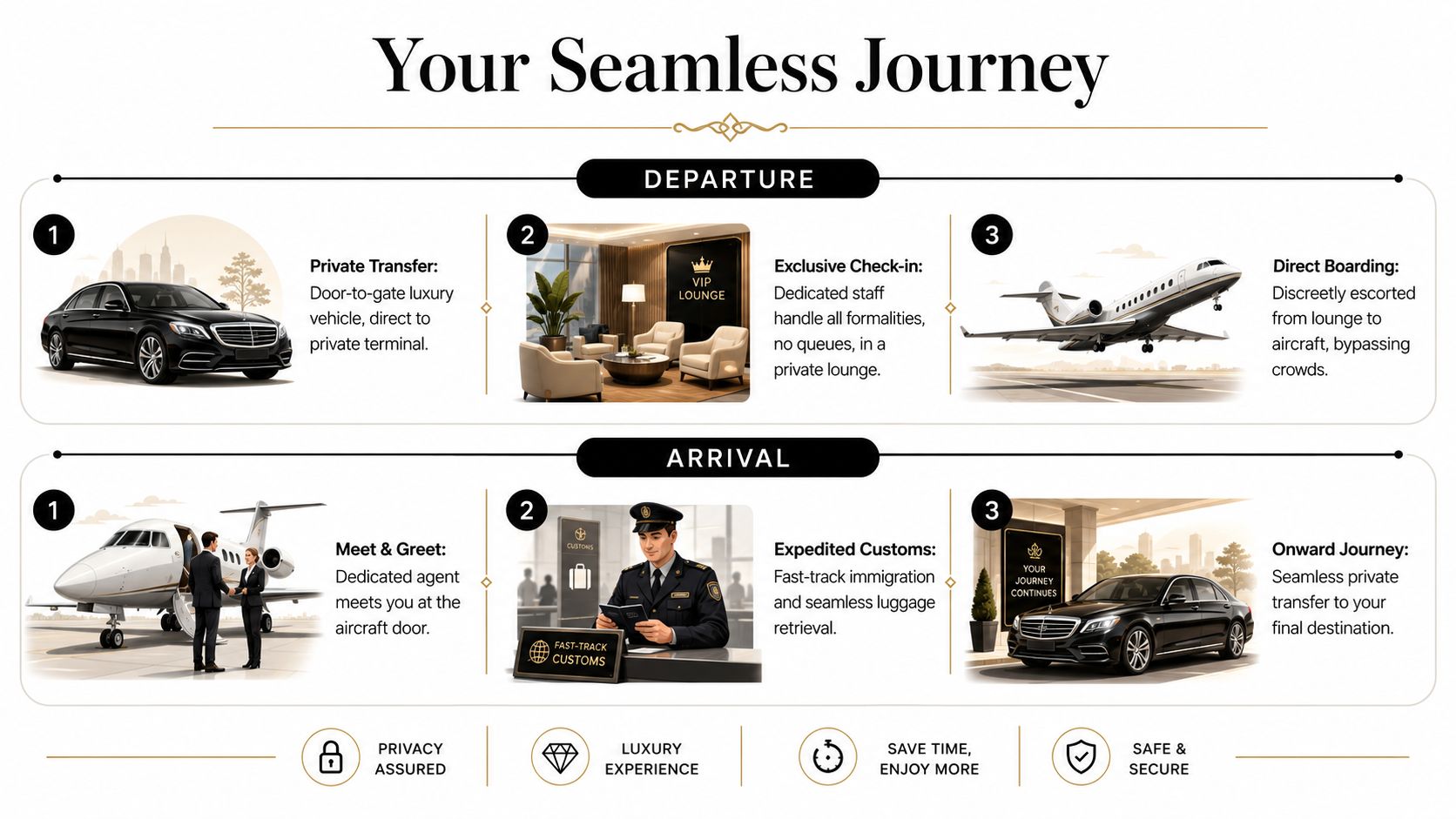
Departure is won at the curb
On departure, the service starts before you enter the terminal. Your representative is positioned in advance, not “on the way.” Bags are identified immediately. Check-in is handled with purpose. Any friction around documentation, airline desks, or terminal routing is dealt with before it becomes your problem.
This is why the integrated model matters. VIP airport concierge services are designed as a coordinated curb-to-gate and gate-to-curb workflow, with staff handling check-in, baggage, security, and immigration as one process rather than a series of disconnected touchpoints, as outlined by The Points Guy's explanation of airport concierge workflows.
A polished departure usually looks like this:
- Curbside handoff: Your agent meets the vehicle, confirms the airline and route details, and takes control of the airport side of the day.
- Formalities managed quickly: Check-in, baggage coordination, and movement to the appropriate control points happen with minimal drift.
- Escort to the next secure waiting point: That may be a lounge, a gate, or a private facility depending on the service tier.
If your journey includes a coordinated air itinerary, it makes sense to align airport handling with the broader air travel planning support offered here, especially when timings, terminals, and ground transfers need to fit together precisely.
For clients flying through the UAE, pair the airport side with reliable upscale Dubai airport transportation so the curbside handoff is just as polished as the terminal handling.
Here's a visual walkthrough of how a managed airport journey should feel in motion.
Arrival is where the service earns its fee
Arrival support is often more valuable than departure support. You're tired, less patient, and usually working against another commitment. Under these circumstances, ordinary premium travel often falls apart. You can land in a premium cabin and still lose momentum the moment you step into the terminal.
With proper arrival handling, someone meets you at or near the aircraft exit, guides you through the arrival sequence, coordinates immigration and baggage support, and delivers you to your onward vehicle without confusion.
The best arrival service feels almost invisible. Doors open, documents are ready, bags appear, and you're already moving again.
Connections need active management
Connections are where weak providers get exposed. A basic escort can walk you between gates. A serious operator monitors the reality on the ground, adapts to terminal changes, and keeps every transition under control.
That matters most when your itinerary includes:
- Short connection windows
- Multiple terminals
- Security re-clearance
- Dependents or staff traveling with the principal
A missed handoff during a connection can unravel the rest of the day. That's why I advise clients to think less about “VIP treatment” and more about “continuity of custody” for the journey itself. If one person or one coordinated team owns the process, things get solved faster.
The Tangible Returns for the UHNW Traveler
The primary case for VIP airport concierge services isn't comfort. It's return. If you're evaluating the service like a leisure splurge, you'll miss its actual value.
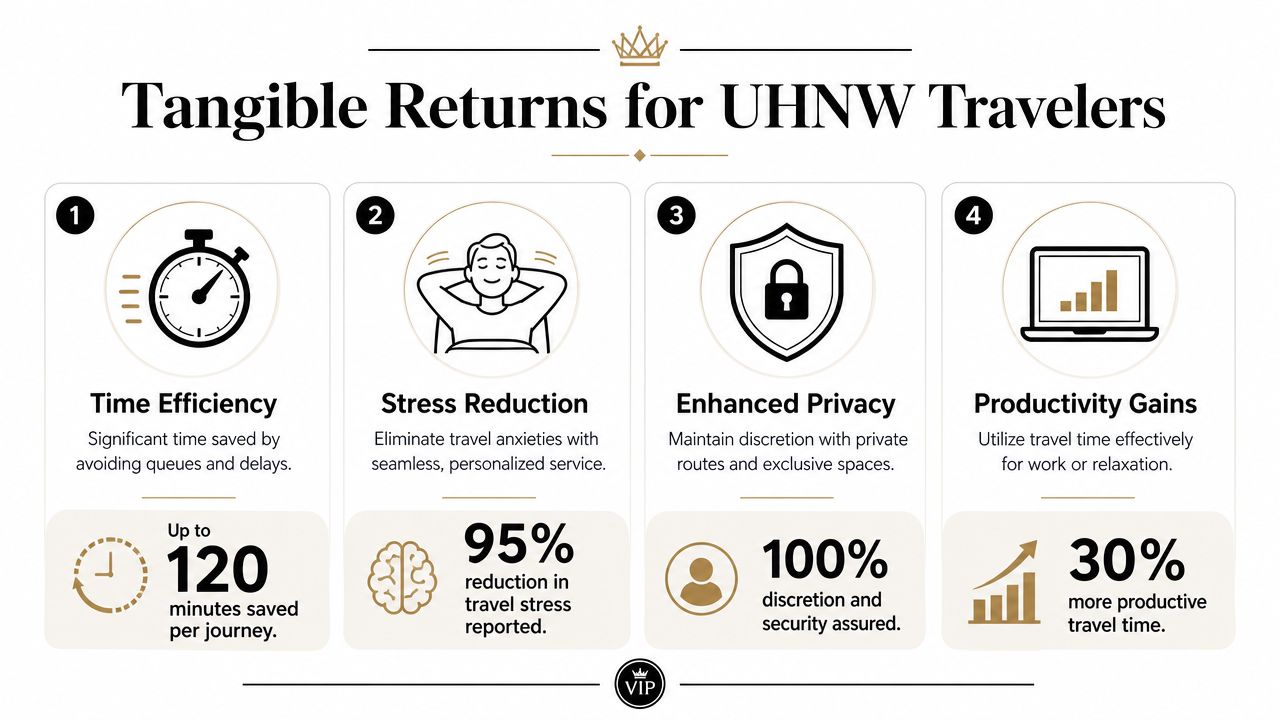
Time is the first asset protected
Airport friction steals time in fragments. Ten minutes at the curb. Another stretch at check-in. More at security. More still on arrival while waiting for someone to point you in the obvious direction. None of this sounds dramatic until it keeps happening across a year of travel.
UHNW travelers shouldn't be spending decision-making energy on public-terminal logistics. That energy belongs elsewhere. A managed airport process converts dead time into usable time. You can stay focused longer before departure and return to your schedule faster after landing.
Privacy has become a travel requirement
Many affluent travelers don't need spectacle. They need less visibility. The wrong airport experience puts you in crowds, in lines, and in predictable public spaces where anyone can observe your movement.
That's why private handling matters even for travelers who don't consider themselves “VIP” in the celebrity sense. Principals, family office executives, public company leaders, and security-conscious families all benefit from reducing unnecessary exposure.
Productivity survives when the process is controlled
Travel drains attention because airports force constant micro-decisions. Where do I go. Which lane is moving. Has baggage been checked properly. Is the connection still realistic. Has the driver been updated.
A strong concierge service removes those decisions. That leaves space to work, review, think, or remain composed before the next obligation. For many clients, that alone justifies the spend.
One smart complement to this approach is building the entire trip with the same mindset. If you want the wider private travel ecosystem around this level of movement, this private jet luxury travel guide is a useful companion read.
Risk drops when ownership is clear
The most underrated benefit is risk mitigation. Somebody is accountable for the sequence. That means fewer missed handoffs, fewer avoidable misunderstandings, and fewer moments where a traveler is left to sort out problems in public.
Consider where things usually fail:
- At documentation points, when a detail is noticed too late
- At terminal transitions, when a traveler is sent in the wrong direction
- At arrivals, when baggage and driver coordination aren't aligned
- During disruptions, when nobody seems to own the problem
If the day matters, airport handling shouldn't rely on luck, signage, or your tolerance for disorder.
That's the point. This service doesn't create luxury for its own sake. It protects momentum.
Navigating Booking Etiquette and Value
Most booking mistakes happen before the traveler ever reaches the airport. People ask for the wrong service, give incomplete information, or assume all providers deliver the same level of access. They don't.
Book the outcome, not the label
“Airport concierge” is broad language. One provider may mean a simple escort. Another may mean full arrival management. Another may offer access to a private facility under specific conditions. If you book by headline rather than by deliverables, you're inviting disappointment.
When arranging VIP airport concierge services, confirm these points in writing:
- Meeting point: Exact curb, terminal entrance, lounge, or aircraft-side coordination point
- Scope of handling: Check-in, baggage assistance, security, immigration, lounge escort, gate escort, or arrival exit support
- Party details: Names of all travelers, children, staff, and any special handling needs
- Vehicle alignment: Who's handling curbside pickup or onward transfer, and how live updates will be shared
- Contingency plan: What happens if the inbound flight is delayed, the gate changes, or the traveler misses the scheduled arrival window
Direct booking versus advisor booking
Direct booking can work for simple, one-airport requests when you already know the provider and the airport well. It's less effective when the itinerary is layered, visibility-sensitive, or tied to other moving parts.
An experienced advisor earns their place when the airport service needs to fit inside a larger trip architecture. That includes commercial premium cabins, private aviation, villas, complex family movement, multiple chauffeurs, or security-aware handling.
If you want a broader view of how concierge support should work beyond the terminal, this guide to luxury travel concierge services is worth reading.
Lead time matters more than people think
Simple airport assistance can sometimes be arranged on shorter notice, but I don't advise relying on that if the traveler is important or the airport is in high demand. The more exclusive the service, the less forgiving the timeline.
My recommendation is straightforward:
- Book early for private-terminal style services
- Book as soon as flights are ticketed for major hubs and peak periods
- Reconfirm all movement details before the day of travel
Waiting until the last minute is a poor strategy when discretion and execution matter.
Ask better pricing questions
You don't need made-up ranges to evaluate value. You need clarity on what you're paying for. Ask whether the quote covers only escorting or also baggage, terminal formalities, waiting time, and arrival coordination. Ask whether the service is airline-dependent or airport-dependent. Ask whether the rate changes if your schedule shifts.
The one public benchmark worth knowing is at the top end of the market. As noted earlier, Los Angeles International Airport's Private Suite charges $2,700 to $4,000 for use of its highly private facility. Everything else should be judged against the level of handling, access, and privacy being delivered, not the glamour of the sales copy.
Etiquette is simple if you act like a professional
You don't need to perform wealth. You need to communicate clearly.
- Send complete details early: Passport names, flight numbers, baggage expectations, and traveler preferences
- Respond quickly on the day: If your agent asks where the vehicle is or confirms a gate change, answer immediately
- Treat timing seriously: These services run on sequencing. If you're late to the curb or slow to deplane, the whole chain gets harder
- Handle gratuities appropriately: Follow local norms and provider guidance, and never make the staff chase you for a decision at the last second
Polish matters. Not because it's formal, but because good service depends on accurate information and clean handoffs.
The Haute Black Advantage Bespoke Curation
A VIP airport service can be purchased. A fully coherent travel experience has to be curated. Those are not the same thing.

Access alone is a low bar
Plenty of providers can arrange an airport escort. That doesn't mean they understand how that airport movement should connect with the rest of the trip. The difference at the top of the market is orchestration.
A curated approach considers the entire chain. Not just the airport arrival, but the principal's tolerance for exposure, the quality of the ground transfer, the realism of the connection, the role of accompanying family or staff, and the rhythm of the journey before and after the terminal.
Relationships improve the experience before you even notice them
The strongest travel networks don't merely submit requests. They know who to call, what to request, and how to shape the brief so the traveler gets a cleaner result. That matters in luxury travel because service quality often depends on context, not just confirmation numbers.
The practical advantage is consistency. The airport service isn't treated as an isolated booking. It becomes one expression of a larger travel standard.
Good curation removes the seams between services. The traveler shouldn't feel where one provider stops and another begins.
Bespoke means personal, not ornamental
This isn't about adding theatrical extras. It's about building around preferences that affect the day. Some travelers want the fastest possible transit. Others want maximum privacy. Some need family-friendly pacing. Others need a route that minimizes visibility and idle time.
An advisor who understands those distinctions can shape the airport component accordingly. That is where bespoke travel stops being a buzzword and starts being useful.
The standard should be integration
For discerning travelers, the airport should never be the unmanaged middle. It should fit cleanly between departure logistics and destination arrival, with no drop in quality or awareness.
That's the benchmark I'd use for any provider, whether the trip is commercial, hybrid, or fully private. If the airport service doesn't feel integrated with the rest of the journey, it isn't premium enough.
Frequently Asked Questions
Are VIP airport concierge services available globally
Availability is broad, but the service standard is not universal. Major international gateways tend to offer the best options, while smaller airports may provide only lighter-touch assistance. The right question isn't “Is it available?” It's “What specific level is available at this airport?”
Can families or small groups use the service
Yes, and in many cases they should. Families with children, multigenerational travelers, and principals moving with assistants or security benefit from coordinated handling because the airport stops becoming a game of keeping everyone aligned. Group movement is exactly where weak handoffs become expensive and stressful.
How much notice should you give
More than you think. If the airport matters, the route matters, or privacy matters, book early. For top-tier handling, especially private-terminal style services, waiting until the final days is reckless. Confirm details again once flights are stable.
Is it worth booking for a short flight
Yes, if the airport side of the journey is the pain point. The duration of the flight is often irrelevant. A short flight can still involve a crowded departure, intrusive arrival flow, or a tight timeline on either side. If the traveler's schedule is compressed, airport support can be worth more on a short trip than on a long leisure itinerary.
Is this only for celebrities
No. Public figures are obvious users, but they're hardly the only ones. Executives, family offices, older travelers, families, and anyone who values discretion and speed can benefit. The deciding factor isn't fame. It's whether your time, privacy, and energy are too valuable to waste on terminal chaos.
What should you prepare before the day of travel
Keep it simple and complete. Share full traveler names, flight details, contact information, baggage expectations, and any support requirements. Confirm the meeting point. Confirm the vehicle plan. Then stay reachable. The service works best when the traveler or assistant is responsive.
What's the clearest sign you booked the right service
You barely think about the airport at all. There's no confusion, no hunting for people, no awkward waiting, and no sense that anyone is improvising. The process moves fluidly.
If you want airport movement handled with the same precision as the rest of your trip, Haute Black is the kind of partner to brief. Their world is built for travelers who expect privacy, timing, and access to work together without friction.
Explore Our Guides


Signature Experiences


