Haute Black Journal
Concierge Service Cost and Luxury Pricing Models

Marlene Azeez
Director, HauteBlack
View all articles →

Concierge service cost is rarely a single universal rate. Basic requests typically range from $50 to $300 per task, while ultra-premium private memberships can reach $50,000 or more annually when they provide 24/7 access and relationship management.
The popular advice is to ask for an hourly rate and compare providers. That works for a restaurant reservation or a simple local errand. It fails when the brief involves a private aircraft, a last-minute villa change, a multi-generational itinerary, or an introduction that depends on trust rather than an online booking form.
Luxury concierge pricing reflects what you're buying beyond task completion. You may be paying for a named advisor, preferential treatment, supplier brokerage, global coordination, after-hours redundancy, and the confidence that one person understands the principal's standards without requiring a complete briefing every time. The cheapest quote often describes a low-touch service. The premium quote pays for access, judgment, and operational continuity.
Redefining the Value of Luxury Concierge Services
Hourly pricing is a poor way to judge high-end concierge work. It measures activity, not access. A personal assistant arranging a delivery and a private travel advisor coordinating aviation, accommodation, security-sensitive movements, dining, and cultural access are selling different services.
Published guidance places pay-per-request concierge work at $50 to $300 or more per task, while hourly arrangements commonly sit between $75 and $250 or more per hour (pricing guidance for concierge services). Use those figures as a baseline, not a definition of the luxury tier. A simple request has a clear endpoint. A complex travel brief can change repeatedly, involve several suppliers, and demand decisions outside normal business hours.
The difference between assistance and access
A task-based concierge follows instructions. A relationship-led advisor protects the principal's time by anticipating complications, knowing which supplier can solve them, and securing attention that public inventory cannot provide. That distinction becomes visible when a preferred suite is unavailable, an aircraft schedule changes, or an important dinner must move at short notice.
For an executive assistant or family office, ask these questions before comparing fees:
- Who owns the relationship: Will one advisor understand the principal's preferences, travel history, and tolerance for compromise?
- What access is included: Does the service provide supplier relationships, VIP recognition, and escalation paths, or only searches of public inventory?
- What happens after hours: Is someone accountable when a request arrives at night, over a weekend, or across time zones?
- How broad is the mandate: Can the provider coordinate homes, aviation, hotels, dining, transport, and events, or only book one component?
The strongest providers sell continuity. They retain context, reduce repeated briefings, and coordinate decisions across the journey rather than treating each booking as a separate ticket.
A principal searching for a London residence may need more than property listings. A boutique home search service can help when the brief depends on discretion, neighborhood judgment, and access to suitable homes that are not presented like ordinary inventory.
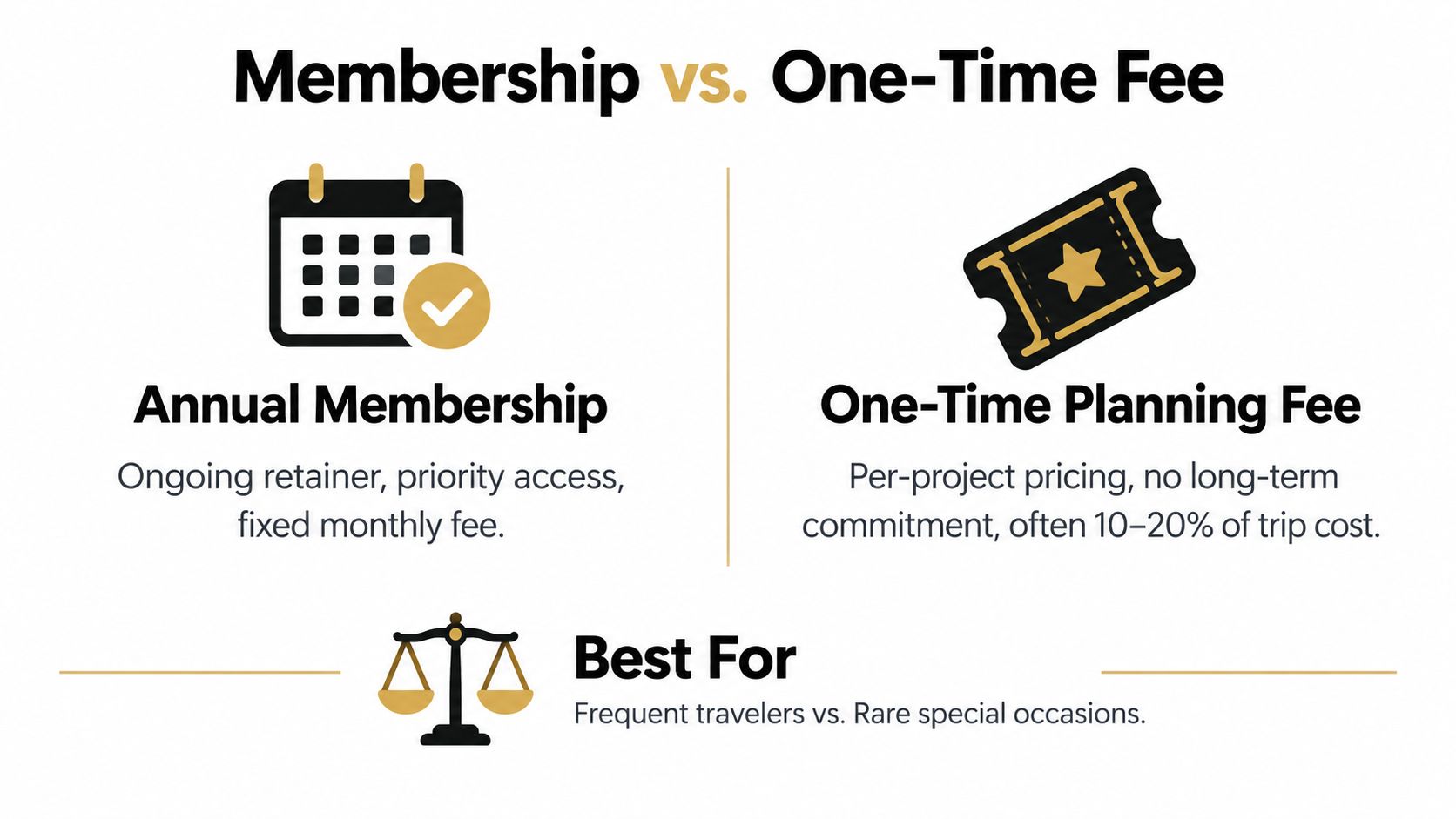
HauteBlack's guide to luxury travel concierge services reflects the practical distinction between one-time planning fees and annual memberships. One-off pricing suits a defined journey. Membership economics make more sense when the advisor becomes part of the principal's operating rhythm and remains accountable beyond a single itinerary.
Practical rule: If the service only sells time, compare hours. If it sells judgment and access, compare the quality of the operating relationship.
Premium pricing earns its place when the provider reduces coordination across multiple touchpoints, protects confidentiality, and gives the principal dependable access to informed judgment. A luxury label alone does not justify a higher invoice.
Decoding the Four Primary Pricing Models
The headline rate is rarely the full cost of a luxury concierge. The deciding factors are access, availability, and how much responsibility the advisor accepts when plans change. The four common structures are pay-per-request, hourly arrangements, monthly retainers, and annual memberships. Urgent, complicated work demands more coordination and supplier brokerage, while recurring work lets the provider reserve capacity and retain context.
| Pricing Model | Typical Cost Range | Best Suited For |
|---|---|---|
| Pay-per-request | $50–$300 or more per task | Occasional, clearly defined requests |
| Hourly arrangement | $75–$250 or more per hour | Flexible assistance with measurable working time |
| Monthly retainer | $1,000–$5,000 or more per month | Recurring travel, lifestyle, or executive support |
| Annual membership | $5,000–$100,000 or more per year | Ongoing access, complex travel, and high-touch relationship management |
Pay-per-request pricing
A task fee works when the brief has a firm beginning and end. A restaurant booking, local purchase, or single transport arrangement can fit that model. The problem starts when a “simple” request expands into guest-list changes, dietary negotiations, a private-room request, and transport coordination.
Ask whether the fee includes revisions, supplier calls, cancellation work, and urgent escalation. If each adjustment creates a new charge, the low opening price becomes expensive and frustrating to administer. Use this model for contained work, not an evolving itinerary.
Hourly arrangements
Hourly billing suits flexible assistance without continuous access. It can work for an assistant handling intermittent lifestyle requests or a traveler who needs research rather than full itinerary ownership.
The trade-off is clear. The provider is paid for time, even when the client values speed, judgment, and the quality of the outcome. Hour tracking also creates the wrong discussion for a principal who expects discretion and rapid resolution. Use hourly support for research and defined administration, not relationship-led travel management.
Monthly retainers
Retainers generally range from $1,000 to $5,000 or more per month. They fit clients with recurring requests, several active trips, or a household requiring consistent support. The provider can reserve capacity, learn preferences, and address work before it becomes urgent.
Define the scope before signing. Some retainers include a set task volume. Others price the relationship around availability and access. Confirm how unused capacity works, whether travel planning fees are separate, and which supplier charges remain payable by the client. A retainer earns its premium when the advisor is accountable between requests, not merely available to process them.
Annual memberships
Annual memberships sit at the relationship end of the spectrum. Published ranges place them from $5,000 to $100,000 or more per year. This structure suits a client who expects ongoing support, international coverage, and a dedicated advisor who can act quickly without rebuilding context.
For ultra-high-net-worth clients, complex itineraries often justify a retainer or membership rather than isolated task fees. The client is securing one accountable service layer across aviation, hotels, villas, dining, events, transfers, and changes. Before committing, verify what true availability means, who handles urgent requests, and whether the membership buys access to judgment and relationships or only a higher task allowance.
Hotel Concierge Versus Private Travel Architecture
A hotel concierge is often excellent at solving immediate, local problems. The desk can recommend a restaurant, arrange a car, secure a table, or help with a property-level request. The service is usually included with the stay, but its mandate is tied to the hotel and destination.
A private travel concierge or VIP travel agency owns a wider piece of the journey. It may coordinate the aircraft, villa, ground movements, hotel sequence, dining, events, and contingency planning before the guest reaches the first property. HauteBlack's coverage of VIP travel agencies and luxury travel experiences draws the relevant distinction. A concierge may handle restaurants, local arrangements, and lifestyle requests, while a VIP travel agency takes responsibility for the broader travel architecture.

What the hotel desk does well
The hotel team has immediate knowledge of its own property and local area. That makes it effective for restaurant recommendations, in-house arrangements, nearby transport, and practical assistance during a stay. It may also help a guest recover from a disruption within the hotel's sphere of control.
It doesn't normally own the full itinerary. The desk won't necessarily know the aircraft operator, the villa manager in the next country, the family's preferred room configuration, or the principal's tolerance for a particular transfer. It also may not remain accountable once the guest leaves the property.
What private architecture adds
An end-to-end advisor builds a coherent operating plan. The value lies in connecting decisions that a series of separate vendors would treat independently.
- Aviation coordination: Private aircraft, first-class arrangements, and helicopter transfers need to align with hotel check-in, ground transport, and baggage requirements. HauteBlack provides information about private aviation arrangements as part of its broader travel offering.
- Accommodation strategy: A villa, estate, or hotel should match the group's privacy, service, access, and rooming requirements rather than solely availability.
- Recognition management: The advisor can communicate preferences and VIP expectations across partner properties instead of relying on the guest to repeat them.
- Contingency ownership: When weather, schedules, or supplier failures disrupt the plan, one accountable team can rework the sequence.
A Virtuoso-affiliated agency with preferred relationships across luxury properties may also secure benefits such as upgrades when available, resort credits, flexible amenities, and a more informed arrival. Those benefits don't erase a planning fee, but they can change the practical value of the engagement.
The Hidden Variables That Drive Price Variability
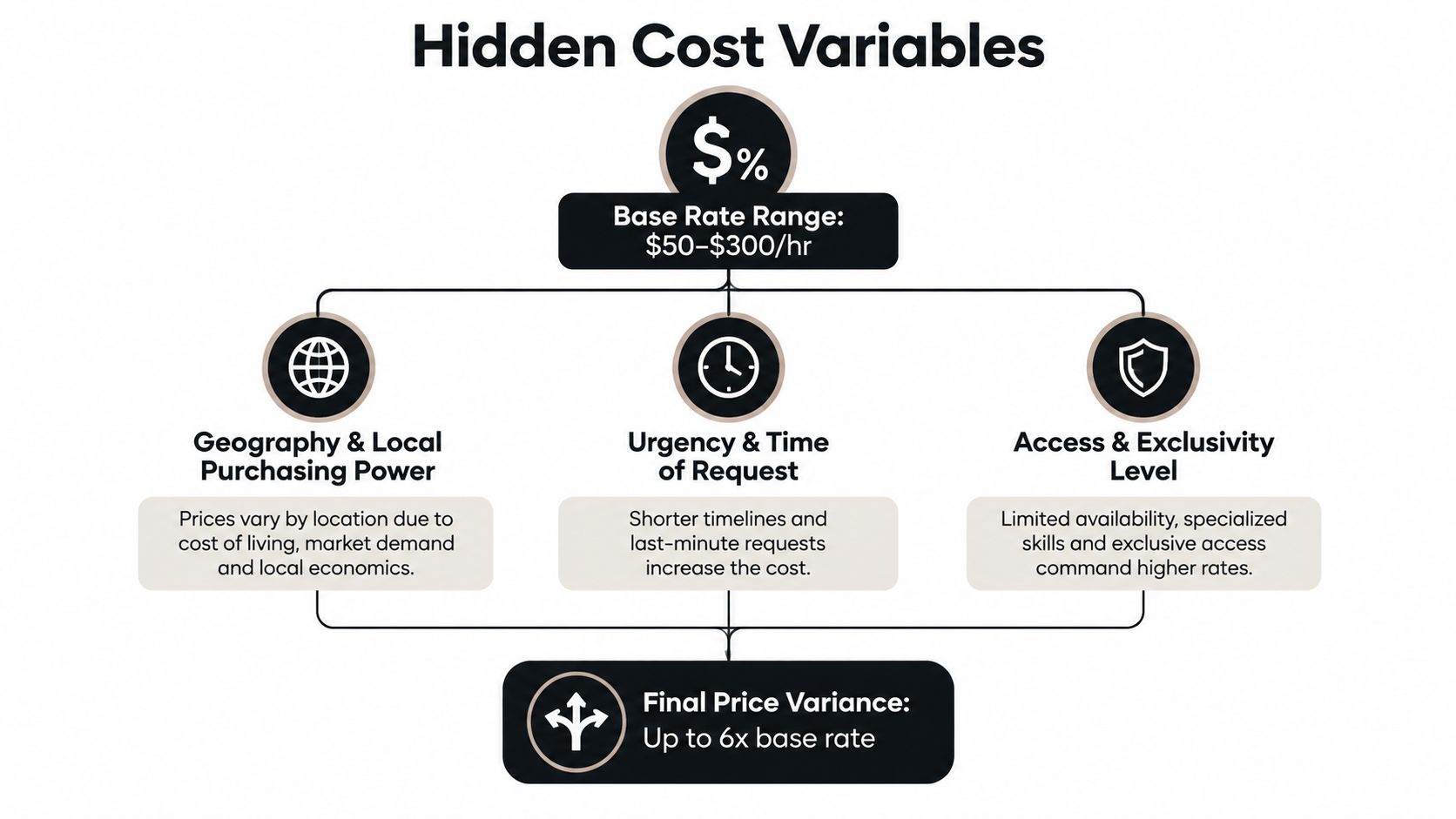
Two clients can request “a luxury car and dinner” and receive very different quotes. Geography, timing, access level, staffing, and service density determine the actual workload. The request may look identical on paper while the operating conditions are completely different.
IFMA reported an average overall cost for concierge services in office facilities of €15.97 per square metre, approximately 87% higher than its 2017 North America benchmark (facilities pricing reference). The useful lesson isn't that office facilities and private travel are interchangeable. It's that concierge cost responds to service density, staffing structure, and local labor conditions, not just to a headcount or a number of hours.
Service density changes the invoice
Service density describes how many touchpoints the operator must support and how often those touchpoints generate work. A low-density client may need occasional reservations. A high-density household may have several simultaneous trips, household requests, guest movements, and changes in progress.
That density requires more than extra labor. It demands coordination systems, supplier knowledge, quality control, and a team capable of handing work between markets. A premium operator can charge more because it maintains the coverage needed to prevent one unresolved issue from affecting the rest of the itinerary.
Geography and labor markets matter
Local labor costs and purchasing power influence the price of live support. A request in a major European capital, a resort destination, and a remote island may require different staffing, supplier brokerage, and transport coordination. The provider may also need local specialists rather than a generalist working from one central office.
The principal should ask for the operational reason behind a geographic premium. “International coverage” is meaningful when it identifies named teams, local supplier relationships, and escalation procedures. It is weak when it merely describes a marketing footprint.
Urgency and access level add pressure
Urgent requests compress the decision window. After-hours work requires coverage when the core team may be offline. Exclusive access may require a trusted intermediary, a specialist broker, or a supplier willing to prioritize the request. These variables can make a task materially more expensive without changing its visible output.
Advisor's view: Pay for the operational capability you need, not a vague promise of luxury. Ask the provider to connect each premium to coverage, expertise, or access.
The best quote explains the service density behind the price. It identifies what the team will manage, who remains accountable, and how the provider handles peak demand.
The Economics of True Availability and Immediate Response
The most expensive part of concierge work is often not the task. It's the promise that someone competent will respond immediately, at any hour, across several markets.
Independent European luxury concierge rate cards illustrate the spread. Per-assignment fees can range from €250 to €12,000, daily packages from €800 to €2,500, and monthly retainers from €1,500 to €12,000 (European luxury concierge rate card). The same source describes premium daily support with overnight standby and VIP daily support with a team and 24/7 standby, both priced above standard daytime assistance.
What availability actually requires
A real response guarantee needs redundancy. One advisor can't personally cover every time zone, emergency, supplier call, and live itinerary change without backup. The provider must maintain handover procedures, secure client information, escalation authority, and people who can act rather than just acknowledge a message.
That infrastructure is what the availability premium buys. It also explains why a low advertised task fee may not represent the cost of dependable access. The quoted amount may cover completion during normal hours, while the principal needs an accountable team available after dinner, during a flight, or while moving between countries.
Digital convenience versus human judgment
The category is moving toward app-based, digital, and AI-assisted concierge models, which creates a useful split between low-touch automation and high-touch human service. Digital tools can handle straightforward discovery, reminders, preference storage, and routine requests efficiently.
They don't replace human judgment in sensitive situations. An automated system may identify a restaurant, but it won't necessarily understand why a particular table matters, which guest should be seated away from a public area, or how to recover a relationship after a supplier fails. Lower pricing can be sensible when the request is routine. It becomes false economy when the client needs discretion, negotiation, or immediate escalation.
Before signing, ask for the response standard in plain language. “24/7 access” should specify who responds, how quickly, what happens if the named advisor is unavailable, and whether urgent supplier intervention is included or billed separately.
Evaluating Memberships and One-Time Planning Fees
The decision between a one-time fee and an annual membership should follow the client's operating pattern, not the provider's sales preference. A rare, self-contained journey usually needs a defined project. A globally mobile principal with recurring travel, lifestyle requests, and frequent changes benefits from continuity.
HauteBlack's luxury family travel guidance frames the practical choice between retainers and one-off bookings. A family travel concierge can provide operational support around an ongoing relationship, while a one-time booking remains tied to a specific itinerary and deliverable.
Choose a one-time planning fee when the brief is contained
A project fee makes sense when the client has a clear destination, travel window, group profile, and end date. It preserves flexibility and avoids paying for access that won't be used between trips.
Before approving the fee, confirm whether it includes:
- Planning revisions: Establish how many rounds of changes the team will manage.
- Supplier communication: Ask whether hotels, villas, aviation providers, and restaurants are handled directly.
- Crisis support: Determine whether disruption management ends when the itinerary is booked.
- Additional services: Separate planning fees from air tickets, accommodation, transfers, event tickets, and cancellation charges.
The one-time model is attractive because the cost is visible. Its limitation is that the advisor may not have an ongoing incentive or mandate to support the principal after delivery.
Choose membership when continuity is the priority
Membership economics suit a client who values a dedicated advisor, priority access, and ongoing context. The provider can learn the family's preferences and coordinate several journeys without restarting the discovery process. Members may also receive waived planning fees, depending on the program and scope.
HauteBlack describes its membership offering in terms of dedicated travel support and member benefits. The relevant diligence question is not the annual price. Ask what access the fee secures, which planning charges are waived, how last-minute requests are handled, and whether the advisor can manage the full travel architecture.
A practical decision test
Use three questions:
1. Frequency: Will the household request support repeatedly throughout the year?
2. Complexity: Do trips involve several countries, aircraft, properties, generations, or sensitive arrangements?
3. Cost of delay: Would a slow response create a material loss of time, access, or comfort?
If the answer is yes across all three, a membership or retainer is usually more coherent than repeated task fees. If the brief is exceptional and self-contained, buy the project and keep the commitment narrow.
Questions to Ask Before Signing a Luxury Retainer
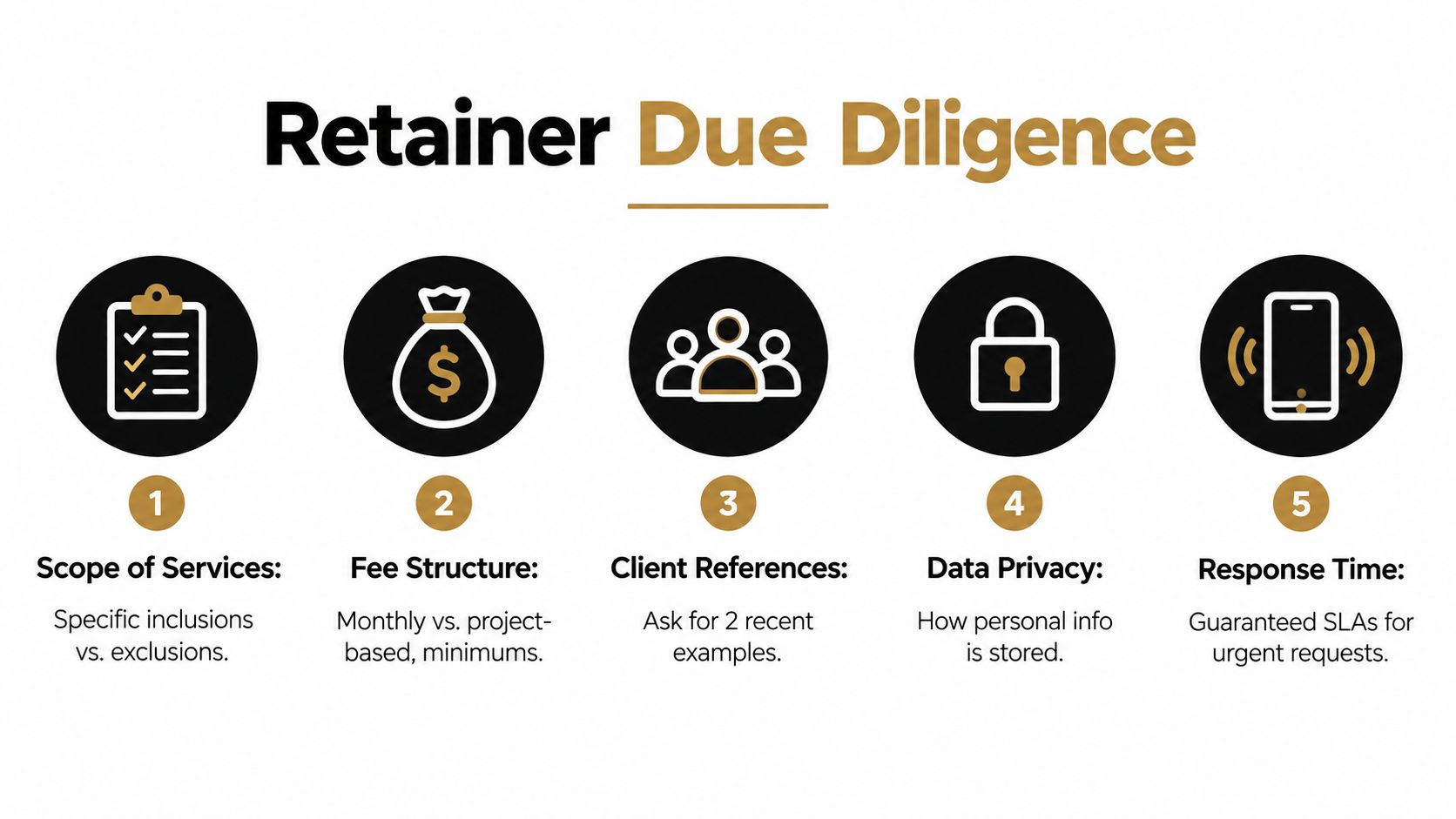
An executive assistant should treat a concierge agreement like an operating contract, not a lifestyle subscription. The first conversation should test accountability, scope, privacy, and response capacity before anyone discusses preferred restaurants or villa aesthetics.
Ask these questions directly:
- Who is accountable: Will the principal have a named advisor, and who takes over during absence?
- What is included: Which services sit inside the retainer, and which requests trigger project fees or supplier charges?
- How does VIP recognition work: Does the provider communicate preferences before arrival, and through which hotel or travel partners?
- How are aircraft and transfers brokered: Who verifies operators, coordinates schedules, and manages a disruption?
- What does 24/7 mean: Is the promise an answering service, a trained advisor, or a team with authority to act?
- How is information protected: Where are passport details, travel patterns, family information, and payment records stored?
- What are the exit terms: Can the client pause or cancel, and what happens to active bookings and deposits?
A provider should answer with process, not adjectives. Ask for recent client references where appropriate, a sample service schedule, and a written escalation path. You should also understand whether the team works from public inventory or uses direct relationships with hotels, villas, aviation providers, restaurants, and event organizers.
The standard is simple: Your advisor should reduce decisions, not create another inbox for the family office.
The right concierge retainer buys reliable judgment and a protected channel into the travel ecosystem. If the contract only promises access to a booking platform with a polished interface, price it as administrative support rather than luxury travel architecture.
HauteBlack provides bespoke itineraries, VIP travel recognition, private aviation coordination, villas and estates, transfers, dining, and member-focused advisor support. Review HauteBlack when you're comparing concierge service cost against the value of one accountable relationship for complex, high-touch travel.
Explore Our Guides


Signature Experiences


