Haute Black Journal
Tours of Sicily: The Luxury Insider's Guide

Marlene Azeez
Director, HauteBlack
View all articles →

# Tours of Sicily: The Luxury Insider's Guide
Published August 2, 2026 by Marlene Azeez
Most tours of Sicily are mis-designed from the start. They treat the island as one neat loop, stack Palermo, Etna, Taormina, and the Baroque towns onto a coach, and call it “in-depth,” even though Sicily is too large, too layered, and too regionally distinct for that approach to work well.
The better question isn't which tour to book. It's which Sicily you want to stay in, because the island changes fast once you choose a base, a coastline, and a driving rhythm. Get that wrong, and even a luxury trip starts to feel like a transfer schedule with good dinners attached.
I've seen honeymooners overbook the east coast, families wear themselves out with cross-island repositioning, and collectors miss the point entirely by trying to “see everything.” The smart way to plan tours of Sicily is to pick the region first, then match it to the traveler, the hotel, and the pace. That's the difference between a polished trip and a forgettable one.
Why Most Tours of Sicily Miss the Point
The standard online pitch for tours of Sicily is lazy. It bundles the island's most famous names into a single route, then expects the traveler to absorb major history, wine, beaches, and volcanic terrain without adjusting the pacing or the base.
That model fails because Sicily is not a compact city break. It's the largest island in the Mediterranean, with about 600 miles of coastline, and it takes roughly 3.5 hours to cross east to west and 2.5 hours north to south, according to a practical travel summary on the island's scale (My Guide Sicily). If you try to treat that footprint like one destination, you spend too much time in the car and not enough time inside the places that matter.
The first decision is regional, not thematic
A traveler who wants Greek archaeology, Baroque towns, and a wine-heavy coastal stay should not start by asking for “Sicily in 7 days.” They should ask whether they want the southeast, the east coast, the northwest, or the islands. That choice shapes everything, from the hotel you book to the guide you need.
Practical rule: choose the region that best matches your main travel appetite, then add a second region only if the trip is long enough to absorb the transfer time without stress.
Luxury trips go wrong when the planner tries to satisfy every Sicily stereotype at once. Sicily rewards focus. A traveler who bases in Taormina and another who bases in Palermo are not just staying in different hotels, they're buying different versions of the island.
The Layers That Make Sicily a Multi-Civilization Island
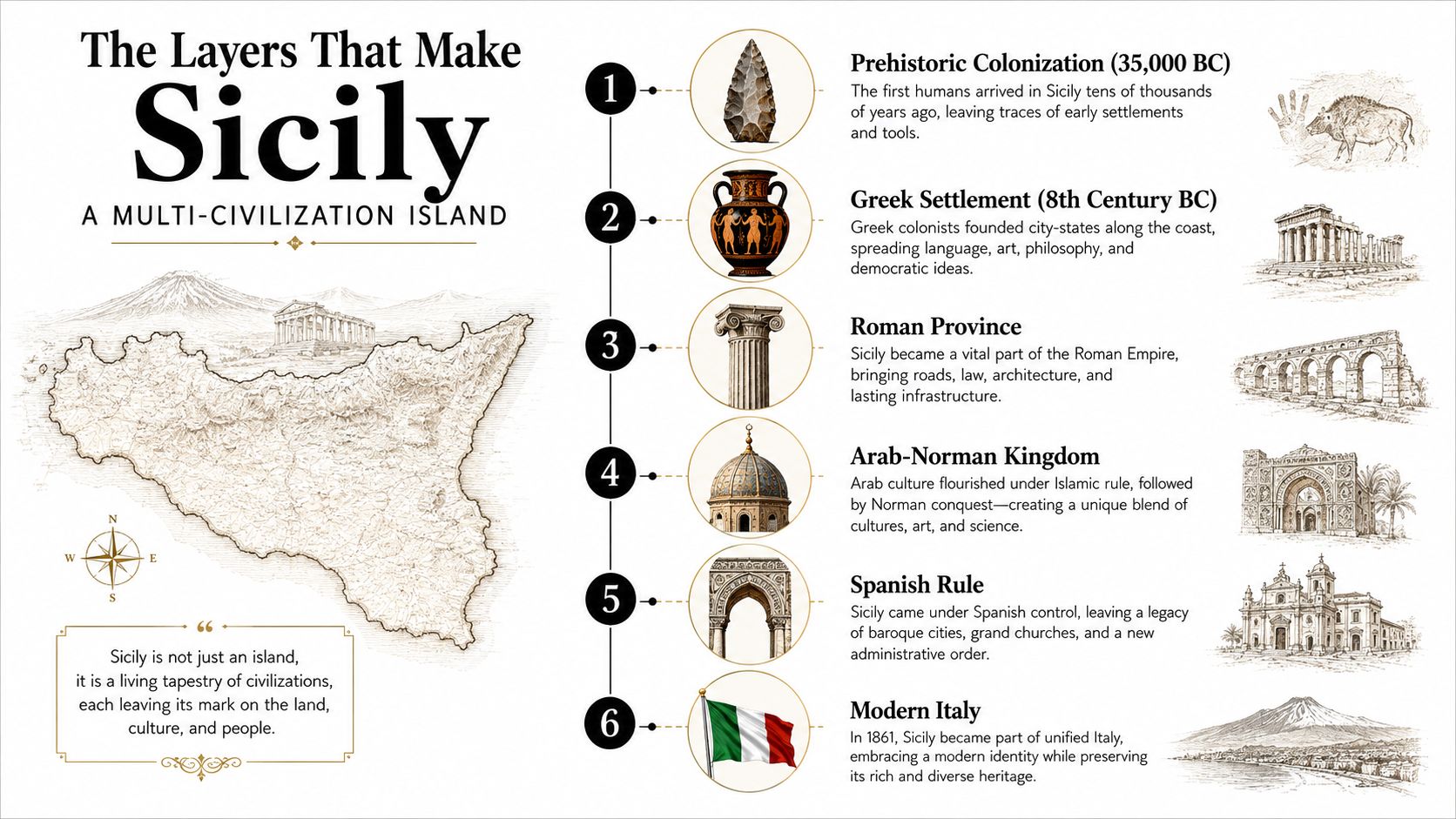
Sicily rewards private touring because its history is stacked, visible, and still easy to read on the ground. The island's timeline runs from prehistoric settlement and Neolithic change through Mycenaean contact, Greek colonisation, Phoenician trading networks, Roman rule, Arab influence, Norman power, and the Baroque rebuild after disaster. That depth is exactly why a serious Sicily trip should be designed around places, periods, and access, not a generic coastal circuit.
What that timeline changes on the ground
Once you follow the chronology, the touring choices become clearer. Syracuse, Catania, Selinunte, Agrigento, and Gela are not interchangeable stops, because each one sits inside a different layer of the island's story. A Greek theatre at sunset, a Norman cathedral, and a Baroque palazzo rebuilt after the 1693 earthquake require different guides, different pacing, and a different kind of traveler.
Sicily later became the first overseas province of the Roman Empire after the Punic Wars, and Roman rule lasted for over six centuries in some accounts (Peter Sommer Travels). That long Roman presence is why villa culture, agricultural remains, and monumental fragments still shape cultural routes in several parts of the island. For a broader visual summary of the island's historical sequence, see An infographic showing the historical timeline of civilizations in Sicily from prehistoric colonization to modern Italy.
Why private touring matters here
A rushed group tour flattens all of this into “old buildings.” Private touring does the opposite. It lets a guide separate prehistory, Greek colonization, Roman legacy, Arab-Norman synthesis, and Baroque rebuilding into distinct experiences instead of one blurred sequence. That distinction matters if you care about what you are seeing, not just checking off landmarks.
Sicily works best as a multi-civilization archive packed into a compact island. If your guide cannot read those layers, you are paying for transport, not interpretation.
Serious travelers should book Sicily the way they book museums and estates, with curatorial intent. The island's value is not only that it is old. It is that the old things are different from each other, often only a short drive apart, and you get more out of the trip when the itinerary treats them that way. For travelers who also care about property and long-view ownership, even finding one euro houses in Sicily only makes sense once you understand which layer of the island you want to be part of.
Choosing Your Sicily by Region
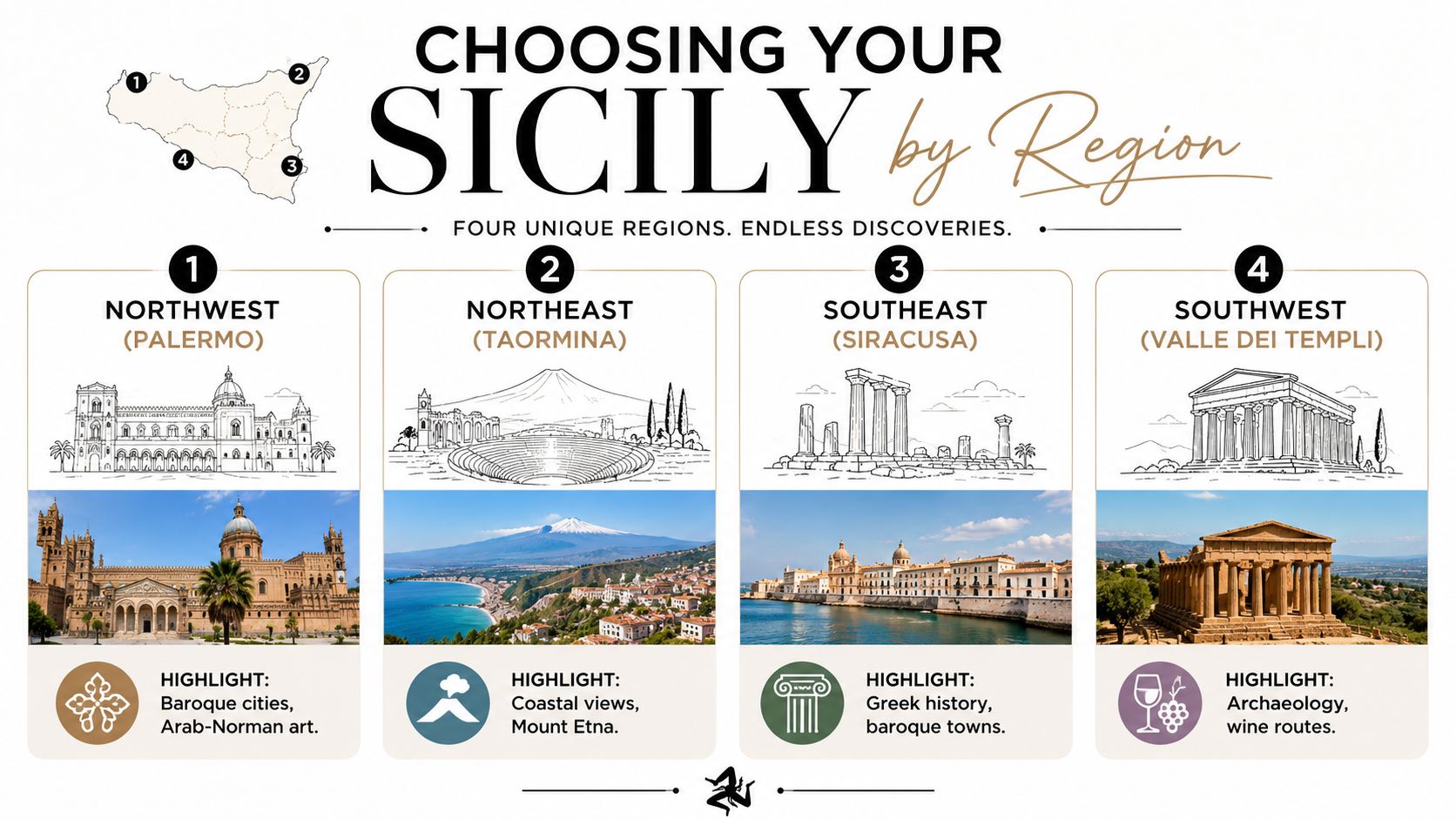
Book Sicily by region and base, not as one island-wide sweep. That is the mistake most itineraries make. The first decision should be whether your trip belongs in the east, the southeast, the northwest, or the islands.
| Region | Best For | Recommended Base | Ideal Trip Length |
|---|---|---|---|
| East Coast | Honeymoons, stylish couples, Mt Etna, polished hotels | Taormina or Catania | 7 to 10 days |
| Southeast | Baroque towns, archaeology, food, slower luxury | Syracuse or Noto | 7 to 10 days |
| Northwest | Palermo, Monreale, Trapani, Erice, Egadi access | Palermo | 10 to 14 days |
| Aeolian Islands | Yacht time, barefoot luxury, island-hopping | Lipari or a split-stay with mainland Sicily | 10 to 14 days |
The east coast is the easiest choice for first-timers because it gives you Taormina, Mount Etna, and clean access to Syracuse. The southeast is calmer and more architectural, with Syracuse, Noto, Ragusa, and Modica forming a strong cultural triangle. The northwest is the richest option for travelers who want Palermo, Monreale, and coastal extensions without rushing. For the island's historical sequence, see An infographic showing the historical timeline of civilizations in Sicily from prehistoric colonization to modern Italy.
My blunt recommendation
If you only have 7 to 10 days, pair the east coast and southeast. That is the strongest luxury route on the island, because it combines coastline, archaeology, and Baroque towns without turning the trip into a moving day every other morning.
If you have 12 to 14 days, add either the northwest or the Aeolians. Sicily starts to feel broader, not cramped. If you are also thinking about property or long-stay options, a practical resource like finding one euro houses in Sicily shows how differently the island's regions are priced, lived in, and discussed. For travelers who want a tightly planned couple's escape, this bespoke honeymoon travel guide for Europe is a useful way to shape the style of the trip before you choose the base.
Sicily Touring Regions at a Glance
| Region | Best For | Recommended Base | Ideal Trip Length |
|---|---|---|---|
| Palermo and the Northwest | Arab-Norman art, markets, coastal extensions, cultural depth | Palermo | 10 to 14 days |
| Taormina and the East Coast | Views, luxury hotels, Mount Etna, romantic pacing | Taormina or Catania | 7 to 10 days |
| Syracuse and the Southeast | Greek layers, Baroque towns, elegant slow travel | Syracuse or Noto | 7 to 10 days |
| Valley of the Temples and the Southwest | Archaeology, countryside, wine routes | Agrigento | 7 to 10 days |
The reason I steer many travelers away from overbuilt island-wide loops is simple. Sicily is large enough to reward focus, but small enough to tempt bad routing. The right base makes the trip elegant. The wrong base makes it exhausting.
A Seven-Day Eastern Sicily Itinerary for Honeymooners and Couples
Seven days in eastern Sicily should feel private, polished, and slightly indulgent. I would build it around one base in Taormina, one structured Etna day, and a slow move into Syracuse or Noto, because couples remember pacing, views, and dinner tables far more than they remember a long list of stops.
Days 1 to 3, Taormina first
Land in Catania, then go straight to Taormina and stay on the cliffs above the Ionian. A property in the style of Belmond Grand Hotel Timeo gives you the right visual drama, while a boutique option like Villa Sant'Andrea works if you want the water closer and the tone slightly softer. Skip a long first-night transfer into the interior. Use the evening for a long dinner, a glass of Etna wine, and an early night.
On day two, keep the morning slow and the afternoon private. Taormina works best when you treat it as a place to linger, not a town to tick off, so I would pair a short walk through the historic center with a relaxed lunch and time at a hotel pool or beach club. For a polished couple's trip, request pre-arranged timing rather than relying on improvisation.
For more inspiration on romantic European getaways, see our guide to honeymoon trips to Europe.
Day 4, Etna with structure
Mount Etna should be handled as a guided experience, not a casual detour. Tour operators describe it as an active stratovolcano, and guided experiences can go up to 3,000 m with cable car, jeep, and trekking logistics already built in (Insight Vacations). That makes it one of the few places in Sicily where a fixed plan works better than a loose one.
Return to the coast in the late afternoon, then book dinner at a vineyard estate rather than back in town. The change in pace matters. Couples remember the shift from lava terrain to wine terrace much more vividly than a rushed summit stop.
Days 5 to 7, Syracuse and the Baroque south
Move south into Syracuse, ideally with one night in Ortygia and one night in the countryside or by the sea. A converted palazzo in the historic center gives the trip texture, while a coastal retreat works better if you want privacy and late swims. I would finish with the southeast Baroque circuit, especially if you want the itinerary to feel like it opened outward rather than ended.
The upgrade over a coach tour is not the landmark. It is the rhythm, private dinners, unhurried arrivals, and the feeling that every transfer was designed for two people, not forty.
For a couple's Sicily trip, that cadence matters more than squeezing in one extra town. The island is seductive when you let it breathe.
A Ten- to Fourteen-Day Grand Sicily Itinerary for Cultural Collectors and Families
Longer Sicily trips should not copy the seven-day east-coast model. They need different pacing, more bases, and more deliberate recovery days, especially for families with mixed ages and collectors who care about major site density.
Start in Palermo, then move with purpose
Begin in Palermo and stay somewhere that lets the city feel layered rather than noisy, such as Villa Igiea or Palazzo Cartari if you want a more aristocratic address. Use the first two nights for Palermo and Monreale, because the Arab-Norman layer deserves full attention and a guide who can read the architecture.
From there, drive west for Trapani or Erice if the family likes a hilltown pause, or head toward the Egadi if the group wants the water. That's where a private boat day earns its keep. It breaks up the cultural intensity and gives children or grandparents a reset without abandoning the itinerary.
Build the archaeological core next
After Palermo, move south to Agrigento for the Valley of the Temples, then continue to the interior for Villa Romana del Casale. This pairing is essential for collectors. It gives the trip a strong classical spine, and it's the point where a private driver saves real energy.
For families, this is also the moment to add a slower day. A beach afternoon, a pool afternoon, or a cooking class with a local host keeps the trip from becoming a string of excellent but exhausting site visits. I prefer a sequence where every heavy cultural day is followed by a lighter one.
Finish in the southeast, not the other way around
End in Syracuse, Noto, Ragusa, and Modica, because the Baroque southeast is the right closing note after Palermo and Agrigento. It's visually rich, compact enough for shorter daily drives, and easy to shape into a graceful finale. If the trip is closer to 14 days, add one island night or another coastal stop, but only if the transfer time stays civilized.
The advantage of a grand Sicily itinerary is that it can serve two completely different traveler types at once. Collectors get the major monuments. Families get a rhythm that protects attention spans, moods, and dinner reservations.
The Luxury Levers That Actually Matter on a Sicilian Tour
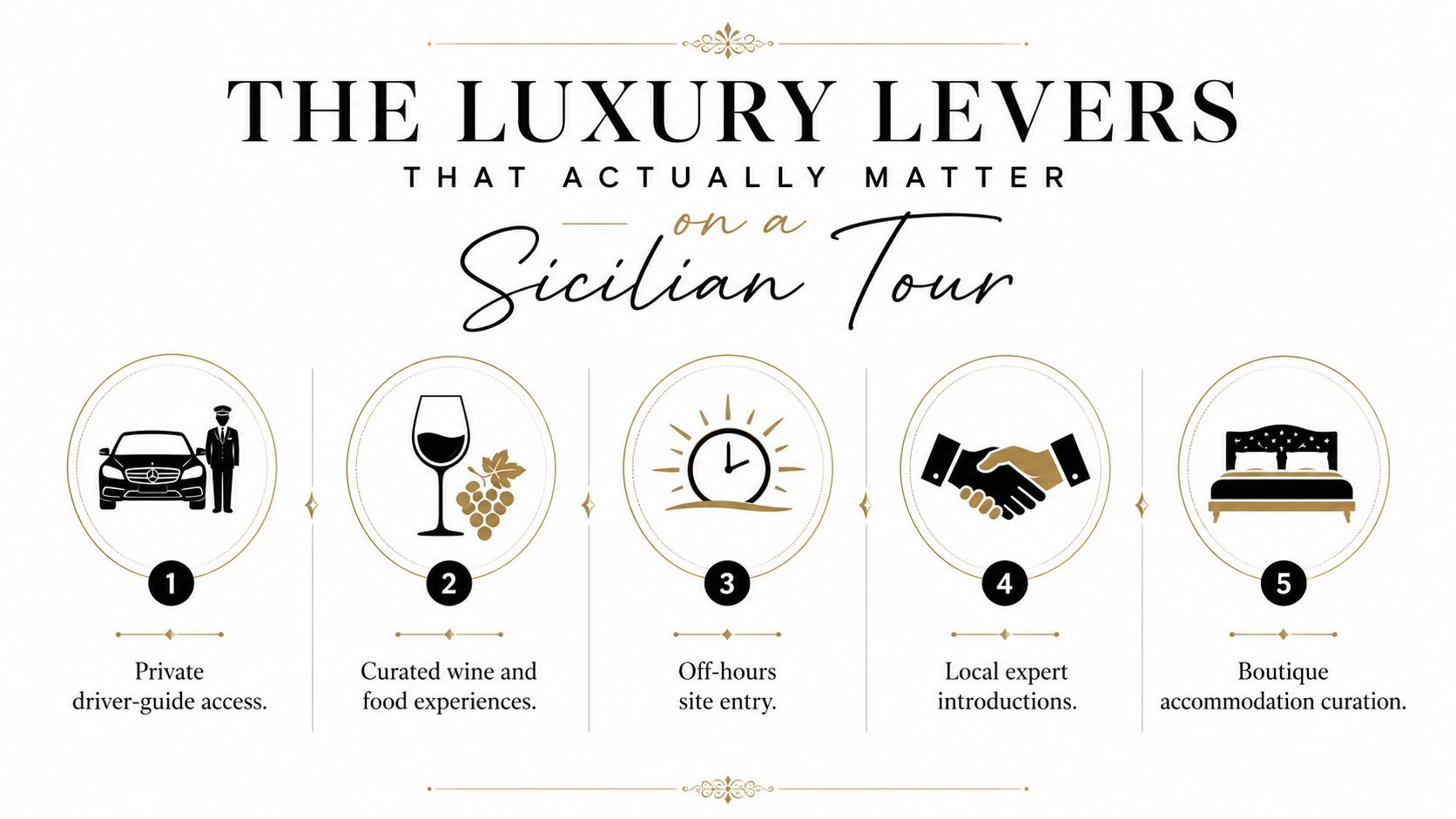
In Sicily, luxury isn't a logo. It's access, routing, and who opens the door before you arrive.
Private driver-guide over scheduled touring
A private driver-guide changes the island from difficult to fluid. The practical win is not just comfort, it's control over timing when roads, transfers, or site access need to shift. That matters more in Sicily than in easier destinations because the island's best trips cross regions and don't benefit from a rigid bus cadence.
Curated food and wine stops
A smart Sicily itinerary uses wine and food as geography, not filler. Vineyard visits in Etna or Marsala do more than add a tasting, they anchor the day in a place with a real agricultural identity. A chef's table or private dinner in a noble palazzo turns a dinner reservation into an event, especially when the host can explain the estate or the family behind it.
Off-hours access and local introductions
The best luxury lever is still access. Private museum openings, after-hours cathedral visits, and archaeological entry outside normal rhythms are what make a trip feel personalized rather than merely expensive. For villa and estate travelers, a good advisor can also create the right introductions to local hosts, guides, and producers instead of leaving every interaction to chance.
Useful rule: if a Sicily trip doesn't include at least one experience you couldn't book as a walk-in, it probably isn't truly bespoke.
For travelers comparing itinerary style with home bases, this guide to luxury villas in Italy for UHNW travelers is relevant because Sicily often works best when the accommodation itself becomes part of the access strategy.
The biggest mistake is overbuying transport and underbuying access. In Sicily, the right guide makes a better trip than the prettier car.
Logistics, Seasonality, and Getting In and Out Privately
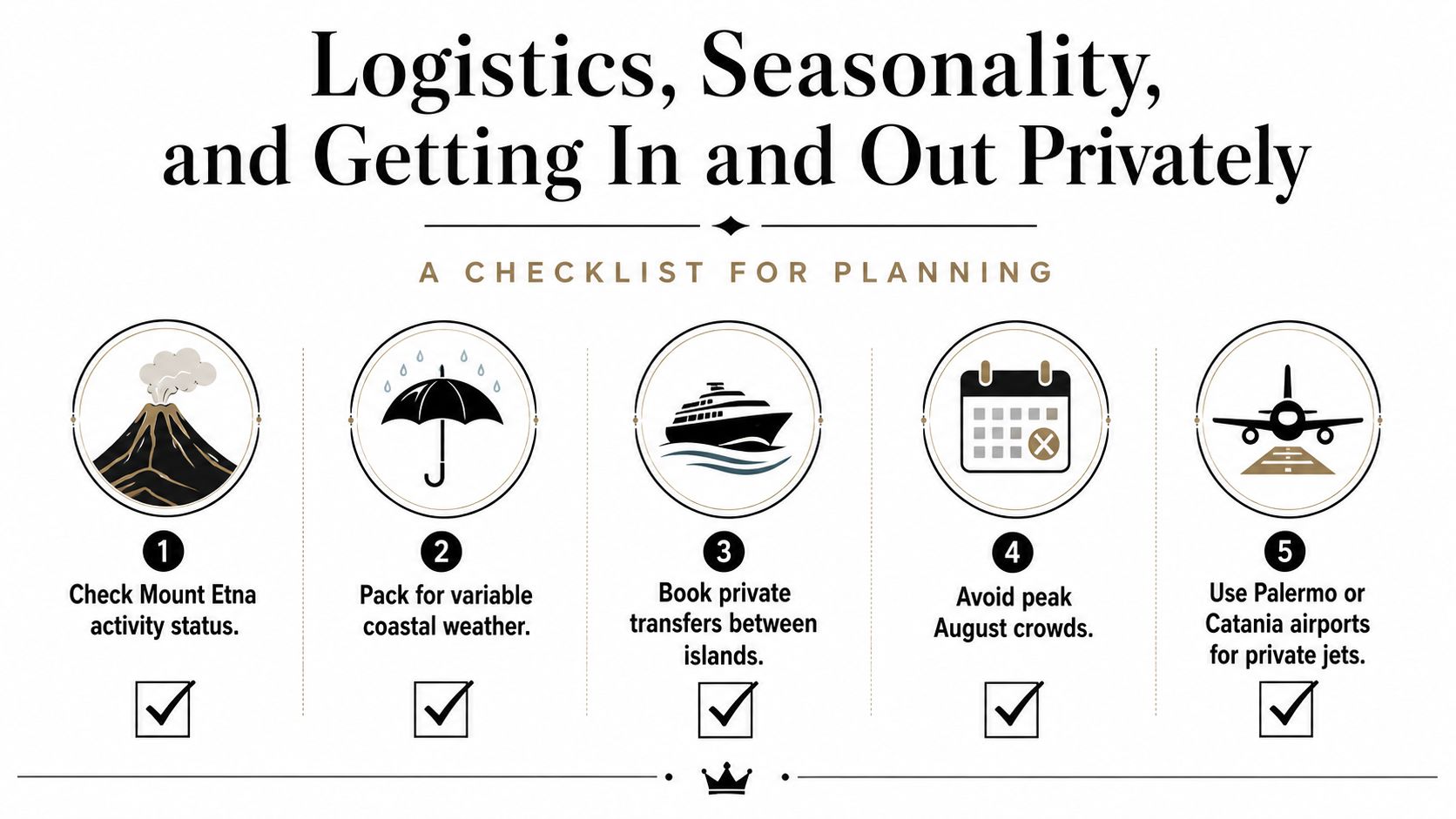
Sicily rewards travelers who plan around weather, elevation, and airport logic. It is an island with real geographic friction, and that matters more here than in most Italian trips. The same route can feel efficient in one month and irritating in the next if you ignore road conditions, mountain weather, and how far your base sits from the airport.
The seasonal sweet spot
The strongest months for a luxury Sicily trip are May, June, and September. They sit inside the broader late-May through September window, but they are easier to shape into a polished itinerary than the most crowded stretch of summer. Beach-focused itineraries can still work in high summer. Sightseeing trips are better in shoulder season, when temperatures are kinder and timing is less punishing.
Etna needs flexibility
Mount Etna is not a standard hill excursion. Access changes with conditions, and operators commonly build the day around cable car, jeep, and trekking options up to 3,000 m (Insight Vacations). Treat it as a weather-led day, not a fixed sightseeing slot. If summit access matters, keep a backup plan in reserve and avoid locking the rest of the day too tightly.
Private arrival logic
For high-end arrivals, Catania and Palermo are the two practical gateways. Private aviation and helicopter transfers make sense when the rest of the itinerary already depends on tight timing, but the ground team still decides whether the trip feels polished or clumsy. A strong driver-guide matters more than a nicer aircraft once you are on the island.
For travelers planning split arrivals, side trips, or a wider European route, private jet luxury travel is the right planning reference. It helps you think about Sicily as part of a larger movement strategy, not as a standalone hop.
Required rule: book the driver first, then the hotels, then the day-by-day movement. Too many Sicily trips are designed backward.
If you want the best version of Sicily, do not optimize for distance alone. Optimize for the least friction between the airport, the hotel, the sites, and the meals.
How to Book a Tour of Sicily Without Losing the Plot
The right way to book Sicily is through an advisor who understands properties, routing, and access, not through a generic package engine. That matters because the island's best trips depend on which region you choose, how many bases you use, and whether the itinerary was designed around your pace or the operator's default departures.
Small-group Sicily tours can be very tight. One provider sells departures capped at 7 participants, with a minimum of 2 travelers required to guarantee departure, and itineraries commonly run 6 to 10 days (Tour of Sicily). Another provider says departures run almost every week of the year (Best of Sicily), which helps with scheduling, but frequency is not the same thing as fit.
A better benchmark is the classic guided format of 9 days to cover the main regions, while many travelers still spend five to seven days on the island when they want a tighter trip (Context Travel). That gap tells you everything. Sicily can be compressed, but it works better when it's given enough room.
Book it like this. First, choose the region that matches your goal. Second, decide whether you want one base or two. Third, brief the advisor around access, hotel style, and daily rhythm, not just attractions. If the planning conversation starts with “we want to see Sicily,” you'll get a brochure. If it starts with “we want the southeast for archaeology and a cliffside finish in Taormina,” you'll get a trip.
Haute Black builds the kind of Sicily journeys that don't feel assembled, they feel authored. If you want tours of Sicily with the right bases, the right properties, and the kind of VIP access that changes the day, visit Haute Black and start with a private itinerary brief.
Explore Our Guides


Signature Experiences