Haute Black Journal
Honeymoon Trips to Europe: A Bespoke Luxury Guide for 2026

Marlene Azeez
Director, HauteBlack
View all articles →
# Honeymoon Trips to Europe: A Bespoke Luxury Guide for 2026
Published July 24, 2026 by Marlene Azeez
You're probably at the stage where the wedding planning is done, the adrenaline's wearing off, and the central question is staring back at you from a screen full of tabs. Amalfi Coast, Greek islands, French Riviera, maybe all three if you keep clicking long enough. That's the wrong way to choose a honeymoon in Europe.
The best European honeymoons aren't the ones that try to do the most. They're the ones that protect your time, put you in the right place at the right moment, and spend aggressively where it changes the experience, on arrival, privacy, dining, and smooth movement. Europe gives you the deepest luxury inventory in honeymoon travel, but the difference between merely expensive and unforgettable is still judgment.
Why Europe Is the Honeymoon Benchmark
A couple planning a honeymoon in Europe is usually holding a map open and trying to solve the wrong problem. The choice is not which famous shoreline looks best on a screen. It is how deliberately you want to spend seven to fourteen nights, and whether you want the trip to feel composed or merely costly.
Europe is the benchmark because it is the deepest market for romance travel. Industry research says Europe accounts for 30% of the global honeymoon market, and another estimate puts Europe's honeymoon tourism market at USD 38 billion in 2025, or 35.6% of global demand (CBI market information on honeymoon tourism). The same source says 72% of Europeans take a honeymoon, which is a strong sign that this is a normal, well-supported travel pattern, not an odd luxury niche.
That scale changes the experience. You get stronger hotel inventory, better private transfer options, better rail connections, and more advisors who know how to build a trip that protects your time instead of wasting it. The downside is simple: Europe also gives you more room to make expensive mistakes. The hotels are plentiful. The judgment calls are what separate a polished honeymoon from a forgettable one.
Practical rule: In Europe, you are not paying for scarcity. You are paying for precision.
Money confirms the point. Europe attracts couples who are willing to spend meaningfully when the trip feels like a true once-in-a-lifetime escape, not a rushed add-on to the wedding. That is why the right plan matters so much. A small shift in timing, routing, or hotel choice can change the whole tone of the trip, while a careless itinerary can make even a beautiful destination feel crowded and thin.
The best European honeymoons are rarely the most famous ones at peak season. They are the quieter city stays, the shoulder-season departures, and the itineraries that concentrate spend where it counts, in the suite, the arrival, the private boat, the dinner reservation, the transfers, and the days you get to enjoy each other. Europe rewards that approach better than anywhere else.
The Economics of a European Honeymoon
The budget conversation goes wrong when couples price only the hotel. A European honeymoon includes flights, routing, transfers, dining, and how often you make yourselves repack. Those choices matter more than the headline room rate.
A good honeymoon is a sequence of smart decisions, not a pile of expensive ones. Spend too widely and the trip feels busy. Spend with discipline and Europe feels intimate, polished, and worth the money.
What a 10-night Europe honeymoon actually buys
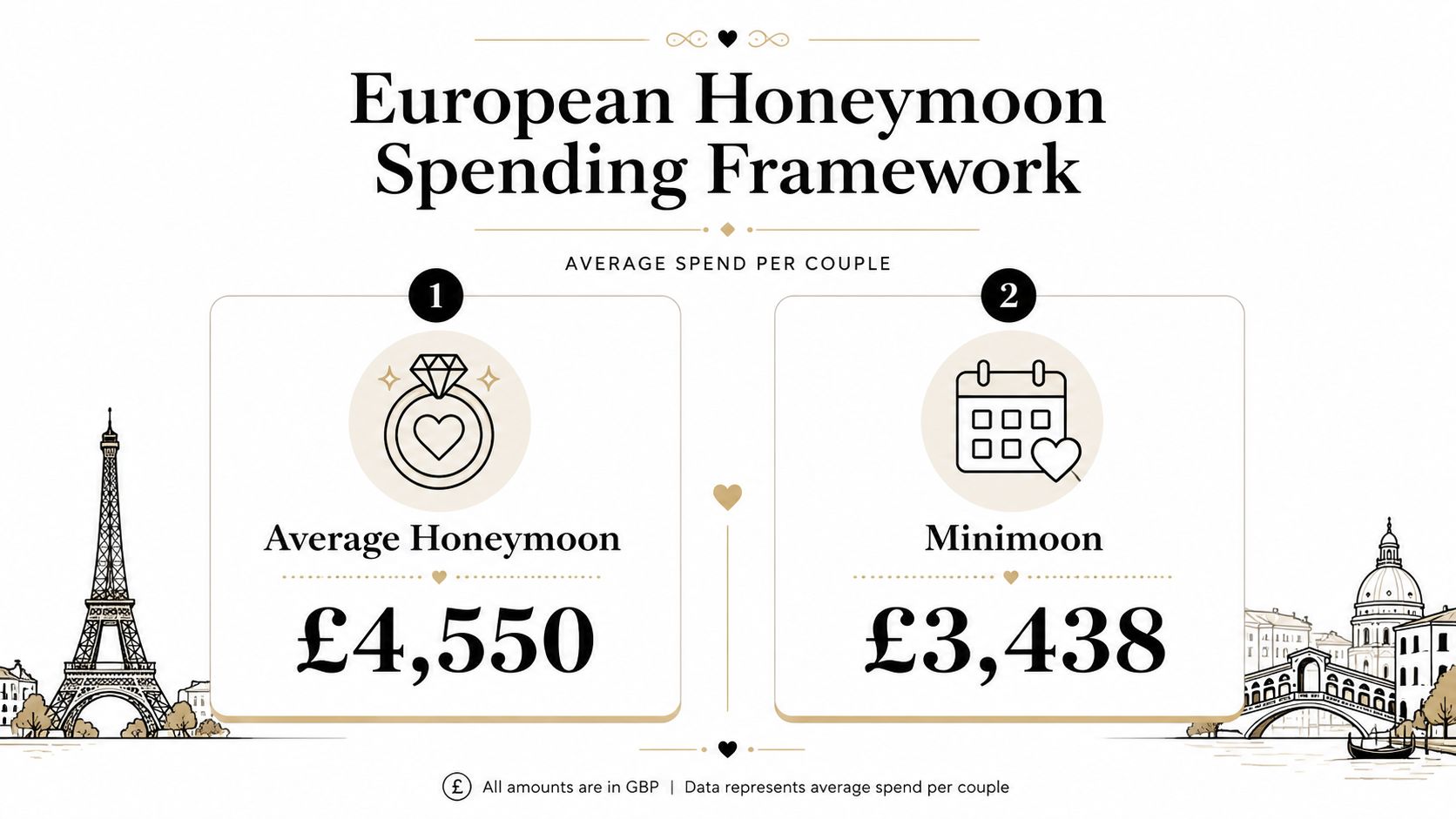
For a 10-night Europe honeymoon including U.S. flights, one planning guide puts the range at $7,000–$13,500 mid-range and $17,000–$36,000 luxury (Honeymoon Bookings). That spread is wide because the country mix matters more than most couples expect. Portugal and Croatia sit closer to value, while France and Italy, especially the Amalfi Coast and Venice, push to the top of the curve.
That is useful because it lets you budget by geography instead of by fantasy. Choose one lower-cost anchor and spend on the parts that make the trip feel special, the suite, private transfers, and memorable dinners. If you want the classic icons, accept that the hotel line item will climb quickly.
Budget logic: Fewer bases usually buy you more romance than more countries do.
Savings come from timing and trip shape. Shoulder-season travel can reduce flight and hotel costs by 20–40% versus peak summer, according to practical planning guidance (Honeyfund Europe honeymoon guide). That does more than trim the total. It creates room for a better room category, a private driver, or a stronger property without stretching the length of the trip.
If you are deciding where the money should go, start with location quality, arrival quality, and fewer moves. Do not scatter the budget across too many countries and then wonder why the honeymoon feels broken up. Europe rewards concentration, and the most romantic trips usually feel deliberate rather than packed.
For couples comparing timing and hotel value, a close look at Europe weather in May for luxury travelers shows why shoulder-season planning gives you more control over both atmosphere and spend.
For couples building a honeymoon fund and deciding what to prioritize, a useful starting point is the practical planning advice in this guide to top honeymoon fund ideas.
When to Go for the Best Weather and Value
Timing is the biggest lever in a European honeymoon, not the destination list. Couples get distracted by iconic names and forget that a beautiful place in the wrong month can feel crowded, overpriced, and oddly transactional. The fix is simple, choose a shoulder season window and plan around it.
The best window is narrow for a reason
The strongest tradeoff tends to be April to June and September to October, because that's when couples can still get good weather while avoiding the worst of peak summer pressure. Planning guidance says shoulder-season travel can cut flight and hotel costs by 20–40% versus peak summer (Honeyfund Europe honeymoon guide). That's not a minor discount. It changes what level of hotel, view, or transfer you can comfortably afford.
It also changes availability. Coastal hot spots like the Amalfi Coast, Santorini, and the French Riviera get congested in July and August. That's when the beaches fill up, reservations get tight, and the whole experience starts to feel managed by crowds instead of by your own rhythm. If you care about privacy, the peak summer calendar works against you.
For couples building a honeymoon fund and deciding what to prioritize, a useful starting point is the practical planning advice in this guide to top honeymoon fund ideas. It's especially helpful if you want guests to support a specific trip instead of giving you generic cash without a plan.
Build the route around two bases, not five intentions
A two-base rule is the right architecture for a week-long honeymoon. A 7-night trip should feel like two settled chapters, not a relay race. For a 10-night trip, cap it at no more than three places. Every extra move adds check-ins, transfers, luggage handling, and that dead feeling of wasting a precious afternoon in transit.
The internal guide to Europe weather for luxury travelers aligns with the same logic, weather and crowd patterns matter more than the fantasy of squeezing in one more city. Shoulder season also makes private guides, villa inventory, and hard-to-get restaurants much easier to secure. That's where romance starts to feel private instead of programmed.
Architecting the Itinerary by Trip Length
Trip length should shape the honeymoon. The biggest mistake is starting with a fantasy list of cities and forcing the calendar to absorb it. That produces a trip that feels rushed, padded with transfers, and oddly disconnected from the places you flew to enjoy.
Pick the right architecture before the destinations
A 7-night honeymoon wants a tight, two-base structure. A 10-night trip can support a clean two-country arc, or at most three places. A 14-night trip is where a third country can work, but only if the transfers are efficient and the sequence feels natural.
| Trip Length | Sample Itinerary | Base Count | Best Suited For |
|---|---|---|---|
| 7 nights | Amalfi Coast plus Rome | 2 | Couples who want coast, culture, and strong dining without overmoving |
| 10 nights | Paris and the French Riviera, or Lake Como and Venice | 2 | Couples who want a classic Europe honeymoon with one elegant transition |
| 14 nights | Lisbon and the Douro, the Amalfi Coast, and a Greek island finale | 3 | Couples who want a grand tour with clear pacing and a strong finale |
For a 7-night romantic core, Amalfi Coast plus Rome is the right shape if you want sea views balanced with historic energy. Use a private transfer between Rome and the coast, then stay put. That gives you dinners, scenery, and a cultural layer without constant packing. It is for couples who want to enjoy Italy, not collect it.
A 10-night two-country arc works best when the move is elegant, not draining. Paris and the French Riviera is the archetype. Rail or short flight down, then anchor into a coastal property with private transfers, boat days, and Michelin dinners. Fewer moves. Better memories.
A 14-night three-country grand tour can work if the pacing is disciplined. Lisbon and the Douro, then the Amalfi Coast, then a Greek island finale is a strong sequence for couples who want the trip to build from city to countryside to beach. It suits food and wine travelers who also want a clear romantic crescendo at the end. Use first-class cabin routing, private drivers, and, where it fits, high-speed rail to keep the trip fluid.
Rule of thumb: If the transfer feels like the highlight, the route is too complicated.
The internal guide to customized travel itineraries and bespoke journeys fits this approach exactly, because the route should be built around rhythm, not around a checklist. A good honeymoon itinerary leaves you wanting one more night in the room, not another airport.
Quiet Alternatives to the Iconic Honeymoon Cities
Paris, Venice, and Santorini are beautiful. They're also crowded enough that couples often pay a premium for less intimacy than they expected. That's the problem with iconic honeymoon planning, people assume the most famous place must be the most romantic place. It usually isn't.
Crowds change the mood more than people admit
Recent travel coverage in 2025 has pushed quieter alternatives like Annecy, Strasbourg, and Bordeaux specifically to help travelers avoid overtourism and recover a more intimate experience (The Independent). That's the right instinct. Romance gets weaker when you spend half the day waiting, dodging day-trippers, or competing for the last decent table with a view.
Annecy is the smartest substitute for couples who like the Lake Como feeling but don't want the same photobombing and premium pressure. It gives you lake scenery, Alpine energy, and a slower pace that feels intentional. If your ideal day is a beautiful breakfast, a walk, and a long dinner, Annecy deserves a serious look.
Strasbourg makes sense for couples who are drawn to half-timbered beauty and wine-country atmosphere but don't want to lean on Bruges. It delivers charm without the same level of pressure, and it works especially well if your honeymoon style is walkable streets, good food, and a calmer evening tempo. The city feels lived-in, not staged.
Bordeaux is the clean answer for food-and-wine couples who might otherwise default to Tuscany. It gives you a refined base, easy wine access, and a more grounded city feel. If the goal is to eat well, sleep well, and avoid the sense that every romantic corner has already been monetized, Bordeaux belongs on the shortlist.
Use classic icons as anchors, not as the entire trip
You don't have to reject the famous names. You just shouldn't let them dominate the route. A better pattern is to pair one iconic leg with one quieter leg, so the honeymoon has both recognition and relief.
Best use case: Put the famous city at the start, then let the quieter place do the heavy lifting emotionally.
That approach gives you the postcard moments without spending the whole trip inside someone else's itinerary. In 2026, intimacy is the luxury.
Booking, Logistics, and the High-Touch Layer
A luxury honeymoon is not just a nice hotel. It is a chain of choices that preserves your energy from the airport to the room key. Couples get this wrong when they book fragments instead of a journey. Europe starts to feel like a series of transactions, and that is exactly how romance gets drained out of it.
The arrival should already feel different
For a long-haul route, first-class cabin or private aviation through services like Haute Jets makes sense when the trip is long enough to justify the reset. For shorter, sharper routes, use high-speed rail when it is clearly the better move. London to Paris by Eurostar is the clean example, with a direct, polished transfer that keeps the trip moving instead of interrupting it.
Private drivers matter most when the alternative is a chain of public transfers that burn time and energy. Helicopter transfers belong only where they solve a real access or timing problem. Use them for utility, not theater. Luxury turns hollow the moment it stops being useful.
If you are planning a practical pre-trip surprise for each other, this list of adventurer gifts for any budget is a smart place to start. It helps you choose gear or trip-related gifts without falling back on generic wedding-registry filler.
Hotels, villas, and the hidden work of a smooth honeymoon
A private villa can be the better base for couples who want privacy and room to breathe. A strong hotel suite is better for couples who want a fuller service layer and faster access to staff, dining, and on-demand help. Choose the setup that matches how you travel. The wrong choice is the one that forces you to manage details when you should be relaxing.
Once you are on the ground, the high-touch layer is what makes the trip memorable. That means private guides, Michelin-starred reservations, yacht days, and spa programming timed around your itinerary. Couples who handle every piece themselves often lose the very parts that make the honeymoon feel custom rather than assembled.
For a closer look at how this orchestration works, the guide to luxury travel concierge services is a useful reference. The concierge layer is not decoration. It is what turns a nice stay into one that feels anticipated from the start.
How a Private Advisor Changes the Trip
A private advisor doesn't make Europe more beautiful. It makes your access to Europe more usable. That's value. Anyone can book a room. Fewer people can turn the same room into a better arrival, a better stay, and a better memory.
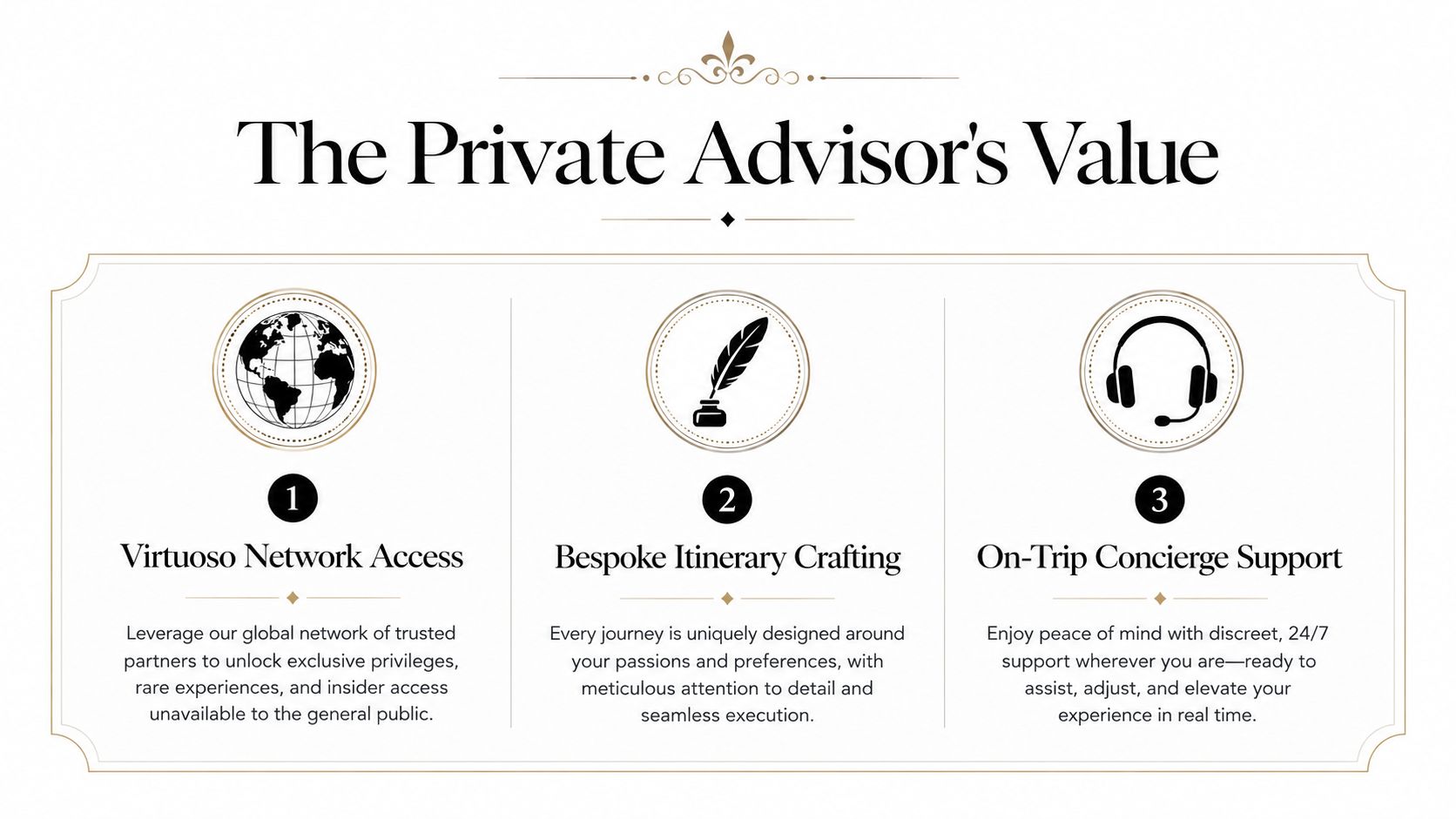
HauteBlack's positioning is useful here because it combines Virtuoso affiliation through Andavo Travel with preferred partner status at over 500 properties, including Four Seasons, Aman, Rosewood, Belmond, and Ritz-Carlton. The practical result is straightforward, complimentary upgrades when available, resort credits, flexible benefits, and genuine VIP arrivals. Those are not cosmetic extras. They change the way a property treats your stay.
The distinction between booking directly and booking through a preferred advisor is bigger than most couples realize. The hotel price can be the same, but what you get access to is not. With the right advisor, the property has context before you arrive. That changes room assignment, communication, and often the subtle details that make a honeymoon feel properly handled.
For non-members, signature journeys and tailor-made trips are still available. For members, the value deepens because there's a dedicated advisor, waived planning fees, and the full weight of two decades of relationships. That matters on a honeymoon because the trip is time-sensitive and emotionally loaded. You don't want to be chasing confirmations while you're trying to enjoy the trip.
The broader Haute Living ecosystem also extends beyond the itinerary. It includes 80+ intimate events annually and an AI-powered network that connects verified founders, executives, investors, athletes, and creators for private introductions and roundtables. That kind of access sits outside the usual honeymoon conversation, but it tells you what kind of world the advisor is operating in. It's a network built around discretion, not noise.
Advisor advantage: You still choose the trip. The advisor changes the level of access around it.
And on a trip like this, the difference is felt in small, expensive moments. The room is ready. The transfer is waiting. The dinner is confirmed. The flight path doesn't waste your best day. That's what turns a European honeymoon from polished to exceptional.
A practical detail couples forget too late is document handling. Passports, backup copies, and booking confirmations need one place, not five inboxes. A simple system like manage passports with Family Folder is worth using before departure, especially if your honeymoon includes multiple countries or internal transfers.
Your First Three Steps to Lock It In
Pick a 7 to 14 night window in April to June or September to October, then sanity-check the broad flight pricing before you overbuild the rest of the trip. Next, choose between a classic icon route and a quieter alternative, then narrow it to two bases unless you have 14 nights. Finally, ask a private advisor to turn the shortlist into a real itinerary with the right partners, transfer logic, and arrival details.
That sequence works because each step removes one layer of uncertainty. Once the dates are fixed, the destination decision gets easier. Once the bases are fixed, the logistics get cleaner. Once the advisor is involved, the trip starts to behave like a honeymoon instead of a collection of bookings.
A CTA for HauteBlack.
Explore Our Guides
Signature Experiences