Haute Black Journal
Customized Travel Itineraries: The Art of Bespoke Journeys

Marlene Azeez
Director, HauteBlack
View all articles →

# Customized Travel Itineraries: The Art of Bespoke Journeys
June 16, 2026
You may be sitting on a beautiful draft itinerary right now. The hotel is famous. The suite is expensive. The restaurant list is polished. The transfers are booked. And yet the whole thing feels oddly interchangeable, as if your trip could just as easily belong to someone else with a different name on the cover page.
That feeling is the dividing line between luxury and customization.
A high-end trip can be flawless on paper and still miss the point. It can over-index on well-known properties, reserve the obvious tables, and fill each day with the right names but the wrong rhythm. Bespoke travel starts where generic luxury stops. It asks different questions. Not only where do you want to go, but how do you want to feel there? What pace restores you? What bores you? Which inconveniences ruin a trip for you faster than a rainstorm ever could? What kind of access matters, and what kind of access is just marketing language?
For ultra-high-net-worth travelers, customized travel itineraries aren't really documents. They're operating systems for time, access, privacy, and flexibility. The file you receive matters. What matters more is the judgment, network, and live decision-making behind it.
Beyond Luxury The Promise of True Customization
A standard luxury vacation often looks impressive from the outside. Think of the usual formula. A celebrated resort, a tasting menu, a spa treatment, a private car, and one or two headline experiences. Pleasant? Usually. Memorable? Sometimes. Personal? Not necessarily.
Now compare that with a trip designed around the traveler rather than around inventory. A couple who dislikes over-choreographed sightseeing doesn't need three museum bookings and a guide with a flag. They may need a late start, a coastal drive timed around light, a discreet lunch that isn't trending online, and a property whose staff understands privacy without performing it. A family with teenagers and grandparents doesn't need "something for everyone" in the vague brochure sense. They need a structure that allows togetherness without forcing identical days.
When a Trip Feels Like You
The best customized travel itineraries don't begin with options. They begin with interpretation.
A client says, "We want Italy, but not the Italy everyone else posts." That can mean many things. It may mean fewer hotel changes. It may mean access to a winemaker instead of another cooking class. It may mean one exceptional villa stay instead of five cities in ten days. It may mean no long formal dinners because the client values ease over ceremony.
The advisor's job isn't to take orders. It's to translate taste into logistics and logistics into ease.
That shift matters because customization is no longer a fringe request. The customized travel market is projected to reach USD 142.38 billion in 2026 according to Research and Markets' customized travel market report. That scale tells you something important. Travelers aren't treating bespoke planning as a novelty. They're treating it as the standard for trips that need to feel aligned, not merely upgraded.
Curation Beats Consumption
Resources can become useful when skillfully employed. For example, a family considering active travel in Europe might browse Outdoor Slovenia Activities' Europe guide for ideas around pacing, scenery, and family-oriented adventure. On its own, that kind of guide is inspiration. In a bespoke process, inspiration gets filtered through fitness levels, privacy preferences, transfer tolerance, dining expectations, and the realities of who in the group wants action and who wants quiet.
Luxury used to signal spend. Today, at the top end, it signals fit. The promise of true customization is simple. The trip stops looking expensive and starts feeling inevitable, as if it could only have been built for you.
What a Customized Itinerary Really Means
A customized itinerary is not a prettier package tour.
That distinction gets blurred constantly. Many companies now use the language of personalization when what they really offer is selection. You choose from a menu of hotels, add a private transfer, swap one excursion for another, and receive an itinerary that feels individualized because your name is on it. That's still assembly, not bespoke design.
Bespoke Versus Tailored Off the Rack
The cleanest analogy is clothing. An off-the-rack designer suit can be luxurious. A tailor can shorten the sleeves, bring in the waist, and make it fit better. But it still began as someone else's pattern. A bespoke suit starts with your posture, measurements, movement, preferences, and use case. Travel works the same way.
A real advisor isn't just asking whether you prefer a sea view or a garden view. They are reading the difference between a traveler who wants stimulation and one who wants relief. They are noticing whether "authenticity" means rustic simplicity, social distance from crowds, or privileged access to people and places that don't feel staged.
Consumer demand supports that shift. 66% of travelers want personalized offers, and 79% consider flexible changes and cancellation policies very important, according to Travel Operations' Q1 2025 travel statistics roundup. Those expectations don't point to more options on a booking engine. They point to planning that adapts to individual priorities and risk tolerance.
Standard Luxury Booking vs. Bespoke Itinerary
| Aspect | Standard Luxury Booking | Haute Black Bespoke Itinerary |
|---|---|---|
| Starting point | Inventory and availability | Client preferences, habits, and trip purpose |
| Hotel selection | Famous names and room categories | Fit, recognition, privacy, location, and rhythm |
| Dining | Popular reservations | Tables matched to mood, schedule, and access |
| Daily planning | Activity stacking | Energy-aware pacing with room for spontaneity |
| Flexibility | Limited after confirmation | Built with change scenarios in mind |
| Problem solving | Reactive support | Managed adjustments with advisor oversight |
| Access claims | Often broad and vague | Expected to be specific and verifiable |
What Algorithms Miss
Technology can suggest. It can't infer nuance with the same reliability.
If someone says they want a quiet honeymoon, software may surface secluded hotels. An experienced advisor may hear something else. Perhaps the couple doesn't want silence. They want insulation from logistical friction. They want to avoid performative romance, skip over-designed experiences, and preserve enough unscheduled time to feel relaxed rather than processed.
That's why the strongest customized travel itineraries sit at the intersection of psychology, operations, and relationships. They aren't built by dragging luxury components into a timeline. They're composed with judgment.
The Anatomy of Bespoke Itinerary Design
Most travelers see the polished itinerary at the end. They don't see the layers underneath it. That's where the value sits.
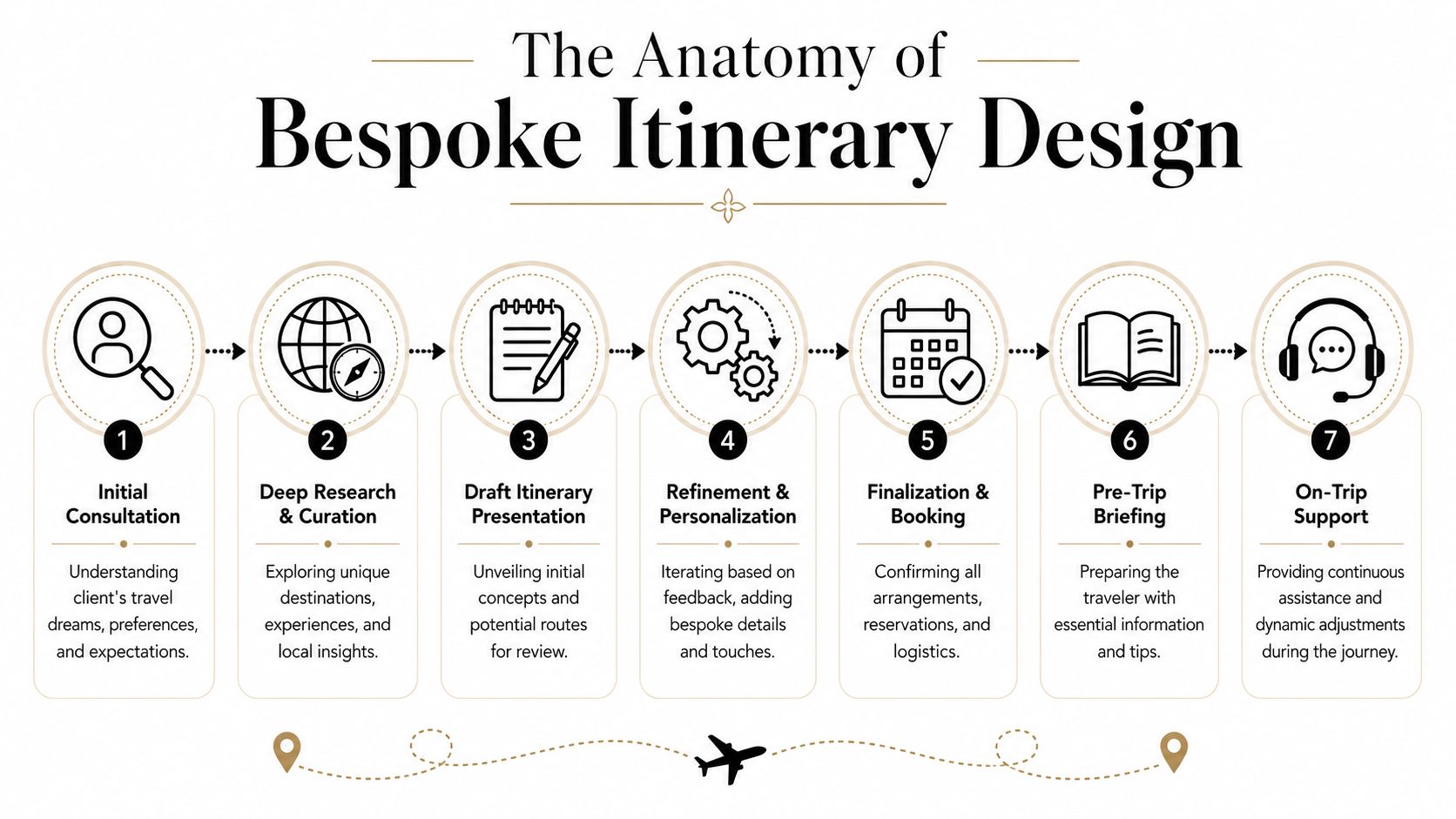
Discovery Before Destination
The first serious conversation is rarely about the hotel. It's about the traveler.
An advisor needs to understand who is going, what the trip needs to accomplish, who controls the schedule, what degree of privacy is expected, where friction tends to appear, and how much structure feels supportive rather than oppressive. If an executive says, "I want to switch off," but still intends to take calls each morning, the itinerary has to be built around that truth, not around the fantasy version of the trip.
A few discovery points usually matter more than clients expect:
- Travel tempo: Some clients like one hotel and deep immersion. Others want movement.
- Non-negotiables: A specific sporting event, privacy requirement, dietary issue, or school calendar can shape the entire route.
- Tolerance for transitions: Helicopters, short hops, border crossings, and same-day repositioning sound glamorous until they don't.
- Social appetite: Some travelers want access and interaction. Others want insulation.
Research, Validation, and Assembly
This is the least visible part of the process and often the most labor-intensive. Even with modern tools, a single custom itinerary can still require 30 to 60 minutes of consultant time because the work isn't just dreaming. It includes validating supplier pricing, checking live availability, and formatting the day-by-day proposal, as explained in TourConnect's analysis of custom FIT itinerary build time.
That number makes sense to anyone who has built bespoke trips professionally. The bottleneck isn't coming up with Paris or Kyoto. The bottleneck is proving that the room is available, that the guide can deliver the right format of experience, that transfer timings work in real conditions, and that all the pieces align without hidden stress.
Practical rule: If an itinerary comes back suspiciously fast, ask what was validated and what was assumed.
A strong design process often includes local transport partners too. In destinations where ground execution matters, planners may review specialized providers such as premium Dubai driver services to ensure the car standard, chauffeur discretion, and on-call flexibility match the rest of the trip.
Architecture, Refinement, and Briefing
Once the raw materials are confirmed, the itinerary has to be composed. Good architecture solves for flow. It considers arrival fatigue, meal spacing, recovery time, backup options, and whether one exceptional day should be followed by stillness rather than another high-touch production.
A useful refinement stage should feel collaborative, not chaotic. Clients don't need endless options. They need edited choices with consequences explained clearly.
That might look like this:
1. Draft route review
The advisor tests whether the overall arc works for season, pacing, and access.
2. Experience calibration
Activities are adjusted for energy, weather exposure, privacy, and age range.
3. Final logistics lock
Confirmations, timing notes, contact flows, and special requests are rechecked.
One practical place to see how this kind of support is packaged is Haute Black's travel services, where bespoke planning sits alongside transport, villas, and concierge support. That's not unusual at the top end. Complex journeys often require one planning thread across multiple service categories.
The final briefing should leave no ambiguity about rhythm, contacts, contingencies, and what can still flex once the traveler is in motion.
Beyond the PDF The Adaptive On-Trip Experience
The static luxury itinerary is overrated.

For many affluent travelers, the old ideal was a perfect document prepared in advance. Every table set. Every transfer confirmed. Every hour optimized. That still matters. But for ultra-high-net-worth clients, perfection before departure is only half the service. The true test begins when conditions change.
A child gets tired. A principal decides to stay an extra night. Weather collapses a planned boating day. A meeting appears mid-journey. A client falls in love with a place and wants to cut the next stop. The plan that looked immaculate a week earlier may suddenly become too rigid.
That is why the adaptive itinerary has become so important. 78% of luxury travelers report that unexpected changes disrupt their experience, and 64% of UHNW clients expect advisors to manage live adjustments during the journey. The implication is straightforward. Fluidity has become part of the luxury product.
What Live Adaptation Looks Like
Adaptive support isn't just "call us if you need anything." It usually involves active monitoring, fast supplier communication, and enough authority within a network to reshuffle key pieces without losing quality.
A capable advisor or support team often manages issues like these in real time:
- Re-routing the day: Moving indoor experiences forward when weather turns.
- Rebooking around mood: Swapping a formal dinner for something easier and more local.
- Adjusting transfers: Delaying drivers, adding security, changing pickup sequences.
- Protecting the next stop: Preserving room value or access when arrival times shift.
Some planning systems now use real-time context such as attractions, accommodations, transportation, and weather inputs to support more responsive recommendations, as described in an academic paper on AI-powered itinerary planning. Used properly, that kind of tooling doesn't replace the advisor. It helps the advisor make faster, condition-aware decisions.
Here's a useful visual reference on how travelers can think about staying agile while moving through a destination:
Fluidity Is the Premium
The highest form of service during travel often looks invisible. A dinner moves. A guide adjusts. A room is held. A transfer waits. The client experiences continuity instead of disruption.
A living itinerary is worth more than a polished PDF because travel happens in motion, not in a document.
For executives, families, and travelers who value optionality, the adaptive layer is not a nice extra. It's the part that protects the trip when real life arrives.
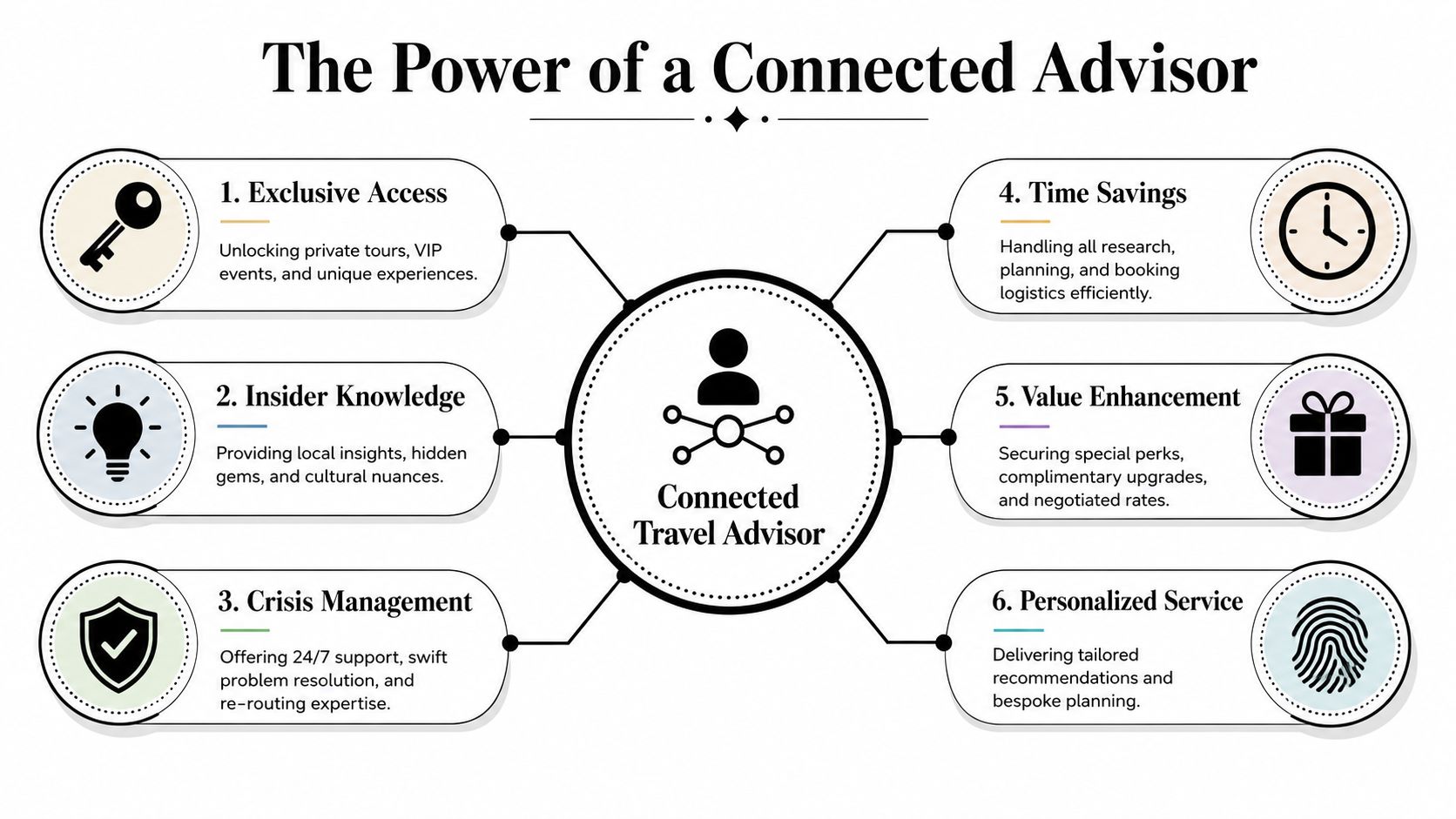
Access Unlocked The Power of a Connected Advisor
Not all access is created equal, and not all access claims are real.
In luxury travel, the phrase "VIP treatment" gets thrown around so casually that it often means nothing. A connected advisor creates value through three separate layers, and travelers should understand the difference because each one produces a different outcome.
The Three Layers of Access
First, there is the institutional layer. Consortia affiliations can provide benefits that many travelers won't get booking on their own. That may include enhanced recognition, preferred rates, breakfast, or property credits depending on the partner and booking structure.
Second, preferred partner status with specific hotel groups often improves execution. Recognition becomes more precise. Requests carry more weight. Waitlists can move differently. The client isn't just another reservation arriving through a generic channel.
Third, and most valuable, is the relationship layer. Within this layer, a planner knows whom to contact, how to frame the ask, and when to ask for a favor. Public inventory doesn't show that. Neither does a generic affiliate badge.
Why Network Quality Changes the Trip
The public often assumes an advisor's job is booking a hotel. That's too narrow. The stronger role is strategic advantage.
A connected advisor can shape outcomes before arrival and during the stay. That may mean communicating guest preferences with enough context that the property acts on them. It may mean securing meaningful room placement rather than just a room category. It may mean recovering a dinner reservation after a delayed arrival, or arranging a private visit that isn't sold through a booking site.
For travelers comparing planning options, it helps to understand the wider service model around these relationships. Haute Black's own perspective on this is outlined in its guide to luxury travel concierge services, which frames travel planning as one component of a larger access and execution ecosystem.
Access Without Proof Is Just Copy
The most experienced travelers have become skeptical for good reason. Listings of partner logos and vague claims about insider treatment don't prove much. The advisor should be able to explain what kind of relationship exists, how it translates into client benefit, and what can be requested versus what can be promised.
Ask for specificity. "Preferred partner with whom, at which properties, and what does that change for me on this trip?"
That question usually separates real network value from luxury-flavored marketing.
How to Vet Your Luxury Travel Planner
A polished website doesn't tell you whether a planner can deliver under pressure.
The sharper question is whether they can verify their access, articulate their process, and manage a trip once it stops behaving as planned. That matters because 42% of affluent travelers have encountered false VIP promises from planners. In practice, the risk isn't just disappointment. It's misallocated trust.
Questions Worth Asking Before You Book
When interviewing a planner, skip broad prompts like "What can you do for us?" Ask questions that force operational clarity.
- Partner verification: Ask which specific preferred partnerships apply to your target hotels and what benefits are typical versus request-based.
- On-trip management: Ask how changes are handled after departure, who is reachable, and whether the advisor remains involved or hands off to a generic support desk.
- Supplier depth: Ask who their local operators are for a given destination and how those partners are vetted.
- Access claims: Ask what "VIP" means in concrete terms for your itinerary, not in brand language.
A good companion read on the affiliation side is this overview of what a Virtuoso travel agent is, because many travelers hear the term without understanding what it does and does not guarantee.
Red Flags That Deserve a Pause
Be cautious if you hear any of the following:
- Vague exclusivity: "We can get anything" is not an answer.
- No process for change: If the planner talks beautifully about design but vaguely about in-trip issues, the service may end at booking.
- Unverifiable access language: If every claim sounds impressive but nothing is specific, keep digging.
- Template-heavy recommendations: If your trip looks too familiar too quickly, it may be a package wearing bespoke clothing.
The right planner should make you feel informed, not dazzled.
Itinerary Vignettes Where Design Meets Desire
A honeymoon in Italy might begin in a grand city hotel but shouldn't stay trapped in that register. The better version shifts quickly into privacy and pace. A private arrival through the side entrance. One thoroughly considered wine experience instead of a parade of tastings. A coastal stay timed around light, not around hotel check-in convenience. Romance usually improves when friction disappears.
A multi-generational safari in Kenya requires almost the opposite discipline. The design challenge isn't only spectacle. It's energy management. Grandparents may want comfort and shorter game drives. Children may need movement between sightings. Parents often want one evening that feels adult without turning family time into logistics. The itinerary has to breathe.
An executive retreat in Japan needs another logic altogether. Precision matters. So does compression. Meetings may sit beside moments of stillness, with transport, dining, and cultural access arranged so nothing feels rushed. If Dubai is part of a wider business-leisure circuit, a planning resource like these best Dubai itineraries for 2026 can be useful as raw inspiration before an advisor reshapes it around actual priorities, time constraints, and access needs.
Customized travel itineraries earn their value when they protect your most finite asset. Not money. Time, attention, and the quality of your experience inside both. That's the true return on a well-designed journey.
If you're planning a trip that needs more than reservations and a polished PDF, Haute Black offers bespoke itinerary design, VIP recognition, and high-touch travel support built for travelers who expect both access and adaptability.
Explore Our Guides


Signature Experiences


