Haute Black Journal
Svalbard Polar Bear Tour: The Luxury Expedition Guide

Marlene Azeez
Director, HauteBlack
View all articles →

# Svalbard Polar Bear Tour: The Luxury Expedition Guide
August 3, 2026
Most advice about a Svalbard polar bear tour gets the premise wrong. It treats the trip like a luxury safari with a bear sighting baked in, when truth is harsher, more interesting, and far more premium: this is an Arctic expedition where the journey itself is the product, and a polar bear is the rare payoff.
That difference matters. Svalbard's official guidance says there are no organized tours aimed specifically at seeking out polar bears, the broader Barents Sea estimate is about 3,000 bears, and only about 300 remain on Svalbard year-round, with the number around the islands likely fewer than 1,000 at peak because of seasonal movement. Add the 500-meter minimum viewing distance from March 1 to June 30, and you're not buying a chase. You're buying access to a remote ecosystem that's managed for conservation first, with the possibility of a bear encounter as a bonus, not a promise. Luxury Arctic expedition context
Why a Svalbard Polar Bear Tour Is Not a Safari
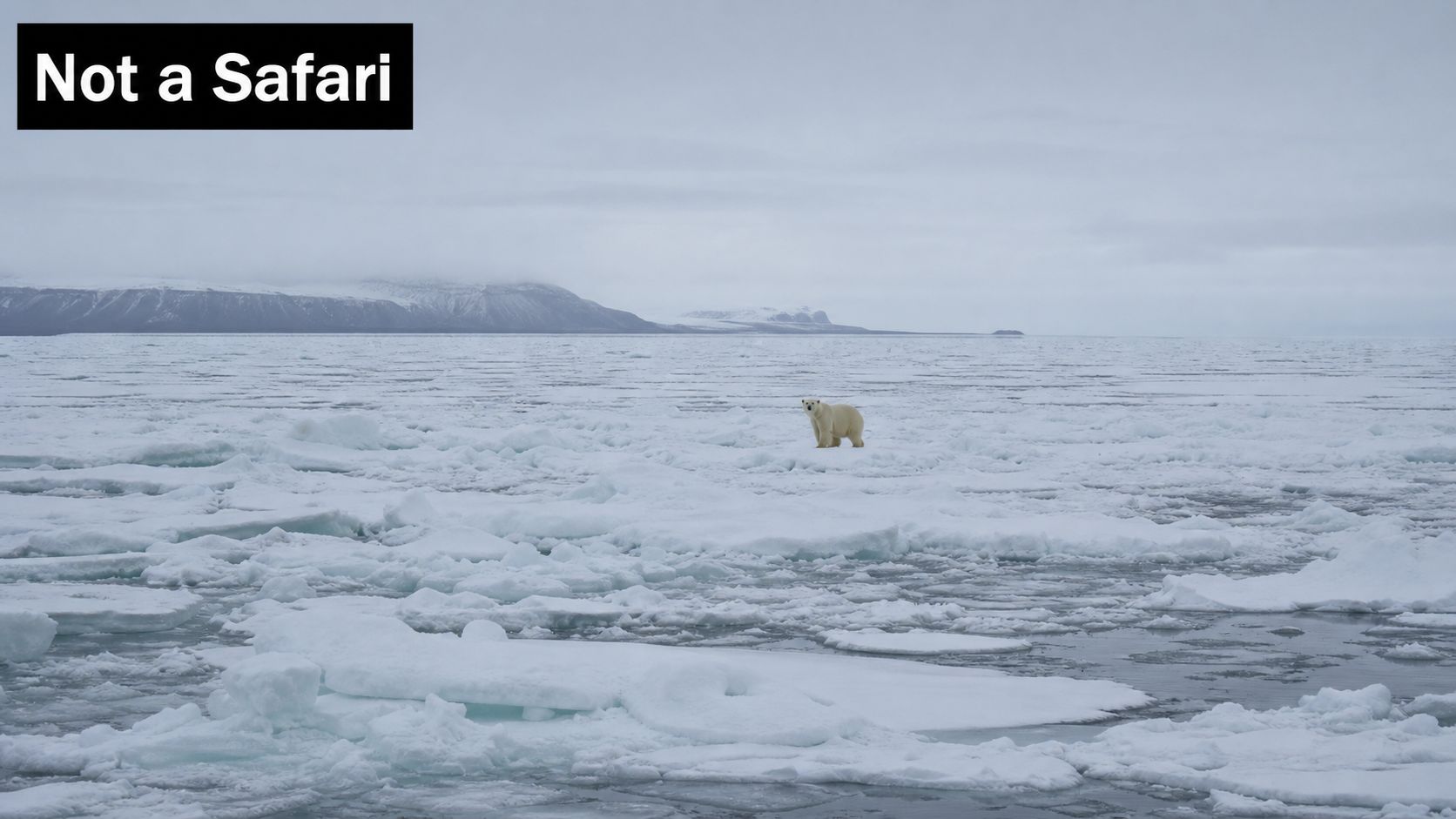
The biggest mistake travelers make is assuming a Svalbard polar bear tour works like a classic wildlife safari. It doesn't. In Svalbard, the bear is not a scheduled attraction, and the operator's job is not to corner one for your camera. The operator's job is to move responsibly through a vast Arctic environment where sightings happen when conditions, ice, and animal movement align.
That's why the best clients I've seen are the ones who stop asking, “Will I see a bear?” and start asking, “How good is the expedition?” Glacier fronts, pack ice, long light, and the silence between animal sightings are the asset and are what make this trip worth the money.
The bear is part of the story, not the whole story
The official visitor guidance is blunt about the reality of the place, there are no organized bear-seeking tours, and the viewing rules are strict because the region is managed for conservation first. That's exactly why the experience feels authentic. You're not being led to a staged encounter, you're traveling through a living Arctic system where the bears move through a much larger Barents Sea range and the islands are only one piece of their world.
This is also why the language around “safari” cheapens the trip. Safari implies a controlled sighting model. Svalbard rewards patience, logistics, and good judgment. The luxury here is not certainty, it's access, interpretation, and the ability to spend time in a place most travelers will never reach.
Practical rule: If your entire buying decision depends on seeing a bear, don't book Svalbard. If you want the best Arctic expedition available to high-spend travelers, then Svalbard belongs at the top of your list.
The winners are travelers who value the atmosphere as much as the wildlife. A quiet Zodiac run past a glacier wall, a midnight-sun deck watch, and a sudden bear report from the bridge can feel more memorable than a conventional animal-spotting itinerary because the whole trip has earned the moment. That's the premium in Svalbard, and it's why expectations need to be reset before you ever choose a sailing date.
Choosing the Right Season for Your Arctic Expedition
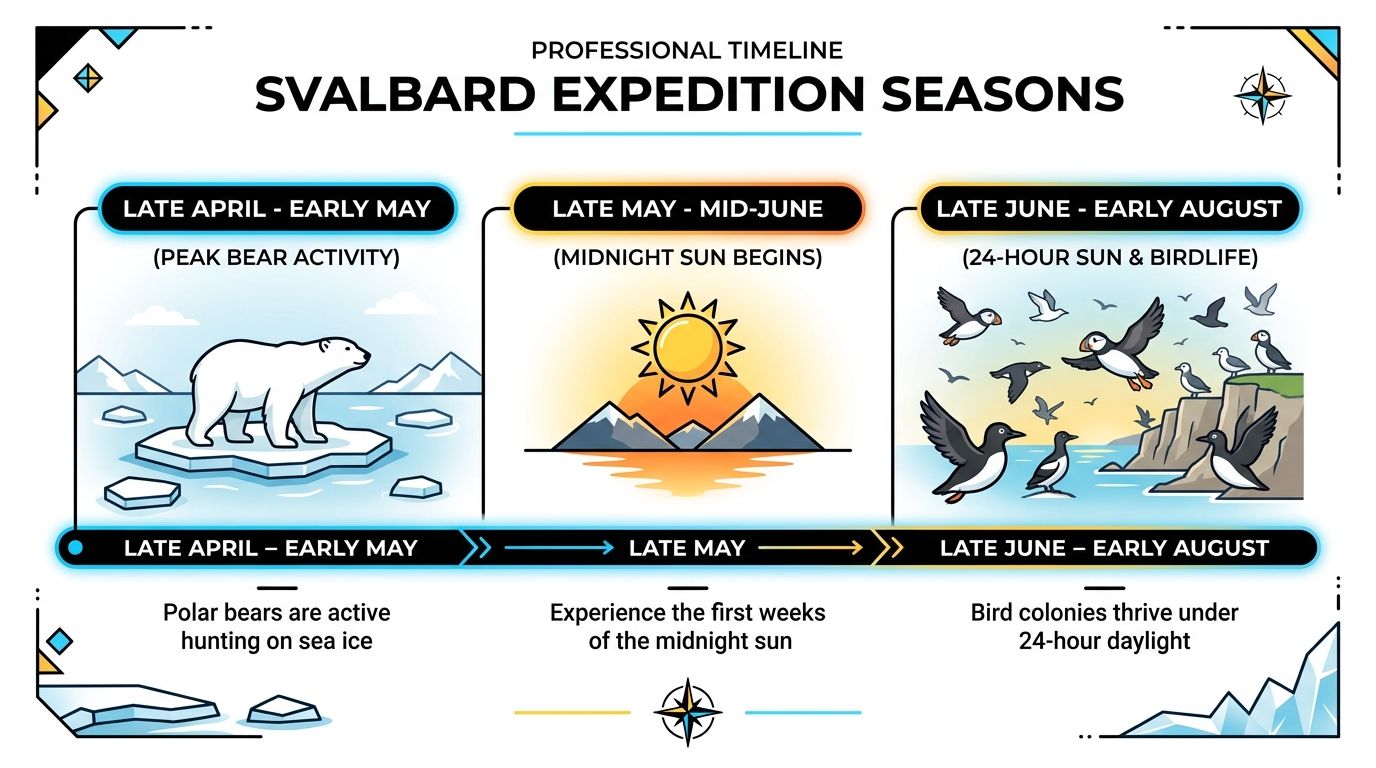
Timing decides whether a svalbard polar bear tour feels disciplined and rewarding, or merely cold and frustrating. The strongest season sits in the Arctic summer, and Seasonal Svalbard timing points to June to September as the best window for polar bear viewing on Svalbard, while another travel source places late May to August in the period when bears actively hunt and travel along pack ice. Those ranges overlap for a reason. Sea ice, wildlife movement, and workable navigation matter more than any neat promise on a calendar.
Use that to your advantage. Earlier departures usually bring more ice, more bear movement, and harder operating conditions. Later departures are easier on comfort, but they give up some of the ice-edge atmosphere that makes Svalbard feel properly remote. If you want the best mix of bear potential and expedition quality, stay inside the summer band and stop trying to force the trip into shoulder-season logic.
How to choose your month without overthinking it
If you care most about bears in active conditions, book earlier in the recommended season. If you care more about easier cruising, calmer deck time, and broader Arctic scenery, later summer is the better fit. That is the trade-off. Pretending there is a perfect month for everyone is lazy advice.
Photographers should weigh light and wildlife together. Couples and families often care more about smoother conditions and fewer operational compromises than about maximizing ice-edge access. If you are deciding between more bear movement and more comfortable logistics, choose the version of the trip you will enjoy, not the one that sounds best in a brochure.
Bears are not on a schedule. The season only improves your odds by putting the ship in the right place at the right time.
The strongest departures are the multi-day ones during summer, because they give the expedition team room to work around weather and ice. Fixed, port-style thinking is the wrong model here. Svalbard rewards travelers who accept that the itinerary should flex around conditions on the ground, not the other way around. For travelers comparing Arctic timing across destinations, this luxury Iceland timing comparison is useful context.
Expedition Ship Formats and What Each Delivers
Ship choice determines whether your Svalbard polar bear tour feels agile or merely expensive. Small-ship expeditions, usually in the 50 to 100 passenger range, are the smartest choice if you care about flexibility, frequent Zodiac work, and access to narrow fjords. Mid-size luxury expedition vessels with 150 to 200 guests can be very comfortable, but they usually trade away some nimbleness for scale and amenity depth.
That trade-off is real. Fewer guests generally means better deck access, less waiting to board, and a more intimate relationship with the expedition team. Larger ships can still deliver a strong experience, but they're best for travelers who want more onboard polish and are less obsessed with chasing every possible landing window.
Matching vessel type to traveler type
| Vessel Category | Passenger Capacity | Zodiac Frequency | Onboard Luxury Level | Best For |
|---|---|---|---|---|
| Small expedition ship | 50 to 100 | High | Moderate to high | Travelers who want the most flexibility and the best chance of spontaneous wildlife repositioning |
| Mid-size luxury expedition vessel | 150 to 200 | Moderate | High | Guests who want more room, more dining polish, and a smoother social atmosphere |
| Ultra-luxury expedition yacht or private charter | Varies | Highest by design | Very high | Families, close friends, and travelers who want privacy, control, and bespoke pacing |
If you're paying for the trip because you want a more personal Arctic rhythm, don't default to the biggest ship with the prettiest brochure. Choose the vessel that gives the expedition team the freedom to pivot when the weather shifts or the ice opens. In Svalbard, that flexibility is worth more than a larger suite.
What luxury should mean here
Real luxury is not chandeliers at sea. It's operational competence, quiet cabins, good sightlines from the observation deck, and the ability to deploy Zodiacs without turning every landing into a crowd-control exercise. It's also the right social scale, because long expedition days are much better when you don't feel trapped in a floating hotel.
The most expensive option isn't always the smartest. Private charters and ultra-luxury yachts make sense when privacy, group cohesion, or bespoke routing matter more than price efficiency. For most high-net-worth travelers, though, the ideal choice is a ship that sits at the point where comfort and expedition capability still reinforce each other instead of competing.
Packing and Medical Preparation for the Arctic
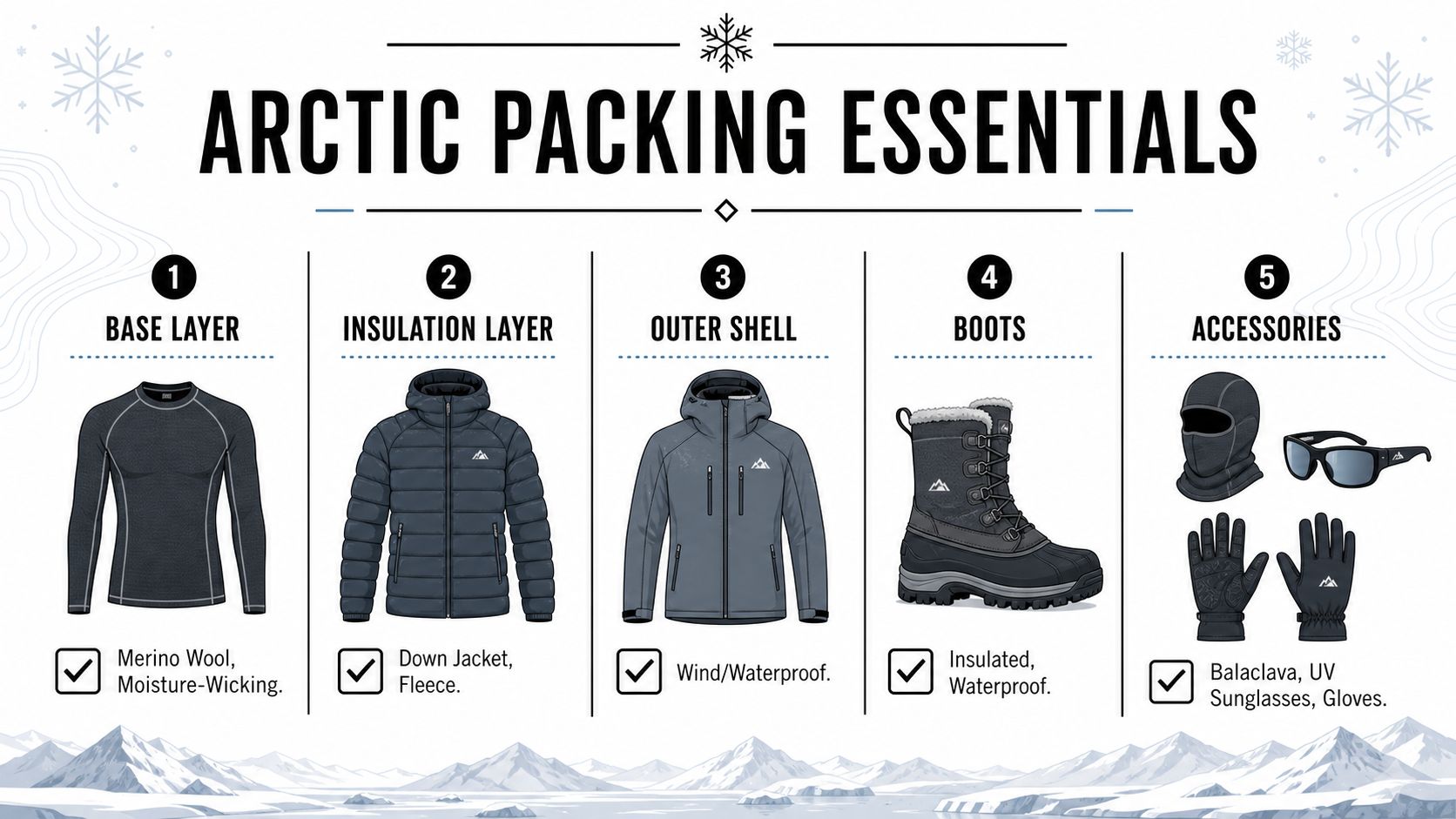
Don't underpack for Svalbard. The environment punishes vanity packing and rewards boring, technical clothing. You need thermal base layers, windproof insulation, fully waterproof outer shells, and knee-high waterproof boots because Zodiac landings can mean stepping into shallow seawater before you ever touch shore. Expedition packing guidance repeatedly emphasizes the same thing for a reason, wet plus wind is where discomfort turns into a bad day. Arctic expedition packing guidance
The other mistake is assuming your city winter gear is enough. It usually isn't. The decks stay exposed, the wind cuts harder than people expect, and you can spend long periods standing still while wildlife or weather develops. That's why I'd rather see a traveler slightly overprepared than elegantly wrong.
What to bring and why it matters
- Base layer: Merino wool or another moisture-wicking layer keeps you dry when you're moving between heated interiors and cold decks.
- Insulation layer: A fleece or down piece traps warmth without forcing you to wear one massive coat all day.
- Outer shell: A proper windproof, waterproof shell matters more than fashion, because spray and snow don't care what brand you're wearing.
- Boots: Fully waterproof, insulated boots are essential for Zodiac work and wet landings.
- Accessories: A balaclava, gloves, and UV sunglasses all earn their place, especially when light reflects off ice and water for hours.
For cold-weather headwear, a practical roundup like layer up with faux fur is useful because it reminds you that exposed skin and wind exposure are the first things to solve, not the last.
Medical prep deserves the same seriousness. Buy solid evacuation insurance, bring motion sickness medication if you're sensitive to open-water crossings, and understand that advanced care is not around the corner. This is remote travel, so convenience disappears quickly when the weather turns.
Pack for discomfort, not for the lobby of the hotel you flew from.
If you need a simple rule, use this one. Dress in layers you can remove, not one oversized piece you can't adapt. That approach keeps you warmer, drier, and much happier when the expedition team asks everyone to come outside because the light or wildlife has finally lined up.
A Day on a Luxury Svalbard Expedition
A good Svalbard day doesn't run on a fixed resort schedule. It runs on weather, ice, and the bridge team's judgement. You wake up, check the water from your window or balcony, and then decide whether the day is going to be about cruising, landing, or waiting for the right opening in the ice.
Morning usually starts with a bridge visit or a quiet look from the observation deck. The captain and expedition staff are reading the route while the naturalists are already scanning for movement along shorelines and floes. If there's a wildlife call, the day can change immediately, and that's exactly how it should be.
What the rhythm actually feels like
When the call for a Zodiac comes, the mood shifts fast. Guests move with purpose, boots get checked, and the expedition team does what it does best, getting people ashore efficiently without making the landing feel chaotic. Some days you'll be out among glacier faces and pack ice for hours, listening to the sound of calving ice and the soft engine note of the Zodiac cutting through still water.
Lunch is usually better than it has any right to be in such a remote place. On strong expedition programs, the chef is not treating food as an afterthought. Warm soups, proper seafood, and thoughtful plated meals matter because they restore you between deck sessions and landings.
By afternoon, the ship settles into a different pace. Guests review photos, warm up, or sit out on deck when the light gets interesting again. Evening brings lectures, map briefings, and naturalist commentary that gives context to what you've just seen, which is important because Svalbard gets much more interesting once you understand the movement of ice, birds, seals, and bears.
The best part is how unforced it feels. A luxury expedition here is not about forced entertainment. It's about the calm confidence that the crew will use the day well, even if the original plan disappears in a weather change.
Wildlife Ethics and Conservation in Svalbard
Svalbard's polar bear story starts with protection. The species has been totally protected since 1973, and a scientific analysis covering 1987 to 2019 found annual kills in Svalbard ranged from 0 to 10, with a mean of 2.9 per year, alongside a statistically significant decline over time of b = -0.045, 95% CI: -0.081 to -0.011, P = 0.013. That's not trivia. It's the backdrop for every ethical expedition decision made on the islands. Scientific analysis of Svalbard bear protection and kills
The viewing rules are strict for good reason. The 500-meter minimum from March 1 to June 30 reflects a conservation-first model that values bear welfare over guest excitement. Good operators don't fight that framework, they build around it. If a bear is near a ship or landing site, the right response is withdrawal, not crowding in for one more shot.
Why ethics raise the value of the trip
Responsible luxury earns its place here. The best expedition teams read bear behavior early, keep guests informed without drama, and leave before they cause stress. That's a better experience anyway, because a calm, compliant sighting feels more authentic than a forced close-up ever could.
Tourism has grown around these protections, and the balance matters. The islands still welcome serious travelers, but the system works only when visitors accept limits. That's one reason a Virtuoso-affiliated advisor can add value, because the right booking partner helps you choose operators known for discipline, not just marketing polish.
A good Arctic advisor doesn't sell access at any cost. They protect the integrity of the trip before the plane ever leaves the ground.
Climate change also hangs over the entire experience. Sea ice is part of the bear's habitat and part of the expedition's operating reality, which is why responsible travel in Svalbard feels more consequential than a standard luxury getaway. You're not just visiting a remote place, you're entering a system that depends on restraint.
Costs and Booking Your Bespoke Svalbard Journey
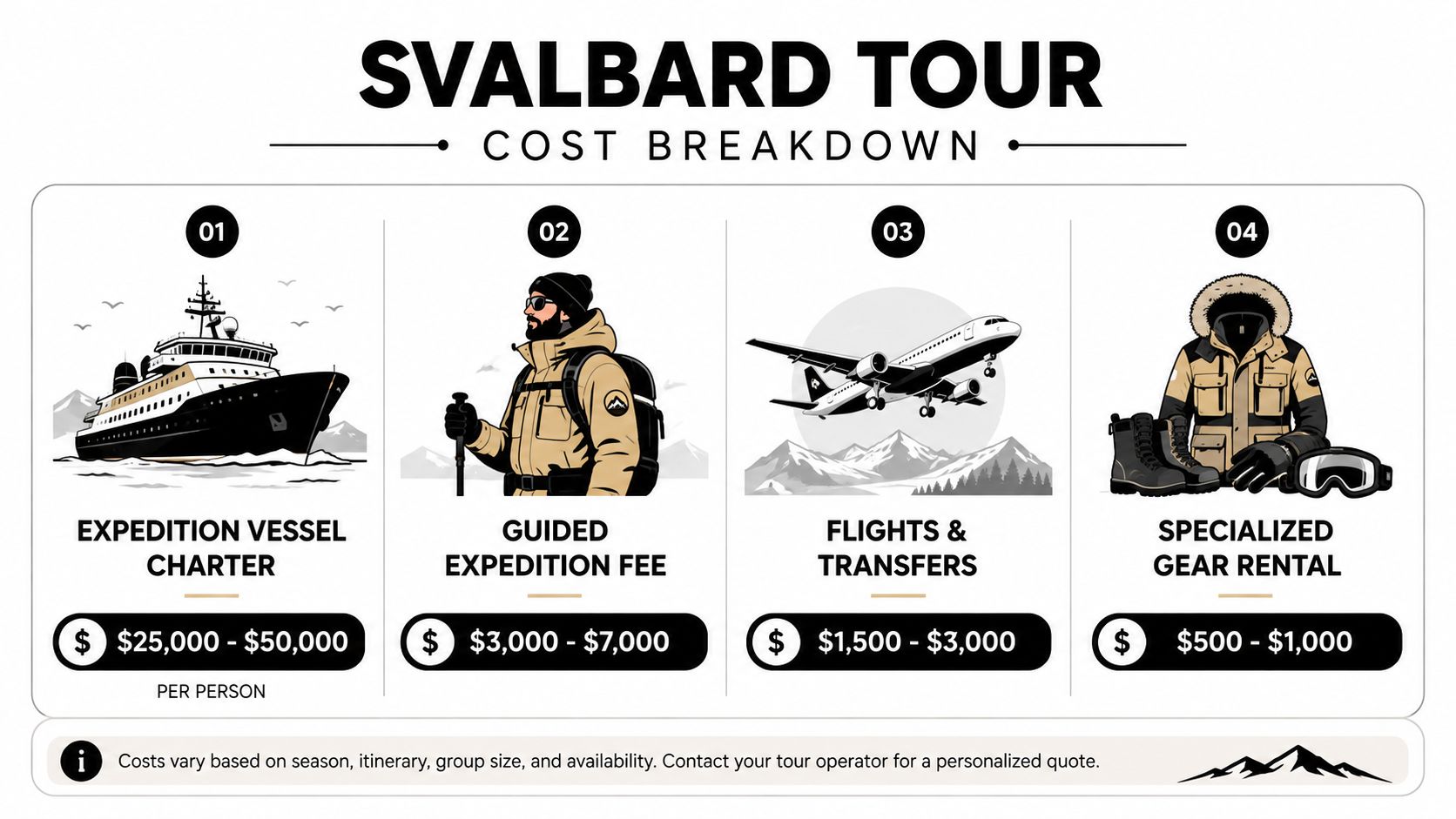
The honest answer on cost is that Svalbard is expensive because it is remote and operationally unforgiving. You are paying for ice-capable logistics, expedition staffing, winter-rated systems, and the reality that no one can mass-produce a credible itinerary here. The best trips run on a long, flexible format, with examples of 8-day and 11-day routes showing how much time it takes to move intelligently through West Spitsbergen and wait for the right conditions. Expedition itinerary examples
Price is easiest to judge by what is included. A higher-end vessel or suite-level departure buys privacy, space, and more control over pacing. Guided expedition fees pay for the people who make the trip worthwhile, not just the berth. Flights, transfers, and gear are the parts that catch travelers off guard, because remote routing and Arctic equipment add friction fast.
What to book and when to book it
- Expedition vessel charter: $25,000 to $50,000 per person for a private-leaning charter framework, the level where real control over pacing begins.
- Guided expedition fee: $3,000 to $7,000, which reflects operating expertise rather than just the bed at sea.
- Flights and transfers: $1,500 to $3,000, a category that matters more than people expect because remote routing can be tedious.
- Specialized gear rental: $500 to $1,000, useful if you do not want to buy Arctic-specific items for one trip. Svalbard tour cost breakdown
For travelers who want the trip to feel easy, private aviation, pre- and post-expedition hotel nights, and transfer planning matter more than they first appear. Private jet luxury travel planning is the right mindset here, because the luxury is not only the ship, it is the absence of friction before and after the sailing.
Book early if you care about a specific summer window or a suite category. If you want the trip handled properly, use an advisor who can work through preferred partner channels, secure the right cabin when available, and manage changes when Arctic weather interferes. That is the difference between a polished expedition and a stressful one.
Haute Black designs Arctic journeys the way they should be designed, with sharp routing, credible expedition operators, and arrivals that respect how remote Svalbard really is. If you want a serious Svalbard polar bear tour built around expedition quality, not hype, visit Haute Black and start planning the version that fits your travel standards.
Explore Our Guides


Signature Experiences