Haute Black Journal
Luxury Trips to Arctic: Exclusive Expeditions 2026

Marlene Azeez
Director, HauteBlack
View all articles →

# Luxury Trips to Arctic: Exclusive Expeditions 2026
July 3, 2026
The Arctic isn't a fringe luxury destination anymore. It's a market moving fast. Cruise passenger numbers in the Arctic rose 60% from approximately 50,000 in 2005 to about 80,000 in 2016, and the broader pattern is even more dramatic, with summer tourism quadrupling and winter tourism increasing by 600% between 2006 and 2016, according to the Arctic tourism fact sheet. That's precisely why discerning travelers need to approach trips to Arctic regions differently now.
If you want the same route, the same ship, and the same photographs as everyone else, the market will happily sell that to you. If you want privacy, strategic timing, controlled exposure, expert-led access, and a journey that still feels rare, you need to curate the how with far more care than the where.
The Allure of the Modern Arctic Expedition
The Arctic is one of the last places where luxury still depends on logistics, not labels.
Its mythology was built by navigators, not resort developers. That distinction still shapes the experience. The names attached to Arctic history matter because they established the region as a place defined by judgment, timing, endurance, and route design. Modern travelers inherit that atmosphere, whether they arrive by private jet to Longyearbyen, helicopter into a remote lodge, or board a chartered yacht in Greenland.
That is why the Arctic still feels rare. Not because it is inaccessible in a literal sense, but because genuine access requires configuration. You need the right aircraft, the right vessel, the right guides, the right landing permissions, the right weather windows, and the discipline to build around them rather than forcing the destination to obey your schedule.
Why the Arctic still feels exclusive
Many luxury destinations sell polish. The Arctic sells selectivity.
Its appeal comes from controlled remoteness. You can still arrange privacy here in a way that feels meaningful, not theatrical. A well-planned Arctic journey can give you a glacier face with no neighboring yacht in sight, a dog-sled transfer timed around light rather than hotel programming, or a heli-supported day that bypasses the public version of the destination entirely. That is the difference between visiting the Arctic and commissioning it properly.
The region itself also rewards discernment. It spans Canada, Greenland, Iceland, Norway, Finland, Sweden, Russia, and the United States, and each one expresses polar travel differently. Greenland delivers scale and maritime drama. Svalbard offers raw expedition intensity. Finnish Lapland provides winter privacy with a higher degree of architectural comfort. Iceland works well as both a standalone escape and a staging point for wider polar travel, especially for travelers planning luxury travel to Iceland with a more private, design-led approach.
The best Arctic trips do not cosplay exploration history. They convert it into precise access, serious comfort, and time used well.
What modern luxury changes, and what it shouldn't
Modern polar travel should remove inconvenience, not consequence.
You should fly privately where schedules are thin, use expert outfitters who can handle permits and ice intelligence, and choose vessels or lodges that give you space, warmth, and discretion. You should also expect excellent food, strong staffing, and guides who can read both terrain and clients. None of that dilutes the Arctic. It lets you experience it with more clarity.
What should remain intact is the region's authority. Weather still dictates terms. Light still shapes the day. Ice still changes plans. A strong operator works with those realities and builds alternatives before you need them. A weak one merely sells atmosphere and hopes conditions cooperate.
Haute Black arranges smoothly connected, high-touch Arctic journeys for private clients who care about access, privacy, and exact execution. That matters here more than in almost any other destination category, because the quality of the trip is determined less by the brochure than by the invisible decisions behind it.
That is the allure of the modern Arctic expedition. It still feels earned.
Choosing Your Arctic Season and Realm
Season is the first major decision, and most travelers make it too simplistically. Summer is not automatically better. Winter is not automatically harder. The essential question is what you're trying to feel, photograph, avoid, and remember.
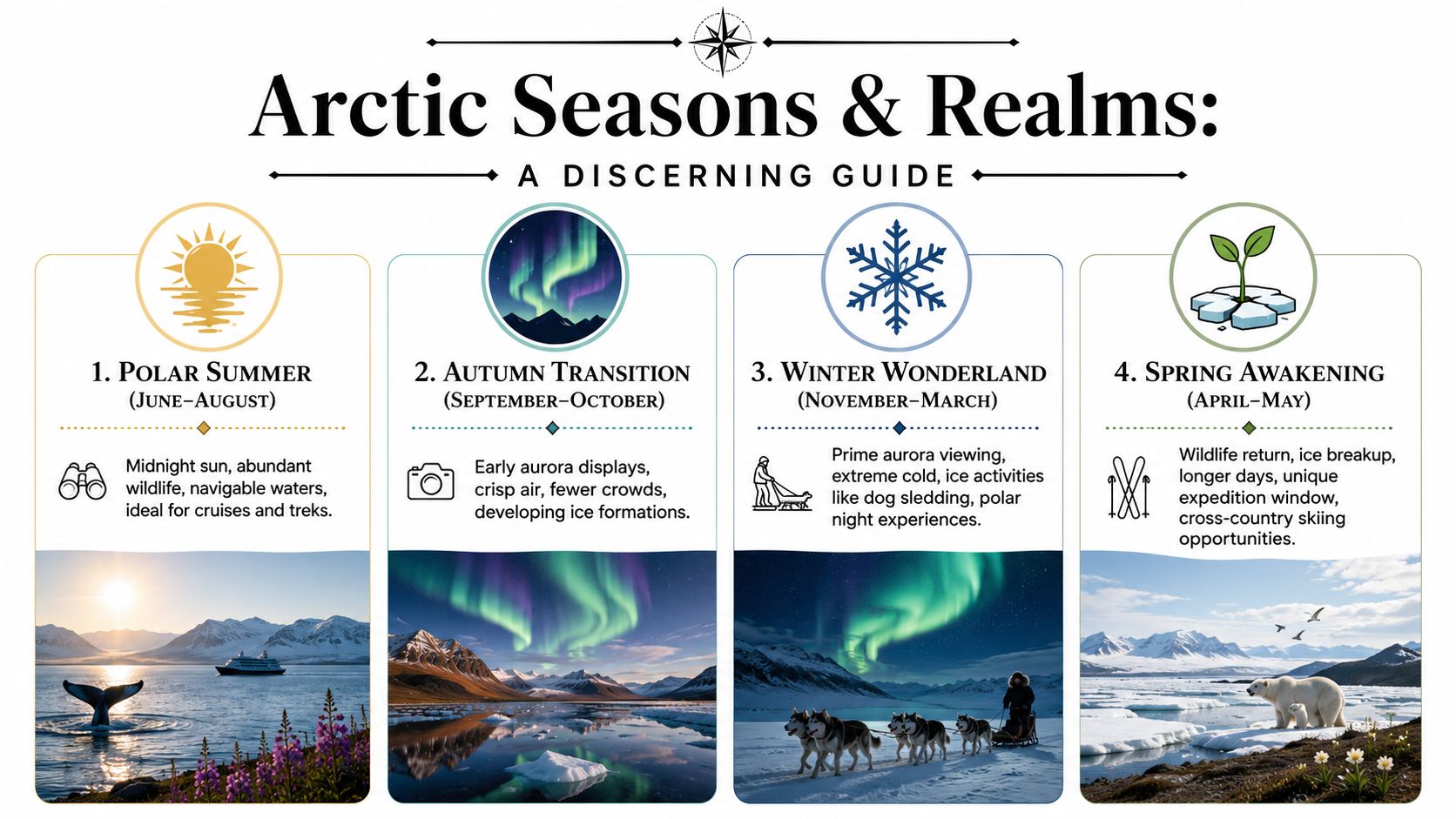
Polar summer for movement and wildlife
Summer gives you breadth. The light barely leaves, the sea opens up, and ship movement becomes the most efficient way to cover terrain. If your priorities are glacier fronts, bird cliffs, expedition landings, and broad-ranging marine itineraries, summer is the obvious season.
Svalbard and Greenland both reward summer travelers who want a stronger sense of geographic sweep. Days feel elastic. Wildlife watching is easier to structure into a moving itinerary. For travelers used to compressed urban luxury, that abundance of time can feel almost disorienting in the right way.
Summer also works well for first-time trips to Arctic regions because the logistics are more intuitive. Private yacht routes are easier to visualize. Shore excursions fit more naturally into a daily rhythm. Families often prefer it for that reason.
Winter for privacy and atmosphere
Winter is where taste shows.
While summer has traditionally received most of the attention, luxury winter Arctic bookings saw a 35% increase in 2025, driven by experiences such as Northern Lights photography and private glass igloo accommodations, according to this Arctic travel guide. That trend makes perfect sense. Winter strips away the casual visitor.
The best winter trips to Arctic destinations aren't about volume of activity. They're about control. Private lodge buyouts. Aurora windows monitored in real time. Dog sledding or snowmobile access timed around weather and daylight. Long, quiet dinners after hard cold air and complete dark. Winter has less spectacle in the conventional sense and more atmosphere, which is exactly why discerning travelers are moving toward it.
For a deeper look at a gateway destination that often anchors broader polar planning, see this luxury travel to Iceland definitive 2026 guide.
Seasonal rule: Choose summer if you want range. Choose winter if you want solitude.
A practical comparison
| Season | Best for | Ideal realm | Trade-off |
|---|---|---|---|
| Polar Summer | Wildlife viewing, expedition cruising, broad access | Svalbard, Greenland | Less privacy on popular routes |
| Autumn Transition | Early aurora, sharper air, lower traffic | Northern Norway, Finland | More variable conditions |
| Winter Wonderland | Aurora, private lodges, stillness | Finnish Lapland, Svalbard | Tighter logistics and colder operations |
| Spring Awakening | Ski journeys, transitional landscapes, fresh expedition windows | Northern Norway, select Arctic fjords | Short, highly specific seasonal opportunities |
Match the realm to the traveler
Not every Arctic realm suits every client.
- For couples: Choose winter lodges and aurora-focused programs. Privacy matters more than distance covered.
- For families: Choose summer expedition formats with soft adventure and structured support.
- For accomplished repeat travelers: Choose hybrid journeys with air, sea, and remote lodge components.
- For active clients: Choose spring ski access or expedition sailing windows with a physical element.
The mistake is picking the Arctic first and the travel style second. Reverse that. The Arctic rewards travelers who decide how they want to move through it before they decide where to plant a flag.
The Spectrum of Arctic Experiences
The Arctic stops feeling luxurious the moment you share it too broadly. The decision is not which map point to choose. It is which operating model protects privacy, controls access, and gives you room to respond to weather, wildlife, and mood without compromising the trip.
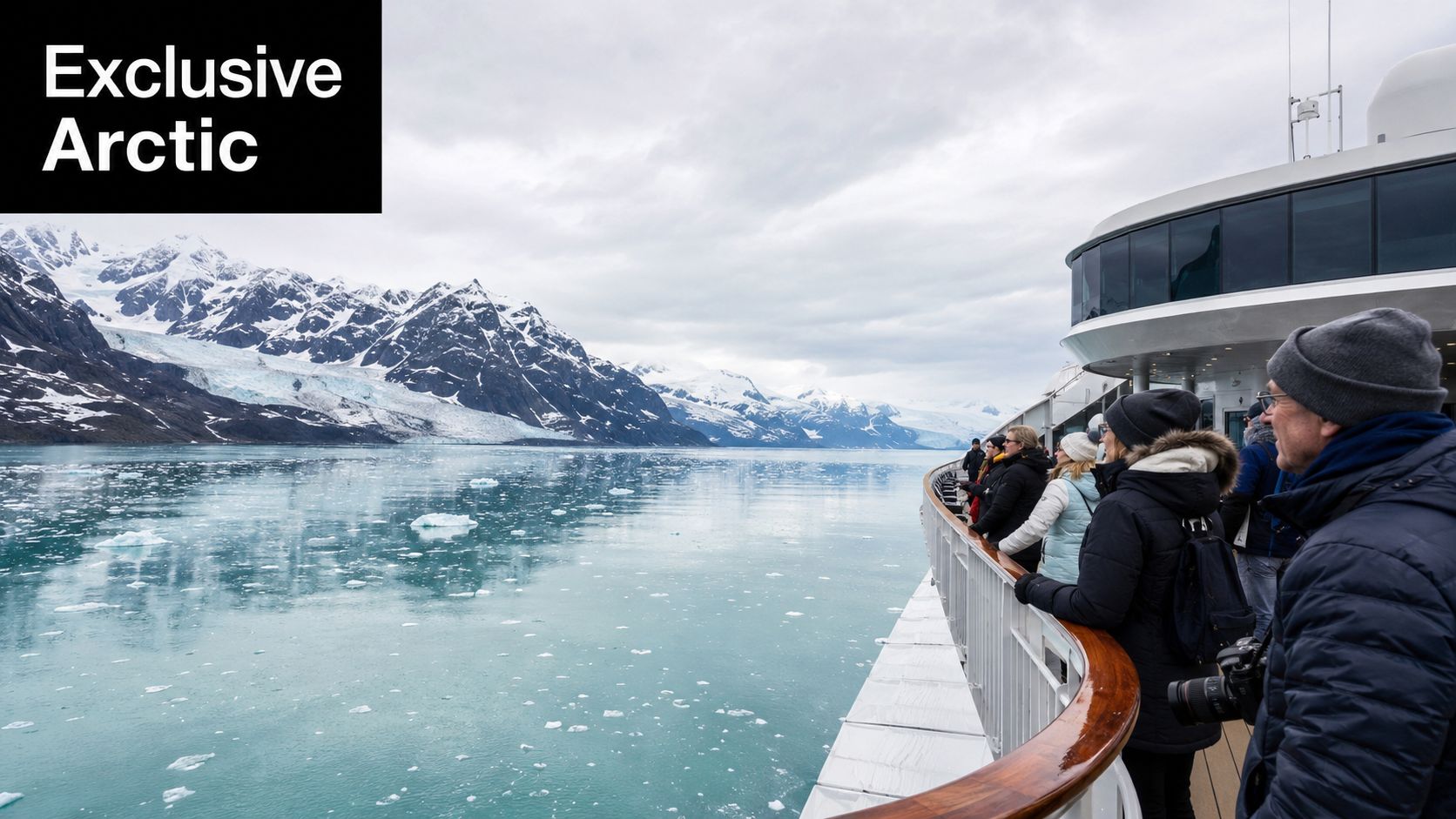
Expedition cruising for structured reach
Expedition cruising remains the most practical way to cover serious ground. In the right hands, it delivers disciplined logistics, experienced guides, and access to coastlines that are inefficient to reach any other way.
Choose this format for a first Arctic journey, for multigenerational groups, or for clients who want variety without building an aircraft-and-yacht ballet around every day. The standard has to be high. Book a true expedition vessel with limited guest count, strong bridge leadership, capable Zodiacs, and suites you would want to return to after eight hours of wind and ice. A large cruise ship with polar branding misses the point.
This is a good format for access. It is a weaker format for privacy.
Private yacht charter for control
Private yacht charter is the strongest answer for clients who care about discretion above all else. You control the guest list, the pace, the anchorage strategy, and the social atmosphere. You stay longer when a glacier face is particularly active. You change course when conditions shift. You dine when you want, not when a shipwide seating dictates it.
That freedom changes the entire tone of the journey. The vessel becomes a private residence with expedition capability, not a hotel with an itinerary.
Yachts work especially well in Greenland and selected Norwegian and Svalbard waters, where coastline, fjords, and ice create constant opportunities to adjust course intelligently. For clients pairing an Arctic sea program with a refined land stay, this Arctic TreeHouse Hotel luxury stays and aurora guide is a useful reference for the lodge portion.
Fly-in lodges for stillness
Some Arctic travelers need fewer moving parts.
A remote lodge suits clients who want silence, design, warm interiors, and a fixed base that feels sheltered rather than transient. This is often the right answer for winter aurora trips, milestone celebrations, and families with different rhythms. One guest can head out with a guide before dawn. Another can stay by the fire, take a late breakfast, and join only the experiences worth leaving the suite for.
The strongest lodges also solve a common luxury problem in the Arctic. They reduce audience. You are not performing the trip in front of other guests all day.
Expedition ships maximize range. Private yachts maximize control. Remote lodges maximize peace. Choose the format that protects the atmosphere you want to live in.
A short visual break helps clarify how these formats differ in practice.
Heli-supported travel for serious access
Heli-supported travel sits in a separate category. It suits strong skiers, high-level photographers, and clients who expect access beyond standard landing sites and marked routes.
This format depends on exact planning. Aircraft type, fuel positioning, landing protocols, guide ratios, medical contingencies, and weather calls all matter. Done properly, it gives you access to faces, ridgelines, and vantage points that surface-only itineraries cannot provide. Done carelessly, it becomes expensive theatre.
Use helicopters only when they materially improve the journey. In the Arctic, restraint is often the wiser choice.
Match the format to the client
Use a simple filter.
- Choose expedition cruising for broad regional access, professional structure, and a strong first reading of the Arctic.
- Choose private yacht charter for discretion, schedule control, and a fully private social environment.
- Choose a fly-in lodge for atmosphere, slower pacing, and low social density.
- Choose heli-supported travel for technical pursuits and access that justifies aviation complexity.
The best Arctic trips are not built around the most dramatic format. They are built around the mode of travel that protects comfort, privacy, and freedom of decision once you are there.
Imagining Your Bespoke Arctic Itinerary
The most convincing Arctic itineraries aren't abstract. They have narrative shape. They know when to move, when to pause, and when to leave room for conditions to dictate the finest moments.
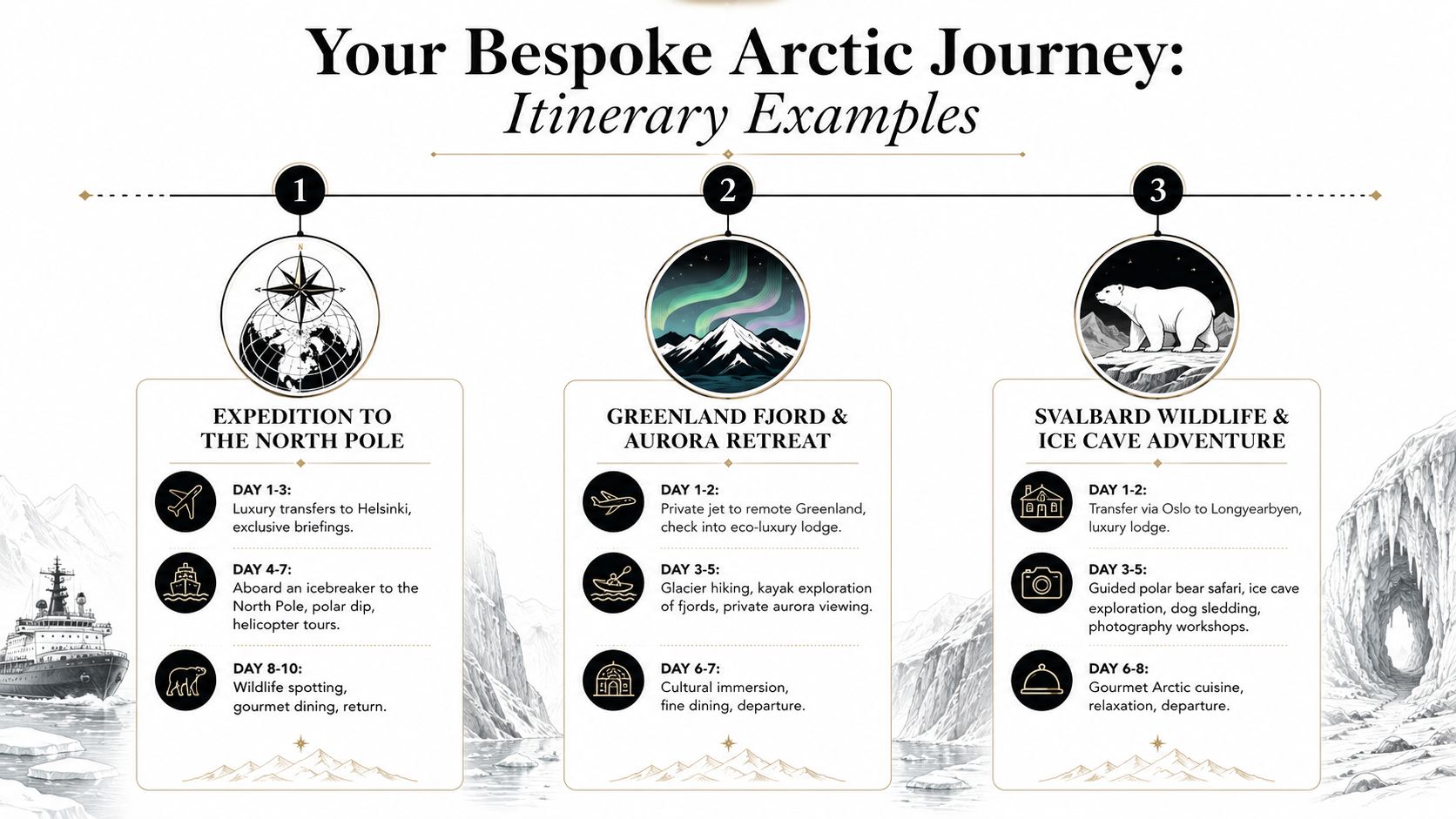
Greenland by private yacht and cultural immersion
A strong Greenland journey begins with a clean arrival sequence. Private air into a gateway, minimal layover friction, then direct transfer to a yacht positioned for fjord travel. Once onboard, the pace should slow immediately. Greenland is too immense for rushed movement.
Days are built around elemental contrasts. Icefjord cruising in silence. Shore landings that feel geologic rather than performative. Encounters with local communities handled with respect and prior arrangement, not as drive-by “culture stops.” Evening service remains polished, but the point isn't opulence for its own sake. It's the privilege of watching ice move while your own environment remains calm, warm, and private.
A yacht-based Greenland itinerary suits travelers who dislike unnecessary audience. You don't need a lobby scene in the Arctic. You need a vessel with a proper deck, excellent provisioning, and a captain willing to treat time as an asset rather than a timetable.
Svalbard in winter with a lodge base
Svalbard changes character in winter. It becomes less about range and more about intensity.
The right approach is a lodge-led itinerary with selective field days rather than nonstop motion. You want mornings that begin with clear weather assessment, guide briefings, and flexible planning. If conditions align, the day may open into snowmobile traverses, remote wildlife observation from controlled distances, or aurora viewing from a dark, sheltered position. If they don't, the itinerary should still feel rich because the lodge itself is part of the experience, not a fallback.
This style of trip works especially well for couples and accomplished travelers who have already done high-gloss alpine winter and want something rarer. There's less social choreography and more elemental presence.
Some Arctic itineraries succeed because they add more. The better ones succeed because they remove noise.
The Arctic Haute Route for active connoisseurs
For clients who want movement and technical pleasure, the Arctic Haute Route is one of the clearest examples of a compact, guide-intensive Arctic journey. It's marketed as the world's most beautiful ski-and-sail adventure above the Arctic Circle, with charter sailings available for spring 2027. That future availability matters because these experiences operate in narrow seasonal windows and should be secured well ahead of travel.
The mechanics are part of the appeal. The voyage spans four total days, combining ship-based lodging with intentional shore-based ski touring in Northern Norway's Arctic fjords. That hybrid structure is exactly what makes it appealing to seasoned travelers who are bored by passive cruising and underwhelmed by generic ski weeks.
The journey also gives a useful reference point for understanding the design of high-touch Arctic adventures:
- The vessel isn't just transport. It acts as mobile lodging and operational base.
- The shore program isn't incidental. Ski touring is the central point of the experience.
- The duration is concise. That concentration can be ideal for clients who want intensity without a long polar commitment.
The broader lesson is simple. Bespoke trips to Arctic regions should be written around a traveler's preferred cadence. Some want long marine immersion. Some want a winter base with exacting service. Some want active, guide-led days with a sense of earned return each evening.
What bespoke really means in practice
A bespoke itinerary is not a menu with nicer adjectives. It should answer questions standard travel products ignore:
| Priority | Bespoke response |
|---|---|
| Privacy | Limited guest overlap, controlled transfers, private dining, route discretion |
| Time efficiency | Aircraft sequencing, short ground times, weather-aware scheduling |
| Meaningful access | Specialist guides, selective shore permissions, thoughtful local interaction |
| Comfort | Layered backup plans, proper recovery time, polished environments at day's end |
If your itinerary can be summarized with a brochure paragraph, it isn't bespoke enough.
Navigating Safety and Logistics in the Extreme
Ultra-luxury Arctic travel is defined by control. If the operating plan is loose, the experience stops feeling exclusive and starts feeling exposed.

The technical realities you should insist on
The Arctic strips away marketing language fast. Equipment fails sooner in deep cold. Weather closes windows without apology. Distance turns minor errors into expensive delays.
According to MIT Lincoln Laboratory's discussion of Arctic operations, communication equipment loses battery capacity sharply in temperatures below -20°C, and vessels in these environments require reinforced ice-class construction to handle ice-loading forces, as outlined in this Arctic operations overview.
Those details shape the entire trip design. Serious operators build around redundancy, not optimism. They carry backup communications, manage battery exposure deliberately, and plan vessel capability as an operational requirement rather than a brochure line.
Privacy matters here as much as safety. In the Arctic, poor logistics create unnecessary touchpoints, longer waits, more weather exposure, and less control over who shares your route. The best itineraries reduce all four.
Questions worth asking before you commit
Ask for specifics. Competent teams answer cleanly and fast.
- Medical response: Who makes the evacuation call, and what assets are realistically available?
- Guide profile: Are your guides trained for polar terrain and wildlife protocols, or are they broad-spectrum adventure staff?
- Communications: What backup systems are carried in the field, and how are they protected against cold-related power loss?
- Aviation handling: Who controls timing, luggage flow, runway changes, and missed-weather scenarios on remote arrivals?
- Access management: How many points in the itinerary depend on commercial schedules or shared transfer infrastructure?
For itineraries that demand tighter air coordination, options like private jet charter services for complex remote routing can reduce exposure to commercial timing friction.
Practical rule: In the Arctic, comfort comes from systems.
Comfort is part of the operating plan
Refined polar travel depends on disciplined separation between field performance and recovery. Blend those categories and the trip becomes clumsy.
Your field kit should be built with intention. Proper layering, tested boots, glove systems that preserve dexterity, and cold-aware battery storage for phones and cameras all matter more than brand signaling. Your indoor wardrobe should do one job well. It should make a remote yacht or lodge feel polished at the end of a hard day, with knitwear, soft tailoring, and proper indoor footwear rather than overpacked excess.
Wildlife protocol deserves the same seriousness. Travelers heading into bear country on land-based excursions should review this concise guide to essential information for outdoor enthusiasts before a North American Arctic journey. It does not replace your guides. It does make you a better client in the field.
Your safety baseline
Use this as your required standard:
| Category | Required standard |
|---|---|
| Marine travel | Ice-class vessel and an experienced polar command team |
| Land operations | Specialist guides, route flexibility, and weather-led decision making |
| Communications | Redundant systems with disciplined battery protection |
| Medical planning | Evacuation protocol set before departure |
| Wardrobe | Purpose-built field kit, separate from refined indoor clothing |
The Arctic can feel vast and pristine. Your trip should still feel tightly controlled.
Understanding the Investment in an Arctic Journey
Price conversations about the Arctic often start in the wrong place. People ask what it costs. They should ask what level of control, access, and risk management they're buying.
The cheapest Arctic itinerary is rarely the least expensive choice in real terms. If it creates transfer friction, poor privacy, weak guiding, or avoidable operational compromises, you're not saving money. You're purchasing inconvenience inside a difficult environment.
What drives the spend
The largest pricing variables are structural:
- Mode of travel: Private yacht, expedition vessel, lodge buyout, or hybrid air-sea format
- Exclusivity level: Shared departures versus fully private programs
- Duration: A concise, high-intensity trip can be more effective than a longer, diluted one
- Logistical complexity: Helicopters, private air, guide specialization, and remote positioning all change the equation
That's why “Arctic pricing” is a meaningless phrase on its own. Two clients may both say they want trips to Arctic destinations, while one means a refined expedition cabin and the other means a private yacht with layered aviation and on-call specialist support.
One useful benchmark
A concrete example helps. The Arctic Haute Route ski-and-sail expedition costs approximately $2,230 USD per person for a concentrated 4-day experience, according to this Arctic Haute Route pricing reference. That figure is not a universal Arctic benchmark. It is a very specific illustration of how highly specialized, guide-intensive experiences can be priced when duration is short and the format is tightly defined.
The lesson is straightforward. A focused, expertly guided Arctic experience can deliver strong value when the concept is narrow and the logistics are contained. Once you add private aviation, vessel exclusivity, security of timing, and a broader service envelope, the investment rises because the operation itself becomes far more complex.
You're not paying for cold weather and a view. You're paying for access, insulation from friction, and the expertise required to move elegantly through a difficult region.
Spend where it matters
If you're going to allocate budget aggressively, do it in these areas:
- Guiding quality: Safety and depth of experience intersect.
- Transport control: Private or tightly managed transfers reduce cascading problems.
- Accommodation format: Privacy changes the emotional quality of the trip.
- Operational redundancy: The Arctic rewards backup plans more than flashy extras.
The right investment produces calm. That's what discerning clients remember most.
The Haute Black Advantage in Polar Exploration
Arctic luxury is decided long before departure. The quality of the journey comes from how it is built. Air routing, vessel selection, permit handling, guide access, suite control, privacy protocols, and contingency design determine whether the experience feels calm or compromised.
Haute Black plans at that level. Its role in polar travel is straightforward: coordinate the operation behind the trip so the client gets privacy, timing control, and access that standard expedition booking cannot deliver. In the Arctic, that matters because even a beautiful itinerary fails if the mechanics are loose.
What good polar planning looks like
High-level Arctic planning starts with restraint. Fewer transitions. Better operators. Clear priorities. You do not improve a polar journey by cramming in every headline experience. You improve it by protecting energy, reducing exposure to delays, and securing the right people on the ground and at sea.
The strongest plans usually get four decisions right early:
- Route discipline: Keep the itinerary tight. Choose fewer stops with stronger payoff.
- Arrival strategy: Use private air or carefully controlled commercial sequencing to reduce fatigue, missed connections, and wasted nights.
- Privacy controls: Secure private guides, low-visibility transfers, preferred suite positions, and departures that do not feel crowded.
- Experience focus: Decide what the trip is for. Wildlife. Aurora. Skiing. Solitude. A retreat with family. Pick the lead theme and build around it.
Clients with means often ask first about novelty. They should ask about control. In the Arctic, control is what protects the experience.
What high-caliber operators should already handle
A serious polar operator does more than deliver scenery and cold-weather gear. It manages access responsibly, keeps wildlife encounters disciplined, and plans for disruption without making the client carry that tension.
That standard shows up in specific ways. Strong bridge teams and expedition leaders keep distance around wildlife instead of chasing a better photo. Ship and camp operations are designed to reduce waste, noise, and unnecessary disturbance. Backup routing, weather holds, and alternate activity plans are prepared before they are needed, not improvised in the moment.
Polar travel at the top end should feel private, precise, and well controlled. It should never feel performative or careless.
Why this matters for the client experience
Well-run Arctic travel is quiet in the right places. The client sees an easy arrival, a well-positioned suite, polished field support, and a rhythm that still feels composed when weather shifts.
Behind that, the planning team is doing the harder work.
| Client sees | Planning team handles quietly |
|---|---|
| An easy arrival | Aircraft coordination, baggage continuity, timing buffers |
| Well-judged remote stays | Supplier negotiation, room control, access requests |
| Refined wildlife encounters | Guide vetting, distance protocols, weather contingencies |
| A calm overall rhythm | Ongoing itinerary adjustments and backup execution |
That is the advantage. Precision. Privacy. Access with discipline.
The Arctic is no place for generic planning. The people who get the most from it are the ones who insist on a clear purpose, tightly managed logistics, and an operator capable of delivering both discretion and reach.
If you're considering trips to Arctic regions and want them designed with privacy, precision, and real access in mind, contact Haute Black to start shaping a customized journey.
Explore Our Guides


Signature Experiences


