Haute Black Journal
Somalisa Camp Hwange: Private Safari Planning Guide

Marlene Azeez
Director, HauteBlack
View all articles →
You may be choosing between a safari that promises elephants and one timed for the moment they're most likely to gather. At Somalisa Camp Hwange, that distinction matters: from the main deck, elephants can come to drink at the pool below, but the encounter is shaped by water, season and movement, not guaranteed on demand.
The camp's appeal is the rare combination of a close-up wildlife vantage and a private concession within a major national park. Planning well means deciding when to go, how much of the day to spend on drives, and what to expect from a camp that runs on solar power. For practical preparation, HauteBlack's luxury safari packing guide can help you think through what belongs in your bag before you leave home.
Arriving at Somalisa Camp in Hwange
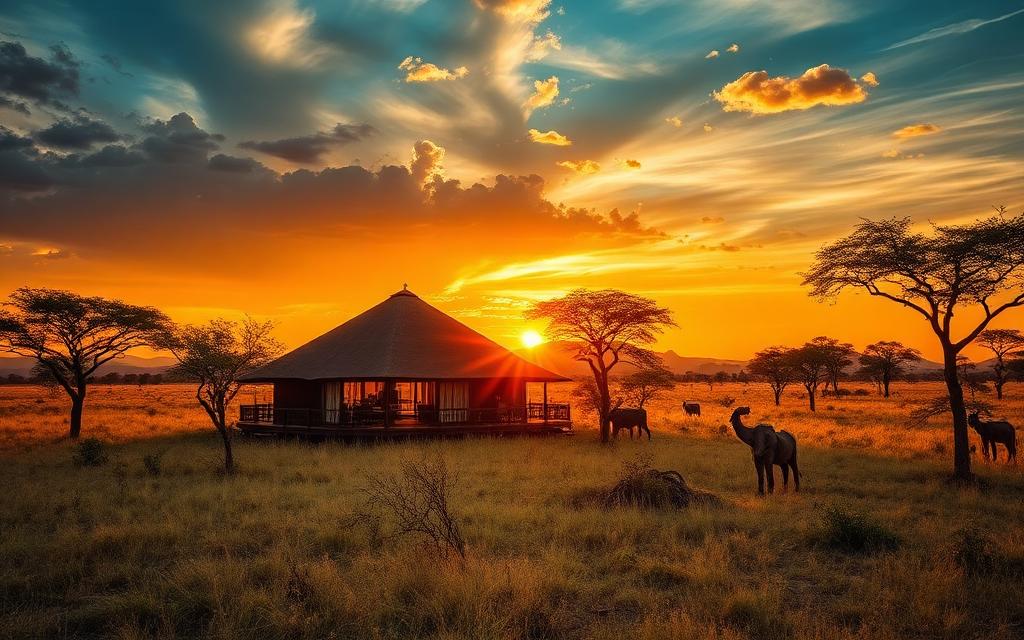
The first scene often stays with you. An elephant crosses the open ground toward camp, pauses at the edge of the pool, then lowers its trunk to drink while you watch from the main deck a few metres above. There is no fence, no timetable and no ranger staging the moment.
The elephant came for the water.
That single fact explains both the magic and the misunderstanding. Somalisa's poolside elephants are a dry-season concentration created by pumped water in a park where natural sources run low, not a resident cast on call. Travel in the dry months and the odds favour the classic deck scene. Travel in the rains and the same herds can disperse through woodland and open country, rewarding patience over promising proximity.
The private concession shapes how you spend the rest of each day. Drives follow the water and whatever is using it, then hand the afternoon back to the deck when animals come to camp on their own terms. A well-planned stay starts with one decision: concentrated elephant viewing at its most reliable, or a greener, quieter Hwange of scattered game and birdlife.
Getting there asks for honest planning as well. Somalisa runs entirely on solar power and sits deep in a remote safari setting reached by transfer, so travellers accustomed to grid-connected resorts should calibrate their expectations around energy and logistics. A packing guide shaped for remote safari camps helps sort what belongs in the bag.
Planning distinction: A beautiful Hwange holiday and a stay timed for concentrated elephant viewing are not the same trip. Dates, guiding and expectations have to work together.
Get the timing right, and the deck does the rest.
How Somalisa Camp Hwange Came to Be
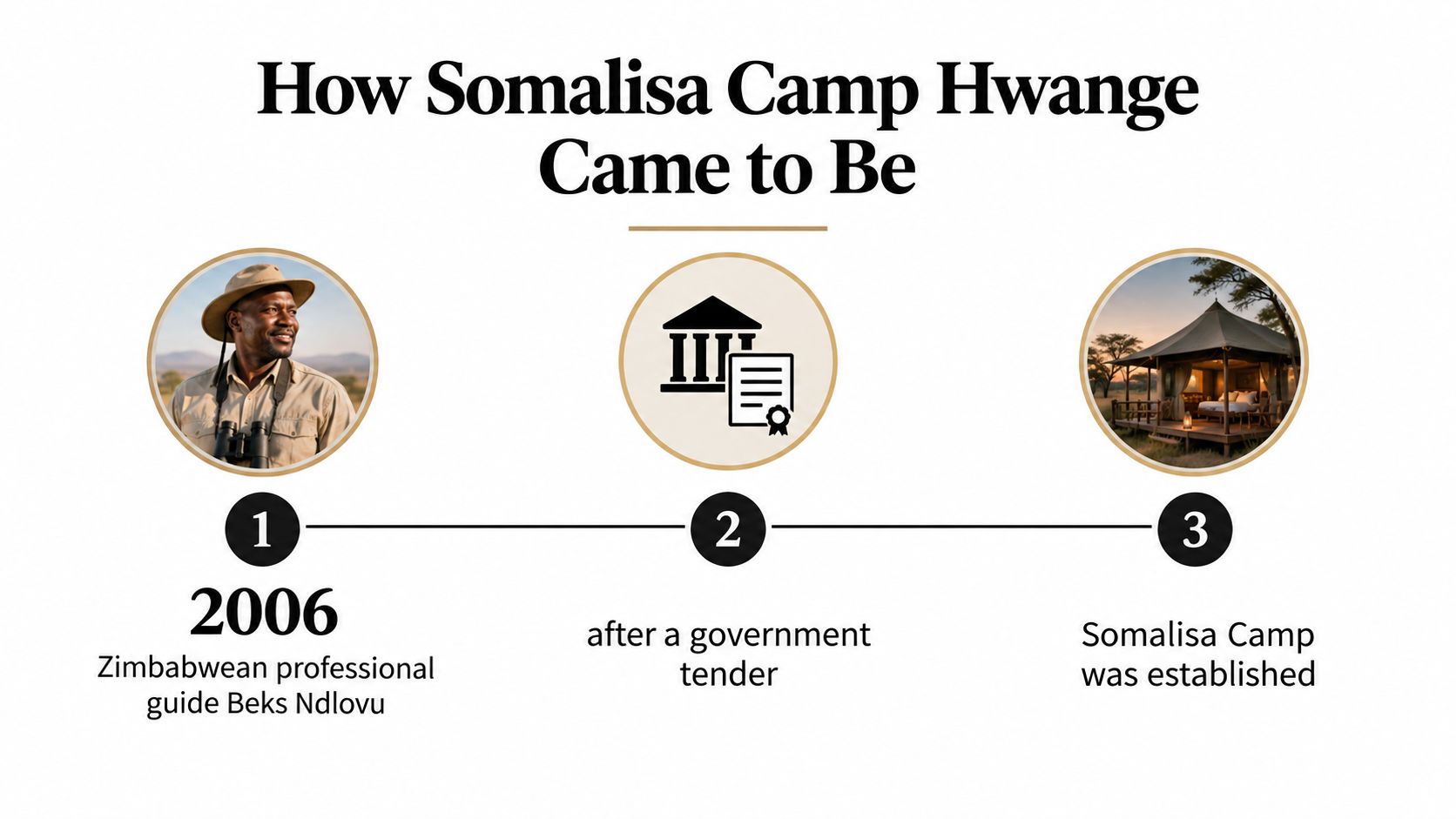
Before Somalisa had a deck, Beks Ndlovu had the ground read already. The Zimbabwean professional guide secured a government tender for the site and opened the camp in 2006, choosing a place where animals already moved between vlei, watercourse and woodland. It became the founding property of African Bush Camps, so Somalisa carries two histories at once: a camp built by a local guide, and the first proof of a safari company grown from Zimbabwean expertise.
A full rebuild in 2015–2016 turned that early outpost into the refined tented camp guests arrive at today. The useful detail is what stayed put: the camp still orients itself toward animal movement rather than hiding the bush behind a resort shell. The Somalisa Camp page from Fitzroy Travel describes African Bush Camps as Africa's largest Black-owned safari operator and says it had expanded to 18 locations across Zimbabwe, Zambia and Botswana. For a first camp, that matters: Somalisa is both a place to sleep and a marker of African ownership in high-end safari travel.
Built around the vlei
The address does the explaining. Somalisa sits beside the Sumamalisa Vlei, an ancient seasonal floodplain, with the elephant waterhole and pool gathered below the main deck. When pans hold water, the scene spreads out across the vlei; when the dry months tighten Hwange's choices, the same edge becomes a meeting point. That is why the famous poolside elephants should be read as a dry-season concentration created by water, not a year-round guarantee.
A stay here inherits that older intelligence. Guides can work the water and the tracks beyond it, while guests on the deck watch the same negotiation unfold at close range. Somalisa's origin story is polished now, but it began with a guide betting that the right piece of Hwange would keep its own calendar.
The Private Concession and Its Wildlife
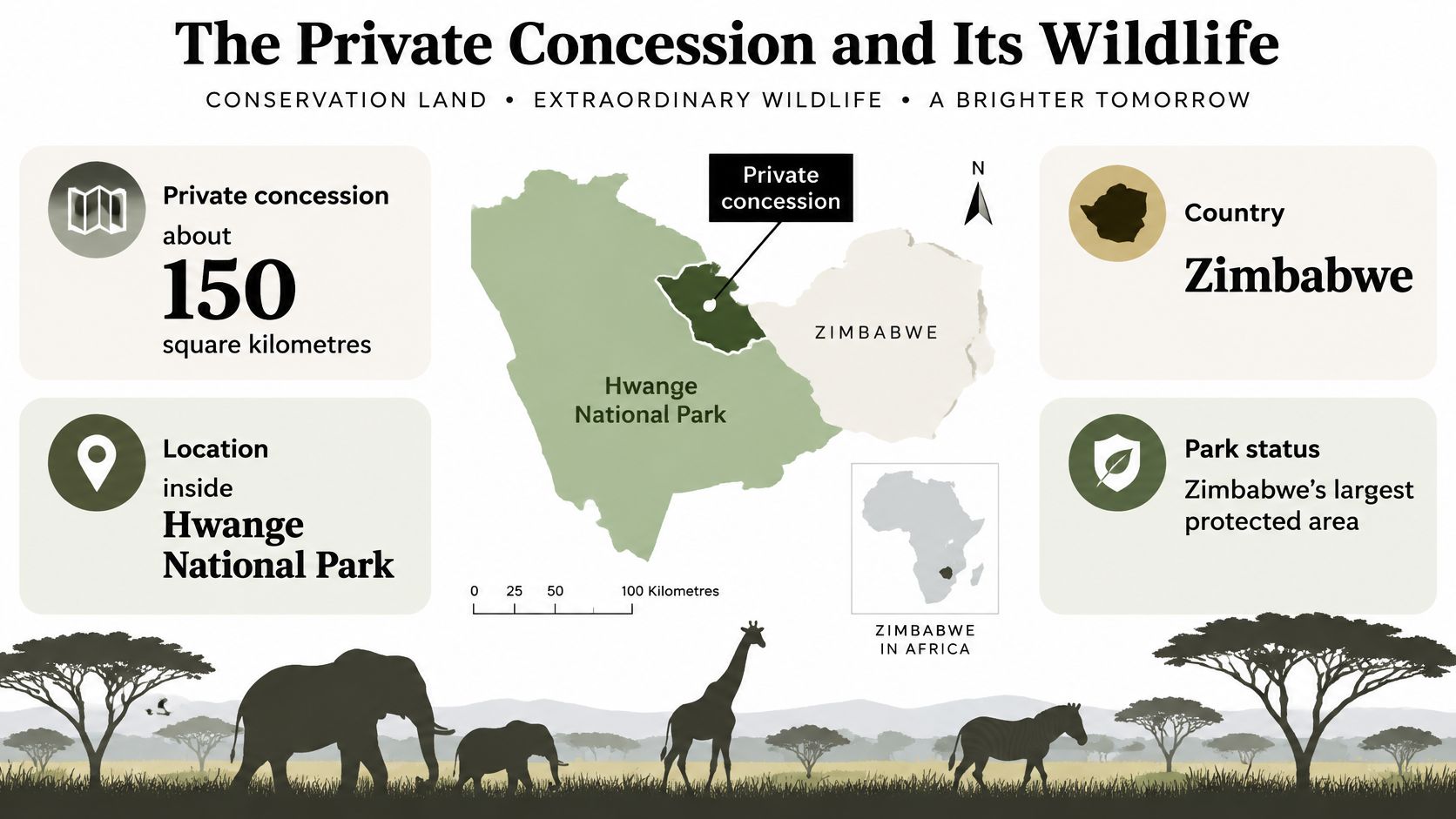
At dawn the concession can feel almost empty: sand tracks ahead, guinea fowl breaking from the grass, no other vehicle shaping the plan. By late morning, the camp edge can become the busiest place in the area because water is there. That contrast explains Somalisa better than any species list. The camp sits in a private concession of about 150 square kilometres inside Hwange National Park, and the wider park covers nearly 15,000 square kilometres with more than 100 mammal species and roughly 400 bird species, according to the Somalisa Camp location and park overview.
Hwange is known for elephants, yet reputation never sets a sighting schedule. The celebrated scenes at Somalisa happen when water pulls animals toward camp; outside those conditions, the same herds may be spread through a water-limited park. Read that way, the concession gives a private-safari itinerary two kinds of value: room to roam when wildlife is scattered, and a focused stage when thirst gathers it.
Scale, then concentration
A guide can work a morning circuit across Kalahari sand and teak woodland, checking tracks, pan edges and shaded lines where kudu or sable might stand. Back at camp, the deck turns waiting into part of the safari. The point is choice. Guests can take the long view across 150 square kilometres of concession, then let the waterhole compress the drama to a few metres when conditions align.
That difference matters for private travel. A family can leave before first light without queueing behind other vehicles, return for brunch, and still watch the afternoon unfold below the deck. The luxury is control over pace in a park whose wildlife ebbs and flows with water.
When Elephant Viewing Is Most Reliable
The elephants at Somalisa's pool are a dry-season concentration, not a year-round fixture. Hwange has no permanent river, natural pans are seasonal, and pumped waterholes become especially important as surface water contracts. That means the same camp can offer different wildlife patterns depending on the month.
Research on elephant movements found that some herds move seasonally in response to water provision. An estimated 20 percent may leave Hwange for Botswana during the wet season, traveling up to roughly 300 kilometres, according to the elephant movement research. A traveler booking for an elephant-focused stay should treat that movement as part of the planning picture, rather than assuming animals will gather at the camp pool in every season.
Match the season to the experience
June through October is the strongest window for predictable elephant-focused viewing at water points. Other months can bring different advantages, including greener scenery, newborn animals and migratory birding. The right choice depends on whether the priority is concentrated elephant activity or a broader seasonal safari.
| Season | Water and elephants | What else the season offers |
|---|---|---|
| Dry season, generally May through November | Natural water becomes scarcer; elephants may concentrate around pumped waterholes. June through October is the strongest window for predictable elephant-focused viewing. | A landscape shaped by limited surface water, with wildlife gathering around available water points. |
| Wet season | Water becomes more widely available, and wildlife may disperse. Some elephants move seasonally, with some leaving Hwange for Botswana. | Green landscapes, newborn animals and migratory birding can make this appealing for travelers with broader interests. |
Artificial water points create a clear conservation trade-off. They help sustain wildlife and offer dependable places to observe animals in the dry season, but they also influence where animals go. When droughts intensify, pressure on those water sources may increase. A thoughtful safari itinerary respects that these waterholes are wildlife resources first and viewing opportunities second.
For honeymooners, a peak dry-season trip may suit the dream of watching elephants gather near camp. Repeat visitors or travelers drawn to the scenery, birdlife or young animals may prefer another season. Choose the month for the experience you want, rather than relying on a generic “best time to visit” claim.
How Water Shapes Every Game Drive
Somalisa's game drives explore terrain where water helps determine animal movement. The camp sits beside the Sumamalisa or Massumamalisa Vlei and an elephant drinking pool. Across the wider concession, the Hwange H2O programme reportedly uses eight deep boreholes to feed seven water pans, as described by Expert Africa's Somalisa Camp overview.
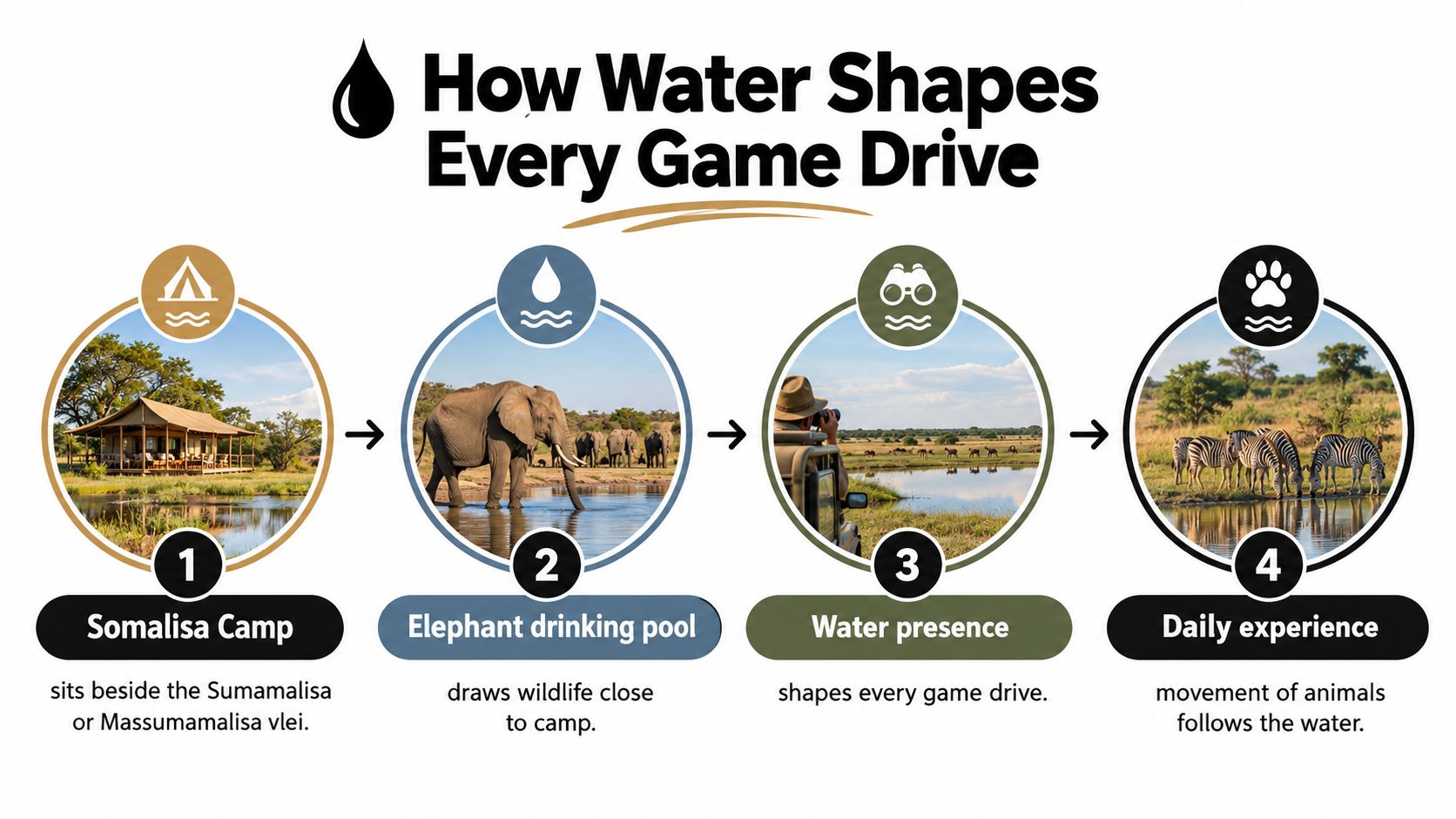
As natural surface water contracts, wildlife can gather at pumped points. That concentration can raise the odds of seeing animals from fixed viewing areas and along tracks linking water sources. The network gives guides a reason to shape drives around where water is available and where animals may move, rather than relying on chance encounters alone.
What the water network changes
The cause and effect is straightforward. Water sustains the animals; the availability of water influences where they travel; guides use those patterns to plan routes and viewing time. At camp, the pool brings the possibility of close observation without a drive. Away from camp, water points can give a route a clear purpose.
The same concentration calls for care. Large mammals may meet at water, so guests should move carefully, keep to distances set by their guide and follow instructions without exception. A waterhole is a valuable wildlife resource, not a stage that guests can control.
Private-concession access can also give a safari more flexibility than an itinerary relying only on heavily visited public waterholes. The benefit is not permission to approach animals at will. It is the ability to plan with a guide around the concession's water sources and the movements those sources shape.
On the drive: Close viewing depends on restraint. Let the guide set the pace, keep noise low and allow animals to use the water without interruption.
At Somalisa, water is part of the design of the safari itself. The boreholes and pans influence where wildlife gathers, while guest discipline helps protect the conditions that make observation possible.
Choosing a Private Stay with HauteBlack
A self-planned stay can suit travelers who are comfortable coordinating transfers, guiding preferences and the details of an off-grid camp. An advisor-led journey can be more useful when the trip needs to fit a particular occasion, such as a honeymoon, a multi-generational family safari or a short executive break. The difference is not who makes the reservation. It is who joins up the decisions around arrival, guiding and expectations.
Somalisa is entirely solar-powered and uses an on-site water-purification system reported to recycle up to 80 percent of total water consumption, according to Condé Nast Traveler's Somalisa Camp profile. That figure is a reported system-performance claim, not an independently audited environmental metric. Solar infrastructure can also make energy-intensive services more operationally constrained than at a grid-connected resort, so it's worth discussing expectations before travel.
Which planning path fits
A self-planned stay leaves the traveler responsible for checking how transfers connect, how much private guiding is needed and whether the camp's operating context matches the desired pace. It can work well for travelers who already know what they want and have experience arranging safari logistics.
HauteBlack is a luxury travel company and private membership world by Haute Living. It designs bespoke itineraries and offers VIP recognition across more than 120 countries. As a Virtuoso-affiliated agency with preferred-partner status at over 500 properties, it can pursue complimentary upgrades when available, resort credits and flexible benefits. Those benefits depend on availability and property terms, so travelers should confirm what applies to their itinerary.
An advisor can also coordinate VIP arrivals, private guiding, transfers through Haute Jets, first-class or helicopter links, and concierge transport. Non-members can book signature and tailor-made trips; members receive a dedicated advisor and waived planning fees. Couples may value a quieter, more romantic pace. Families may need guiding and transfers arranged around the group. An executive assistant booking for a principal may prioritize a clear itinerary and smooth handoffs.
For travelers new to safari, HauteBlack's guide to African safari first-timers can help frame the questions to raise before choosing between independent arrangements and advisor-led planning.
Planning Your Somalisa Camp Hwange Journey
Start with the reason for the trip. If concentrated elephant viewing is the priority, consider June through October, the strongest window for predictable elephant-focused viewing. If the draw is green scenery, newborn animals or migratory birding, choose the wetter months deliberately rather than treating them as a lesser alternative.
Then tell your planner who is traveling and what the stay needs to feel like. A honeymoon may call for a quieter rhythm; a multi-generational family journey may need more attention to transfers and shared time; a short executive break may depend on careful coordination from arrival to departure. Those details shape the itinerary more usefully than a generic request for “luxury.”
Confirm the safari mechanics
Ask for private guiding on the concession and discuss how drives will be shaped around water sources, not only public waterholes. Confirm what a solar-powered, off-grid camp means for pacing, power and energy-intensive services. It is better to align expectations before arrival than to discover that the camp's operating conditions differ from a grid-connected resort.
For travel preparation beyond the safari itself, Misaj's tropical travel skincare tips offer practical context on caring for skin and choosing insect protection in warm destinations. And if you're adding time elsewhere in the country, HauteBlack's Zimbabwe travel guide can help you consider the wider destination.
A conversation with an advisor can turn those choices into a tailor-made Hwange journey, including VIP recognition on arrival, private safari arrangements and transfers suited to a remote camp. Members work with a dedicated advisor; non-members can still commission a signature or custom trip.
The deck is still the image to keep in mind: elephants coming to drink below, the camp quiet around you. Give that scene a month, a guiding style and a plan for getting there, and it becomes more than a promise in a brochure.
HauteBlack can shape a bespoke Hwange itinerary around the season, private guiding and the transfers that make a remote camp feel effortless. To plan a Somalisa stay timed to your priorities, visit HauteBlack and start a conversation with its travel team.