Haute Black Journal
Private Jet Travel Around the World: The Ultimate Guide

Marlene Azeez
Director, HauteBlack
View all articles →

At 7:10 a.m. in Miami, a family can leave a private terminal with breakfast packed, land in Paris for an afternoon meeting, and continue toward Asia before the day is over. The aircraft matters, but the true luxury is having the route, permissions, ground transfers, and hotel arrival prepared as one continuous journey.
The New Reality of Private Jet Travel Around the World
A global private itinerary rarely begins with a desire to “fly private” in the abstract. It starts with a reason to move differently. An executive may need to combine board meetings in Europe with a client visit in the Middle East. A family may want a route that links cultural cities with island retreats without repeatedly returning to major commercial hubs. A couple may prefer to spend its time in private estates, rather than in airport queues and connecting terminals.
Private aviation makes that design possible because the aircraft becomes part of the itinerary rather than a fixed schedule imposed on it. Smaller airports can place travelers closer to resorts, coastal towns, safari gateways, and regional centers. The group keeps its luggage, its privacy, and much of its daily rhythm intact.

The market is expanding beyond its historic concentration in the United States. WingX data reported by FlyUSA recorded 3,878,836 global private jet flights in 2025, an increase of 4.6% from 2024 and 113,901 flights above the previous record set in 2022. The United States accounted for 67.9% of worldwide departures in 2025, down from 70.6% in 2019, while Europe reached 555,254 business jet flights, above its 2019 level of 523,653.
The regional movement is just as important as the headline total. Latin America grew 11% year over year, and Africa grew 15% year over year, even though both remain smaller portions of worldwide activity, according to the same private aviation statistics overview. That shift changes how advisors build global itineraries. A round-the-world journey no longer means a predictable North America to Europe circuit. It can involve Latin American cities, African lodges, Middle Eastern hubs, Asian capitals, and remote regional airports.
The customer base remains highly concentrated. A widely cited estimate placed the number of people who flew by private jet in 2023 at about 256,000 worldwide, approximately 0.003% of the global adult population, while an industry estimate valued global private aviation at $27.3 billion in 2023 and projected a 5.2% CAGR through 2030, as reported by Forbes. Private jet travel around the world is therefore both exclusive and commercially significant. It isn't mass transport. It's a specialized mobility channel for travelers whose time, privacy, and access carry unusual value.
How Global Itineraries Are Planned and Executed
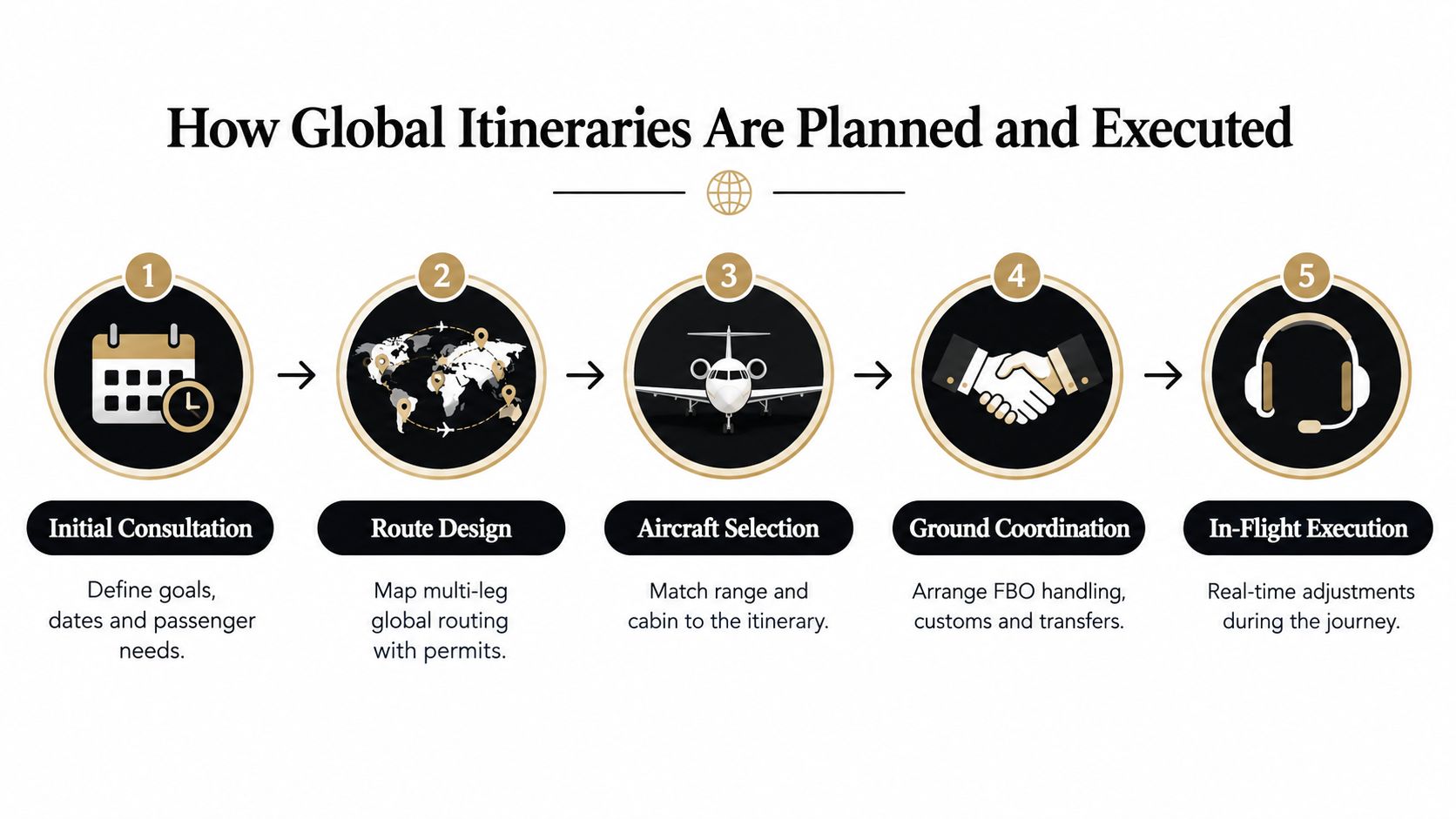
A multi-continent journey is produced in stages. The best advisors don't begin by presenting a glossy aircraft brochure. They first establish the purpose of the trip, the travelers' tolerance for long sectors, the dates that matter, and the destinations that are essential.
Start with the route, not the aircraft
The first draft should identify the geographic logic of the trip. An eastbound or westbound direction may work better depending on the destination sequence, seasonal conditions, aircraft positioning, and preferred arrival times. A route that looks elegant on a map can become inefficient if it requires repeated repositioning or lands far from the hotels and experiences that define the trip.
Ultra-long-range private jets can fly missions of roughly 7,000 to 7,700 nautical miles nonstop, enough to connect many intercontinental city pairs without refueling, according to BlackJet's international private flight guidance. Those figures describe operational potential, not a guarantee for every departure. Payload, headwinds, runway performance, fuel reserves, and airport conditions all affect the usable range, so professional dispatch planning preserves contingency rather than relying on the maximum published figure.
Match the aircraft to the whole journey
Aircraft selection should reflect the longest meaningful sector, the passenger count, the baggage requirement, and the cabin experience expected between destinations. A jet that is ideal for a short European hop may be a poor choice for a demanding ocean crossing. Conversely, using the largest aircraft for every leg can create unnecessary cost and reduce airport options on shorter regional sectors.
The aircraft also needs to suit the group. Families may value separate sleeping areas, generous baggage capacity, and a cabin that allows children to move without disturbing other passengers. Executives may prioritize a quiet work zone and reliable connectivity. Couples often care more about privacy, dining, and the ability to depart at an intimate local airport.
Clear the regulatory path
International private flying still involves formal aviation and border procedures. Overflight permissions, landing rights, customs and immigration arrangements, and airport slots must be coordinated for the actual aircraft, dates, and route. At constrained airports, approvals and slots can take days to weeks to secure, as explained in BlackJet's guide to choosing a private aircraft.
A capable operations team confirms each clearance before the aircraft commits to the itinerary. It also prepares alternatives. Weather, airspace restrictions, airport operating hours, crew-duty limits, and local handling capacity can change the practical route even after a client has approved the broad concept.
Practical rule: Treat every long-haul sector as a planning problem with a preferred solution and a credible fallback.
Ground coordination deserves the same attention. A private terminal can shorten the airport experience, but it doesn't remove immigration requirements. The team must arrange fixed-base operator handling, secure vehicles, confirm hotel arrival windows, and ensure that local guides, boats, helicopters, or other transfers are waiting at the correct airport.
For a detailed look at the decisions that affect executive and international departures, use this private jet flight booking executive guide. The operational payoff is simple: travelers spend their energy on the destination instead of solving a border, baggage, or transfer issue after landing.
Choosing Your Access Model Charter Fractional or Membership
The right access model depends on how predictably you fly, how much control you need over aircraft choice, and whether your international travel happens in concentrated bursts or throughout the year. A traveler planning one major global journey may need a different structure from an executive who departs internationally whenever business requires it.
The market is large enough to support several approaches. HauteBlack reports roughly 23,000 active private jets, about 5 million private flights in 2023, and 58% of flights booked within 7 days of departure in its private aviation news and charter coverage. Those booking patterns reinforce an important point. Some clients plan carefully, while others value the ability to act quickly when an opportunity appears.
| Model | Best For | Cost Structure | Flexibility | Commitment |
|---|---|---|---|---|
| Charter | Occasional travelers and one-off global journeys | Pay for the selected flight and associated trip costs | Highest aircraft and route choice for each trip | Low |
| Fractional | Travelers with recurring, predictable usage | Shared ownership costs plus operating expenses | Access may follow program rules and fleet availability | Significant |
| Membership | Frequent travelers who value advisory support and a consistent service layer | Program fees or agreed pricing structure, with trip costs varying by plan | Strong access within the network, subject to terms and availability | Ongoing |
Charter suits the irregular traveler
On-demand charter works when dates, destinations, and passenger needs change from trip to trip. It lets an advisor compare aircraft categories for a specific route instead of forcing every journey into one fleet. That flexibility is valuable for a family planning a single multi-continent celebration or a couple whose route depends on hotel availability.
Its weakness is that availability and pricing must be assessed for each itinerary. A last-minute request can narrow aircraft choice, especially when the route requires unusual permissions or an airport with limited handling capacity.
Fractional ownership suits a stable pattern
Fractional arrangements can make sense when a traveler flies regularly, prefers a defined fleet, and values a structured availability process. The trade-off is commitment. A traveler whose destinations change constantly, or who flies heavily in one season and rarely in another, may pay for predictability that doesn't match actual use.
Membership sits between transaction and ownership
Membership programs appeal to clients who want an ongoing advisor, a curated operator network, and a more consistent planning experience without owning an aircraft. The benefits depend on the program, so ask about availability guarantees, aircraft substitutions, peak-period rules, repositioning, cancellation terms, and what support exists outside the flight itself.
The private jet charter and membership guide is useful when comparing those structures. Do not choose membership just because it sounds more exclusive. Choose it when repeated international travel and a preference for relationship-based service justify the ongoing arrangement.
Understanding the True Cost of Private Jet Travel
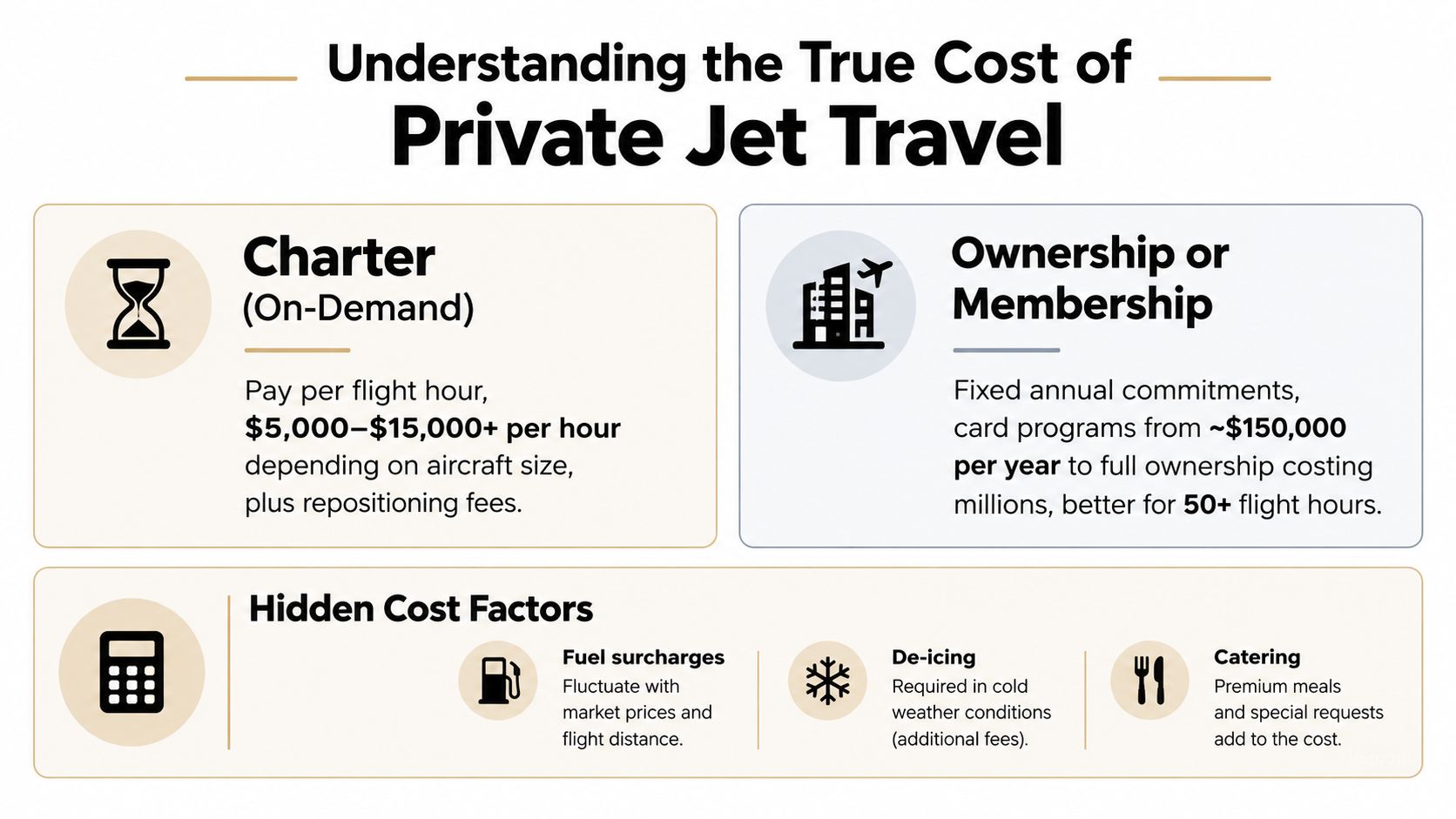
The hourly rate is only the beginning of a global private aviation budget. A credible quote should show the aircraft, billable flight time, positioning, airport charges, crew requirements, catering, handling, and any border-related services that apply to the route.
For a market baseline, HauteBlack's pricing coverage places most private jets at approximately $2,300 to $17,000 per billable flight hour, while VIP airliners can reach $18,000 to $23,000 per hour, as detailed in its private jet pricing guide. The range is broad because aircraft size, cabin configuration, range, crew requirements, and availability vary substantially.
Read the quote beyond the headline
Billable time may include more than the time a passenger spends in the air, depending on the operator's pricing method. Confirm whether the proposal includes ferry sectors and how flight-hour calculations are defined.
Positioning becomes important when the aircraft isn't already based near the departure airport. An apparently attractive aircraft can become less attractive after the operator adds the cost of bringing it into position and returning it afterward.
Airport and handling charges vary by location. Landing, parking, ground handling, customs coordination, and local support can all affect the final figure. A remote airport may improve access to a resort but require more complex handling or a separate ground transfer.
Crew and service requirements can add costs when the itinerary involves overnight stays, extended duty periods, special catering, de-icing, or unusual operating conditions. Fuel surcharges may also change with market conditions, so the quote should explain whether fuel is fixed or adjustable.
Ask for an all-in itinerary cost, then request a line-item explanation. A lower hourly rate isn't necessarily a lower trip cost.
Global travel also creates risk-management questions. Insurance terms can differ by aircraft, jurisdiction, operator, and passenger profile. Travelers who want additional context should review specialist aviation coverage from ABS Insurance Brokers Pty Ltd, particularly when a complex itinerary involves multiple countries and high-value arrangements.
The private jet charter cost guide can help travelers frame those questions before comparing proposals. The practical test is transparency. If an advisor can't explain what drives the total, the quote isn't ready for approval.
The Role of Luxury Concierge and Curated Networks
A private aircraft can remove friction from the airport experience, but it can't by itself create a meaningful trip. The difference between a technically efficient itinerary and an exceptional one usually appears after landing. Hotel recognition, restaurant access, local expertise, vehicle timing, and the ability to adjust plans all depend on the people coordinating the journey.
A concierge team should connect the flight plan to the ground plan. That means understanding whether a family needs adjoining villas and flexible meal times, whether a couple wants privacy over ceremony, or whether an executive needs a quiet arrival before a meeting. It also means knowing which requests are realistic in each destination rather than promising access that hasn't been verified.

The network matters after touchdown
A well-connected advisor may arrange VIP recognition at a hotel, preferred treatment where available, private dining, specialist guides, and cultural access that fits the traveler's interests. Those details don't replace good routing, but they determine whether the itinerary feels coherent once the aircraft doors open.
Membership can add another layer of continuity. Depending on the program, clients may receive a dedicated advisor, waived planning fees, preferred-partner benefits, resort credits, or support for dining and transport. The value isn't only financial. A consistent advisor learns how the client travels, which reduces repetitive briefing and improves decisions when the route changes.
HauteBlack's guide to a high-end trip around the world frames this style of travel around private jets, bespoke itineraries, exclusive access, and logistics. That combination is more useful than treating aviation as a standalone purchase. A private flight to a poorly chosen hotel, with an uncertain transfer and no local support, is still a poorly designed trip.
Build one operating brief
Before departure, the concierge team should hold a single working brief covering passenger details, dietary needs, luggage, sleep preferences, ground transfers, hotel priorities, medical considerations, and the experiences that cannot move. Local partners then receive the information they need without forcing the traveler to repeat it at every stop.
The strongest networks also know when not to over-program. Around-the-world travel can become exhausting if every landing triggers a formal dinner, guided tour, and early departure. The advisor's role is to protect recovery time and preserve a sense of discovery, not fill every available hour.
Sample Itineraries for Different Traveler Profiles
A global itinerary should reflect the travelers' lives, not an abstract list of famous destinations. The route below shows how the same private aviation capability can serve very different priorities.
A multi-generational family expedition
A family traveling across Southeast Asia and the Indian Ocean might begin with a city that offers cultural depth, then move toward beach and nature destinations where relatives can settle into villas for several nights. The aircraft would be selected for comfortable long sectors, generous baggage capacity, and a cabin layout that lets children sleep while adults work or socialize.
The planning priorities would include school calendars, dietary requirements, medical access, child-friendly excursions, and the pace of transfers. Rather than changing hotels every night, the advisor could use a stable villa base and organize day experiences around it. That makes the private aircraft useful for the difficult connections, while the ground program gives the family time to develop a rhythm.
The Indian Ocean portion might emphasize a private island, marine activities, and unstructured afternoons. A separate Southeast Asian stop could focus on food, craft, or history, with guides selected for their ability to engage different generations. The aircraft schedule should protect the group's energy. A technically possible early departure may be the wrong choice if it turns a special day into a recovery day.
A couple's European and Mediterranean route
A couple usually needs less cabin space than a large family, but often wants greater control over timing and atmosphere. A route through European capitals, private estates, and Mediterranean coastlines could use regional airports to reduce road transfers and preserve flexibility between destinations.
The experience might pair a city hotel with an intimate countryside stay, followed by a coastal property where the couple can decide each morning whether to sail, dine privately, or do nothing at all. Private guides can arrange access around the couple's interests, while the concierge protects privacy by avoiding unnecessary group activities.
Here, charter often works better than a long-term access model because the journey is defined by a specific sequence and a strong preference for bespoke timing. The aircraft is a tool for preserving the mood of the trip. It shouldn't dictate the itinerary.
Making the Right Choice for Your Global Travel Rhythm
Private jet travel around the world is a design decision before it's a purchasing decision. Start with your actual pattern. Do you travel internationally several times a year with family, or are you planning one ambitious journey? Do your destinations repeat, or does every trip require a new aircraft and route? Do you value a dedicated relationship more than maximum choice on every sector?
Frequent international family travelers may find membership more useful than repeated on-demand bookings because consistent advisory support and a familiar service structure can reduce planning friction. Fractional access can suit a stable usage pattern, but it may be excessive for travelers whose routes and frequency change substantially. Charter remains the clearest fit for opportunistic, highly customized journeys.
Write down your essential destinations, preferred pace, passenger needs, and service expectations before speaking with an advisor. Then request a route proposal that explains aircraft logic, permissions, alternatives, and the complete cost structure. The right question isn't which jet you want to board. It's what kind of global experience you want the journey to create.
HauteBlack arranges bespoke itineraries, private aviation, hotel stays, transfers, dining, and insider access as one coordinated travel plan. Visit HauteBlack to discuss a private jet journey around the world designed around your destinations, traveling party, and preferred rhythm.
Explore Our Guides


Signature Experiences