Haute Black Journal
Private Jet Charter Membership: A UHNW Guide

Marlene Azeez
Director, HauteBlack
View all articles →
# Private Jet Charter Membership: A UHNW Guide
June 25, 2026
Your calendar is already telling you the answer. You're flying enough that ad hoc charter feels inefficient, but not in a pattern clean enough to justify owning an aircraft. One month it's a board meeting in New York, a family weekend in Palm Beach, and a last-minute Europe departure. The next month it's almost nothing. That's exactly where a private jet charter membership becomes useful, or wasteful, depending on how you choose.
Most first-time buyers look at the glossy promise: fixed rates, priority access, concierge support. That's not enough. You need to decide whether a membership gives you an advantage. If it doesn't improve control, predictability, and recovery when plans change, it's just a prepaid aviation product with elegant branding.
Defining Private Jet Charter Membership
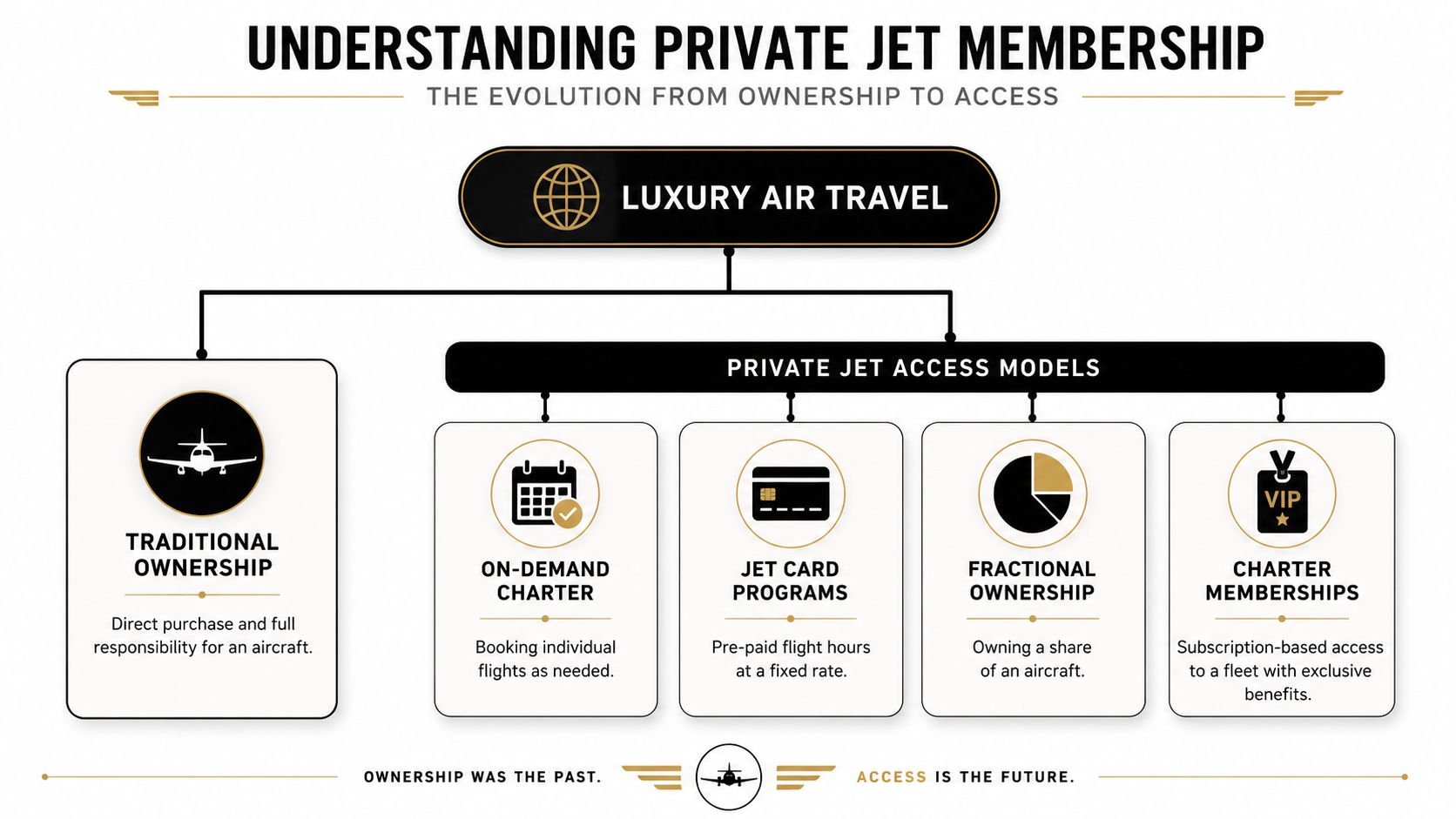
A private jet charter membership sits between two familiar models. On one side, you have on-demand charter, which gives you flexibility but very little consistency. On the other, you have fractional ownership or full ownership, which gives you control but also capital exposure, administrative drag, and ongoing complexity.
Membership is best understood as a retainer for access to a high-value asset. You're not buying the jet. You're buying priority, structure, and a service relationship that should perform when your schedule tightens.
What membership actually means
In practical terms, a membership usually gives you access to a fleet or network under a defined contract. That contract may include fixed hourly pricing, booking windows, service guarantees, and cancellation terms. You pay for access first, then for usage under the program's rules.
That distinction matters. With on-demand charter, every trip is a fresh negotiation. With ownership, every trip sits on top of an asset you carry whether you fly or not. Membership strips away the asset burden and turns private aviation into a managed access model.
The shift toward access is no longer niche. Private jet membership programs have emerged as a dominant force, with the on-demand charter and membership sectors valued at approximately $21.24 billion in 2024 and projected to reach $24.28 billion by 2025 according to industry market data summarized in Source Citation 3. That's happening because many UHNW travelers want the utility of private aviation without the friction of ownership.
How it differs from the alternatives
The easiest way to understand it is:
- On-demand charter: Best when you fly occasionally and don't mind market pricing, variable aircraft quality, and inconsistent service teams.
- Membership: Best when you want repeatable standards, faster booking, and better cost visibility without tying up capital in an aircraft.
- Ownership or fractional: Best when utilization is high enough that direct control outweighs the burden of managing the structure around the aircraft.
Practical rule: If your biggest frustration is inconsistency, membership deserves attention. If your biggest frustration is lack of control over a specific aircraft and crew, ownership is the more honest answer.
A good program doesn't just get you airborne. It removes negotiations, compresses decision time, and gives your office a cleaner operating system for travel. That's why serious travelers often evaluate it the same way they evaluate legal counsel or security support. It isn't a luxury purchase first. It's a continuity tool.
If you want broader context on how private aviation fits into a luxury travel strategy, Haute Black's private aviation coverage is a useful starting point.
The Three Core Membership Models Explained
Not all memberships work the same way. Providers package them differently, but most fall into three buckets: deposit programs, jet cards, and pay-as-you-go memberships. If you confuse these, you'll buy the wrong product.
Deposit programs
This is the most common structure for serious users. You place a substantial amount on account, then draw it down as you fly. A typical membership operates on a deposit drawdown model, where a member prepays a sum often between $100,000 and $1,000,000, and each flight is debited against an all-in hourly rate, as outlined in the Stratos guide to private jet memberships.
The attraction is obvious. You get a cleaner budgeting framework and avoid the capital drag of owning an aircraft. The risk is equally obvious. If the contract language is weak, your deposit buys less flexibility than you thought.
Deposit programs suit clients who fly enough to value structure, but don't want to commit to equity in an aircraft.
Jet cards
Jet cards are simpler to explain and often easier to compare. You prepay for a block of time or a defined amount of usage under a cabin category, and the provider applies a fixed rate structure to that allotment. This model appeals to families and executives who want predictable billing and don't want to think about aviation finance every month.
Jet cards also tend to be easier for executive assistants to manage because the rules are usually clearer. That said, “clearer” doesn't mean “good.” A bad jet card still hides restrictions in peak periods, substitutions, and service areas.
Pay-as-you-go memberships
This is the lightest commitment model. You pay an annual or recurring membership fee for access to member pricing, preferred service, or booking privileges. Then you pay flight charges as you use the service.
This can work well for travelers who want the relationship benefits of membership without parking a large deposit. But it's rarely the strongest option for heavy users. Lower commitment often means less protection when demand spikes.
Private Jet Membership Model Comparison
| Model | Capital Outlay | Rate Structure | Best For |
|---|---|---|---|
| Deposit Program | High upfront deposit, often six to seven figures | Funds are drawn down against an all-in hourly rate | Frequent private flyers who want structure without ownership |
| Jet Card | Prepaid block of hours or usage | Usually fixed pricing within a cabin category | Clients who want simplicity and easier budgeting |
| Pay-as-you-go Membership | Lower upfront commitment plus annual or recurring fee | Access pricing, usage billed per trip | Occasional private flyers who still want preferred access |
Which model I'd recommend
If you fly regularly and care about consistency, start with a deposit model or a strong jet card. Pay-as-you-go sounds attractive because it keeps capital free, but it often leaves you with less influence when aircraft are tight.
The wrong membership is usually the one that feels cheapest at signing and most restrictive when you actually need it.
Choose by travel pattern, not by marketing language. If your flying is episodic but high stakes, a substantial deposit or card structure usually wins. If you only need private aviation a few times a year, skip membership entirely and use a disciplined charter advisor.
Analyzing the True Cost and Strategic Value
Headline hourly rates don't tell you what you're buying. They tell you what the provider wants you to notice first.
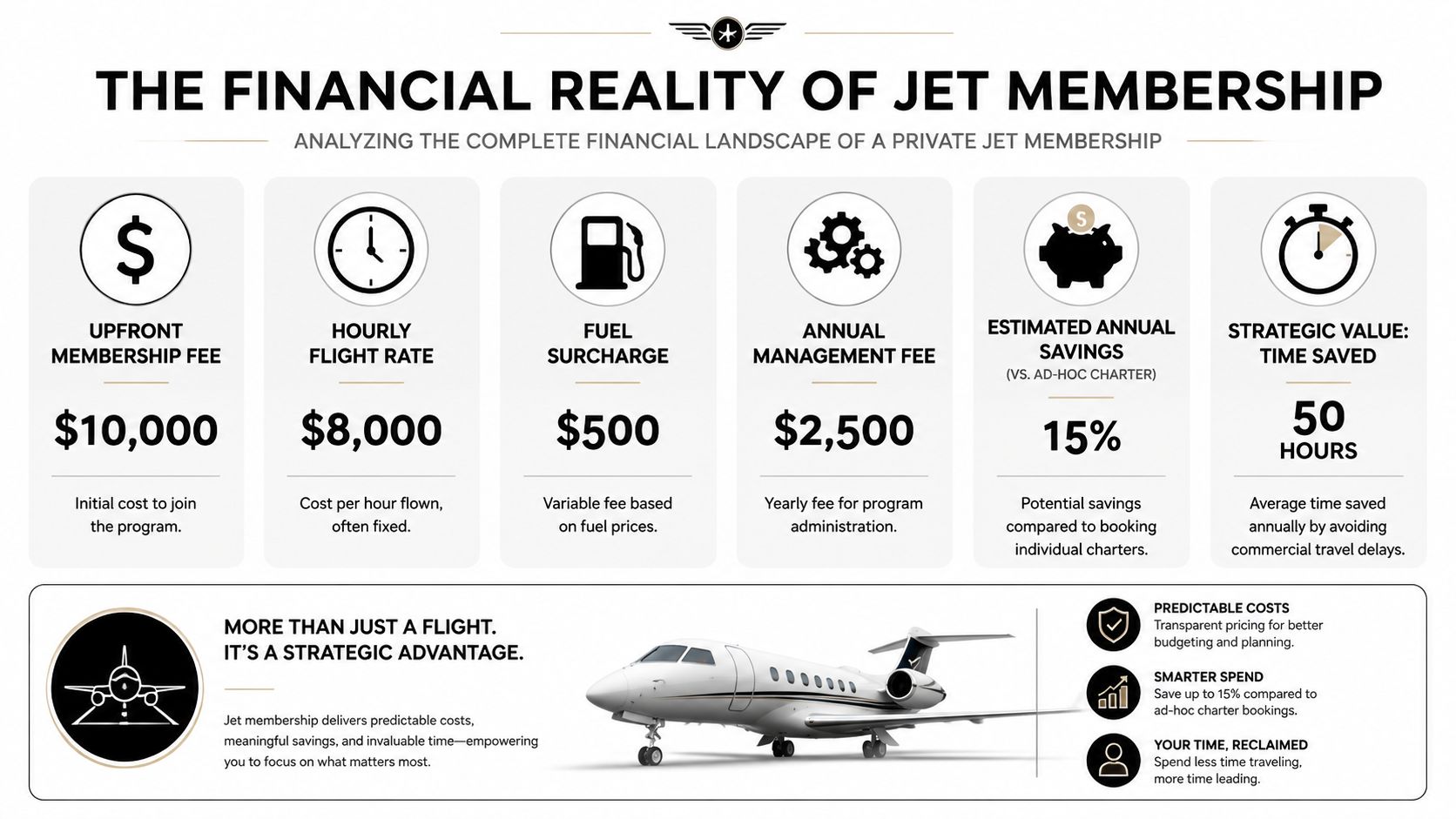
Private jet memberships can offer fixed hourly rates starting around $5,000 for turboprops and exceeding $15,000 for large cabin jets, with rate protection typically locked for 12 to 24 months after a qualified deposit, according to SherpaReport's overview of private jet cards. That's useful, but only as a starting point.
What your invoice is really buying
The essential question isn't “What is the hourly rate?” It's “What's included when things go smoothly, and what happens when they don't?”
Review these points before you treat any rate as meaningful:
- Annual fees and membership dues: Some programs separate access fees from usage fees. That can be fine. It can also make an average program appear cheaper than it is.
- Fuel and operational surcharges: Some memberships reduce volatility better than ad hoc charter, but not all eliminate extra cost exposure.
- Repositioning and recovery terms: If your aircraft has an issue, who pays for the replacement solution and at what rate?
- Peak-day treatment: Fixed pricing has little value if your most important travel dates sit behind exclusions.
Astute buyers gain an edge. They compare sample invoices and the legal definition of “all-in,” not the headline promise.
A good membership should reduce uncertainty, not repackage it.
Here's a useful companion for thinking about the broader travel tradeoff between private and commercial flying: this guide to private jet versus commercial travel.
Strategic value is not the same as lower cost
Most UHNW clients don't adopt private aviation because it's cheaper. They adopt it because the alternatives waste time, expose plans, and reduce optionality.
Membership creates strategic value in four ways:
1. Time compression
You stop building your day around airline infrastructure.
2. Protected privacy
Sensitive conversations stay in a controlled environment.
3. Decision speed
You can move when a business, family, or security need changes quickly.
4. Operational continuity
Your office deals with one framework instead of recreating the trip logic every time.
Buy membership when delay is expensive. Skip it when inconvenience is merely annoying.
That's the right lens. Membership isn't a bargain product. It's a control product.
Service Perks and Guarantees of a Premier Program
The aircraft matters less than most first-time buyers think. The service system around the aircraft matters more.
A mediocre provider can source a beautiful cabin. That doesn't mean they can recover when weather shifts, reposition a substitute aircraft cleanly, coordinate your ground transport, or brief your assistant with the right level of precision. Premier programs distinguish themselves before departure and after disruption.
What a top-tier member experience should include
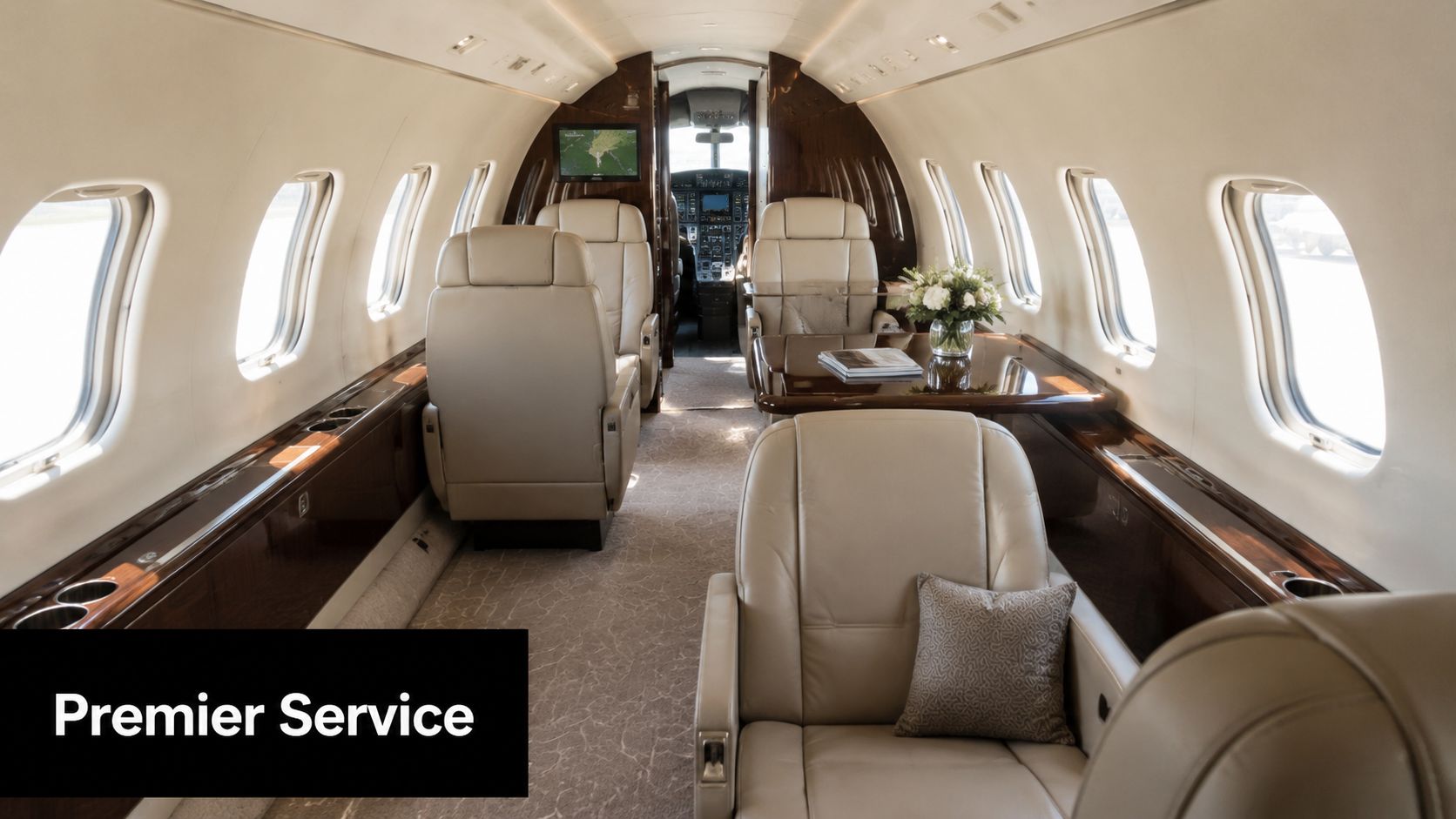
Don't settle for generic concierge language. A serious membership should deliver a real service spine:
- Dedicated aviation advisor: One person, or one tightly coordinated team, who knows your aircraft preferences, your security concerns, and how your office works.
- Coordinated ground handling: Cars, tarmac timing, luggage coordination, and private terminal choreography should feel pre-solved.
- Bespoke cabin preparation: Catering, family-specific requirements, pet handling, and onboard setup should not require repetition every trip.
- Discreet issue management: Problems should be resolved with discretion. You should hear solutions, not internal excuses.
That's what separates acceptable from premium. The flight itself is only one part of the experience.
Guarantees that actually matter
The global fleet supporting private aviation numbers around 23,000 aircraft, and premier memberships can improve access by operating within a curated system rather than the open market. VistaJet's members fleet includes over 200 jets, offering flight assurance and priority access beyond what standard ad hoc sourcing usually provides, according to Source Citation 2 on fleet scale and curated access.
That kind of guarantee matters because availability is the true currency in private aviation.
Ask every provider to define these terms in writing:
| Guarantee | What you want to hear |
|---|---|
| Aircraft availability | Your cabin category is contractually supported within a stated notice window |
| Recovery protocol | A substitute aircraft is sourced under clear pricing and priority rules |
| Safety oversight | Operators meet recognized third-party standards such as ARGUS or Wyvern |
| Service authority | One accountable team manages the trip from booking through arrival |
A polished cabin impresses first-time users. A polished recovery protocol impresses people who fly enough to know better.
If you want a sharper sense of what modern luxury aviation service should feel like in practice, this private jet luxury travel guide offers a useful reference point.
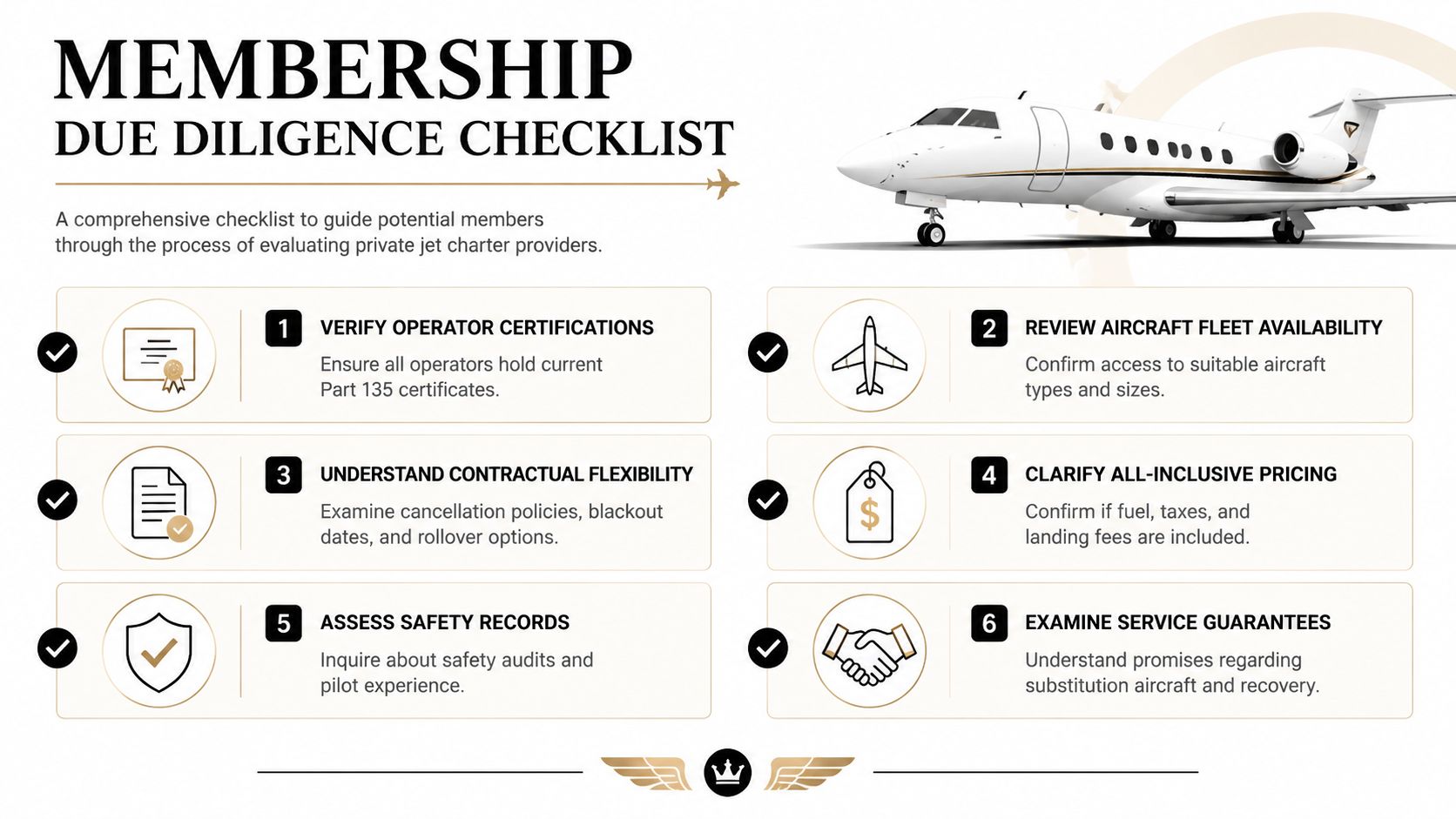
Your Due Diligence Checklist Before Committing
Most buyers ask the wrong opening question. They ask, “What's the rate?” They should ask, “Where does this contract stop working when demand is highest?”
That's not theoretical. A 2023 market analysis found that 68% of charter membership complaints stem from unexpected blackouts during peak travel seasons, according to the NBAA market analysis on fractional and jet card programs. If you don't interrogate blackout policy before signing, you're buying uncertainty with better branding.
The questions that expose weak programs
Use this checklist. Don't soften it.
- Blackout precision: Ask for every peak day restriction in writing, including holiday periods, event-driven exclusions, and any limits by aircraft category.
- Fleet sourcing: Ask whether flights are fulfilled by an owned fleet, a captive fleet, or an external charter network. The answer changes consistency.
- Substitution rules: Ask what happens if the promised aircraft isn't available. You want contract language, not verbal reassurance.
- Notice periods: Ask what booking windows apply by aircraft class and whether short-notice requests change pricing or priority.
- Safety process: Ask how operators are vetted, audited, and monitored. If you want an external benchmark for what strong aviation risk controls can look like, review PilotGPT safety features.
- Cancellation treatment: Ask how changes are priced and whether weather, owner interference, or maintenance events change your financial exposure.
- Unused funds or hours: Ask exactly how rollover, refundability, and termination work.
What to request before signing
Don't rely on a sales deck. Ask for documents.
1. A sample contract with blackout dates and defined recovery language.
2. A sample invoice showing how a normal trip is billed.
3. A peak-period booking example for the routes and dates you use.
4. A provider explanation of operator standards in plain language.
5. A written escalation path for day-of-flight disruptions.
If a provider hesitates to show you the ugly parts of the contract, assume the ugly parts are the product.
Most bad memberships reveal themselves. Not in the brochure. In the definitions.
When Membership Delivers a True Strategic Advantage
A private jet charter membership is not automatically the right answer. It becomes the right answer when your travel pattern rewards consistency more than spontaneity, and when the cost of delay is high enough that structured access matters.
The C-suite executive
This client takes multi-city trips on short notice, often with changing agendas and sensitive conversations onboard. Membership works because it standardizes response time, booking flow, and service handling for both the executive and the assistant managing the calendar.
On-demand charter can still work here, but only if the volume is low. Once the office starts repeating the same aviation decisions under pressure, membership reduces friction and protects attention.
The global family
Families with layered travel needs often underestimate how operationally complex their trips are. There may be grandparents, children, staff, pets, ski gear, security considerations, and changing departure windows. Membership becomes valuable when it turns that complexity into a repeatable system.
The best programs help families maintain privacy, reduce airport chaos, and adapt aircraft choice to the trip instead of forcing every journey into the same template. For this group, the right membership is less about status and more about reducing family travel failure points.
The high-profile individual
Athletes, entertainers, founders, and public figures often need something more specific than luxury. They need discretion, controlled movement, and schedule ownership. Membership can deliver a strong advantage when privacy and reliability matter every single trip, not just occasionally.
For these clients, the value often sits in protocol. Known service teams. Better substitution standards. Cleaner departure environments. Less exposure.
When I'd tell you not to buy
Skip membership if your private flying is infrequent and opportunistic. Skip it if your routes vary wildly and you don't need reliable repeatability. Skip it if you're mostly reacting to occasional leisure opportunities and can tolerate market pricing.
Buy it when travel is integral to how you operate. That's the dividing line.
The right program doesn't just move you from one airport to another. It gives you a cleaner decision structure, a tighter margin for error, and more control over the moments that matter most.
If you want that level of control paired with broader luxury travel coordination, Haute Black offers a discreet way to align private aviation with the rest of your itinerary, from VIP hotel recognition and ground handling to the kind of high-touch planning that keeps complex travel simple.
Explore Our Guides


Signature Experiences


