Haute Black Journal
Bespoke 2026 Tour Switzerland and Italy with HauteBlack

Marlene Azeez
Director, HauteBlack
View all articles →

# Bespoke 2026 Tour Switzerland and Italy with Haute Black
June 19, 2026
You're likely staring at a map with too many seductive options and one practical concern nobody addresses well enough. How do you move through Switzerland and Italy in a way that feels elegant instead of exhausting?
That question matters more than whether you choose Lake Como or Lucerne, Milan or St. Moritz. A poorly designed route turns a dream trip into a sequence of unpacking, platform changes, and wasted afternoons. A well-designed one lets you wake to alpine silence, cross a border without friction, and arrive in Italy in time for a late lunch on a sun-warmed terrace.
The Art of the Alpine-Italian Journey
A great tour of Switzerland and Italy isn't about checking off iconic stops. It's about managing contrast with finesse. Switzerland gives you precision, stillness, and altitude. Italy gives you texture, appetite, and theater. The pleasure comes from how one dissolves into the other.
A client might begin with a few nights above a glassy Swiss lake, where the rhythm is clean and deliberate. Then the route softens southward. The air warms. Lunch becomes longer. Tailoring becomes looser. The scenery stops posing and starts seducing. Done properly, this isn't two trips stitched together. It's one continuous mood shift.

A route with real history
This corridor has depth. It isn't a fashionable pairing invented for social media. Germany became the leading inbound tourism market for Italy in 2024, and German travelers continued to favor Italian and Swiss touring circuits, contributing over 15% of Italy's total international tourism revenue according to Statista's travel and tourism in Italy overview. That matters because discerning European travelers have treated this route as a classic for generations.
The appeal is obvious. You can move from disciplined alpine luxury to the operatic pleasure of northern Italy without losing continuity. The service standards remain high. The scenery remains cinematic. The culture changes just enough to keep the trip alive.
The smartest luxury itineraries don't chase novelty. They refine a classic until it feels private.
Details that separate tourists from insiders
The difference often lies in small acts of fluency. At lunch in Milan or Bellagio, you don't need perfect Italian, but you should avoid sounding like a phrasebook. If you want a practical primer on how to sound like a local ordering food, it's worth reviewing before you travel. It changes the tone of the room immediately.
If Switzerland is the first half of your journey, choose places with emotional range, not just postcard value. Our own view on places worth prioritizing in Switzerland starts with the idea that scenery alone isn't enough. The right stop must also support your pace, your transfer style, and the kind of privacy you expect.
A serious tour of Switzerland and Italy should feel edited. Not crowded. Not performative. Edited.
Designing Your Journey's Flow
Most travelers think an itinerary is a list of places. It isn't. It's a transport strategy disguised as a holiday.
That mistake is expensive in time and energy. Most luxury travel coverage fixates on the obvious. St. Moritz, Lake Como, Milan, Lucerne. What it often ignores is the practical trade-off between rail-first planning and private-transfer planning, even though a hybrid approach often works better for travelers carrying multiple bags or working within tighter schedules, as noted in this analysis of Northern Italy and Switzerland itinerary planning.
Three ways to structure the trip
There are only three serious frameworks.
| Journey model | When it works | Where it fails |
|---|---|---|
| Rail-first | Couples, honeymooners, travelers who value scenery and center-to-center efficiency | Harder with children, ski gear, shopping, or multiple hotel changes |
| Private-transfer-led | Families, executives, villa stays, rural detours, heavy luggage | Can feel passive, and scenic road hours aren't always restful |
| Hybrid | Most high-end travelers | Requires real planning discipline |
The hybrid model wins most of the time because it assigns each leg to its strongest format. Use rail when it saves friction. Use a driver when station changes would be annoying. Use air transfers sparingly, only when they recover a day or create an experience worth the premium.
Direction changes the emotional rhythm
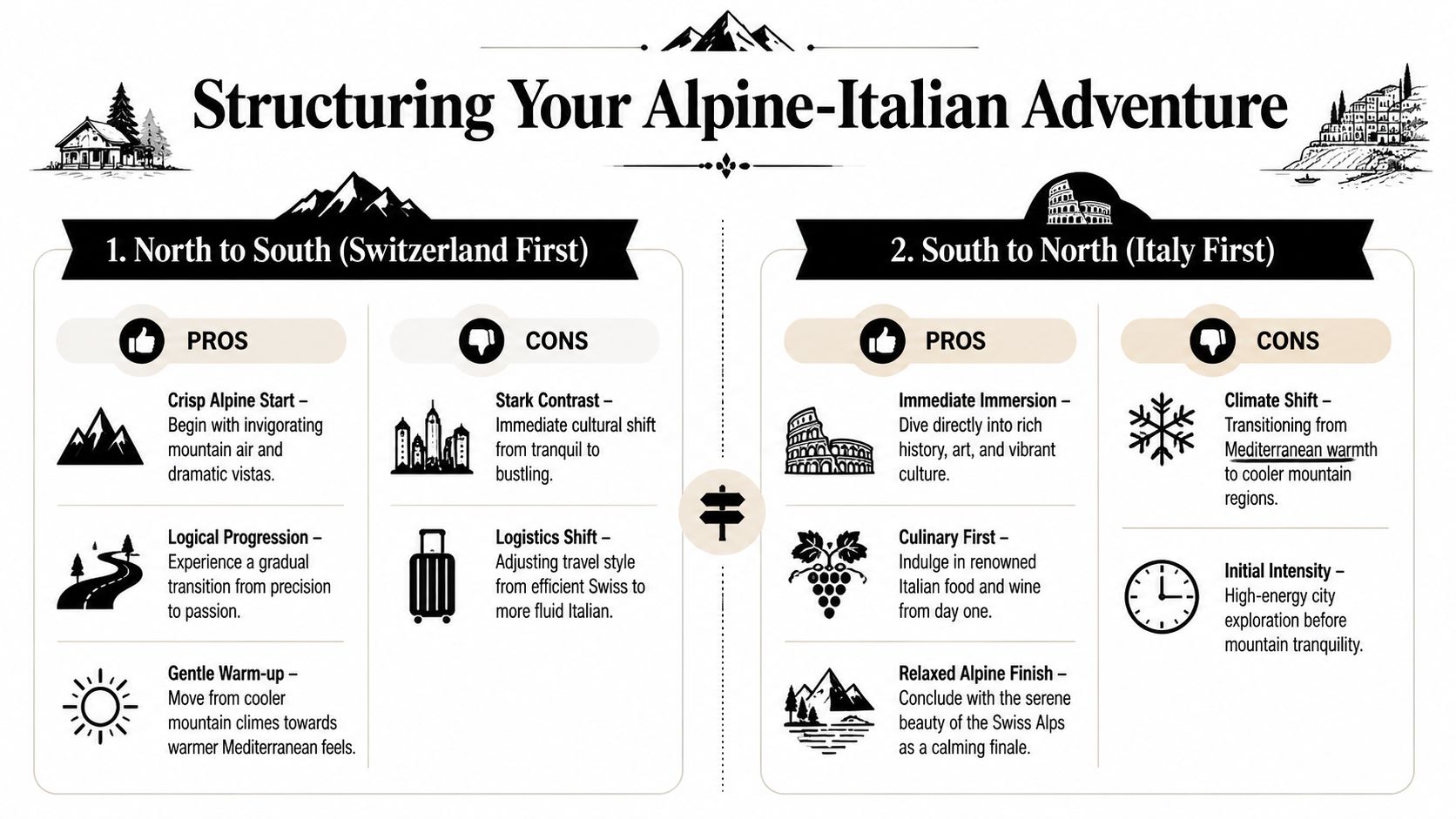
Some clients should start in Switzerland. Others should start in Italy. This isn't a minor preference. It affects how the entire trip lands.
- Switzerland first suits travelers who want control at the beginning. You arrive, reset, sleep well, and let the trip open in a composed way.
- Italy first suits travelers who want immediate cultural intensity. You start with appetite, street life, and momentum, then retreat into the Alps at the end.
- North to south often feels more sensual. The weather softens and the trip loosens.
- South to north often feels more restorative. The finale is cleaner, quieter, and calmer.
Decision rule: Start where your nervous system needs the most support. Some people need an elegant landing. Others need instant stimulation.
Build around transfers, not attractions
The smartest bespoke planning begins with movement blocks. Morning departure windows. Border crossings. Luggage handling. How many consecutive one-night stays are acceptable. Which hotel arrivals deserve daylight. Which scenic train is worth the ceremony and which one is slower.
That's why a custom route should be built from the inside out, not by copying a generic map. If you're thinking in terms of pacing rather than pure geography, this perspective on customized travel itineraries and bespoke journeys is the right lens.
A beautiful itinerary isn't one with the most stops. It's the one with the fewest bad transitions.
Signature Itineraries From Seven to Fourteen Days
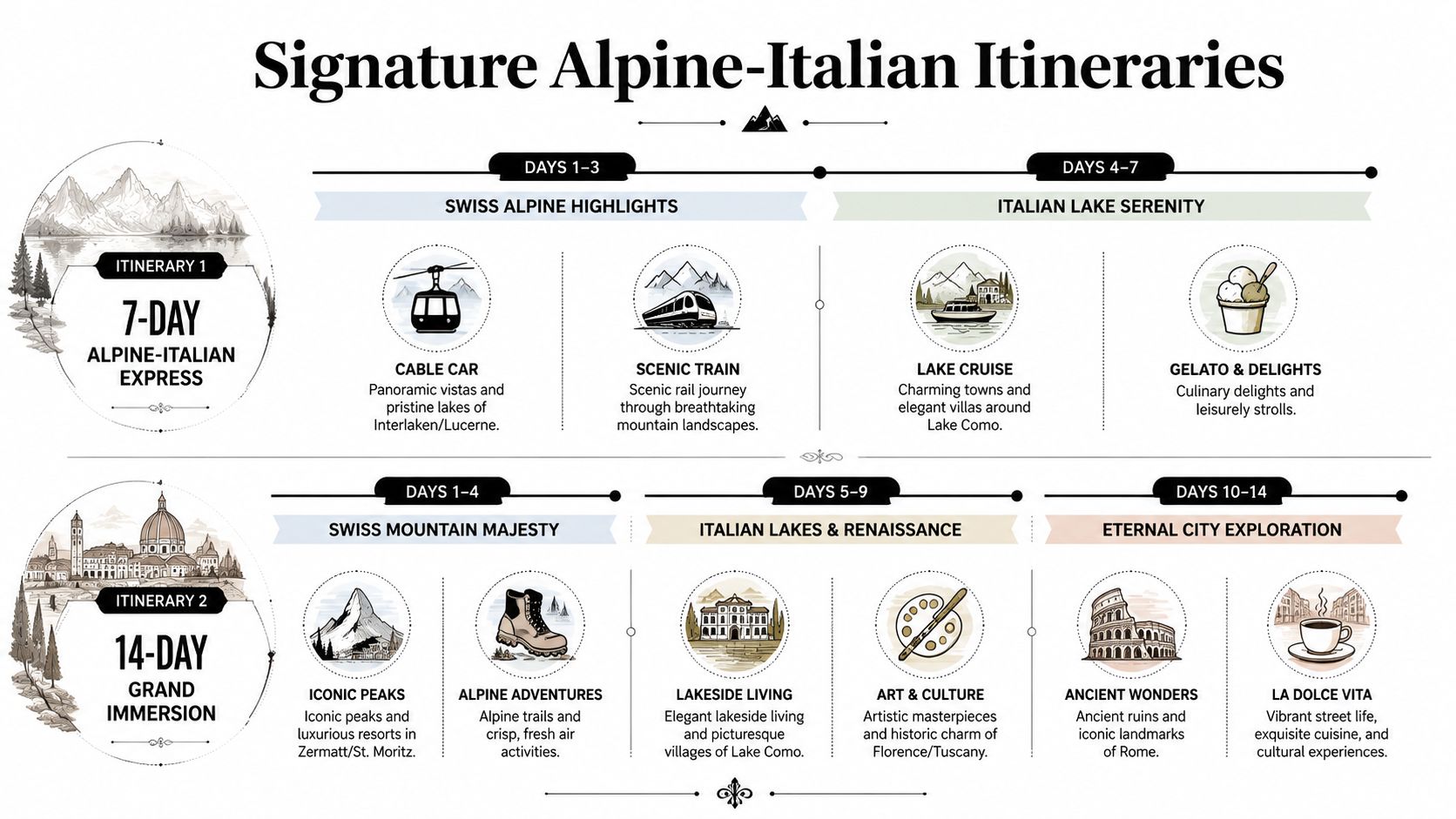
The right route depends on what you want the trip to do. Some journeys should seduce quickly. Others should unfold. I usually design one of two patterns. A tight northern circuit for clients who want altitude, lakes, style, and no dead time. Or a longer grand route for travelers who want Switzerland and Italy to reveal their full range.
Seven days for the northern connoisseur
This is the route for clients who don't want to waste a single day but refuse to rush.
Days 1 to 2, Zürich or Lucerne
Arrive in Switzerland and begin somewhere that absorbs jet lag without demanding performance. Zürich works if you want polished urban ease. Lucerne works if you want an immediate lake-and-mountain reset. Either way, the first stop should be restorative, not ambitious.
Days 3 to 4, St. Moritz or the Engadin
Move into the high Alps. The point here isn't just scenery. It's tone. St. Moritz gives you old-world mountain glamour, crisp service, and a sharper social edge than softer resort towns. Stay long enough to enjoy the altitude instead of merely photographing it.
A scenic rail segment can be worthwhile here if the carriage quality and timing align with your hotel sequence. If they don't, take a private transfer and stop selectively for views rather than committing the entire day to rails and station choreography.
Days 5 to 6, Lake Como
Drop south into Italy and let the mood change. The trip exhales. I prefer Bellagio, Tremezzo, or a more discreet lakeside base over a frantic hop through every town. One private boat afternoon is worth more than a checklist of ferry stops.
Stay fewer places and go deeper. On this route, every extra hotel change costs more than it gives back.
Day 7, Milan departure or one final night
Milan works well as a final urban punctuation mark. Fashion, architecture, aperitivo, a proper suite, then a direct departure the next day. If your flight timing is awkward, spend the night. If not, keep Milan lean and leave the trip wanting one more day.
A short visual reference helps clarify the pacing:
Fourteen days for the grand immersion
This version suits travelers who want mountain drama, lakeside elegance, and Italy's cultural depth in one coherent arc.
1. Zürich or Geneva arrival
Start in a city that gives you smooth international access and one easy evening to settle in.
2. Zermatt or St. Moritz
Choose one marquee alpine resort, not both, unless you're comfortable dedicating more of the trip to transit. Zermatt is iconic and romantic. St. Moritz is social, architectural, and more clubby.
3. Lucerne or a Swiss lake interlude
This stop softens the alpine intensity. It also creates a graceful handoff before Italy.
4. Lake Como
Give it proper time. Clients often make the wrong call and stay too briefly. Como isn't a scenic stop. It's a lifestyle stop.
5. Milan
Use Milan strategically. Shopping, design, private fittings, contemporary dining, and effortless onward transport.
6. Florence and Tuscany
Shift from sleek northern energy to aesthetic depth. A city hotel in Florence paired with a countryside estate in Tuscany is better than forcing yourself to choose between them.
7. Rome finale
End with weight. Rome can absorb grandeur. It rewards a client who arrives with enough time for private access, measured pacing, and proper dinners.
Why this sequencing works
The longer itinerary succeeds because each stop changes the texture of the trip.
- Alpine resorts sharpen the senses.
- Lake districts slow the pulse.
- Italian cities reintroduce appetite and cultural density.
- Tuscany gives space.
- Rome closes with consequence.
What you should avoid is trying to include everything iconic. Venice, the Bernese Oberland, Portofino, and Amalfi may all tempt you, but they don't all belong in the same trip. Editing is what makes a tour of Switzerland and Italy feel expensive in the right way.
Unlocking Truly Exclusive Experiences
Luxury isn't a larger suite alone. It's access that changes the texture of the day.
The difference between a premium trip and a memorable one usually comes down to who opens the door. Anyone can book a famous hotel. Fewer travelers gain the private hour before opening, the owner-led tasting, the closed workshop, the hidden table, or the alpine landing site that turns transit into a moment worth dressing for.
Experiences that justify the effort
A private glacier picnic in Switzerland works because it combines movement, natural beauty, and privacy. It isn't merely scenic. It rearranges the day. You leave breakfast by helicopter, step onto silence, take Champagne where nobody else is lingering, and return before lunch without losing the afternoon.
In Italy, a serious wine experience shouldn't feel like a production line. Skip crowded cellar circuits. Ask for a private estate visit with a host who can speak about land, vintage judgment, and family decisions. That's the difference between tasting and understanding.
- After-hours cultural access works best in places that are normally overwhelming. Empty rooms change your relationship to art.
- Private workshops matter when the craft is the attraction. Watchmaking, shoemaking, marquetry, textile finishing. These aren't souvenirs. They're forms of entry.
- Closed-door dining is often better than a public dining room, especially in lake regions and smaller towns where the right villa or palazzo setting matters as much as the menu.
The most coveted experiences are often quiet. They don't advertise themselves because they don't need to.
Taste matters in the small things
Discerning clients notice details others dismiss. Water is one of them. In Italy, the difference between a generic bottled water and authentic Lurisia water is exactly the kind of subtle marker that separates a thoughtful table from a merely expensive one.
What to request instead of what to book
When clients ask for exclusivity, I usually steer them away from broad labels and toward precise asks.
Ask for:
- A host with authority, not a standard guide reading from a script.
- Private timing, especially early morning, after closing, or between public sessions.
- An experience tied to place, not a generic luxury add-on that could happen anywhere.
- A natural handoff, so the transfer in and out feels as polished as the experience itself.
The hallmark of refinement isn't how much you spend. It's whether the day feels like it was assembled for you and impossible to replicate off the shelf.
Mastering the Art of the Seamless Transfer
Transfers decide whether this journey feels effortless or amateur. Travelers often focus on the scenery and under-plan the movement. That's backward.
The most operationally efficient way to combine Italy and Switzerland is often rail, because integrated cross-border corridors connect hubs such as Milan and Zürich, reducing airport friction and keeping city-center transit highly competitive, as described in this overview of Switzerland and Italy rail-connected touring. That doesn't mean every leg should be rail. It means rail should be your default until a better reason replaces it.
Choose the mode by purpose
A transfer should do one of three things. Save time. Add pleasure. Remove stress. If it does none of those, it's the wrong transfer.
| Transfer type | Best use | Watch-outs |
|---|---|---|
| Cross-border rail | Milan to Swiss hubs, major city pairs, couples traveling light | Station handling, porter coordination |
| Private driver | Families, villas, shopping-heavy itineraries, panoramic road routes | Road hours can blur together if overused |
| Helicopter | Recovering a day, dramatic arrivals, mountain-to-lake transitions | Only worth it when schedule and landing logistics are exact |
| Boat transfer | Lake Como positioning, scenic arrivals, avoiding road congestion near the lake | Weather and dock timing matter |
Profiles matter more than preferences
A honeymooner and a family shouldn't move through this region the same way.
For honeymooners, I prefer one ceremonial rail journey, one spectacular boat arrival, and private car support around luggage-intensive days. Romance collapses quickly when you're dragging cases through stations.
For families, drivers matter more. Children don't care that a famous train is iconic if the boarding process is awkward and lunch is late. Predictable door-to-door movement wins.
For executives or founders traveling with limited time, the question is simple. Which route protects concentration and preserves usable hours? In that case, a rail spine with selective chauffeured handoffs often beats a fully road-based plan.
Don't buy scenic transport out of obligation. Buy it when the journey itself is part of the memory.
Where clients usually get it wrong
They over-index on famous names. They assume every scenic train is worth half a day. They forget that a private driver can stop at exactly the right overlook, hold the luggage, adjust to weather, and take you straight to a dock or hotel entrance.
That's why I recommend treating transport as part of the design brief, not a back-office detail. Services such as luxury ground transportation planning are useful when you need the route to function cleanly across borders, hotel arrivals, and lifestyle demands.
The art is in the blend. Rail for elegant efficiency. Drivers for control. Helicopters for selective drama. Boats for arrival theater.
Your Private Sanctuaries The Pinnacle of Accommodation
Where you sleep shapes how you remember the trip. On this route, accommodation isn't a backdrop. It's part of the narrative.
A grand hotel on Lake Como creates one kind of Italy. A private Tuscan estate creates another. A palace-style alpine property in St. Moritz produces a very different Switzerland from a minimalist design retreat above a lake. You should choose your hotels the way a collector chooses rooms for a house. Each one should add something distinct to the whole.
Match the property to the mood
If your Swiss chapter is about ceremony and winter-sport heritage, choose Badrutt's Palace in St. Moritz. It has social authority. It knows exactly what it is. If your priorities are softer, lake-focused, and discreet, a resort above Lucerne can offer a quieter reset.
In Italy, Villa d'Este represents classic Lake Como grandeur. It's not for travelers who want invisibility. It's for those who appreciate ritual, legacy, and a sense of arrival. Grand Hotel Tremezzo gives a more playful glamour. In Milan, Four Seasons Hotel Milano works because it handles fashion, privacy, and urban convenience with unusual ease.
Then there are villas. A staffed villa in Tuscany changes the rules entirely. Breakfast on your own terrace, a household rhythm set by your preferences, and enough space for family or friends to travel well without crowding each other. For multi-generational travel, this often beats even an excellent hotel.
What sophisticated travelers should prioritize
- Arrival experience matters more than lobby theatrics. If the hotel can't handle you elegantly at the exact hour you land, keep looking.
- Room category should fit the trip's purpose. On a short city stay, location may matter more than square footage. On a lake or countryside stay, private outdoor space matters more.
- Service temperament matters. Some properties are warm and intuitive. Others are polished but rigid. You should know which style suits you before booking.
- Context matters. The greatest suite in the wrong neighborhood is still the wrong choice.
Avoid the common luxury mistake
Travelers often spend too much on the wrong nights. They splurge in transit cities and underinvest in places where they'll linger. Reverse that.
If you're staying one night in Milan before a morning flight, don't build the whole budget around that stop. Put more of your spend into the lake, the mountain resort, or the countryside estate where time slows enough for the property to matter.
A high-end tour of Switzerland and Italy should feel like a progression of sanctuaries, not a collection of room keys.
The Haute Black Difference Your Journey Perfected
You leave a suite in St. Moritz after breakfast, board the right train without waiting on a platform, step off in Italy to a driver who is already in position, and arrive at your hotel before the city feels busy. That level of ease is designed. On a Switzerland and Italy itinerary, the transfer is the trip.
The primary test on this route is flow. Anyone can reserve notable hotels and secure a table with a view. The harder job is arranging the handoffs so the rhythm stays intact from one country to the next. That means knowing when a panoramic train adds pleasure, when a private car saves the day, and when a helicopter is the only intelligent choice because it gives back half a day you would otherwise waste.
What expert orchestration changes
A strong advisor does far more than book inventory. They set the order of the journey, shape each transfer around your energy, and prevent the common luxury failure of treating every leg the same. Switzerland responds to precision. Italy responds to timing, instinct, and local judgment. You need both.
On this particular route, the hybrid model is what separates a polished trip from an expensive but tiring one. Use trains for the great scenic corridors. Use private road transfers for control, privacy, and difficult station or hotel arrivals. Use air transfers selectively, especially when mountain access, event timing, or a tight sequence makes overland travel a poor use of time.
One practical option in this space is Haute Black, which offers bespoke itineraries, private aviation and helicopter coordination, villa access, preferred partner hotel benefits, and advisor-led planning through a Virtuoso-affiliated model. For a multi-stop journey like this, those capabilities matter when they remove friction from transport, rooming, and in-trip support.
The payoff is usually invisible
The room is right on arrival.
Your bags appear where they should. The boat departs from the correct dock, not the public one that adds ten unnecessary minutes and confusion. Lunch lands at the hour you want it, not the hour a booking engine happened to offer. A transfer day still feels civilized because no one built it around optimistic timings or generic assumptions.
Effortlessness is not luck. Someone builds it.
That is the difference. A serious Switzerland and Italy journey deserves disciplined planning because the region offers too much to waste on clumsy connections, poor sequencing, and avoidable dead time. The distance between polished and irritating is small. The right advisor closes it.
If you want a Switzerland and Italy journey designed around privacy, flow, and exacting detail, speak with Haute Black about a bespoke itinerary suited to how you travel.
Explore Our Guides
Signature Experiences