Haute Black Journal
Private Jet Range Explained by Category and Model

Marlene Azeez
Director, HauteBlack
View all articles →

You're planning a nonstop trip, perhaps New York to Hong Kong or London to Perth, and the aircraft brochure appears to make the route easy. Then the operator asks about winter winds, passenger count, luggage, alternate airports, and reserve fuel. Suddenly, the published range is no longer a simple yes-or-no answer.
That distinction matters. Private jet range is a planning benchmark, not a guaranteed nonstop promise. The figure helps narrow the aircraft category, but the actual itinerary depends on winds, routing, reserves, payload, weather, and airport requirements. This guide translates those variables into practical booking decisions, so you can understand what an aircraft can potentially do and what the operator must verify before confirming your trip.
Introduction to Private Jet Range and Why It Matters
A private jet's range determines more than how far it can fly. It shapes whether you can depart from a convenient airport, arrive directly at your destination, avoid a fuel stop, and preserve the privacy and time savings that made charter attractive in the first place.
Consider two aircraft with similar brochure figures. One may carry your party and luggage comfortably while retaining enough fuel for the planned route. The other may require a payload adjustment, a slower cruise profile, or a technical stop once winds and reserves are included. The published number can look comparable, while the practical itinerary feels very different.
The history of business aviation shows how dramatically expectations have changed. Early aircraft such as the Lockheed Jetstar offered about 2,604 nautical miles, while the Learjet 23, introduced in 1964, had about 1,590 nautical miles. The Gulfstream II, introduced in 1966, raised the expected ceiling to 3,550 nautical miles. The Gulfstream G650, announced in 2008 and first delivered in late 2012, brought that benchmark to 7,000 nautical miles. This historical overview of private jet range places today's long-range aircraft in context.
For a first-time charter client, the most useful questions are practical:
- Which category fits the mission?
- Which model can cover the city pair?
- What happens after reserve fuel and payload are included?
- Should you prioritize a nonstop flight, a larger cabin, or a more convenient airport?
The category guide below helps with the first decision. The model and planning sections then show how to test the route before you book.
How Private Jet Range Is Defined and Measured
A charter itinerary can appear feasible on a brochure map and still require a fuel stop after winds, reserves, and passenger luggage are calculated. Range becomes useful only when the assumptions behind the figure are clear. Manufacturers and operators may publish different numbers for the same aircraft because they use different payloads, cruise speeds, fuel policies, routing conditions, or reserve profiles.
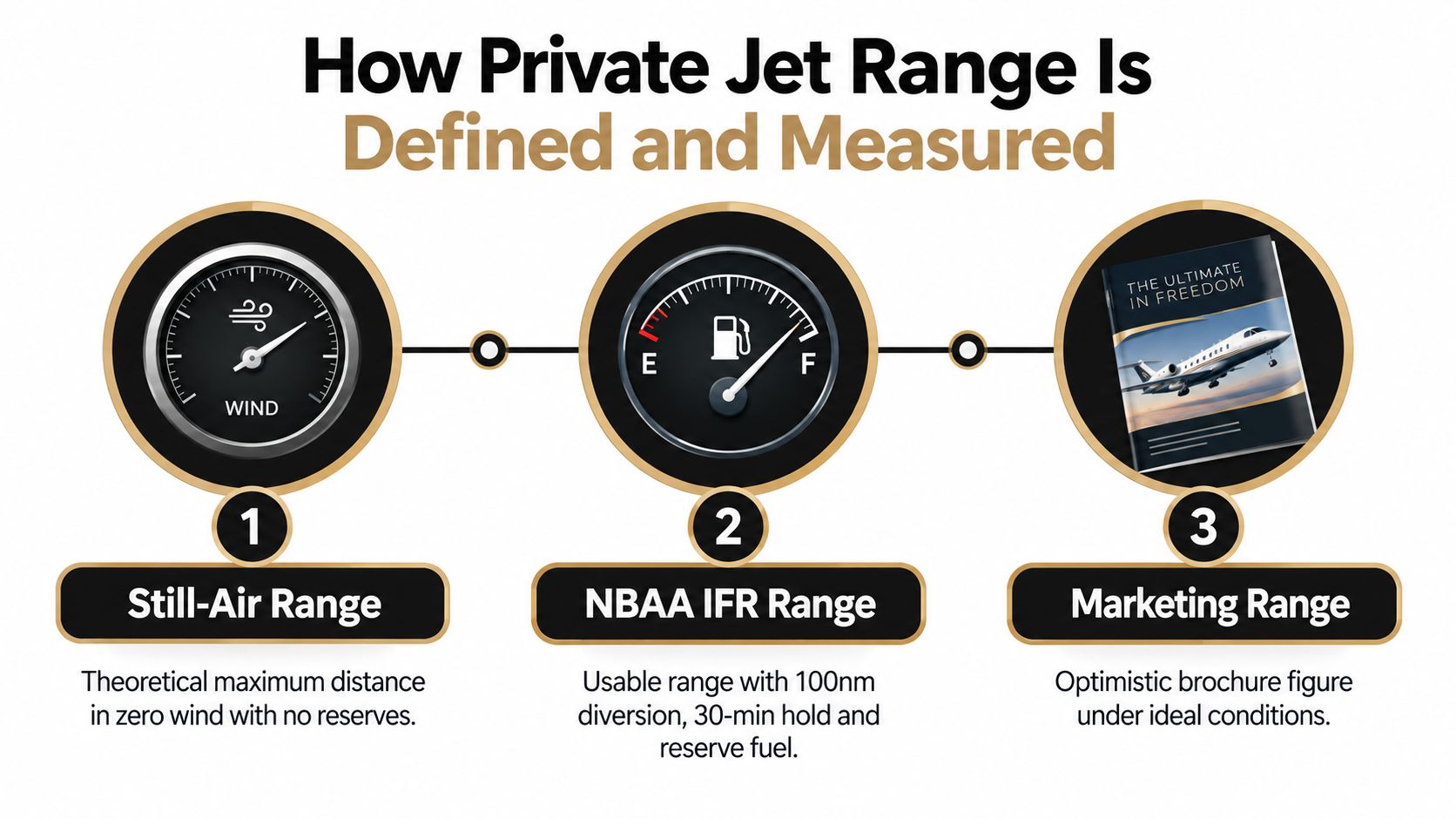
Three figures you'll encounter
Still-air range measures distance in calm atmospheric conditions. It provides a theoretical reference, while leaving out headwinds, routing restrictions, alternate-airport requirements, and operational reserves.
NBAA IFR range is closer to a real flight-planning benchmark. A common reserve scenario includes fuel to divert to an alternate airport and a 30-minute holding reserve. Published business-jet guidance indicates that this reserve structure can reduce usable range by roughly 200 to 300 nautical miles. The G280 flight-planning guidance shows why calculating only the distance to the destination can overstate nonstop capability.
Marketing range is the brochure figure calculated under defined, often favorable conditions. It may be accurate within those assumptions, but the footnotes determine whether it applies to your trip. Check the passenger load, cruise speed, wind conditions, fuel reserves, airport elevation, and whether the figure represents a theoretical maximum or an IFR planning profile.
Compare aircraft on the same basis. A range figure at one cruise speed may differ from a figure calculated at another. A lightly loaded aircraft may cover a route that cannot support a full cabin and baggage load. Calm winds may also produce a different result from strong seasonal headwinds.
Treat published range as a planning benchmark, not a promise. Before approving a city pair, request a mission-specific calculation using the actual departure date, passenger and baggage load, alternate airport, routing, weather outlook, and required reserves. That calculation turns a brochure estimate into an itinerary decision.
Private Jet Categories and Their Typical Range Bands
Aircraft categories provide a fast way to narrow the market. They don't replace a flight plan, but they help you avoid choosing an aircraft that's too small for the distance or unnecessarily large for the mission.
Industry guidance commonly places very-light jets at roughly 1,500 to 4,000 kilometers, midsize jets at about 2,800 to 6,200 kilometers, heavy jets at around 3,200 to 11,000 kilometers, and ultra-long-range jets at approximately 9,000 to 15,000 kilometers. This category guide to private jet range explains how those bands translate into common mission profiles.
| Category | Typical Range Band | Best For |
|---|---|---|
| Very-light jet | 1,500 to 4,000 km | Short regional flights and smaller groups |
| Light jet | Short regional to moderate domestic missions | Efficient point-to-point travel with a compact cabin |
| Midsize jet | 2,800 to 6,200 km | Longer domestic routes and selected transcontinental missions |
| Super midsize jet | Extended domestic and transatlantic missions | Larger groups, more cabin comfort, and longer endurance |
| Heavy jet | 3,200 to 11,000 km | Long domestic, transatlantic, and international itineraries |
| Ultra-long-range jet | 9,000 to 15,000 km | Nonstop intercontinental travel |
The light and very-light segments work well when the priority is airport access, a smaller party, or a relatively short route. Their cabins and baggage capacity can be more limiting than the raw distance.
Midsize and super midsize aircraft create a useful middle ground. They offer more space and endurance, but a nonstop transoceanic mission still depends heavily on winds, payload, and reserves. Heavy jets support longer international trips and larger cabins, while ultra-long-range aircraft are designed for the most demanding city pairs.
The top tier matters commercially because it can connect distant markets without a scheduled stop. Recent coverage describes the Gulfstream G800 at 8,200 nautical miles at Mach 0.85, while the Bombardier Global 8000 is described at about 8,000 nautical miles, enough for routes such as New York to Hong Kong or London to Perth under suitable assumptions. Those routes still require mission-specific verification.
Popular Private Jet Models and Their Published Range
Model names make the category bands tangible. A light jet and an ultra-long-range jet may both be excellent aircraft, but they solve entirely different itinerary problems.
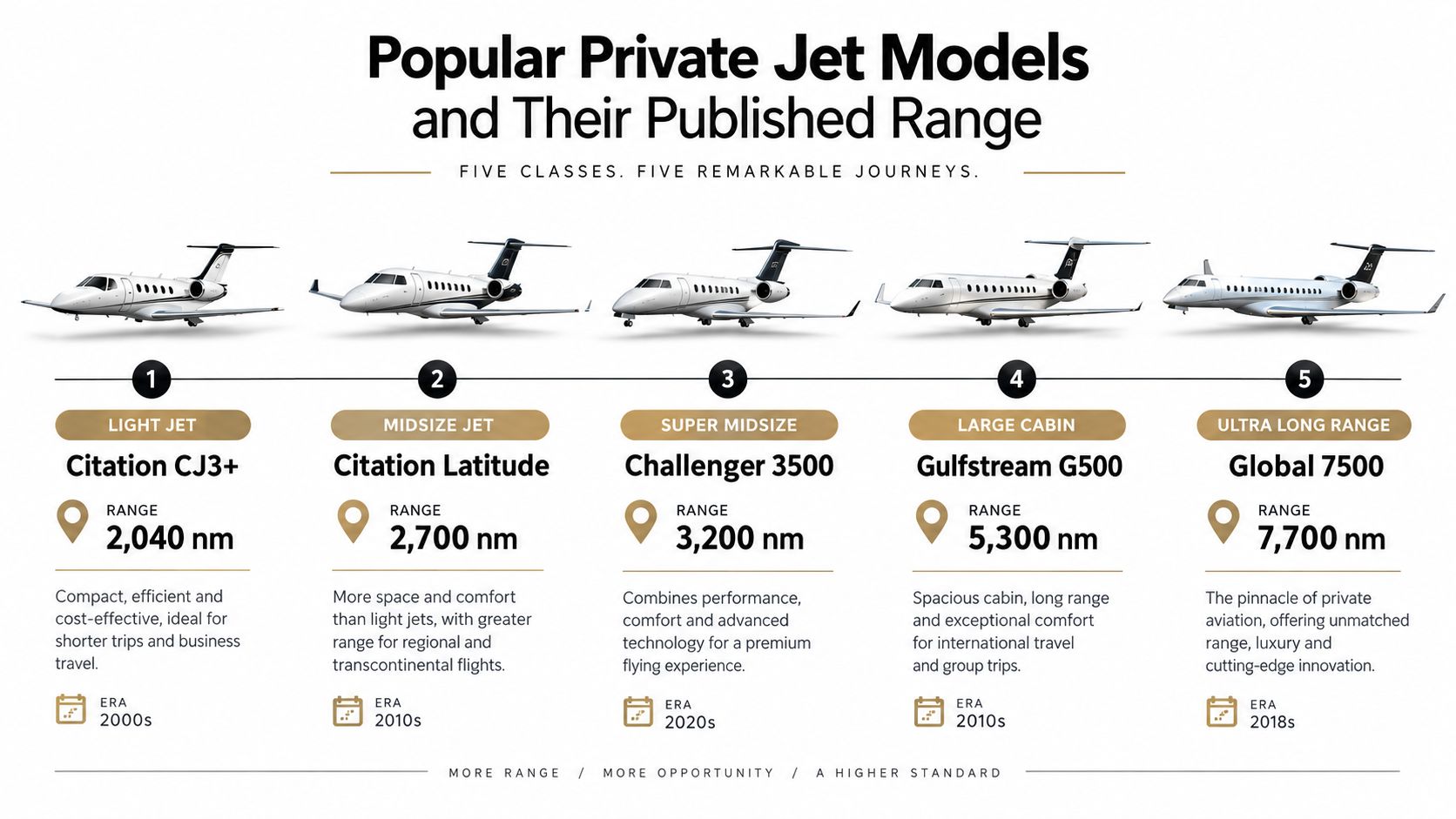
Light and midsize reference points
The Citation CJ3+ appears in the light-jet range at a published 2,040 nautical miles. That makes it a practical reference for regional and shorter domestic missions where speed, access, and operating efficiency matter more than a large cabin or intercontinental endurance.
The Citation Latitude represents the midsize category, with a published range of 2,700 nautical miles. It can suit longer domestic itineraries and selected transcontinental routes, but the actual route depends on the departure and arrival airports, winds, passenger load, and reserve requirements.
Super midsize and large cabin aircraft
The Challenger 3500 is a super midsize reference point at 3,200 nautical miles. Its positioning illustrates why clients often choose this class for longer domestic flights, larger groups, and greater cabin comfort without stepping immediately into an ultra-long-range aircraft.
The Gulfstream G500 sits in the large-cabin segment with a published range of 5,300 nautical miles. That figure can support substantial international planning, although a long route near the aircraft's upper limit requires careful review of payload, routing, alternates, and weather.
Ultra-long-range capability
The Bombardier Global 7500 represents the modern ultra-long-range class at over 7,700 nautical miles under ideal conditions. Its published capability shows how far the market has moved beyond early business jets, but the words “under ideal conditions” are operationally important. The aircraft still needs a route calculation based on the specific mission.
For a model-by-model reference, Haute Jets private aviation provides a starting point for reviewing aircraft access alongside itinerary requirements. Treat every listed model as a candidate for verification, not as an automatic promise that your preferred city pair will be nonstop.
The model's published range is only the first filter. The next questions concern what you're carrying, how much reserve fuel the flight plan requires, and what conditions the aircraft will encounter.
Understanding NBAA Reserves and Real World Range Adjustments
A city pair can look comfortably within a jet's published range and still require a technical stop. The difference comes from flight-planning fuel, weather, routing, and the operating conditions on the day. Published range is a planning benchmark, not a promise that the aircraft will arrive with empty tanks.
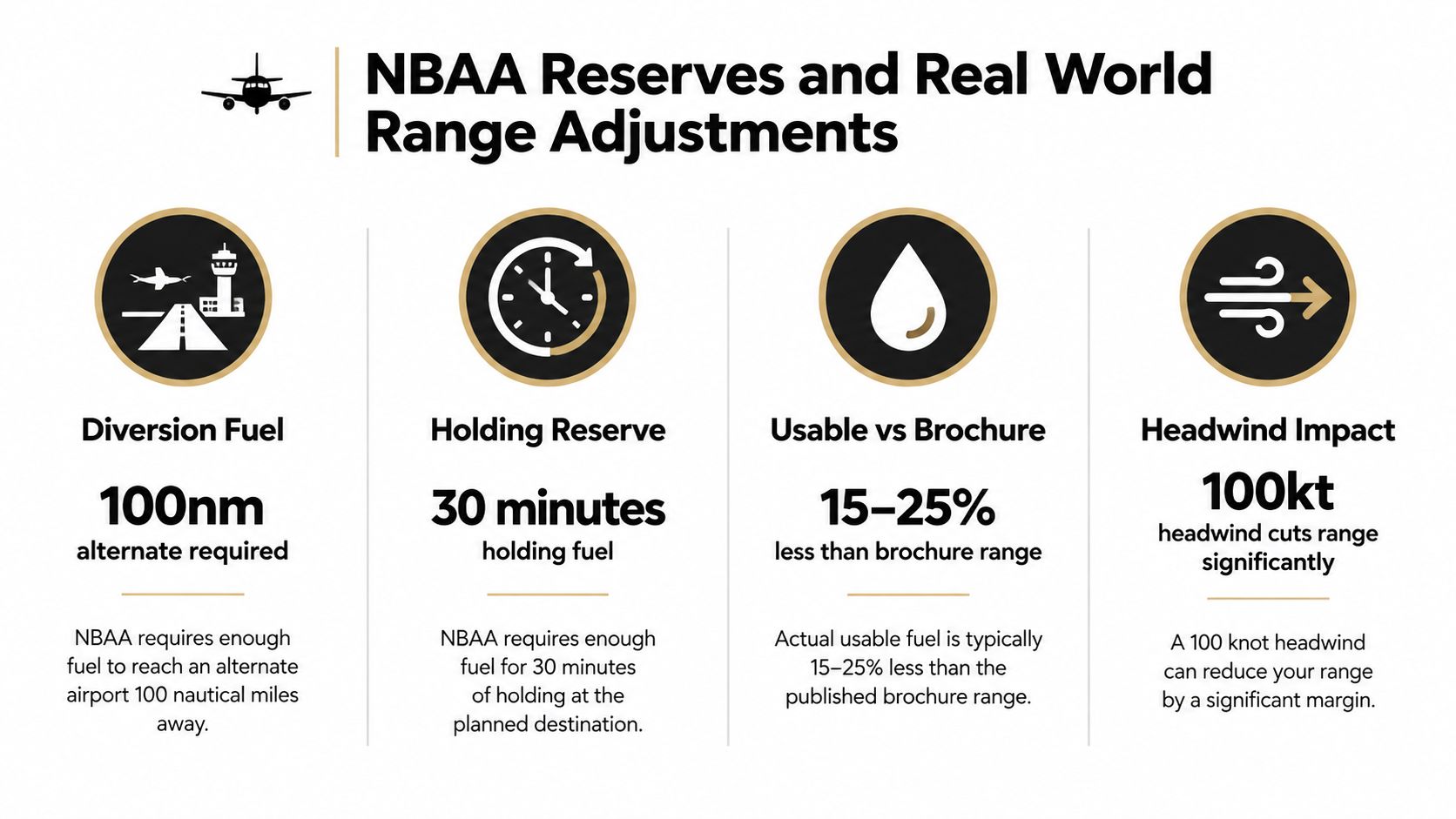
A common NBAA-style IFR reserve profile includes fuel to divert to a suitable alternate airport and 30 minutes of holding fuel. Depending on the aircraft and mission assumptions, those requirements can reduce usable range by approximately 200 to 300 nautical miles. A route close to the brochure maximum may therefore fail the operational check once reserves are included.
Conditions that change the answer
Winds can alter the result in either direction. A strong tailwind can improve progress toward the destination, while a headwind increases flight time and fuel consumption. Routing also matters. Air traffic procedures, restricted areas, and airway structure can make the flown path longer than the straight-line distance on a map.
Weather is tied to the departure date. A route that works comfortably in favorable conditions may require a fuel stop when winter headwinds increase time in the air. The same aircraft can have different practical nonstop capability on different dates, even with the same passengers and airports.
A simple rule helps: a route near the aircraft's published ceiling requires a dated operational calculation, not a range comparison alone.
Ask your advisor or operator to show the assumptions behind the recommendation:
- Reserve profile: Which alternate and holding requirements were included?
- Wind model: What forecast winds and temperatures were used?
- Routing: Does the calculation follow the expected airway structure rather than a straight-line track?
- Fallback plan: What happens if the preferred aircraft cannot meet the route with the required reserves?
For broader coordination covering aircraft selection and international trip logistics, review this 2026 private jet charter services guide. The practical question is whether the selected aircraft can complete this specific mission safely and comfortably under the expected conditions. Confirming that calculation before booking helps distinguish a credible nonstop itinerary from a brochure-based assumption.
Payload Range Trade Offs With Passengers and Luggage
Fuel isn't the only weight that affects private jet range. Passengers, luggage, catering, equipment, and cabin furnishings all contribute to the aircraft's payload. As payload rises, the operator may need to reduce fuel, adjust the route, select a different aircraft, or plan a stop.
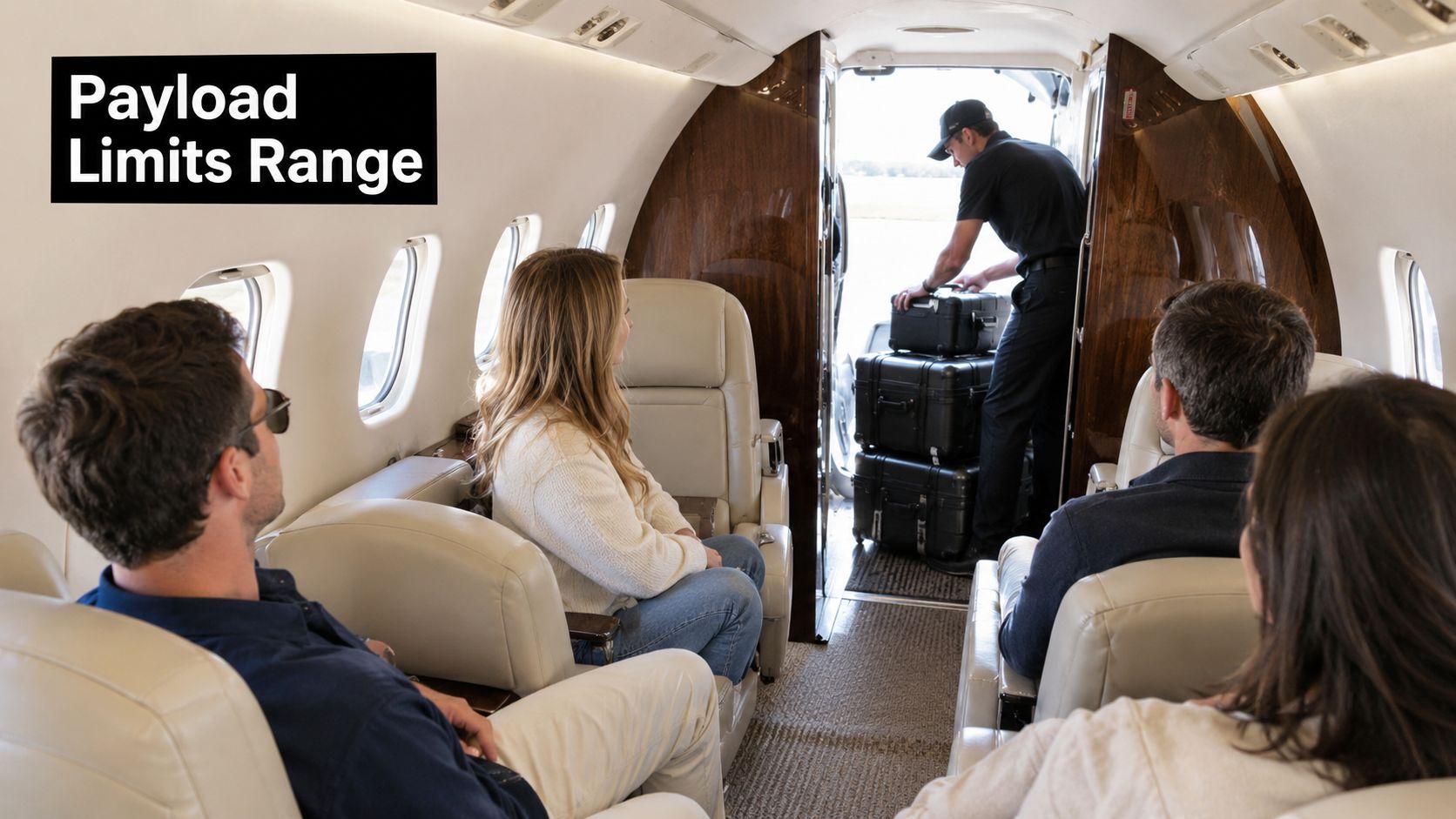
The trade-off becomes noticeable when a route sits near the aircraft's practical limit. A light passenger load with compact luggage may leave more flexibility than a full cabin carrying large cases, sports equipment, formalwear, or materials for a business trip.
How the mission changes
A couple traveling with carry-on luggage might fit comfortably within an aircraft's expected range profile. A larger family, executive team, or production entourage could create a different calculation, even if the city pair hasn't changed.
A full cabin can affect more than distance. The aircraft may need to depart with less fuel and make a planned technical stop, or the operator may recommend a larger aircraft with greater fuel capacity and payload capability. The larger aircraft can preserve the nonstop objective while offering more cabin room, but it may require a different airport or availability check.
A good advisor will ask for the details early:
- Passenger count: Who is traveling, and does anyone require additional space or special seating?
- Baggage profile: Are there oversized cases, equipment, instruments, or sporting items?
- Cabin preference: Do you need sleeping arrangements, a dedicated work area, or more room to move?
- Nonstop priority: Is avoiding a stop more important than keeping the original aircraft category?
The right aircraft is the one that carries the people, baggage, and comfort requirements without forcing the flight plan beyond its practical margin.
You don't need to calculate the payload-range curve yourself. Give the operator an honest inventory of passengers and luggage, then ask for two options: the aircraft that meets the mission with the requested payload, and the larger or differently routed alternative if it doesn't.
Flight Planning Implications for Nonstop Luxury Itineraries
A nonstop itinerary should be tested as a real mission, not as a line between two points on a map. Start with the aircraft's published range, then ask the operator to apply the route distance, expected winds, required reserves, payload, alternate airports, and seasonal conditions.
A practical verification sequence
1. Define the actual mission. Confirm departure airport, destination, preferred departure date, passenger count, baggage, cabin expectations, and any timing constraints.
2. Choose a suitable aircraft class. Use the category bands to narrow the field, then compare specific models. A midsize aircraft may be adequate for one transcontinental route, while an ultra-long-range jet may be justified for a demanding intercontinental city pair.
3. Run the dated flight plan. Request calculations using forecast winds and temperatures for the planned travel period. Ask whether the route uses the expected airway structure and whether the alternate airport is practical.
4. Test the margin. If the route sits close to the aircraft's limit, ask what changes would preserve the nonstop plan. Those changes might include a different model, a lighter baggage load, a revised departure time, or another airport.
5. Keep a refined fallback. A planned technical stop can be preferable to an aircraft operating with little flexibility. The stop may also open more aircraft choices and protect the arrival schedule.
The newest ultra-long-range aircraft cluster around roughly 7,500 to 8,200 nautical miles, so small changes in winds, payload, or routing can determine whether a city pair clears the threshold. Coverage of the longest-range private jets highlights why brochure comparisons alone aren't enough at this end of the market.
For a deeper explanation of endurance calculations, a pilot guide to fuel planning can help you understand the operational language your charter team may use. For timing decisions that affect connections, ground transfers, and arrival planning, see private jet flight time compared with commercial travel.
Build a little schedule flexibility around the arrival. A nonstop flight that lands with a comfortable reserve and a reliable ground plan is more valuable than a theoretical route that leaves no room for weather or operational changes.
How HauteBlack Aligns Aircraft Range With Bespoke Journeys
Range becomes more useful when it's integrated into the whole journey. A client may need a private aircraft for the long sector, first class for another leg, a helicopter transfer to a remote property, and coordinated ground transportation at both ends. Aircraft selection is only one part of that plan.
HauteBlack's travel ecosystem includes private jet access, first-class arrangements, and helicopter transfers, as described in its 2026 private jet charter services guide. That multimodal scope matters when the most efficient itinerary doesn't use the same transport mode for every segment.
When to involve an advisor
Bring an advisor into the process when the route is close to an aircraft's published range, when several travelers have substantial luggage, or when the trip includes multiple countries and time-sensitive connections. The advisor can coordinate the aircraft request with arrival services, airport handling, transfers, hotel timing, and contingency options.
HauteBlack describes its broader concierge offering as combining private jet access, curated global experiences, and member benefits in its luxury travel concierge guide. Its 2026 private jet charter cost guide focuses on pricing mechanics, which is useful once the operationally suitable aircraft and routing have been identified.
Destination details can also change the practical recommendation. A Miami private jet charter guide for 2026 reflects a market-specific approach rather than treating every departure point as interchangeable.
The best briefing is precise: preferred route, acceptable alternatives, aircraft comfort requirements, baggage profile, timing, and the level of contingency support you expect. That lets the advisor match range capability to the journey instead of selling you a model based only on its headline specification.
Quick Reference Glossary and Range Lookup
Use this section when you need to verify terminology quickly before speaking with a charter advisor.
Range terms
| Term | Plain-language meaning | Why it matters |
|---|---|---|
| Published range | The aircraft figure stated by the manufacturer or operator | It's a starting point, not a guaranteed route result |
| Still-air range | Distance calculated without wind effects | Useful for theory, weak for date-specific planning |
| NBAA IFR range | Range calculated with an IFR reserve profile | More relevant to practical nonstop decisions |
| Alternate airport | A planned airport used if the destination becomes unsuitable | Fuel must be reserved for the diversion |
| Holding reserve | Fuel retained for delay or holding requirements | Reduces fuel available for destination distance |
| Payload | Passengers, baggage, catering, and other carried weight | More payload can reduce practical range |
| Technical stop | A planned landing for fuel or operational needs | It can preserve flexibility when nonstop isn't viable |
Category lookup
- Very-light jets: Best for shorter regional missions where a compact cabin and airport access are priorities.
- Light jets: Suitable for regional and moderate domestic travel, with a smaller cabin and limited long-haul flexibility.
- Midsize jets: A balanced choice for longer domestic routes and selected transcontinental missions.
- Super midsize jets: More cabin space and endurance for extended domestic or some transatlantic itineraries.
- Heavy jets: Appropriate for substantial international missions and larger passenger groups.
- Ultra-long-range jets: Designed for the longest intercontinental routes, subject to reserves, winds, and payload.
Model-to-mission matcher
The Citation CJ3+, published at 2,040 nautical miles, is a light-jet reference for regional travel. The Citation Latitude, at 2,700 nautical miles, suits a broader midsize mission profile. The Challenger 3500, at 3,200 nautical miles, adds super midsize capability.
The Gulfstream G500, at 5,300 nautical miles, addresses longer international planning. The Global 7500, at over 7,700 nautical miles under ideal conditions, belongs in the ultra-long-range conversation. Each figure comes from the model comparison reference used earlier, and each still requires a route-specific calculation before booking.
Frequently Asked Questions About Private Jet Range
Can an aircraft make my route nonstop in winter headwinds?
Maybe, but the brochure number can't answer that. Winter headwinds may increase fuel burn and reduce practical reach, especially when the route is near the aircraft's upper limit. Ask for a dated flight plan using seasonal wind forecasts, the expected routing, the required alternate, and the full reserve profile. The operational answer may be a different aircraft, a different departure time, or a planned technical stop.
Does a full passenger load reduce private jet range?
It can. Passengers, luggage, catering, and equipment increase payload, which may require a fuel adjustment or a different aircraft. Provide the operator with the actual baggage profile, not just the number of travelers. A full cabin with substantial luggage can produce a different result from a lightly loaded cabin on the same city pair.
Why do different sources show different range figures for the same aircraft?
Sources may use different assumptions for wind, cruise speed, payload, reserves, routing, and airport conditions. One figure may represent a marketing or still-air benchmark, while another may reflect an IFR planning scenario. Ask the operator to compare all aircraft on the same assumptions and to identify the reserve profile behind the answer.
When is an ultra-long-range jet necessary?
It's most useful when the route is intercontinental, the nonstop objective is important, and the passenger and baggage load require substantial fuel and cabin capacity. It may be unnecessary for a shorter route where a midsize, super midsize, or heavy jet offers a more suitable balance. The correct choice depends on the dated mission calculation, not the aircraft label alone.
Should I accept a fuel stop if the nonstop route is marginal?
A planned stop can be the more reliable luxury decision when the nonstop option leaves little flexibility. It may allow a wider aircraft selection, more comfortable payload planning, and greater resilience to changing weather. Ask the advisor to present both options, including the effect on total journey time, airport convenience, arrival coordination, and cabin experience.
HauteBlack can help match private aviation access, aircraft range, and multimodal travel arrangements to a bespoke itinerary. Visit HauteBlack with your city pair, travel dates, passenger and baggage details, and nonstop preference so an advisor can validate the mission before you book.