Haute Black Journal
How Much Does It Cost to Charter a Private Jet? 2026

Marlene Azeez
Director, HauteBlack
View all articles →

Published August 22, 2026 by Marlene Azeez
An executive assistant opens a charter broker's email before a board meeting and pauses. The aircraft's hourly rate looks manageable, yet the total quote is far higher than expected. The discrepancy usually isn't an error. It reflects the difference between airborne pricing and the cost of the complete aircraft mission.
So, how much does it cost to charter a private jet? There's no single fare. Pricing depends on aircraft category, distance, repositioning, seasonal demand, airport conditions, and ancillary charges. A useful comparison starts with the aircraft class, then adjusts for the route and operating requirements. This is the same distinction travelers need when weighing private aviation against commercial service, as outlined in this private jet versus commercial travel guide.
The Real Answer to How Much It Costs to Charter a Private Jet
A broker may quote a light jet at one hourly figure and still produce a very different final price from another broker serving the same city pair. The aircraft might be based elsewhere, the preferred airport may impose higher handling costs, or the operator may need to reposition the jet before departure. Those details sit outside the number initially seen.
The broad market range for most private jets is about $2,300 to $17,000 per billable flight hour, while VIP airliners can reach $18,000 to $23,000 per hour, according to Paramount Business Jets' 2026 private jet rental cost guide. The range is wide because a regional light-jet mission and a long-range large-cabin flight aren't comparable products.
Five variables determine the mission price
- Aircraft category: Cabin size, range, performance, and onboard equipment establish the rate floor.
- Flight distance: Longer sectors consume more fuel and may require a larger aircraft.
- Repositioning: The operator may need to fly the aircraft empty to your departure airport or onward to its next assignment.
- Seasonal demand: Popular dates and destinations reduce availability and can strengthen the operator's pricing position.
- Ancillary fees: Handling, landing, crew accommodation, catering, permits, ground transport, and weather-related services can change the final invoice.
The practical mistake is asking only, “What's the hourly rate?” Ask instead, “What aircraft is being proposed, where is it based, what does the all-in mission include, and what could change before departure?”
Practical rule: Treat the hourly figure as a pricing component, not the trip price.
A strong quote should show aircraft type, routing, estimated flight time, positioning, taxes, fees, cancellation terms, and inclusions. That format lets an executive assistant compare two proposals without mistaking a low headline rate for a low total cost.
Aircraft Categories and Hourly Rate Ranges
Aircraft category is the most important pricing variable because it determines the mission's operating profile. A larger cabin generally brings greater range, higher fuel consumption, more complex maintenance requirements, and different crew and airport considerations. Distance matters, but distance alone doesn't tell you which aircraft can perform the trip efficiently.
For the 2026 U.S. market, light jets are typically quoted at roughly $3,800 to $5,200 per hour, midsize jets at $5,500 to $7,500, and heavy jets at approximately $9,500 to $13,000, based on Paramount Business Jets' current pricing guide. The same guide places VIP airliners at $18,000 to $23,000 per hour.
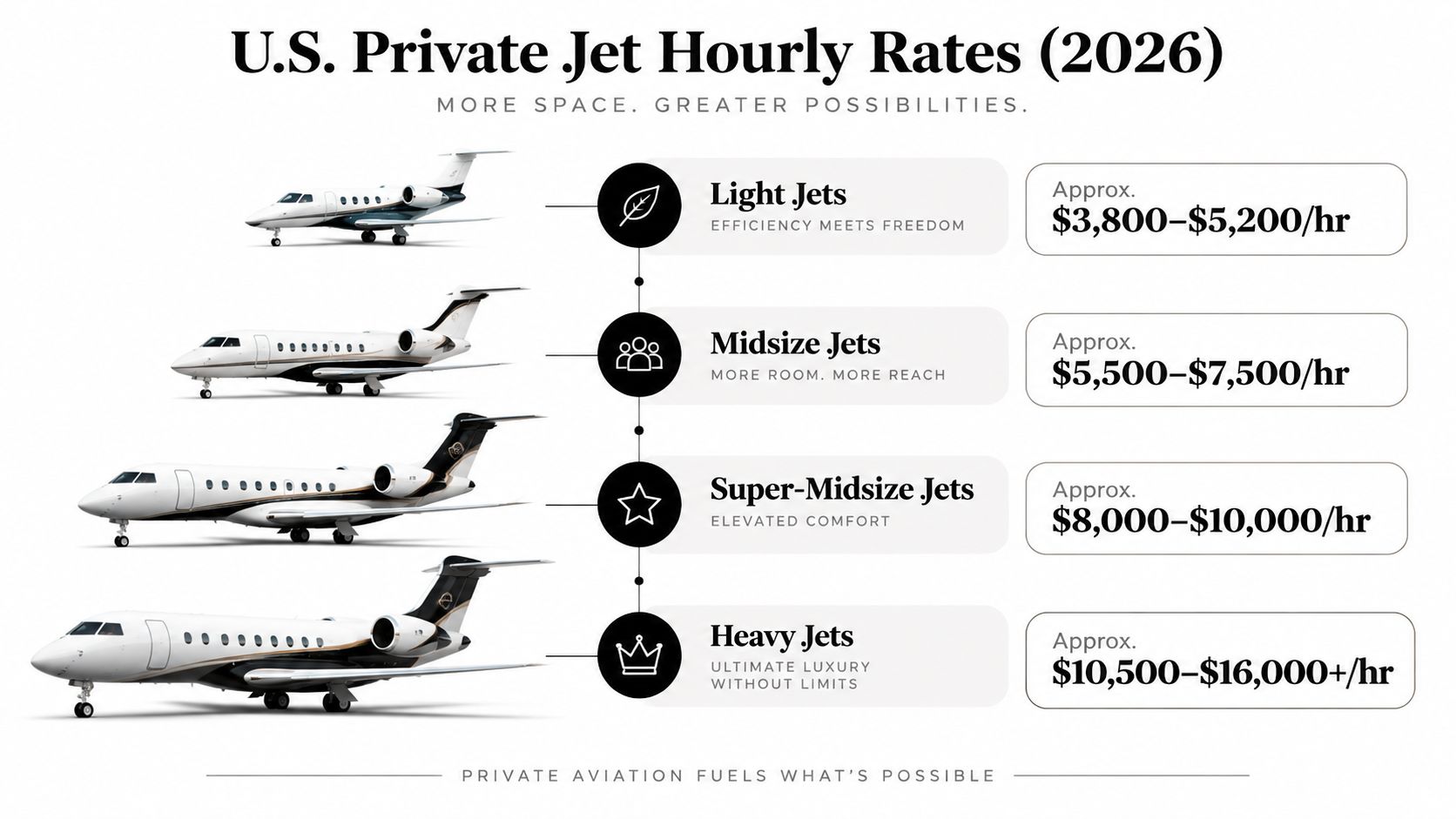
The U.S. pricing map
| Aircraft category | U.S. hourly range | Typical planning role |
|---|---|---|
| Light jet | $3,800 to $5,200 | Regional travel with a smaller party |
| Midsize jet | $5,500 to $7,500 | More cabin space and longer domestic missions |
| Heavy jet | $9,500 to $13,000 | Long-range travel and larger cabins |
| VIP airliner | $18,000 to $23,000 | Large groups, maximum space, and premium configuration |
A visualization may show super-midsize aircraft separately, but brokers don't always use identical category labels. One 2026 pricing guide groups super-midsize and heavy aircraft in a higher band of roughly $9,500 to $13,000 per hour for the U.S. market, while another infographic may present narrower aircraft-specific estimates. Always compare the actual aircraft, not just the category name.
Geography changes the starting point. A Europe-focused 2026 guide lists a light jet at about €3,000 per hour and an ultra-long-range jet at up to €22,000 per hour. In Asia-Pacific, light jets are listed at approximately $6,000 to $8,000 per hour, compared with the U.S. light-jet range of $3,800 to $5,200, as explained by Jetvice's 2026 regional rate guide.
That gap reflects local supply, positioning legs, fuel, airport restrictions, and timing. Travelers planning international journeys should evaluate aviation costs alongside other cross-border expenses, including this practical international health insurance cost guide from Expat Global Medical.
Sample Itineraries and Real-World Cost Ranges
An hourly rate becomes meaningful only when tied to a complete mission. A charter quote can include aircraft positioning, route requirements, airport charges, and operational planning, so multiplying the published rate by flight time rarely produces the final trip cost.
Miami to New York
A light-jet mission between Miami and New York is cited at approximately $12,000 to $18,000 in Haute Jets' private charter pricing guide. That range can represent different aircraft and operating assumptions. An aircraft already near the departure airport may cost less than one that must be repositioned, while the selected airports can change landing, handling, and parking charges.
For this regional route, the smallest suitable aircraft often offers the strongest value. Passenger count, luggage, runway access, and the aircraft's ability to complete the route without an operational compromise all affect the decision. A cheaper quote can lose its advantage if it depends on inconvenient airports or an aircraft substitution.
New York to London
A New York to London mission on a super-midsize jet is cited at approximately $55,000 to $75,000. Transatlantic range and fuel planning place this trip in a different cost tier from a domestic light-jet flight. The quoted aircraft must support the route without a technical stop or a later change in equipment.
Crew planning, alternate-airport provisions, overflight requirements, landing arrangements, and customs coordination can also affect the total. Compare the complete mission rather than the hourly figure. A lower rate on an unsuitable aircraft is not a saving if the operator must add a stop or substitute a larger jet.
New York to Dubai
An ultra-long-range mission from New York to Dubai is listed at approximately $80,000 to $120,000. The range reflects aircraft class and the operational demands of a long intercontinental itinerary, not the distance between the two cities.
Empty-leg availability can materially change the economics when the schedule is flexible. HauteBlack members may receive access to opportunistic routes that do not fit a fixed itinerary, making empty legs a planning tool rather than a casual discount. The trade-off is limited departure timing, routing, and aircraft choice.
A quote should answer one question clearly: What will the complete mission cost under the stated assumptions?
Review the aircraft model or tail, airports, estimated block time, positioning, international charges, crew arrangements, catering, ground services, and change rules. A broker who cannot explain those line items has not provided a decision-ready quote.
Hidden Fees That Inflate Your Charter Quote
The most expensive surprise usually comes from treating the base estimate as the invoice. Private terminals, known as fixed-base operators, charge for handling, parking, passenger services, and aircraft support. Landing fees vary by airport and aircraft, while international missions may add permits, customs, and overflight costs.
Crew accommodation is another common variable. If the crew must remain away from home overnight, the operator may add lodging, meals, and per diem expenses. De-icing can create a significant winter charge, with cited costs of approximately $2,000 to $15,000, depending on aircraft size and severity, as documented in the Stratos Jets pricing reference.
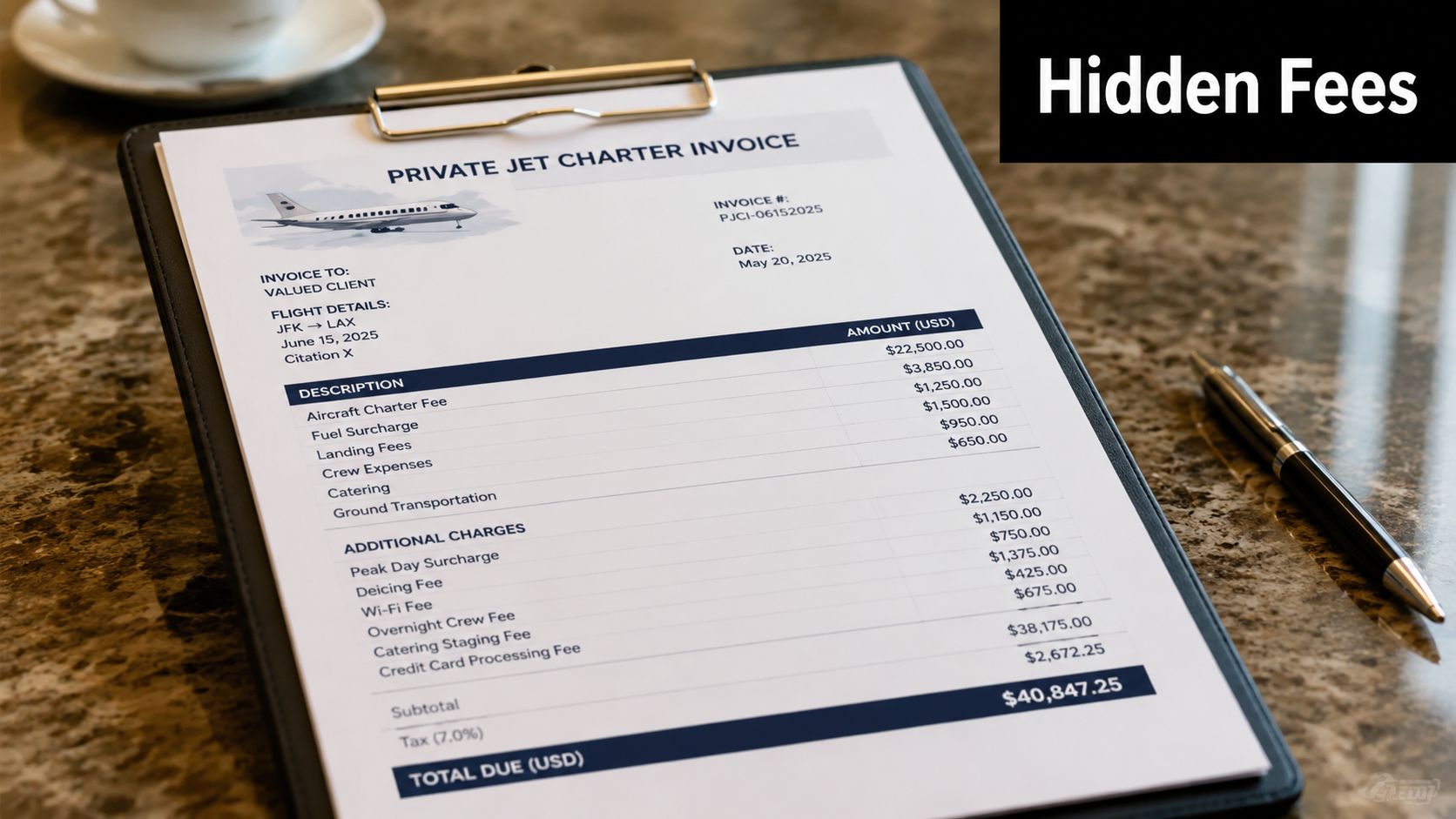
Charges that deserve a line-by-line explanation
- Airport and FBO services: Landing, ramp, handling, parking, and terminal charges may be included or passed through separately.
- Crew costs: Overnight lodging, meals, and duty-limit complications can change the total.
- Weather services: De-icing, hangar use, and winter protection can apply when conditions require them.
- Passenger requests: Catering, specialty beverages, Wi-Fi, ground transport, and additional concierge services may sit outside the aircraft rate.
- Positioning: A deadhead leg can become one of the largest differences between two apparently similar quotes.
The percentage each item represents isn't fixed across missions, so a broker shouldn't present a universal fee ratio. The reliable approach is to ask for an all-in total and a clear list of conditions that could cause it to change.
If you're traveling with a dog or other companion animal, confirm aircraft rules, cabin arrangements, and ground logistics early. A practical luxury pet guide from Pet Magasin can help with accessory planning, but it won't replace operator-specific approval.
Ask these questions before signing:
1. What's included in the all-in rate?
2. Which events trigger an ancillary charge?
3. What happens if a delay pushes the crew past its duty limits?
Charter vs Jet Card vs Membership vs Ownership
Private aviation access models solve different problems. On-demand charter suits an occasional traveler who values choice and doesn't want a standing financial commitment. A jet card favors predictable pricing and availability, while membership programs add an ongoing relationship and service structure. Ownership offers control, but also brings responsibility for the aircraft and its operating obligations.
Empty-leg charter sits apart from the standard models. Operators can offer roughly 35% to 50% savings against full charter rates on identical routes when they monetize a repositioning flight, according to MarketIntelo's empty-leg platform report. Another 2026 source notes that route-demand asymmetry can produce discounts of 50% to 75% on some return legs, including one-way markets such as Paris to Nice in peak season, as discussed in Jetvice's regional charter analysis.
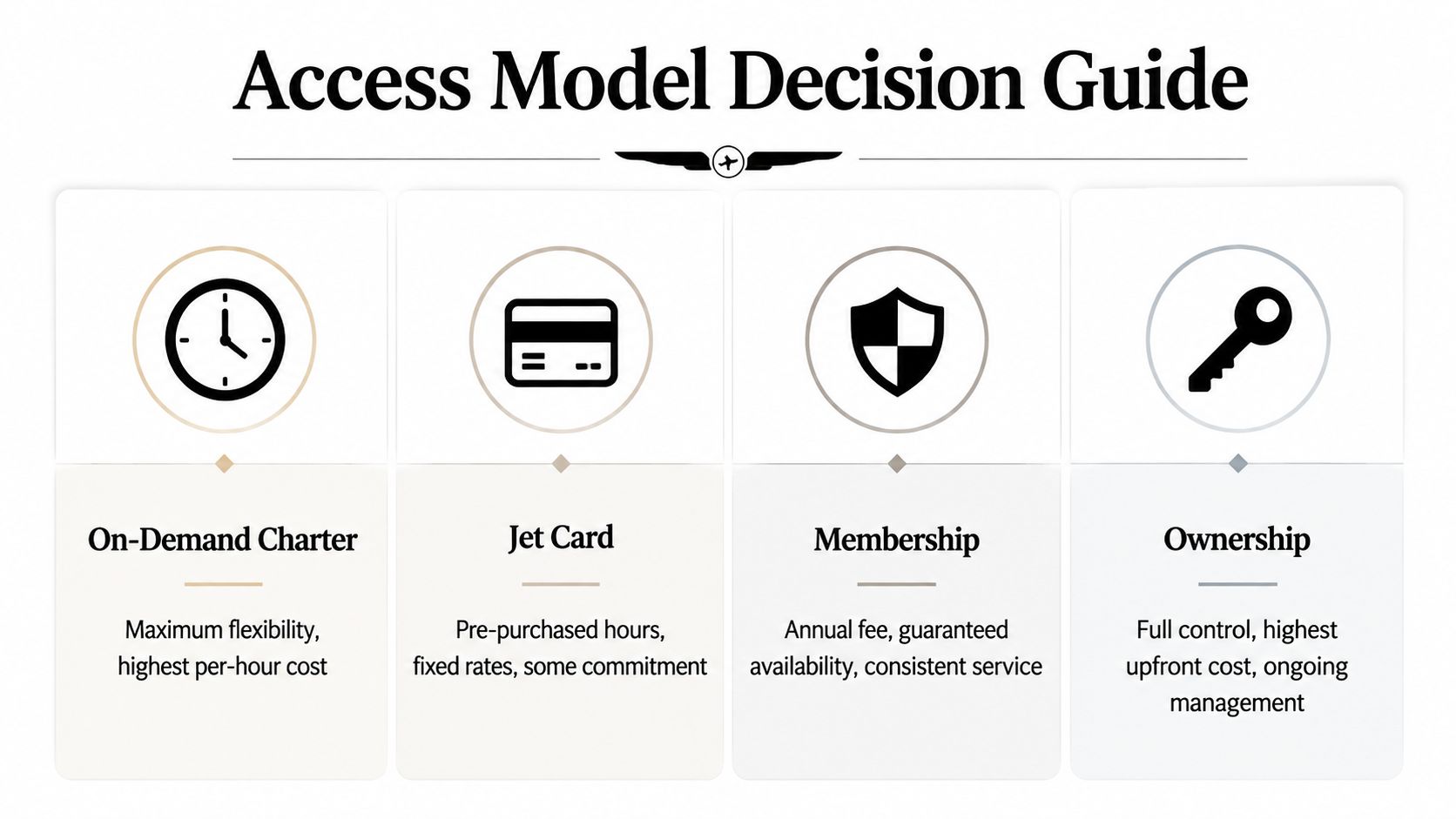
A practical comparison
| Access model | Cost structure | Flexibility | Commitment | Best fit |
|---|---|---|---|---|
| On-demand charter | Trip-specific quote | Highest schedule and aircraft choice | None beyond the booking | Sporadic travelers |
| Empty-leg charter | Discounted opportunistic route | Limited, schedule can change | None, but availability is uncertain | Flexible travelers seeking savings |
| Jet card | Pre-purchased hours and defined rates | More predictable availability | Prepaid commitment | Executives flying regularly |
| Membership | Annual fee plus flight charges or structured access | Consistent service and support | Ongoing membership | Travelers who value continuity |
| Fractional ownership | Shared asset investment plus operating costs | Access tied to program terms | Multi-year commitment | Frequent flyers with repeatable needs |
A jet card can make sense for an executive who flies four to twelve times per year, while a frequent flyer completing more than eight missions annually may find membership or another structured model worth evaluating. Those usage thresholds are decision prompts, not universal rules. Route patterns, cabin requirements, lead time, and tolerance for aircraft substitutions matter just as much.
Fractional ownership may reduce the operating cost per hour compared with purely on-demand flying, but the buyer accepts capital exposure, management fees, asset obligations, and a multi-year commitment. It's a poor fit for someone whose destinations and schedule change constantly.
Watch the decision guide for a visual comparison of the four access paths:
HauteBlack's UHNW private jet charter membership guide is useful for readers evaluating the mechanics of membership rather than comparing aircraft rates alone. The important question is not which model sounds most exclusive. It's which structure matches your actual travel behavior.
How to Optimize Your Charter Costs Without Sacrificing Service
Cost control works best when you change the mission, not when you ask the broker to cut the rate. The most effective savings often come from flexibility around routing, airport choice, aircraft size, and timing.
Use flexibility deliberately
Empty legs can produce substantial savings, but they're not ordinary discounted tickets. The aircraft may depart at an inconvenient time, operate from a different airport, offer a different cabin configuration, or disappear when the operator receives a paying charter. Use this strategy when the itinerary can move. Don't use it for a board meeting, wedding, medical appointment, or same-day international connection that cannot tolerate disruption.
Alternative airports can also help. A smaller executive airport near your origin or destination may reduce congestion, simplify handling, and improve aircraft availability. The benefit disappears if the ground transfer creates more inconvenience than the aviation saving, so compare the full door-to-door plan.
Match the jet to the mission
Choose the smallest aircraft that comfortably accommodates your passengers, luggage, range requirement, and service expectations. A larger cabin can be justified for a long sector, a substantial amount of luggage, or a need for sleeping arrangements. It's wasteful when it adds space nobody will use and creates a higher operating profile.
Timing matters too. Peak travel periods, major events, and holiday demand can tighten availability and raise quotes. Booking too late can leave you choosing from a smaller pool of aircraft, while a reasonable advance window generally gives the broker more options to compare.
For HauteBlack members, dedicated advisors can monitor empty-leg availability across multiple operators and evaluate whether an opportunistic route fits the traveler's schedule and service requirements. That kind of review matters because the cheapest visible option isn't always the lowest-risk option.
The best saving is often a flexible routing decision, not a cheaper aircraft.
Next Steps for Ultra-High-Net-Worth Travelers and Executive Assistants
For an occasional traveler completing one to three flights per year, request all-inclusive quotes from at least three operators or brokers. Ask each provider to itemize the aircraft, positioning, taxes and fees, cancellation terms, insurance coverage, and operator safety credentials. Review the complete mission price, not only the hourly rate, then compare the quote with the trip's schedule and ground requirements.
Frequent travelers face a different calculation. Someone flying more than eight missions annually should compare on-demand charter with jet cards and membership programs offering defined access, consistent service, or rate predictability. An advisor can coordinate aircraft, transfers, villas, hotels, dining, and itinerary changes through one contact. For guidance on coordinating the flight and ground plan, review this private jet flight booking guide for executives.
HauteBlack provides private aviation coordination alongside bespoke travel planning. Its broader platform includes Virtuoso-affiliated preferred partner status at over 500 properties, member planning support, and benefits such as complimentary upgrades and resort credits when available. Its 2026 coverage includes the definitive private jet charter services guide and a membership-focused resource on the HauteBlack news page.

Before booking, ask for the final all-in amount, written cancellation terms, aircraft tail or model, and transfer plan. Then test those details against the trip's purpose and required arrival time.
HauteBlack can help compare charter options, assess mission pricing, and coordinate the ground experience. Visit HauteBlack for travel guidance.
Frequently Asked Questions
Explore Our Guides


Signature Experiences


