Haute Black Journal
Private Jet Charter Miami: The Complete 2026 Guide

Marlene Azeez
Director, HauteBlack
View all articles →

# Private Jet Charter Miami: The Complete 2026 Guide
Published July 26, 2026 by Marlene Azeez
You're probably comparing quotes right now, trying to decide whether to move fast for Art Basel or wait and risk missing the aircraft you want. In Miami, that decision isn't about luxury first, it's about control. The right private jet charter Miami plan keeps your schedule intact, your arrival clean, and your total cost from turning into a surprise.
Miami is a market where the route matters as much as the aircraft. A Miami to Bahamas trip can start around $4,500, a Miami to New York trip begins around $17,650, and a Miami to Los Angeles charter in a light jet is quoted at $26,100 to $33,300 (Miami route pricing guide). That kind of spread tells you the city is not a simple hourly-rate market. It's a mission market.
Why Miami Is a Private Aviation Capital
A Wednesday morning in Miami can look like this. A New York executive clears Opa-locka after 9 a.m., lands, takes a noon lunch at the Four Seasons Surfside, then heads back east that evening without touching a commercial terminal. That is the appeal here, not novelty. Miami sits at the intersection of the U.S. East Coast, the Caribbean, Latin America, and Europe, and demand never really lets up.
The market structure explains why this city stays busy. Miami charter pricing is highly route-dependent, with hourly bands often quoted at roughly $2,600 to $3,500 for light jets, $4,300 to $5,000 for midsize jets, $5,100 to $7,500 for super-midsize jets, and $6,800 to $10,000 for heavy jets (Miami route pricing guide). Broader private aviation pricing also stays anchored to aircraft class, from turboprops near $1,300 to $3,000 per hour through larger private jets at roughly $8,600 to $13,000 per hour, with luxury VIP services pushing billable rates to $15,000 to $20,000 per hour (Jet statistics and industry data). Miami sits inside that same market logic.
That is why the city works for snowbird traffic, Art Basel, Formula 1, cruise connections, and second-home owners who do not want a commercial timetable dictating the day. A flight brief also has to look as polished as the itinerary, and Pinnacle Property Media is a useful reference for aviation imagery and presentation support.
Practical rule: In Miami, do not ask first, “What's the hourly rate?” Ask, “What route, what airport, and what class of aircraft fits the trip?”
If you are mapping your own Miami aviation strategy, Haute Black's broader private aviation page gives a useful sense of how charter fits into a larger travel program.
| Sample Miami Charter Trip Ranges | Aircraft Class | Starting Range |
|---|---|---|
| Miami to Bahamas | Light or turboprop | Around $4,500 |
| Miami to New York | Light jet and above | Begins around $17,650 |
| Miami to Los Angeles | Light jet | $26,100 to $33,300 |
Matching the Aircraft to the Mission
The wrong cabin is where budgets get wrecked. Book a heavy jet for a short Caribbean hop, and you pay for range you never use. Underbook a transcontinental or long-haul trip, and you buy discomfort, schedule pressure, or both.
Start with the mission, not the brochure
For a 40-minute run to the Bahamas or a quiet Key West hop, a turboprop is often the right call. A Bentley Continental is refined, capable, and completely overkill only if you use it for the wrong road. The published Miami market range for turboprops sits around $1,300 to $3,000 per hour in one pricing structure and $2,000 to $3,000 per hour in another, which is why this category stays the most economical option for short sectors (Jet statistics and industry data, Miami jet pricing).
A light jet is the sports sedan of Miami charter. It fits same-day East Coast business, quick repositioning, and trips where speed and efficiency matter more than cabin theater. For most first-time charter clients, this is the sweet spot when the route is under a few hours and the passenger count is modest. Miami light-jet pricing typically lands around $2,400 to $5,000 per hour or $3,000 to $4,500 per hour, depending on the source and the exact mission (Jet statistics and industry data, Miami jet pricing).
Size up only when range and cabin matter
A midsize jet makes sense when you want transcontinental comfort for about six or seven passengers without moving into the next cost tier too soon. It is the long-range SUV of private aviation, the choice when luggage, luggage tolerance, and cabin breathing room matter. Miami midsize pricing usually sits around $4,000 to $8,000 per hour or $4,500 to $6,000 per hour (Jet statistics and industry data, Miami jet pricing).
A super-midsize jet starts to enable nonstop Los Angeles, Aspen, and more ambitious east-west pairings without feeling cramped. The rate bands here are typically $5,100 to $7,500 per hour or $6,000 to $8,000 per hour (Miami route pricing guide, Miami jet pricing). A heavy jet is a private penthouse with range, the right answer when you need cabin space, long legs, and fewer compromises. Hourly pricing here often runs $6,800 to $10,000 and can climb higher depending on service level and mission (Miami route pricing guide, Jet statistics and industry data).
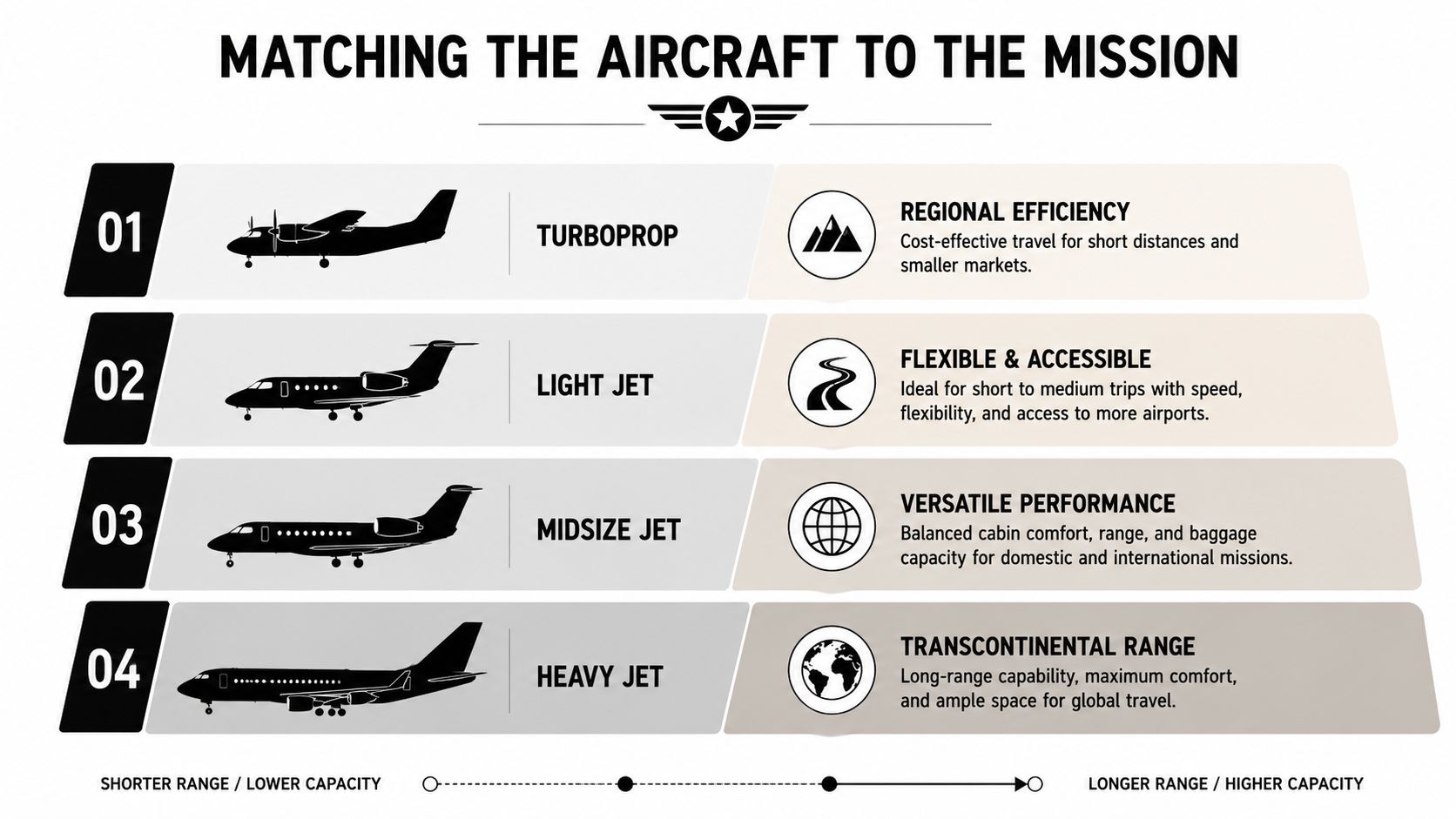
Bottom line: Match the aircraft to the route first. Everything else, including comfort, comes after that decision.
Miami Airports and FBO Choices That Change Everything
The airport choice in Miami is never cosmetic. It changes delay risk, transfer time, customs flow, and how exposed you are when the city is under pressure. If a client treats every airport as interchangeable, they usually pay for it with wasted time.
Pick the field that fits the trip
Miami International Airport, MIA, is the right answer when the mission is long-haul or international and you need the broadest infrastructure. It's the field you choose when the routing itself is the story. Opa-locka Executive, OPF, is the dedicated private aviation hub and usually the cleanest choice when speed and private-terminal efficiency matter more than general airport scale. Fort Lauderdale Executive, FXE, often wins on simple speed during peak periods, especially if the mission is northbound or the client is already closer to Broward. Homestead General and Miami Executive give you flexibility when Keys access or certain cruise flows matter more than defaulting to the obvious field.
Choosing MIA because it sounds more premium, or selecting OPF because it sounds more private, is a mistake. The right field depends on whether the trip prioritizes international arrival infrastructure or pure departure efficiency. A client traveling to or from Europe will value the first option. A client heading out for a Bahamas weekend will care about the second.
Use the airport as part of the schedule
A private jet charter Miami trip gets smoother when the airport matches the friction level of the mission. MIA gives you scale. OPF gives you private aviation focus. FXE often gives you less chaos. Homestead gives you tactical flexibility. The buyer who understands that usually gets better outcomes than the buyer chasing the most famous runway.
One Miami operator profile lists Privé Jets at 4200 NW 21st St, Miami, FL 33142, with the phone number (305) 917-1602 and hours shown as open seven days from 6:00 AM to 5:30 AM, which is effectively near-24/7 availability (Miami business news guide). That kind of availability matters in this city, because peak demand doesn't respect office hours.

Choose the airport the way you choose the aircraft, by mission. Not by habit.
What a Private Jet Charter in Miami Really Costs
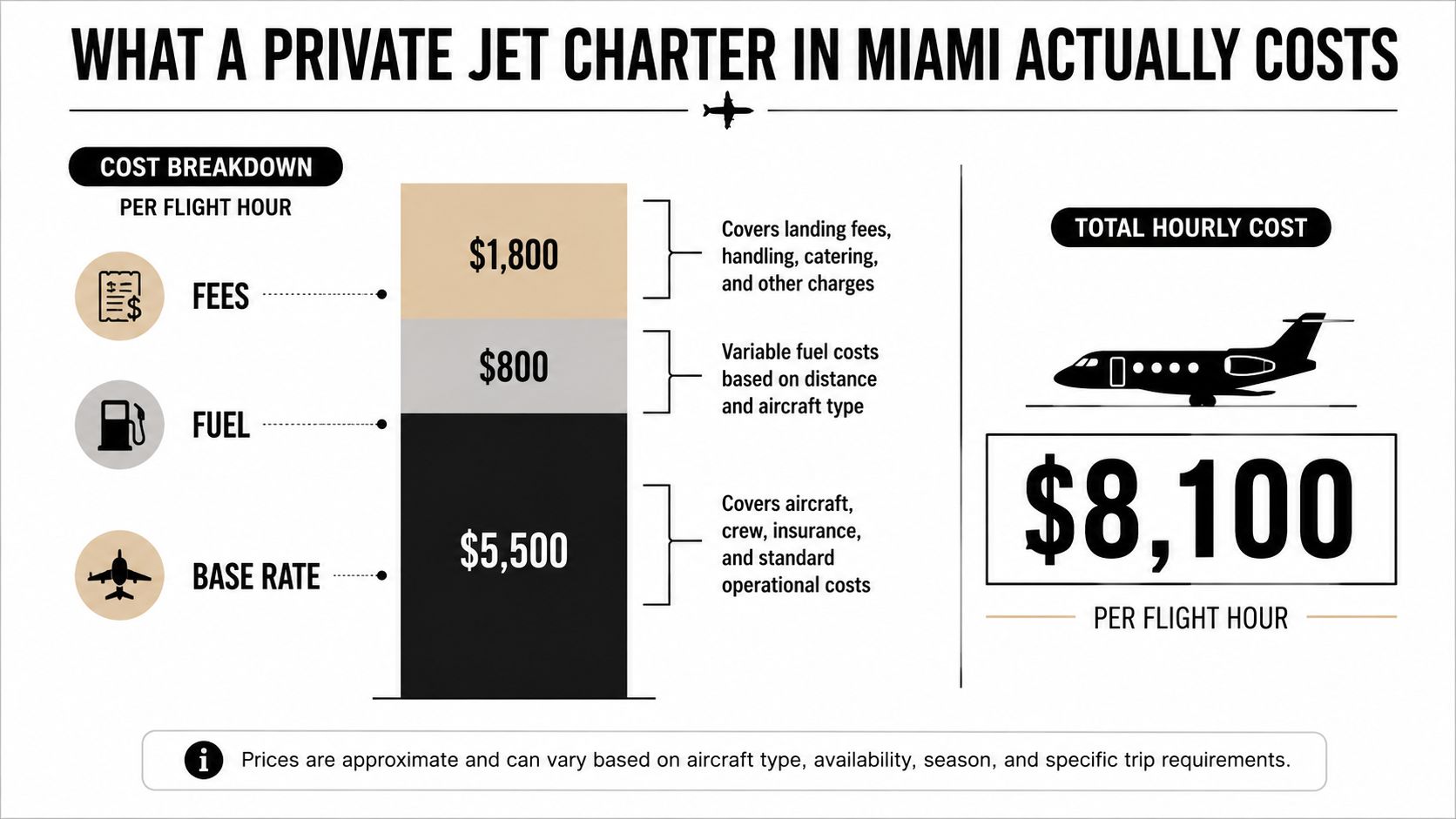
The headline rate is only the first number. Buyers get into trouble when they stop there. A charter invoice usually reflects more than the published hourly band, because the aircraft might need to reposition, the operator may add handling or peak-day charges, and short legs can trigger minimums that make a quick hop far more expensive than it looks on paper.
The landed cost is wider than the hourly quote
Miami charter pages often advertise broad hourly ranges, from about $1,300 to $15,000+ per hour depending on aircraft class (Miami trip-cost guide). That range is useful, but it is not the full answer. The final price can move when the jet is not already based in Miami, when the route is hot, or when the trip involves airport handling and timing pressure.
Route examples make that obvious. A Citation X between New York and Miami is independently estimated at $26,000 to $40,000, with fuel, fees, and taxes included (Citation X route estimate). A Miami to Orlando guide quotes a total trip range of $3,891 to $25,082 depending on aircraft type, which shows how much aircraft choice changes the end number (Miami route-cost guide). A Miami charter source also says booking a private jet to Miami generally ranges from $5,000 to $100,000 per trip, with example pricing of about $2,800 for a 40-minute small-aircraft flight and about $34,500 for a 1.5-hour midsize-jet flight (Private jet to Florida pricing).
What should be on your mental checklist
- Aircraft positioning: If the jet has to come to Miami first, you may be paying for that movement.
- Peak demand: Art Basel, winter snowbird traffic, and major event weekends tighten supply.
- Handling and airport fees: FBO choice changes the structure of the bill.
- Short-leg minimums: Very short flights can still price like much longer ones.
The cleanest way to think about it is this. Two travelers can book the same city pair and land at very different totals because one is paying for availability, timing, and convenience, while the other is only looking at a glossy hourly quote. That's why the question is never just “What's the rate?” It's “What am I buying?”
For a first-time charter client, the smarter move is to ask for a complete quote package before you compare jets. A private jet flight booking executive guide should spell out the aircraft type, repositioning, airport handling, and any event-week surcharge so you can compare real totals instead of headline numbers.
Booking Timeline and the Operational Checklist
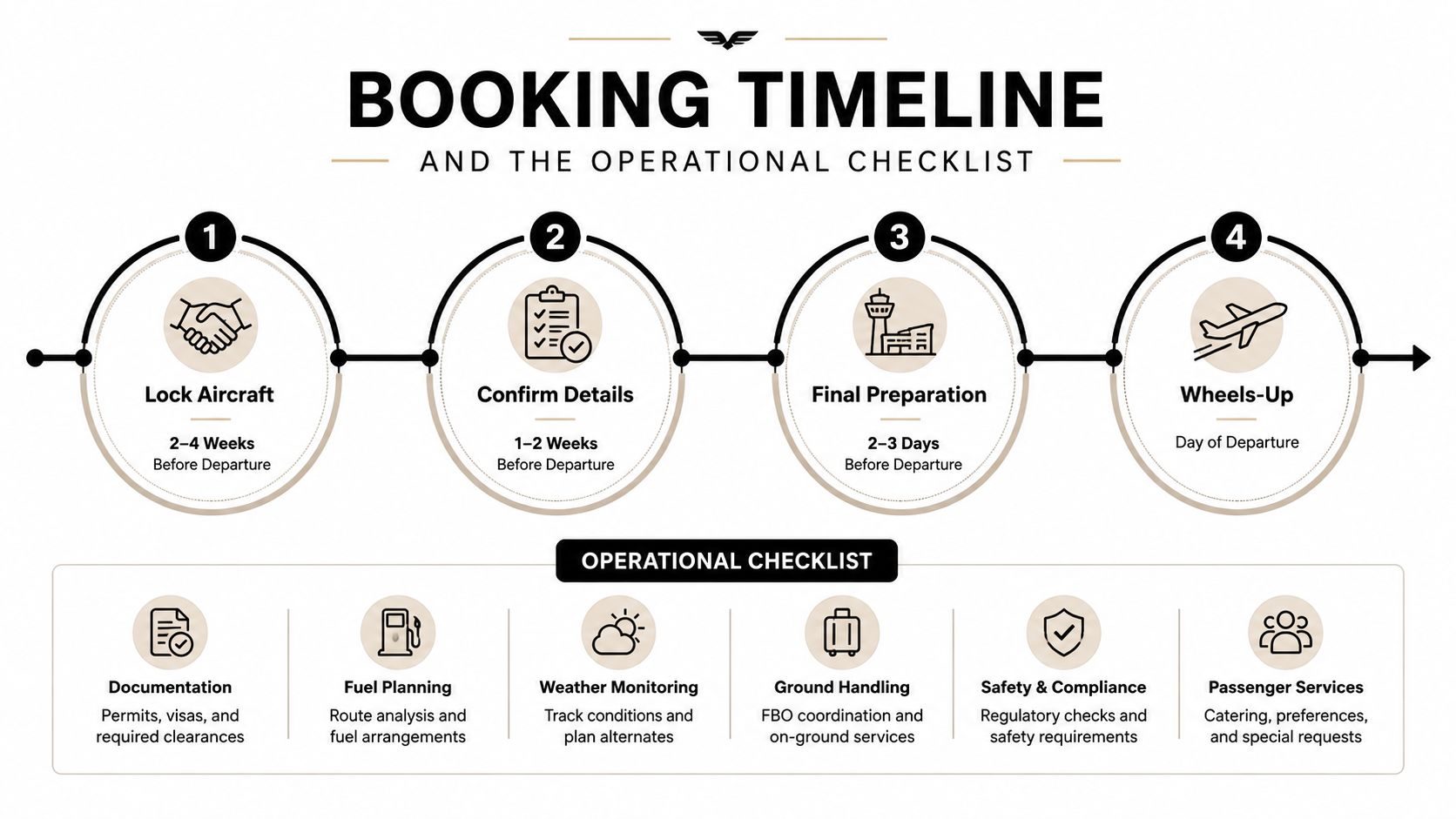
The smoothest charter bookings don't feel rushed because the work was done early. That starts with aircraft availability, not catering menus. It also starts with the right legal frame, because paid charter in the U.S. operates under FAA Part 135, while Part 91 covers non-revenue repositioning legs (Part 135 framework).
Build the trip backwards from wheels-up
Two to four weeks out, lock the aircraft class and the route logic. That's when you decide whether the mission really needs a light jet, a midsize, or something larger. Seven to ten days out, confirm catering, ground transport, pet needs, child seats, and any security or privacy requirements. At 48 to 72 hours, the operator should verify crew legality and check the weather windows. At 12 to 24 hours, you should already have the confirmation packet, including the tail number, crew, FBO suite assignment, and luggage details.
The best operators do not wait for the client to remember every detail. They run the sequence for you. That matters most when the trip touches Miami during a congested weekend or a big event week.
Use a simple operational standard
- Lock the aircraft early: The aircraft class has to fit the mission before any luxury detail matters.
- Confirm the departure field: MIA, OPF, FXE, or another airport can alter the whole experience.
- Send passenger and passport data promptly: That keeps manifests and crossing prep clean.
- Coordinate ground movement: Chauffeured transfers, helicopters, and backup plans belong in the same file.
- Verify the crew and departure packet: At the end, you want a clean handoff, not a scramble.
Operational truth: A private charter feels effortless only when someone handled the unglamorous details on your behalf.
For a deeper booking playbook, Haute Black's executive guide to private jet flight booking is a useful reference point if you want the process organized before you commit.
Customs, Immigration, and International Crossings
Half of Miami's private aviation value is what happens at the border. That's where amateur planning falls apart. The right FBO and the right pre-clearance routine can turn a simple Caribbean hop into a fast, calm movement. The wrong setup can leave a jet sitting on the ramp while paperwork catches up.
Treat customs as part of the itinerary
At cleared FBOs, U.S. Customs and Border Protection processing is built into the trip flow. In practice, that means the concierge should already have the passenger data ready, the manifest filed, and any passport or visa questions resolved before the group leaves the hotel. Pet paperwork should be handled the same way. When the prep is clean, the aircraft keeps moving. When it isn't, the aircraft waits.
Miami travelers often underestimate this because the route looks short. A Bahamas round trip can feel trivial on a map, but the operational difference between a prepared departure and an unprepared one is enormous. The right airport and crew pairing can make the turnaround feel almost frictionless. The wrong pairing can add an overnight nobody wanted.
What matters most on international runs
Use the FBO that already understands the mission. MIA, OPF, and FXE are the obvious examples of airports where this matters most, but the deeper point is simple. Cross-border travel is not a separate category. It's a layer inside the trip, and it needs to be managed before the first bag is loaded.
If your assistant is still asking customs questions at the terminal, the booking started too late.
That is why high-end Miami charter planning should think about the border as early as it thinks about cabin class. It's not bureaucracy. It's the difference between a clean arrival and a delay that wrecks the day.
Ground Transfers, Helicopters, and Three Sample Itineraries
A charter doesn't end when the wheels touch down. In Miami, the last mile can matter as much as the flight. The transfer from the FBO decides whether a client rolls into the hotel, the beach club, or the meeting on time, and the wrong ground choice can erase the advantage of the private flight.
Build the arrival around the next move
At OPF or MIA, chauffeured Mercedes-Maybach or Range Rover service is the expected finish for many private travelers. For Miami Beach, Star Island, Fisher Island, Bal Harbour, and Key Biscayne, helicopter transfers can save time and keep the itinerary moving. If the right jet isn't available at the right price, first-class commercial backup can still protect the trip without forcing a bad charter decision.
A good example is a Friday-to-Sunday Bahamas weekend. The right aircraft is often a light jet or turboprop, the airport choice should favor fast private handling, and the ground vehicle should be waiting on arrival so the trip feels continuous. For a bigger Miami event week, like Art Basel, the setup changes. You want an OPF base, flexible routing, and a willingness to adjust the airport if the private field is getting squeezed.
For those who like a helicopter option folded into the plan, the broader travel logic in Haute Black's private helicopter charters guide lines up well with Miami's island and beachfront logistics.
Three itineraries I'd actually recommend
1. Bahamas day trip: Keep the aircraft simple, the airport efficient, and the ground ride short. This is about turnaround speed, not cabin drama.
2. Art Basel weekend: Base near the private aviation flow, expect pressure on slots and parking, and keep the backup plan ready if weather or congestion changes the day.
3. Aspen or Bahamas plus Manhattan ski escape: Use super-midsize logic for the longer leg and don't force a short-range aircraft into a mission it can't handle comfortably.
The important thing is that aircraft, FBO, and ground transfer all have to agree with each other. If one of them is wrong, the whole trip feels clumsy.
How a VIP Concierge Transforms the Charter
An à-la-carte booking gives you an aircraft. A true concierge gives you a trip. That difference matters most in Miami, where peak demand can distort availability and pricing during Art Basel, winter snowbird surges, and major event weekends.
A VIP concierge does more than source the jet. It coordinates the whole movement, including private helicopter or first-class transfers, preferred hotel recognition, and the details that keep a high-profile client from being treated like a stranger at the edge of the runway. Haute Black, for example, operates as a luxury travel company and private membership world with preferred partner access at over 500 properties including Four Seasons, Aman, Rosewood, Belmond, and Ritz-Carlton, plus private aviation support through Haute Jets. It is one model among several, but it shows what integrated trip design looks like when the booking, transfers, and on-the-ground support are handled together.
The practical value is simple. A fragmented booking forces you to solve problems in pieces. A concierge plan absorbs the friction before you feel it. That matters most when weather shifts, mechanical issues appear, or a 4 a.m. change threatens the day.
A strong concierge also helps you avoid false economy. The cheapest aircraft quote can turn expensive once you add repositioning, peak surcharges, parking constraints, and the wrong FBO. A good advisor will tell you when to use OPF for speed, when a different airport is the better fit, and when the hotel or ground transfer should be adjusted to protect the schedule.
If you're going to charter from Miami more than once, do not shop for seats. Build a relationship with a team that understands the city, the airports, and the pressure points that come with peak season. That is how you keep the total landed cost under control and the experience consistent.
If you want a Miami charter plan that treats the aircraft, airport, FBO, and transfer as one clean itinerary, Haute Black can build it with the same level of discretion it applies to luxury travel and private aviation. Visit Haute Black to start a conversation about your next Miami departure, whether it is Art Basel, a Bahamas turnaround, or a longer international mission.
Explore Our Guides


Signature Experiences