Haute Black Journal
Private Helicopter Charters: 2026 Luxury Travel Guide

Marlene Azeez
Director, HauteBlack
View all articles →

# Private Helicopter Charters: 2026 Luxury Travel Guide
Published July 25, 2026 by Marlene Azeez
You've just landed after a long-haul flight, your driver is waiting somewhere in the traffic crush, and the resort, estate, or meeting across town still feels annoyingly far away. That's the moment when private helicopter charters stop looking like a vanity purchase and start looking like the cleanest logistical solution on the board.
The best helicopter booking is never just about glamour. It's about moving fast, moving privately, and moving on your own timetable, whether that means clearing an airport bottleneck, skipping a punishing coastal drive, or arriving at a hard-to-reach property without burning the first half of the day on the road. The bad helicopter booking, by contrast, is expensive, delayed, and poorly matched to the route.
This guide takes the practical view luxury travelers need. It covers aircraft choice, real-world routes, the pricing traps operators don't advertise, the regulatory checks you should insist on, and the situations where a helicopter is the wrong answer.
What Private Helicopter Charters Offer Luxury Travelers
A well-run helicopter transfer starts before you leave the terminal. Your bags are already being handled, the ground crew knows who is coming, and you move from aircraft to aircraft without the dead time that can wreck a tight itinerary. That is the value of private helicopter charters, control over timing, privacy, and access.

Scope of the service
Private charter means the helicopter is reserved for your party, your route, and your schedule. It is not a shared shuttle, and it is not the same product as a seat sold on a sightseeing flight. In luxury travel, that distinction matters because the service is built around privacy, precise timing, and reaching places that ground transport can't match.
The market reflects that demand. The global private helicopter charter market is estimated at USD 7.01 billion in 2023 and projected to reach USD 13.7 billion by 2032, with a 7.74% CAGR from 2024 to 2032, according to Wise Guy Reports. Independent estimates also place the market at USD 8.7 billion in 2025 and USD 15.4 billion by 2034 at a 6.6% CAGR, which points to steady, organized growth rather than a passing luxury fad.
Practical rule: if the helicopter saves time, protects privacy, or reaches a property that road access cannot, it earns its place. If the route is easy by car and the helicopter is there only for show, you are paying for drama.
Luxury travelers use helicopters for airport transfers, remote resort access, executive hops, event arrivals, and scenic flights that are part of the trip itself. I treat it as a precision tool. Use it where the itinerary has friction, where road access is poor, or where a long drive would waste the day. If the ground transfer is simple and comfortable, take the car and keep the helicopter for a route that needs it.
Aircraft Categories and Which One Fits Your Journey
Clients often ask for "a helicopter" without realizing the aircraft choice changes everything. Cabin space, baggage room, flight range, noise, and landing flexibility all shift by category. So does the bill. If you want the right aircraft, start with the route, the passenger count, and the luggage, then choose the smallest machine that can do the job cleanly.
Light, intermediate, and heavy classes
A light helicopter such as a Robinson R44 or Cabri G2 usually carries 2 to 4 passengers and works best for short transfers or scenic flights. Use it for short hops, modest baggage, and routes where speed matters more than cabin volume. Market guidance puts light helicopter pricing around €800 to €1,200 per flight hour and, in broader public guidance, roughly $500 to $1,500 per hour (Avico, Paramount Business Jets).
An intermediate helicopter such as a Bell 407 or Airbus EC130 usually carries 5 to 7 passengers and is better suited to VIP and corporate transport. The extra cabin room helps when you have multiple travelers, heavier bags, or a route where comfort matters more than keeping the aircraft footprint tiny. Indicative pricing rises to about €1,400 to €2,000 per hour for this class (Avico).
A heavy or VIP twin-engine helicopter belongs on more demanding missions, or on trips where the client expects more cabin authority and better redundancy. Public market guidance places heavy or VIP twin-engine helicopters at roughly $5,500 to $8,000+ per hour (Paramount Business Jets). The extra capability is real, but so is the price. You are paying for aircraft class, mission flexibility, and the operational overhead that comes with larger twin-engine machines.
How to choose without overbuying the aircraft
Choose the smallest helicopter that still fits the route and the group. Bigger is not automatically better. A compact aircraft can be the smarter call for a quick island hop, while a larger cabin can be wasted on a short scenic transfer. I see overbooking all the time, and it usually comes from clients trying to solve a logistics problem with a status purchase.
A separate issue matters just as much, airspace and landing permissions. A beautiful aircraft is useless if the operator cannot use the heliport, clear the route, or land where you expect. Before you book, ask for the operator's AOC status, confirm the landing site is approved, and make sure the flight plan matches the actual operational restrictions. That is the difference between a polished transfer and an expensive delay.
My rule of thumb: match the aircraft to the actual mission, not the fantasy version of it.
| Helicopter Categories at a Glance | Example Aircraft | Passenger Capacity | Best For | Indicative Hourly Rate |
|---|---|---|---|---|
| Light | Robinson R44, Cabri G2 | 2 to 4 | Short transfers, scenic flights | €800 to €1,200, or roughly $500 to $1,500 |
| Intermediate | Bell 407, Airbus EC130 | 5 to 7 | VIP and corporate transport | €1,400 to €2,000 |
| Heavy or VIP twin-engine | VIP twin-engine helicopters | Higher-capacity VIP missions | Longer or more demanding premium trips | $5,500 to $8,000+ |
For remote destinations, the aircraft decision should be tied to the whole itinerary, not just the flight leg. If the helicopter is only one piece of a larger journey, read the Haute Black Patagonia travel guide and consider whether the aircraft or a well-run ground transfer gives the better experience.
Popular Routes and Itineraries for Helicopter Transfers
The best helicopter routes usually have one thing in common, they're annoying by land. Long coastal drives, island logistics, and event traffic are where the aircraft earns its keep. That's why private helicopter charters are so common in luxury corridors where access matters as much as the arrival.
Where helicopters earn their value
Airport-to-resort transfers are the classic use case. They make sense in places where a road transfer would chew up the start or end of the trip, and where a heliport or landing site is part of the property experience. Island-hopping itineraries are another strong fit, especially when the alternative is tying yourself to ferry schedules or complicated multi-leg routing.
Event movements are even more straightforward. Cannes, Monaco, Davos, and Art Basel Miami all create the same problem, too many people, too little road capacity, and not enough patience. A helicopter can turn a chaotic arrival into a controlled one, which is often the whole point for UHNW travelers.
For inspiration on remote destinations that reward smart transport planning, see Haute Black's Patagonia travel guide.
When helicopters make a trip better
There are routes where the helicopter isn't just faster, it changes the tone of the trip. A city-to-airport transfer can become a calm, discreet exit instead of a late-night crawl through traffic. A scenic flight can turn a transfer into part of the destination story. For some travelers, that's worth the premium.
The useful question is not whether helicopters are impressive. It's whether they solve the specific friction in front of you. In dense luxury corridors, they often do. In other places, they're a convenient overreach.
If the route depends on bad roads, hard-to-reach islands, or venue access that crowds can choke off, the helicopter is often the cleanest answer.
The strongest itineraries are the ones where the aircraft, the landing point, and the ground transfer on the other side all line up cleanly. When those three pieces fit, the experience feels effortless. When they don't, the helicopter becomes an expensive way to inherit someone else's logistics problem.
Understanding Helicopter Charter Pricing and Hidden Costs
The quote you see first is rarely the number you pay. Helicopter charter pricing varies widely by aircraft, mission, and operating base, and the bill builds from more than airborne minutes. If you want a useful estimate, start by assuming the headline rate leaves out the most annoying parts of the trip.
What actually moves the total
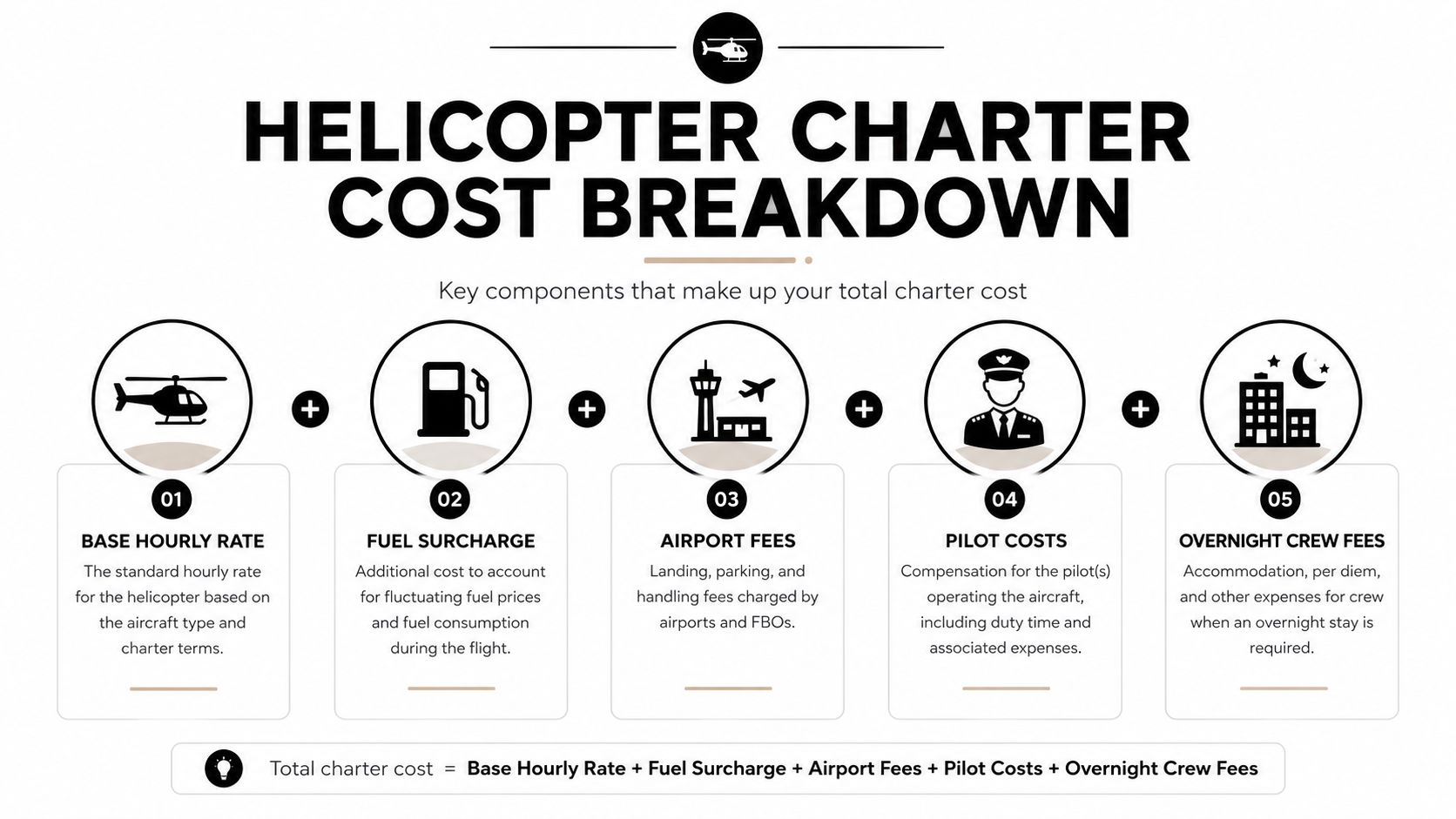
The biggest hidden variable is repositioning. If the helicopter has to fly empty to reach you, that movement gets built into the price one way or another. Landing fees, parking charges, fuel surcharges, pilot overnight costs on multi-day trips, and taxes all push the total higher, and they do it quickly.
Minimum booking rules matter just as much. A 15-minute transfer is still billed like a much larger job if the operator requires a minimum hour, and many do. That is why short hops can carry a surprisingly high floor price.
A published example from Heliflite shows airport transfers starting at $3,300 plus taxes and fees and Manhattan-to-Hamptons flights starting at $10,300 plus taxes and fees. That kind of pricing makes the point plainly. Access, route structure, and operating logistics matter as much as distance.
How to get a quote you can trust
Ask for an all-inclusive quote. If the operator will not separate landing fees, parking, repositioning, or crew overnight costs, you are not looking at a clean comparison. Many public charter pages never publish comparable pricing at all, so the quote request is where the market check begins.
Ask what is included, and ask it directly. A proper quote should tell you whether the aircraft is already in position, whether taxes are included, and whether the flight requires any waiting time or overnight crew support. If the answer is vague, the final invoice will not be pleasant.
My recommendation: never compare a helicopter quote on hourly rate alone. Compare the full mission cost, line by line, and make the operator explain every line.
There is also a simpler question that many travelers avoid. Is a helicopter the right choice for this route? For a short transfer in a premium corridor, yes, it can be the cleanest option. For a basic road transfer with no real time pressure, it is usually poor value, and in some cases the car or boat does a better job with less friction.
Safety Standards and Regulatory Requirements You Must Verify
Luxury charter is not a substitute for diligence. It's more expensive than most transport, which makes it even more important to verify the operator before you pay. The first thing I ask for is the operating paperwork, not the interior photos.
The checks that matter
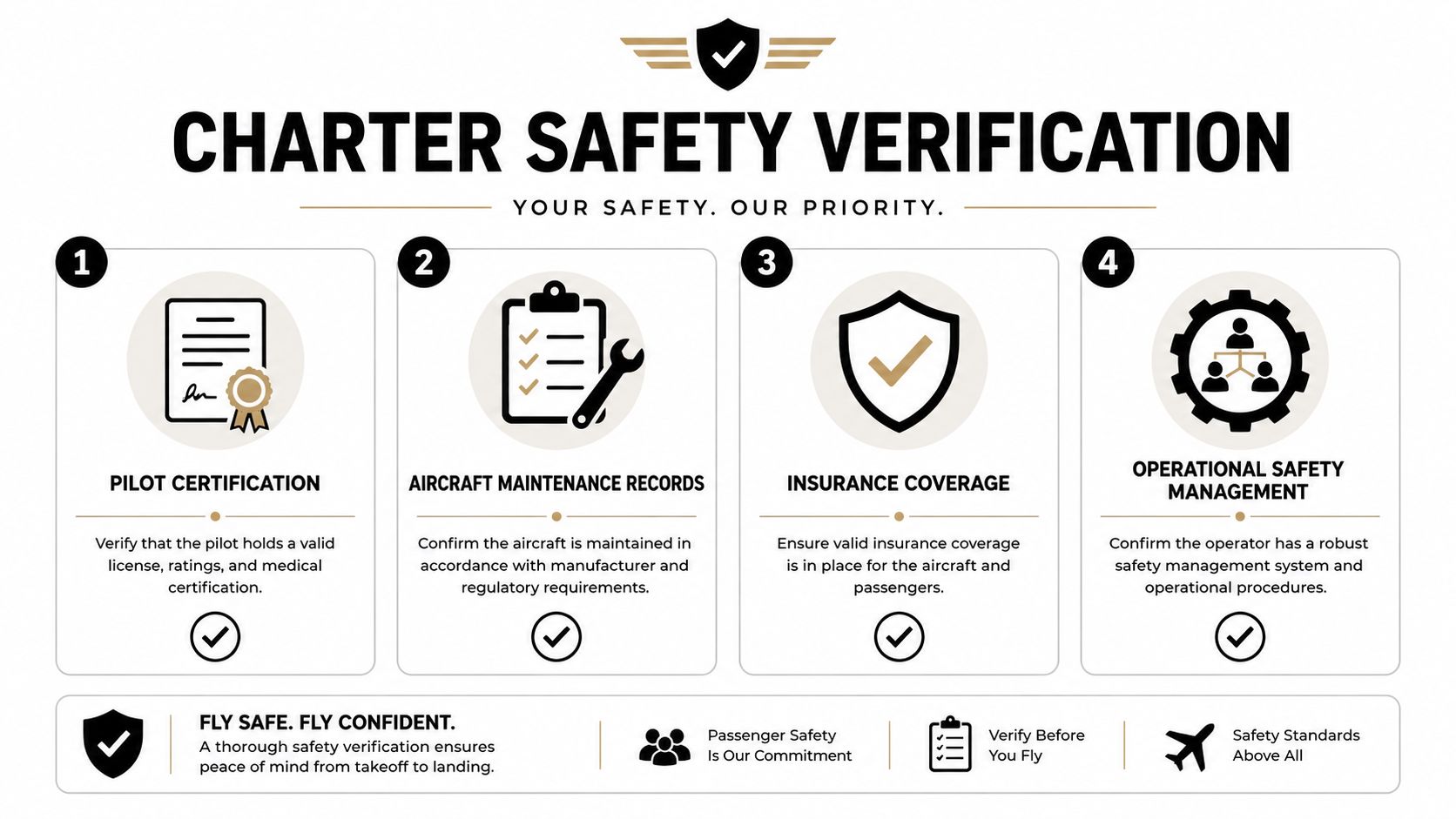
In the UK, customers are advised to verify that the operating company holds an Air Operator's Certificate (AOC), and that the AOC is in the name of the company receiving payment unless the booking is being made through a known agent (British Helicopter Association PDF). That's not a formality. It tells you who is responsible for the flight.
Irish aviation guidance draws a clear line between a private flight and commercial air transport. A private flight is not aerial work and not a commercial air transport flight, and no payment from or on behalf of the passenger may occur on such a flight. It also says private flights operate to a lower required safety standard than CAT flights, do not require an Air Operator Certificate, and allow only limited cost-sharing in certain circumstances (Irish Aviation Authority). That distinction matters if someone tries to blur the legal category of your trip.
In the United States, FAA Advisory Circular 91-37A requires that certain charter contracts be delivered or mailed to the FAA within a specified time after execution, that personal or telephonic notice be given to the appropriate district office at least 48 hours before first flight, and that a copy of the contract be carried in the airplane (FAA AC 91-37A). Those are real operational obligations, not back-office trivia.
The questions I always ask
Before booking, ask who operates the aircraft, who owns it, what certificate covers the flight, what happens if weather shuts the route down, and whether the price includes every airport or heliport charge. If the answers are vague, walk away.
A slick sales process doesn't make an operator safe. Documentation does.
A helicopter charter should feel polished, but the polish has to sit on top of real compliance. If an operator can't explain the framework cleanly, they're not ready for your itinerary.
Helicopter Charters Versus Alternative Luxury Transfers
The wrong transfer choice can make a luxury trip feel fussy instead of fluid. A helicopter is excellent at one thing, moving fast over awkward ground. It's not automatically the best answer for every route, and a strong advisor should say that plainly.

Where each mode wins
A private jet wins when the distance is long enough that fixed-wing speed and cabin comfort matter more than direct landing access. A helicopter wins when the last mile is the problem, especially around cities, resorts, or event venues where time on the ground is the enemy.
A luxury SUV often beats both when the route is shorter, the scenery matters, and the schedule has room to breathe. The ride is calmer, luggage is easier, and there's no need to manage heliport permissions or weather-sensitive dispatch. A yacht is the right answer when the water is the point of the trip, not just the transport method.
How to choose without defaulting to the most expensive option
Use the helicopter when arrival precision matters more than cabin indulgence. Use the car when the transfer is pleasant enough to enjoy. Use a jet when distance dominates. Use a yacht when the itinerary is built around the sea.
For broader private-aviation planning, compare helicopter options with Haute Black's private aviation page.
The best luxury transfer is the one that makes the whole itinerary easier, not the one that sounds the most exclusive.
A helicopter is rarely the cheapest option, and it shouldn't pretend to be. Its value is in efficiency, access, and discretion. If those don't matter on your route, don't force the aircraft into the story.
How Haute Black Arranges Bespoke Helicopter Experiences
A clean helicopter itinerary starts with the full trip, not the aircraft. The advisor needs the hotel, the villa, the restaurant, the event time, the baggage load, the number of passengers, and the backup plan if the weather changes. That's how a transfer becomes efficient instead of merely booked.
The booking sequence that actually works
First, match the route to the operator and aircraft. Then coordinate the ground transfer on both ends so the helicopter isn't waiting on a curbside delay or a gate agent who doesn't know the timeline. After that, confirm the landing point, the check-in plan, and what happens if the destination can't accept the aircraft on the day.
The cleanest luxury bookings also account for the rest of the evening. If the helicopter lands near a resort or city helipad, the next move should already be arranged, whether that's a villa check-in, a private dining reservation, or a driver waiting on the apron. That's the difference between a transport booking and a properly managed arrival.
For clients who want helicopter transfers integrated into broader trip design, Haute Black's air travel services sit inside a larger concierge framework that can connect aviation, ground logistics, and destination planning.
What to expect from a serious advisor
A serious luxury advisor won't push a helicopter just because it's impressive. They'll tell you when the aircraft makes sense, when it doesn't, and how to structure the route so the experience stays smooth. That's the whole point of using a seasoned planner instead of making a blind booking online.
If you're planning a transfer that needs precision, privacy, and proper execution, start the conversation now with Haute Black.
Explore Our Guides


Signature Experiences


