Haute Black Journal
Private Jet Charter for Pets: A Practical 2026 Guide

Marlene Azeez
Director, HauteBlack
View all articles →
Your family is leaving Aspen for Geneva, the senior French Bulldog is coming with you, and the aircraft has already been shortlisted. The mistake would be treating the dog as a cabin amenity to add after booking. For a well-managed private jet charter for pets, the aircraft is only one part of the plan. The key questions concern custody, documentation, health, ground transfers, and what happens when the itinerary changes.
Most business jets permit pets in the cabin, but approval remains specific to the aircraft, operator, route, animal, and required restraint. Private aviation can reduce separation and handling, but it doesn't waive import rules or remove responsibility during curbside transfers, screening, diversions, and overnight delays. My recommendation is direct: lock the pet logistics before you lock the aircraft.
Why Cabin Access Is Only Half the Answer
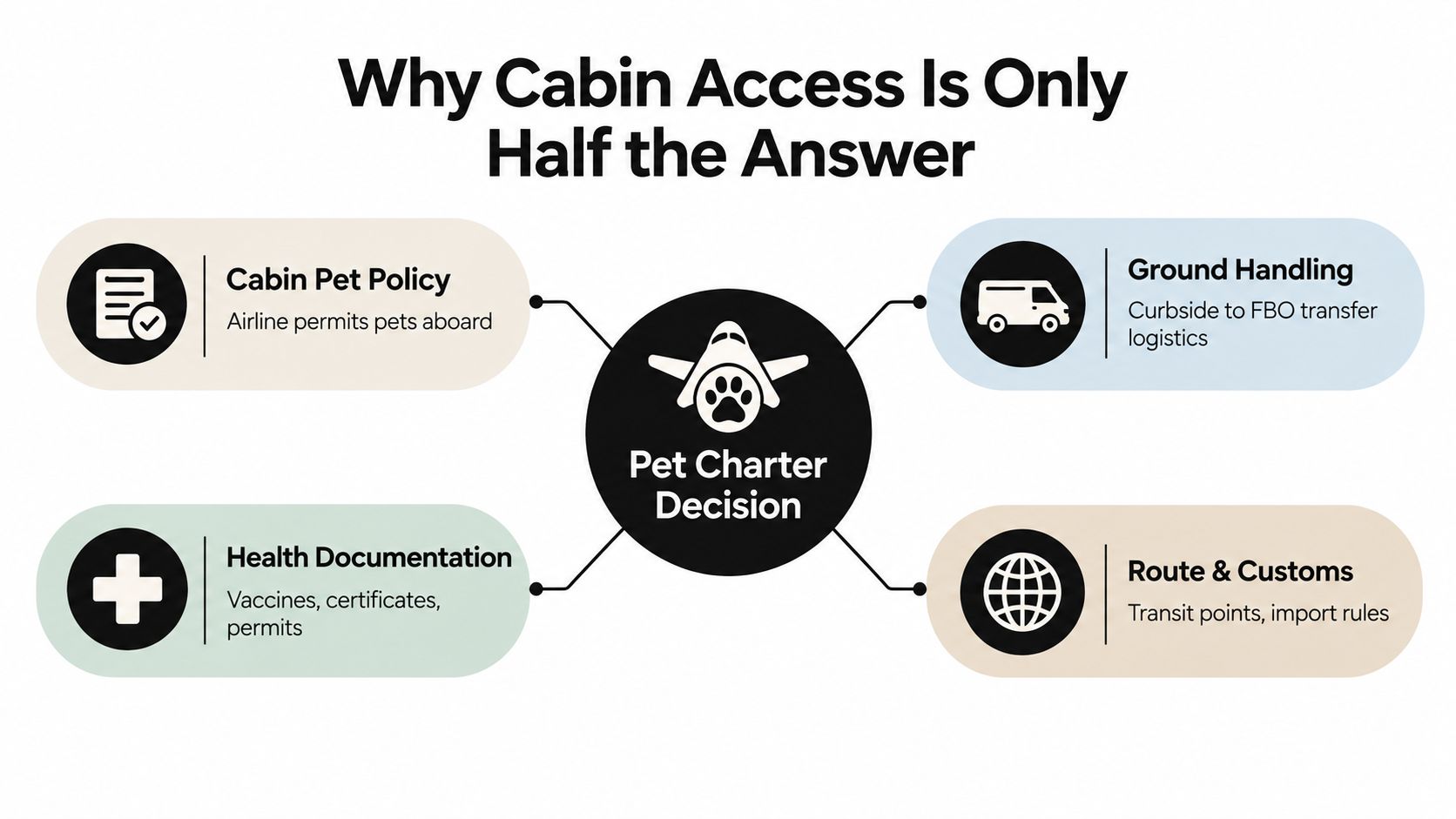
A private cabin solves one obvious problem. Your pet can usually remain close to you instead of entering an airline cargo process. It doesn't answer who takes custody at the FBO, who handles the animal during screening, whether a crate can pass through the aircraft door, or what happens if weather forces an overnight stay.
For the Aspen to Geneva family, the chain begins at the residence, not at takeoff. A familiar ground handler may collect the dog, an FBO team may manage the transfer, security personnel may inspect the crate or documents, and the crew may impose containment rules during taxi, takeoff, landing, and turbulence. If a diversion occurs, the owner needs to know which party remains responsible for food, hydration, temperature, medication, and safe accommodation.
The U.S. Department of Agriculture distinguishes between pets traveling with their owners and animals transported commercially. Owner-accompanied pets are generally outside Animal Welfare Act transporter requirements, while businesses taking custody of regulated animals for hire are subject to registration and transportation standards. That distinction matters when a concierge, ground company, operator, or pet shipper physically handles the animal.
The three controls that matter
Custody means identifying the person or company responsible at every handoff. Ask who holds the leash, who signs for the animal, and who makes decisions during a delay.
Documentation means treating health certificates, vaccination records, permits, endorsements, and microchip information as operational documents with validity windows. A private cabin doesn't make an incomplete file acceptable to customs.
Comfort includes aircraft ventilation, temperature, crate security, familiar handling, feeding, hydration, and a plan for waste or anxiety. Comfort isn't just legroom. It is the quality of every transition.
Demand for pet-inclusive private aviation grew sharply during the COVID-19 period. VistaJet reported an 86% increase in pet travel between September 2019 and September 2021, and its executives said pets accompanied approximately one in four members during that period. The lesson for operators and clients is clear: pet travel has moved from an occasional exception to a recurring itinerary requirement.
Practical rule: A private cabin reduces separation. It doesn't eliminate border controls, custody transfers, or contingency planning.
The Charter Inquiry Checklist Before Aircraft Selection
Lead every charter inquiry with a pet brief. State the species, breed, age, body mass, temperament, crate or carrier dimensions, route, transit points, destination, return route, and known health considerations. An aircraft recommendation without those details remains provisional, and it can fail once the operator reviews custody, documentation, or loading requirements.
Disclose the pet during the first charter inquiry, alongside medical needs, golf equipment, and security requirements. HauteBlack's New York private-jet charter guide identifies pets as a special requirement that belongs in trip planning. Early disclosure gives the operator time to review cabin layout, stowage, ground handling, documentation, and routing before the itinerary is finalized.

Ask these questions on the first call
1. Who has physical custody at each stage? Obtain the names of the owner, concierge, ground handler, operator, crew, and veterinarian involved from residence pickup through arrival.
2. Who remains responsible during a delay? Require a plan for weather diversion, missed departure, aircraft substitution, or overnight accommodation. It should specify food, water, temperature control, medication, relief, and secure lodging.
3. Has this exact operator approved this species and setup? “Pets allowed” is insufficient. Request written approval covering the aircraft category, animal, carrier or crate, and planned route.
4. What routing constraints apply? Confirm destination entry airports, transit-country rules, customs availability, and any advance animal-clearance requirement.
5. Is the return leg covered equally? The outbound plan may not satisfy the return country's certificates, endorsements, or timing rules.
6. What is the handler plan? Confirm whether the owner remains responsible, whether a dedicated handler is available, and how many animals one handler can supervise safely.
7. What happens if the requested aircraft is substituted? Require written reapproval for the replacement aircraft, including its cabin arrangement, crate position, and handling plan.
Use this private-flight-attendant role guide to assess whether the cabin crew's duties include practical pet support or only passenger service. Require named handlers, a documented custody chain, and aircraft-specific approval in writing.
Apply the same standard to catering and other special requests. Disclosing pet travel during the first call shows whether the operator coordinates requirements across departments. You want a specific operational response, with owners and deadlines attached, rather than a casual “we can probably accommodate that.”
The video below provides a visual reference for organizing a pet travel checklist. Use it to structure the inquiry, then verify every item with the operator in writing, since an aircraft shown in a general demonstration does not approve a particular animal, crate, or route.
In-Cabin Versus Cargo on a Private Charter
On a private charter, the decision is which containment arrangement is safe and workable for your animal, the aircraft, the crew, and the route. Cabin access is only one part of the custody plan. Ask who receives the pet at each handoff, where the animal remains during boarding and taxiing, and who can access it in flight.
A small, calm dog may travel in a carrier beside the owner. A larger animal may require a secured crate. Several pets may call for a larger aircraft category or a documented separation plan. Pets must remain clear of aisles, exits, crew access, and emergency egress, and the operator may require restraint while the aircraft is moving.
| Position | Best for | Limits | Confirm with operator |
|---|---|---|---|
| Cabin with owner | Small or medium pets that can remain controlled | Space, restraint, cleanliness, and turbulence management still apply | Cabin placement, carrier or harness rules, and movement restrictions |
| Cabin with a dedicated handler | Anxious, medically monitored, or owner-separated pets | Adds coordination and may create an extra service charge | Handler identity, duties, feeding plan, and custody responsibility |
| Dedicated hold or secured crate area | Very large pets, multiple animals, or aircraft layouts requiring separation | Temperature, access, ventilation, and loading procedures need specific review | Hold suitability, crate security, in-flight access, and diversion procedures |
Cabin comfort isn't the same as cabin freedom
A crate provides predictable containment and limits movement during turbulence, yet it can create loading and space problems. Measure its widest points, including door hardware, then ask whether it fits through the aircraft's baggage door or cabin entrance. A soft carrier may be easier to position, while the operator may require a rigid crate for the animal, route, or aircraft. Review these Nandog Pet Gear airline carrier tips before presenting the setup to the operator. The carrier is operational equipment, not an accessory chosen after booking.
State the animal's actual classification clearly. Service animals, emotional-support, comfort, companion, and in-training animals do not receive the same classification under U.S. rules. The operator also needs the animal's behavior, size, and restraint requirements documented.
A flight attendant may provide passenger service without serving as a pet handler. Confirm feeding, hydration, medication, waste, and behavior-monitoring duties in writing. Use this private flight attendant role guide to assess whether the crew's role includes practical pet support. Require a named handler, a custody chain, and aircraft-specific approval.
If the animal has respiratory or heat sensitivity, ask how the crew will manage cabin temperature and ventilation, where the pet will be positioned, and who records each check. A family should receive one written plan covering boarding, restraint, access, monitoring, and any diversion.
Ask whether this animal can be secured, monitored, and transferred safely through this aircraft's exact layout. That answer matters more than a general promise that pets are allowed.
Documentation and Health Requirements That Drive the Schedule
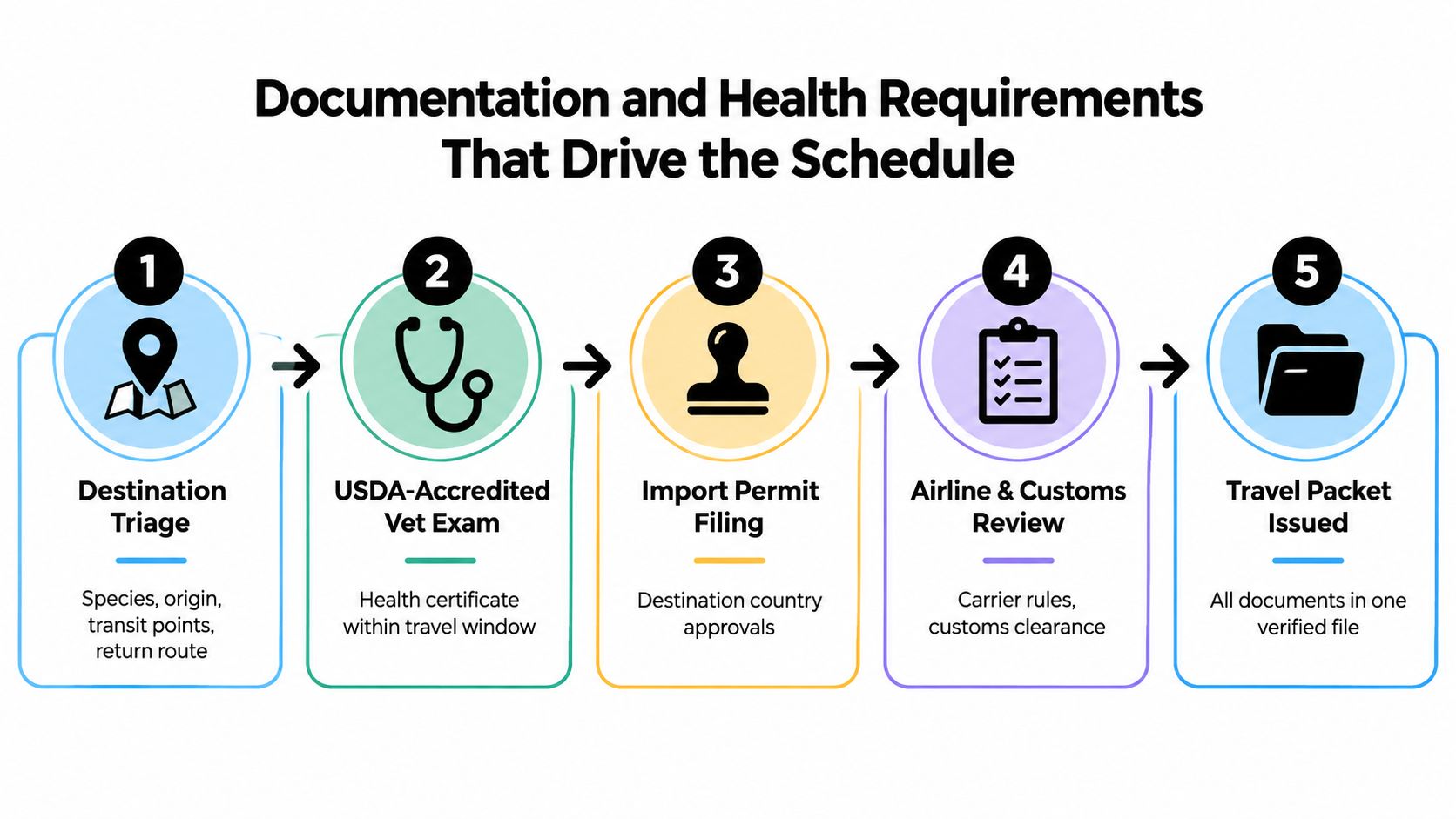
Documentation should begin with destination triage, not aircraft selection. Identify the species, origin, transit points, final destination, intended return route, vaccination history, microchip records, and any medical considerations. Then ask a USDA-accredited veterinarian to map the requirements against the proposed travel dates.
USDA APHIS recommends contacting an accredited veterinarian as soon as travel is contemplated because destination requirements vary and may require official endorsement. Your veterinarian should identify required vaccinations, tests, treatments, microchip records, health certificates, import permits, and government endorsements.
Build a document-control file
Use one controlled file with a document owner and a visible expiry review.
- Destination rules: Confirm requirements for the destination and every transit point, not only the departure and arrival countries.
- Medical records: Verify vaccination history, microchip information, treatments, tests, and veterinary fitness.
- Certificate timing: Record the issue date, accepted travel window, destination validity period, endorsement requirement, and whether an original is required.
- Import permissions: Identify permits, pre-approvals, designated arrival airports, inspection procedures, and customs contacts.
- Return planning: Map the return route before departure. A certificate that works outbound may not satisfy re-entry requirements.
For dogs entering or returning to the United States after exposure to a rabies high-risk country, additional CDC documentation may be required, including a Certification of U.S.-Issued Rabies Vaccination. Private aviation can simplify passenger handling, but it doesn't remove rabies rules, health certificates, import permits, quarantine conditions, or airport-specific animal clearance.
Timing errors are more dangerous than missing comfort details
A medically accurate certificate can still fail if it falls outside the destination's accepted timing window. That can lead to denied boarding, delayed clearance, or quarantine. The flight department should receive both scans and originals, with a named person responsible for checking every field before departure.
IATA notes that most airlines require a veterinary health certificate confirming fitness to fly, while destination governments may impose requirements beyond general live-animal standards. Even on a private charter, the operator, customs authority, veterinarian, and ground handler need a consistent document packet.
Ask for a written answer to five questions:
1. Which documents must be originals?
2. Which documents need government endorsement?
3. What language or translation requirements apply?
4. Which airport or customs office can clear the animal?
5. Who checks the file before departure and who carries it onboard?
Lock the regulatory pathway before locking the departure date. A late certificate field is still a gate, and a private aircraft can't depart for a destination that won't legally admit the animal.
What a Pet Charter Costs
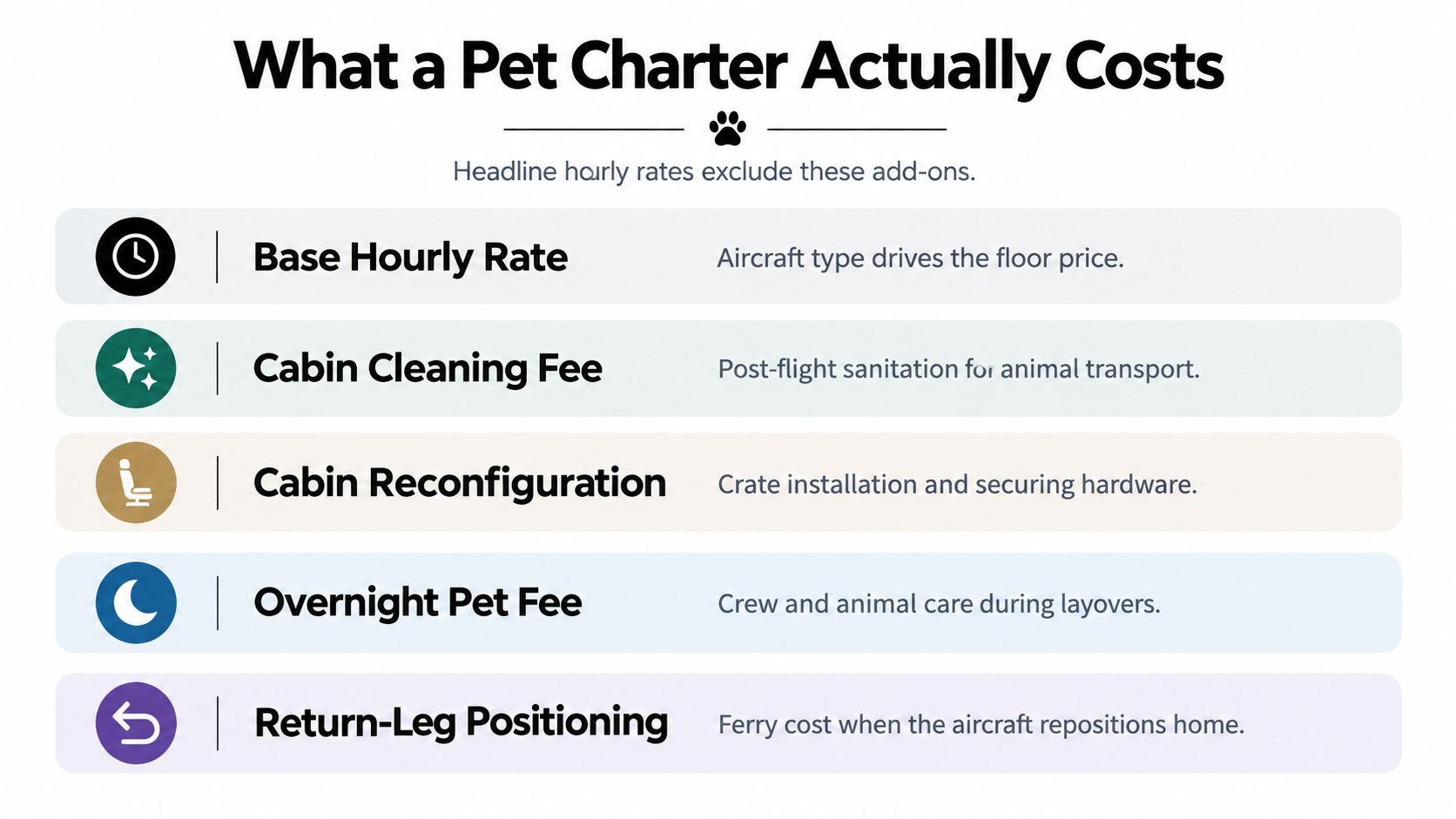
A pet-inclusive quote should expose the full chain of custody, not just the aircraft's hourly rate. The animal may be a minor cost line, while cleaning, cabin configuration, handling, documentation support, and aircraft positioning determine the final figure. Require the broker to show each charge and identify which conditions can change it.
Require an itemized quote
| Cost line | What it may cover | Why it matters |
|---|---|---|
| Aircraft and positioning | The aircraft, flight time, and any repositioning required | A suitable pet setup may narrow aircraft availability |
| Cabin cleaning | Post-flight sanitation, hair removal, or accident treatment | The operator may charge according to cleaning complexity |
| Cabin reconfiguration | Crate installation, protective coverings, or securing hardware | Large crates can affect seating and usable cabin space |
| Dedicated handler | An onboard or ground professional assigned to the animal | Adds supervision but clarifies custody and continuity |
| Overnight care | Crew, ground handling, accommodation, feeding, and animal support during disruption | A diversion can create costs outside the original flight plan |
| Return-leg positioning | Aircraft movement or minimums for the return itinerary | The outbound quote may not reflect the full round trip |
The quote should label every pet-related charge as fixed, conditional, or subject to inspection after arrival. Ask whether pricing applies per animal or to the complete setup, whether a cleaning deposit is required, whether a layover triggers an overnight pet fee, and whether separate minimums apply to the return leg.
The right comparison depends on the itinerary and the animal. A healthy small pet traveling directly on a commercial route may not justify a full charter. A brachycephalic dog, medically fragile animal, unusually large pet, or multi-pet family may place greater value on cabin supervision, schedule control, and fewer custody handoffs.
Charter becomes financially defensible when the operator can document what it controls. Ask for the cost of dedicated supervision, the handling plan at each airport, the consequences of a delay, and the charge for any aircraft or crew repositioning. Those answers matter more than a broad promise of convenience.
Commercial-airline incident figures provide context, not a universal verdict. Airlines reported 8 pet-related incidents in 2025, comprising 1 loss, 4 injuries, and 3 deaths, versus 12 incidents in 2024, including 8 deaths. The same report notes that only 117,861 animals were covered by its reporting system in 2025, so the figures cannot establish a universal safety trend.
For a full breakdown of aircraft, positioning, crew, and operational pricing, see our private jet charter cost guide. Before signing, have the broker separate the pet premium from the base aircraft cost and list every condition that could expand the quote.
Coordinating the End-to-End Pet Transfer
The aircraft is one node in a longer transfer. A dog that leaves a residence in Aspen may pass through a vehicle, an FBO, aircraft stairs, a cabin restraint, a destination vehicle, and a villa entrance in Geneva. Each handoff can increase stress or introduce a custody gap.
Start with the least disruptive ground plan. Use a familiar handler where possible, select an FBO that minimizes unnecessary walking and waiting, and keep the animal's bedding, medication, food, water, and documents accessible. If a helicopter connection is required, confirm crate dimensions, cabin access, securing points, ventilation, and the handoff procedure before the jet departs.
Design the itinerary around the animal
A high-touch plan should answer these operational questions:
- Residence to FBO: Who collects the pet, what vehicle is used, and where does custody change?
- FBO to aircraft: Who manages screening, documentation, relief, and boarding?
- Aircraft segment: Who handles restraint, hydration, feeding, waste, and behavioral monitoring?
- Connection: Is the pet moving by helicopter, vehicle, or another aircraft, and has the same handler been briefed?
- Arrival: Who meets the aircraft, who manages customs or veterinary clearance, and who escorts the pet to the villa or hotel?
- Disruption: What happens if the aircraft diverts, the property isn't ready, or customs clearance takes longer than planned?
HauteBlack's approach to bespoke travel presents private aviation as part of a coordinated stack that can include jets, helicopters, VIP ground transportation, and luxury accommodations. Applied to pet travel, the principle is simple: the pet requirement must follow the traveler through every node, rather than stopping at the aircraft door.
A practical PetScy guide to travel planning for dogs can help owners prepare familiar routines, supplies, and behavior expectations before a complex transfer. Use that preparation alongside an operator's formal custody and safety plan.
The private jet flight booking executive guide is relevant here because senior travelers shouldn't be solving curbside problems during a connection. The advisor should already know the handler, vehicle, arrival contact, clearance procedure, and fallback location.
The value of a pet charter isn't only cabin access. It is choreography. If one handoff is vague, the itinerary isn't finished.
Comfort Prep and the Final Pre-Flight Checklist
Comfort is built before departure. Acclimate the animal to the approved carrier or crate, preserve familiar bedding and routines, and ask the veterinarian about feeding, hydration, exercise, and medication. Don't use unapproved sedation. A calm flight begins with preparation, not with a last-minute attempt to suppress anxiety.
The FAA's cabin-safety principle remains useful even when a private aircraft offers more space. An in-cabin pet container must be properly stowed during aircraft movement, takeoff, and landing, and it can't obstruct an aisle, exit, crew access point, or emergency egress. Confirm the aircraft's exact restraint and placement rules before arrival at the FBO.
Assign one responsible handler per animal. That person should own feeding, hydration, waste, medication if authorized, and behavior monitoring. Ask the operator to confirm cabin temperature and ventilation controls, especially for senior, brachycephalic, respiratory-sensitive, or medically fragile pets.
Flight department handoff checklist
- Veterinary fitness: Confirm the veterinarian has cleared the animal for the planned journey.
- Microchip verification: Match the chip record to the health and import documents.
- Document originals: Carry certificates, permits, endorsements, and vaccination records onboard.
- Crate fit: Confirm dimensions, securing method, aircraft access, and stowage in writing.
- Handler assignment: Name the person responsible for the animal at every stage.
- Cabin supplies: Keep food, water equipment, medication, wipes, waste supplies, and familiar bedding accessible.
- Contingency contacts: List the operator, ground handler, veterinarian, customs contact, destination property, and diversion coordinator.
A memorable pet charter should be remembered for the destination, not for the moment someone discovers that the crate, certificate, or handler plan doesn't fit.
If the operator can't answer these questions before departure, don't treat the uncertainty as a luxury inconvenience. Treat it as an unresolved operational risk and delay booking until the plan is complete.
HauteBlack can coordinate the aircraft, documentation workflow, ground transfers, helicopter connections, and arrival logistics around your pet's needs. Visit HauteBlack to begin a private travel consultation with an advisor who can turn the custody chain, document windows, and comfort plan into one controlled itinerary.
Explore Our Guides


Signature Experiences