Haute Black Journal
Luxury Travel Agency: Bespoke Vacations

Marlene Azeez
Director, HauteBlack
View all articles →
# Luxury Travel Agency: Bespoke Vacations
August 6, 2026
You already know the feeling. The hotel is right, the dates are locked, and the trip should be easy, but one unanswered question hangs over everything: who is making sure the details hold together once you leave home. That's where a luxury travel agency earns its place. Not by acting like a booking tool, but by running the trip like a relationship, with judgment, skill, and a live human who knows how to solve problems before you ever see them.
The market backdrop is clear. The broader luxury travel ecosystem has moved into trillion-dollar scale, with Deloitte placing global luxury travel at US$1.2 trillion in 2021 and projecting 7.6% CAGR through 2030 in one estimate, while another puts the market at US$1.48 trillion in 2024, rising to US$2.36 trillion by 2030 at roughly 8.2% CAGR (Deloitte). At the agency level, one estimate values the luxury travel agency market at $13.2 billion in 2025 and projects $23.8 billion by 2034 at 7.8% CAGR, with customized tours holding 28.5% of product share and Asia Pacific leading regional revenue at 32.8% (marketintelo). That's not a niche built on volume. It's a service category built on precision.
What a Luxury Travel Agency Actually Does
A couple planning a milestone trip usually doesn't need more hotel options. They need the right person holding the phone when the room isn't ready, the transfer is late, or the restaurant that looked easy is suddenly full. The difference between a decent trip and a smooth one is usually not the destination, it's the advisor who already knows which problems are likely to appear.
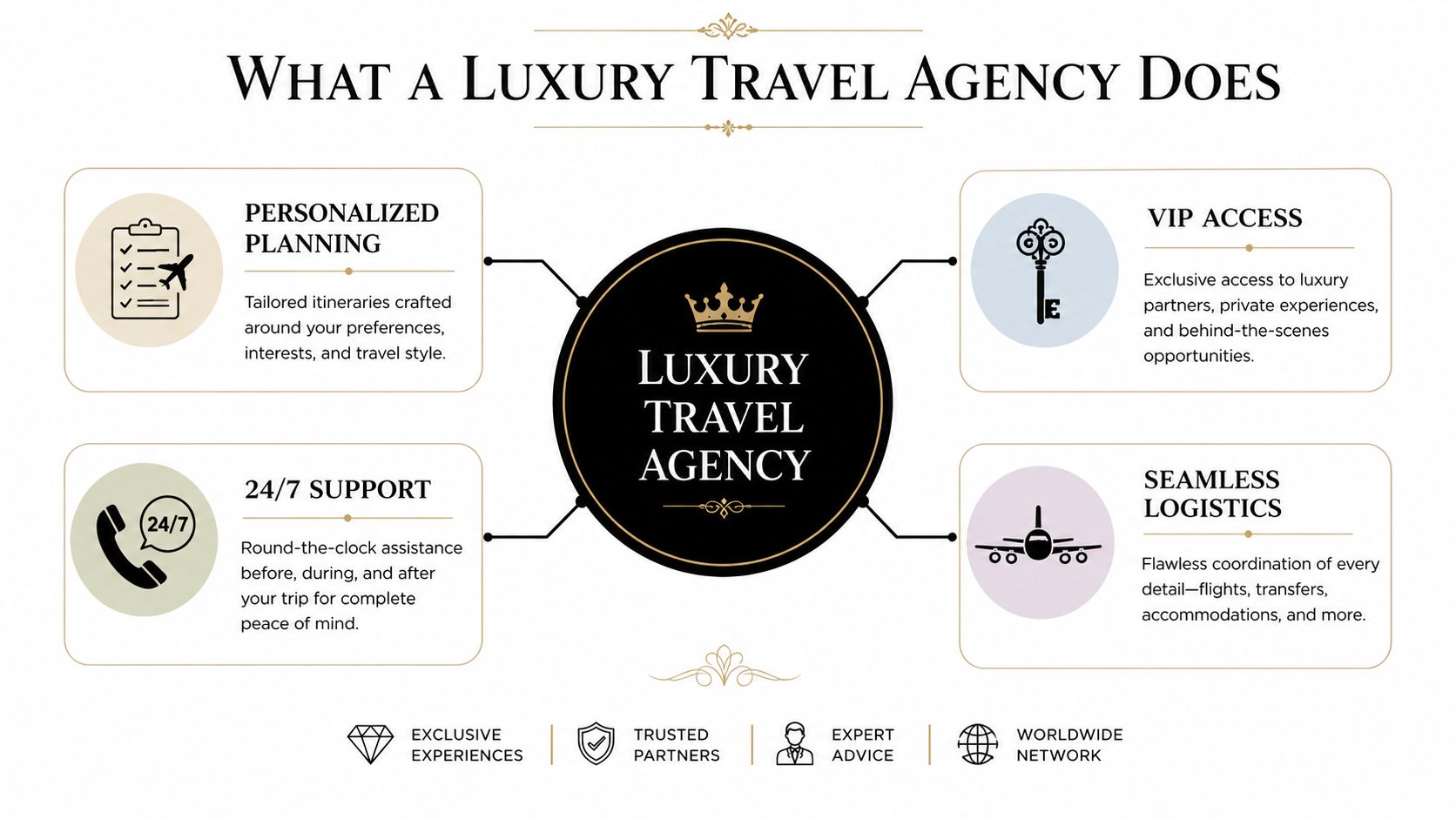
A serious luxury travel agency runs on four pillars. First is advisor expertise, meaning someone who understands how affluent travelers move, dine, rest, and connect. Second is supplier relationships, which is where access, recognition, and favors come from. Third is 24/7 service infrastructure, because high-touch travel falls apart when support disappears after office hours. Fourth is inventory that isn't publicly bookable, which covers rooms, villas, private transport, and experiences that depend on human relationships rather than search filters.
Practical rule: if an agency only talks about destinations, it's selling inspiration, not orchestration.
The reason this matters is simple. Luxury travel is now a complex service stack, and agencies face bottlenecks like manual data entry, disconnected systems, rising operating costs, delayed reporting, and workflow inefficiencies (traveloperations.com). The good agencies reduce drag. The mediocre ones create it.
For a useful benchmark, a traveler who wants to see how bespoke planning is framed in the market can also look at book bespoke LA tours as a practical example of how high-touch travel can be packaged around a specific experience rather than a generic booking path.
If you're comparing agency-style service to a broader local planning resource, the service description at Haute Black's services page is a useful reference point for how a relationship-based model is presented to clients.
The Core Services That Define a Top Agency
A top agency doesn't impress me with adjectives. It impresses me with how many moving parts it can coordinate without making the client do the glue work. The test is whether the agency can take a complicated trip and make it feel obvious.
Bespoke Itinerary Design
This is the backbone. A bespoke itinerary should reflect how the client travels, not how the agency prefers to sell. A honeymoon couple might want long white-space mornings, one unforgettable dinner, and zero logistical friction. A weak advisor sends options. A strong one sends a rhythm that feels lived-in.
VIP Recognition at Hotels
Good agencies know how to get the hotel to see the client as a known guest, not a reservation number. That's where preferred relationships matter, because recognition often turns into welcome amenities, smoother room assignment, and the kind of attentive arrival that changes the tone of the entire stay. It's not magic, it's supplier memory.
Private Aviation and Ground Transfers
A premium trip can collapse in the minutes between air and ground if nobody handles timing well. A competent agency coordinates the handoff, so the client doesn't stand around solving for curbside confusion. If the itinerary includes a helicopter transfer or a tight same-day connection, this becomes essential rather than optional.
Private Villas and Estates
Villas work when the agency understands privacy, staffing, sleeping arrangements, and pace. A family traveling across generations doesn't need a prettier listing, it needs a property that fits real life. The right advisor asks how the group eats, where grandparents will rest, and what kind of service style everyone can tolerate.
Concierge Dining and Experiences
Relationships earn their keep. A strong agency doesn't just recommend a restaurant, it helps shape the conditions for getting the table, the tasting, or the chef interaction that matters. Same logic applies to private access experiences, from tastings to cultural appointments.
Member-Only Events
Events matter because they transform the agency from a booking channel into a community. A well-run calendar creates reasons to stay in touch, meet other members, and enter rooms that don't exist in standard travel search. The point is not just attendance. It's relevance.
For travelers who want a practical reference on service layers, the guide to luxury travel concierge services is a solid way to see how these pieces fit together in real use.
Bottom line: if the agency can't handle itinerary design, hotel recognition, transport, villas, dining, and events, it's not a full-service operator. It's a sales desk with prettier language.
Membership vs One-Off Bookings
Not every traveler needs a membership. Some need one excellent advisor for one difficult trip, and that's enough. The mistake is assuming every trip should be bought the same way, because the economics change fast once travel becomes frequent, complex, or time-sensitive.
A one-off booking model works when the client has a single milestone journey, wants expert help, and doesn't need a long-term relationship. Membership makes more sense when travel is recurring, schedules shift, or the client wants someone who already knows the family, the preferred room type, the dining habits, and the privacy tolerance. The value of membership is not just perks. It's memory.
| Dimension | One-Off Booking | Membership |
|---|---|---|
| Relationship | Trip-specific | Ongoing |
| Best for | A single complex journey | Frequent premium travel |
| Advisor knowledge | Starts fresh each time | Builds over time |
| Service model | Transactional | Personal and cumulative |
| Ideal traveler | Honeymooner or one-time planner | Executive, family, or repeat traveler |
The objection I hear most is that membership feels intangible. It doesn't, once you translate it properly. A waived planning fee is obvious. So is time saved when the advisor already knows your preferences and can skip the back-and-forth that burns hours. Priority access also matters when a trip depends on speed, because the person who already has the relationship usually moves faster.
A practical comparison is useful here. If you're traveling once a year, one-off service may be enough. If you're doing three or more premium trips, or coordinating travel for a household that never fits neatly into a standard booking engine, membership starts making real sense.
For travelers who also care about packing and trip organization at a granular level, even something as specific as a mens jewelry organizer for travel can show how much thought goes into protecting the small details that make a premium trip feel polished.
The membership page at Haute Black membership is where that relationship model becomes concrete.
How to Vet and Evaluate an Agency
Don't vet a luxury travel agency by how elegant its website looks. Vet it by how the advisor behaves when you ask hard questions. The first conversation tells you almost everything you need to know.
Ask About Real Supplier Access
Start with Virtuoso affiliation, preferred partner status, and direct contracts with villa or aviation suppliers. Then ask how those relationships show up for you in practice. If the answer is vague, the agency probably doesn't have the depth it claims. If the advisor can explain how access works, you're dealing with someone who knows the machinery.
Ask Who Handles Problems
A good advisor should be able to tell you who answers when a flight changes, a hotel misses the room setup, or a transfer is delayed. You want to know whether there's a real service structure behind the promise. If the response sounds like “we'll figure it out,” keep looking.
Ask for Specifics, Not Slogans
A serious agency can name hotel contacts, explain what it can and can't secure, and tell you whether the trip is a fit before taking your money. That's the difference between confidence and salesmanship. Opaque fee structures are a red flag, especially when the agency won't explain what the client is paying for.
If the inquiry starts feeling like a transaction, the relationship probably won't get better after payment.
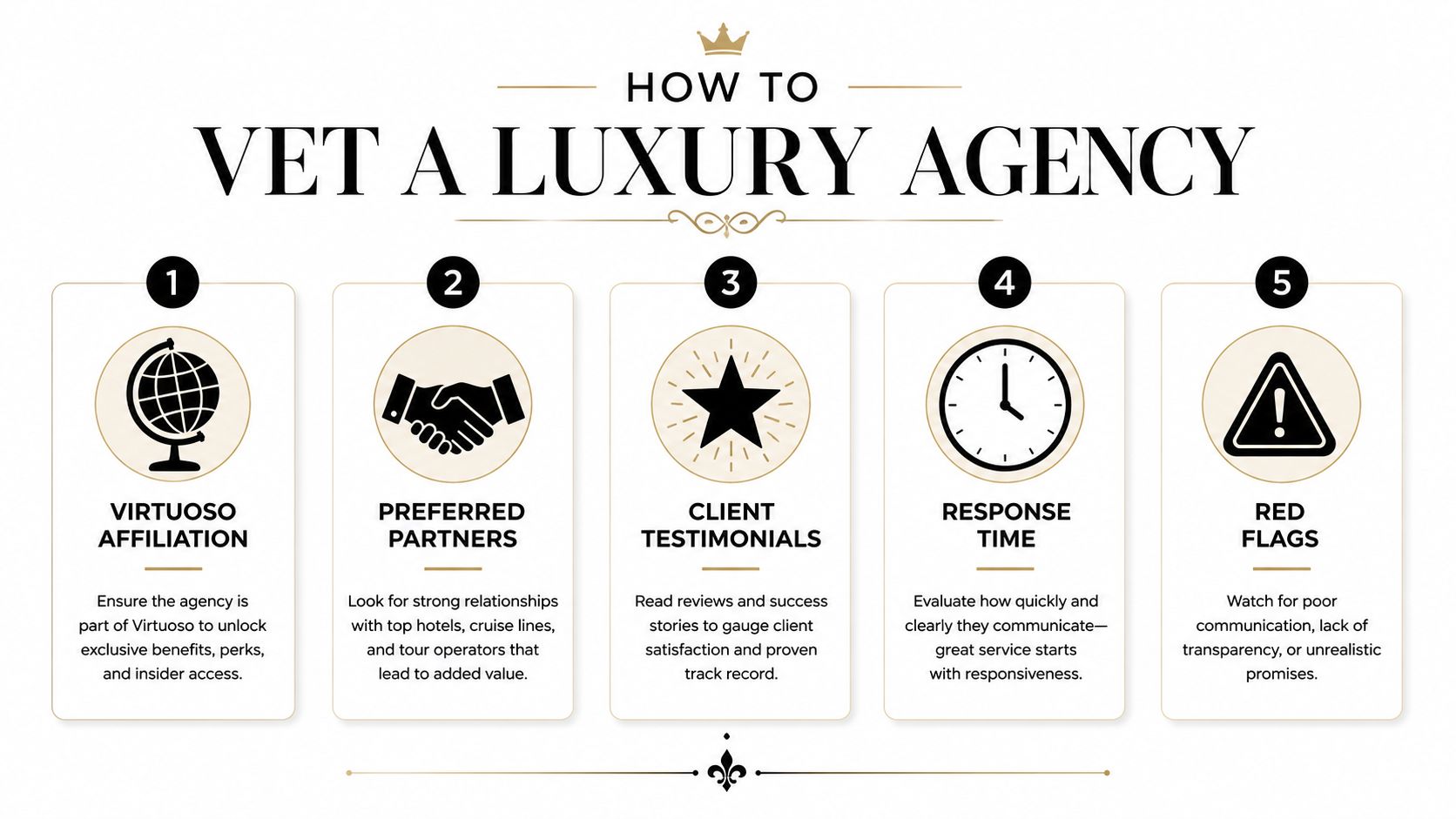
A simple scorecard works. Does the advisor know your travel style? Can they explain access without sounding rehearsed? Do they answer directly about fees? Do they ask questions before quoting? If the answer is yes across the board, you're probably in the right room.
Agency Booking vs DIY Online Booking
DIY works fine for straightforward travel. A direct flight, a standard hotel stay, a city break with flexible timing, that all can be booked online without much drama. The trouble starts when the trip has moving parts that depend on people, not just inventory.
Take a private island villa, a chartered seaplane, and a dinner reservation at a chef's table in the same trip. The online booking path can handle pieces of it, but not the stitching. One platform sells the villa, another handles the air, and a third may show a restaurant that's already full. The burden of coordination lands on the traveler, and that's exactly where a high-end trip becomes work.
A full-service agency is useful when the itinerary has any of these traits, complexity, coordination, or fragility. Fragility is the one people forget. A work conflict, a missed connection, or a change in family plans can wreck a carefully built trip unless someone can reroute it quickly.
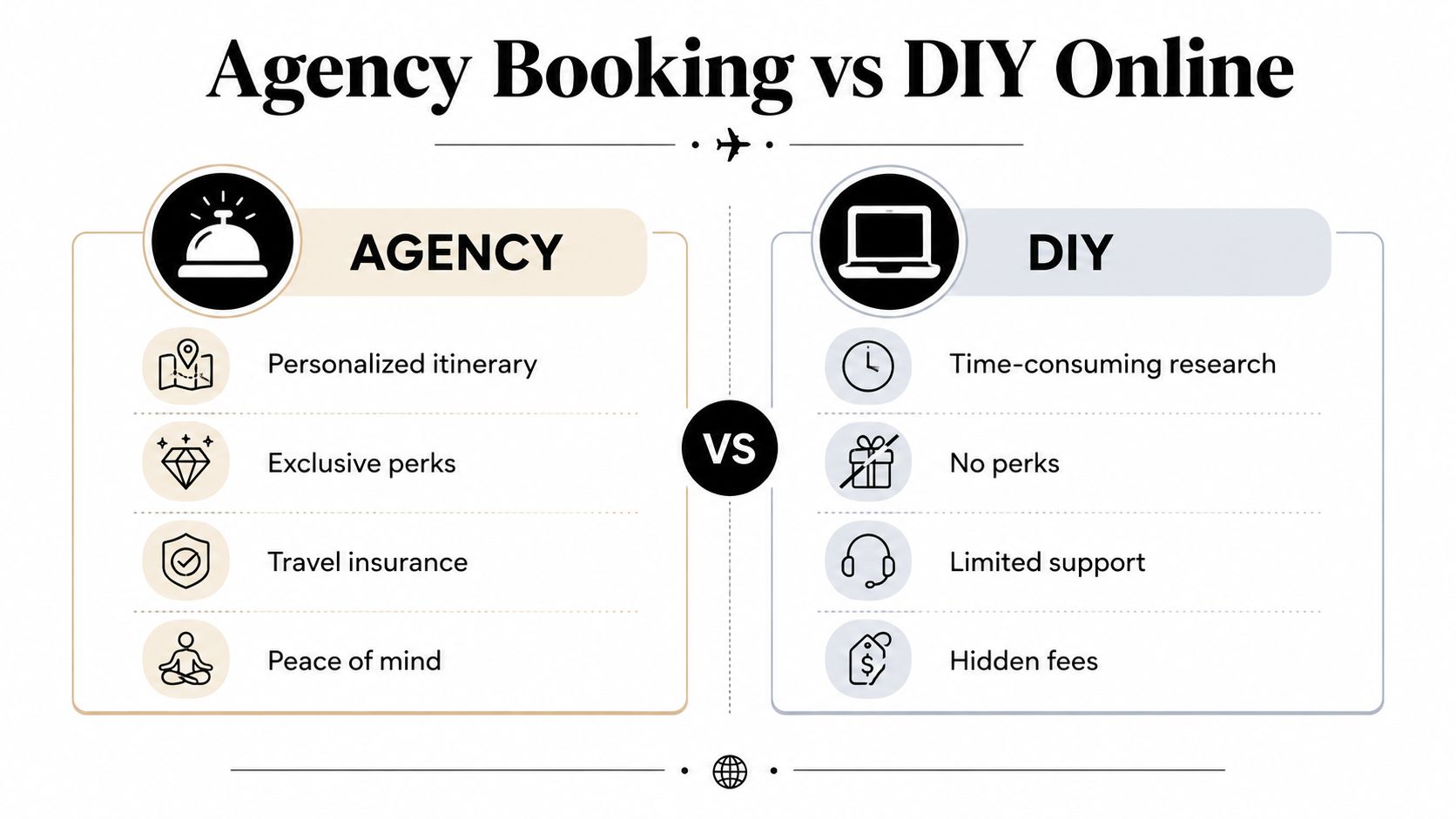
Clear line: self-book the simple trip. Use an advisor when the trip needs orchestration.
For travelers who like to self-direct certain pieces, DIY is still smart for routine domestic stays and simple point-to-point flights. But once the trip includes a private villa, inter-island timing, VIP recognition, or family logistics, the agency earns its fee by removing friction you'd otherwise have to manage yourself.
Here's a useful video walkthrough for anyone comparing the two approaches:
Sample Itineraries and Real Client Scenarios
A honeymoon client usually comes in with a short brief and a long list of feelings. They want privacy, romance, and the sense that nobody is watching the clock. A good agency turns that into a trip where the hotel understands it is a celebration, the transfers are quiet and well timed, and the days leave room for the couple to enjoy being away together.
A multi-generational family is harder to get right. Three generations rarely want the same pace, and the wrong property turns an elegant trip into a negotiation. The advisor has to think about room adjacencies, shared meals, downtime, and whether the grandparents can move easily between spaces without feeling managed. The agency earns its fee the moment the family stops arguing about logistics and starts enjoying the trip.
The CEO scenario is different again. A board meeting shifts by 24 hours, and the trip that looked locked suddenly is not. A weak operator replies slowly and treats the change like a burden. A strong one recalculates the route, keeps the client informed, and protects the experience instead of just protecting the reservation.
What ties all three together is simple, the client does not want more options, they want fewer mistakes. That is why the best advisors do not sound like sellers. They sound like operators who know where trips break down, who knows which hotel teams deliver, and who already have the relationships to make the right room, transfer, or table happen without drama.
For planners who also need a setting for private entertaining, the right venue matters just as much as the trip itself. A resource like host your event at the winery can fit neatly into a larger celebration plan when the group wants something more intimate than a standard venue.
The right advisor makes the trip feel inevitable, even when the logistics were anything but.
How Haute Black Is Built for Ultra High Net Worth Travel
A strong luxury travel agency does not just book hotels, it keeps the entire trip from drifting off course. Haute Black is built around that standard. Its Virtuoso affiliation through Andavo Travel gives it a recognized luxury booking framework, while preferred partner status at more than 500 properties including Four Seasons, Aman, Rosewood, Belmond, and Ritz-Carlton helps shape arrivals that feel properly handled from the start. That matters because a UHNW trip is judged by how it feels before check-in, at the door, and after the room key is in hand.
The platform also reaches beyond hotel inventory. Haute Jets handles private aviation, and the travel stack includes first-class and helicopter transfers, which is the kind of coordination that prevents a trip from falling apart at the seams. A fixed Miami headquarters matters too. Clients who expect fast answers and continuity do not want a rotating contact list.
The member side is where Haute Black separates itself from a basic booking desk. Its AI-powered network connects verified founders, executives, investors, athletes, and creators for introductions and private roundtables. It also runs 80+ events annually, including private chef dinners with Nobu, Daniel Boulud, and Thomas Keller, plus cultural evenings with names from sports and entertainment. That makes the relationship bigger than transaction management, because the same advisor ecosystem that arranges travel also creates access to people, rooms, and invitations clients use.
For private entertaining, the partner calendar matters. A venue option like host your event at the winery fits naturally when the trip includes a dinner, retreat, or celebration that needs a polished setting.
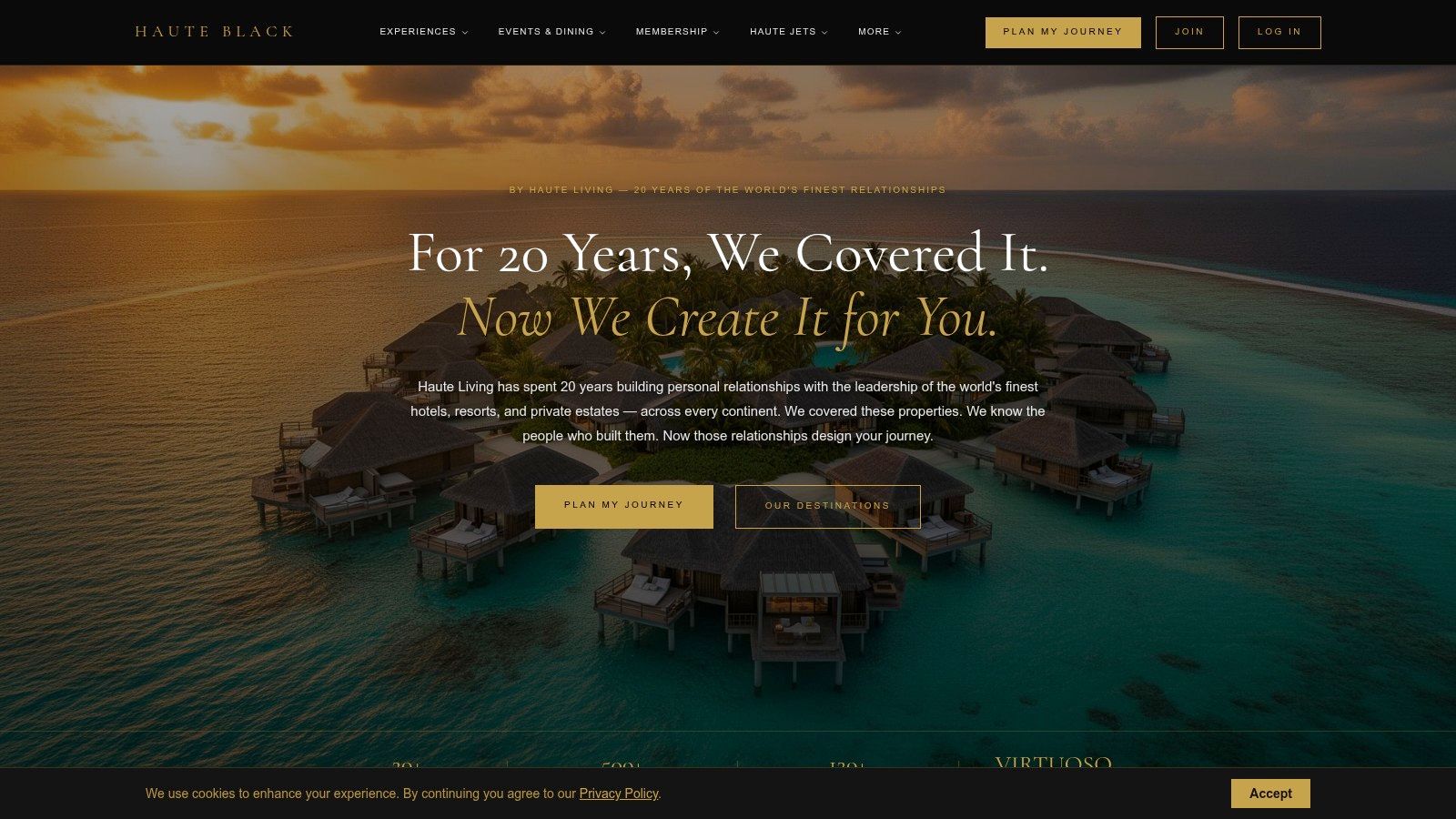
The strength is coherence. Haute Black ties travel, dining, transfers, events, and relationships into one operating environment, which is what ultra-high-net-worth travelers pay for when they want fewer moving parts and better outcomes.
Choosing the Right Agency for Your Travel Style
Stop asking whether a luxury travel agency is worth it in the abstract. Ask whether the advisor matches how you travel. If you need privacy, speed, and a trip that feels assembled by someone who knows your standards, the relationship matters more than the booking channel.
Before you sign anything, answer three questions. Does the advisor understand your style without forcing you into a template? Do their supplier relationships create real access, not just marketing language? Is the fee structure clear enough that you know what you're paying for?
The best agency is the one that can prove it will save you friction before you ever leave home.
Use a short checklist. Advisor fit, supplier relationships, service coverage, and fee transparency. If those four pieces are strong, you're probably looking at a real operator. If one of them is weak, the trip will usually expose it.
If you want a travel relationship that handles bespoke itineraries, VIP recognition, and the kind of behind-the-scenes coordination luxury trips depend on, visit Haute Black and see whether the model fits the way you travel.
Explore Our Guides


Signature Experiences


