Haute Black Journal
Private Flight Attendant: What the Role Really Involves

Marlene Azeez
Director, HauteBlack
View all articles →
The principal is boarding in a few hours. Catering has changed twice, one child has a food allergy, the itinerary may shift after landing, and the executive assistant is still deciding whether the cabin needs a dedicated attendant or a polished charter crew. That decision shouldn't be made on linen, champagne, or appearance alone.
A private flight attendant is both a service professional and an operational risk manager. The right person protects the cabin standard, keeps inventory and safety checks under control, communicates cleanly with the cockpit, and knows when fatigue, security, or an itinerary change has become a safety issue. The role is demanding for good reason. In the United States, flight attendants recorded 4,980 nonfatal workplace injuries and illnesses involving days away from work in 2019, at a rate of 517.0 per 10,000 full-time workers, compared with 86.9 across private-industry workers, according to the Bureau of Labor Statistics' flight attendant injury data.
What a Private Flight Attendant Actually Does
A long-range Gulfstream or Global cabin is usually won or lost before the principal arrives. The attendant starts by checking the aircraft's cabin configuration, catering delivery, beverages, blankets, seat belts, tray tables, emergency equipment, lighting, temperature, and cleanliness. These aren't cosmetic details. A missing medical item, an incorrect meal, or an unsecured bag can create a service failure at best and an operational problem at worst.
The attendant then matches the galley loadout to the passenger profile. That means confirming allergies, religious or dietary restrictions, preferred brands, coffee preparation, wine service, children's requirements, and any timing constraints around meetings or sleep. Job descriptions for private cabin crew commonly include catering checks, inventory reconciliation, preference files, and post-flight records, because the position combines hospitality with logistics. Private jet stewardess and steward role descriptions show why this administrative discipline matters during short ground stops and flexible schedules.
The operating sequence
Before departure, the attendant coordinates with the captain and first officer, confirms the cabin is ready for boarding, and helps choreograph the movement between the aircraft, FBO, customs, and immigration. The attendant isn't replacing the cockpit crew or acting as a standalone concierge. On many missions, the cabin professional works as part of a three- or four-person flight crew, with responsibilities divided between flight operations and cabin service.
In flight, the work becomes continuous observation. The attendant sets a service rhythm that respects conversation, work, sleep, children, and privacy. They may monitor turbulence expectations with the pilots, secure luggage during an overnight stay, adjust the cabin for a diversion, or support a last-minute medical stop. The key skill is knowing which request can be handled discreetly and which change must be escalated immediately.
After landing
A proper post-flight reset includes cleaning, restocking, documenting consumption, reconciling catering, recording passenger preferences, and reporting defects or irregularities. A cabin that looks perfect but has poor records isn't being managed properly. Tight configuration and inventory control reduces avoidable failures and helps the aircraft turn efficiently when the schedule changes.
Safety training now receives more structured attention than hospitality coaching alone. FlightSafety International's cabin-safety program describes training designed to prepare attendants to protect passengers, and industry reporting has documented private-jet attendants completing formal classroom training alongside online coursework before undertaking paid trips. Discretion, adaptability, and self-sufficiency are the core operating currency.
Private vs Commercial Cabin Crew
Commercial and private cabin crew share a safety mandate, but the working environments are materially different. A commercial flight attendant follows an established service sequence for a large passenger population, supported by standardized procedures, defined staffing, and a predictable chain of command. A private attendant works with a much smaller group, often with direct access to the captain and a client expectation that service will be adjusted in real time.
The commercial role generally offers clearer roster boundaries, formal operating procedures, and stronger institutional protections. The private role offers greater autonomy but more scope creep. A private attendant may manage bespoke catering, wine presentation, cabin logistics, family requests, and security coordination in the same duty period.
| Dimension | Commercial Cabin Crew | Private Flight Attendant |
|---|---|---|
| Staffing | Larger cabin teams serving a broad passenger group | Smaller crew, sometimes one dedicated cabin professional |
| Service model | Standardized sequence and published procedures | Personalized service shaped by the principal or charter client |
| Decision-making | Decisions follow airline procedures and escalation channels | Decisions are made closely with the captain and operations team |
| Passenger relationship | Mostly transactional | More continuous and preference-driven |
| Schedule | Rostered duties with formal flight and rest limitations | Principal-led, charter-led, or standby scheduling |
| Scope | Safety, service, and cabin compliance | Safety, service, logistics, discretion, and irregular-operation support |
| Employment structure | Often tied to an airline employment framework | Owner, operator, fractional, agency, or contract engagement |
A private attendant may support one family repeatedly, which creates powerful knowledge of preferences but also raises the standard for consistency. A commercial crew can rely on a team member to handle a defined task. A private attendant must often see the entire cabin, identify the next problem, and solve it without creating noise for the principal.
That difference is why executive assistants should treat the role as an operating appointment, not a luxury add-on. The private jet versus commercial travel guide is useful background, but the hiring question is narrower: does the candidate have the judgment to work independently while respecting the captain's authority?
Practical rule: Hire for calm autonomy, then train the preferred service style. You can teach a menu system more easily than you can teach judgment under pressure.
Training, Qualifications, and the Soft Skills That Matter
Start with the operating category. Part 91 owner operations and Part 135 charter operations don't create identical training expectations, documentation requirements, or emergency procedures. A candidate moving between them needs to understand the operator's manuals, recurrent program, crew resource management expectations, and the practical authority of the captain.
The conventional path combines aviation experience with targeted corporate-cabin training. Employers commonly look for emergency procedures, first aid, CRM, security awareness, and recurrent training. FlightSafety International and other specialist providers offer structured safety programs, while operators add aircraft-specific induction and internal procedures. A private aviation attendant shouldn't be approved for a new aircraft just because the person can deliver polished service.
The baseline file
Before interviews, verify the fundamentals rather than relying on presentation:
- Eligibility: Confirm the candidate is at least 18, has a high school diploma, holds a valid passport, and can meet the operator's medical and physical requirements.
- Medical readiness: Review the applicable aviation medical documentation, including any FAA requirements used by the operator.
- Safety currency: Check first aid, CPR, emergency equipment, firefighting, evacuation, and security training dates.
- Travel access: Confirm passport validity, visa eligibility, and the ability to reposition internationally when the aircraft schedule changes.
- Aircraft fit: Match experience and training to the cabin size, galley complexity, passenger profile, and operating rules.
The soft layer determines whether the hire lasts. A strong attendant anticipates a principal's preferences without becoming intrusive, reads the cabin's mood, handles intoxication without humiliation, protects dietary information, and refuses to discuss passengers outside the proper chain of command. Confidentiality isn't a courtesy. It's a condition of access.
For an additional way to assess communication, composure, and customer-facing tendencies, use this personality assessment guide as one input, never as a substitute for references or scenario testing. Prior UHNW household, yacht, luxury hotel, or family-office experience can matter more than another certificate when the role requires discretion across every interaction.
Hiring Routes and Contract Models
The right contract depends on how the aircraft is used, not how impressive the principal's travel sounds. A single owner who flies irregularly needs a different arrangement from a family with multiple cabins, frequent international movement, and overlapping schedules.
Three practical models
Full-time dedicated employment provides continuity. The attendant learns the family's preferences, manages the cabin's inventory system, and becomes familiar with the principal's security and travel routines. The trade-off is fixed commitment, benefits administration, leave coverage, and the need to manage rest properly even when the aircraft isn't flying.
Fractional or shared staffing works when several aircraft or principals can share a qualified cabin pool. It offers resilience and wider coverage, but the operator must control training records, availability, preference files, and conflict resolution. Shared staffing fails when nobody owns the final decision about who is assigned.
On-call contract work suits irregular charter demand, occasional owner use, or a backup requirement. It provides flexibility, but the principal pays in coordination time and may receive less preference continuity. The operator must confirm training currency, travel documents, insurance responsibilities, cancellation terms, and rest expectations before the first assignment.
| Model | Typical Annual Hours | Cost Profile | Flexibility | Best Fit |
|---|---|---|---|---|
| Full-time dedicated | Define from the principal's forecast | Highest fixed commitment | Lower once rostered | Frequent use, one family, or a dedicated heavy cabin |
| Fractional or shared | Allocate across aircraft and principals | Shared staffing cost with coordination overhead | Moderate to high | Multi-aircraft programs or recurring but uneven demand |
| On-call contract | No fixed annual commitment | Premium per assignment and positioning exposure | Highest | Irregular flying, backup coverage, and charter peaks |
Don't accept a contract that promises guaranteed availability without defining rest, rotation, per diem, travel, cancellation, and command authority. Specialist aviation staffing firms, fractional operators, vetted crew-leasing agencies, and direct referrals through chief-of-staff networks are usually more productive than broad hospitality recruiting. The private jet charter careers guide offers useful context on the labor market, but your decision should rest on operational coverage and documented vetting.
Cost, Compensation, and Budgeting
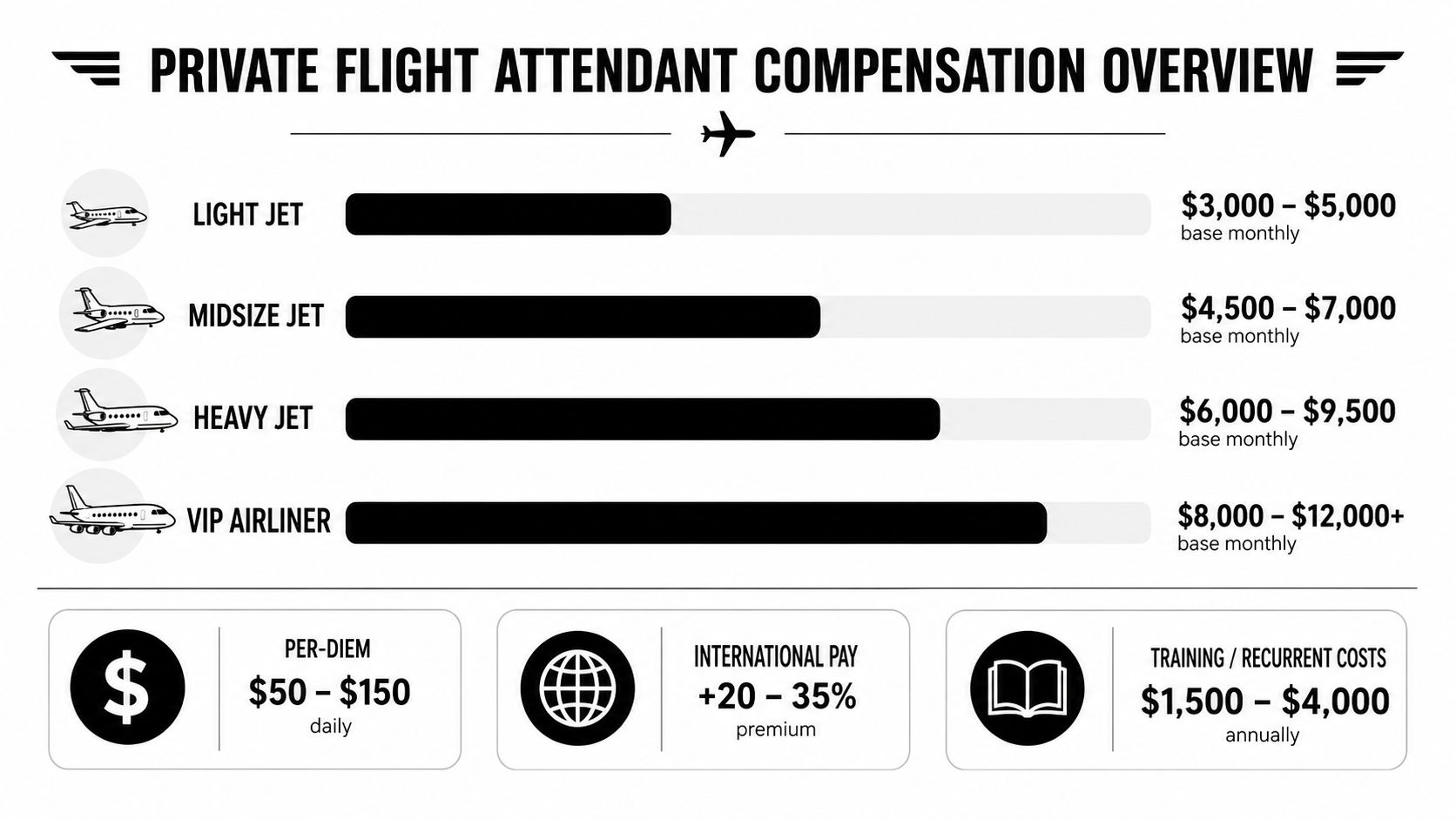
Private flight attendant budgeting becomes unreliable when principals compare only base pay. The package may include per diem, international premiums, training, recurrent certification, uniforms, grooming, insurance, benefits, positioning, hotel nights, agency margin, and replacement coverage during rest or leave.
The Bureau of Labor Statistics estimated a May 2023 U.S. employment base of 126,020 flight attendants, with a mean annual wage of $70,980. Its reported pay range ran from $39,580 at the 10th percentile to $104,100 at the 90th percentile, and the occupation is projected to grow 9% from 2025 to 2035, with about 18,500 openings per year on average. Those figures cover the broader occupation, not a guaranteed private-aviation package, so use them as market context rather than a private-cabin quote. (BLS occupational employment and wage data)
Spend where it reduces risk
Put money into current emergency training, aircraft-specific familiarization, security awareness, language capability, and a reliable relief plan. These investments directly affect readiness and continuity. A decorative catering relationship or an expensive uniform tier won't compensate for weak documentation, poor rest planning, or an attendant who can't manage an irregular operation.
For a heavy jet, build the budget from the role outward:
1. Base compensation: Set a defensible annual amount based on responsibility, experience, aircraft complexity, and availability.
2. Variable pay: Define per diem, international work, positioning, overtime treatment, and approved expenses.
3. Training: Fund initial and recurrent programs rather than asking the attendant to absorb operational costs.
4. Employment load: Add payroll taxes, insurance, benefits, leave coverage, uniforms, and recruitment fees where applicable.
5. Continuity: Budget for a second qualified attendant or contractor when duty limits, illness, leave, or fatigue make substitution necessary.
For owner-operators, these costs sit directly with the family or aircraft budget. Charter and fractional programs may pass portions through operating rates, but the principal still pays for poor planning through delays, service failures, and crew turnover. The private jet charter cost guide can help frame the broader trip economics, but cabin staffing should be modeled as an operational line item, not an amenity.
Privacy, Security, and Service Etiquette
A trip from Aspen to Geneva with a security escort and minor children shows why the role requires more than polished table service. Before departure, the attendant confirms the approved passenger list, dietary needs, child arrangements, security contacts, ground transport, and document-handling rules. The cockpit receives the relevant operational information, while sensitive personal details stay compartmentalized.
In the cabin, the attendant keeps devices, printed itineraries, business papers, and passenger conversations out of public view. Phones remain controlled, photos aren't taken, and social media activity doesn't reveal aircraft interiors, destinations, schedules, or recognizable details. An NDA should be paired with a practical digital policy, because a signed document is weak protection when staff casually share screenshots or location clues.
A disciplined itinerary
At an FBO, the attendant coordinates with the handler and security team without broadcasting the principal's movements. If the itinerary changes, the attendant confirms the new requirements through the designated chain of command, checks catering and transport, and avoids making promises before the captain or operations team approves the change.
Cross-border work adds another layer. The attendant needs clear instructions on customs, immigration, restricted-country briefings, crew movement, and what information can be shared with local vendors. Basic people-search and information-handling principles, such as those outlined in these people search OPSEC basics, can help an executive assistant identify unnecessary exposure in public records and online workflows.
The best service is quiet. Serve a family member, staff member, and business guest with equal professionalism. Learn religious and dietary requirements without making them a conversation topic. Offer help before it's requested, then leave the cabin alone when the principal is working or sleeping.
Fatigue belongs in the security discussion as well as the safety discussion. A 2025 cabin-crew position paper argues that fatigue requires science-based duty and rest rules, while a 2025 study identified duty length, time of day, prior sleep, and total time awake as major fatigue drivers. The EurECCA position paper on cabin-crew fatigue supports treating rest as an operational control, not a personal preference.
Sample Interview Questions and Member Checklist
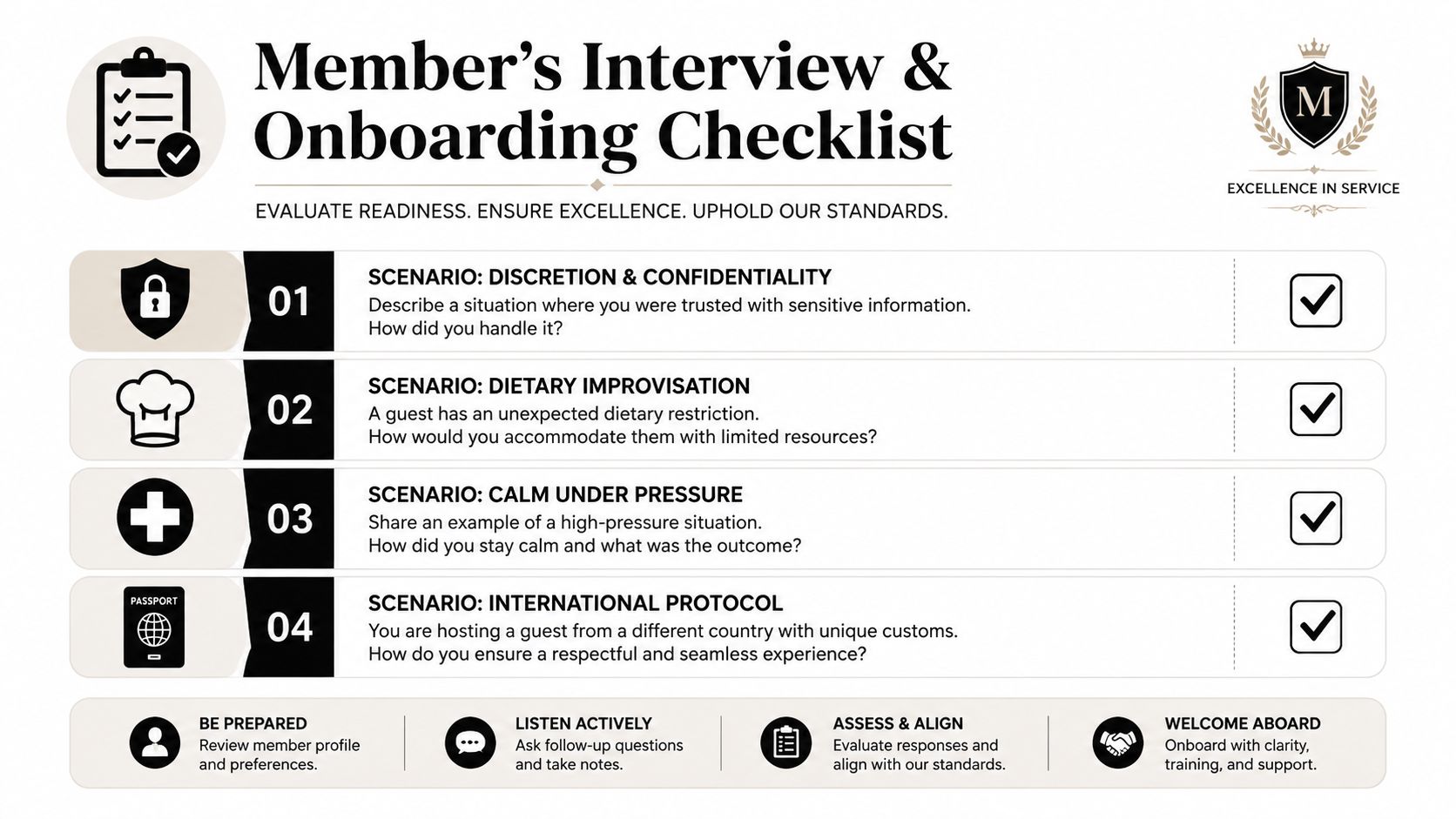
Don't ask only, “Tell me about your service background.” That question produces rehearsed answers. Test the candidate with situations that reveal judgment, escalation habits, and restraint.
Ask these scenario questions
- Discretion: “A passenger asks whether a well-known guest is on the aircraft. What do you say, and who do you notify?”
- Dietary improvisation: “Catering arrives without the principal's required meal, and the aircraft is scheduled to depart. What do you verify, what alternatives do you offer, and when do you escalate?”
- Medical calm: “A child develops symptoms after takeoff. Walk me through your first actions, cockpit communication, onboard resources, and documentation.”
- Crew-rest judgment: “You feel unfit after a night duty and a short sleep window, but the principal wants an early departure. How do you raise the issue?”
- Irregular operations: “The aircraft diverts and the family's ground plan is no longer usable. What information do you protect, and how do you rebuild the plan?”
Use the answers to assess whether the person follows the captain's authority, protects confidentiality, and communicates facts without dramatizing them. A candidate who focuses only on pleasing the passenger is missing half the job.
Copy this into the EA file
- Verify credentials: Confirm applicable FAA or EASA certification, medical documentation, first aid, CRM, security, and emergency-training currency.
- Confirm travel readiness: Check passport, visa eligibility, positioning expectations, and international availability.
- Review vetting: Obtain references and complete the operator's background process, including any required NINJATRACS or RDC checks.
- Set confidentiality terms: Include NDA language, device rules, photography restrictions, social-media controls, and information escalation.
- Define money clearly: Agree per diem, approved expenses, tips, uniforms, training, cancellation, and positioning treatment.
- Name the chain of command: State who controls safety, itinerary changes, passenger requests, security decisions, and irregular operations.
- Run a trial: Use a real or simulated trip to observe preparation, cabin awareness, communication, and post-flight records.
Reject vague references, resistance to an NDA, casual attitude toward photos, inability to describe a past irregular-operation response, or any suggestion that service outranks safety. A candidate who can't explain how they protect crew rest shouldn't be placed on a demanding private schedule.
A Practical Framework for Engaging a Private Flight Attendant
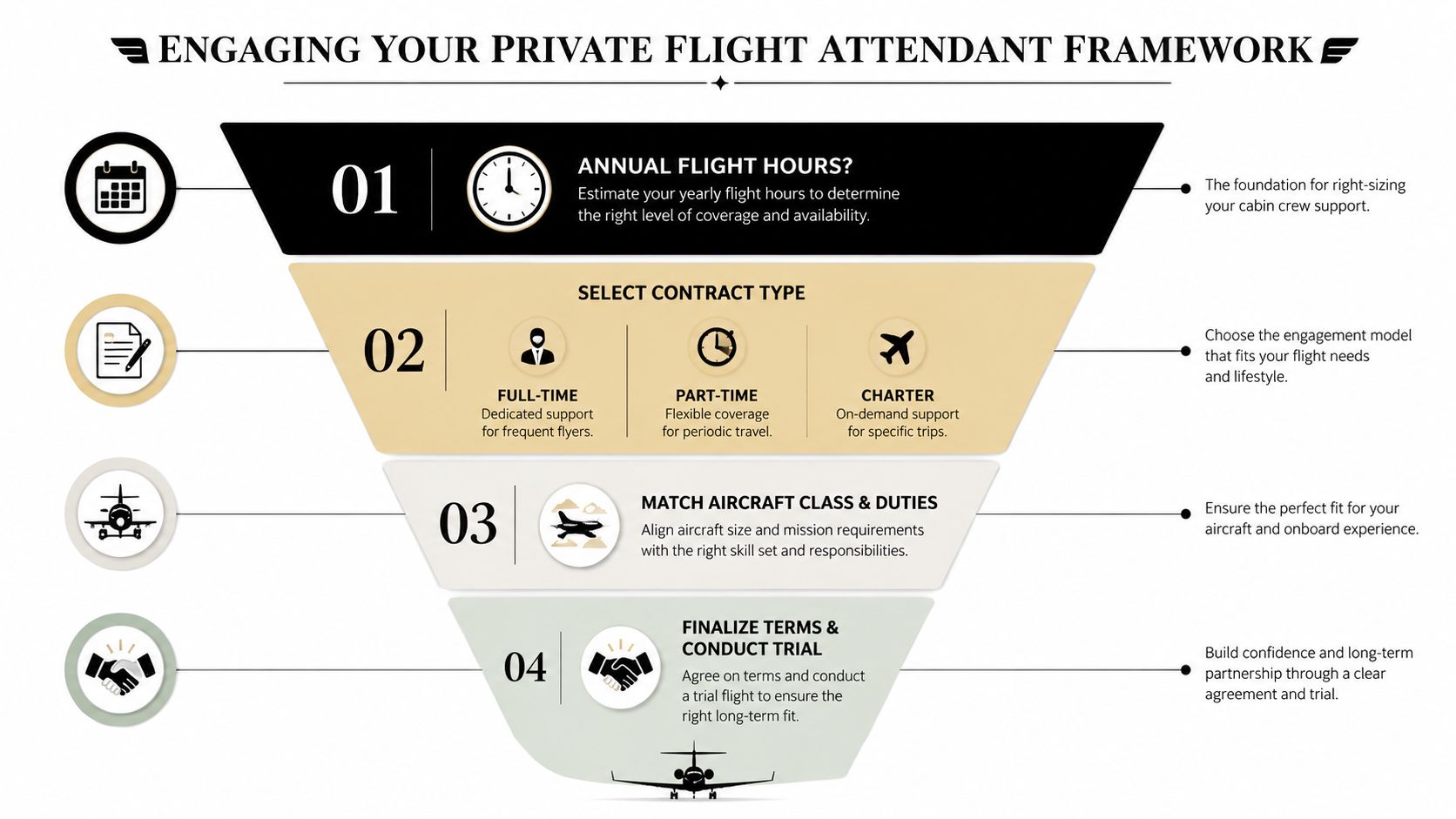
Start with annual flight hours, then adjust for aircraft complexity, passenger profile, international exposure, and backup needs. Hours provide the first filter, but they don't replace judgment about duty patterns. A light aircraft with frequent short-notice changes can create more staffing pressure than a larger aircraft with stable family routines.
Use this decision path
- Under 200 hours: Start with on-call or fractional coverage. Source through specialist aviation staffing firms or trusted operator referrals. The essential requirement is current emergency training and documented availability.
- From 200 to 600 hours: Consider a dedicated contractor or a structured shared arrangement. Match the candidate to the aircraft, principal profile, and likely international schedule. Require reference checks and a trial period before granting broad autonomy.
- Above 600 hours: A full-time hire with benefits, relief coverage, and a defined base usually makes more sense. Source from experienced Part 135 operators, established aviation personnel networks, or direct referrals from trusted pilots and chiefs of staff. Verify training currency, rest practices, and confidentiality history before appointment.
Don't use salary bands as a substitute for a compensation study. The package should reflect the attendant's responsibility, required availability, aircraft class, travel pattern, and whether the role includes training, inventory management, family travel, or security coordination.
Fatigue and cross-border rules deserve a written operating plan. Recent aviation safety reporting describes regulators and operators adopting different approaches to fatigue oversight, including fatigue-risk management policies, fatigue safety groups, scientifically based duty limits, hotel provisions, transport assistance, and removal from duty when a crew member reports fatigue. Coverage of evolving fatigue oversight in India and Australia reinforces the practical point: international operators need a clear escalation protocol before a tired crew member is standing at the aircraft door.
An attendant protects the passenger experience only when the operating system protects the attendant's readiness. Define rest, authority, privacy, cross-border documentation, and relief coverage before you define the preferred champagne.
For principals and executive assistants who want one aviation contact to coordinate aircraft, catering, ground transport, connections, and pre-flight details, HauteBlack offers private aviation coordination alongside broader bespoke travel planning. Use that support when the itinerary demands tight coordination, but keep the attendant's role, authority, rest requirements, and confidentiality terms explicit.
If you're hiring for a dedicated aircraft, ask HauteBlack to coordinate the journey requirements and cabin preferences before you brief candidates. Visit HauteBlack to discuss private aviation support, ground arrangements, catering, and high-touch travel planning through one point of contact.
Explore Our Guides


Signature Experiences


