Haute Black Journal
Private Jet Charter Careers: A Definitive Guide

Marlene Azeez
Director, HauteBlack
View all articles →
# Private Jet Charter Careers: A Definitive Guide
August 6, 2026
You can spend months circling the private aviation world from the outside, watching aircraft photos, job posts, and polished cabin shots, while still wondering which role fits your background. Private jet charter careers aren't reserved for pilots alone. They're built by people who can fly, sell, coordinate, inspect, and service a trip without letting the client feel any of the complexity underneath.
The World of Private Jet Charter Careers
A pre-dawn arrival at a hangar changes the way the job feels. Crews are already on site, dispatch is checking weather and aircraft positioning, and a charter jet on the ramp represents more than a luxury object. It sits at the center of safety, logistics, and high-touch service, and every team member has a hand in keeping that system moving.

The market has real structural weight behind it. In the United States, employment in private jet charters reached 48,598 people in 2024, up from 48,139 in 2023, and IBISWorld estimates 1.9% average annual growth over 2019 to 2024 and 2.1% over 2018 to 2023 (IBISWorld employment data). That matters because this is not a narrow pilot track. It supports brokers, sales teams, dispatchers, maintenance coordinators, and cabin staff, along with the cockpit crews clients usually notice first.
Why the industry keeps pulling in talent
The demand picture stays strong because charter work is built on repeat utilization, not one-off indulgence. Industry data compiled in 2026 reported 5.1 million global private jet charter hours in 2023, a 15% increase from 2022 (global private aviation statistics). Another 2026 industry estimate placed the global private jet market at about $32.7 billion in 2023, with a projection to $45.2 billion by 2030 at a 4.6% CAGR (global private aviation statistics). Those figures point to ongoing activity across charter sales, scheduling, maintenance, and onboard service.
The hiring profile matches that breadth. The average private jet charter business employed about 23.5 to 23.6 workers per company in 2024 (IBISWorld employment data). That is small enough to require flexibility, but large enough to create distinct career paths. One person may never touch a yoke, yet still shape the trip from inquiry to wheels-up.
The best entry point is not always the cockpit. If you come from luxury hotels, private clubs, fine dining, or concierge work, you already understand the pace, discretion, and service standard the client expects. That same mindset translates well into charter sales, trip coordination, cabin service, and operations support, where details matter and mistakes are visible fast.
Practical rule: if you want to build a real career here, stop asking only “How do I become a pilot?” and start asking “Which function can I execute better than the average candidate on day one?”
For readers coming from luxury travel, the overlap is obvious. The private aviation coverage at Haute Black shows how closely charter work tracks the expectations of high-end clients who want polish, discretion, and speed.
Core Roles That Power the Industry
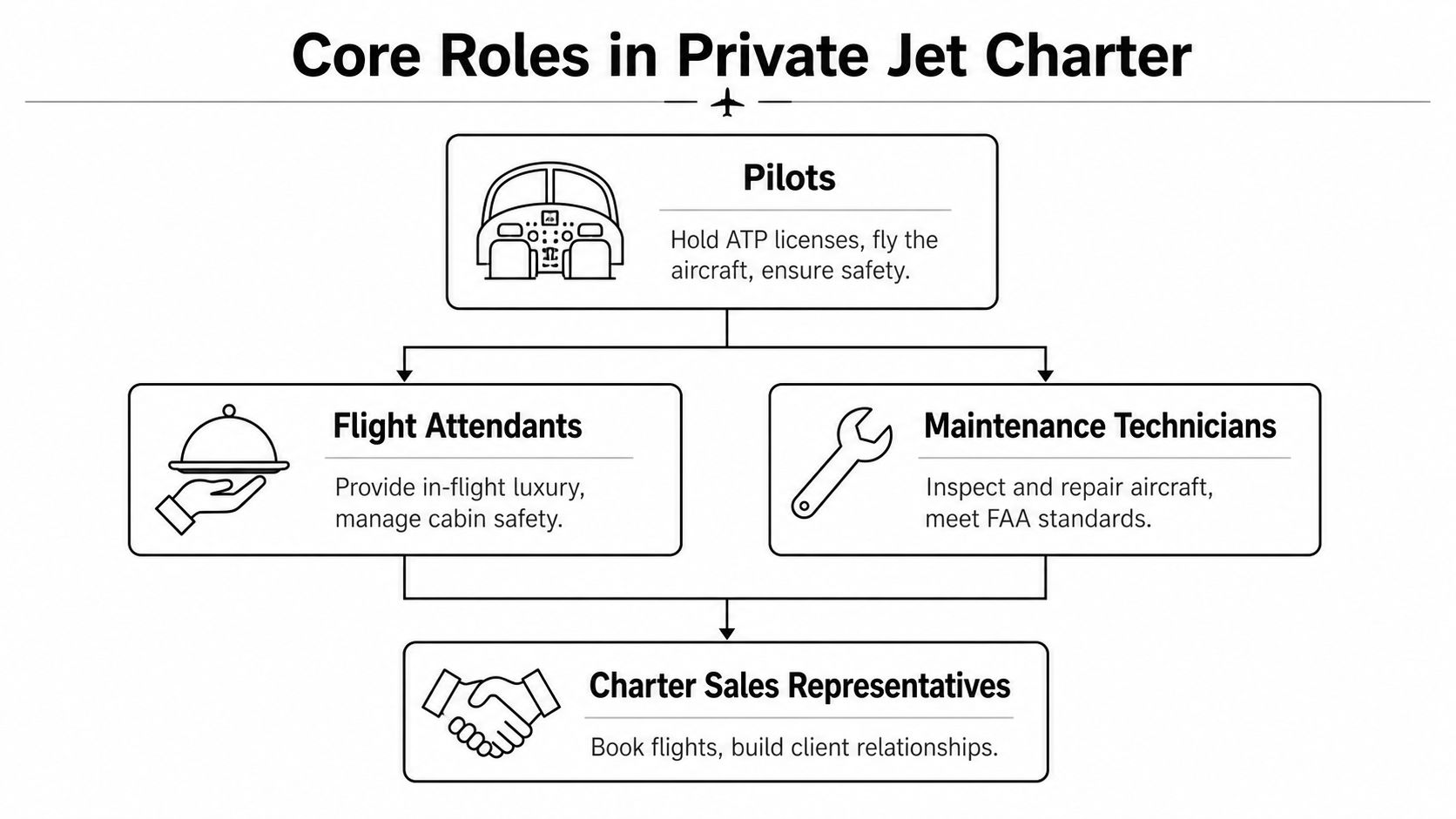
A private aviation operation falls apart quickly if you reduce it to the pilot seat alone. A flight leaves on time because brokers, coordinators, dispatchers, maintenance staff, and cabin teams each do their part under pressure, and the handoffs between them are where many careers live.
The cockpit and cabin side
Pilots still carry the safety responsibility, and the bar remains high. Charter operators usually want people who can step into commercial or ATP-level work with strong multi-engine, turbine, and IFR experience. That matters because the job is rarely predictable. Aircraft changes, international legs, and late schedule shifts all test whether a pilot can keep the operation moving without creating delays.
Cabin crew carry a different kind of pressure. A private jet flight attendant is responsible for luxury hospitality, cabin safety, and a client's unspoken preferences at the same time. The strongest people in that role read the cabin quickly, stay discreet, and solve small problems before they become visible to the client.
The people who make the trip possible
The less visible roles keep the charter business functioning. Charter brokers source aircraft and work through terms with clients and operators. Trip coordinators manage catering, ground transport, passenger preferences, and timing. Operations staff monitor crew legality, dispatch, and compliance. Maintenance coordinators keep aircraft availability grounded in reality, not wishful planning.
A lot of career changers can enter through those roles sooner than they expect. Firms value people who can use CRM systems, manage schedules, recover service when plans change, and keep aviation logistics organized. In many companies, those skills matter more on day one than a polished aviation résumé.
Sales and client development
Sales professionals sit close to revenue and client retention. They build relationships with corporate travelers, family offices, and repeat flyers who care about discretion, responsiveness, and consistency. The private aviation careers guide also points to a wider mix of roles across business development, scheduling, finance, and management, which shows how much broader the field has become than the old pilot-first view.
Private aviation rewards people who understand where each handoff can fail. Pilots protect safety. Cabin crew protect the onboard experience. Ops protects the schedule. Sales protects the pipeline.
The work feels polished from the outside because the team hides the friction well. That only happens when people in different roles know how to hand off cleanly and stay calm when the plan changes. For a service-led view of how charter is presented to luxury travelers, the private jet charter services guide at Haute Black News gives a useful reference point. If you are comparing open roles across the sector, current job opportunities at certseal.com/careers/ show how varied the entry points can be across aviation and service functions.
Certifications and Credentials That Open Doors
The wrong credential path wastes time fast. In private aviation, the right move depends on the role you want, because cockpit, cabin, and ground-side candidates are judged on very different signals.
If you want to fly
Pilot-facing charter roles usually start with a commercial pilot license, then add multi-engine and instrument ratings, and for most captain positions, an Airline Transport Pilot credential. For operators, the question is whether you already bring the kind of turbine and multi-crew experience that reduces training friction on day one.
Charter employers often look for a strong fixed-wing background with substantial PIC, multi-engine, turbo-jet, turbine, night, and simulated-instrument experience. That profile matters because operators do not want a long conversion period. They want a pilot who already understands turbine aircraft, crew discipline, and IFR work.
If you want to work the cabin or the ground
Cabin crew need safety training and service instincts. In practice, the strongest candidates often come from luxury hospitality, premium airline service, or other high-end guest-facing work. They need calm judgment, discretion, and an eye for detail that is hard to teach quickly.
Ground and support roles are less uniform, but aviation literacy still carries weight. FAA dispatch credentials, IATA-related training, and maintenance type ratings send a stronger signal than a generic interest in aviation. They show an employer that you understand the tempo, compliance burden, and service standards that private aviation runs on.
If you are comparing openings across adjacent roles, the job opportunities page at CertSeal can help you see how different employers describe requirements and responsibilities.
Good credential rule: choose qualifications that make your first 90 days easier for the operator, not just credentials that look impressive on paper.
The common thread is straightforward. Credentials that show you understand safety culture, regulatory discipline, and client sensitivity carry more weight than broad enthusiasm. That applies in the cockpit, the cabin, and dispatch.
Compensation and Career Trajectories
Money in private aviation is real, but it does not follow a standard corporate salary ladder. Some roles pay well early. Others start modestly and then rise as your reputation, client list, aircraft experience, or operational judgment grows. If you do not understand that shape, you can misread the opportunity.
Where the ceiling sits
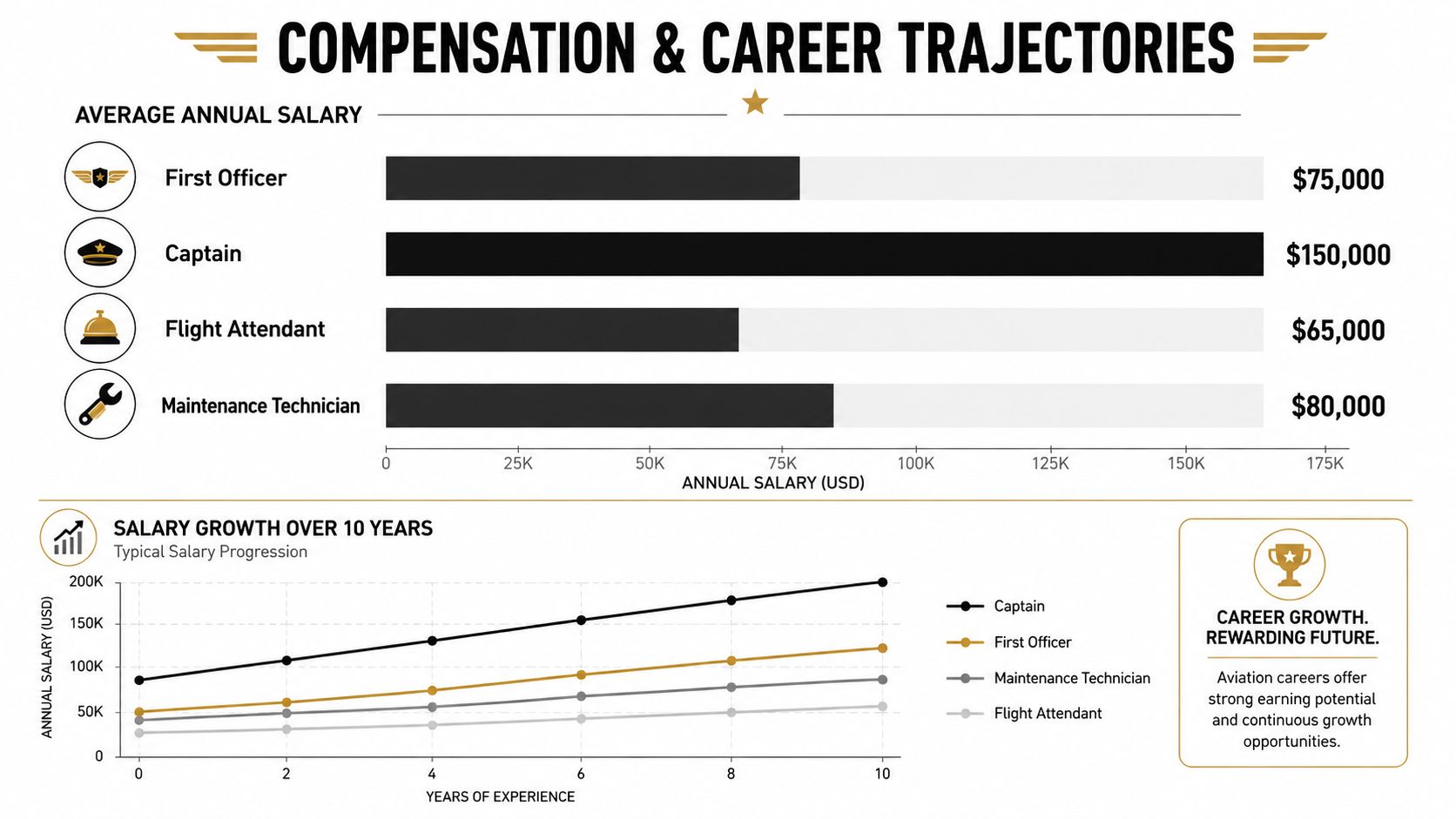
In pilot-facing charter work, compensation can be strong once you are fully qualified and proven. Advertised pay for highly qualified candidates can reach the $250,000 to $290,000 range. A private aviation careers guide also says private jet captains and top sales professionals can cross the $250,000 threshold, while flight advisors can earn commissions above $150,000 annually.
That ceiling makes sense once you look at the job itself. Charter missions are irregular, client-specific, and often global, so operators pay for people who can handle volatility without losing reliability. Part of the premium is technical skill. Part of it is composure, judgment, and the ability to keep a premium experience steady when plans change.
The broker and advisor path
Broker income is especially commission-driven. A broker training video says compensation tends to start slowly in years one and two, then many brokers reach at least $150,000 by year three, with about $250,000 by year five. That is a very different profile from a fixed paycheck, and it rewards relationship depth more than job-hopping or short stays with one firm.
The same logic applies to other client-facing roles. Advisors, trip support staff, and coordinators who understand client expectations can build value faster than their job titles suggest, especially when they can keep trips moving under pressure and protect the service standard at every handoff.
The part many job posts leave out
A major blind spot is career portability and income volatility across private aviation roles, especially for brokers, flight attendants, and operations staff. The same title can hide very different realities depending on region, operator size, client mix, and demand cycle. Job boards do not always explain that, and candidates often learn it only after they start.
That is why transferable skills matter so much. Luxury hospitality, premium guest service, scheduling, logistics, and calm communication all translate directly into this field, even if the job post does not say so in plain language. In practice, those skills can shorten your ramp-up time and make you more useful to the operator from day one.
For people changing industries, Eztrackr's 2026 transition guide is a useful starting point for framing experience without overselling it.
Many people misjudge this field. They see the glamour, but not the unevenness. A strong year can feel very different from a soft one, and that matters if you are planning a mortgage, a family move, or a lateral career shift.
Video reference for a closer look at charter compensation dynamics.
Breaking Into Private Aviation Step by Step
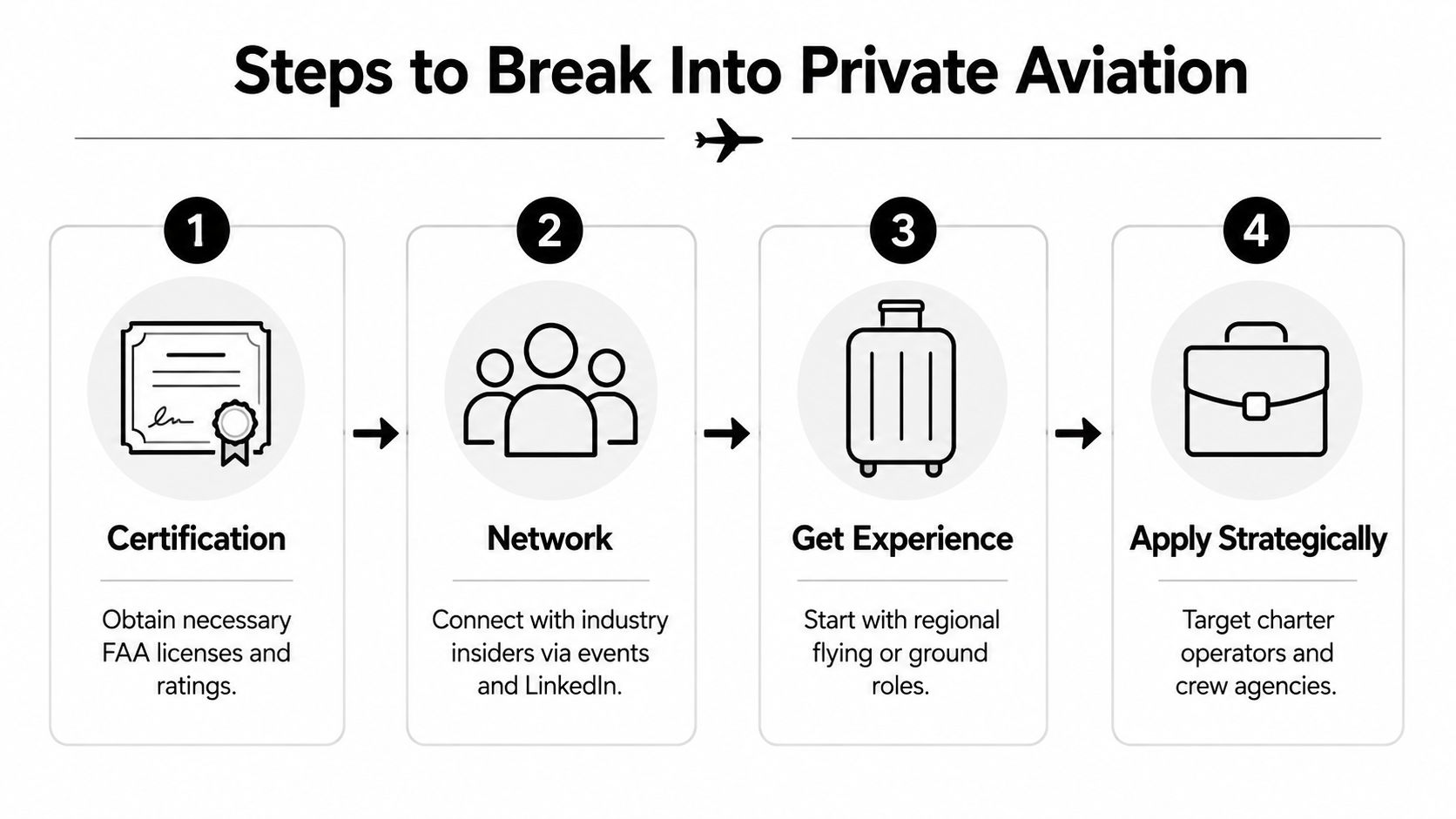
The fastest way in is to stop thinking the industry has one entrance. It doesn't. The route you choose should match your current experience, not some idealized version of the job you wish you had.
Start from your strongest lane
If you're pursuing flying, build your logbook with purpose. Charter operators favor candidates who already have multi-engine, turbine, and IFR exposure because those hours shorten the conversion time once you're hired. The higher-quality the time, the more useful it is.
If you're coming from hospitality, logistics, or corporate support, don't treat that background as second-tier. Trip coordination, dispatch support, broker operations, and customer management all live close to the client experience. In those lanes, multilingual capability, CRM fluency, and scheduling precision can outweigh generic aviation enthusiasm.
Use the transition resources that fit your profile
Career switches go faster when you use a structured transition plan instead of improvising. The Eztrackr transition guide is useful if you're moving from another industry and need to frame transferable skills without underselling them.
That said, don't confuse a transition tool with a destination. You still need to target the right role and explain why your background fits the pace and discretion of charter work.
Build experience that operators recognize
Aviation hiring rewards proof. If you're pilot-track, that proof is flight time, ratings, and aircraft familiarity. If you're ground-side, it's proof that you can handle pressure, service recovery, and multiple moving parts without losing accuracy.
A practical filter helps here:
- Pilot candidates: emphasize turbine exposure, multi-engine time, IFR comfort, and any type rating that reduces training friction.
- Cabin candidates: highlight high-end guest service, confidentiality, culinary coordination, and problem-solving under time pressure.
- Operations candidates: show scheduling discipline, CRM knowledge, permit or dispatch familiarity, and the ability to keep vendors aligned.
- Sales candidates: demonstrate relationship management, lead follow-up, and the ability to translate client needs into fast action.
The people who break in fastest usually do one thing well, they make it easy for an employer to imagine them in the seat on day one.
Interview Strategies and Networking Tactics
Private aviation hiring doesn't behave like mass corporate recruiting. A polished résumé helps, but so does the quality of your references, your poise under pressure, and whether you sound like someone who already understands the service standard.
What interviews are really testing
Most interviews in this field are checking three things at once, technical competence, discretion, and calm. That applies whether the role is in the cockpit, on the cabin side, or in operations. If you can't speak clearly about last-minute changes, international travel, or client expectations, the hiring team notices quickly.
Preparation should include knowing the operator's fleet, understanding the kinds of missions they fly, and being able to explain how you work when a day changes fast. That's especially important in charter, where schedule disruption is part of the job, not an exception.
Why referrals matter so much
Networking is relationship-driven here. People hire people they trust to protect the passenger experience and the operation. A referral can move your résumé ahead of dozens of anonymous applications because the industry runs on reputation and reliability.
Interview rule: never oversell glamour. Operators want to hear that you understand coordination, confidentiality, and consistency more than they want to hear that you “love jets.”
Career changers often have an edge if they present it properly. Hospitality veterans already know how to manage elite expectations. Logistics professionals understand timing and handoffs. Sales professionals understand follow-up and client memory. Those are not side skills, they're core charter skills when the aircraft is full and the schedule changes twice before noon.
The best networking approach is simple, and it's not flashy. Show up to industry events, ask useful questions, follow up with specificity, and stay visible without sounding desperate. In private aviation, people remember the professional who was prepared, not the one who sounded impressed by the room.
Resources and Where to Find Opportunities
A strong job search in private aviation starts with using the right channel for the role you want. Operators, brokers, and support teams do not all hire the same way, and candidates lose time when they treat every opening as if it sits in the same pipeline.
Where openings tend to surface
AeroTime, the NBAA career center, Indeed's private aviation listings, and specialist business aviation recruiters are all practical places to start. Trade publications such as Business Aviation Insider and Controller magazine also help you see which functions are hiring, how operators talk about their needs, and which skill sets keep showing up.
For sales and broker tracks, company career pages at operators such as Jetsmart, XO, and VistaJet are worth checking, along with boutique brokerage firms that work directly in on-demand charter. If you are exploring a service-adjacent route, the employment options with Ace Aviation can also help you compare how training-focused aviation employers describe their openings.
The best roles often surface before they look polished on a public board. Former colleagues, industry events, and targeted recruiter relationships can put you closer to trip coordinator, operations, client service, and maintenance openings that never attract broad attention. A plain hiring page can tell you what exists today, while conversations in the field tell you what an operator needs next.
How to think about the market
Private aviation careers now extend well beyond the cockpit, and the market continues to support that mix of roles. The global private jet market is forecast to expand from about US$25.87 billion in 2024 to US$38.31 billion by 2033, which points to sustained demand across multiple functions (BlackJet private plane jobs). That does not make every role easy to secure, but it does mean qualified people can still find room to grow.
Strong applicants match their background to a specific function. A pilot applicant should show flight time and ratings. A hospitality applicant should show guest management and discretion. An operations applicant should show process discipline. A sales applicant should show relationship conversion.
For readers who already move between travel, service, and executive support, Haute Black's private jet flight booking executive guide is a useful reminder that aviation roles sit inside a broader client experience. The more clearly you understand how premium travel is sold and serviced, the better positioned you are to enter this field and build inside it.
Private aviation rewards people who can work with discretion, accuracy, and speed. If you are serious about turning that into a career, visit Haute Black to see how luxury travel, private aviation, and high-touch client service connect in practice, then use that perspective to target the role that fits your strengths.
Explore Our Guides


Signature Experiences


