Haute Black Journal
Luxury Safari in Botswana: The Complete 2026 Guide

Marlene Azeez
Director, HauteBlack
View all articles →
You've decided you want Botswana, but the booking screen has turned a romantic idea into a maze of camps, flood charts, airstrips, transfer schedules, and prices that rarely show the full cost. You're comparing the Okavango Delta with Chobe, wondering whether peak season is worth it, and trying to understand why a seven-night safari can involve several aircraft and more planning than a conventional luxury holiday.
A luxury safari in Botswana should be designed as one connected journey, not assembled as a collection of attractive lodges. The right combination of region, flood conditions, concession rules, guide access, and charter routing determines whether the trip feels private and fluid or merely expensive. These are my recommendations for planning Botswana in 2026.
What a Luxury Safari in Botswana Actually Feels Like
You step from a small bush plane onto a remote airstrip near the Okavango Delta. Your guide is already waiting beside an open safari vehicle. There's no reception queue, no transfer coach, and no crowd gathering around the baggage belt. Your soft bag is loaded, the guide checks the light, and the first conversation is about tracks, water levels, and what the afternoon might reveal.
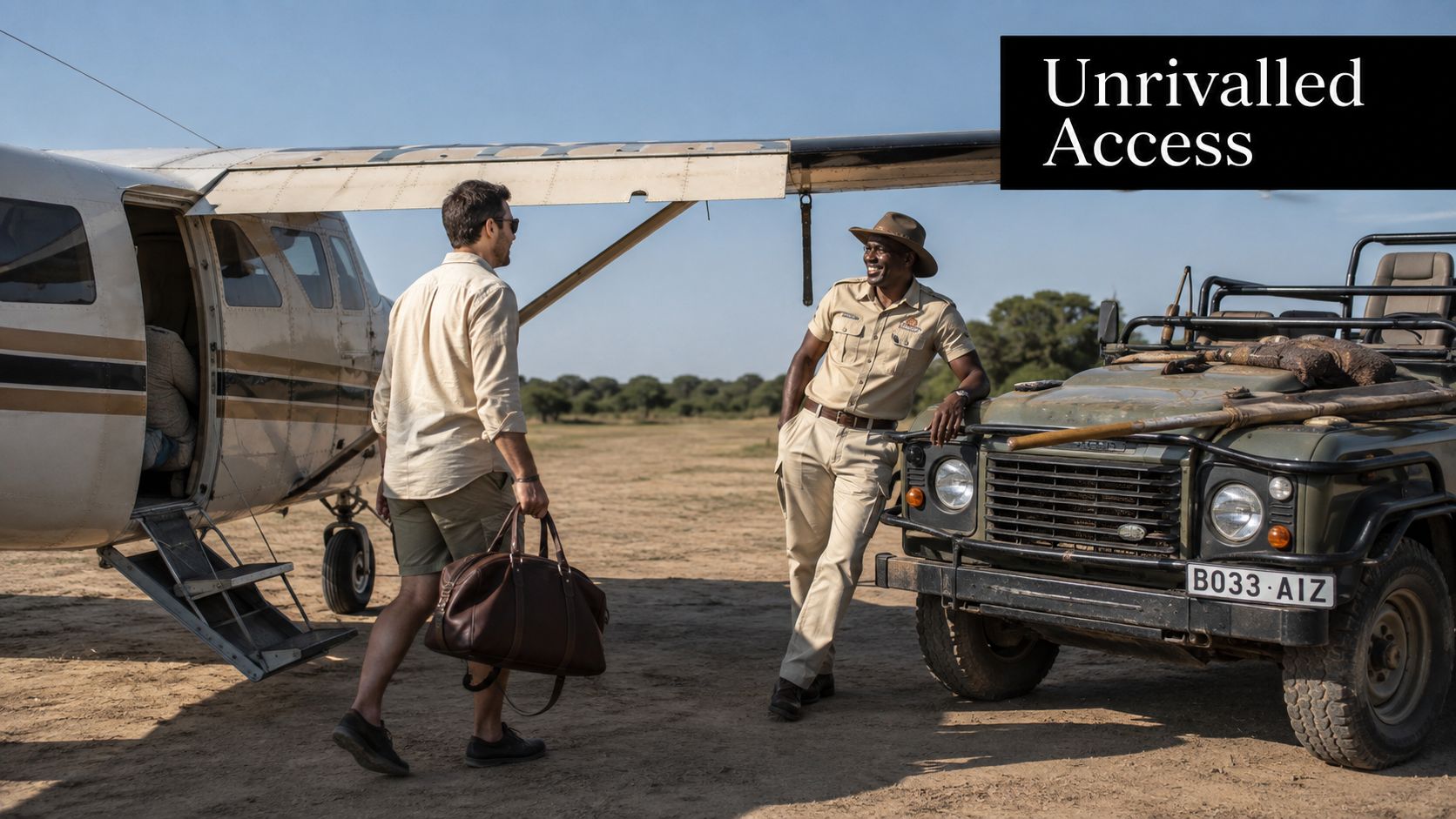
At a high-end camp, the atmosphere is deliberately quiet. You're not following a convoy, competing for a sighting, or listening to loudspeaker chatter between vehicles. Game drives leave at first light and return after dark, with a sundowner arranged on a sand spit or beneath a jackalberry tree. A mokoro rests nearby when water levels allow, and the guide decides whether the next outing should follow a channel, a game trail, or the edge of a floodplain.
The luxury is measured in space
Your suite may have a copper tub, an indoor-outdoor shower, and a private deck open to the floodplain. Dinner is plated rather than served from a buffet, but the meaningful upgrade is not the tableware. It's the ability to linger over a sighting, change the pace of the day, or return to camp without negotiating every decision with a group.
Botswana's exclusivity comes from a low-volume, high-value tourism model. The Okavango Delta became a UNESCO World Heritage Site in 2014, and it was the 1,000th site inscribed on the World Heritage List, giving Botswana a globally recognised conservation asset that supports premium wildlife travel. Government-cited tourism material also records that 7% of tourists visiting Botswana identified the Okavango Delta as their final destination, while about 15% reported visiting Maun, the Delta's main access point. The Okavango information resource also describes proposed development controls in the core area, including a maximum of 24 beds per lodge.
My rule: Don't judge Botswana by the nightly rate alone. Judge it by how many people share the vehicle, the concession, and the sighting.
That restraint is why Botswana feels luxurious rather than merely costly. If you're building a wider private journey around the safari, the same principle applies to the ground arrangements. A resource such as bespoke tours by Unique Private Transportation can help when your itinerary includes private transfers or city-based extensions before or after the bush.
The Three Defining Safari Regions
Choose the region before choosing the camp. Botswana's premium ecosystems deliver distinctly different experiences, and the wrong combination can leave you paying for activities that don't match your priorities.
Okavango Delta
The Delta is a seasonal inland wetland of channels, lagoons, islands, palms, and open floodplains. Depending on the concession and the water level, you may explore by 4x4, motorboat, or mokoro, with the scenery changing the balance between land and water activities.
The wildlife brief is broad. Lion and leopard appeal to big-cat followers, while red lechwe and sitatunga make the Delta especially rewarding for travellers who want water-adapted species. Birding is also a major strength. Select the Delta when you want atmosphere, varied habitats, and the possibility of moving through water rather than spending every outing on a vehicle.
Chobe Riverfront
Chobe is the choice for volume and spectacle. The riverfront concentrates wildlife around a dependable water source, and river cruises can replace the conventional morning drive with a low-angle view of elephants, buffalo, and other animals coming to drink.
Chobe National Park is widely cited as having the largest concentration of African elephants on Earth, with estimates exceeding 120,000 animals. In the dry season, herds gather along the Chobe River in very high densities, making riverfront positioning a tactical advantage for a first-time safari or a family that wants frequent, visible wildlife encounters. This Chobe and Okavango comparison is useful when deciding between water-based spectacle and Delta immersion.
Private concessions near Moremi and Linyanti
Private concessions bordering Moremi and the Linyanti offer the strongest sense of wilderness control. Their operating permissions can allow off-road tracking, night drives, and walking safaris, experiences that aren't generally available in the same way inside national parks.
The Linyanti is particularly compelling for travellers who value remoteness, riverine scenery, elephants, and predators without the public-park traffic. Moremi-adjacent concessions suit guests who want a mix of dry-land game viewing, water access, and flexible guiding. Expect intimate camps, with bed counts often kept below thirty guests in these exclusive areas.
| Region | Landscape & Access | Signature Wildlife | Signature Activities | Best For |
|---|---|---|---|---|
| Okavango Delta | Channels, lagoons, islands, floodplains, access by 4x4, boat, and mokoro | Lion, leopard, red lechwe, sitatunga, birds | Mokoro, boating, game drives, walking where permitted | Water, birds, and varied scenery |
| Chobe Riverfront | River frontage and dry woodland, access by vehicle and boat | Elephants and buffalo in exceptional density | River cruises and game drives | Wildlife volume and spectacle |
| Moremi and Linyanti private concessions | Remote wilderness, seasonal waterways, private access | Predators, elephants, water-adapted species | Off-road drives, night drives, walking, boating | Privacy and flexible exploration |
Seasonal Timing and the Flood Factor
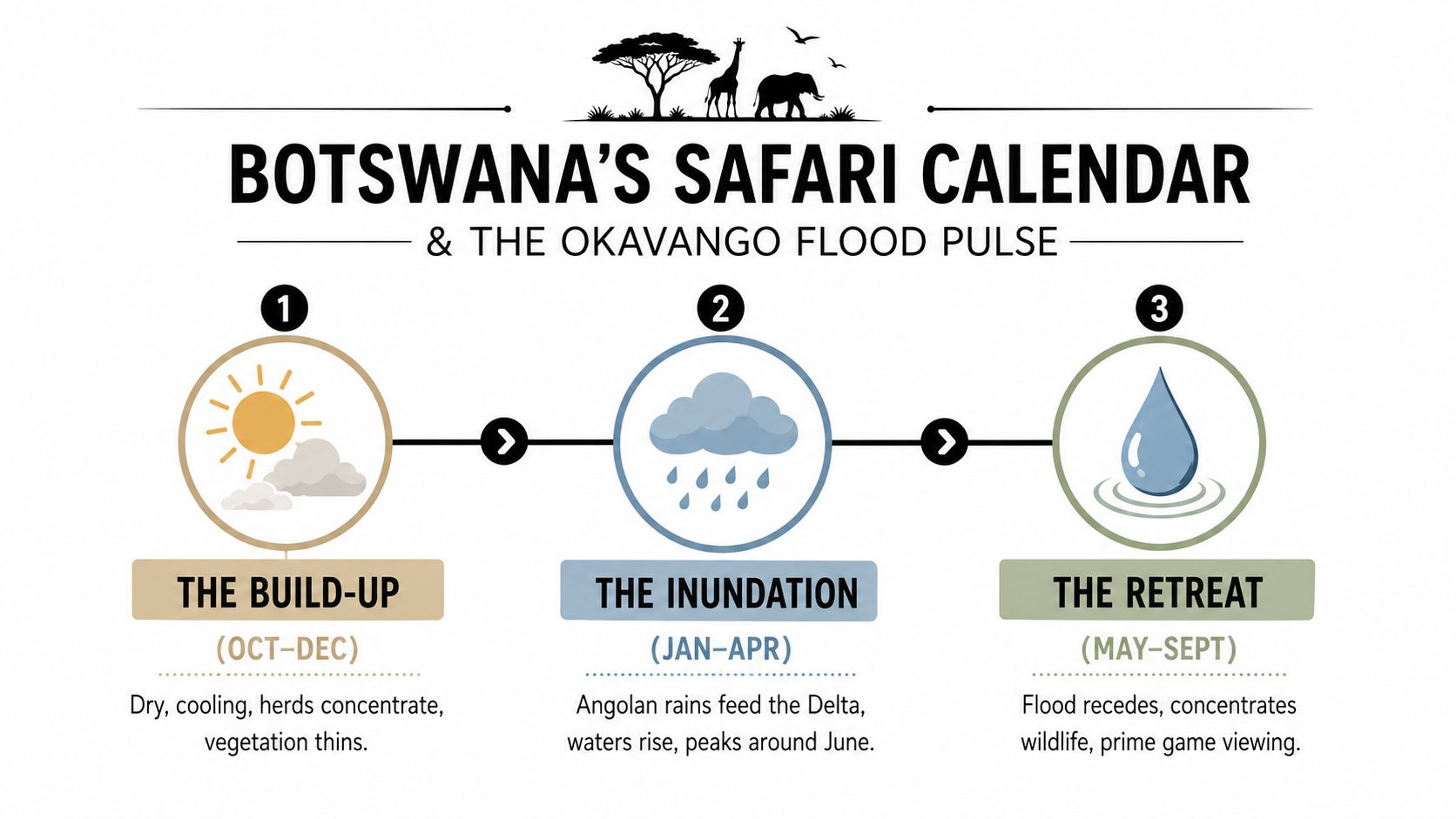
Botswana's calendar makes more sense when you follow the Okavango flood pulse, not a generic wet-season and dry-season label. Rain falling in Angola from January to April travels south through the catchment system before the water reaches the Delta. The flood commonly peaks between June and August, even though Botswana's own dry season is already underway.
Match the month to the experience
From May through October, water thins outside the permanent channels and animals become easier to track around dependable sources. This is the classic dry-season choice for predictable game viewing, especially in Chobe and the drier Delta concessions. Yet July isn't automatically the answer for every traveller. It's popular because the flood and wildlife concentration often coincide, but demand and camp availability matter just as much.
Late September and early October can be excellent in the Delta for sharper predator activity as heat and water scarcity reshape animal behaviour. March can be particularly strong for Chobe photography, when summer colour, dramatic skies, and riverfront wildlife create a different visual register from the dusty dry season.
The emerald months from November through March bring afternoon thunderstorms, lush vegetation, migratory birds, and the possibility of predator cub sightings. Roads and water access become more variable, so camp location matters more. HauteBlack's seasonal Botswana guide is a useful companion for comparing flood timing with camp style.
My timing recommendations
- January to March: Choose the Delta for green terrain and birding, or Chobe for photography and dramatic weather.
- April and May: Use the transition period for a quieter itinerary, with region selection based on the specific camp's water access.
- June to August: Prioritise the Delta for flood-driven water activities and Chobe for concentrated riverfront wildlife.
- September and October: Choose private concessions for predators, off-road flexibility, and a more intense dry-season rhythm.
- November and December: Return to the Delta for colour, young predators, and birdlife, while accepting less predictable conditions.
Demand is clustering around the windows many travellers already consider ideal. A 2025 safari-trend report recorded Botswana's share of safari enquiries rising from 7% in 2024 to 12% in 2025, while April, May, September, and October together represented 38% of safari enquiries in the available data. The State of Safari 2025 report supports a practical conclusion: “best time” advice is incomplete without discussing availability and pricing pressure.
What Separates a Truly Exceptional Camp
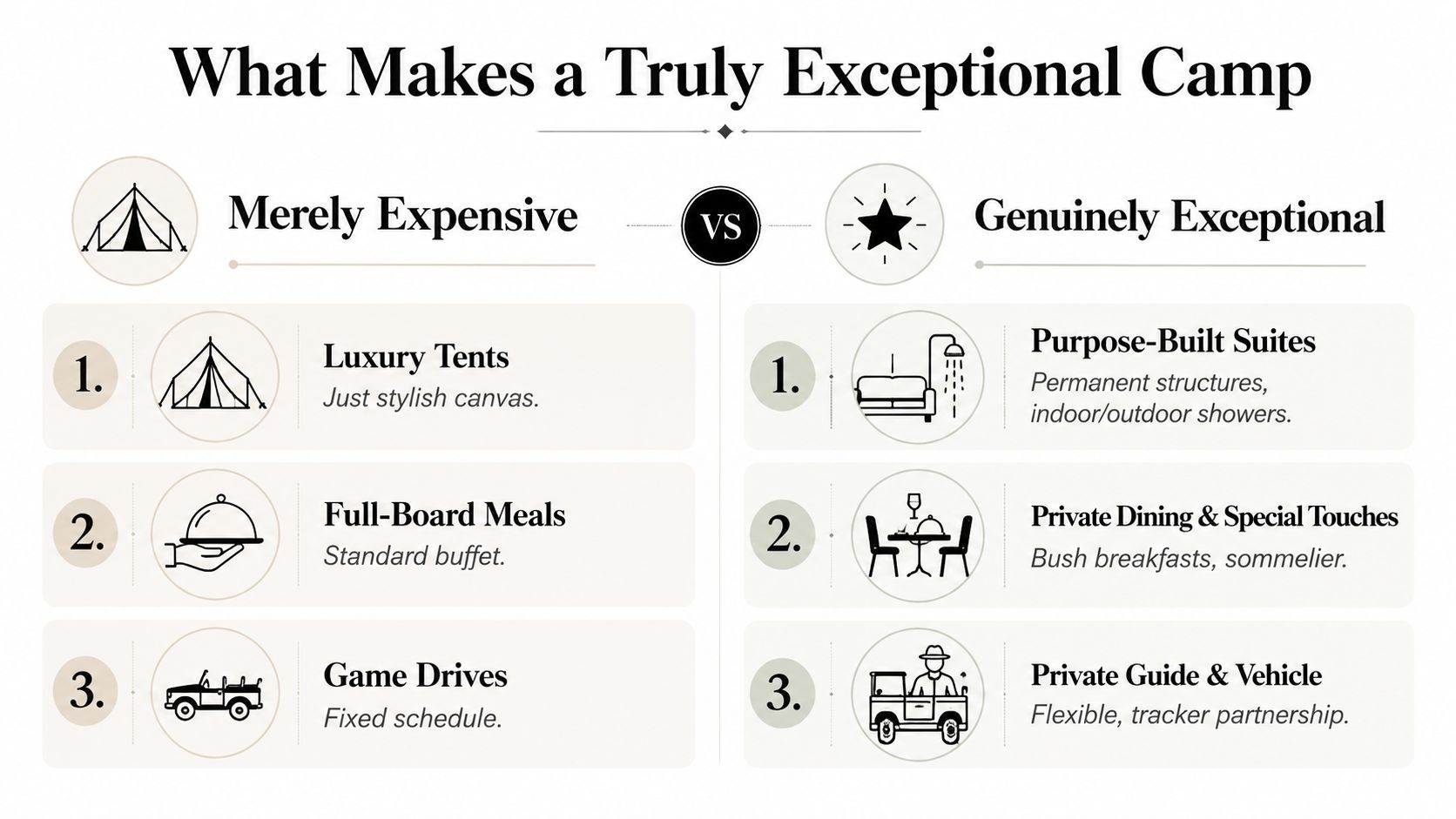
A polished tent doesn't automatically make a camp exceptional. The best camps solve operational problems that guests feel immediately: they reduce vehicle congestion, give guides room to adapt, and place you in a concession where the rules support richer exploration.
Start with the bed count
Bed capacity remains one of the clearest indicators of intimacy. The strongest private concessions often cap camps at 8 to 12 beds, which allows staff to know guests properly and makes a private vehicle arrangement more meaningful. Botswana's wider planning framework reinforces this preference for controlled density, as the Okavango source cited earlier records a proposed 24-bed maximum per lodge in the core area. The Okavango tourism and conservation overview provides that policy context.
Guide access matters just as much. I look for a guide-to-guest ratio of 1:4 or better when the camp positions itself at the very top of the market. A private guide and vehicle are more valuable than another decorative upgrade because they let you decide whether to stay with a leopard, leave early for a track, stop for photography, or spend an afternoon on the water.
Read the concession rules
A private concession can permit night drives, off-road tracking, and walking. Those permissions change the safari more substantially than a larger bathroom or a more elaborate wine list. National-park camps can still offer excellent guiding and comfort, but the operating framework may limit how close you can follow a track or how late you can remain in the field.
Larger branded properties tend to deliver polished service, consistent standards, wellness facilities, and strong family infrastructure. Smaller owner-run camps often offer more flexibility and deeper local guiding character. I'll choose the larger camp when service predictability or family logistics lead the brief, and the smaller camp when privacy and guiding take priority.
The expensive mistake: Booking a beautiful camp in a concession that doesn't permit the activities you actually want.
For a closer look at one of the Delta's high-end properties, this guide to Xigera Safari Lodge can help you assess design, positioning, and experience rather than relying on room photography alone.
A Realistic Seven to Ten Night Itinerary
A nine-night itinerary gives you enough room to combine water, dry-land predators, elephants, and remote concessions without turning every day into a transfer day. I'd structure it around contrasts, not a checklist of famous names.
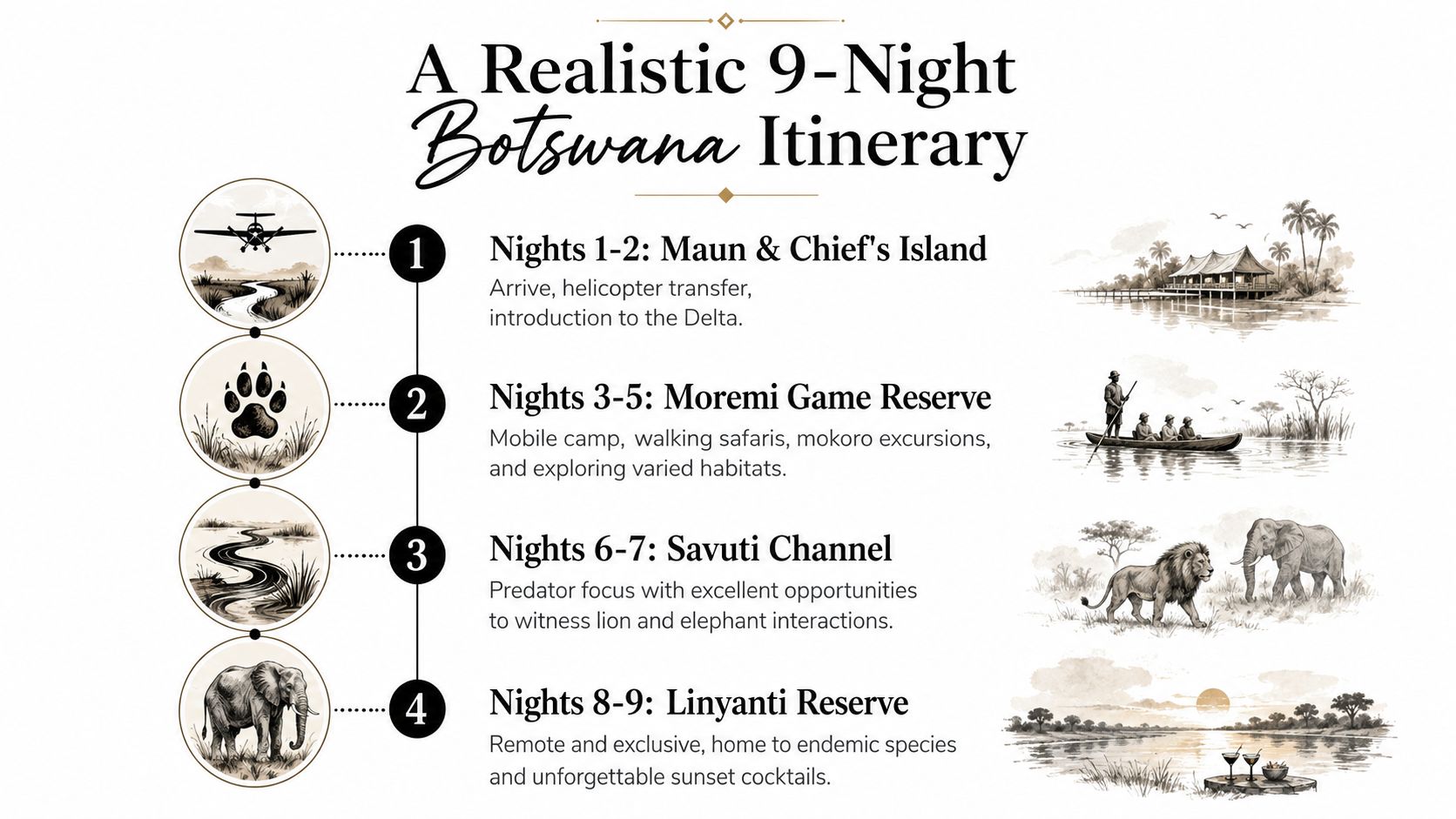
Nights 1 and 2 in the Okavango Delta
Arrive in Maun, then connect by light aircraft to a Delta camp. If the seasonal flood has reached the concession, make the first two nights about orientation: a gentle game drive, a mokoro excursion when conditions allow, and time to understand how water has shaped the island and channel system.
I wouldn't schedule an overpacked arrival day. The bush flight itself is part of the experience, and the first afternoon should leave enough space for a proper briefing and an unhurried sunset.
Nights 3 to 5 near Moremi
Move by charter to a private concession adjacent to Moremi for three nights. The itinerary shifts toward dry-land predator viewing, off-road tracking, and walking if the camp and conditions permit.
Three nights gives the guide time to read the area rather than chase a single sighting immediately. Charter flight times vary with the airstrip sequence, weather, and other guest movements, so the itinerary should be built around routing rather than promised minute-by-minute schedules.
Nights 6 and 7 along the Chobe River
Fly onward toward the Chobe Riverfront and change the rhythm completely. Replace the early vehicle routine with a river outing, watching elephants and buffalo approach the water from a boat rather than from a track.
This stop works particularly well for guests who want high sighting frequency and a visual contrast to the Delta. Kasane access can also make the riverfront a logical gateway or exit point, depending on the international routing.
Nights 8 and 9 in Linyanti or Savute
Finish in a Linyanti or Savute-style camp, where predator action and remote scenery provide a strong closing chapter. The final transfer may require another bush flight and a camp vehicle connection, so leave room for airstrip logistics and weather-related flexibility.
The order can be reversed when flood levels, camp inventory, or flight schedules demand it. What shouldn't change is the design principle: combine different habitats, avoid unnecessary backtracking, and give each camp enough nights to produce a real safari rather than a brief hotel stay.
The Real Cost of a Luxury Botswana Safari
Botswana's price makes more sense when you separate the camp rate from the transport and conservation infrastructure that connects the camps. Current market guidance places a typical 7-night luxury Botswana safari at about USD 12,000 to USD 25,000 per couple, before international flights. The same guidance estimates that bush flights for a multi-camp itinerary can add roughly USD 1,500 to USD 3,000 per person. This luxury Botswana safari cost guide explains why headline comparisons often understate the total.
The nightly rate may include accommodation, meals, drinks, guiding, and selected activities, but inclusions differ. Ask whether park or concession fees, air transfers, premium drinks, private vehicles, gratuities, and meet-and-greet services are included before comparing proposals.
Where additional spend changes the trip
Paying more has a clear return when it buys private guide-and-vehicle use, better concession access, or a camp with the water activities you want. Paying more for a room that sits beside a larger shared operation usually delivers a smaller practical improvement.
The table below uses qualitative planning categories where the brief doesn't provide verified component-level estimates. It keeps the verified overall market guidance separate from invented line items.
| Cost Component | Low Estimate (USD) | High Estimate (USD) |
|---|---|---|
| Seven-night luxury safari, per couple before international flights | 12,000 | 25,000 |
| Multi-camp bush flights, per person | 1,500 | 3,000 |
| Park and concession fees | Varies by itinerary | Varies by itinerary |
| Private guide and vehicle | Quoted by camp or operator | Quoted by camp or operator |
| Drinks and gratuities | Depends on inclusions and preference | Depends on inclusions and preference |
| Maun or Kasane VIP services | Quoted separately or included | Quoted separately or included |
A practical budget conversation should begin with the complete route, not a lodge's advertised nightly figure. Once you've selected the regions, ask the operator to price the flights, fees, vehicle arrangements, and arrival services as one package.
My recommendation: Spend first on privacy, guiding, and efficient routing. Add nights only when they introduce a genuinely different habitat or activity.
Permits, Conservation and Booking Logistics
Botswana rewards early, precise planning. I'd begin by confirming camp inventory 9 to 12 months ahead, especially if you want a specific private concession, peak flood travel, or adjoining rooms for a family. Deposits are commonly handled in USD, and the operator should explain cancellation terms before you commit.
The physical logistics are part of the booking, not an afterthought. Inter-camp transfers use light-aircraft charters, and luggage usually needs to travel in a soft bag within a 20kg limit. Hard-sided cases create problems on small aircraft, so pack for the aircraft system rather than for a conventional luxury hotel.
Build the reservation in the right order
1. Define the experience first. Decide whether water, predators, elephants, photography, walking, or privacy leads the brief.
2. Hold the camps. Secure inventory before finalising the most complex routing.
3. Map the air transfers. Check whether the flight sequence is direct, shared, or dependent on other guest movements.
4. Confirm inclusions. Ask specifically about park fees, concession levies, drinks, gratuities, private vehicles, and VIP airport handling.
5. Prepare for the bush. Use soft luggage, keep valuables accessible, and expect airstrip transfers rather than conventional airport services.
Botswana's conservation model relies on controlled development and high-value travel rather than unrestricted bed growth. Park fees, community-levy contributions, and concession contracts form part of the financial and administrative structure supporting protected areas and local participation. The operational result is a safari product built around limited inventory and carefully managed access.
When an advisor adds value
An agency with access to held allocations can sometimes solve a sold-out itinerary by shifting dates, changing the concession mix, or using late availability. That isn't a substitute for planning, but it can matter when a preferred camp is unavailable.
HauteBlack membership is one option for travellers who want a dedicated advisor and access to pre-released inventory, late-availability opportunities, and preferred air-transfer slots during high-demand flood periods. The HauteBlack news hub is the publisher's travel-insights page, while the practical work happens through the booking relationship.
Choosing the Right Botswana Safari for You
The right itinerary depends on what you want to notice each day. Couples often prefer a Delta camp with strong privacy and water access, followed by Chobe for a completely different riverfront finish. Honeymooners should prioritise a private suite, an adaptable guide, and enough unstructured time to enjoy camp rather than moving every other night.
Serious wildlife photographers should anchor in a private concession such as Khwai or Selinda during the dry-season predator concentrations, then add a river location only if elephants and boat photography matter. Families need a different filter. Two-bedroom suites, flexible drives, and guides comfortable with varied ages are more important than a camp's reputation among specialist photographers.
This 2026 guide to Botswana's Chief's Camp is relevant for travellers drawn to the Delta's predator country and high-end island setting. Repeat visitors who already know the classic 4x4 safari should consider a mokoro-led Khwai experience or a water-focused Delta camp during peak flood conditions.
| Traveller Type | Recommended Region | Sample Camp | Best Months |
|---|---|---|---|
| Couples and honeymooners | Okavango Delta, followed by Chobe | Mombo or Vumbura Plains, then a Chobe riverfront camp | Flood season for water, or dry season for concentrated game |
| Wildlife photographers | Khwai or Selinda private concessions | A camp with private vehicle access | Dry-season predator viewing |
| Multi-generational families | Moremi or Savute | Mombo or a Savute camp with family accommodation | Dry season for accessible game drives |
| Repeat safari travellers | Water-focused Okavango concession | Mokoro-led Khwai or Belmond Eagle Island | Peak flood conditions |
| Privacy-first travellers | Linyanti or a small private concession | A low-bed-count camp | Shoulder or dry-season dates, based on inventory |
Use three decision filters before requesting a proposal:
- Region priority: Choose Delta water and birds, Chobe volume, or private-concession solitude.
- Season preference: Decide whether flood access, dry-season tracking, green-season colour, or predator timing matters most.
- Transfer tolerance: Accept several bush flights for a multi-region itinerary, or stay longer in one concession for a slower pace.
If you're extending the trip with remote work or a longer personal journey, resources covering top travel ideas for digital nomads can help shape the non-safari portion without diluting the bush experience. My strongest advice remains simple: choose fewer, better-connected camps, and let the itinerary express your priorities.
HauteBlack can design and book a bespoke Botswana safari around your preferred camps, flood timing, private guiding, and charter routing, with the logistics handled as one coordinated journey. Visit HauteBlack to speak with an advisor about building your 2026 itinerary.
Explore Our Guides
Signature Experiences


