Haute Black Journal
Lima to Machu Picchu Tours: The 2026 Luxury Guide

Marlene Azeez
Director, HauteBlack
View all articles →
# Lima to Machu Picchu Tours: The 2026 Luxury Guide
Published August 16, 2026 by Marlene Azeez
You've landed in Lima with a carefully chosen hotel, a dinner reservation, and a simple question for tomorrow: fly to Cusco, or go directly toward the Sacred Valley? The answer isn't just about scenery or speed. Lima to Machu Picchu tours are controlled by scarce access, fixed entry windows, rail schedules, and altitude, so one missed connection can affect the centerpiece of the journey.
The right luxury itinerary doesn't try to overpower those constraints. It works with them. Your advisor secures the citadel admission first, places the rail journey around that commitment, and builds enough breathing room for weather, delays, and acclimatization. The result feels calm because the complicated decisions were made before you arrived.
Why the Lima to Machu Picchu Route Is Different
Your first morning sets the pattern. A private car collects you in Lima, your luggage is already tagged for the next leg, and your planner has to choose between a direct move toward the Sacred Valley or a night in Cusco. The decision affects rail boarding, altitude exposure, and how much margin remains before your Machu Picchu entry window.
This isn't a destination with unlimited daily access. Peru's Ministry of Culture set the daily maximum at 2,244 visitors in 2020, citing preservation needs and UNESCO guidance, then raised it to 4,044 per day in 2022. In 2025, the government maintained seasonal ceilings of 4,500 visitors in the low or regular season and 5,600 in the high season while a technical study continued. Those figures are documented in the official Machu Picchu capacity announcement.
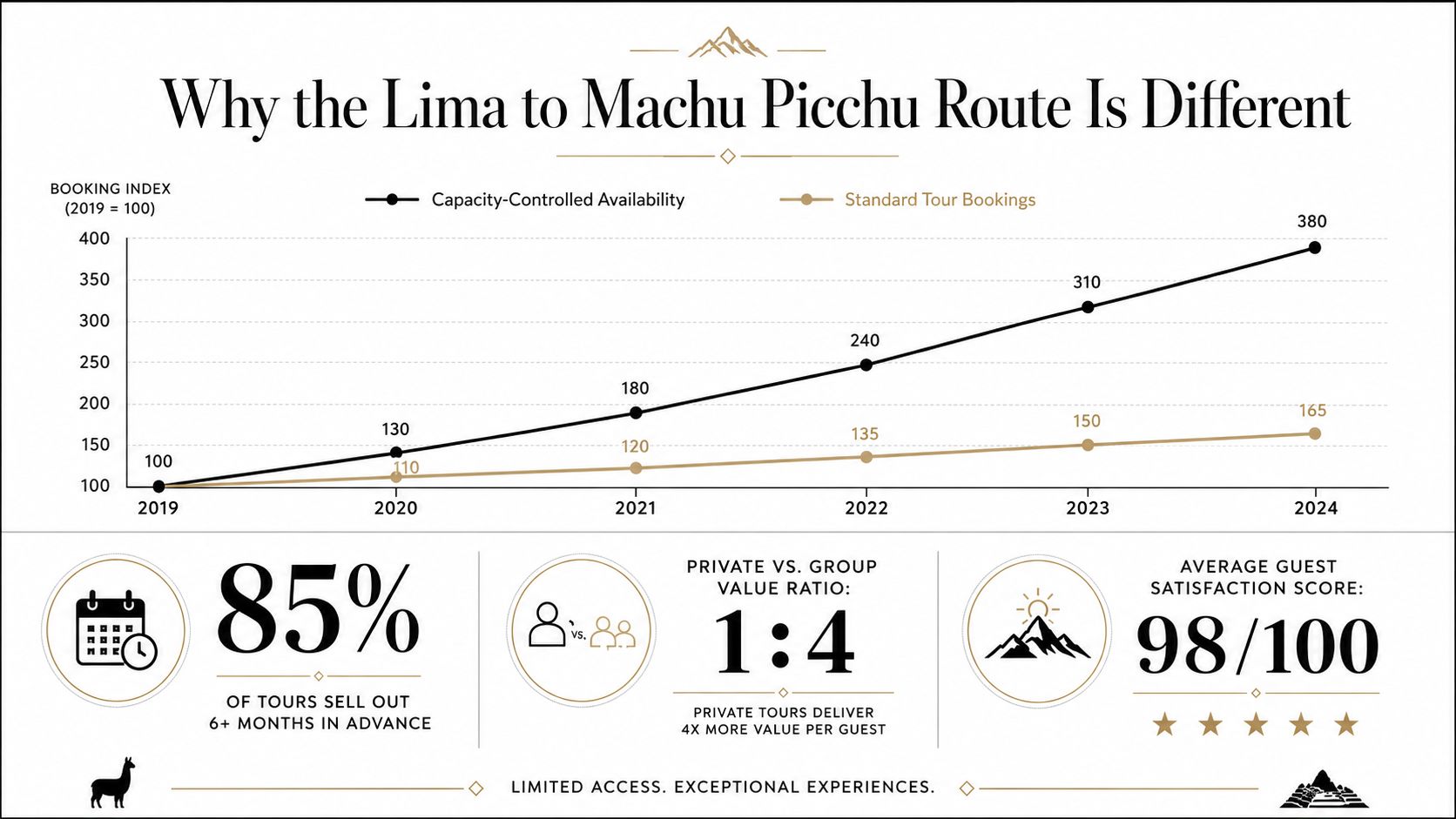
The site received more than 1.5 million visitors in 2024, according to the independent reporting summarized in the verified destination data. That combination, high demand and a deliberately limited supply of admissions, shapes everything from hotel availability to the value of a private guide and a well-timed rail departure.
Capacity changes the meaning of luxury
A self-built itinerary often starts with attractive elements in the wrong order. Travelers choose a hotel, select a scenic train, and only later discover that the preferred circuit or entry window isn't available. A professional planner reverses that process. The entry commitment comes first, then the rail class, hotel location, vehicle movements, and dining schedule are fitted around it.
The luxury advantage is not simply a nicer train. It's having fewer exposed points of failure.
That's why a polished journey can feel almost uneventful. Your guide knows where to meet you, your driver has a delay plan, and the hotel team understands the next morning's departure. If you're spending time in Lima before the Andes, arrange a comfortable departure from the airport with a book with LoungeDeal option rather than beginning the trip in an overcrowded terminal.
The route's history reinforces its importance. Machu Picchu received about 1.4 million visitors in 2017, roughly four times the level recorded in 2000, according to a historical tourism study. In the first nine months of 2025, tourism authorities reported 1,170,389 visitors, with 78.4% foreign travelers, as summarized in the verified tourism data. This is an international luxury product, not a casual add-on to a Lima stay.
The Two-Stage Transfer Explained
The efficient route has two distinct movements. First, you take a domestic flight from Lima to Cusco or the Sacred Valley area. Second, you board a train toward Aguas Calientes, also known as Machu Picchu Pueblo, and continue to the citadel by the assigned access arrangements.
The PeruRail guide to traveling from Lima to Machu Picchu confirms the practical structure and the rail-time variation. The journey from Ollantaytambo is typically about 1 hour 30 minutes, while departures from Poroy or Cusco can take about 3 hours 30 minutes or longer. Those are rail durations, not total door-to-door times, so your vehicle transfer, airport handling, and station timing still matter.
Cusco or the Sacred Valley
Cusco is the obvious aviation gateway, but it isn't always the best first overnight. The city's altitude can make an immediate arrival, transfer, and early citadel visit an unnecessarily aggressive plan. A lower-risk design often moves from the airport toward the Sacred Valley, where the itinerary can begin at a gentler pace before the rail departure.
The Sacred Valley option usually pairs naturally with Ollantaytambo. It shortens the rail leg and gives your driver more control over the day, but it requires careful coordination if your flight arrives late or baggage is delayed. Cusco offers more urban dining, cultural programming, and hotel choice, while the valley offers calmer pacing and a stronger acclimatization strategy.
| Transfer Option | Total Travel Time | Best For |
|---|---|---|
| Lima flight to Cusco, then rail from Poroy or Cusco | Longer rail component, about 3 hours 30 minutes or more from the Cusco area | Travelers prioritizing a Cusco stay and city experience |
| Lima flight to Cusco, private transfer to Ollantaytambo, then rail | Shorter rail component, about 1 hour 30 minutes from Ollantaytambo | Travelers seeking efficient rail access with Sacred Valley pacing |
| Lima flight toward the Cusco region, overnight in the Sacred Valley, then rail | Depends on flight and road timing, with an acclimatization buffer | Couples and families who value comfort over compression |
A same-day arrival-and-visit sequence is a poor choice for most luxury travelers. The Max's Luxury Rides guide is useful background for understanding how premium ground transportation can protect the itinerary when flights, station transfers, and hotel check-ins need to work as one plan.
Your planner should also treat the car service as part of the journey, not a gap between attractions. A private transfer services guide offers useful context on the standards to expect, including luggage handling, driver communication, and contingency planning.
Private vs Small Group Touring
The citadel experience changes most through guide quality, pace, and control, not through the label attached to the vehicle. A small group with an excellent archaeologically informed guide can be rewarding, especially for travelers who enjoy conversation and a shared sense of discovery. A private tour is better when your priorities are photography, family rhythm, quiet interpretation, or the ability to linger without negotiating with strangers.
A private guide can shape the explanation around your interests. One couple may want Inca engineering and ceremonial architecture. Another may prefer a concise historical narrative followed by time for photographs. Families may need pauses, while experienced travelers may want to move efficiently between viewpoints and preserve energy for the return rail journey.
Choose private when the schedule matters
Private touring earns its place when the entry window is tight or your party has different physical abilities. Your guide can coordinate directly with the driver, adjust the pace within the permitted route, and handle small decisions without waiting for a group consensus. That matters at a site where access isn't open-ended and a late arrival can compromise the visit.
Choose a small group when the itinerary is already stable and the guide is the main attraction. It's the sensible luxury choice for solo travelers, sociable couples, or repeat visitors who want expert interpretation without paying for exclusive staffing. The group should remain small, and the operator should explain the meeting point, walking pace, circuit, and rail coordination before you commit.
| Decision | Private Tour | Small-Group Tour |
|---|---|---|
| Guide attention | Built around your interests | Shared across the group |
| Pacing | Easier to adapt | Governed by the group |
| Photography | More discreet and flexible | More dependent on group movement |
| Families | Strong choice for mixed ages | Best for confident, compatible travelers |
| Value | Highest control | Better balance of expertise and cost |
Don't pay for private touring merely because it sounds more exclusive. Pay for it when the itinerary has meaningful personal variables. If your party is punctual, mobile, and comfortable with a fixed rhythm, a well-run small group may deliver the better balance.
The wrong compromise is a large group with vague meeting instructions. That format adds waiting at precisely the point where the destination offers the least flexibility.
Sample Itineraries for 2, 4 and 7 Days
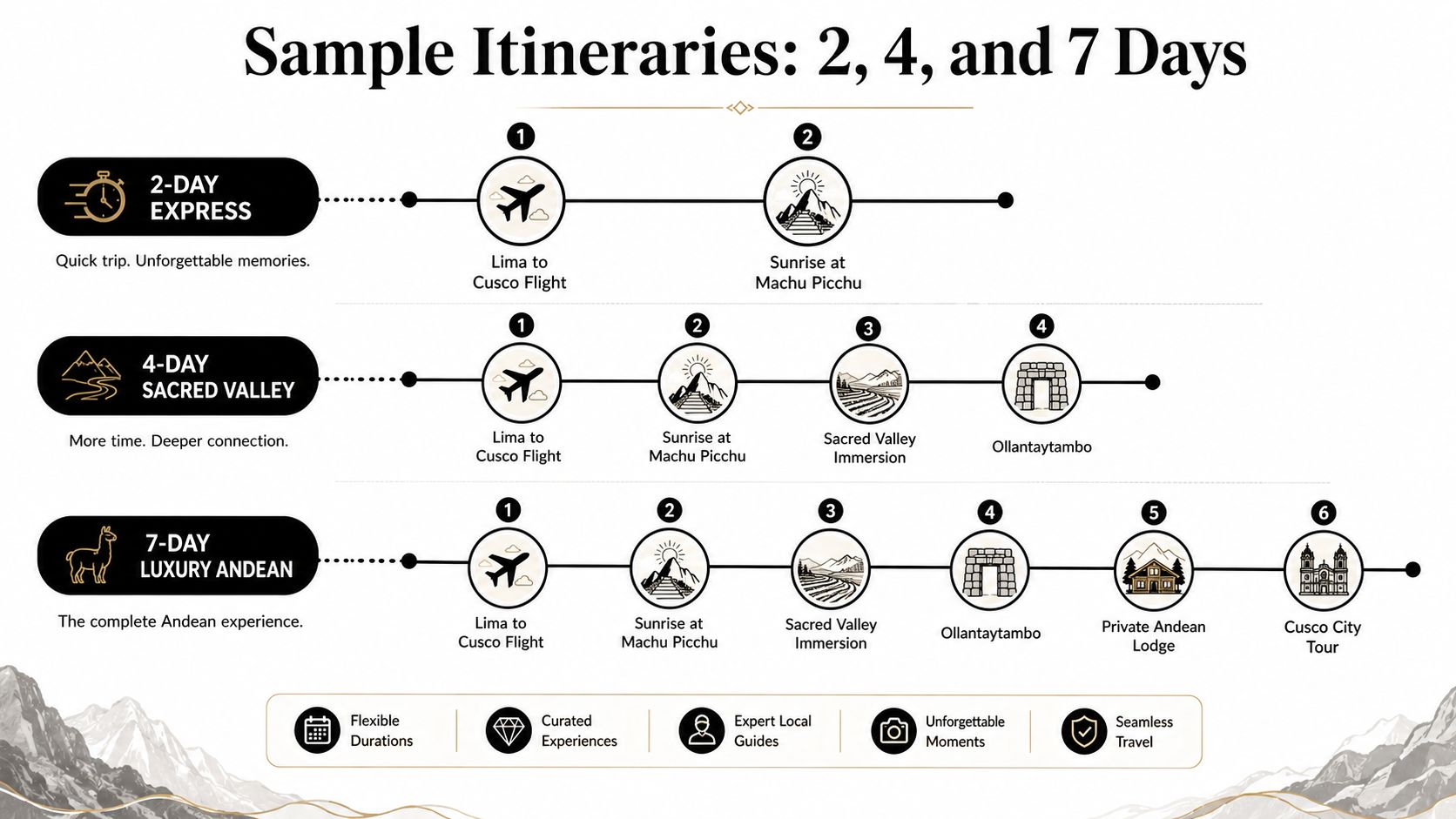
The right duration depends on whether Machu Picchu is the entire purpose of the trip or the centerpiece of a broader Andean journey. A two-day plan is possible, but it's an express operation. Four days creates a more composed Sacred Valley sequence. Seven days gives the altitude and culture enough room to feel intentional rather than compressed.
Two days for the focused traveler
Day one: Fly from Lima to Cusco, meet your private driver, and continue toward Ollantaytambo or the Sacred Valley. Board the rail service to Aguas Calientes only if the flight arrival, road transfer, and rail departure leave a proper margin. Overnight in Aguas Calientes, with the next morning's admission and guide coordination already confirmed.
Day two: Visit Machu Picchu during the assigned entry window, then return by rail and road to the Cusco area or connect onward. This plan suits a returning traveler who has already managed high-altitude destinations, travels with light luggage, and accepts that weather or transport disruption can remove flexibility.
I wouldn't recommend it for a first visit, a multigenerational family, or anyone arriving after a long international flight. The route has too many fixed elements to justify pretending it's a casual weekend excursion.
Four days for the best balance
Day one: Arrive from Lima and transfer to the Sacred Valley. Keep the afternoon light, with a relaxed meal and an early night at a valley property.
Day two: Explore the Sacred Valley with a private guide, including a selected combination of Pisac, Moray, Maras, or local craft experiences. Overnight near Ollantaytambo so the rail departure feels natural rather than rushed.
Day three: Take the train to Aguas Calientes, overnight there, and visit Machu Picchu on day four, or reverse the sequence if the entry window requires it. This is the itinerary I recommend most often because it protects the experience without turning every hour into a transfer.
For destination context and a broader cultural framework, see Lords of the Inca.
Seven days for a complete Andean immersion
A seven-day design can include Cusco, the Sacred Valley, Machu Picchu, and an additional Andean experience such as the Maras Salt Pans or Rainbow Mountain. I'd place the first acclimatization period in the Sacred Valley, not schedule a demanding high-altitude excursion immediately after the Lima flight, and reserve a full day for Cusco's historic center.
The accommodation strategy should match the geography. Use a refined Cusco hotel for the city portion, a strong Sacred Valley property for the slower middle, and an Aguas Calientes hotel that protects the Machu Picchu morning. If the traveler prefers a more remote atmosphere, a private Andean lodge can replace one valley night, but only if the transfer doesn't erode the buffer that makes the longer itinerary worthwhile.
The seven-day version is the right answer for honeymooners, families, and travelers who care as much about the journey through the Andes as the citadel itself.
VIP and Upgrade Options Worth the Splurge
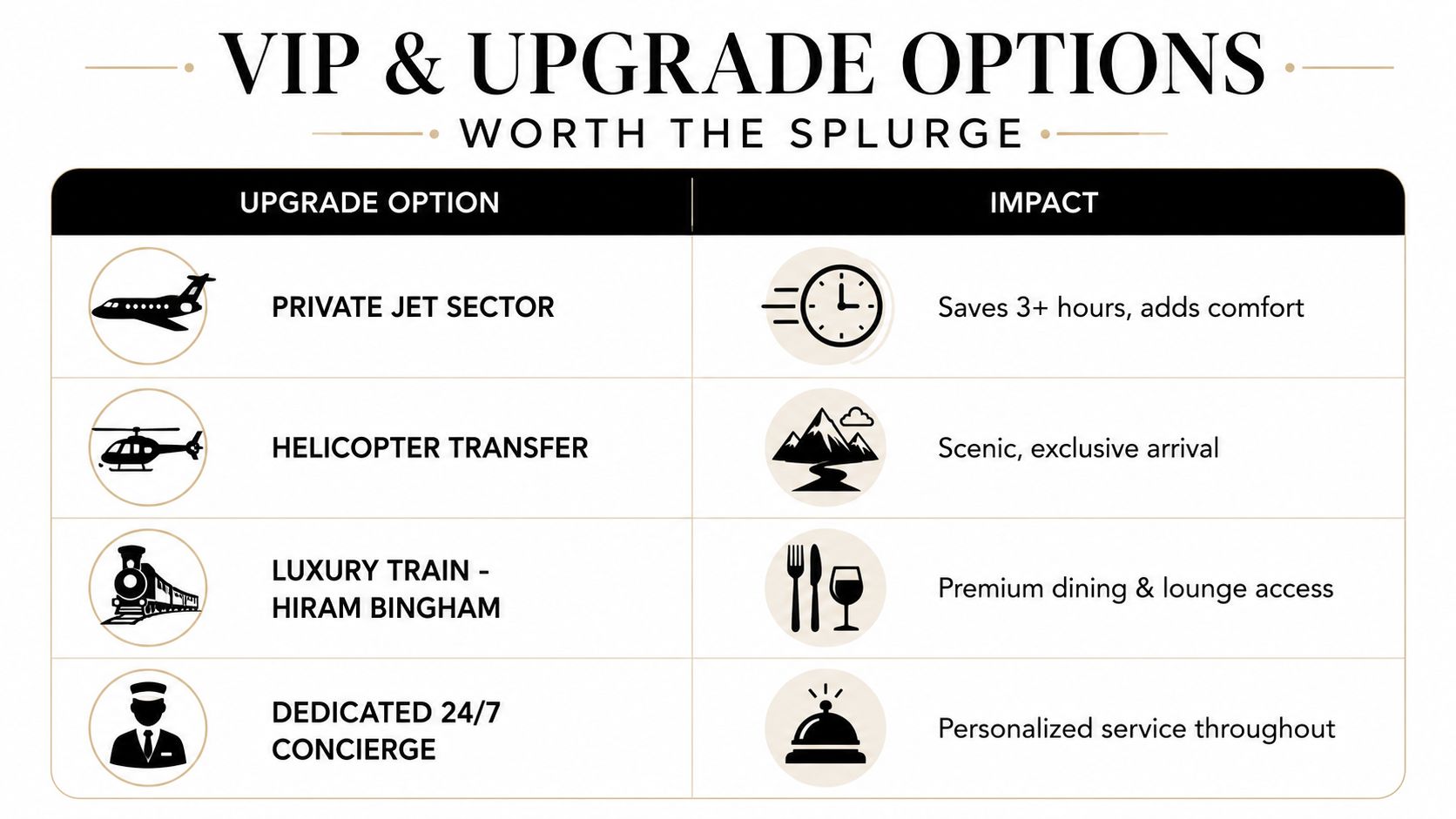
Not every upgrade improves the journey. Spend first on the elements that protect access and energy, then add glamour where it changes the day.
A private jet sector from Lima to Cusco can simplify the aviation experience, reduce airport friction, and give your party more control over departure handling. It doesn't remove altitude, rail schedules, or entry rules, so it's most valuable when time is scarce or the group includes executives, children, or older travelers who benefit from a quieter airport experience.
A helicopter transfer is a different proposition. It offers a scenic, exclusive arrival and can replace part of the road movement, but it remains subject to operational, weather, and landing constraints. Choose it for the experience and the sense of occasion, not because it magically makes Machu Picchu unrestricted.
Train upgrades with a purpose
The Belmond Hiram Bingham is the right splurge for travelers who want the rail journey to feel like a formal occasion, with premium dining and lounge access built into the experience. It's not merely a faster solution. Its value comes from service, atmosphere, and the deliberate transition from the Sacred Valley toward Machu Picchu.
The PeruRail Vistadome Observatory is better for travelers who want the scenery to remain central. The glass-sided observation experience makes the journey feel open and scenic, while the Hiram Bingham leans toward ceremony and polished hospitality. Choose one, not both, unless rail travel itself is a major interest.
The hotel and concierge decision
A hotel near the citadel can reduce the strain of the morning, but it still won't create a private entry window if official access rules don't allow one. What it can do is protect sleep, simplify the transfer to the entrance, and make the assigned arrival feel less exposed to road or rail variability.
A dedicated 24/7 concierge earns its keep when your trip includes multiple countries, private aviation, complex family needs, or a tight onward schedule. It gives one person responsibility for the moving parts, including restaurant changes, luggage questions, transport updates, and communication between hotels.
The luxury travel guidance for Machu Picchu is a useful reference when weighing those upgrades against the actual structure of the route.
Spend on control before spectacle. A private transfer, reliable guide, and protected buffer usually improve the trip more than an ornamental upgrade added to an unstable itinerary.
Permits, Entry Times and Baggage Logistics
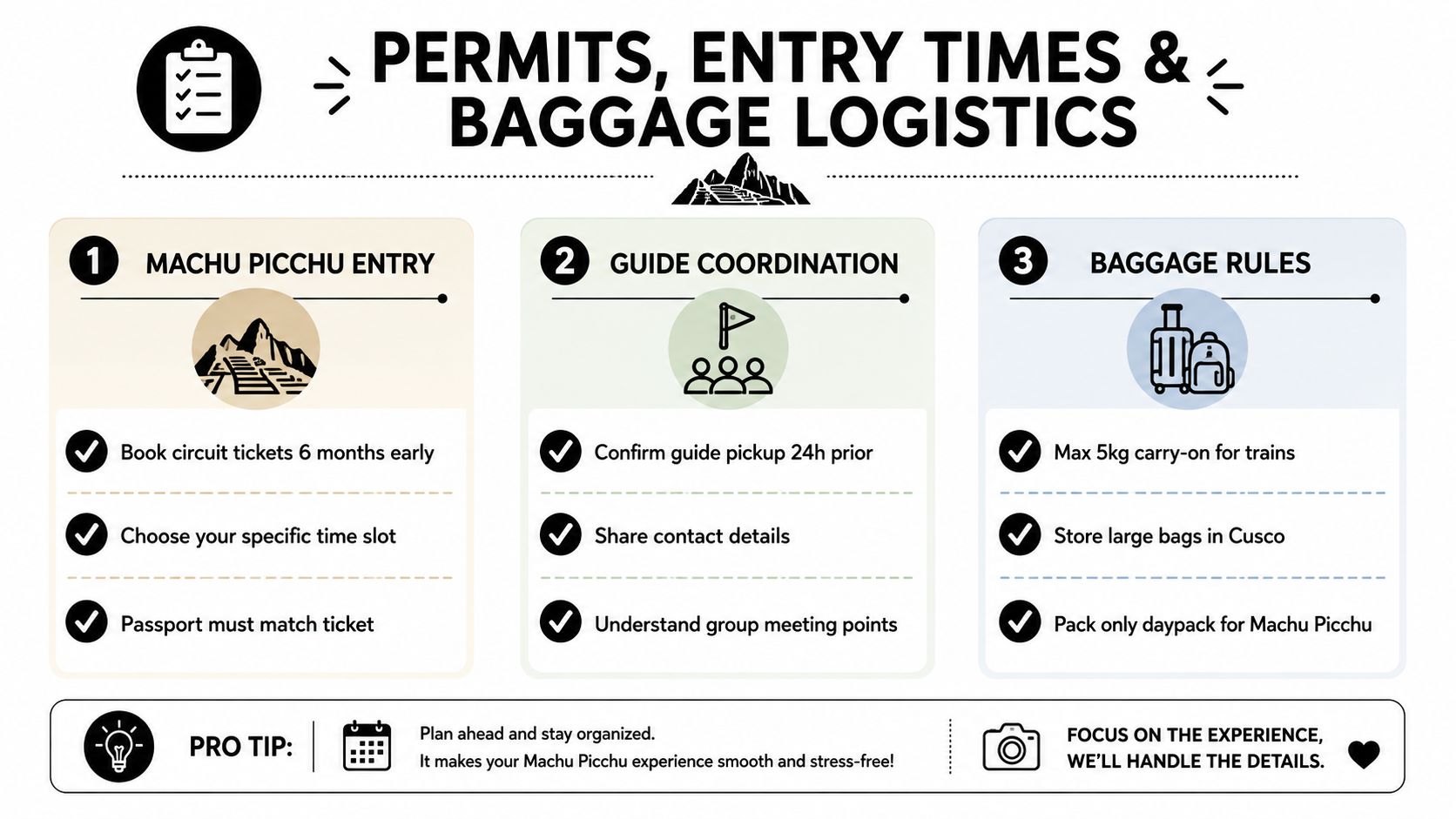
The administrative details are where expensive trips become fragile. Machu Picchu uses timed entry and daily capacity controls, so your planner should confirm the circuit, date, time window, passport details, guide arrangement, and transport sequence before treating the itinerary as final.
The practical guidance summarized in the 2026 Machu Picchu visitation rules describes fixed entry windows, no open-ended access, and seasonal capacity of roughly 4,500 visitors in the low season and 5,600 in the high season. Missing the assigned window can invalidate the visit and leave little room to improvise.
The planner's checklist
- Secure the admission first: Confirm the specific circuit and entry window before booking nonrefundable rail arrangements.
- Match identity details: Your passport information must align with the ticket, and your advisor should verify this before departure.
- Coordinate the guide: Establish the meeting point, guide contact, and pickup procedure in advance. Don't assume the guide will find you automatically at the gate.
- Protect the rail connection: Build a buffer between vehicle arrival, station access, and the train departure. A luxury vehicle can't compensate for a missed fixed rail schedule.
- Separate large luggage: Keep the Machu Picchu portion to a practical daypack and arrange storage for larger pieces through the hotel or operator.
- Confirm restricted items: Ask specifically about cameras, tripods, drones, and oversized equipment before packing them.
The rail operator's baggage policy also deserves attention. Rules can vary by service, and a traveler arriving with a large suitcase may find the station or train less accommodating than expected. Your advisor should provide the current allowance for the exact departure, not a generic answer copied from an old itinerary.
Your ticket, guide, rail departure, and passport should be checked as one system. Treating them as separate reservations is how avoidable mistakes happen.
What Luxury Machu Picchu Tours Cost in 2026
There's no responsible universal price for a 2026 Machu Picchu journey without knowing the party size, hotel category, rail service, guide format, and aviation plan. The cost spread comes from control. A standard small group may share guides and transfers, while a private itinerary can require dedicated vehicles, exclusive guiding, flexible handling, and more carefully protected rail arrangements.
The most important caveat is that the verified data doesn't provide reliable 2026 dollar ranges. I won't manufacture them. Any advisor who publishes precise package prices without stating the inclusions is giving you a marketing number, not a planning tool.
Compare inclusions, not headline totals
A standard small-group journey generally offers the lowest luxury threshold. It can work when dates are flexible, the group is comfortable with fixed pacing, and the rail service is practical rather than ceremonial.
An upgraded small-group plan may add a premium rail experience such as Belmond Hiram Bingham or the PeruRail Vistadome Observatory, but the upgrade should be evaluated against the full day's schedule. If the train service doesn't improve your arrival margin or comfort, it's an atmosphere purchase, not an operational one.
A fully private itinerary typically includes a Cusco-based guide, private vehicle movements, a more customized pace, and stronger coordination between hotel, rail, and admission arrangements. The premium becomes more defensible for families, honeymooners, and travelers with limited time.
A full VIP package may incorporate private jet sectors or helicopter transfers. Those services can add comfort, privacy, and a distinctive arrival, but they won't eliminate official entry windows or daily capacity controls.
Ask for a line-item proposal
Request these details in writing:
- Guide format: private or shared, with language and specialization stated.
- Rail class: exact service name, not simply “luxury train.”
- Hotel location: Cusco, Sacred Valley, Ollantaytambo, or Aguas Calientes.
- Admission details: circuit, date, and assigned entry window.
- Transfers: vehicle type, luggage handling, and contingency coverage.
- Exclusions: meals, entrance fees, gratuities, domestic flights, and emergency changes.
Two quotes can differ substantially because one includes private staffing and protected transfers while the other leaves those items for you to arrange. Compare the operational architecture before comparing the total.
Packing, Health and When to Book
Altitude deserves a conservative strategy. Lima is a sensible starting point because it lets you recover from the international flight before entering the Andes, while the Sacred Valley can provide a gentler transition than an immediate, activity-heavy Cusco schedule. Don't plan a demanding hike on the first high-altitude day, and speak with your physician about any medication or health concern before departure.
Pack for changing Andean conditions rather than a single forecast. Use layers, a waterproof outer shell, sun protection, comfortable walking shoes, and a small daypack. Keep a second set of essentials in your carry-on in case checked luggage arrives later than you do.
A practical booking sequence
1. Start with the Machu Picchu date: Choose the preferred travel period and ask your advisor to assess admission availability before confirming the rest.
2. Build the rail plan around the window: Select Ollantaytambo or a longer Cusco-area departure based on pacing, not just scenery.
3. Place acclimatization deliberately: Give the first high-altitude days a lighter rhythm and avoid stacking long transfers with strenuous activities.
4. Choose the season for your priorities: May through September is generally treated as the drier Andean travel window, while rainy-season travel can offer greener terrain and a different atmosphere. For current seasonal luxury guidance, consult Haute Black's rainy season Peru guide.
5. Confirm every handoff: Your advisor, hotels, guides, rail operator, and drivers should share the same arrival times, passport details, luggage plan, and emergency contact.
Begin planning as soon as your dates are meaningful, particularly for peak travel periods. Capacity-controlled access rewards early coordination, while last-minute flexibility is usually an illusion.
Haute Black designs bespoke Peru journeys around the realities that make Lima to Machu Picchu tours demanding, including timed entry, premium rail, private aviation, helicopter transfers, and preferred hotel benefits. Visit Haute Black to start a tailored conversation with a luxury travel advisor who can secure the right sequence before availability disappears.
Explore Our Guides
Signature Experiences