Haute Black Journal
Private Transfer Services: Luxury Ground Transport Guide

Marlene Azeez
Director, HauteBlack
View all articles →
# Private Transfer Services: Luxury Ground Transport Guide
July 1, 2026
You've landed after a long-haul flight, your phone is reconnecting, the arrivals hall is loud, and three different people are offering a ride before you've even cleared the terminal. Your luggage is delayed by minutes that feel longer, your hotel is expecting you, and the first impression of the trip is already fraying.
That's the moment discerning travelers get wrong when they treat ground transport as an afterthought.
The airport transfer isn't a minor detail. It determines whether the trip begins in control or in friction. For an ultra-high-net-worth traveler, that distinction matters. So does discretion, timing, and the quality of the operator behind the wheel. The difference between a random car and a proper private transfer service isn't cosmetic. It's operational.
The First and Last Mile of Luxury Travel
A premium itinerary can unravel in the final ten minutes of planning.
You can have the right suite, the right table, the right aircraft, and still arrive into disorder because no one properly handled the ground segment. Airport arrivals are where even experienced travelers lose time and patience. The terminal is crowded, app-based availability shifts without warning, and local taxi standards vary wildly by destination.
A well-arranged private transfer changes the entire mood of the journey. You move from aircraft to car without negotiation, queueing, or improvisation. The environment is controlled. The route is known. The handoff is calm.
Why this moment matters more than most travelers admit
Luxury doesn't begin at the hotel check-in desk. It begins the second you step off the plane.
That first mile into the city sets the tone for the entire stay. The last mile back to the airport does the same in reverse. If either is sloppy, the trip feels less considered than it should. If both are handled correctly, everything feels continuous.
The best transfer is the one you barely notice because nothing goes wrong, nothing feels uncertain, and nothing requires your intervention.
I advise clients to think about airport transfers the way they think about security, villa staffing, or private aviation handling. It's part of the system, not an add-on. If you want a sharper breakdown of what a polished airport arrival should look like, this guide to seamless VIP airport transfers is worth reviewing.
The real luxury is removal of friction
The point isn't just comfort. It's elimination of exposure to avoidable variables.
That means no haggling at the curb, no uncertainty around the route, no waiting while a driver circles, and no need to explain yourself after a long flight. A private transfer service turns a chaotic public environment into a managed private one. That's why serious travelers book it early and don't revisit the decision.
What Exactly Are Private Transfer Services
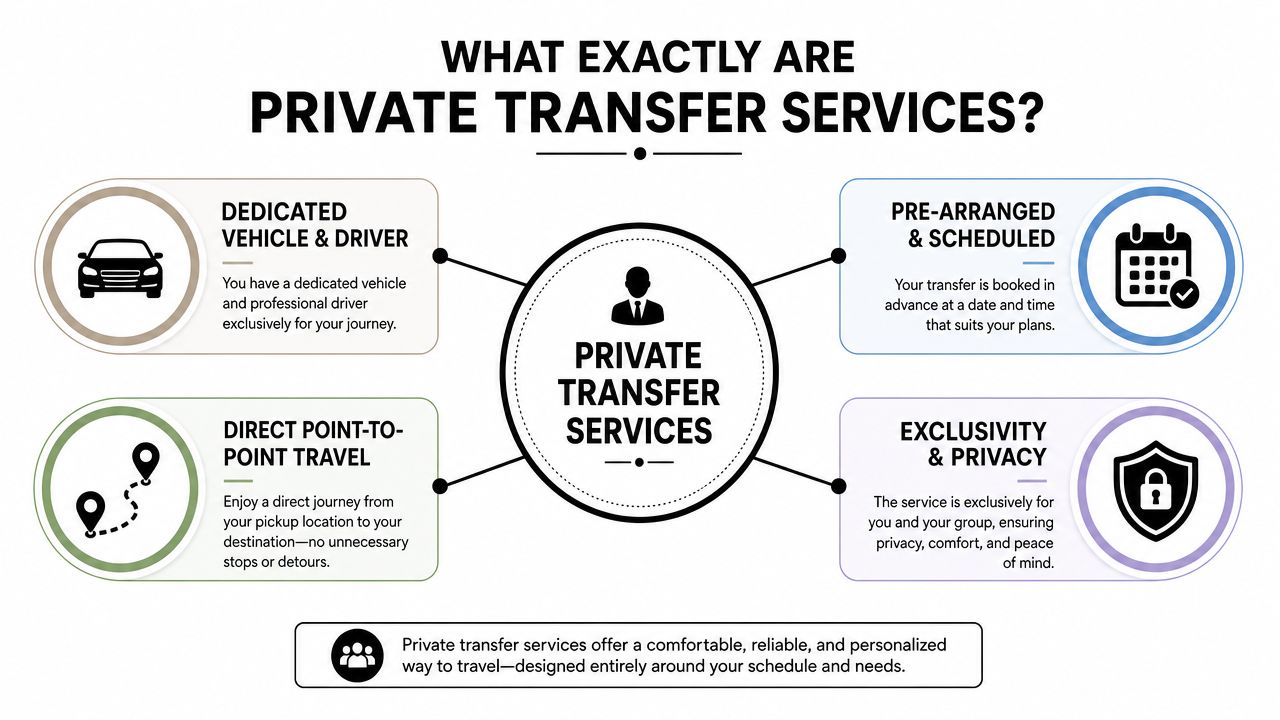
A private transfer service is a pre-booked ground transport arrangement where a specific vehicle and chauffeur are dedicated to you or your group. It's not a taxi. It's not a ride-share request sent into the market. It's not a hotel shuttle making multiple stops.
The distinction matters because the service model is different from the start.
What you're actually buying
You're buying dedicated capacity, controlled timing, and a direct route.
According to DRVN's explanation of airport transfer services, private transfer services operate on a pre-booked model with a dedicated vehicle, which reduces average transit time by 30 to 40 percent compared to shared shuttles. The same source notes that pricing is fixed before booking, which removes surge pricing risk that can inflate costs by up to 200 percent during peak periods in major cities.
That's the operational advantage in plain terms. You reserve the outcome before the trip begins.
How it differs from the usual alternatives
A taxi is reactive. You find one when you need one.
A ride-share is conditional. The app may produce a car, or it may produce delay, surge, confusion over pickup zones, or the wrong vehicle class.
A hotel shuttle is shared transport. You're moving on the operator's schedule, not yours.
Private transfer services are closer to a mobile concierge function than a basic ride. The vehicle is assigned in advance. The driver is briefed. Flight timing is tracked. If your arrival shifts, the dispatch side adjusts. That's why the experience feels quiet and inevitable rather than improvised.
Where this matters beyond major gateways
The model becomes even more valuable in destinations where local transport quality is uneven or where language, routing, and reliability create unnecessary friction. In places where travelers want certainty from the moment they land, services such as private transfers in Albania show why pre-arranged transport is often the smarter choice than hoping the airport curbside ecosystem will meet a premium standard.
Use a simple test when evaluating whether you need a proper private transfer. Ask yourself three things:
- Is timing critical: If a missed dinner, yacht departure, meeting, or security handoff creates downstream problems, pre-book the car.
- Is privacy important: If you don't want your movements exposed to a random driver marketplace, don't use one.
- Is the arrival unfamiliar: If the destination isn't one where you know the airport flow and local norms, remove uncertainty before departure.
If any one of those answers is yes, the decision is already made.
The Spectrum of Private Transfer Options
Not all private transfer services are built around the same brief. The right vehicle depends on who's traveling, how much luggage is in play, what level of visibility is acceptable, and whether the transfer is only transport or part of a larger arrival strategy.
The mistake is to choose by category name alone. “Luxury car” tells me almost nothing. The correct choice comes from matching the transport form to the actual use case.
Sedan, SUV, van, or something faster
For a solo traveler or couple, a luxury sedan usually gives the cleanest experience. It's discreet, efficient, and appropriate when the priority is a direct airport-to-hotel or airport-to-residence transfer without drawing attention.
SUVs are better when luggage volume is higher, when security presence matters, or when the route involves terrain, weather, or road conditions that demand a more commanding vehicle. Families often prefer them because the boarding process is simpler and the cabin feels more forgiving after a long flight.
Executive vans and sprinters are the right answer for family offices, assistants traveling with principals, small entourages, or multi-generational groups. They also work well when everyone needs to arrive together rather than in staggered cars.
For some itineraries, road transport isn't the final form. Helicopter or private aviation links may become part of the transfer logic when road congestion, distance, or estate access makes terrestrial movement inefficient. In those cases, the ground transfer isn't a stand-alone booking. It's one component in a larger choreography.
What should be inside the vehicle
Premium transport isn't defined by a badge on the hood. It's defined by how well the vehicle supports the traveler inside it.
According to Alpha Zug's overview of private transfer services, vehicle specifications for premium private transfers are benchmarked to include amenities such as Wi-Fi and climate-controlled interiors. The same source notes that hourly limo pricing ranges from $75 to $250, and that private transfers account for 65% of all ground transport bookings among UHNW travelers within a $10B+ global luxury ground transport market.
That tells you two things. First, this is an established premium category, not a niche indulgence. Second, the service expectations are already set at a high level.
| Travel need | Best-fit option | Why it works |
|---|---|---|
| Solo executive arrival | Luxury sedan | Low profile, efficient, polished |
| Couple on leisure itinerary | Luxury sedan or SUV | Comfort without excess footprint |
| Family with significant luggage | SUV or executive van | Better capacity and easier handling |
| Group arrival or convention movement | Executive van or larger group vehicle | Keeps timing coordinated |
| Congested or remote destination transfer | Ground plus helicopter or aviation support | Saves time and preserves schedule integrity |
Practical rule: Choose the smallest vehicle that delivers the privacy, luggage capacity, and service function you actually need. Excess for its own sake rarely feels luxurious.
The final decision should align with the wider itinerary. If the transfer connects to villas, estates, private terminals, or multiple hotels, the transport plan should be built with that full sequence in mind. When clients need that level of orchestration, ground transportation planning for luxury itineraries belongs in the conversation early, not after flights are ticketed.
Strategic Benefits for Discerning Travelers
The true value of private transfer services isn't leather seating or bottled water. It's strategic control.
That's why this category keeps growing. The projected pre-book airport transfer market is expected to expand from USD 13.4 billion in 2025 to USD 38.8 billion by 2035, with the private segment holding 68.4% of the market in 2025. The same projection says international travelers account for 61.5% of the market, which tracks with what seasoned cross-border travelers already know. Predictability becomes more valuable when you're moving across jurisdictions, languages, and operating standards.
Privacy isn't a perk
For public figures, founders in active deal cycles, family offices, and anyone who values discretion, the transfer isn't just transport. It's protected transition space.
In a proper private transfer, you're not entering a marketplace. You're entering a managed environment. The route, the pickup, and the handoff are set in advance. That matters when you don't want conversations overheard, habits observed, or arrival patterns exposed to strangers.
Time recovered is value recovered
A CEO can use the ride to prepare for a board meeting. A family can move directly from airport to residence without managing children, bags, and uncertainty in a public queue. A honeymooning couple can preserve the emotional pace of the trip instead of breaking it with logistics.
The point is simple. Every transfer either protects momentum or destroys it.
Here's where discerning travelers see the difference most clearly:
- At arrival: You avoid the slow decision-making that follows a tiring flight.
- In transit: You use the vehicle as a private continuation of your travel environment.
- At destination: You arrive composed, not depleted.
Reliability feels invisible when it works. That's why so many travelers underestimate its value until they experience the alternative.
Personalization changes the standard
The best private transfer services don't just move the client. They support the context around the client.
That can mean the right child seat already installed, the preferred cabin temperature set before boarding, the route chosen for discretion rather than scenery, or the vehicle class aligned to a security profile rather than aesthetics. Those details don't read as dramatic from the outside. For the person traveling, they change everything.
Understanding Cost and Booking Expectations
If a transfer provider can't explain pricing clearly, move on.
The strongest private transfer services use fixed pricing because fixed pricing protects the traveler from uncertainty. You know the cost before the vehicle is dispatched. You know the class of car being booked. You know whether the service level justifies the number attached to it.
Why fixed pricing matters
A metered journey shifts risk to the passenger. A surge-based app does the same.
A premium transfer should do the opposite. It should lock in the outcome and remove pricing volatility from the experience. That's especially important in major urban markets where local conditions can turn an ordinary ride into a costly annoyance.
A concrete example helps. Black Car Everywhere's Las Vegas airport pricing lists a luxury sedan transfer from Las Vegas Airport to Downtown Las Vegas at a fixed $120, while an SUV for the same route is priced at $146. That's what transparency looks like. No guessing. No curbside negotiation. No post-ride surprise.
What to confirm before you book
A polished booking process should feel concise, but the operator should still gather the right information. If they don't, they can't execute correctly.
Confirm these points before you approve the reservation:
- Flight details: The provider should have the exact arrival or departure information, not just a rough time.
- Passenger count and luggage profile: This determines whether the proposed vehicle is suitable.
- Pickup protocol: Ask how the meet-and-greet works and where the handoff takes place.
- Included services: Clarify whether waiting tied to flight timing is handled operationally within the service model.
- Special requirements: Security preferences, child seats, wheelchair access, multiple stops, or privacy concerns should be noted in advance.
When to book
For straightforward airport transfers in well-served cities, early booking is wise because it lets you secure the operator you want rather than whoever is left.
For high-season travel, major events, holiday periods, or itineraries involving family offices, assistants, or multiple vehicles, treat transport the same way you treat top suites and villa inventory. Reserve early, confirm details in writing, and don't assume quality remains available at the last minute.
How to Choose a Provider Safety and Discretion First
Most travelers still evaluate private transfer services by the wrong criteria. They ask what car shows up. They should be asking how the operator runs.
That blind spot is common enough to be measurable. A 2025 report on luxury traveler safety diligence found that 43% of luxury travelers fail to confirm whether their transport provider holds critical safety certifications such as ISO 39001. That's a serious lapse. If the provider doesn't proactively disclose safety audit processes or driver vetting frequency, you shouldn't assume the standards exist.
Surface luxury is easy to fake
Any operator can photograph a black SUV well.
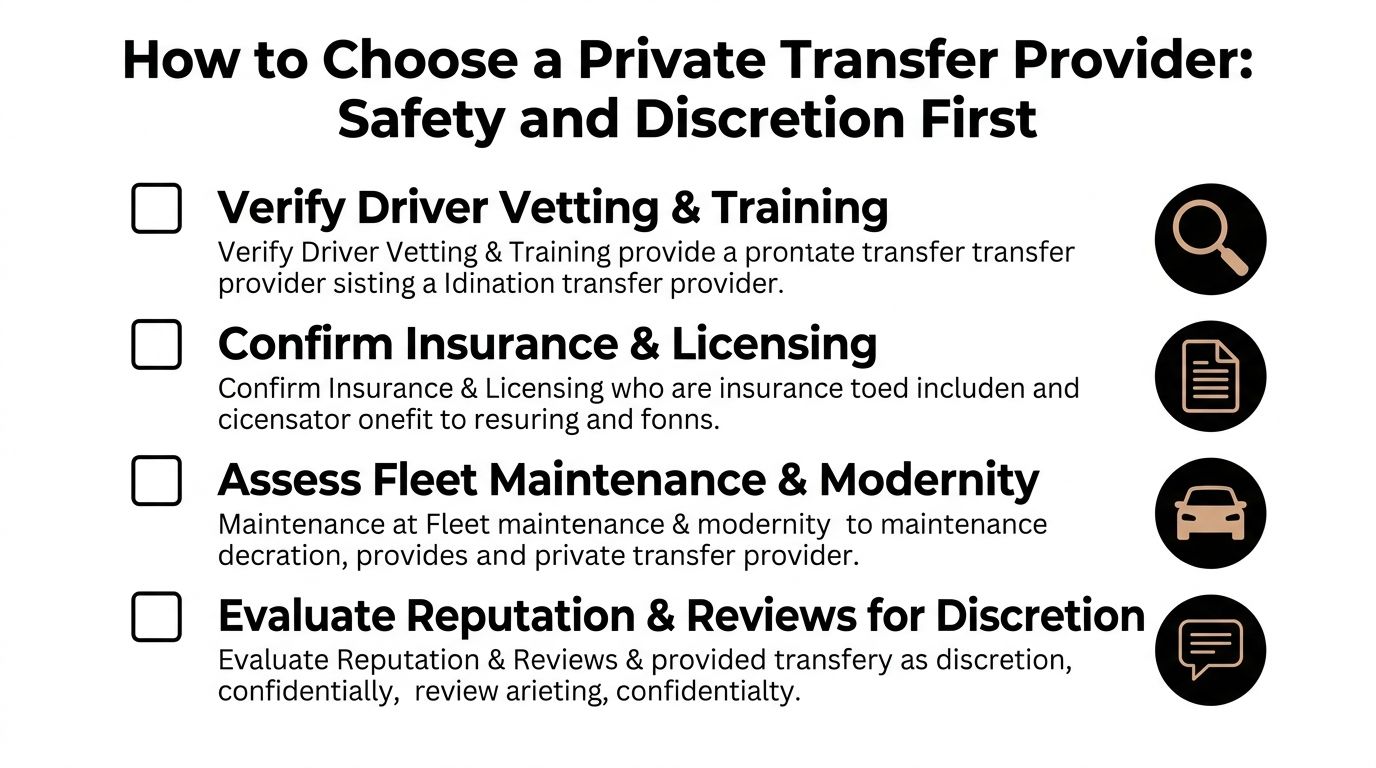
What separates a serious provider is what you don't see in the marketing gallery. Insurance. licensing. maintenance discipline. chauffeur screening. dispatch competence. incident protocol. Those are the factors that protect you when the journey doesn't go exactly to plan.
A beautiful car with weak operating standards is not a premium service. It's just a polished risk.
Questions worth asking directly
Don't soften these questions. A credible operator will answer them without discomfort.
- How are chauffeurs vetted: Ask about background checks, training standards, and whether vetting is repeated.
- What safety standards are documented: If certifications exist, the provider should be able to identify them clearly.
- How is the fleet maintained: You want proof of process, not vague reassurance.
- Who sees client itinerary data: Privacy failures often happen on the administrative side, not in the vehicle.
- How are delays or irregular arrivals handled: A provider's answer reveals whether dispatch is reactive or disciplined.
Ask for evidence, not adjectives. “Premium” and “VIP” are marketing words. Vetting records, insurance documentation, and operational clarity are what matter.
Reputation should include discretion
Public reviews can tell you whether a provider is punctual or pleasant. They rarely tell you enough about confidentiality.
For high-profile clients, discretion has to be part of the service culture. That means restrained communication, secure handling of itinerary details, and chauffeurs who understand when silence is the correct form of professionalism. If you want a wider lens on how elite concierge operators think about these standards across travel categories, this guide to luxury travel concierge services is a useful reference point.
The Haute Black Difference Seamless Journeys Redefined
Most transport failures happen because no one is managing the full picture.
Flights are booked in one place. Hotels in another. Ground transport gets handled late by an assistant, a hotel desk, or a local contact with uneven standards. The traveler ends up with fragmented service and inconsistent execution.

That's the wrong model for serious travel. The right model treats the transfer as one link in a larger luxury ecosystem, tied to private aviation, hotel arrivals, villa access, event timing, and personal preferences that shouldn't need to be re-explained at every step.
Why integrated travel management changes the result
When a single trusted advisor manages the journey, the transfer stops being a transaction and becomes part of a synchronized plan.
That's where consistency becomes possible. The same team can coordinate airport handoffs, preferred vehicle types, route discretion, special requests, and complex movement across multiple destinations. For travelers moving between resorts, residences, yachts, private terminals, or helicopter connections, that integration matters more than the individual car booking.
A fragmented provider stack creates gaps. A curated ecosystem closes them.
Here's a closer look at the travel environment that supports that standard:
What discerning clients should expect now
The modern premium traveler should expect more than a car and a confirmation email.
They should expect a vetted operator network, a single point of contact, and service continuity across borders. They should expect the same level of care whether the movement is a straightforward city transfer or a layered itinerary involving jets, helicopters, villas, and multiple properties. They should also expect their preferences to compound over time so the experience improves rather than resets.
That's the difference between booking transportation and building a travel system. One solves a ride. The other protects the entire journey.
Haute Black delivers that higher standard through a private membership and bespoke travel platform built for travelers who don't outsource important details to chance. If you want a trusted partner to coordinate private transfer services, private aviation, preferred hotel access, and discreet door-to-door execution across a global itinerary, explore Haute Black.
Explore Our Guides


Signature Experiences


