Haute Black Journal
How to Make Itinerary Planning for VIPs

Marlene Azeez
Director, HauteBlack
View all articles →

Most luxury travel advice is wrong about the objective. A great itinerary doesn't maximize the number of attractions, restaurant reservations, or cities a traveler can fit into a day. It protects the principal's energy, preserves access to the experiences that matter, and remains usable when traffic, weather, delayed departures, or a late lunch disrupt the original plan.
That distinction matters because travel planning is a staged decision process, not a single booking event. A Google-commissioned Ipsos survey across 15 major markets found that 32% of respondents were thinking about traveling, 26% were browsing or researching ideas, and 10% had already booked a trip during the survey period from February 10 to 13, 2022. Google's travel search analysis also identified searches for areas to stay, the best time to go, flights, entry requirements, insurance, and cancellation policies.
For executive assistants, travel advisors, and UHNW principals, the practical lesson is clear. How to make itinerary planning work is less about adding more ideas and more about turning those ideas into a verified, resilient operating plan.
Rethinking the Luxury Travel Schedule
A dense schedule can look impressive in a proposal and feel punishing on the ground. Four museums, a private lunch, a cross-city transfer, a shopping appointment, and a tasting menu may appear to justify the investment in a destination. In practice, the traveler may remember little beyond the car journeys, rushed meals, and pressure to leave one excellent experience before it has finished.
Luxury travel should optimize weighted utility, not activity volume. Cultural value, exclusivity, recovery time, comfort, and logistical reliability all deserve a place in the planning decision. A private gallery opening may carry more value than three conventional sightseeing stops, especially if the principal can enjoy it without watching the clock.
Practical rule: If removing one activity makes the day feel dramatically better, that activity probably shouldn't have been scheduled as a core commitment.
Score the day, not just the destination
Before approving a daily plan, score it against four operational measures:
- Transfer risk: How many movements depend on traffic, airport procedures, ferries, border crossings, or a narrow connection?
- Physical intensity: Does the day involve walking, heat, altitude, uneven terrain, or prolonged standing?
- Time-zone burden: Is the traveler arriving from a long-haul flight or adjusting to a new sleep pattern?
- Flexibility: Which experiences can be shortened, postponed, or replaced without damaging the day?
This scoring method makes hidden fatigue visible. A day with one private cultural appointment and an unstructured afternoon can be more valuable than a day filled with nominally prestigious access. The itinerary should give the traveler room to linger when the experience deserves it, rather than forcing every transition to happen on schedule.
Buffer days are particularly important around milestone celebrations and long-haul arrivals. A 2026 global survey found that 82% of respondents taking milestone trips planned buffer days around the central celebration, while 72% intended to extend the stay by at least three or four days. American Express's 2026 travel trends also identified family travel as the most-planned leisure trip type in 2026, with 32% of surveyed U.S. travelers expecting to travel with family, including on multigenerational journeys.
Make room for deliberate idleness
Unstructured time isn't an omission. It's a form of access. It allows a family to use a hotel properly, gives a principal space for calls or recovery, and lets a guide respond to changing interest instead of forcing the group through a preset sequence.
A day trip can still be carefully designed without becoming overprogrammed. For example, a traveler considering a Las Vegas departure can use this Grand Canyon day trip planning resource to compare route logic and timing before deciding whether the excursion belongs in the itinerary. The useful question isn't how many viewpoints can be added. It's whether the transfer, experience duration, and return timing support the traveler's energy for the following day.
The best luxury itinerary often contains fewer anchors, stronger transitions, and a fallback experience close to the hotel. It should feel spacious because the planning was exacting, not because the advisor left the day to chance.
Capturing Hard Constraints and Traveler Priorities
A flawless itinerary begins with an intake, not a hotel search. If the advisor starts by collecting attractive destinations, the planning process becomes a wishlist exercise. If the advisor starts by identifying constraints, preferences, and consequences, the itinerary becomes a workable operating model.
Use a structured intake before selecting destinations. Record the answers in a shared document that the executive assistant, advisor, household staff, and relevant suppliers can reference.
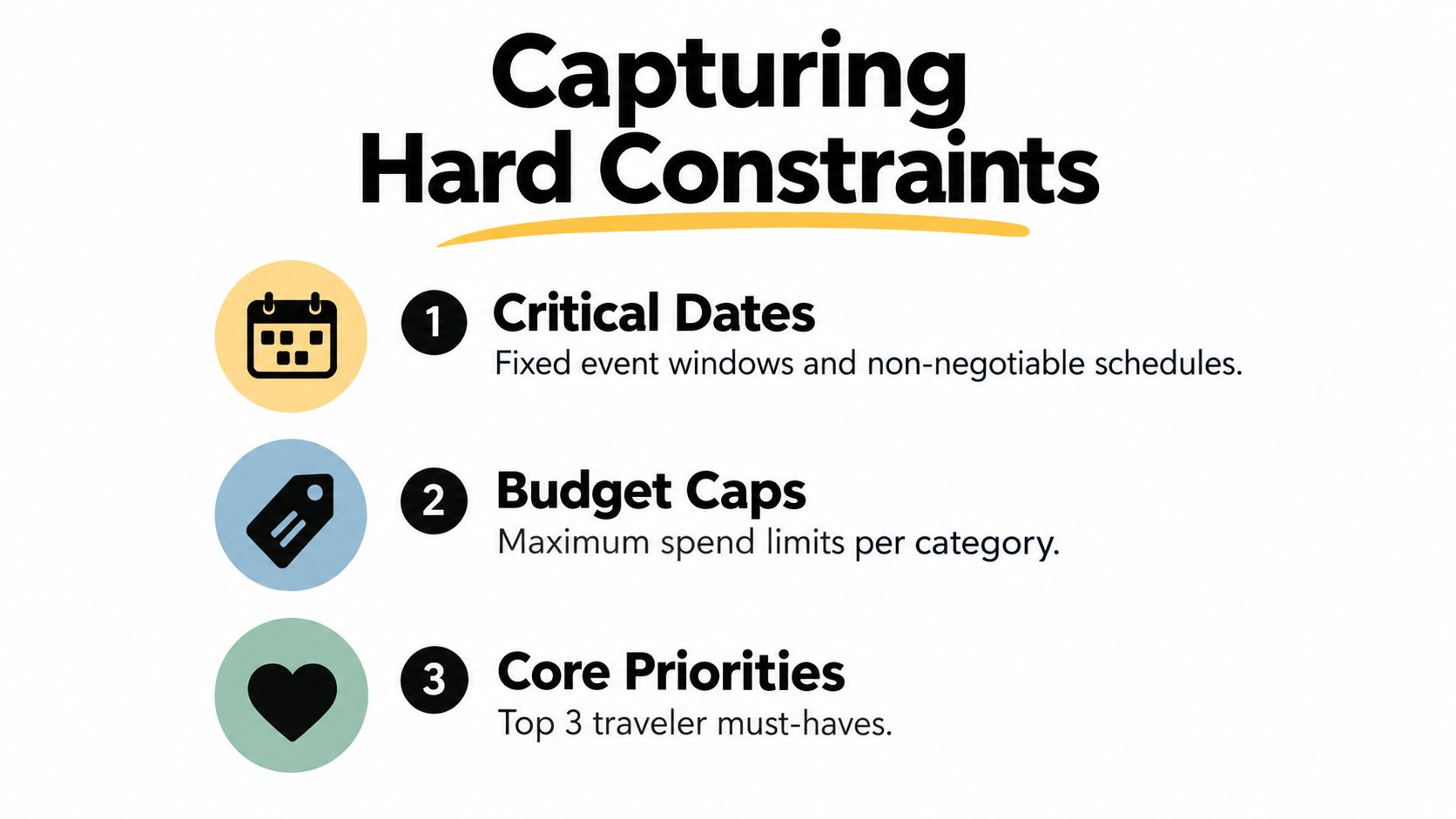
Start with what cannot move
First, document the fixed elements:
- Critical dates: Capture departure and arrival windows, board meetings, celebrations, school schedules, medical appointments, and fixed return times.
- Arrival and departure realities: Record the actual landing time, preferred airport, baggage requirements, immigration expectations, and the traveler's tolerance for a same-day connection.
- Lodging geography: Note whether the traveler needs to be near a client, a venue, a private terminal, a ski lift, a safari airstrip, or a particular neighborhood.
- Mobility requirements: Include walking tolerance, stairs, vehicle access, luggage handling, wheelchair or hoist needs, and the distance acceptable between drop-off points and entrances.
- Body clock and pacing: Ask about sleep patterns, early-morning aversion, preferred breakfast timing, mid-day rest, heat tolerance, and appetite after flights.
- Dietary and medical needs: Record allergies, religious requirements, preferred meal rhythm, medication logistics, and access to appropriate facilities.
The luxury travel advisor responsibilities guide is useful context for understanding why this work extends beyond selecting hotels. An advisor coordinates preferences, reservations, transportation, and access conditions into one coherent plan. That coordination should begin before any nonrefundable commitment.
Separate preferences from hard constraints
Ask the traveler to rank priorities rather than approving every preference as equal. A principal may say they want art, wellness, local cuisine, shopping, and complete privacy. The advisor must determine which three elements define success and which can yield when timing becomes difficult.
Use a simple hierarchy:
1. Non-negotiable: The experience, date, access condition, or comfort requirement must be protected.
2. Preferred: The element should be included if it doesn't threaten a core commitment.
3. Optional: The element can be removed without disappointing the traveler.
This distinction prevents a scenic detour from compromising a private museum appointment or a late lunch from jeopardizing an airport transfer. It also gives the advisor permission to say no early, before suppliers are booked and expectations harden.
Build each activity as a point of interest with a value score, visit duration, location, opening window, and reservation condition. Academic itinerary systems describe this as a constrained optimization problem, often using a Tourist Trip Design Problem or a time-dependent Orienteering Problem with Time Windows. Research on itinerary optimization explains why merely listing desirable stops isn't enough when time, geography, preferences, and opening hours interact.
The working principle is straightforward: collect constraints first, then optimize the experience around them. Don't ask whether the itinerary can fit one more stop. Ask whether that stop improves the journey enough to justify its energy and operational cost.
Strategic Routing and Stochastic Time Budgeting
Most itinerary failures occur between the headline experiences. A perfect hotel and an exceptional guide can't compensate for a missed flight, a rushed border crossing, or a chauffeur waiting at the wrong terminal. Routing needs its own strategy.
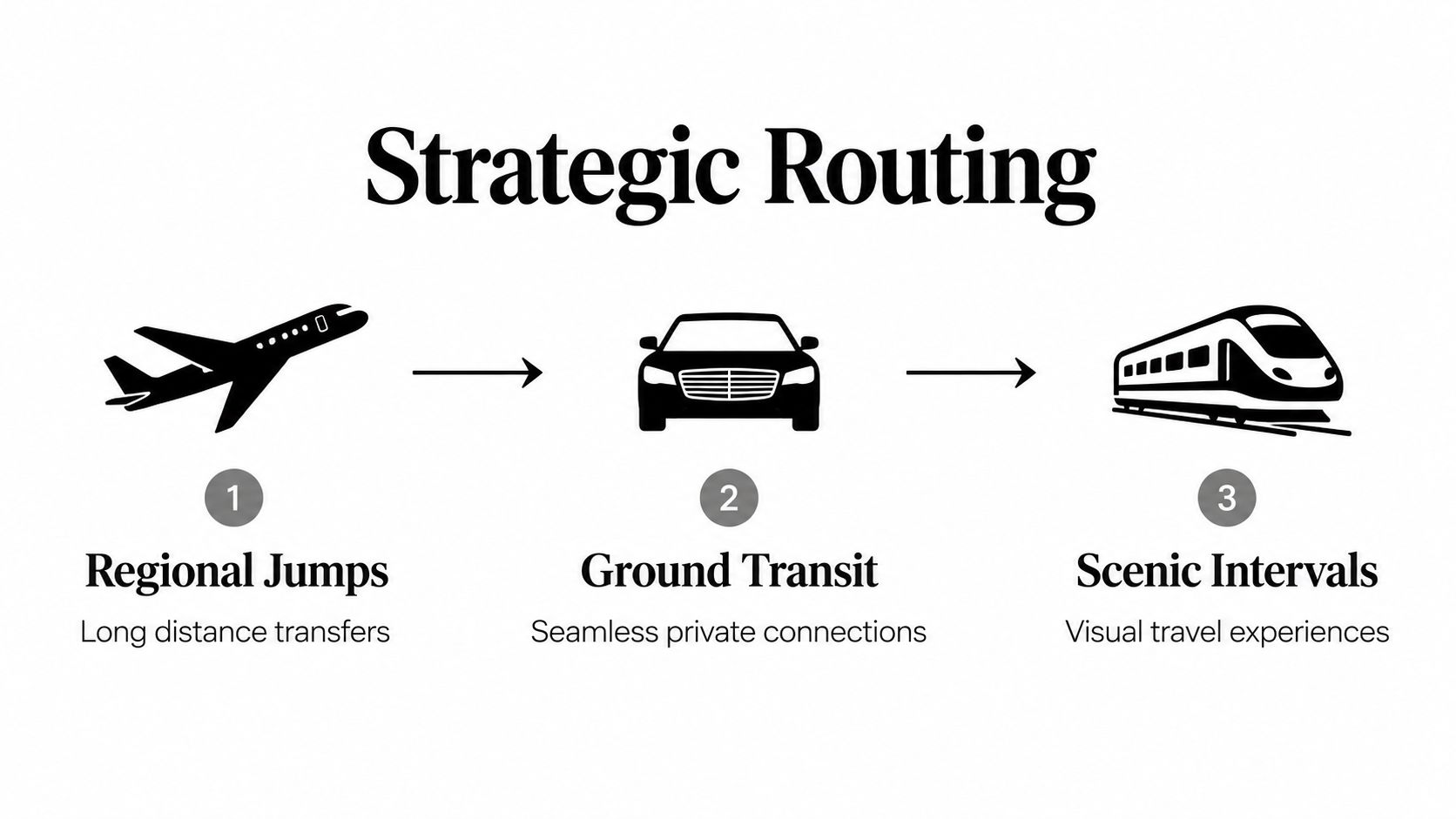
Classify every internal movement into one of four categories:
- Long regional jumps: Use private aviation or premium nonstop commercial flights when distance and timing justify them.
- Scenic interludes: Choose rail, river travel, or a carefully designed road journey when movement itself is part of the experience.
- Final-mile cultural arrivals: Use the transport mode that delivers the traveler into the destination with the least friction, including a private vehicle or helicopter only when it materially improves access or timing.
- Urban transfers: Choreograph vehicle positioning, luggage handling, VIP meet-and-greet, lounge access, and hotel arrival as one handoff.
This framework stops planners from treating every transfer as a generic car ride. A helicopter may be appropriate for a remote access problem or a meaningful time saving. It shouldn't be added merely because it sounds premium. Rail may be slower than flying but superior when the route is scenic, the station is convenient, and the journey provides recovery time.
Replace optimistic timing with scenario timing
A single travel-time estimate is not a plan. For each movement, establish a base duration and then add a buffer based on uncertainty. Consider traffic variance, airport security, immigration, weather, luggage delivery, late departures, vehicle positioning, and the consequences of missing the next reservation.
Separate the day into hard commitments and flexible elements. Flights, private aviation slots, timed museum entries, restaurant deposits, rail departures, and guide availability are hard commitments. Shopping, a neighborhood walk, a casual drink, and an optional viewpoint are flexible. Put flexible activities at the edges of the day so they can be shortened or removed without creating a chain reaction.
Test every important day under three conditions:
| Scenario | Planning question | Required response |
|---|---|---|
| Normal conditions | Does the route feel comfortable without rushing? | Keep the planned sequence and monitor handoffs. |
| Moderate delay | Can the principal still reach every critical reservation? | Remove or shorten flexible activities. |
| Severe disruption | What remains possible if the primary route fails? | Activate a nearby fallback and protect the next anchor. |
Reject a plan if a moderate delay causes a critical reservation to fail. That standard may reduce the number of scheduled experiences, but it protects the journey's purpose.
Research on two-stage itinerary optimization models incorporates stochastic traffic time, with an initial route plan followed by adjustments once uncertainty is observed. The study of resilient itinerary optimization reports improved traveler utility while maintaining high reliability and operator profitability. The practical translation is simple. Build the first version with uncertainty in mind, then recalculate when conditions change.
A delay shouldn't force the advisor to improvise from scratch. Record the assumptions, buffer sizes, cancellation deadlines, driver instructions, and decision owner for each critical movement.
Before continuing, use this strategic routing walkthrough as a visual reference for how planes, vehicles, and trains can work together within a coherent journey.
Verifying Access and Managing AI Recommendations
AI is useful for generating possibilities. It isn't a substitute for verified inventory, supplier relationships, or human judgment.
A language model may suggest a restaurant that has closed, describe an amenity a hotel doesn't offer, or present a standard tour as private access. It may also miss the operational detail that determines whether a VIP experience is actually available, such as a venue's entrance protocol, guide language, security requirements, blackout dates, or the difference between a private room and a private event.
That makes a strict human-override framework essential.
Use AI for alternatives, never authority
The safest workflow has four stages:
1. Define the constraints: Give the system dates, locations, traveler priorities, mobility needs, dietary requirements, preferred pace, and hard commitments.
2. Request alternatives: Ask for several routes, experiences, or neighborhood combinations. Don't ask AI to make the final payment decision.
3. Verify critical details: Confirm operating hours, admission rules, transport connections, cancellation terms, visa implications, and inventory through the official provider or relevant authority.
4. Approve before booking: A human advisor, executive assistant, or principal must approve nonrefundable commitments and high-consequence routing.
Recent cross-market research found that 33% of travelers would allow AI to spend up to $1,000 without approval, rising to 41% among solo travelers, while 73% said their primary goal when using AI for travel suggestions was saving money. Mastercard's 2026 travel research shows why adoption shouldn't be confused with a desire for full autonomy.
The numbers point to a trust gap. Travelers may welcome AI for cost comparison and inspiration while reserving financial and safety decisions for themselves.
Protect the decisions that carry consequences
Never delegate the following to an algorithm without human verification:
- Visa-sensitive routing: Confirm entry rules, transit permissions, passport requirements, and documentation with official authorities.
- Tight airport transfers: Validate terminal changes, meet-and-greet locations, security procedures, luggage handling, and realistic connection time.
- Nonrefundable deposits: Confirm the supplier, date, cancellation deadline, inclusions, and payment terms before approval.
- Medical and accessibility needs: Obtain direct confirmation from the property, carrier, restaurant, or activity provider.
- Exclusive access: Ask who is providing the access, what exactly is private, whether the named person or guide is confirmed, and what happens if the venue changes its policy.
A verified VIP experience has an owner. Someone can identify the supplier, confirm the booking status, explain the access conditions, and provide a contact number for the day itself. If no person can answer those questions, the experience belongs in the inspiration file, not the operational itinerary.
AI can accelerate research. Human oversight converts suggestions into dependable travel.
Executing the Plan with VIP Logistics and Contingencies
Consider a multigenerational South Africa journey built around safari, the Garden Route, and Cape Town. The attractive version of the itinerary moves quickly from Johannesburg or Hoedspruit to a private reserve, then continues through coastal scenery and the Winelands. The operational version begins by asking what happens after the long-haul arrival, who handles the first luggage transfer, and how much energy the family has before the first game drive.
For a luxury South Africa route, a commonly recommended sequence combines Johannesburg or Hoedspruit for safari access, Sabi Sands for premier game viewing, the Garden Route, and Cape Town, with at least four nights in a private reserve. This South Africa luxury itinerary guidance emphasizes matching the arrival city to the first experience, avoiding ambitious same-day connections after a long-haul flight, and using vetted chauffeurs for city and Winelands travel.

Build the handoffs before the activities
The traveler shouldn't have to solve the journey at every transition. Assign responsibility for each handoff:
- Airport team: Confirm arrival monitoring, meet-and-greet location, fast-track eligibility, luggage collection, and vehicle position.
- Chauffeur: Hold the correct vehicle, understand the passenger's preferred pace, and know the fallback route and stop points.
- Lodge or hotel: Confirm arrival time, dietary needs, room configuration, luggage delivery, and the first meaningful activity.
- Guide: Know which interests are primary, which family members need a lower-intensity option, and when the group can leave early.
- Advisor or assistant: Maintain the master itinerary, monitor disruption, and authorize changes according to the principal's preferences.
The premium VIP airport transfer planning guide helps frame the airport arrival as a coordinated service rather than a vehicle reservation. A chauffeur waiting at the wrong exit is not a minor inconvenience when a family has just crossed time zones and a lodge transfer has a fixed departure window.
Give every anchor a nearby fallback
Test the safari day under normal conditions, moderate delay, and severe disruption. Under normal conditions, the family reaches the lodge, settles into rooms, and joins the planned activity. Under moderate delay, the lodge holds a flexible arrival meal and replaces the first game drive with a private property experience. Under severe disruption, the advisor protects the next day's core activity and shifts the group into a geographically coherent alternative rather than sending them across the region.
The same approach applies in Cape Town. If weather affects a scenic excursion, keep a private culinary, cultural, or design-led experience nearby. If a Winelands appointment runs late, the driver should know which reservation can be released, which can be moved, and who has authority to make that call.
Don't hide contingencies from the traveler. Explain that the itinerary contains protected anchors and optional branches. That reassurance gives the principal confidence to enjoy the current experience without worrying that a delay has compromised the entire trip.
The Operational Brief and Final Checkpoints
A polished PDF does not run a luxury trip. The working document must operate as a single operational brief that the advisor, executive assistant, chauffeur, hotel, guide, and traveler can read and execute without interpretation.
Bring the research, confirmed reservations, routing decisions, access conditions, and contingency branches into one controlled version. Record the latest update time, assign an owner to every decision, and list the supplier contact authorised to act without waiting through an extended email chain. Treat the document as a live control panel, not a presentation.
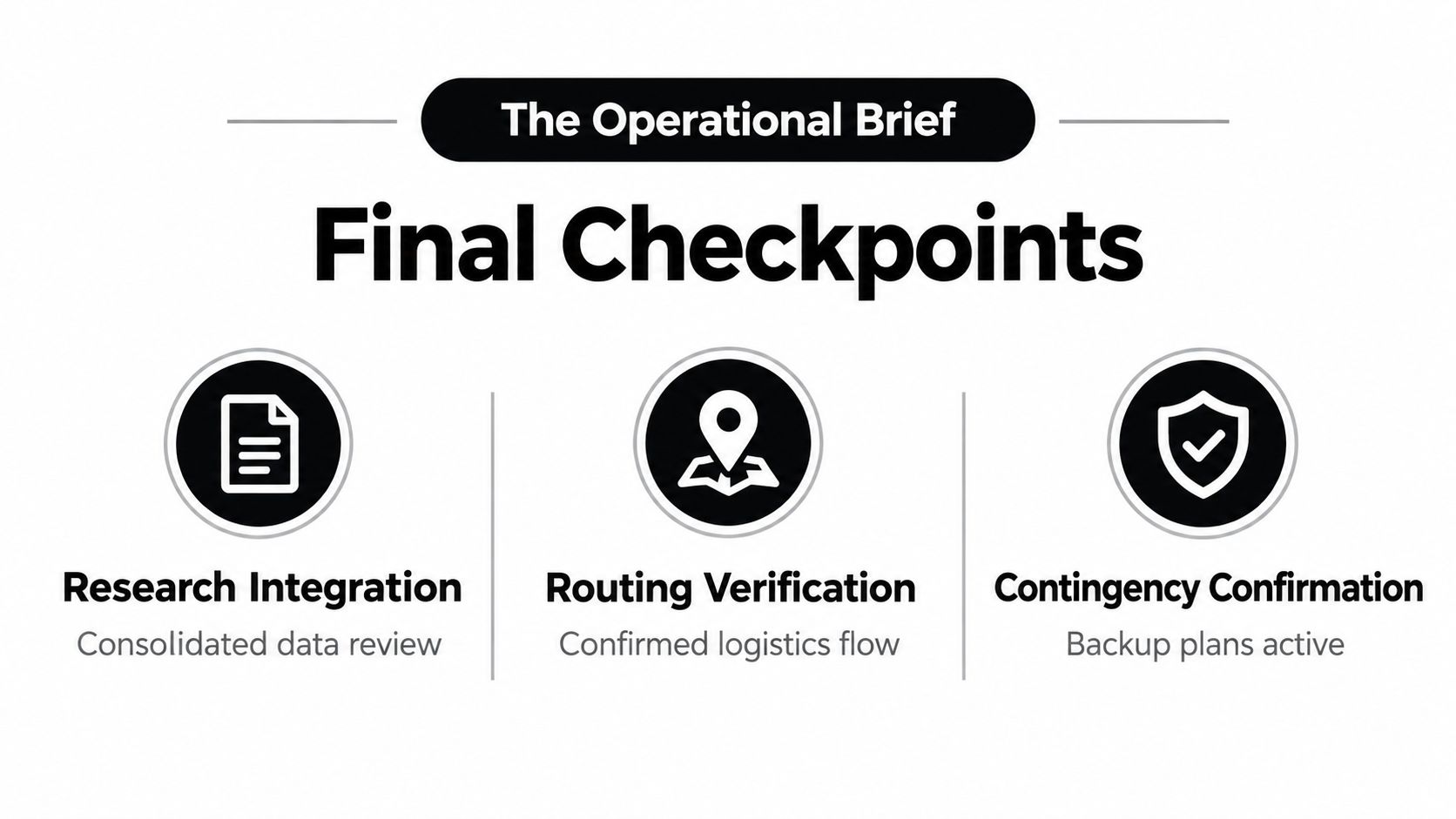
Complete the final checkpoints
Use these checks before departure. For a full end-to-end model, review this bespoke itinerary planning guide and reconcile its final stages with your operational brief.
- Research integration: Verify every attraction, restaurant, hotel amenity, guide, and access claim. Delete suggestions that remain unconfirmed.
- Entry and risk review: Check passport and visa requirements, travel insurance, health considerations, cancellation rules, and destination-specific restrictions.
- Routing verification: Reconfirm flight numbers, private aviation slots, train departures, vehicle positions, airport terminals, border procedures, and transfer buffers that reflect actual conditions.
- Reservation protection: Mark nonrefundable bookings, timed entries, deposits, and preferred access clearly. Place the cancellation deadline beside each item.
- Contingency confirmation: Assign a fallback experience, alternate route, nearby hotel or restaurant, and decision owner to every high-risk anchor.
- VIP handoff review: Write the exact meet-and-greet protocol, including terminal, meeting point, signage, phone contact, luggage process, lounge access, and escalation procedure.
- Traveler communication: State what is fixed, what can change, why buffers exist, and who can adjust the pace.
Use stochastic time budgeting throughout the brief. Protect the traveler's energy by separating fixed commitments from flexible options and by reserving capacity for delays, recovery, and spontaneous decisions. A schedule that fills every hour may display more attractions, but it gives the operator fewer ways to protect the day when access or transport changes.
Search behavior also changes the planning window. In the United Kingdom, Google reported that search interest for flight-related terms peaked on Sundays and was 10% higher than the average for other days. The same Google travel-planning analysis recorded German interest in “last-minute vacation” rising elevenfold, French interest in all-inclusive ski travel increasing 355%, South African searches for packages including flights growing twelvefold, and U.K. searches related to traveling to Spain increasing 540%. These figures support a practical rule: revisit assumptions as intent changes instead of treating the first route as permanent.
The final brief must tell the traveler where to be, when to move, what may change, and who will act. That is how itinerary planning becomes dependable for high-value travel. The objective is a resilient decision framework that protects energy, verified access, time, and confidence.
HauteBlack offers advisor-led itinerary design covering hotels, experiences, dining, transfers, and other trip details, shaped around the traveler's destination, dates, preferences, and budget. Visit HauteBlack to discuss a VIP itinerary built around verified access and operational control.
Explore Our Guides


Signature Experiences


