Haute Black Journal
What Does a Luxury Travel Advisor Do

Marlene Azeez
Director, HauteBlack
View all articles →

A luxury travel advisor is a high-touch concierge, and the advisor channel was valued at USD 7.85 billion in 2025, with projected growth to USD 22.95 billion by 2035. The advisor uses deep industry relationships to secure VIP upgrades, private access, and effective crisis management that automated platforms can't provide.
But what does a luxury travel advisor do when the flight is canceled, the villa isn't ready, or a supposedly perfect hotel turns out to be wrong for the client? The answer reveals why the role has moved far beyond booking flights and five-star rooms. A capable advisor designs the journey, coordinates the moving parts, protects the client's time, and stays accountable when plans change.
Luxury travel is often sold as a collection of expensive products. In practice, the actual product is judgment applied across an entire trip. That means knowing which property fits a family's rhythm, when to request recognition from a hotel, how to connect a private transfer to an international arrival, and who to call when a supplier stops responding.
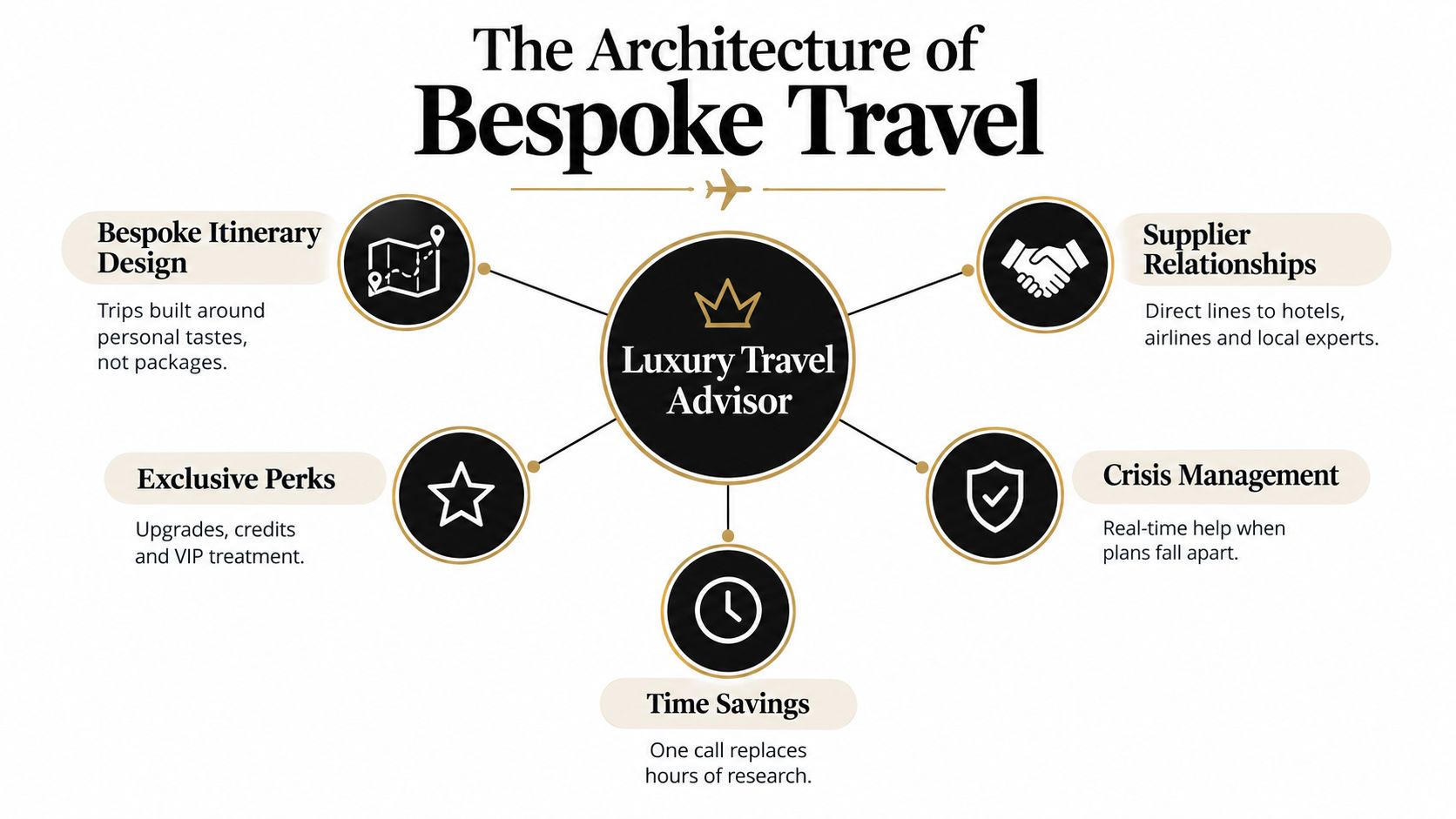
The Architecture of Bespoke Travel
Why do conventional booking methods fall short on trips where every detail matters? A search engine can show available suites and flights, but it can't understand that a client wants a quiet room far from the elevator, a guide who can adapt to young children, or a honeymoon itinerary with generous breathing room between major experiences.
A luxury travel advisor acts as a relationship architect. The advisor turns personal preferences into a connected plan, then uses supplier relationships to make that plan workable. The work may include destination selection, hotel and villa research, flights, transfers, dining, local experts, and special access. None of those components has much value in isolation if the connections between them create stress.
From reservation to relationship
The profession has shifted from transaction-based booking to relationship-driven curation. Deloitte reported that 68% of luxury travel advisors said travelers are increasingly choosing experiences aligned with what they value most, including longer vacations, more privacy, and premium amenities, as reported in its analysis of the future of luxury travel.
That shift changes how an advisor works. A booking agent asks where the client wants to go and processes the reservation. An advisor asks how the client wants to feel, what has gone wrong on previous trips, which compromises are acceptable, and where convenience matters more than price.
The distinction becomes clear with a multigenerational trip. One traveler may want early starts and cultural visits, another may need slower pacing, and someone else may care most about a private pool and reliable dining. The advisor's job is to reconcile those needs into one itinerary instead of handing the family a list of disconnected options.
Practical rule: A bespoke itinerary should reflect how the client travels, not simply where the client wants to go.
Protecting time and access
The commercial scale of the sector supports this broader view. The luxury travel ecosystem built around advisors was valued at USD 7.85 billion in 2025, with projected growth to USD 22.95 billion by 2035 and an 11.3% growth rate for the channel, according to Global Market Insights' luxury tourism market analysis.
Those figures matter because they show that advisors are a significant distribution layer in luxury travel, not a niche service for travelers who dislike online booking. Their value comes from reducing research, improving fit, and creating a clear line of accountability across a complicated journey.
Beyond Booking - The Core Services
A luxury advisor's work follows the client through three operational phases, before, during, and after the trip. McKinsey describes this model as personalized planning combined with technology-enabled back-end service that reduces friction at every touchpoint, as outlined in its report on today's luxury traveler.

Before departure
The first task is discovery. The advisor identifies the client's priorities, constraints, preferred pace, room requirements, dietary needs, mobility considerations, loyalty preferences, and tolerance for transfers. Good discovery prevents an expensive mistake later.
The advisor then builds the itinerary around those findings.
- Route design: Connect destinations in a way that avoids unnecessary backtracking and tiring transitions.
- Property selection: Compare hotels, villas, and resorts according to service style, location, room configuration, privacy, and fit.
- Supplier coordination: Align accommodations, drivers, guides, restaurants, aviation, and activities so each handoff works.
- Preference management: Record celebrations, arrival details, dietary requirements, and room requests, then communicate them to the relevant suppliers.
- Documentation review: Flag passport, entry, transfer, insurance, and timing issues that could disrupt the plan.
The advisor also explains trade-offs. A more remote villa may offer privacy but require longer transfers. A central hotel may simplify dining and sightseeing but feel less secluded. Luxury planning isn't about eliminating every compromise. It's about choosing the right compromises before the client arrives.
For readers evaluating the commercial side of agency work, Samba's guide to agent commissions offers useful context on how travel advisors may be compensated across supplier relationships. Compensation shouldn't replace transparency, but understanding the business model helps clients ask better questions about fees, inclusions, and service scope.
During and after travel
During the trip, the advisor or support team monitors changes, responds to requests, and coordinates adjustments. That might mean revising a transfer, communicating a late arrival, replacing an activity, or helping the client understand a supplier's policy.
Afterward, the advisor closes the loop. Feedback can influence future recommendations, supplier relationships, and the client profile used for the next journey. This continuity is one reason a relationship-based advisor can improve over time, while a new booking platform starts from zero on every search.
For a practical look at the broader service model, explore this guide to luxury travel concierge services. The important distinction is simple: the advisor isn't just assembling reservations. The advisor is managing dependencies between them.
The Relationship-Driven Difference
What changes when a traveler works with an advisor instead of booking alone? The value shifts from transaction speed to context, advocacy, and access. That difference matters most when an itinerary involves several suppliers, high expectations, a special occasion, or little room for error.
Luxury travel depends on relationships that operate behind the reservation. Hotels, destination specialists, guides, and transport providers each control part of the experience. An advisor knows whom to contact, how to frame a request, and when to act. Supplier timing matters too. A well-placed request before arrival can produce a better outcome than a complaint after the client is already at the property.
When a client's preferred suite category is sold out, the advisor can call the property's reservations manager to discuss a comparable layout rather than leaving the client to repeat the same search. That conversation may not create inventory, but it can clarify alternatives, preserve the trip's priorities, and reach someone with authority to make a practical decision.
The Deloitte analysis notes that Virtuoso's network generated USD 35 billion in annual sales, illustrating the scale of the advisor ecosystem.
What the network changes
A relationship never guarantees an upgrade or special treatment. Availability, property policy, seasonality, and booking details still determine what can be delivered. The advisor's advantage lies in choosing the right partner, presenting the request clearly, and following up with the people responsible for execution.
That judgment also includes declining a request that sounds attractive but does not improve the trip. A different room category may offer more space but a worse layout. A highly rated property may create longer transfers and more daily friction. The advisor weighs those consequences before presenting a recommendation.
The strongest advisor does not sell every perk. They distinguish between a visible benefit and a useful one.
Curation over volume
Travelers who pay for luxury usually want more than a polished list of options. They want decisions shaped around their habits, relationships, and priorities. Good advice filters choices until the remaining options have a clear reason to exist.
A less famous hotel may suit a private couple because its service culture is quieter. An executive may need discreet check-in, reliable transfers, and flexible meeting arrangements. A family may benefit from room configurations and dining logistics that reduce effort each day.
The advisor's relationships create access to people and information, but judgment determines whether that access matters. A long supplier list is not enough. The client needs a clear explanation of why a particular partner, room, guide, or routing fits the trip, followed by accountability for the recommendation.
Unlocking Exclusive Access and Perks
The tangible benefits of an advisor relationship usually fall into three categories: recognition, value, and access. Preferred partner programs may provide benefits such as daily breakfast, a hotel or resort credit typically around USD 100 per stay, and room-upgrade priority subject to availability, as described in this independent overview of Virtuoso benefits.
Those benefits matter, but they aren't the entire value proposition. A credit is useful only if the property fits the trip. Breakfast is valuable only if the client would eat there. An upgrade is meaningful only if the resulting room improves privacy, space, view, or comfort.

What preferred status can provide
A preferred relationship gives the advisor a clearer route into the property. The advisor can share the client's priorities before arrival, coordinate a celebration, request appropriate recognition, and communicate details that a standard reservation form may not capture well.
For instance, a honeymoon couple may value privacy and a thoughtful arrival more than a larger room. A family may need adjoining rooms, practical meal timing, and a transfer vehicle that accommodates everyone comfortably. An executive may need discretion, predictable connectivity, and rapid coordination between meetings and transport.
HauteBlack is Virtuoso-affiliated and has preferred partner status at over 500 properties, with travel reach across 120+ countries, according to its explanation of luxury travel agent service fees. Those markers show the scope a connected advisor can utilize, although the usefulness of that scope still depends on destination knowledge and client fit.
Access beyond the room
Luxury access also includes local expertise. An advisor may connect travelers with destination specialists, private guides, culinary experiences, cultural visits, or transport providers whose value comes from execution and timing rather than a public discount.
The trade-off is that exclusivity can increase complexity. A private experience may require precise arrival coordination, deposits, cancellation terms, or local operating conditions. The advisor earns trust by explaining those conditions clearly instead of presenting access as effortless or guaranteed.
For travelers unfamiliar with the Virtuoso model, this guide to what a Virtuoso travel agent is provides useful background. The practical test is whether the advisor converts partner benefits into a better trip, not whether the itinerary contains the most impressive list of amenities.
Navigating Complexity and Crisis
The clearest answer to what does a luxury travel advisor do often appears after something goes wrong. A canceled connection, missed transfer, sudden illness, weather disruption, or documentation problem can turn a polished itinerary into a chain of urgent decisions.

The advisor's crisis role is practical. They identify what has changed, determine which reservations are affected, contact suppliers, protect the next workable option, and keep the client informed. They may need to reroute transportation, adjust hotel nights, replace an excursion, handle a late arrival, or coordinate documentation with the relevant provider.
Safety and security have become central to this service. 75% of Virtuoso clients rank safety and security as important, while 65% cite added protection as a top benefit of using an advisor, according to Virtuoso's luxury travel trends release. Those figures explain why support during disruption can matter more than a welcome amenity.
Technology supports judgment
Modern advisors use technology to organize client profiles, monitor reservations, draft routes, compare options, and communicate quickly. AI can help with logistics and early-stage planning, but it doesn't replace verification, supplier relationships, or the judgment required when a plan no longer fits reality.
A generated itinerary may suggest an elegant route. A human advisor must check whether the connections are bookable, whether the timing is comfortable, whether the hotel is appropriate, and what happens if one component fails. That distinction is especially important in complex travel, where small errors can cascade across several suppliers.
A role posting for a luxury travel advisor cites average booking values of USD 25,000 to USD 30,000, reinforcing that the work is consultative, revenue-critical, and operationally complex, as shown in this Destination Expert role listing.
The best support feels calm because the client isn't forced to coordinate every supplier personally. The advisor absorbs the operational pressure, presents clear choices, and stays involved until the revised plan is stable.
Is a Luxury Travel Advisor Right for You
A luxury travel advisor makes the strongest case when the cost of getting the trip wrong is high in time, complexity, or emotional importance. That includes honeymoons, milestone celebrations, multigenerational travel, remote destinations, executive travel, and itineraries with several moving parts.
Self-booking may be perfectly sensible for a straightforward stay at a familiar hotel. It becomes less attractive when the traveler must compare room categories, coordinate transfers, arrange dining, manage changing schedules, and solve problems across different suppliers.
Use this practical test:
- Choose self-booking when the itinerary is simple, the destination is familiar, and you're comfortable owning every change.
- Consider an advisor when privacy, timing, access, or supplier coordination matters as much as the destination.
- Prioritize an advisor when a disruption would affect a family, executive schedule, celebration, or high-value business commitment.
The return on investment isn't limited to complimentary benefits. It can come from avoiding the wrong property, protecting a scarce reservation, reducing research, and having one accountable person when plans shift. Executive assistants can also benefit because the advisor becomes a specialized operating partner rather than another vendor to manage. For solo business owners organizing travel alongside company finances, a solo business spending solution can help keep travel administration separate from personal spending decisions.
Travelers should ask how the advisor charges, what support is included, who answers during disruptions, which suppliers they know directly, and how they document preferences. The right fit isn't the advisor with the longest list of destinations. It's the advisor whose relationships and working style match the trip.
HauteBlack offers bespoke itineraries, dedicated advisor support, preferred hotel benefits, VIP recognition, private aviation, villas, transfers, and concierge coordination across more than 120 countries. If your next journey requires precise planning and dependable support before, during, and after travel, visit HauteBlack to explore the available travel services.
Explore Our Guides


Signature Experiences


