Haute Black Journal
Travel Agent Service Fees Explained for Luxury Travel

Marlene Azeez
Director, HauteBlack
View all articles →

You've found the private villa, selected the right suite, and asked an advisor to coordinate flights, transfers, dining, and a few experiences that aren't available through a standard booking site. Then the proposal arrives with a travel agent service fee. The immediate question is understandable: why pay for planning when hotels, cruise lines, or tour operators may already compensate the advisor?
For luxury travel, the answer rarely fits into a single line item. A fee can cover judgment before booking, detailed coordination during planning, and advocacy when the itinerary changes. It can also reveal how seriously an advisor treats the work. A commission-only model may suit a straightforward hotel reservation, while a complex honeymoon, executive trip, or multigenerational journey often needs a more deliberate commercial structure.
This guide moves from the basic economics of fees to current pricing tiers, practical decision-making, value assessment, and confident negotiation. The aim isn't to make every fee seem justified. It's to help you identify what you're buying, what should be included, and which advisor relationship fits the way you travel.
Why Travel Agent Service Fees Confuse Even Frequent Travelers
A couple planning a safari and coastal escape may ask an advisor to arrange flights, recommend lodges, add private transfers, and make the trip feel effortless. Behind that request are several different tasks: researching routes, checking room categories, coordinating ground teams, and preparing for the possibility that one delayed flight could affect the entire journey. Before any reservation is confirmed, the advisor presents a planning fee.
The surprise is understandable. A traveler may have booked hotels through an advisor for years without seeing a separate charge. The explanation is that supplier compensation applies to some reservations, while air ticketing and extensive custom design may produce little or none. The traveler sees one itinerary. The advisor sees research, judgment, coordination, and future support.
The same itinerary can contain different economics
A hotel or cruise reservation may generate a preferred partner commission after travel is completed. A flight booking can require substantial research and post-booking attention without comparable compensation. A multi-country journey adds more work: the advisor tests connections, sequences services, manages suppliers, and protects the experience when plans change.
Service fees became more visible as the economics of air travel changed. A historical overview of travel agent costs from AAA describes fees evolving from uncommon in the 1990s to routine by the late 1990s and early 2000s. According to a 2000 Los Angeles Times report cited by AAA, agents who had previously charged nothing began charging $5 to $30 per ticket. The same AAA discussion cites ASTA reporting that 87% of surveyed agents had initiated ticket fees since January 1997, 88% considered them business as usual, and the average service fee was $13 per ticket.

For a high-touch journey, the fee can function as a quality filter. It gives the advisor an economic basis to spend time on decisions that a commission-only model may not fund, including air research, detailed revisions, supplier coordination, and advocacy during disruption. The fee does not guarantee excellent execution, but a clear fee structure can signal that the advisor is pricing the work rather than treating it as an unpaid add-on.
What travelers should ask before comparing prices
A lower fee may provide less involvement, while a higher fee may cover more responsibility. Ask:
- What work is included: Does the fee cover research, itinerary design, reservations, changes, and support during travel?
- What happens if plans change: Are rebooking and cancellation requests included, or billed separately?
- Who handles disruptions: Will you reach the advisor, an operations team, or a general supplier line?
- How the advisor is compensated: Does the agency receive supplier commissions in addition to your fee?
- What level of customization is expected: Are you requesting a curated hotel stay or a fully managed journey?
Compare the service relationship, not only the amount on the invoice. The choice may be limited transaction support or accountable travel design.
How Travel Agent Service Fees Work
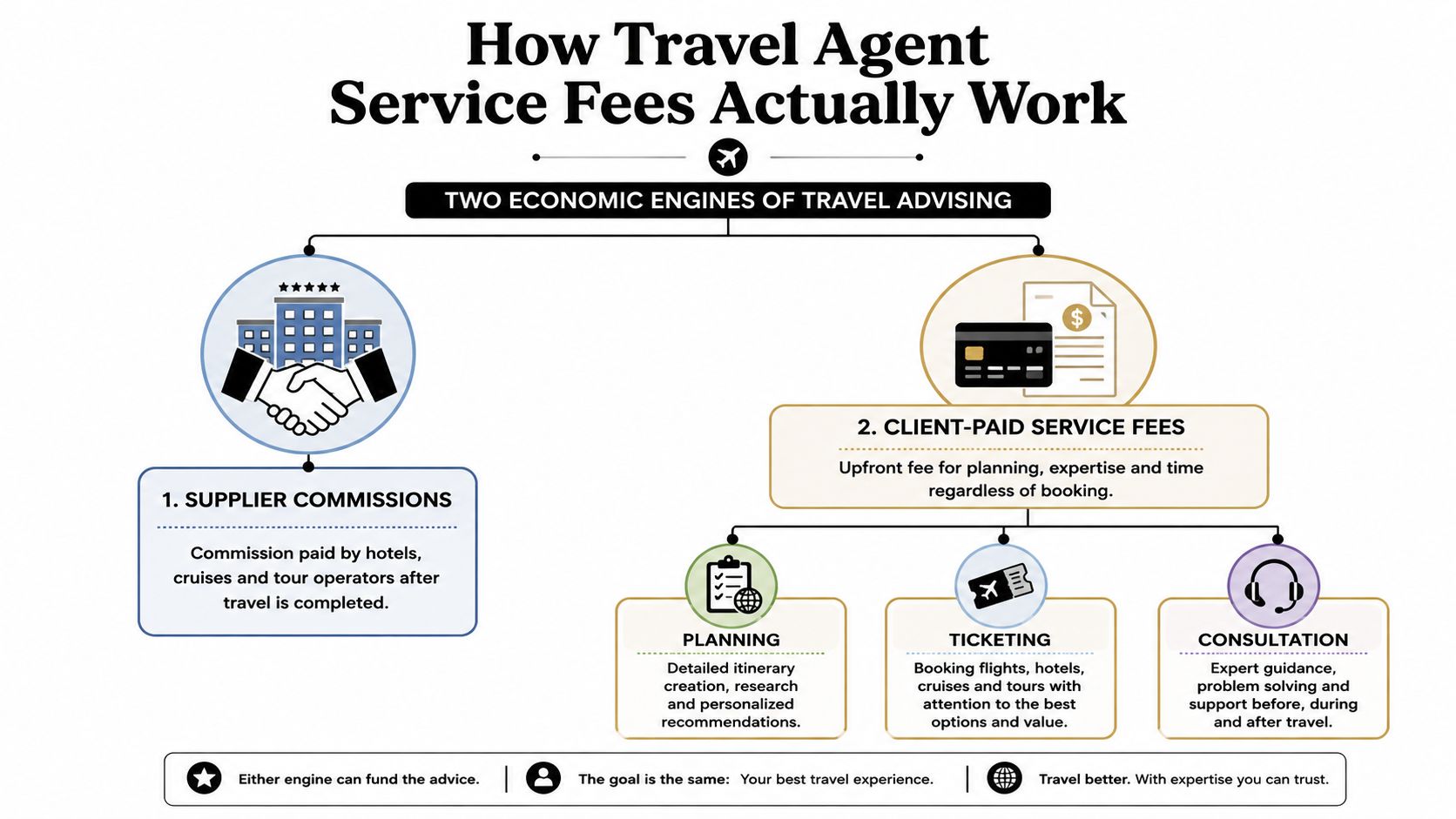
Travel advising rests on two economic engines: supplier commissions and client-paid service fees. Separating them makes a proposal easier to read and shows what each payment supports.
Eligible hotels, cruise lines, and tour operators generally pay supplier commissions after the traveler completes the trip. Client-paid fees compensate the advisor directly for planning, consultation, ticketing, research, and professional time, even if the traveler does not book every component through that advisor.
A retainer-style comparison
The distinction resembles the difference between a private attorney's retainer and a contingency arrangement. A contingency model pays only when a particular outcome occurs. A retainer pays for access, preparation, and professional time, even when the matter changes or does not proceed as first planned.
Travel compensation does not mirror legal compensation in every respect, but the comparison clarifies the economics. An advisor may receive a supplier commission from a completed hotel booking while also charging for the intellectual and operational work behind the journey. That fee funds attention a supplier may not compensate directly, including research, revisions, coordination, and advocacy.
This structure became more relevant as airlines reduced or eliminated commission-based compensation. As noted earlier, ticketing fees became established more than 25 years ago, rather than emerging as a recent luxury-market invention.
Four fee types appear most often
Consultation fees cover a focused conversation or professional recommendation. They suit destination guidance, a second opinion on an existing plan, or help choosing between competing options.
Planning fees cover trip design. Depending on the proposal, they may include research, supplier selection, itinerary construction, revisions, and coordination across multiple components.
Ticketing fees apply to air reservations and sometimes later changes. Air-only work can require fare-rule research, routing analysis, review of ticket conditions, and reissue procedures, while airline compensation may be limited.
Retainers establish an ongoing relationship. They can suit frequent travelers, executive assistants, or families seeking recurring access, priority handling, and continuity across journeys.
Agencies may combine these structures. A luxury advisor could charge a planning fee for a bespoke itinerary, receive supplier compensation where applicable, and set separate terms for substantial rework after approval. This arrangement is reasonable when the proposal identifies the distinct work covered by each payment. In that sense, a fee can act as a quality filter and an economic enabler for high-touch service, rather than as another line on the invoice.
Practical rule: Ask whether the fee pays for a reservation, a defined planning process, ongoing access, or all three.
The following short video offers additional context on how travel professionals support a journey beyond the initial booking.
For a broader view of luxury concierge economics, see this guide to concierge service cost and luxury pricing models.
What Luxury Travel Advisors Charge Today
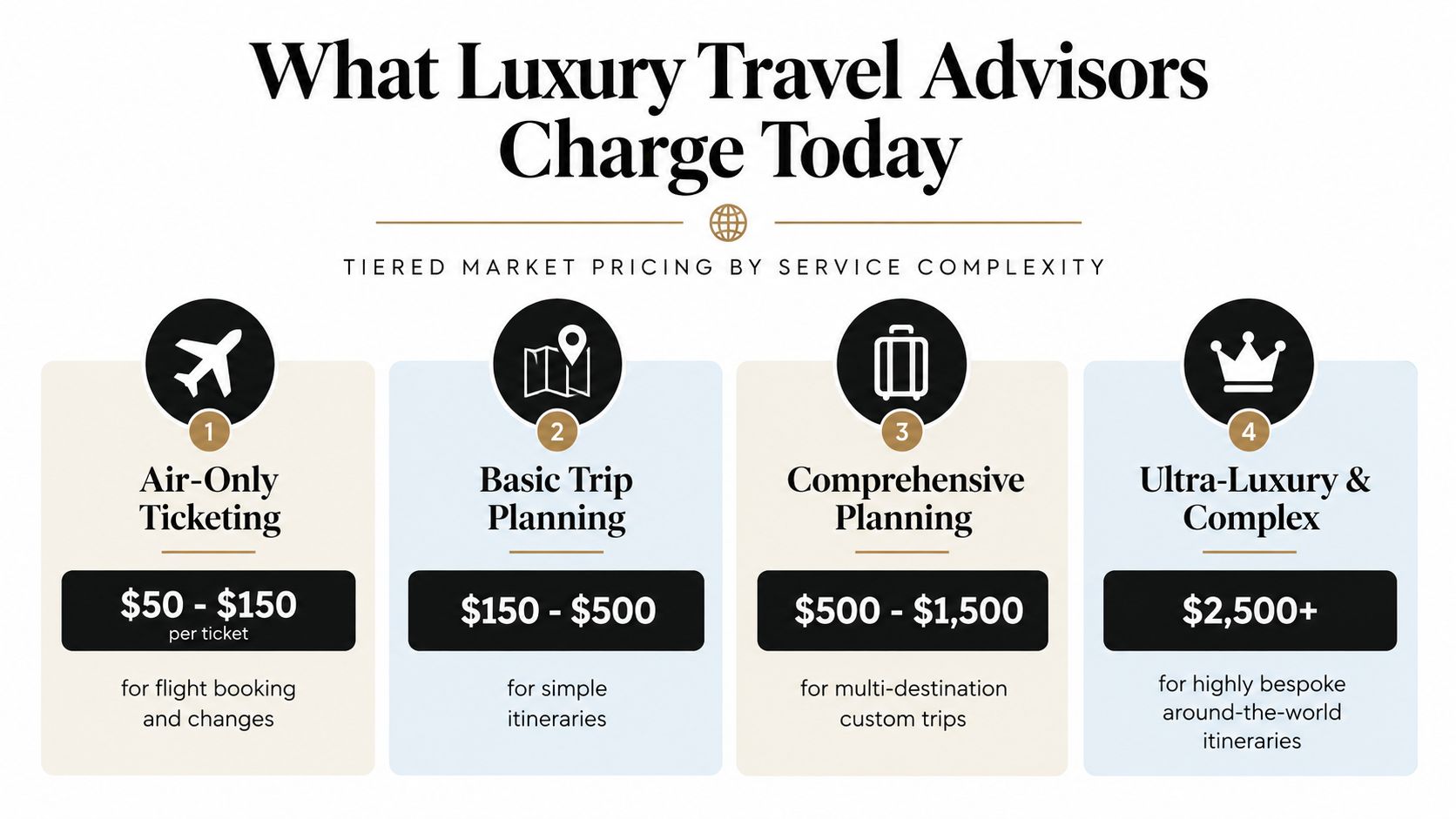
Luxury travel agent service fees vary because the work varies. A flight-only request, a standard vacation, and an ultra-custom itinerary don't place the same demands on an advisor. Current market guidance from AAA's 2026 travel fee overview gives a useful benchmark: airfare-only help commonly runs $25 to $175 per ticket, standard vacation planning typically costs $25 to $250, consultation fees often fall between $100 and $250, and average trip planning frequently ranges from $100 to $300.
Complexity moves the fee upward. AAA's guidance places complex itineraries at $300 to $700 or more, while highly customized luxury planning can range from $420 up to $6,175. These are market benchmarks, not a universal tariff, and the source makes the underlying logic clear. Advisors charge for expertise, coordination, customization, and VIP handling, not for the minutes spent clicking through a reservation system.
A practical tiered view
| Service level | Common market benchmark | What usually drives the price |
|---|---|---|
| Airfare-only assistance | $25 to $175 per ticket | Ticketing, fare research, routing, and changes |
| Consultation | $100 to $250 | Destination judgment or a focused planning session |
| Standard trip planning | $25 to $250 | Routine vacation design with limited complexity |
| Average trip planning | $100 to $300 | Broader coordination across the itinerary |
| Complex itinerary | $300 to $700 or more | Multiple suppliers, intricate routing, and active management |
| Highly customized luxury planning | $420 to $6,175 | Bespoke design, extensive coordination, and VIP handling |
The ranges overlap because the word “trip” hides too much. A short luxury stay with one hotel may require less planning than a lower-profile journey involving several countries, private guides, tight connections, special dietary needs, and multiple travelers with different priorities.
What pushes a fee higher
A fee rises when the advisor must make more decisions and remain responsible for more moving parts. Research depth matters because a luxury traveler isn't choosing between generic search results. The advisor may be evaluating location, room configuration, service culture, access, transfer timing, and the practical fit for the traveler.
Change exposure matters too. An executive itinerary may need to adapt around meetings, while a family journey may involve different arrival times and accessibility requirements. After-hours support adds another service dimension, especially when a disruption occurs outside a supplier's normal office schedule.
The market data also helps correct an old assumption. A service fee isn't necessarily a small administrative surcharge. For bespoke work, it can be a significant part of the agency's economics, allowing an advisor to devote attention to work that commissions alone may not fund.
When You Pay a Fee and When You Do Not
The most useful question isn't whether travel advisors charge fees. It's which kind of work deserves a direct fee in your situation.
A simple air-only booking often involves time-consuming fare research and later changes, while airline commissions remain near zero in many markets. A hotel or cruise reservation may be different, because preferred partner compensation can offset some or all of the advisor's commercial requirement. Neither structure is superior. The important point is whether the payment matches the work and the access you expect.
A decision matrix for common scenarios
| Trip Scenario | Typical Fee Treatment | Why This Structure |
|---|---|---|
| Air-only ticketing | A ticketing fee is common | The advisor may receive little or no airline commission while handling fare rules, booking, and changes |
| One hotel or resort stay | Fee may be waived or bundled | Supplier commission may support the advisor's work, especially through preferred partnerships |
| Custom honeymoon | Planning fee is common | The advisor coordinates preferences, room choices, experiences, transfers, and special moments |
| Multi-country itinerary | Flat or hybrid fee is common | Several suppliers and routing decisions require sustained design and management |
| Executive travel | Retainer or defined service fee may apply | The traveler or executive assistant needs continuity, priority handling, and change support |
| Rebooking after approval | Included within limits or charged separately | A major change can require new research, supplier contact, and itinerary reconstruction |
| Emergency support | Included in a premium package or billed under stated terms | The advisor is providing availability and intervention beyond the original booking |
Membership and retainer structures
Some travelers prefer a relationship that replaces individual planning charges with a broader membership or retainer. Membership models can waive planning fees for eligible travel while preserving access to a dedicated advisor. Retainers can also make sense for executive assistants managing repeated travel, because the value lies in continuity and response rather than in one isolated itinerary.
Ask for the boundary. Does the arrangement cover every journey, only certain trip types, or only the initial design? Are air changes included? Does emergency assistance form part of the relationship? A fee waiver isn't meaningful if the highest-effort tasks remain outside the agreement.
When a fee may be redundant
A fee deserves closer scrutiny when the advisor is providing little beyond a transaction you could complete directly, the scope is vague, or the agency adds separate charges for every ordinary communication without explaining the service level. The issue isn't that a fee exists. The issue is that you can't connect it to a defined outcome.
A clear proposal should state what the advisor will research, book, monitor, revise, and support. It should also explain what happens if you decide not to travel or change direction after work begins.
Is the Fee Worth It for Luxury Travel
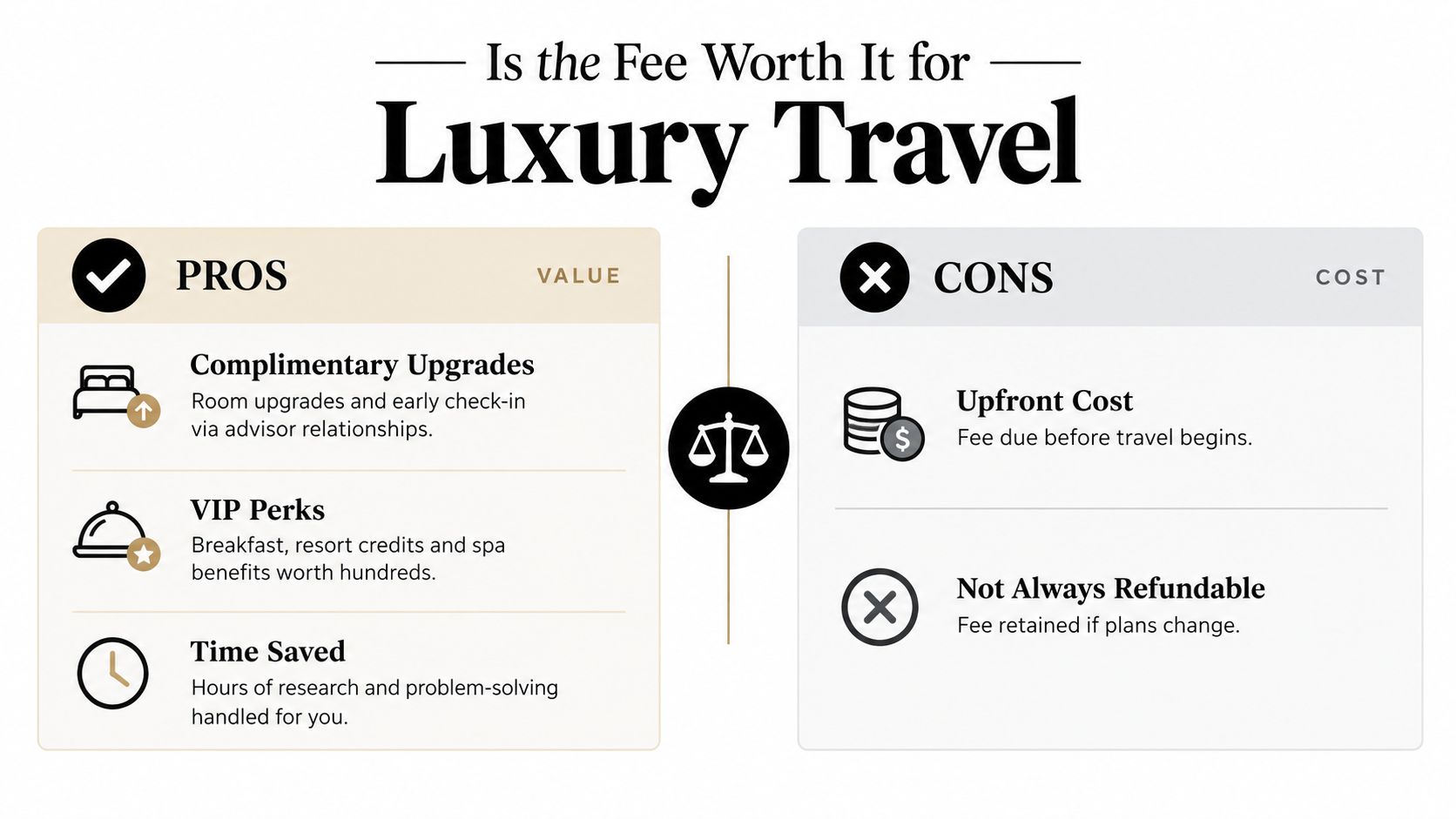
Luxury travel creates value in places a booking engine can't easily display. A room upgrade, a resort credit, a flexible benefit, or a smooth VIP arrival may change the experience without changing the headline itinerary. An advisor's relationships can also help the traveler receive available benefits, though no professional should promise an upgrade or perk that depends on availability.
Evaluate the outcome, not the line item
For a honeymoon, the fee may buy careful pacing, a room category that fits the occasion, meaningful dining reservations, and a fallback plan if weather or transport disrupts the sequence. For a multigenerational family, it may buy room placement, transfer coordination, activity choices that work across ages, and one person responsible for keeping the details aligned.
Executive travel has another value equation. An assistant may not need more search results. They may need a trusted advisor who understands preferences, watches deadlines, handles changes, and communicates clearly when a principal's schedule shifts.
A luxury fee earns its place when it purchases judgment and intervention, not merely access to a booking screen.
Four questions reveal the real return
1. Will the advisor improve the itinerary? Look for destination-specific recommendations, thoughtful sequencing, and choices suited to your priorities.
2. Will the advisor protect your time? The value grows when someone else handles research, supplier communication, revisions, and documentation.
3. Will the advisor advocate during disruption? Ask who responds when flights move, a transfer fails, or a hotel issue needs escalation.
4. Will preferred access add practical benefits? A preferred relationship may provide complimentary upgrades when available, resort credits, flexible benefits, or a more recognized arrival.
The HauteBlack perspective on luxury travel networks reflects why network access matters, but access alone isn't enough. The advisor still needs to interpret your preferences and use the relationship intelligently.
Higher fees can also function as a quality filter. They discourage casual requests that consume extensive planning time without commitment, giving the advisor more capacity for clients who value careful execution. That doesn't mean every expensive advisor is attentive, or every affordable advisor is limited. It means price can help establish a serious working relationship when the scope, communication standards, and deliverables are equally clear.
How Luxury Travelers Negotiate Service Fees With Confidence
Negotiating a travel agent service fee shouldn't feel like haggling over a hotel room. You're defining a professional relationship. Start by asking for scope, not a discount.
Use direct language:
- Clarify deliverables: “Please outline what the planning fee includes from our first consultation through departure.”
- Define revisions: “How many itinerary revisions are included, and what counts as a substantial redesign?”
- Separate support levels: “Does the fee include flight changes, supplier follow-up, and assistance after business hours?”
- Ask about compensation: “Will you also receive supplier commissions on eligible bookings, and how does that relate to my fee?”
Choose the structure that matches the work
A flat fee suits a defined itinerary with a clear scope. An hourly structure can fit a consultation or research assignment where the final booking remains uncertain. A hybrid model often works well for complex luxury travel, combining an initial planning fee with stated charges for major changes or ongoing management.
Executive assistants should request a written escalation process. Who receives urgent requests? What information should the assistant provide? Which changes need principal approval? These details matter more than shaving a small amount from the initial fee.
Couples and families can ask whether several journeys can be considered under one relationship. A traveler who books a honeymoon, family holiday, and future business trip may reasonably ask whether the advisor offers a bundled or membership structure. The answer should reflect actual scope, not an automatic discount.
Ask about benefits without demanding guarantees
If the advisor works with preferred luxury partners, ask which benefits may apply to your booking. The right wording is: “Which preferred partner benefits are available, and are they subject to availability or property rules?” This keeps expectations realistic while making the value visible.
A useful negotiation standard: Trade clarity for commitment. If you want a lower or bundled fee, offer a defined scope, a serious booking timeline, or an ongoing relationship.
The written agreement should also state payment timing, refund treatment, change policies, and the point at which planning work begins. A transparent advisor won't resent these questions. They'll use the answers to establish a smoother engagement.
Choosing the Right Advisor Relationship for Your Next Journey
The best advisor relationship depends on how much complexity you want removed from your life. A straightforward stay may need transaction support. A private celebration, multi-country itinerary, or executive travel program may justify a dedicated relationship built around judgment, access, and rapid intervention.
Review the fee model alongside the service model. A credible proposal explains what happens before booking, during preparation, and when plans change. It distinguishes supplier benefits from client-paid work and gives you a realistic picture of support after departure.
For travelers evaluating advisor credentials, this guide to Virtuoso travel agents can help clarify the role of preferred relationships and network affiliation. HauteBlack operates as a Virtuoso-affiliated luxury travel company, with preferred partner status at over 500 properties and travel reach across 120+ countries, according to the publisher information provided for this article. Its membership model includes a dedicated advisor and waived planning fees, while non-members can book signature journeys and tailor-made trips.
The important decision isn't whether a fee appears. It's whether the advisor can turn your priorities into a well-managed journey, then remain useful when the itinerary meets reality.
HauteBlack offers bespoke itineraries, dedicated advisor access for members, waived planning fees within its membership model, and VIP travel planning across 120+ countries. If you want to compare a high-touch membership relationship with traditional fee-based advising, visit HauteBlack and explore the travel options that fit your next journey.
Explore Our Guides


Signature Experiences


