Haute Black Journal
Luxury Travel Network: How It Works and Why It Matters

Marlene Azeez
Director, HauteBlack
View all articles →

# Luxury Travel Network: How It Works and Why It Matters
Published July 24, 2026 by Marlene Azeez
You're probably dealing with the same problem I see all the time, a CEO wants an escape with no hiccups, the assistant needs it locked down, and the property is already tight on inventory. That's where a luxury travel network stops being a buzzword and starts acting like an operating system for the trip. The right network can change what you get at the hotel, how fast problems get handled, and whether the booking feels ordinary or properly VIP.
What It Actually Means to Book Through a Luxury Travel Network
The Maldives example is the one that exposes everything. A CEO wants peak-season dates, the resort is close to full, and you're deciding whether to book direct, use a generic platform, or go through an advisor inside a luxury travel network. One path gives you a reservation. The other can provide preferred treatment, better recognition, and sometimes the small details that make a luxury stay feel worth the money.
A network is not just a prettier search engine. It's a distribution layer built around vetted advisors, preferred hotel relationships, and a process for attaching value-added benefits to a booking. If you need a broader comparison for how premium trip ecosystems work, compare cruise ships is a useful external reference point, because cruise products also show how access and perks matter more than the raw fare alone.
The most common mistake is assuming direct booking always equals better control. It doesn't. Direct booking can be fine for a simple stay, but once you're chasing upgrades, credits, or priority recognition, the advisor's relationship with the property starts to matter more than the public rate. If you want the conceptual baseline for how these communities differ from ordinary travel booking, HauteBlack's own overview of an exclusive travel club is the cleaner framing.
Practical rule: if the trip has expensive dates, specific room needs, or high service expectations, use a networked advisor instead of booking blind.
That's the lens for the rest of this discussion. A strong network doesn't just sell travel, it controls the route to better inventory and better treatment.
The Architecture of a Modern Luxury Travel Network
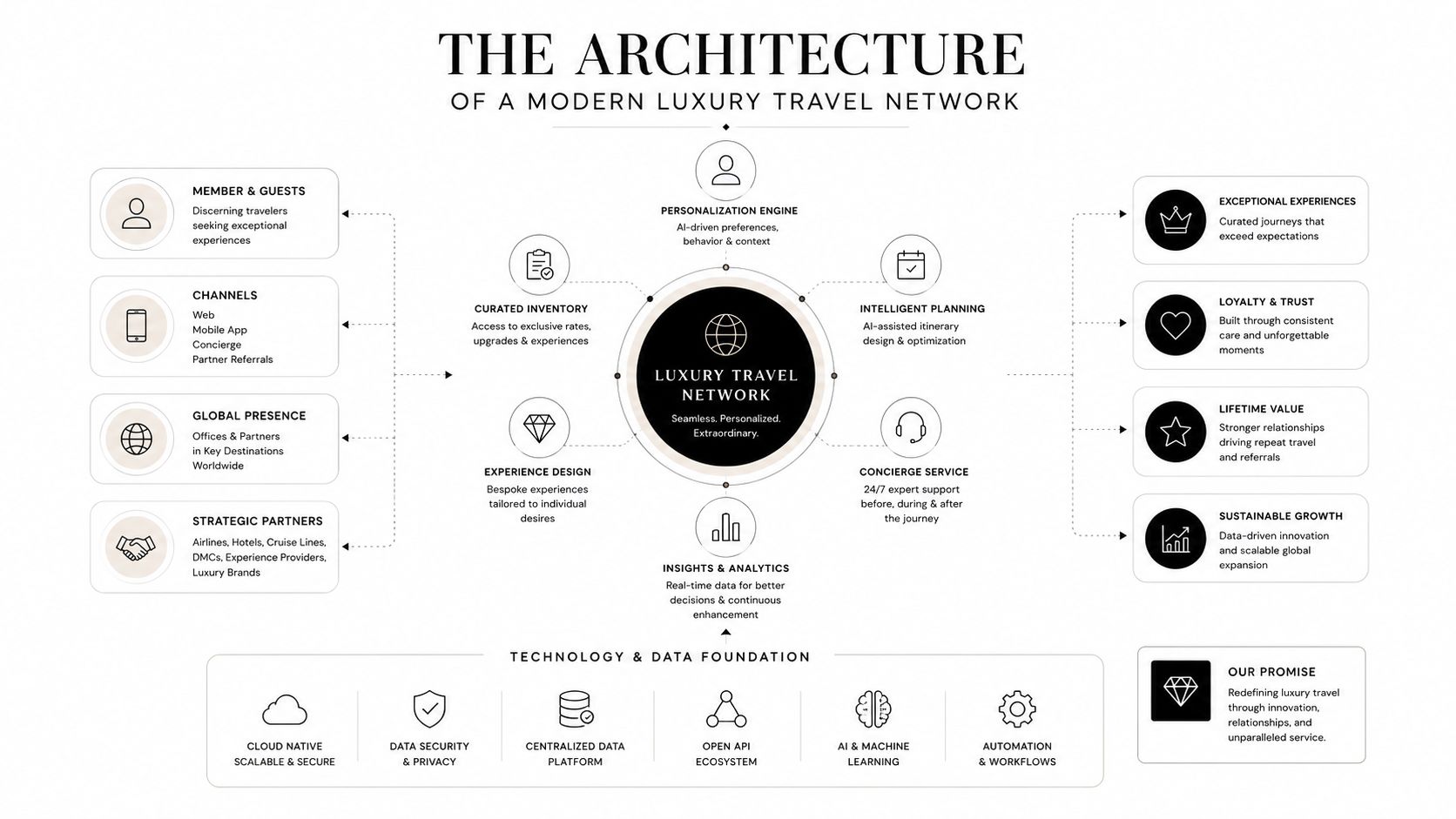
Think of a luxury travel network as a private members' club fused with a high-end distribution system. The club part is about access and vetting. The distribution part is about how the booking gets made, recognized, and upgraded once it reaches the hotel.
The four pieces that have to work together
First, there's the advisor base. These are the people who know how to match a client's brief to the right property, the right room category, and the right timing. Second, there are the preferred partners, the hotels, villas, cruise operators, and experience providers who agree to treat network bookings differently from ordinary retail bookings.
Third, the network needs some form of status depth. That status is what gives the advisor influence when a property is deciding whether to honor an upgrade, a credit, or a preferred room assignment. Fourth, there's the curated layer of experiences, private transfers, dining access, events, and other extras that are hard to recreate through public channels.
The language around this can get muddy fast, so keep the terms straight. A consortium is the broader affiliation layer. A preferred partner is the supplier relationship that creates the benefit. Advisor status is the influence inside the system. A host agency is the operational home for some advisors and agencies, which matters because the advisor's back office affects how smoothly the trip gets handled.
For a concrete mental model, think of hotels such as Four Seasons, Aman, or Belmond as the kind of properties that make this system visible. Their value isn't just the room. It's the recognition and treatment that follow the booking through the network.
If you want the service layer that sits closest to the guest experience, how penthouse concierge works is a useful parallel. The principle is the same, service becomes more useful when the underlying network can activate the request.
A serious network is not a brand halo. It's a set of operating privileges.
For readers who want the live network view, HauteBlack's network shows how those pieces can sit on top of a membership model without turning into a generic booking site.
Membership Models and How They Differ
Not every premium travel affiliation works the same way. Some are invite-only, some are paid, and some are really lifestyle clubs with travel attached. If you choose the wrong model, you'll pay for access you don't use or expect benefits the program never promised.
| Model | Entry | Primary Benefit | Trade-off |
|---|---|---|---|
| Invite-only consortium | Application or invitation | Broad preferred-partner access and advisor leverage | Less control over personal style, depends on advisor quality |
| Membership-based private agency | Membership fee or selective onboarding | More tailored service and direct relationship depth | Fewer scale advantages than large consortia |
| Paid private club | Membership purchase | Event access, community, and lifestyle perks | Travel benefits can be narrower or less consistent |
| Credit-card-adjacent program | Financial product qualification | Bundled travel perks inside a wider rewards structure | Benefits can feel secondary to the banking relationship |
The biggest practical difference is who controls access. In a consortium, the network admits the advisor, then the advisor books the client into preferred inventory. In a private club, the member is buying membership into a world that may include travel, dining, and events. In a card-linked program, travel sits inside a much broader financial product.
That matters because the client's real objective is usually not "membership." It's better treatment, less friction, and more influence when a booking gets complicated. A paid club can be great for social access, but it won't always have the hotel depth a serious traveler needs. A consortium can be excellent for hotels, but it may not give you the same intimacy or event layer.
If you want a parallel from another membership world, top Dubai clubs for startup founders shows how the value of a club often comes from who's inside it, not just the door policy.
Tangible Benefits and How They Are Negotiated

The benefits clients care about are the ones you can feel on arrival. The big ones are room upgrades when available, daily breakfast for two, resort or spa credits, early check-in, late checkout, and priority handling when a property is sold out or nearly sold out. In the world, those touches are what separate a decent luxury trip from one that feels properly handled.
Those perks are possible because preferred-partner agencies deliver business the hotel values. They're not just pushing a rate, they're sending guests who often book high-value stays and return again. The hotel can justify extra treatment because the booking arrives through a channel that supports its revenue strategy, not just its occupancy.
The rule is simple: if the property already values the agency relationship, it has more room to extend extras without fighting the revenue team.
What changes from one network to another is not the existence of benefits, but their consistency and depth. Breakfast and late checkout are the common baseline. Suite upgrades, club access, or special arrival treatment depend much more on advisor status and the property's inventory position. If the resort is fully committed, some benefits cannot be forced.
You also need to be realistic about rate restrictions. Promotional rates and tightly controlled inventory often limit what can be attached to the booking. That's why a good advisor doesn't oversell outcomes, they tell you what the hotel can honor before the trip is confirmed.
A network is useful when it reduces guesswork. It's not magic, and anyone promising otherwise is selling fantasy, not service. The best advisors know which benefit matters most for a given stay, then push for that one instead of making noise about every possible perk.
How to Choose the Right Network for Your Travel Style
Start with the properties, not the branding. If a network can't show you genuine depth at the hotels and destinations you use most, the rest is decoration. A serious advisor should be able to explain which partners are strongest for your pattern of travel, not just recite big names.
Ask these five questions
- Preferred-partner depth: Do they have strong relationships with the brands you book most, or are they name-dropping properties they barely use?
- Advisor specialization: Does the advisor know your type of trip, whether that's honeymoon villas, multi-generational suites, or executive travel?
- Fee clarity: Are planning fees waived for members, charged per itinerary, or hidden inside something you won't notice until later?
- Concierge scope: Can they handle private aviation, ground transfers, dining, and event access, or just the hotel?
- Event programming: If the network claims to be community-driven, what kinds of invite-only experiences do members really receive?
One useful shortcut is to ask how the advisor builds confidence before booking. Someone who has personally inspected properties, spoken with managers, and kept current on the actual room mix is operating at a different level than someone working off brochures. That gap shows up the moment a trip becomes complex.

For a principal or EA, the right test is simple. Ask whether one person can own the trip end to end, or whether you'll be bounced between a booking team, a concierge line, and a hotel contact who doesn't know the brief. If the answer is fragmented, the network isn't strong enough for demanding travel.
How HauteBlack Fits and Where It Differentiates

HauteBlack sits in the part of the market that blends a Virtuoso-affiliated travel model with a private membership world built on long-standing relationships. That matters because it isn't just selling hotel access, it's layering travel service onto a broader membership environment. The about page makes that structure clear.
The visible travel advantage is preferred-partner reach across more than 500 properties, including Four Seasons, Aman, Rosewood, Belmond, and Ritz-Carlton. For members, the practical package includes a dedicated advisor, waived planning fees, upgrades when available, resort credits, and VIP arrival handling. For non-members, it still functions as a luxury travel company, but the membership layer adds a different level of continuity and recognition.
The difference from a standard consortium-only model is the surrounding ecosystem. HauteBlack doesn't stop at hotel bookings. It also includes Haute Jets private aviation, first-class and helicopter transfers, private villas and estates, and a calendar of more than 80 intimate events annually. That event layer is where the relationship capital shows up in a way many travel networks can't replicate.
Where it actually stands out
A pure consortium can give breadth. A private club can give atmosphere. HauteBlack is trying to combine both, wide preferred-partner access plus a smaller, higher-touch member environment. That combination is useful for clients who don't want to explain themselves five times every time they travel.
The editorial point is simple. If you only want a hotel booking, almost any competent advisor can help. If you want a system that handles rooms, transfers, access, and the social layer around travel, then the network model starts to matter much more.
Real Use Cases Across Client Profiles
A honeymoon couple wants a private villa, a clean arrival, and a surprise upgrade that feels personal rather than transactional. In that case, the network matters because the advisor can push the hotel to treat the booking like a special occasion, not just another reservation. That's the difference between a nice stay and a memory that lands.
For a multi-generational family, the main challenge is coordination. Suites need to sit near each other, transfers need to be timed properly, and one strong experience has to work for different ages without collapsing into compromise. A strong network helps because one advisor can align the room plan, the transport, and the activity choices without forcing the family to manage every supplier separately.
A C-suite executive with an EA needs something else entirely. The job is to remove noise, keep one point of contact in charge, and make sure hotel stays, private aviation, and a dinner reservation all work as one itinerary. In that scenario, the value is not one perk, it's the fact that nothing gets lost between the handoff points.
Key Takeaways and Common Questions
A luxury travel network is worth using when the trip is expensive, the details matter, and the cost of a mistake is high. If you travel often, care about room type and recognition, or need someone to manage more than a hotel booking, the network model pays for itself in reduced friction and better treatment. If you only care about the lowest public rate, you're not the right buyer for this system.
The right way to evaluate a network is to ask three things. First, how deep are the preferred-partner relationships. Second, what exactly does the advisor control. Third, does the concierge scope cover the whole journey or only the lodging. If the answers are vague, keep moving.
The best network is the one that can solve your trip before you start chasing fixes during it.
FAQ
Can non-members book through the network? Yes, they usually can, but members are more likely to get the full relationship benefit, including planning fee waivers where offered.
Do planning fees exist? They can, and transparent advisors should tell you up front. Members often get planning fees waived, while non-members may still be charged depending on the service.
How far ahead should peak-season trips be planned? Earlier is better, especially when you need a specific suite, a private villa, or a heavily booked resort.
What happens if something goes wrong on the trip? The advisor should handle it directly with the property or supplier. If you're left calling random numbers, the network isn't working properly.
If you're serious about better treatment, cleaner logistics, and fewer compromises, stop shopping travel like a commodity and speak with a dedicated advisor at HauteBlack.
A CTA for HauteBlack.
Explore Our Guides


Signature Experiences


