Haute Black Journal
Do Travel Agents Travel for Free? An Insider Guide

Marlene Azeez
Director, HauteBlack
View all articles →

Travel agents do not travel for free as a standard perk, and complimentary access usually means conditional industry education such as a FAM trip, not an unlimited free vacation. If you're asking do travel agents travel for free because you want the job for the holidays, or because you're wondering whether your advisor's recommendation was bought with a comped suite, stop using the word free. It's the wrong frame. It lumps together four different economic arrangements, only one of which ever puts money in the client's pocket, and it flatters an industry that has become far more selective than the old stories suggest.
The Short Answer Most Guides Avoid
No, travel is not an automatic employment benefit. Some advisors receive complimentary or heavily discounted professional travel, but access is selective, conditional, and tied to selling. That's not a perk in the airline staff travel sense. It's a supplier investment with strings.
The main mechanism is the familiarization trip, called a FAM trip. A hotel, cruise line, tourism board, or tour operator invites an advisor to inspect rooms, cabins, dining, transfers, and service standards so that advisor can later describe the product accurately and, ideally, sell it. Historically, suppliers were more generous with free airline tickets, hotel stays, and discounted cruises. As the advisor channel professionalized, invitations narrowed.
The Four Categories You Need
Every claim you'll hear fits one of these boxes, and confusing them is where bad advice starts.
- Fully hosted FAM trips: A supplier covers the core land or cruise component, sometimes more, in exchange for inspections, meetings, and your working time.
- Advisor-only industry rates: A reduced rate for a credentialed advisor's own stay or sailing. Cheaper is not free, and it isn't transferable to you.
- Client-facing booking amenities: Upgrades when available, breakfast, or resort credits attached to your reservation through a preferred partner program.
- Supplier commissions: Cash compensation paid to the agency after you travel. This is income, not a holiday.
Practical rule: When someone says complimentary travel, ask which of the four categories they mean. If they can't answer, they are selling you a headline.
The numbers confirm scarcity rather than abundance. In a 2025 report, 88% of advisors attend between one and three FAM trips annually, while 61% would attend more if additional availability existed, according to Cruise Planners' summary of how advisors obtain FAM trips. People who travel free at will don't queue for one to three work trips a year.
Eligibility usually turns on booking volume, agency affiliation, credentials, training, or supplier capacity. Even a hosted trip often covers only lodging or a cruise cabin. Airfare, transfers, taxes, tips, insurance, and personal spending frequently stay with the advisor. A complimentary room can still cost real money and several days away from clients who are actively traveling.
My recommendation is blunt. Don't choose an advisor because they travel a lot on someone else's budget. Choose one who can tell you, specifically, what they inspected, what they rejected, and which benefit on your booking is contractual versus merely possible.
How FAM Trips Actually Work Behind the Scenes
A FAM trip is a sales tool. Suppliers fund it because advisors steer spending, not because suppliers are generous employers. The American Society of Travel Advisors' 2025 fact sheet reports approximately one in four dollars spent on travel is booked through a travel advisor, and projects travel agency sales could reach 26% of the total travel market by 2026, totaling $141.3 billion. That distribution power explains the subsidy. It doesn't make the subsidy universal.
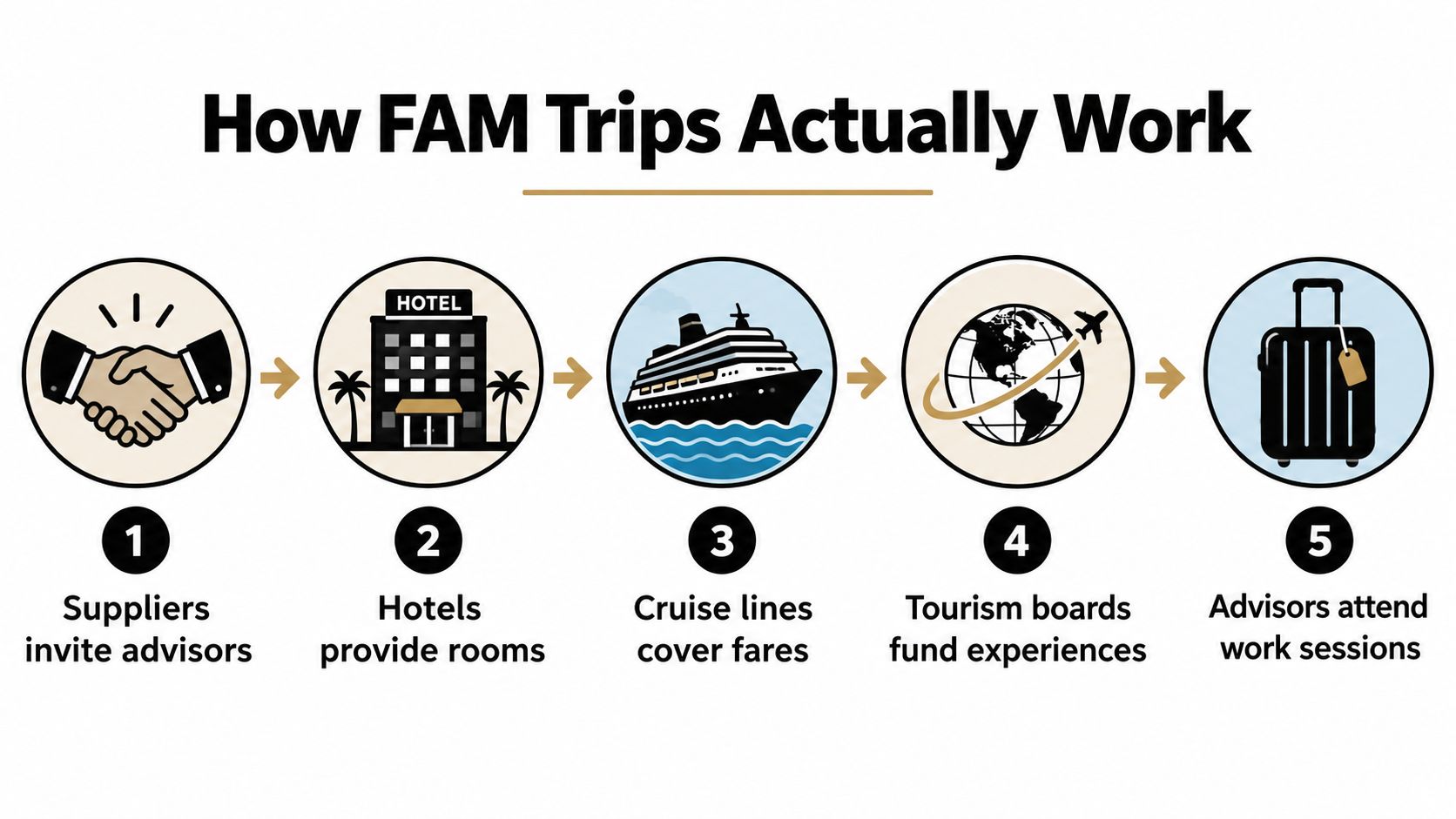
Hotels provide rooms they want sold. Cruise lines provide cabins on sailings they want filled with future group and suite business. Tourism boards fund destination experiences because an advisor who has handled the airport transfer, the road conditions, and the distances between sights will stop building itineraries that collapse on day two.
The flow below shows the sequence most hosted trips follow, from supplier partnership to advisor work sessions.
Who Gets Invited and Why
Invitations are allocated, not claimed. A supplier looks at past production, the advisor's host agency or consortium, certifications, niche fit, and whether the advisor sells the right client profile. A luxury safari operator doesn't host an advisor whose book is budget cruises. A golf resort courting group business looks for advisors who already move that demand, a segment examined in Golf Problems on trip growth.
Capacity is the quiet constraint. A property can host a small group without displacing paying guests, so it does. It cannot host every credentialed advisor in North America, so it doesn't.
What the Advisor Owes in Return
The itinerary is scheduled like work because it is work. Expect site inspections across multiple room categories, supplier presentations, hosted meals designed to showcase specific outlets, transfers timed to test logistics, and meetings with sales managers and general managers. Good advisors take notes on noise, bathroom layout, beach access, staff response time, and which suite category is worth the premium.
- Attendance isn't optional: Skipping inspections to sit by the pool ends future invitations.
- Reporting is common: Host agencies and suppliers may expect feedback, content, or a sales plan after the trip.
- Companions usually pay: A spouse or friend is rarely covered, and when allowed, they often pay a supplement and stay out of work sessions.
Coverage varies by sponsor budget. Some hosted FAMs cover most costs. Others cover the room and scheduled activities while the advisor pays airfare, taxes, gratuities, and everything personal. That's why two advisors can attend the same property and describe completely different out of pocket totals.
A FAM trip is best understood as paid product training where payment comes in kind, not in cash, and only covers part of the cost of attending.
The Four Categories of Advisor Benefits Explained
Use this classification every time an agency, a recruiter, or a social media post waves the phrase complimentary travel at you. The categories differ in who pays, who qualifies, and whether you, the client, ever benefit.
The Four Categories of Travel Advisor Benefits
| Benefit Type | Who Funds It | Who Qualifies | Transfers to Client? | Typical Coverage |
|---|---|---|---|---|
| Fully hosted FAM trip | Hotel, cruise line, tourism board, tour operator | Invited advisors with relevant sales, credentials, or agency affiliation | No | Lodging or cabin, scheduled inspections and activities, some meals |
| Advisor-only industry rate | Supplier, with advisor paying the reduced price | Credentialed advisors, often with production or affiliation requirements | No | Discounted room, fare, or package for the advisor's own travel |
| Client-facing booking amenity | Supplier through a preferred partner or consortium program | Clients booking qualifying rates through an affiliated advisor | Yes | Upgrade when available, breakfast, resort or shipboard credit |
| Supplier commission | Supplier, paid to agency after travel | The agency of record on an eligible, completed booking | No, it's agency income | A percentage of the commissionable booking value |
Hosted FAMs deliver knowledge, not transferable value. Your benefit is indirect. The advisor learns that the oceanfront category at a resort faces a service road, or that a ship's suite perks don't justify the fare gap, and steers you accordingly. That's valuable. It isn't a discount.
Advisor-only rates confuse people most. An advisor might stay at a property for less than the public rate to evaluate it, or sail at a reduced fare in an unsold cabin category. Suppliers restrict these rates, blackout dates apply, and the advisor cannot hand the rate to a client. If an advisor promises you their personal rate, ask for that in writing. You won't get it.
Client-facing amenities run the opposite direction. The benefit attaches to your reservation because the agency holds preferred status, and the supplier funds it to win the booking through that channel. You receive the breakfast or credit. The advisor receives nothing extra to consume personally.
Commission is compensation, and it's thinner than outsiders assume. Advisor compensation is commonly reported at 7%-20% of the booking depending on the travel product, while commission-only bookings can produce margins below 5%, compared with roughly 12%-20% for fee-based transactions. On top of that, host agencies or consortia may retain a share in exchange for technology, training, and supplier access.
How to Classify Any Claim in Ten Seconds
Ask three questions. Who pays? Who consumes the benefit? Does it survive if the booking cancels? A FAM is supplier funded, advisor consumed, and gone if the advisor can't attend. An amenity is supplier funded, client consumed, and tied to a live qualifying reservation. Commission is supplier funded, agency consumed, and generally payable only after travel completes.
Decision test: If a benefit disappears when you book direct, it's probably client facing. If it disappears when the advisor stops selling that supplier, it was never yours.
Don't pay a premium for an advisor whose main credential is access to category one or two. Pay for the judgment those trips produced, and for category three benefits that show up on your confirmed itinerary by name.
Where Advisor Income Actually Comes From
Commissions pay the rent. FAM trips don't. An advisor can attend excellent hosted trips and still run a weak business if bookings don't convert, clients cancel, or the product mix pays poorly. Understanding the income side explains both advisor behavior and the pressure behind some recommendations.
Suppliers generally pay commission after the traveler completes the trip, and only on the commissionable portion. Taxes, port charges, some fees, and air components may be excluded. A large headline trip price can produce a much smaller commissionable base.
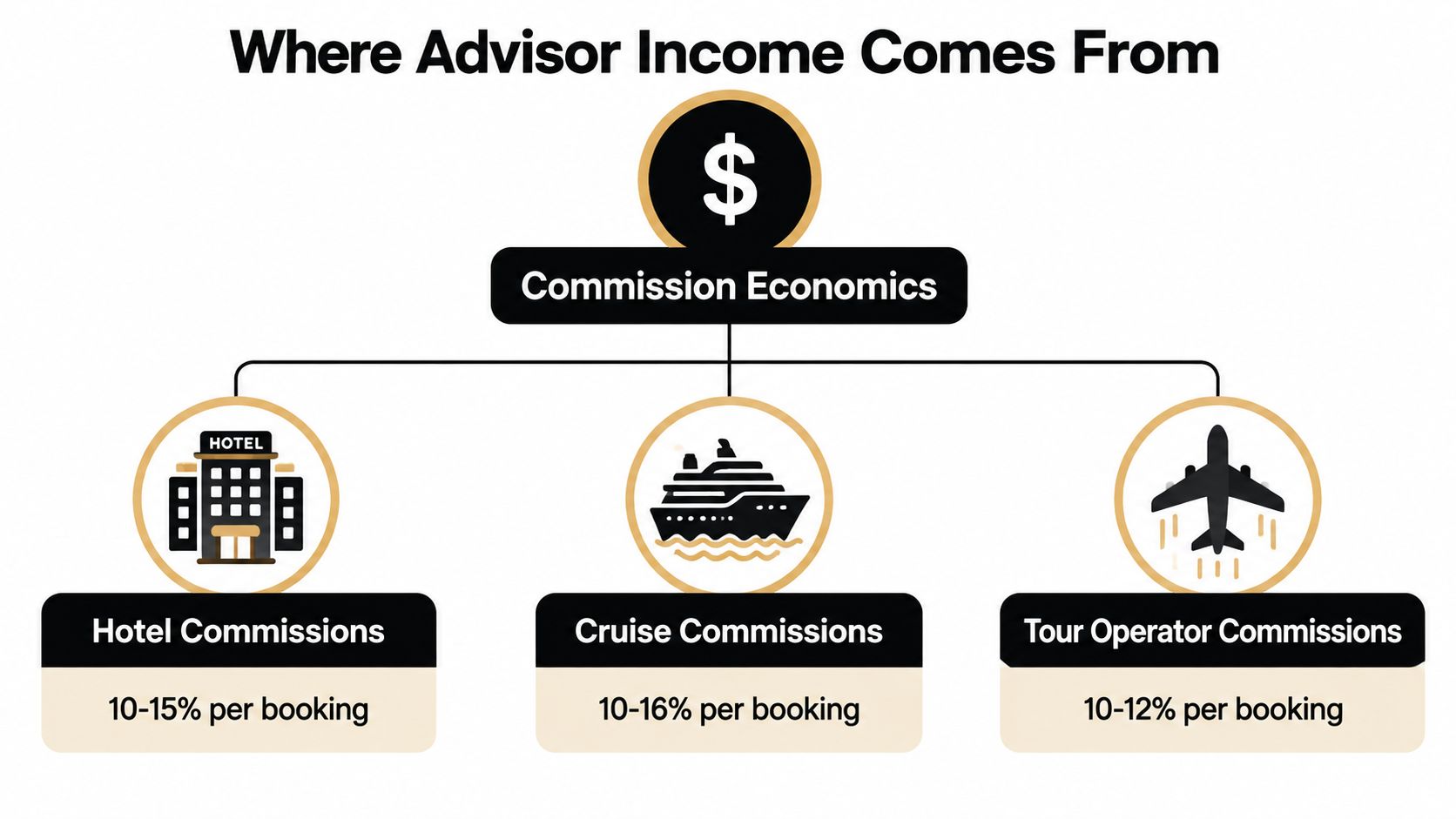
The diagram below maps the main commission sources, with hotels, cruises, and tours doing most of the work.
Product Mix Decides Everything
ASTA published supplier material documents cruise commissions reaching up to 18% in specific programs, while broader industry reporting describes typical supplier commissions of around 10%-16% across several vacation categories. Hotels, cruises, tours, and packaged luxury itineraries support the business. Scheduled air often generates little or no base commission, which is why serious advisors charge ticketing or service fees rather than pretending flights are profitable.
That's also why extensive custom design breaks the commission only model. Ten hours of research across noncommissionable components, restaurant logistics, and complex multi country routing isn't funded by a hotel commission that arrives months later.
- Paid after travel: Commission timing punishes cancellations and rewards advisors who protect bookings through departure.
- Split with the host: Independent advisors commonly share commission with a host agency or consortium that provides supplier contracts and support.
- Bonus thresholds exist: Some supplier programs add bonuses or enhanced commission at volume tiers, which ties benefits to production, not employment status.
Why Planning Fees Keep Rising
Client paid planning fees increasingly supplement commission because advice is the product. Fees compensate consultation, research, itinerary design, and ticketing work that suppliers don't fund. I consider a transparent fee a good sign, not a rip off, provided the scope is written down before work begins. Our explainer on how luxury travel agent service fees are structured lays out what those fees should and shouldn't cover.
Be skeptical of the opposite pitch. An advisor who charges nothing, earns thin commission, and travels constantly on supplier invitations has to make the economics work somewhere. Usually that somewhere is steering you toward whoever pays best or hosts most often.
Common Misconceptions Clients Should Drop
Most confusion comes from marketing language, and some of it comes from advisors who enjoy the mystique. The image below is the less glamorous reality behind the itinerary in your inbox, an advisor working through options at a desk.

Misconception one, complimentary means fully covered. It often means the room is covered. Airfare, transfers, taxes, gratuities, insurance, meals outside the program, and a companion's costs can still land on the advisor. Add lost working time and the free trip carries a real price.
Misconception two, FAM trips are vacations. They're scheduled inspections with early starts, property tours in sequence, and supplier meetings. An advisor may extend a stay at personal expense to rest, which tells you everything about the hosted portion.
The Two That Cost Clients Money
Misconception three, advisor perks and client perks are the same thing. They aren't. Advisor rates and FAM invitations belong to the advisor. Amenities on a preferred partner booking belong to you. The Four Seasons Preferred Partner explanation states that travelers pay the public Best Available Rate while the brand funded advisor relationship adds benefits at no extra cost to the client, which shows preferred status working for the guest, not funding the advisor's holiday.
Misconception four, preferred status guarantees an upgrade. It doesn't. Upgrades are typically subject to availability, sometimes confirmed at booking, often decided at check in. A good advisor tells you which benefits are guaranteed, which are prioritized, and which are a polite hope.
The short video below is a useful watch before your next advisor conversation, because it focuses on the questions that separate genuine access from sales language.
Misconception five, hosted access never affects recommendations. It can, and pretending otherwise insults your intelligence. An advisor who just spent four days as a supplier's guest has fresh relationships, fresh material, and sometimes a fresh incentive. That doesn't make the recommendation wrong. It makes disclosure reasonable.
Ask directly whether the advisor visited as a paying guest, on an advisor rate, or as a hosted guest. A professional answers without flinching.
Drop these five assumptions and you'll read every travel pitch more clearly, including ours.
What Clients Should Ask Their Advisor About Perks
You don't need industry credentials to vet an advisor. You need four precise questions and a refusal to accept vague answers about access, relationships, and VIP treatment.
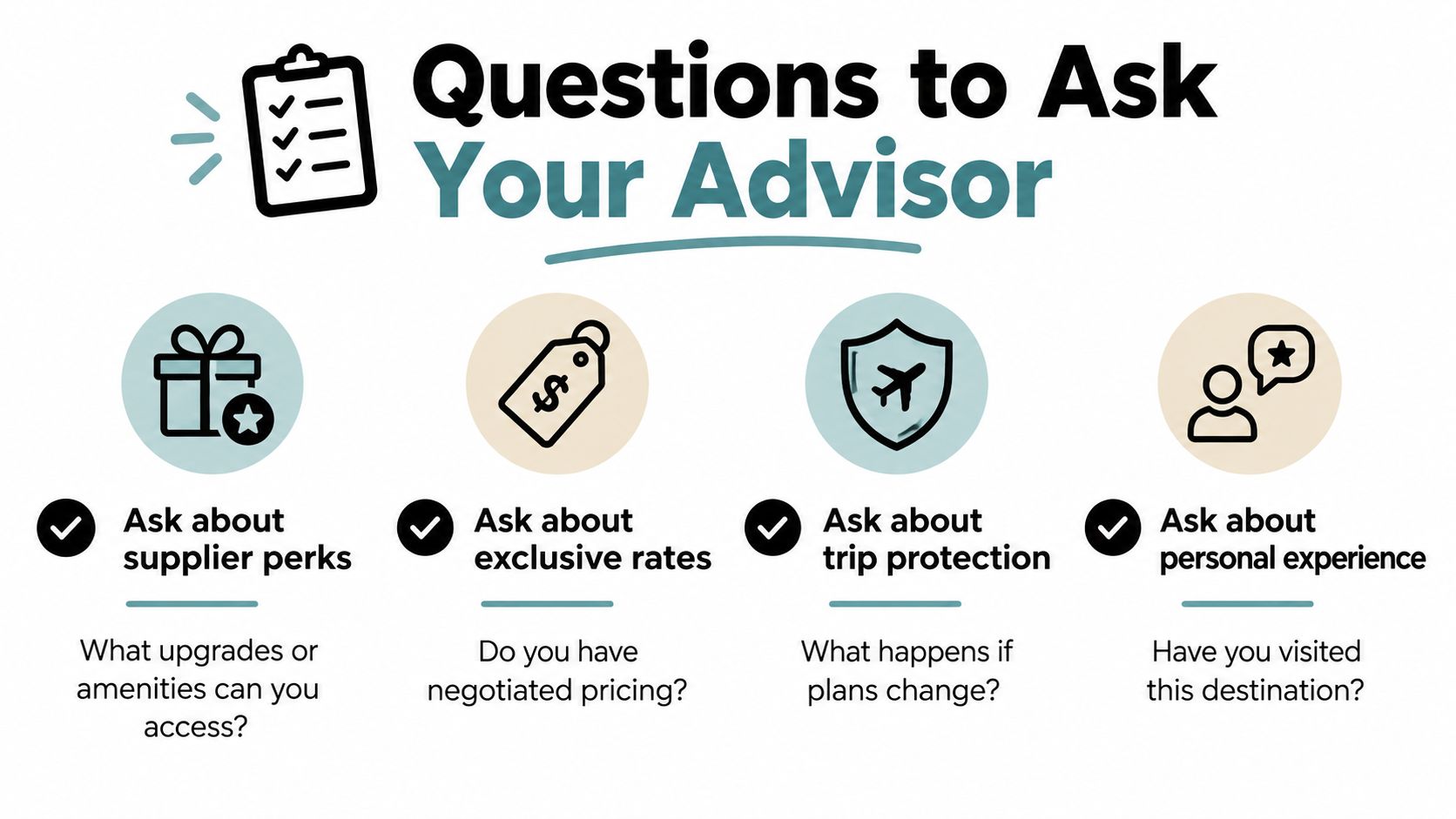
The checklist below summarizes the questions, covering perks, rates, protection, and firsthand experience.
The Four Questions
1. Is this benefit a hosted FAM, an advisor rate, or a client facing amenity? This forces the category conversation and kills most inflated claims immediately.
2. What does coverage include, and what do I still pay? Get the rate basis, taxes, resort fees, cancellation terms, and whether amenities require a specific qualifying rate.
3. Is the upgrade guaranteed, or based on availability at check in? Ask who decides, when it's decided, and what happens if the property is full.
4. What preferred partner or consortium status activates this, and how is it attached to my booking? You want the program name, the benefits in writing on your confirmation, and a named contact at the property when that applies.
Then test expertise, because that's the advantage worth buying. Ask what the advisor would not book at the destination and why. Ask which room category they'd take with their own money. Ask what goes wrong logistically in that destination during your travel month. Weak advisors describe brochures. Strong ones describe trade offs.
Keep loyalty thresholds in the right box too. For perspective, approximately $25,000 in annual travel spend can qualify a customer for complimentary HauteBlack Access, while $350,000 can qualify for one complimentary year of the invitation only Black Card. That's a traveler loyalty benefit earned by spending, not an advisor's free trip, and the distinction is the whole point. For a fuller breakdown of what a good booking relationship should deliver, read the 2026 guide to the benefits of booking with a travel agent.
If an advisor answers all of this cleanly, in writing, you've found a professional. If they retreat into phrases like insider access and special relationships without specifics, keep looking.
Why Expert Planning Matters More Than Free Trips
You don't need an advisor who travels free. You need an advisor whose travel, hosted or self funded, produced judgment you can use. As covered earlier, advisors earn their living from supplier commissions and, increasingly, client paid planning fees, not from unlimited complimentary vacations. That model rewards advisors who protect your trip through completion, not advisors who collect invitations.
What drives luxury outcomes is a working combination of preferred partner status at properties such as Four Seasons, Aman, Rosewood, Belmond, and Ritz-Carlton, a dedicated advisor who knows your preferences, complimentary upgrades when available, resort credits on qualifying bookings, and member planning fee waivers where they apply. If you're unsure what that work involves day to day, the overview of what a luxury travel advisor actually does sets realistic expectations.
Judge every advisor by one standard. Can they convert supplier access into a better room, a cleaner transfer, a table that was supposedly full, and a problem solved at midnight in another time zone? That's the benefit. The FAM trip was just homework.
Stop paying for the myth of free travel and start buying judgment that's been tested on the ground, across bespoke itineraries in more than 120 countries, with Virtuoso affiliation and preferred partner status at over 500 properties. Visit HauteBlack to work with a dedicated advisor who will tell you exactly which perks attach to your booking, which are subject to availability, and which are marketing, then build the trip around the answers.
Explore Our Guides


Signature Experiences


