Haute Black Journal
Benefits of Booking with a Travel Agent: 2026 Guide

Marlene Azeez
Director, HauteBlack
View all articles →

Booking with a travel agent can save an average of $452 per trip, while luxury clients gain something more valuable than a lower price: VIP recognition, curated access, and an advocate when plans change. For UHNW travelers and executive assistants, the strongest benefit is risk control backed by supplier relationships.
A five-star reservation can still fail at the moment it matters. A couple may book an overwater villa in the Maldives, pay a premium rate, and discover during the trip that a transfer window, cancellation term, or room arrangement has changed. They're left negotiating across time zones with a hotel team that sees a reservation number, not the full context of the journey.
The right luxury travel advisor changes that dynamic before departure. They confirm the details with the property, identify fragile connections, document preferences, and establish a human escalation path. Luxury travel isn't only about finding an impressive hotel. It's about having someone who can protect the experience, apply influence discreetly, and solve problems before they become expensive.
Why Luxury Travel Advisors Deliver What Self-Booking Cannot
The couple's Maldives booking may look flawless online. The villa photographs are accurate, the rate appears competitive, and the itinerary fits the dates. The weakness is hidden in the gaps between suppliers: the seaplane schedule, the resort's transfer policy, the payment terms, and the consequences of a delayed international arrival.
If the couple books independently, each supplier owns only its own fragment. The airline won't usually coordinate with the resort, and the resort may not adjust its transfer plan unless someone contacts the right department. A dedicated advisor reviews the entire chain, asks what happens if the first flight is delayed, and confirms who will act if the itinerary breaks.

Luxury is coordination, not just selection
A public booking engine can display a room. It can't understand that a guest needs a quiet villa away from a construction zone, a discreet arrival because of a public profile, or a flexible plan around a private aircraft schedule. An experienced advisor translates those preferences into supplier instructions and follows up with people who can implement them.
That human connection matters at properties such as Four Seasons, Aman, Rosewood, Belmond, and Ritz-Carlton. An advisor who knows the property's reservations, guest-relations, and concierge teams can present the guest properly before arrival. The result may include recognition, a thoughtful welcome, or an available upgrade, but the deeper benefit is accountability.
Practical rule: A luxury booking is only as strong as the person responsible for the weakest connection in the itinerary.
The value of that advocacy becomes clearest during disruption. If a flight is cancelled, the advisor can work through the airline, ground operator, and hotel rather than asking the traveler to restart the process with each company. If a room type changes, the advisor has a documented brief and a supplier relationship to draw on.
For a useful explanation of how these relationships function across luxury suppliers, review how a luxury travel network works. The decision isn't whether a traveler can find the property alone. They usually can. The decision is whether the traveler wants to be the only person protecting the booking.
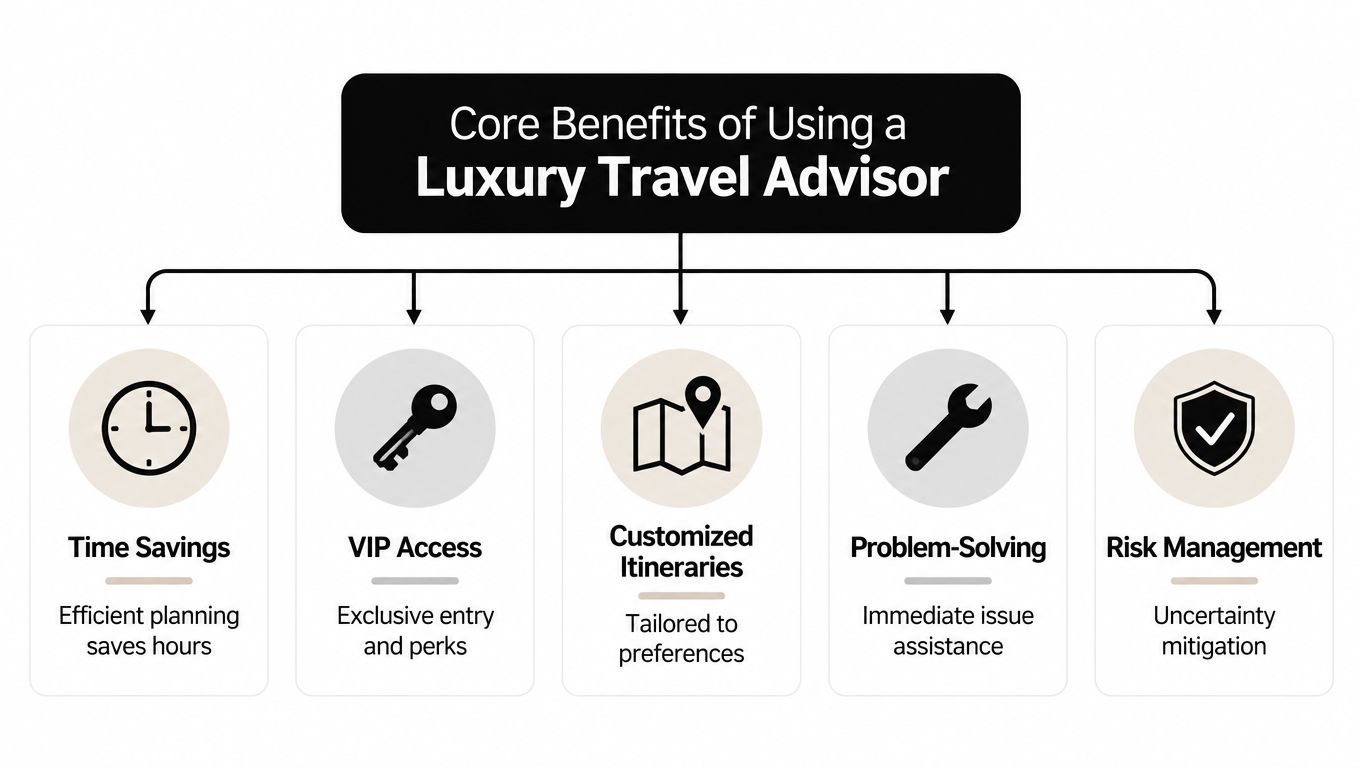
The Core Benefits of Using a Luxury Travel Advisor
The benefits of booking with a travel agent become structural when the trip includes multiple suppliers, high-value reservations, or little tolerance for disruption. An advisor creates a decision layer between the traveler and a fragmented travel system.
Independent survey data identifies the practical reasons consumers choose agents. 54% selected ease of booking, 43% wanted help if something went wrong, 43% wanted to save time, 39% cited value for money, 36% felt more confident, and 35% wanted expert advice. These figures are reported in travel agency statistics from Condor Ferries, and they align closely with what executive assistants and private offices need from a travel partner.
Time is a financial resource
The same source reports that the average U.S. adult spends 16 hours crafting one vacation itinerary. For an executive assistant coordinating principals, children, guests, security requirements, dietary needs, and changing schedules, the key cost isn't just research time. It's the opportunity cost of managing suppliers instead of the principal's priorities.
An advisor can reduce that burden by narrowing the field early. They know which properties suit a particular travel style, which transfer arrangements are unreliable, and which room categories deliver genuine privacy rather than attractive marketing copy.
Access has a measurable shape
Virtuoso-affiliated bookings commonly include benefits such as breakfast, upgrades when available, late checkout, transfers, and resort credits. One industry summary reports that this hotel-benefit package averages over $500 per stay while the guest pays the same rate as a direct booking, as detailed in Forbes' coverage of travel agents.
That value matters most at high-rate properties. Daily breakfast, a credit, or a room improvement can change the economics of an advisor booking without requiring the advisor to chase a lower public rate. For specialized requirements, a resource on pet travel logistics help can also support planning when an animal must be included in a complex journey.
Risk management is the premium service
Luxury travelers often focus on upgrades because they're visible. The more important function is preventing avoidable failure. ASTA-reported research cited in the benefits of booking through a travel agent found average savings of about $452 per trip and roughly four hours of planning time. It also reports that 69% said agents save time, 66% said agents help avoid costly mistakes, and 64% said agents find better deals.
Those findings support a practical conclusion. Advisors don't only sell inventory. They consolidate fare rules, supplier policies, transfer timing, and change conditions into one accountable plan. On a multi-country itinerary, that can prevent a small error from becoming a chain of missed services and unrecoverable costs.
Self-Booking vs Advisor-Assisted Luxury Travel
Self-booking works well when the trip is simple, familiar, and flexible. A direct hotel reservation for a short city stay may not need an intermediary. The calculation changes when the journey includes villas, cruises, private transfers, several countries, or travelers whose time has a high operating value.
| Decision area | Self-booking | Advisor-assisted travel |
|---|---|---|
| Property choice | Based mainly on public descriptions, reviews, and visible rates | Matched to preferences, room positioning, service style, and trip purpose |
| VIP recognition | Requested through standard channels | Presented through preferred-partner or supplier relationships |
| Itinerary design | The traveler connects each reservation | One person coordinates hotels, transfers, experiences, and timing |
| Disruption handling | The traveler contacts each supplier | The advisor manages escalation across the affected providers |
| Value assessment | Focuses on the headline price | Weighs rates, amenities, flexibility, access, and service recovery |
| Accountability | Spread across websites and call centers | Concentrated in a named advisor and support structure |
The room rate is often the least interesting part of the comparison. An advisor may charge a service fee, and HauteBlack's explanation of luxury travel-agent service fees makes the central point clear: the right question is whether the total value exceeds the fee.
For a basic booking, the answer may be no. For a honeymoon, family trip, or international itinerary, the equation includes avoided mistakes, preferred amenities, flexibility, and the cost of having the traveler solve a crisis personally.
The correct comparison isn't “agent fee versus online price.” It's “unmanaged exposure versus coordinated value.”
An advisor-led trip also creates continuity. The person arranging the journey knows why a particular suite was selected, which travelers need adjacent rooms, and whether a late arrival affects dinner or transfer plans. That context gives the supplier a more complete brief and gives the traveler someone to call who already understands the situation.
UHNW clients should still retain control over the decisions that matter. The advisor's role isn't to remove choice. It's to make the choice set sharper, protect the execution, and intervene when public channels stop being useful.
How to Choose the Right Luxury Travel Advisor
Start with supplier access, not social media polish. A luxury advisor should be able to explain which hotel programs they use, what benefits attach to a booking, and how they communicate a guest's preferences to the property.
Ask for specifics about preferred-partner relationships with properties such as Four Seasons, Aman, Rosewood, Belmond, and Ritz-Carlton. “We know luxury hotels” is weak evidence. A stronger answer identifies the programs, the type of recognition available, and the advisor's process for confirming it before arrival.
Use this selection checklist
1. Confirm network credentials. Virtuoso affiliation or equivalent preferred-partner status can create access to amenities and supplier escalation that public channels don't provide.
2. Test responsiveness before booking. Ask how the advisor handles an after-hours flight cancellation, a missed transfer, or a last-minute room change. You're evaluating the operating model, not just the sales conversation.
3. Examine itinerary depth. A true partner should handle more than hotel reservations. Ask about private aviation coordination, helicopters, villas, dining, ground transport, guides, and special-access experiences.
4. Request evidence of complexity. The advisor should be comfortable with multi-stop travel, multi-generational groups, executive schedules, and sensitive preferences. They should ask precise questions before recommending properties.
5. Clarify fees and scope. Establish what the planning fee covers, when it applies, and what support continues after travel begins. A cheap booking can become expensive if nobody owns the disruption.
HauteBlack's service-fee explainer states that the company is Virtuoso-affiliated, has preferred-partner status at over 500 properties, and operates across 120+ countries. Those details illustrate what to verify when comparing advisors: network breadth, property access, and geographic capability, not merely the promise of personalized service.
Executive assistants should also assess documentation. The advisor must keep a clean record of passport details, preferences, approved budgets, cancellation terms, and decision authority. For private offices, discretion and permission controls are as important as itinerary creativity.
Use this guide to choosing a VIP travel agency as a further framework. The right advisor should feel like an extension of the office, with enough supplier influence to act quickly and enough discipline to know when approval is required.
Real Examples of Advisor-Only Experiences and Crisis Solutions
A luxury advisor's work often happens out of sight. The traveler sees the dinner reservation, the preferred room, or the replacement transfer. They don't see the calls and messages that made those outcomes possible.
Consider a fully booked private estate for a family milestone. A public website shows no availability, and an online request form returns a standard response. An advisor with a direct relationship can ask the estate manager about release timing, cancellation movement, staffing, and whether an alternative residence can deliver the same privacy. The advantage isn't magic. It's knowing whom to contact and presenting a credible client brief.

A second example involves a cancelled international flight before a critical event. The traveler needs a new routing, a revised airport transfer, and a hotel that can still honor a late arrival. A self-booker may spend hours rebuilding each component. An advisor can work on the air, ground, and hotel arrangements at the same time, then send one consolidated update to the executive assistant.
The same principle applies to access. A luxury advisor may secure a private guide, hard-to-obtain dining reservation, or a cultural experience that isn't exposed through mainstream booking channels. The advisor also checks whether the experience fits the traveler's security, mobility, privacy, and timing requirements.
The useful question: Who can still act when the public inventory says no?
The advisor's role continues after a reservation is confirmed. They can monitor changes, reconfirm sensitive services, and give suppliers the context needed to respond appropriately. That's especially valuable when the traveler has little room for improvisation.
For an executive assistant, this support protects both the principal's time and the office's credibility. A failed transfer or missed reservation doesn't become a personal emergency managed from a hotel lobby. It becomes an operational issue assigned to someone who already has the relevant contacts and itinerary history.
Why the Right Advisor Changes Everything
The strongest benefits of booking with a travel agent appear when the trip carries consequences beyond the fare. A honeymoon has emotional stakes. A family itinerary has multiple points of failure. An executive trip may depend on privacy, punctuality, and the ability to change plans without public friction.
Luxury travelers also increasingly value protection over decoration. Luxury-traveler data reports that 75% prioritize safety and security, while 65% cite an added layer of protection as a top benefit of using an advisor, as reported in Virtuoso's luxury travel trends announcement. That is the right lens for evaluating an advisor. Upgrades are welcome. Risk reduction is essential.
HauteBlack's luxury-travel guide says members receive a dedicated advisor and waived planning fees, along with preferred rates, complimentary upgrades when available, resort credits, and concierge support for private jets, helicopters, villas, dining, and ground transportation. These services show how an advisor can operate as a travel office rather than a booking intermediary.
The relationship should therefore be selected with the same care as any important professional partner. Look for judgment, supplier credibility, discretion, responsiveness, and the ability to make decisions under pressure. A lower room rate can't compensate for a preventable failure on a high-value trip.
For UHNW clients and executive assistants, the practical takeaway is simple: hire an advisor before the itinerary becomes urgent. Share the travel profile, define approval boundaries, and test the advisor with a meaningful journey where access, continuity, and recovery matter.
HauteBlack designs bespoke journeys with dedicated advisor support, preferred-partner benefits, and coordination across hotels, experiences, transfers, villas, and private aviation. Visit HauteBlack to discuss a trip where VIP recognition, discreet access, and reliable execution matter more than just booking a room.


