Haute Black Journal
Travel Consultant vs Travel Agent: Who You Should Choose

Marlene Azeez
Director, HauteBlack
View all articles →

A travel consultant typically charges planning fees of $150–$300 for in-depth work and earns supplier commissions of 7–20%, while a traditional travel agent relies almost entirely on commissions. Consultants are usually the better fit for complex, bespoke trips, while agents are often sufficient for simple bookings.
You're probably weighing the choice after opening several hotel tabs, comparing conflicting flight options, and wondering whether professional help will save money or just add another line to the invoice. The answer depends less on the title and more on what happens after you pay: who researches the details, who has supplier relationships, who handles changes, and who answers when a carefully planned journey starts to unravel.
A consultant's fee pays for judgment, design, and accountability. An agent's commission typically pays for arranging and servicing reservations, although many experienced agents now offer a more advisory level of care. The useful question isn't “Which title sounds more premium?” It's what kind of trip are you buying, and what kind of responsibility do you expect your travel professional to accept?
Why the Travel Consultant vs Travel Agent Debate Matters Now
A couple planning a weekend in Lisbon may use “travel agent” and “travel consultant” interchangeably without consequence. They need a flight, a hotel, and perhaps a rental car. A capable professional can process those reservations efficiently, and the distinction between titles won't change the outcome very much.
The stakes change when the trip includes several countries, multiple travelers, tight connections, or a celebration that can't be repeated. Consider a high-net-worth couple planning a honeymoon around an Aman property, a private guide, a hard-to-secure restaurant, and a connecting safari. If one transfer is booked on the wrong date, the cost isn't limited to correcting a reservation. It can mean losing a prepaid experience, missing a connection, or arriving at a luxury hotel after the room category and preferred benefits have disappeared.

The title matters less than the operating model
The industry itself acknowledges the overlap. “Travel agent,” “travel advisor,” “travel consultant,” and “travel specialist” may all appear in marketing materials for professionals who perform similar booking work. The label can indicate positioning, but it doesn't prove specialization, access, or commitment after payment.
The more revealing questions are practical:
- How does the professional get paid? Is the business commission-only, fee-based, or hybrid?
- What does the fee cover? Research, proposal revisions, booking, document review, and on-trip support may be treated differently.
- Who owns the relationship? Will you speak with the same advisor, or enter a general service queue?
- What complexity have they handled? A specialist in luxury safaris may not be the right person for a corporate air-heavy itinerary.
- What happens during disruption? Ask who will act if a flight cancellation affects the next three reservations.
Practical rule: A title describes a professional's positioning. A written scope of work describes the service you're actually buying.
Complexity creates the financial difference
A simple booking has a narrow problem. A complex itinerary has dependencies. Flight timing affects transfers, transfers affect check-in, check-in affects guides and activities, and every supplier may have a different cancellation policy. Someone must keep those pieces aligned.
That's why the travel consultant vs travel agent decision is really a decision about risk management and accountability. Travelers who want the lowest-friction transaction may prefer an agent or direct booking. Travelers who want someone to interpret trade-offs, coordinate suppliers, and remain involved when conditions change may find the consultant model more appropriate.
Before comparing titles, classify the trip. Is it routine, or does it involve meaningful financial exposure, several moving parts, vulnerable travelers, or a rare personal milestone? That answer usually points toward the right professional faster than any job description.
The Industry Shift Behind the Terminology
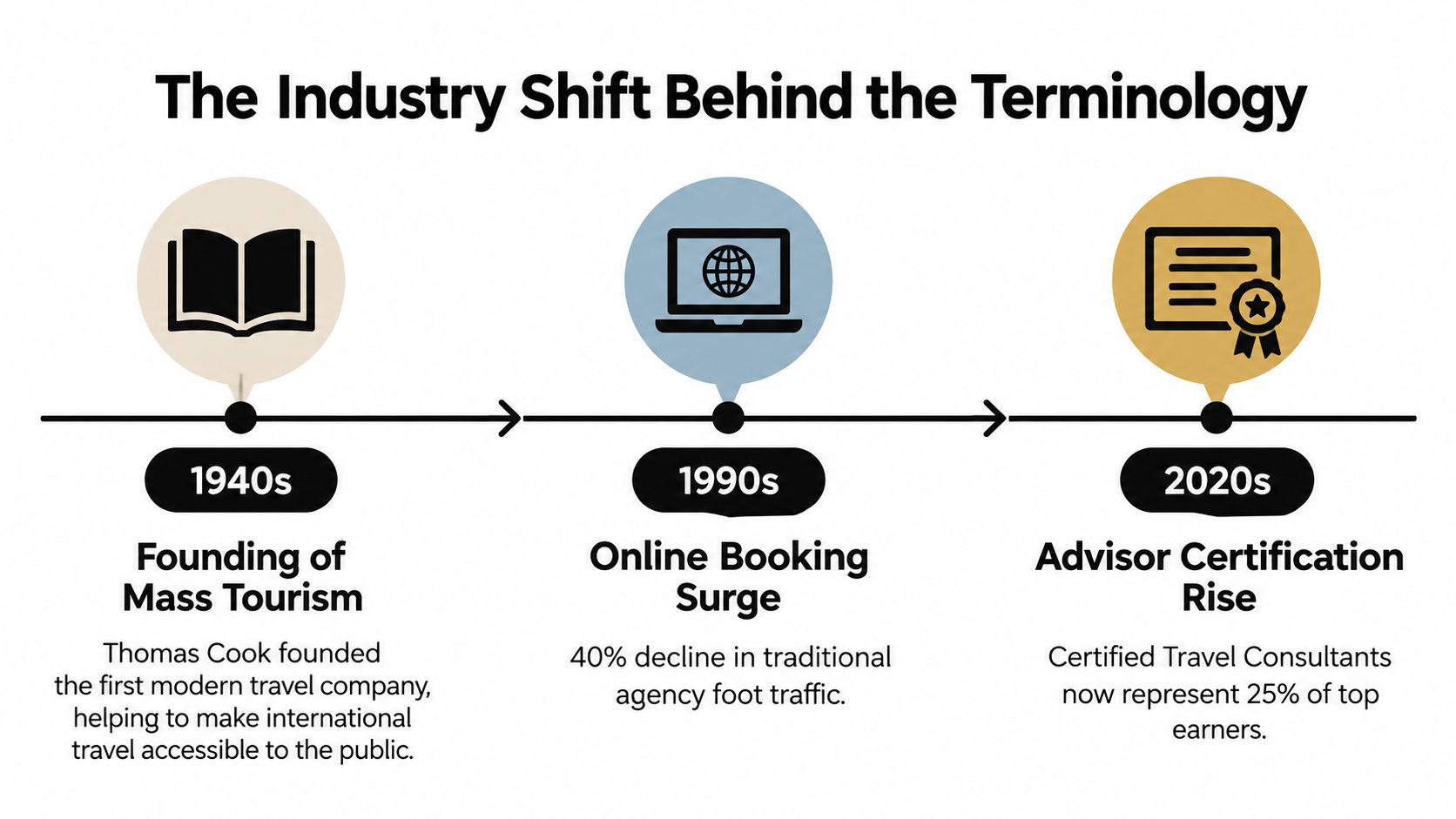
Organized travel selling predates modern job titles. Thomas Cook's 1841 rail excursion is widely cited as an early milestone in organized travel sales, although “travel agent” was not yet the industry term. In the United States, the profession was formalized by the American Society of Travel Agents in 1931, according to this history of the travel profession.
The original job was transactional: arrange transportation, secure lodging, and connect travelers with available inventory. Digital distribution changed that equation. Clients can now compare routes, room categories, cancellation terms, and reviews themselves. The professional earns their place by interpreting those choices, coordinating suppliers, and accepting responsibility after the reservation is made.
A larger market with a sharper service divide
The U.S. travel agency industry generated $45.3 billion in revenue in 2026, included 65,181 businesses, and grew at a 9.4% CAGR over the prior five years, according to IBISWorld's travel agencies industry profile. The revenue figure matters because agencies still control meaningful booking volume despite direct-to-consumer channels. The money remains in the market, but clients increasingly pay for judgment rather than simple access to inventory.
U.S. travel agents held about 61,500 jobs in 2025, while online sales accounted for over 70% of global travel and tourism market revenue in 2025. Together, those figures describe a large profession operating beside powerful digital purchasing channels. Online systems handle straightforward comparison and checkout. Human value appears in itinerary design, supplier coordination, disruption support, and decisions that are difficult to reverse.
A consultant may build the business around itinerary architecture, destination expertise, and personal oversight. An agent may focus on efficient booking, supplier breadth, and responsive transaction servicing. The labels overlap, but the commercial model can differ. That difference affects where the client's money goes, whether through planning fees, commissions, or both.
Why “advisor” has become a meaningful label
Service positioning is driving the terminology shift. In a 2024 industry survey, 49% of respondents identified as “travel advisor,” compared with 19% using “travel agent” and 18% using “travel consultant,” as reported in the PAX history of the profession. The survey shows that “advisor” has become the dominant self-description, signaling advisory positioning rather than a specific booking function. It still proves nothing about how the professional is paid.
Consumers should treat the label as a starting point, not a quality guarantee. An advisor may work primarily on commissions, while an agent may deliver detailed, highly personalized service. Examine the fee policy, destination focus, supplier relationships, and support process instead.
The practical distinction is commercial intent. One professional may be paid to complete a reservation. Another may be paid to design, coordinate, and defend the entire journey. The right choice depends on which outcome the trip requires.
Comparing Services, Fees, and Client Types
A family booking a direct flight and hotel needs a different service from an executive coordinating arrivals, meetings, transfers, and contingency plans across several cities. The distinction becomes clearer when you examine the work, the payment model, and who remains accountable after the booking is confirmed.
| Criteria | Travel Consultant | Travel Agent |
|---|---|---|
| Primary role | Designs and coordinates complex, personalized journeys | Arranges and services standard travel reservations |
| Typical client | Luxury travelers, executives, families, and clients with specialized needs | Leisure travelers seeking efficient flights, hotels, cruises, or packages |
| Compensation | Often combines client-paid planning fees with supplier commissions | Commonly relies primarily on supplier commissions |
| Personalization | Detailed discovery, itinerary design, destination specialization, and ongoing coordination | Efficiently matches available products to stated requirements |
| Booking channels | May combine direct supplier relationships, preferred-partner programs, and agency systems | Often relies on GDS tools, supplier systems, and standard workflows |
| Best use case | Bespoke, multi-destination, luxury, corporate, or high-stakes travel | Straightforward bookings where speed and price efficiency matter |
Where the money goes
Supplier commissions for travel advisors usually range from 7–20%, depending on the booking type, according to this explanation of travel advisor compensation. A consultant may also charge a planning fee because research and itinerary design take place before a supplier booking produces commission.
For in-depth planning, consultation fees are reported at about $150–$300, with project-based fees ranging from $50–$500 or calculated as a percentage of the trip cost. The margin picture explains why: fee-based transactions run at 12–20%, compared with less than 5% for commission-only bookings, according to AltexSoft's travel advisor market analysis.
The payment structure affects the service a business can sustain. A commission-only model earns when inventory is booked and may include research without a separate charge. A fee-based consultant can price the planning work directly, making it practical to compare routing options, contact properties, revise proposals, and remain involved after confirmation.
For a closer look at potential luxury planning charges, see HauteBlack's guide to travel agent service fees for luxury travel.
Services and channels aren't interchangeable
Travel Weekly distinguishes consultants who use destination knowledge, hotel relationships, and client preferences to arrange personalized stays from agents who may rely more heavily on GDS systems and standard workflows in its comparison of agents and consultants.
GDS access remains useful. It supports schedules, availability, ticketing, and changes efficiently. Direct supplier relationships matter more when a trip depends on room placement, special handling, local judgment, or a property's willingness to advocate for the guest.
Complex journeys also create deadlines, approvals, supplier conversations, and document handoffs. Advisors and executive assistants handling those parallel responsibilities need a visible way to assign and track each item, which is the same operational problem addressed by a task management platform comparison. Clear ownership reduces the chance that a transfer confirmation, dietary request, or schedule change disappears inside an email thread.
Who Should Choose a Travel Consultant
A consultant earns the strongest case when the trip has enough complexity or consequence to justify design work. That usually includes luxury travelers, executives, and families coordinating an important occasion.
Luxury travelers paying for judgment
A luxury traveler isn't just buying a more expensive room. They're choosing location, room position, arrival timing, transfer quality, dining access, privacy, and the right balance between structure and freedom. The wrong recommendation can produce an expensive trip that still feels poorly matched.
A specialist with relevant relationships at Four Seasons, Aman, Rosewood, Belmond, and Ritz-Carlton properties may know which benefits are available through a preferred-partner channel and which requests need to be made before arrival. Depending on availability and the program, those benefits may include upgrades, resort credits, flexible amenities, or stronger arrival recognition. They aren't guaranteed outcomes, so a consultant should explain what is confirmed, what is requested, and what remains subject to availability.
Executives and high-consequence schedules
Corporate travel often fails at the connections between reservations. A CEO retreat may involve several executives arriving from different cities, private transfers, meeting rooms, dietary requirements, and a return schedule that cannot move easily. The value of a consultant lies in coordinating those dependencies and giving someone clear ownership of the plan.
The advisor also needs to understand the traveler's tolerance for risk. One executive may prioritize the shortest route. Another may prefer a longer connection at a reliable hub, a specific aircraft, or a hotel close to the meeting venue. A booking agent can execute the request. A consultant is more likely to challenge the request when it creates a fragile itinerary.
Families planning once-in-a-lifetime trips
Multi-generational travel exposes planning weaknesses quickly. Grandparents may need accessible rooms and shorter transfer times, parents may want independent time, and children may need age-appropriate activities. A destination wedding or safari adds group communication, payment deadlines, rooming lists, and supplier coordination.
A consultant can build the itinerary around the family's actual priorities rather than just distributing the same reservation to every traveler. That work is especially useful when a missed detail affects several rooms or an entire group.

When the fee isn't justified
A consultant may not be the right choice for a simple domestic trip, a familiar resort package, or a budget-sensitive booking where the traveler already knows exactly what to buy. Paying for design doesn't make sense if there's no meaningful design problem.
Use these questions before hiring:
- How many moving parts exist? One flight and one hotel need less oversight than a connected itinerary.
- What happens if something fails? If disruption support matters, ask whether it's included.
- How costly is a mistake? The higher the financial or emotional consequence, the more accountability matters.
- Do you want recommendations or execution? Those are different services.
For a broader explanation of the role and selection criteria, review this guide to choosing a luxury travel expert.
When a Traditional Travel Agent Makes Sense
A traditional travel agent fits a trip with a clear product, fixed parameters, and limited design work. A domestic flight, familiar beach resort, cruise with set dates, or straightforward flight-and-hotel package may not justify a separate consulting engagement.
The model also suits travelers who value speed and price comparison. If you already know the destination, hotel, dates, and room category, the agent can confirm availability, apply the correct terms, and keep the reservation organized. Advice may still be part of the service, but execution remains the main deliverable.
Commission-only doesn't mean careless
Compensation explains the workflow, not the professional's character. A commission-based agent can be experienced, responsive, and highly effective when a booking problem needs solving. The business model may leave less room for separately paid research, repeated revisions, or extended itinerary design.
Ask what happens before and after the sale. Find out which research is included, how many revisions the quoted price covers, whether changes receive personal support, and who responds outside normal business hours. A zero planning fee does not mean the service has no cost. The expense may sit within supplier commissions, while the scope may be narrower than a consultant's.
Because commission-only margins remain thin, an agent handling straightforward bookings generally needs an efficient workflow and steady volume. That structure works well for repeatable transactions. It becomes less suitable when the brief keeps changing or requires substantial destination research.
Ask how many hours of preparation the quoted price includes. The answer often shows whether you are buying fast execution or paid design time.
How to assess an agent
Ask direct questions before sending payment or personal information:
- Supplier access: Which airlines, hotels, cruise lines, or tour operators do you book regularly?
- Change handling: Will you manage schedule changes, cancellations, and rebooking?
- Support boundaries: Who responds during travel, and what qualifies as an emergency?
- Experience match: Have you handled this destination or booking type recently?
- Terms: Are there planning, cancellation, change, or research fees?
An agent may be unnecessary when you can evaluate the product, understand the terms, and manage disruption yourself. Independent booking suits travelers who want control and do not need an intermediary.
For a practical explanation of the benefits and limits of agency support, read this guide to booking with a travel agent. Simple travel rewards efficiency. Complicated travel rewards ownership and judgment, so hire the professional whose process matches the consequences of getting the trip wrong.
Making Your Decision with Confidence
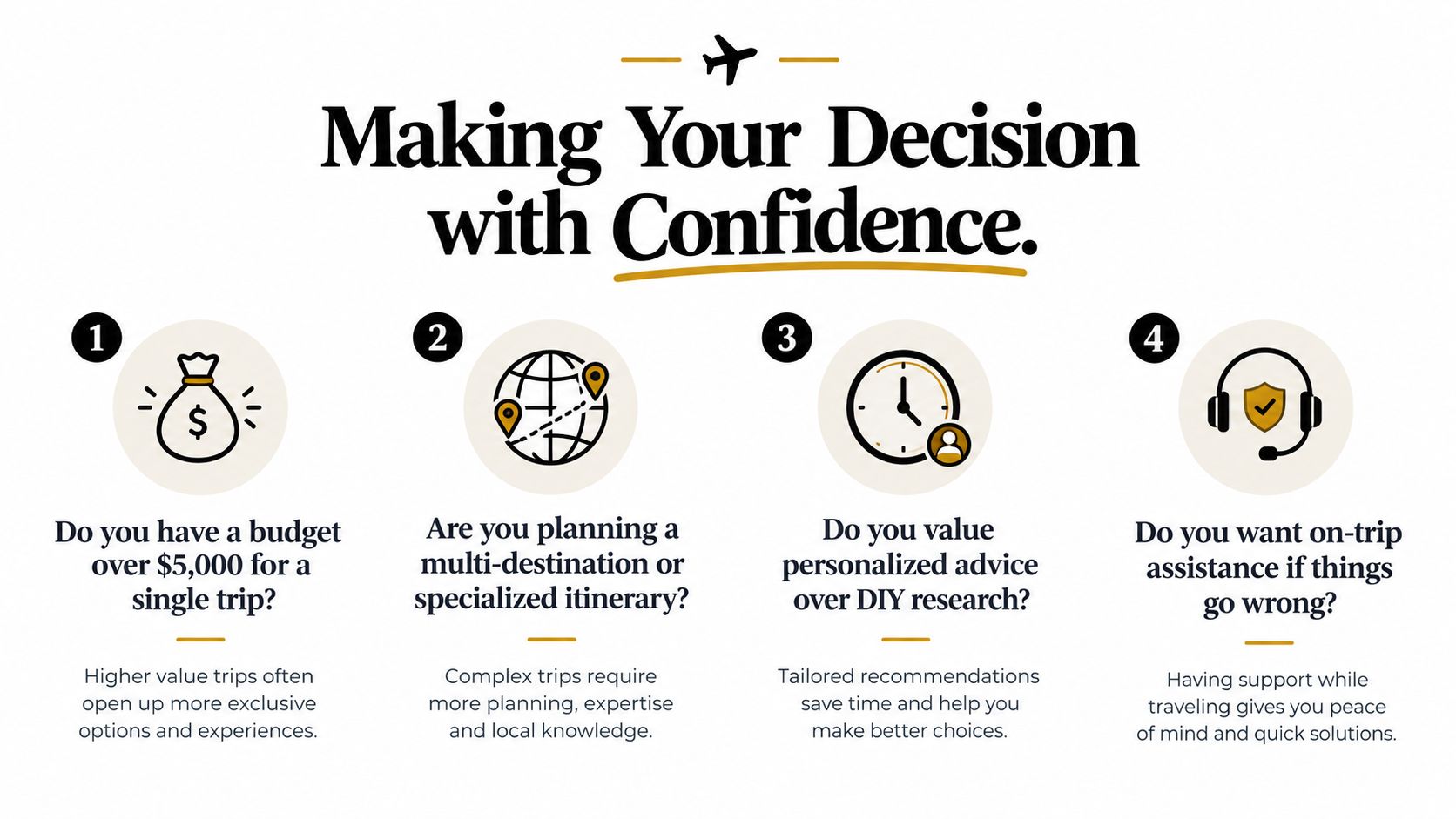
Start with the trip, then interview the professional. Don't choose based on “consultant” or “agent” alone. Choose the person whose process matches the risks, preferences, and service level your itinerary requires.
Ask what you're buying
Request a clear explanation of the commercial arrangement. A serious professional should be able to describe the planning fee, when it is due, whether it is refundable or creditable toward booking, which services it covers, and what happens if you change the brief.
Then ask about the person's actual experience:
1. Which similar trips have you planned? Ask about the destination, traveler profile, and complexity.
2. Which supplier relationships matter here? A network name is less useful than an explanation of the benefits it may offer for this specific itinerary.
3. What is confirmed versus requested? Upgrades, amenities, early check-in, and special access may depend on availability.
4. Who handles disruption? Get a name and an escalation process, not just a general service promise.
5. How do you document the trip? Confirm that flights, transfers, deadlines, cancellation terms, and emergency contacts are easy to access.
Understand affiliations in practical terms
A Virtuoso affiliation can connect an advisor with a luxury travel network and preferred-partner programs, but it doesn't guarantee every benefit at every property. Andavo Travel membership can indicate an advisor's relationship with a host or agency structure, yet it doesn't replace the need to assess the individual advisor's expertise and service process.
Preferred-partner status at a hotel group or property generally matters because it may provide a channel for recognized amenities, upgrade consideration, resort credits, or communication with the hotel before arrival. The advisor's relationship still matters more than the logo. Ask how often they work with the property, who receives the request, and what happens if the preferred room category isn't available.
That principle is becoming more important as AI makes generic destination information easier to obtain. An AI tool can help organize options and summarize public information. It can't independently accept responsibility for a missed connection, persuade a property to reconsider a room assignment, or coordinate a human response across several suppliers. For complicated travel, judgment, relationships, and accountability remain the product.
Match the professional to the trip
| Trip profile | Practical choice |
|---|---|
| Routine domestic travel | Agent or direct booking |
| Simple flight and hotel | Agent if you want execution support |
| Luxury resort with meaningful preferences | Specialized consultant or luxury advisor |
| Multi-country itinerary | Consultant with destination and supplier expertise |
| Corporate retreat or executive travel | Consultant with complex logistics experience |
| Multi-generational celebration | Consultant who manages groups and family needs |
| Budget-focused, familiar destination | Agent or independent booking |
A consultant isn't automatically better because the trip costs more. The consultant becomes more valuable when the itinerary contains decisions you can't easily evaluate, suppliers you need someone to coordinate, or consequences you don't want to manage alone.
HauteBlack provides dedicated travel advisor support, itinerary planning, and tailor-made journeys for luxury travelers, while its private membership includes a dedicated advisor and waived planning fees. That model is relevant when the traveler wants an ongoing relationship rather than a one-time reservation.
HauteBlack helps design bespoke luxury journeys, coordinate VIP recognition, and manage complex travel through dedicated advisor support and preferred relationships across luxury properties. If your next trip involves multiple destinations, a milestone celebration, executive logistics, or a level of service beyond standard booking, visit HauteBlack to begin a tailored travel inquiry.
Explore Our Guides


Signature Experiences


