Haute Black Journal
Luxury Travel Expert: What They Do and How to Choose One

Marlene Azeez
Director, HauteBlack
View all articles →

You usually don't hire a luxury travel expert because you can't find a hotel. You hire one because the trip has too many moving parts, too much money attached to it, or too much reputational risk to leave in the hands of a booking engine.
That's the distinction affluent travelers often miss. A suite is easy to buy. A smooth trip isn't. The harder part is timing the seaplane so you don't lose the evening, getting the villa category that has privacy, flagging the hotel that your child has sensory sensitivities, making sure the museum opens after hours for your family alone, and knowing exactly who picks up the phone when weather, strikes, or aircraft issues hit.
The luxury-travel market is not a small niche. One estimate places it at USD 1.59 trillion in 2025, projected to reach USD 3.04 trillion by 2033 at 8.5% CAGR from 2026 to 2033, while another market view estimates USD 1.77 trillion in 2025 rising to USD 2.10 trillion by 2030, according to Grand View Research on the global luxury travel market. That matters because more money in the segment attracts more noise, more intermediaries, and more people calling themselves experts.
A real luxury travel expert is not a search tool with a glossy Instagram feed. It's a human operator with judgment, supplier relationships, and enough scar tissue to know where expensive trips usually go wrong.
The Moment a Luxury Travel Expert Earns Their Fee
It's Friday afternoon in Aspen. Your party is packed, the birthday weekend in St. Moritz is timed down to the dinner hour, and the connecting charter you expected to board is suddenly grounded by weather. The table at the chef's restaurant is still on the books. Your luggage is already tagged. Your family assumes this will somehow sort itself out.
It won't sort itself out on its own. Someone has to rebuild the sequence.
A real advisor starts with the chain, not the flight. First, reroute the air segment through a paired turboprop or another workable aircraft type. Then retime the ground transfer at arrival, hold the suite, alert the hotel that the principal guest still expects a proper arrival, push the restaurant from main dining into a private room, and secure a backup helicopter option in case the second routing tightens. The client doesn't need the play-by-play. The client needs the weekend intact.
Practical rule: If the trip can break in three places at once, you want one person accountable for all three.
That's the point most “best advisor” lists miss. The fee isn't earned by sending hotel options. It's earned when logistics, relationships, and judgment converge fast enough to preserve a trip that was about to slip.
What the client is actually paying for
You're paying for four things, whether the invoice spells them out or not:
- Timing control: Sequencing air, ground, dining, and access so one delay doesn't collapse the itinerary.
- Supplier relationships: Knowing who can bend, who can't, and which favors must be asked for before arrival.
- Context: Understanding whether this is a milestone birthday, a board-level retreat, a honeymoon, or a three-generation trip. The answer changes every recommendation.
- Accountability: One operator owns the outcome instead of five vendors blaming each other.
Where generalists fail
Generalists tend to optimize the visible layer. They focus on room type, public rates, and broad destination ideas. Experienced advisors obsess over the hidden layer: transfer buffers, immigration choke points, weather contingencies, restaurant hold policies, luggage timing, private guide quality, and what happens after local business hours.
That hidden layer is where luxury either feels effortless or amateur.
Defining the Luxury Travel Expert and How the Role Differs
A luxury travel expert is a relationship-led advisor who designs, books, and manages the full journey. Not just the hotel. Not just a package. The full operating system behind the trip.
That means flights if needed, villas, hotel preferred partner bookings, dining strategy, private guides, local fixers, security considerations, celebration notes, on-trip advocacy, and post-booking changes when reality intrudes. If you want a clean explanation of one important subset of this role, HauteBlack's guide on what a Virtuoso travel agent is is worth reading.
What this role is not
The confusion usually comes from four roles that sound similar and function very differently.
| Role | Scope of Service | Supplier Relationships | When Things Go Wrong |
|---|---|---|---|
| Luxury Travel Expert | End-to-end trip design, booking, coordination, advocacy | Direct hotel, DMC, guide, aviation, dining, and partner relationships | Rebooks, escalates, reroutes, and owns the fix |
| Generalist Travel Agent | Basic hotel, cruise, or package booking | Often broad but shallow | Limited escalation power |
| OTA | Self-serve inventory search and booking | Platform-level, not personal | You handle the fallout through support queues |
| Hotel Concierge | In-property assistance only | Strong inside one property | Helpful on site, but limited beyond the hotel's perimeter |
The cleanest test
Ask what happens before you arrive.
A luxury travel expert may pre-book an after-hours museum visit, brief the GM on your preferences, coordinate separate airport arrivals for family members, and make sure the right nanny-ready suite connects to the principal bedroom. A concierge usually starts once you're checked in. An OTA never does any of this. A generalist agent may try, but often lacks the direct contacts to execute.
The title matters less than the operating behavior. If nobody owns the whole trip, nobody owns the result.
The accountability difference
The role also differs in how success is measured.
- A booking platform measures conversion.
- A hotel concierge measures in-stay service.
- A generalist agent often measures transaction volume.
- A luxury travel expert measures trip integrity.
That's why I don't define the role by taste alone. Taste is common. Real control is rarer.
A strong advisor also understands who is buying luxury travel now. In the U.S. luxury travel market, customized and private vacations held 27.21% share in 2025, direct bookings represented 48.89%, and travelers aged 41 to 60 made up 38.92%, according to Grand View Research on the U.S. luxury travel market. That profile fits a client who wants bespoke planning and direct accountability, not a mass-market funnel.
Four Pillars of Value an Advisor Brings to UHNW Travel
The value is easy to understand once you break it into four pillars. Not perks alone. Not inspiration alone. A complete advisor brings recognition, access, support, and orchestration.
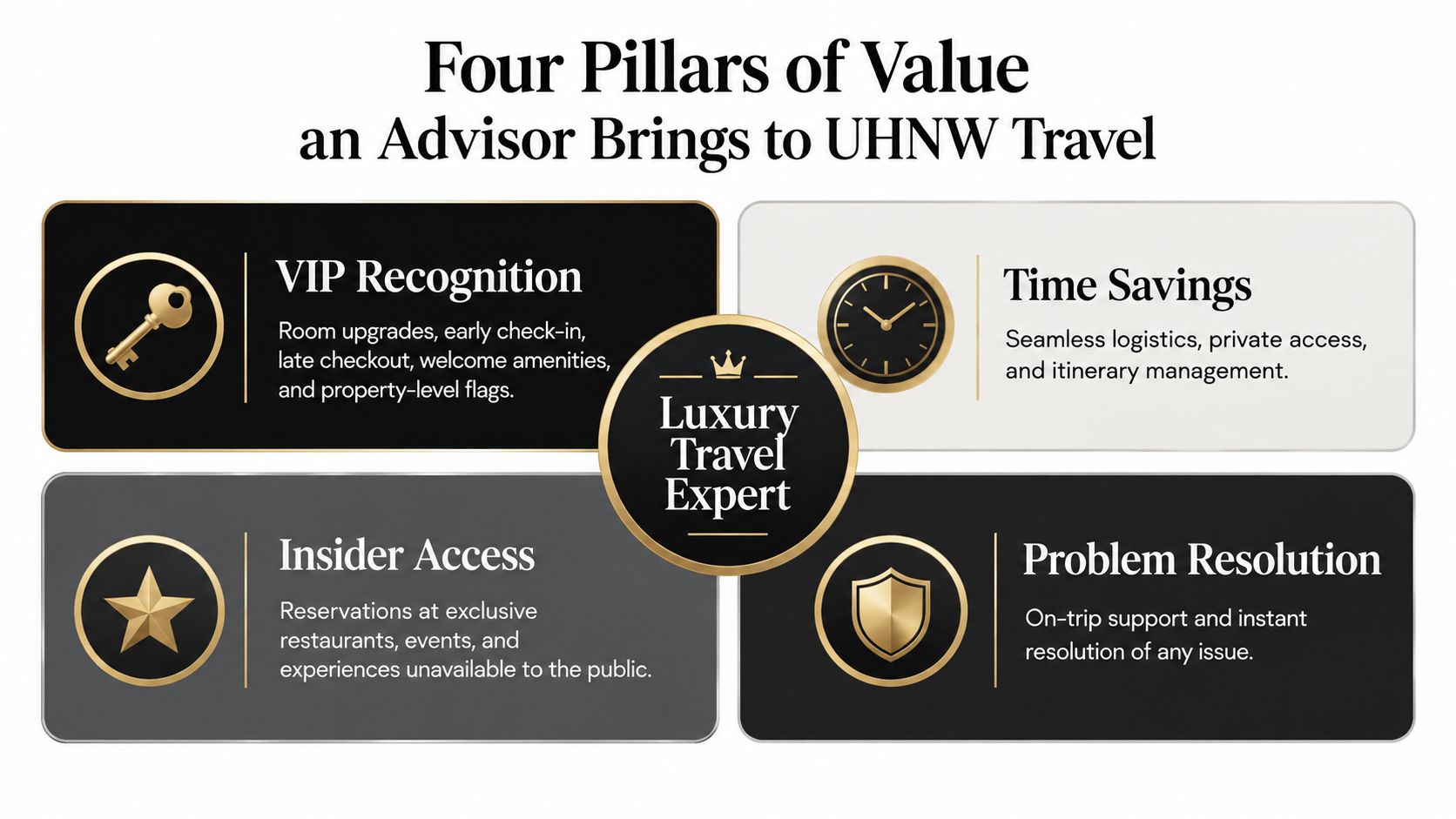
VIP recognition
This is the visible layer clients notice first. Preferred partner bookings can trigger upgrades when available, early check-in, late checkout, welcome amenities, and property-level notes that tell the hotel this guest matters.
That isn't just vanity. It changes room assignment priority, flexibility, and the seriousness with which a property handles requests. A repeat advisor with real volume can often get sharper attention than a one-off direct booking.
Insider access
Luxury travelers are moving beyond hotel worship and toward experiences with texture. One 2026 trend report found 87% of luxury travelers value authentic and exclusive cultural experiences, 72% plan trips around dining, concerts, sporting events, or other cultural moments, and Virtuoso data cited there says fall 2026 bookings are up 59% while sales are up 69%. The same report also notes that roughly one in two multi-destination luxury trips crosses an international border, according to Capital One Travel's luxury trendcast coverage.
Those figures point to a practical truth. The high-value work is often outside the hotel. A serious advisor gets the hard reservation, the private viewing, the after-hours opening, or the well-timed event access that turns a trip from expensive to memorable.
Concierge support on the road
When things move, things break. Drivers arrive early. Guides get swapped. Illness appears at the wrong moment. Restaurants overbook. A child's passport panic hits at the airport. Someone has to solve problems without pushing you back to the hotel front desk.
Private membership models can be useful. Firms like HauteBlack operate with a dedicated advisor and concierge-style support structure for bespoke travel and on-trip coordination, which is the kind of setup that suits clients who travel often and expect one point of contact rather than scattered vendors.
Orchestration
This is the pillar most clients underprice until they've had it done well. Orchestration is what makes a trip feel smooth instead of crowded. It is pacing. It is buffer time. It is knowing when not to schedule a tasting, when to split vehicles, when to build in recovery time after long-haul flying, and when to move dinner later because immigration is running long.
- Recognition gets you treated properly.
- Access gets you into the right rooms.
- Support saves the day when plans slip.
- Orchestration prevents half the problems in the first place.
Without orchestration, the rest is just ornament.
Advisor-Led Booking Versus Booking It Yourself
Let's be blunt. Self-booking works fine until the booking stops being simple.
A seven-night Aman or Rosewood stay booked direct may look identical on the confirmation page. That's where many travelers stop their analysis. They compare rate to rate and miss the structure around the reservation.
What changes on a luxury property booking
| Element | Advisor-Led Booking | Booking It Yourself |
|---|---|---|
| Rate visibility | Usually same public flexible rate when booked through preferred channels, depending on property and dates | Public rate only |
| Breakfast | Often included for two at participating luxury properties | Often extra unless package includes it |
| Resort or property credit | Sometimes included through preferred programs | Usually not |
| Upgrade handling | Priority for upgrade when available, often with pre-arrival advocacy | Based on hotel discretion without advisor advocacy |
| Arrival notes | Advisor can flag celebrations, privacy needs, bedding, transfer notes, and VIP handling | Guest enters notes and hopes they are read |
| Mid-trip issue resolution | Advisor can escalate directly to management or partner teams | Guest handles support personally |
The issue isn't just extras. It's outcome control.
Stress test the booking
Now apply pressure. You miss a connection into a remote island destination. A storm shifts operating windows. A villa owner changes check-in terms. A medical issue requires a rapid hotel extension and immediate local support. Your direct booking confirmation won't do much for you by itself.
Bookings are easy. Recoveries are where the channel matters.
This is why the “I can do this myself online” argument collapses on more complex trips. You can book it yourself. The question is whether you want to manage the consequences yourself.
Business Insider also noted that the luxury-travel market is estimated at about $1.3 trillion and is expected to grow 7.9% from 2024 to 2030, in a piece on career opportunities and advisor demand in luxury travel. In practical terms, more advisors are chasing premium bookings. Clients should assume that only some of them have the supplier depth to make advisor-led booking meaningfully better.
How to Vet and Choose the Right Luxury Travel Expert
Most clients ask the wrong opening question. They ask where the advisor likes to send people. Ask instead how the advisor works when the itinerary gets difficult.
The title is cheap. The operating model is what matters.
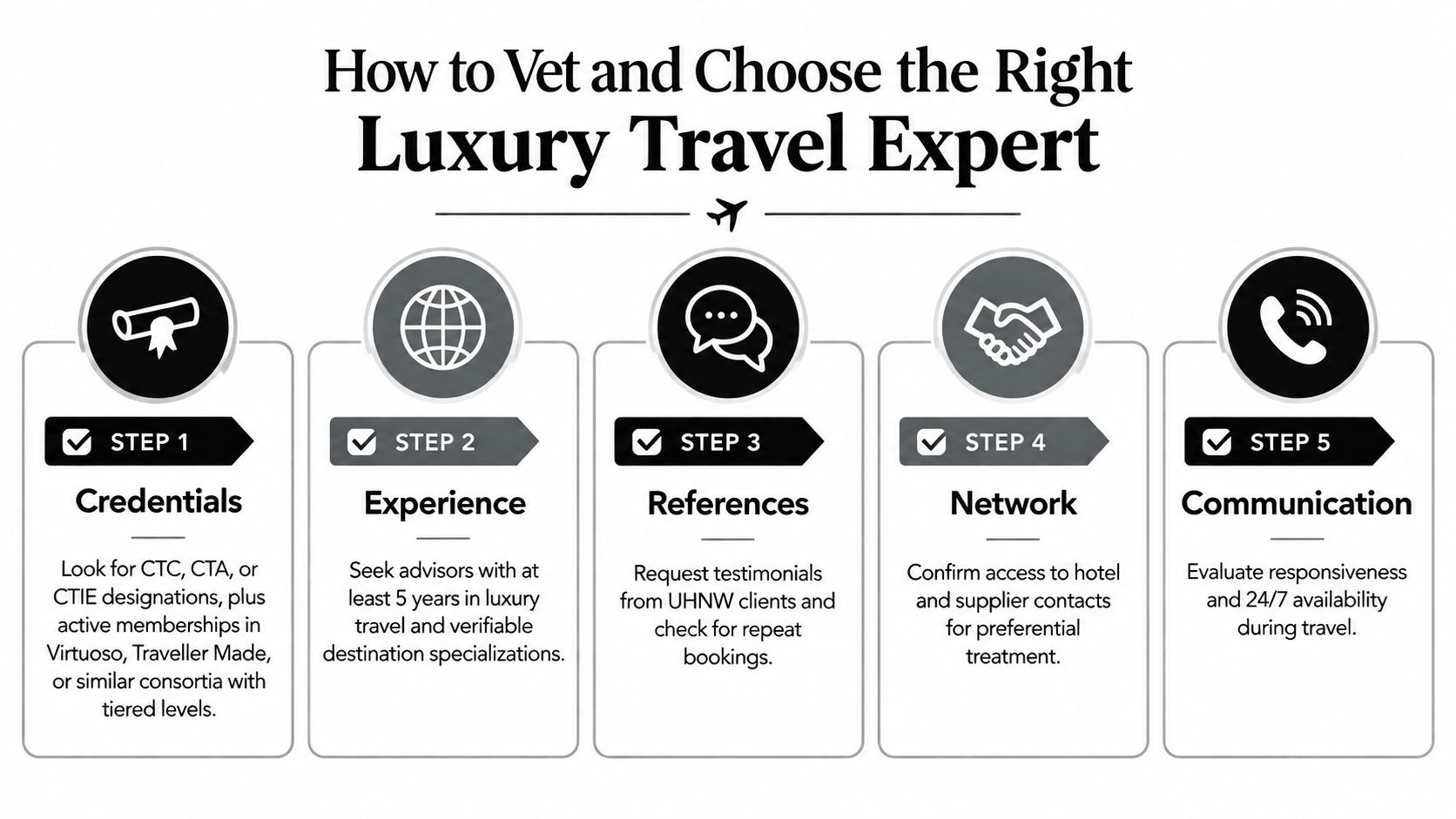
Start with proof, not polish
Use this filter first:
- Credentials: Ask whether the advisor holds CTC, CTA, or CTIE designations and whether their consortium memberships are active and meaningful.
- Supplier depth: Ask which preferred partner programs they book through and which hotel brands recognize them by name.
- Fee disclosure: Every planning fee, service fee, markup structure, or membership charge should be in writing before work starts.
- Relevant specialization: Don't accept “we book everywhere” as an answer. Ask for recent examples in the destination and travel style you want.
- Emergency ownership: If something breaks at 3 a.m., who answers and who has authority to act?
A useful companion read is HauteBlack's article on what a VIP travel agency is and how to choose one, especially if you're deciding between a membership-style relationship and a one-off booking service.
The video below gives another practical lens on what to look for.
The five questions worth asking
Ask these verbatim if needed.
1. What preferred partner status do you actively hold right now?
2. When did you last inspect the property or destination I'm considering?
3. Who handles a middle-of-the-night disruption while I'm traveling?
4. Do you charge planning fees, and when are they earned?
5. How are you compensated on this exact booking?
If the answers are vague, you have your answer.
Red flags I'd walk from
If an advisor won't put fees in writing, stop there.
Other red flags include generic supplier lists, broad claims with no recent examples, instant enthusiasm for every destination, and a refusal to discuss escalation paths. Another warning sign is a consultant who confuses aesthetics with expertise. A beautiful PDF itinerary means very little if nobody has checked transfer timing, local strike patterns, operating days, privacy concerns, and supplier reliability.
The current client base for premium travel also isn't as old-fashioned as many advisors still assume. A McKinsey-backed survey of 5,061 travelers who spent an average of $500 or more per night found that most high-end leisure hospitality spenders were under 60, with Gen X the largest share, according to Luxury Daily's coverage of the survey findings. If your advisor still sells luxury as a static, old-world hotel list, they're behind.
Pricing Models, Fees, and What Contracts Should Cover
Clients rarely mind paying fees. They mind opaque fees.
That's reasonable. There are several valid pricing models in luxury travel. None is superior. The right one depends on complexity, booking mix, and whether the advisor is delivering a transaction, a full itinerary, or an ongoing relationship.
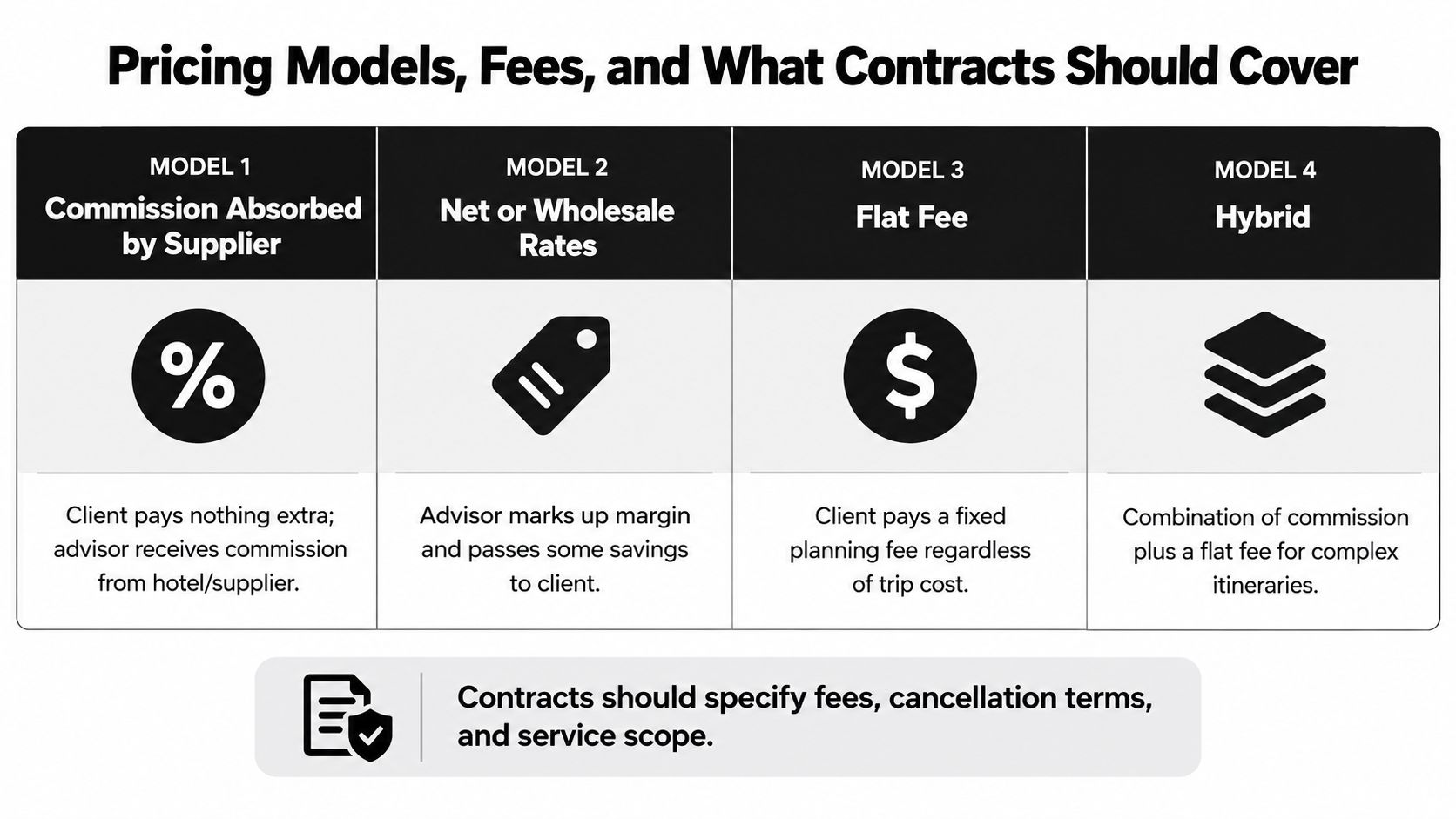
The common structures
- Commission absorbed by supplier: The hotel, cruise line, or tour operator pays the advisor. This is common on straightforward hotel bookings.
- Net or wholesale rates: The advisor sources a rate privately, adds margin, and may still deliver better overall value depending on inclusions.
- Flat planning fees: Common when the work involves design, sequencing, research, revisions, and multiple suppliers.
- Retainer or membership model: Ongoing access, planning, and concierge-style support sit inside a broader relationship.
If you want a clean breakdown of one of the murkier areas, HauteBlack's piece on travel agent service fees for luxury travel is a useful reference.
What the contract must cover
A proper engagement letter should spell out:
- Scope of services: What the advisor will book, coordinate, and monitor.
- Fee structure: Planning fees, booking fees, markups, retainers, and timing of payment.
- Cancellation terms: What happens if you cancel, postpone, or materially change the brief.
- Supplier obligations: Which vendors control fulfillment, refund timing, and operational changes.
- Confidentiality: Important for public figures, family offices, and principals with security concerns.
- Dispute resolution: Not exciting, but essential.
One more thing matters now. Timing strategy. Virtuoso reporting cited by Journal by YATCO says 45% of advisors see clients actively shifting away from peak seasons, 76% of those travelers choose shoulder or off-peak windows, and 75% favor destinations with moderate climates and minimal tourist infrastructure, according to the Virtuoso Luxe Report coverage. If your advisor is charging a premium and still only discussing where to go, not when to go, you're paying for half a service.
Signature Experiences an Expert Makes Possible
The easiest way to understand the role is to look at trips where details compound.
Honeymoon sequencing done properly
A Bhutan and Maldives honeymoon sounds romantic on paper. In reality, it requires disciplined sequencing. The right advisor locks the villa category early, chooses a routing that protects the softer part of the trip, and arranges a meaningful private moment in Bhutan that isn't just another packaged “cultural experience.” That could be a private dinner, a scholar-led conversation, or a monastery visit timed around privacy rather than bus traffic.
Then the handoff matters. The seaplane should land at the right hour. Not the available hour. The right one.
Multi-generational Japan without friction
Tokyo, Kyoto, and Hokkaido for three generations can become logistical punishment if handled casually. Grandparents often need different pacing from teenagers. Luggage movement, language matching, rail versus private vehicle decisions, and restaurant acoustics suddenly matter.
A real luxury travel expert separates what should be shared from what should be split. Different cars. Different wake-up times. One guide who understands family dynamics. A private dining moment where nobody is rushed.
Event-led travel where access matters
Cannes, Art Basel, Monaco, Formula 1, private collectors' weekends. These aren't hotel bookings. They're access problems wrapped inside traffic, invitation lists, and time pressure.
For clients planning private gatherings around those journeys, useful inspiration can come from adjacent hospitality formats too. If you're evaluating how wine country handles high-touch hosting for celebrations or executive dinners, these private event spaces in Sonoma offer a grounded example of the kind of venue thinking that helps when building event-led itineraries.
The trip feels effortless only because someone else did the hard work of aligning venue, guest flow, transport, and access in advance.
When Working With a Luxury Travel Expert Is Worth It
Here's the clean test. If the cost of getting the trip wrong exceeds the advisor's fee, hire the advisor.
That usually means trips involving multiple countries, private aviation, peak-season scarcity, event-led access, villa contracting, family complexity, or any itinerary where one missed handoff ruins the rest. It also means situations where your time is worth more than the planning process, or where you want one person accountable from deposit to wheels down.
When I'd use one without hesitation
- Complex geography: More than two countries or multiple internal transfers
- Family logistics: Multi-generational travel, nannies, security, or medical sensitivities
- Scarcity: Major events, festive periods, cherry blossom timing, peak Mediterranean summer
- Private-use travel: Villas, yachts, estates, aviation, buyouts, or executive movement
When you probably don't need one
A single hotel in a city you know well. A short domestic weekend. A straightforward points redemption if you already understand the program and don't need anyone to hold the rest together.
For clients considering group formats, buyouts, or wellness-driven gatherings, this guide to exclusive stays for retreats and groups is a useful example of the kind of property thinking that becomes relevant once travel shifts from “book a room” to “control the environment.”
The actual product isn't a reservation. It's a relationship with someone who knows how you travel, what you won't tolerate, and which details must never be left to chance.
HauteBlack publishes daily luxury travel intelligence on its news page, including destination guides, property reviews, and insider field notes across 120+ countries, according to HauteBlack News. If you want the relationship side of this done properly, not just the booking side, visit HauteBlack to explore its travel advisory and private membership offering.
Explore Our Guides


Signature Experiences


