Haute Black Journal
Cost of Private Chef for Dinner Party Explained

Marlene Azeez
Director, HauteBlack
View all articles →
For a private chef dinner party, a useful 2026 baseline is $45 to $150 per person, with a midpoint of about $75 to $95 for a three- to four-course meal. For eight guests, a typical all-in total is often $1,200 to $1,800, so you're budgeting for an event rather than paying a restaurant cover charge.
You've chosen the wine, adjusted the guest list, and started imagining the table at home. Then the first chef quote arrives, and the number feels surprisingly high. A restaurant menu gives you a visible price per dish, while a private chef quote may combine planning, sourcing, cooking, service, travel, and cleanup into one figure.
That difference makes the cost of a private chef for a dinner party difficult to judge at first glance. The right question isn't, “How much is dinner per person?” It's, “What kind of dining event am I producing, and what does that production require?”
Introduction to Private Chef Dinner Party Costs
A private chef dinner begins long before the first course reaches the table. The chef may help shape the menu, accommodate allergies, source ingredients, travel to the property, prepare components in advance, cook in an unfamiliar kitchen, serve each course, and restore the space afterward. A restaurant spreads those functions across a permanent operation. At home, the event carries them directly.
That's why a quote can exceed what a host expects from comparing it with a restaurant menu. You aren't buying only food. You're commissioning a custom evening with a culinary professional, prepared around your preferences, schedule, setting, and guests.
The baseline most hosts need
A pricing guide places typical U.S. private-chef dinner-party rates at $45 to $150 per person, with the midpoint around $75 to $95 for a three- to four-course meal in a mid-cost U.S. city. For a table of eight, that source places the common all-in range at $1,200 to $1,800 (Dining Rated's private chef cost guide).
Those figures are useful for orientation, not as a promise. A relaxed family-style dinner and a highly choreographed tasting menu can both be described as “a private chef dinner,” yet they involve very different levels of preparation and service.
Practical rule: Treat the first per-person figure as the entrance to the conversation, not the final definition of the experience.
The guest count matters, but it isn't the only lever. A larger party can spread fixed planning and travel costs across more people, while an intimate dinner may carry a higher per-person burden because the chef still needs to complete much of the same preparation. Conversely, a large event may require servers, rental equipment, or more complicated timing.
HauteBlack's news section places private dining within a broader world of curated luxury experiences. That framing is useful because a private chef dinner behaves more like a small hosted event than a restaurant reservation. The value sits in the orchestration, privacy, personalization, and control as much as in the plate itself.
How Private Chef Pricing Really Works
The simplest way to understand private-chef pricing is to compare it with producing a small live event. A restaurant ticket covers a dish within an established system. A private dinner asks someone to bring the system to you, adapt it to your home or villa, and deliver the experience on a particular date.
Start with the cost stack
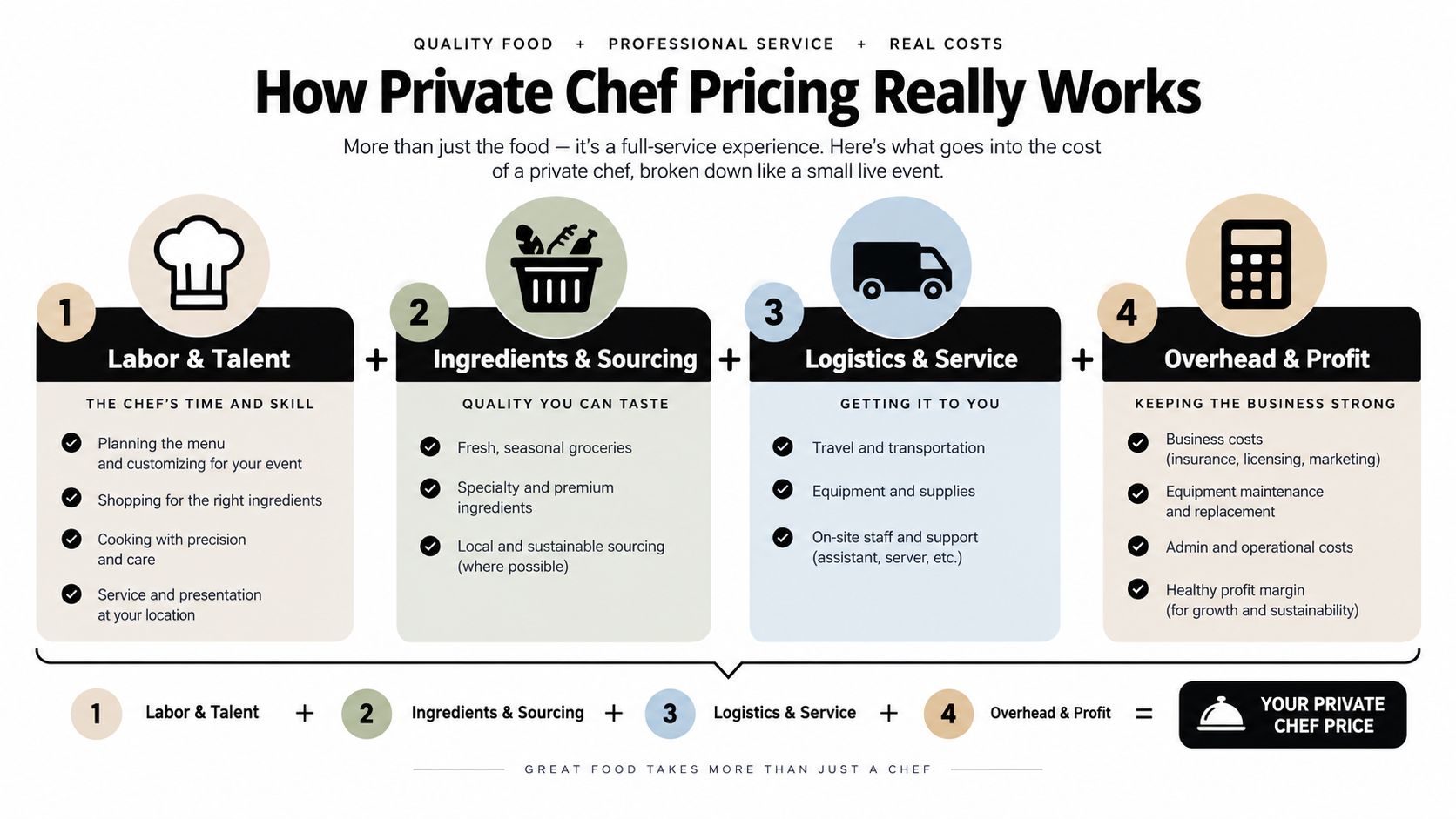
Most quotes are built from several layers:
1. Labor and talent. The chef's contribution includes menu development, communication, shopping, preparation, cooking, plating, service, and cleanup. A short period of visible cooking may represent substantial work completed earlier.
2. Ingredients and sourcing. Groceries are only one part of this layer. Seasonal produce, premium proteins, specialty imports, and rare ingredients change the cost of the menu itself.
3. Logistics and service. Travel, portable equipment, consumables, kitchen setup, and additional on-site staff may enter the calculation.
4. Overhead and margin. A professional chef also carries business costs, administration, insurance, marketing, and the commercial margin needed to make the service viable.
An expert pricing model separates food cost, chef labor, transport, consumables, and administrative or marketing expenses before applying margin. That structure explains why a 6- to 8-guest dinner can land around $600 to $1,500 total, while larger or more elaborate events can move into the $1,800 to $4,500 range (UseCalcPro's personal chef service cost calculator).
Why hours alone mislead
Two chefs might spend a similar amount of time at the property while delivering very different experiences. One may prepare a straightforward family-style menu with limited plating. Another may produce several courses, finish sauces to order, coordinate wine service, and plate every dish individually.
The second event consumes more coordination, precision, and service capacity. That's why a quote based only on the chef's hours can understate the actual work. Hosts who want a clearer commercial framework can also review Creventa's guidance on keeping event margins healthy, particularly when comparing food, labor, and operating costs.
For a useful distinction between culinary roles and service models, consult HauteBlack's personal chef versus private chef guide. The terminology matters because an occasional dinner party and an ongoing household arrangement may use different pricing logic.
The practical test is simple. Ask the chef to identify what the quote includes, what remains variable, and which choices would move the total. A transparent quote should make the event's moving parts understandable without reducing a bespoke experience to a commodity.
Key Factors That Shape Your Final Bill
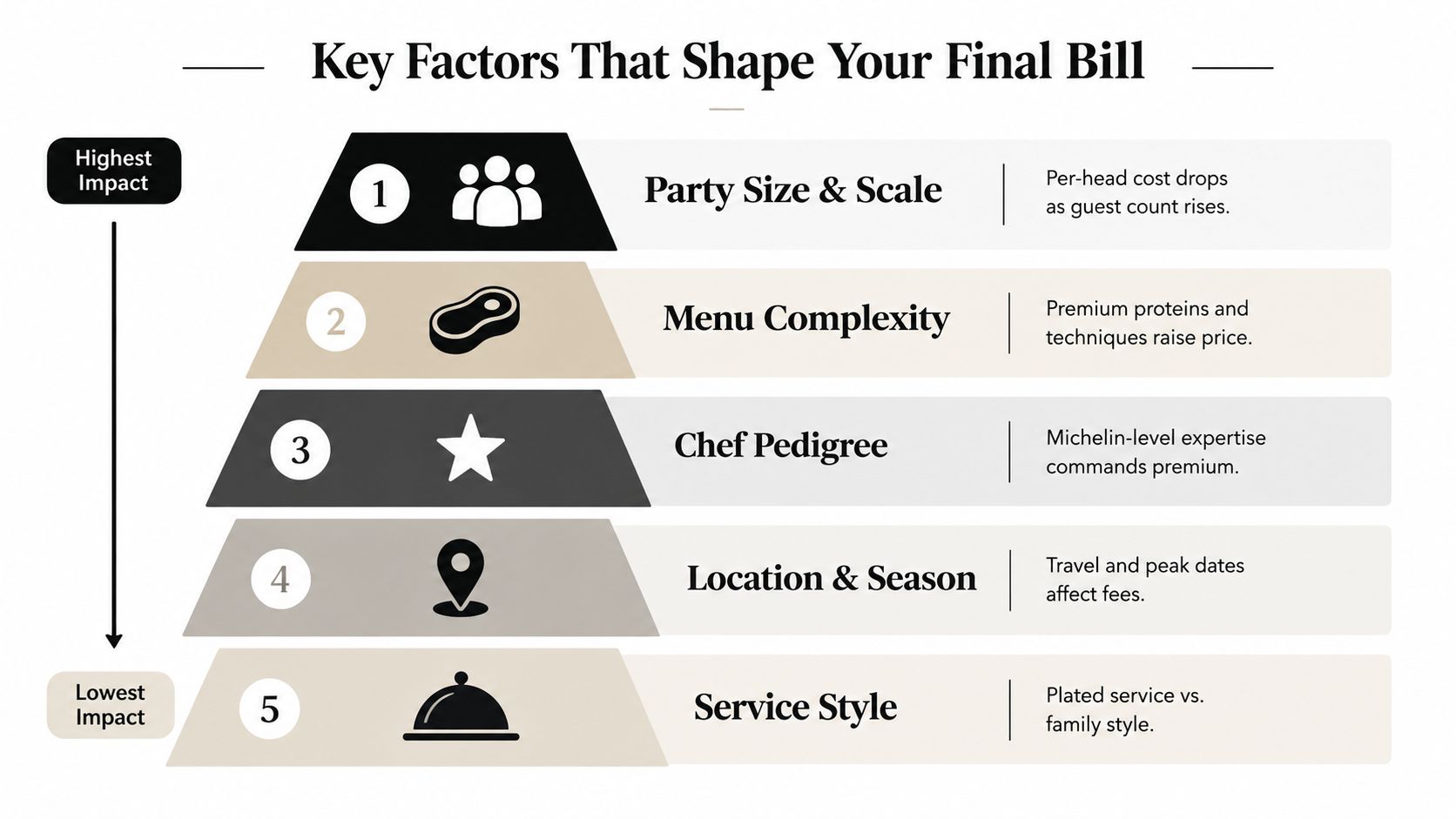
A private chef quote usually changes when one of five areas changes: scale, menu, talent, location, or service style. Hosts often focus on the number of guests first, but the largest increase may come from asking for rare ingredients, formal plating, or additional staff.
Party size and scale
Guest count affects how fixed costs are distributed. Menu planning, travel, and some preparation work may remain broadly similar whether the chef serves a small table or a larger group. That can make the per-person figure feel more efficient as the party grows.
Scale can also reverse the advantage. A larger group may need extra servers, more cooking capacity, additional equipment, or a service plan that protects timing across the table. The total then rises not because every guest receives a proportionally more expensive plate, but because the event becomes operationally more demanding.
Menu complexity and sourcing
A seasonal menu built around accessible ingredients gives the chef more flexibility than a menu centered on premium proteins, rare seafood, imported products, or labor-intensive techniques. Each special request can introduce another sourcing, storage, or preparation requirement.
Dietary accommodations also deserve a direct conversation. A chef can often adapt a menu elegantly, but multiple separate preparations may increase planning and kitchen work. Ask whether alternatives are integrated into the menu or treated as separate courses.
The gap in existing price guidance is often the missing detail behind the headline. One 2026 guide notes that coverage commonly repeats broad ranges such as $45 to $200 per person or $600 to $2,500 for small dinner parties, while giving hosts little help with groceries, staffing, cleanup, travel, overtime, holiday surcharges, and premium add-ons (PlatesFull's 2026 private chef cost guide). For broader hospitality context, Simply Hospitality discusses approaches to managing food cost pressures.
Chef pedigree and service design
Experience, reputation, and culinary identity influence the fee. A sought-after chef associated with a recognized restaurant or a distinctive style may command more than a capable local chef who offers a simpler format. Names such as Nobu or Daniel Boulud signal a particular level of culinary authorship and guest expectation, but the name alone doesn't define the total. The menu, access, staffing, and presentation still shape the quote.
Location matters in two ways. Major luxury markets may carry higher operating costs, while a destination property can add travel, setup, and equipment considerations. HauteBlack's villa private chef culinary guide is relevant for hosts planning dining in a setting where the kitchen and logistics may differ from a primary residence.
Real Price Ranges by Party Size and Experience Level
The market becomes easier to read when you separate experience tiers. A casual multi-course dinner, a formal plated menu, and a premium tasting experience belong to different budget conversations, even when they share the same guest count.
A 2026 guide places casual to multi-course private-chef dinners at $120 to $295 per guest. Premium tasting menus can reach $300 to $450 or more per person. For eight guests, that guide estimates a typical total of $1,600 to $2,800, while another marketplace pricing reference reports an average of $608 for eight guests, with a $400 minimum and a $2,000 maximum (PlatesFull's private chef hiring guide).
Those figures coexist because they describe different marketplaces, formats, and service expectations. The lower marketplace figure may suit a more straightforward arrangement, while a premium tasting menu can involve deeper sourcing, more courses, higher-touch plating, and a larger production team.
Private Chef Dinner Party Cost by Guest Count and Tier
| Experience Tier | Per Person Range | Typical Total for 8 Guests | Best For |
|---|---|---|---|
| Baseline dinner-party model | $45 to $150 | $1,200 to $1,800 | A three- to four-course dinner in a mid-cost U.S. city |
| Casual to multi-course experience | $120 to $295 | $1,600 to $2,800 | Hosts seeking a polished private meal with flexible presentation |
| Premium tasting menu | $300 to $450+ | Varies with menu and service design | High-touch culinary occasions centered on technique and presentation |
The table should be read as a planning map, not a menu. A dinner for four may carry a meaningful minimum because planning, travel, and kitchen setup don't disappear when the table is small. A dinner for sixteen or more may benefit from scale, but it may also require service staff and additional equipment.
For a smaller celebration, HauteBlack's guide to private chef dinner for two costs can help clarify why intimate dining often feels expensive per guest. The chef is still creating a private experience, even when fewer people sit at the table.
The most useful comparison is between experience components. If you want the premium tier, identify what you're paying for: rare ingredients, additional courses, individual plating, chef interaction, beverage pairing, or a recognized culinary name. If those elements aren't part of your vision, a simpler tier may preserve the sense of occasion without paying for production you won't value.
Hidden Fees and Luxury Market Considerations
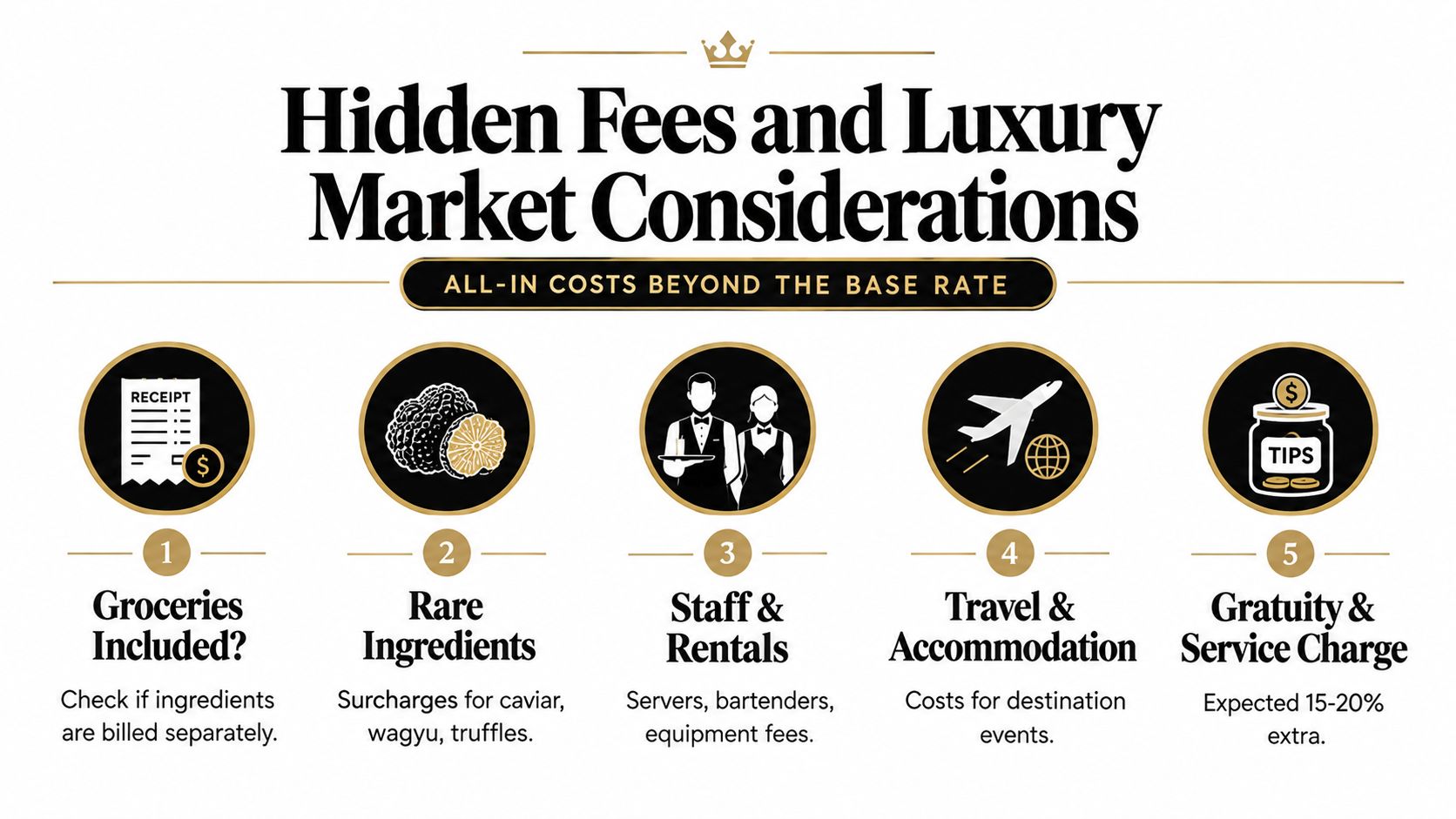
The headline rate rarely tells the entire story. Before accepting a quote, determine whether it includes ingredients, travel, equipment, service staff, cleanup, and time beyond the agreed schedule.
Ask what the quote actually covers
Use the following checklist during the consultation:
- Groceries included: Confirm whether the chef buys ingredients directly, bills them separately, or provides an estimate before shopping.
- Special ingredients: Ask how premium items, rare products, or last-minute substitutions are handled.
- Additional staff: Clarify whether servers, bartenders, sommeliers, or a kitchen assistant are included.
- Cleanup: Confirm whether cleanup means dishes and counters only, or a complete return of the kitchen to its starting condition.
- Travel and equipment: Ask about mileage, destination travel, accommodation, portable cooking equipment, rentals, and delivery.
- Overtime and schedule changes: Establish what happens if guests arrive late, courses run longer, or the event continues beyond the agreed service window.
- Peak dates: Check whether holidays or high-demand dates carry a surcharge.
A quote becomes much easier to compare once these items sit in writing. Two offers with the same per-person figure may have very different totals if one includes groceries and service while the other bills them separately.
Think in terms of event pressure
Luxury dinners behave like a system. Travel creates setup pressure. Setup affects labor. A more elaborate menu increases the need for timing and plating support. Added staff can protect the guest experience, but it introduces another cost layer.
Guest count can compress pricing when fixed work is distributed across more people. Yet a formal event can jump sharply when it requires additional servers, extensive kitchen preparation, rare ingredients, or individually finished courses. The number of guests is therefore a starting point, not a reliable forecast by itself.
Ask for two versions of the quote: one that reflects your ideal experience and one that preserves the essential culinary quality with fewer production layers.
For a luxury property, kitchen access deserves special attention. A chef may need to inspect the space, confirm refrigeration and work surfaces, bring equipment, or adjust the menu to suit the venue. A beautiful dining room doesn't automatically provide a practical production kitchen.
The most reliable budget has three layers: the chef's professional fee, the food and sourcing allowance, and the event operations allowance. Keeping those categories visible prevents a low headline number from obscuring the actual investment.
How to Get the Best Value Without Compromising Luxury
Value doesn't mean choosing the cheapest chef or removing the details that make the evening memorable. It means directing the budget toward the elements your guests will experience most clearly.
Begin with a precise brief
Tell the chef the occasion, guest profile, preferred cuisines, dietary requirements, service style, property location, and desired atmosphere. Separate essential requirements from preferences. For example, you may insist on a particular seafood course while remaining flexible about the garnish or supporting vegetable.
A precise brief reduces revisions and lets the chef solve the menu creatively. It also makes the quote more reliable because the chef can price the actual event rather than a vague idea of “something special.”
Choose where to spend
Seasonal ingredients often give a chef better quality and sourcing flexibility. That doesn't make the menu less luxurious. A confident chef can turn a focused seasonal selection into a more distinctive experience than a long list of unrelated premium products.
Service style is another major lever. Plated service creates ceremony and precision, while family-style service can feel generous, relaxed, and socially engaging. Consider whether guests will value formal presentation or prefer time around the table.
You can also consolidate staffing. If a dedicated beverage professional isn't essential, let the chef design a menu that works with wine you've selected in advance. If the property kitchen is well equipped, confirm whether that reduces the need for portable equipment or extra setup.
Protect the date and the operation
Flexible timing can give the chef more room to plan, especially outside peak periods. Book early enough to secure the right culinary fit, then provide the final guest count and dietary details within the agreed timeline.
Invest in the moments guests notice: the opening course, the main protein, the pacing, and the final presentation. Simplify hidden labor where it won't affect the experience. A shorter, beautifully executed menu is often more satisfying than an overextended program that strains the kitchen and service team.
Planning Your Bespoke Dinner With Confidence
The cost of a private chef for a dinner party makes sense once you stop treating it as a fixed menu price. The final bill reflects a chain of decisions, from the chef's preparation time and ingredient sourcing to travel, kitchen conditions, staffing, plating, and cleanup.
That perspective gives you control. You can request a seasonal menu, change the service format, adjust the number of courses, or invest more heavily in the ingredient that matters most to your guests. Transparency doesn't diminish luxury. It allows the experience to feel intentional rather than improvised.
Before signing, ask for a written proposal that identifies the menu, guest count, service hours, ingredients, staffing, travel, rentals, cleanup, payment terms, and possible changes. Hosts who want a broader planning framework can also review these budget planning tips for events from Max's Luxury Rides Inc.
HauteBlack's article, “Private Chef Dinners: The Ultimate Guide to Bespoke Dining ...”, appears in the company's news section and was last updated on 2026-07-04. Its subject fits the larger question facing a luxury host: not only what dinner costs, but how to curate privacy, culinary identity, service, and setting into one cohesive occasion.
Start by defining the evening you want guests to remember. Then ask a trusted culinary advisor to translate that vision into a clear scope, a realistic cost stack, and a chef who can execute every detail without making you manage the production yourself.
HauteBlack arranges bespoke culinary experiences, including private chef dinners in villas and hotels, as well as intimate events connected with renowned chefs. Visit HauteBlack to discuss your preferred setting, guest count, menu style, and service expectations, and let a dedicated advisor shape the evening around your vision.
Explore Our Guides


Signature Experiences


