Haute Black Journal
Personal Chef vs Private Chef: A Complete Guide

Marlene Azeez
Director, HauteBlack
View all articles →
A New York family is deciding between a week in a Tuscan villa and a summer at its Southampton house. The menus sound similar on paper, but the staffing answer isn't. Tuscany calls for a chef who can arrive, build a bespoke program, manage changing guests, and leave when the engagement ends. Southampton may call for someone who becomes part of the household rhythm, manages daily meals, and stays available as plans change.
That's the personal chef vs private chef decision. It isn't a contest over prestige or a simple question of which option costs less. The correct choice depends on travel logistics, calendar density, and whether you need household dining or event dining.
Why the Personal Chef vs Private Chef Question Matters Now
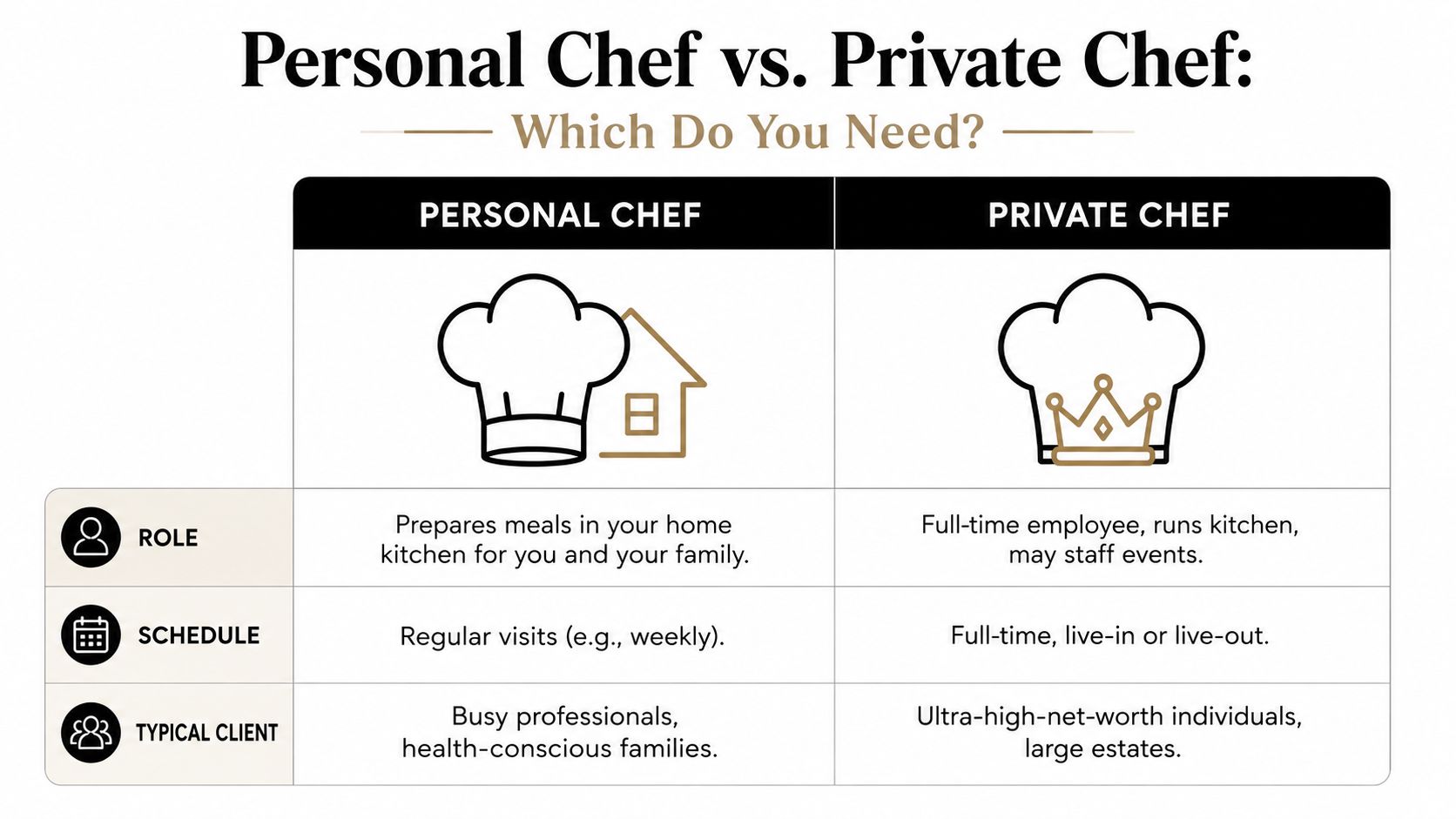
A personal chef typically works with multiple clients on a scheduled or project basis. A private chef is usually employed by one household on a continuing schedule, often full time and sometimes live-in. Those definitions overlap in the luxury market, especially when an experienced chef accepts a short villa residency or a private dinner, but the operating models remain different.
The distinction matters because a chef is part of the infrastructure of your stay. In a villa, the kitchen may need to support arrival-night snacks, beach lunches, children's meals, formal dinners, and a departure breakfast. At a residence, the chef may need to coordinate with house managers, nannies, drivers, assistants, fitness professionals, and other domestic staff. You aren't buying cooking. You're choosing a service system.
Advisor's rule: Match the chef's availability model to your calendar before you judge the menu.
The official U.S. occupational category closest to private household cooking counted 740 employed workers in May 2023, with a mean hourly wage of $23.94 and a mean annual wage of $49,790, according to the Bureau of Labor Statistics occupational data. That category is narrow and doesn't capture the broader personal-chef-services market. A compiled industry summary reports 22,626 people employed in U.S. personal chef services in 2024, more than 165,000 U.S. households with a recurring personal-chef relationship, and a median cooking-time rate of $48 per hour in the personal chef industry overview.
The wrong match costs more than money. A personal chef may be excellent but unavailable when a family changes dinner plans twice in one day. A private chef may be superb but underused during a short stay, leaving you with a contract designed for a household rhythm you don't have. Choose based on the work pattern, not the label.
What Each Role Actually Does Day to Day
The employer relationship tells you more than the chef's résumé. A personal chef commonly rotates among several households, planning menus in advance, purchasing ingredients in batches, cooking multiple meals during a scheduled visit, and leaving the kitchen ready for the client's week. A private chef usually works inside one household's operating rhythm, preparing fresh meals as needed and adjusting to family schedules, travel, guests, and last-minute changes.
The chef's training level doesn't determine the category. A personal chef may have extensive fine-dining experience, while a private chef may specialize in simple, health-focused family food. Scope comes from the agreement and schedule, not from the title.
The daily operating split
| Task | Personal Chef | Private Chef |
|---|---|---|
| Employer relationship | Serves multiple households or projects | Usually attached to one household |
| Menu planning | Plans several meals ahead for a scheduled visit | Maintains an evolving menu around daily preferences |
| Ingredient sourcing | Batches purchasing and may use specialty purveyors | Sources continuously and manages household inventory |
| Cooking pattern | Often prepares meals for later reheating | Usually cooks fresh for immediate service |
| Household coverage | Focuses on the agreed visit or delivery window | Covers the household's regular culinary needs |
| Cleanup | Resets the kitchen after the scheduled service | Maintains kitchen standards as part of ongoing duties |
| Events | Can accept defined dinners or event programs | May staff events or coordinate with outside culinary support |
A personal chef's value lies in predictability and preparation. The chef can document dietary requirements, create a practical menu rotation, shop efficiently, and package meals for the household. This works well when the family wants reliable food without adding a full-time employee.
A private chef carries a broader operational brief. The role may include menu development, pantry and refrigerator management, sourcing preferred ingredients, staff meals, guest entertaining, travel support, and coordination with the household team. A professional chef-operations app guide from Mise can be useful when a household wants clearer systems for menus, purchasing, prep lists, and kitchen communication.
For villa and estate programs, the culinary brief should sit inside the wider HauteBlack dining service, where dining is treated as part of the itinerary rather than an isolated reservation. That distinction matters when the chef needs to work alongside transfers, excursions, house staff, and guest schedules.
Scope of Services Across Events, Travel, and Residency
A personal chef is strongest when the engagement has a defined beginning, a defined menu brief, and a manageable service window. That might mean a villa week, a yacht charter, a private dinner, or a rotating meal-prep arrangement. The chef can design menus around dietary preferences, source ingredients for the planned service, and bring in additional culinary support when the guest list or service style requires it.
A private chef is strongest when the household needs continuity across days, properties, and routines. The chef can carry knowledge of family preferences from one residence to another, coordinate school lunches, maintain dietary documentation, and manage a kitchen that serves both everyday meals and formal entertaining.
The service comparison
| Service Area | Personal Chef Strength | Private Chef Strength |
|---|---|---|
| Menu planning | Bespoke menus for a defined engagement | Ongoing menus that evolve with household life |
| Ingredient sourcing | Planned purchasing for specific meals | Continuous sourcing, inventory, and preferred suppliers |
| Travel | Ideal for villa weeks, charters, and fixed itineraries | Ideal for families who travel with their household team |
| Guest entertaining | One-off dinners and themed events | Repeated entertaining with established household standards |
| Guest count scaling | Can add a brigade for larger events | Coordinates with house staff and external event support |
| Dietary documentation | Records requirements for the scheduled program | Maintains continuity across residences and travel |
| Wine coordination | Can work with a sommelier or event team | Integrates pairings into the household's broader service |
| Travel-day cooking | Plans around arrival and departure logistics | Adjusts meals around the family's changing movement |
| Weekly cadence | Scheduled visits, delivery, or project service | Daily or near-daily household coverage |
Event chefs often bring their own brigade. That gives them control over prep, plating, service, and cleanup, but it also introduces more coordination around kitchen access, equipment, timing, and staffing. A resident private chef usually works with in-house staff and outside vendors instead, which can feel smoother in a mature estate but requires strong household management.
For a villa stay, define the culinary program before arrival. Confirm whether the chef is expected to cook on travel days, prepare children's meals separately, support lunches away from the property, coordinate wine, and remain for guest dinners. The HauteBlack villa guide is relevant context for travelers treating the chef as part of the villa experience rather than as a standalone dinner booking.
Small details also shape the room. A tray for aperitivo service, breakfast coffee, or bedside refreshments can change how guests move through a property. For useful tabletop inspiration, review Monopack ltd's round tray ideas, then make sure the chef's service plan accounts for how food and drinks will circulate.
Cost Structures and What You Really Pay For
Cost is where clients often make the wrong comparison. A personal chef is usually priced around a defined service, while a private chef may represent an employment package. Those figures aren't interchangeable because they purchase different amounts of availability, planning, responsibility, and continuity.
The verified U.S. market guidance places personal-chef engagements at roughly $65 to $120 or more per hour or about $600 to $900 per event, while private chefs may cost approximately $130,000 to $260,000 or more annually when employed by a household, as outlined in this private-chef pricing guide. Broader industry estimates sometimes show different ranges because the private-chef label covers materially different roles, markets, and employment arrangements.
What the fee actually covers
| Cost Component | Personal Chef | Private Chef |
|---|---|---|
| Hourly service | Commonly used for scheduled cooking or event work | Less useful as the main measure of value |
| Per-event service | Often the clearest structure for dinners and short engagements | May apply when the chef is booked for a defined event |
| Weekly service | Based on visits, menus, shopping, prep, and cleanup | Based on residency, availability, and household coverage |
| Annual structure | Usually not required | Salary, benefits, travel, and employment costs may apply |
| Ingredients | May be billed separately or included under an agreed budget | Usually managed through the household's food budget |
| Travel | Transport, lodging, and travel time need written treatment | Travel may be part of the employment package |
| Insurance | Chef or agency liability coverage should be verified | Household may need employer-related coverage |
| Staffing | Extra cooks, servers, or dish staff may be added | Private chef may coordinate with existing household staff |
Menu complexity, specialty ingredients, party size, remote locations, and travel requirements all move the price. A tasting menu with multiple courses and a coordinated wine program demands different labor from a family-style villa dinner. A chef who must source unusual ingredients in a rural destination is solving a logistics problem, not merely cooking a recipe.
Private-chef compensation is dispersed because households define the role differently. One contract may cover straightforward daily meals at one residence. Another may require travel between properties, live-in availability, staff coordination, specialized wellness menus, and formal entertaining. Benefits, insurance, lodging, transport, and time away from the chef's home can matter as much as salary.
Don't treat gratuity as a substitute for a clear contract. Establish whether service charges, travel expenses, ingredient purchases, extra staff, and extended hours are included before the chef begins. The right question isn't “Which chef is cheaper?” It's “Which structure gives us the availability we'll use?”
Hiring, Contracts, and Food-Safety Essentials
The hiring process should start with the service brief, not a chef's Instagram feed. Write down the property, dates, guest pattern, meals required, dietary restrictions, event expectations, travel needs, and who will make decisions on site. A villa week and a year-round residence need different candidates even if both descriptions include “private chef.”
Vet the person behind the menu
Source through a specialist agency, a trusted hospitality network, or direct referrals from property managers and travel advisors. Ask for a portfolio that reflects your actual use case. A chef who produces beautiful plated dinners may not be the right person for children's lunches, family-style meals, inventory management, or multi-property travel.
Before signing, complete these checks:
- Taste the work: Arrange a trial meal that reflects the household's normal food, not only the chef's signature dish.
- Check references: Ask previous clients about punctuality, discretion, flexibility, kitchen standards, and how the chef handled changes.
- Verify insurance: Confirm current general liability coverage and clarify who carries responsibility at the property.
- Confirm food safety: Request ServSafe or equivalent credentials where appropriate, and verify the chef's sanitation procedures.
- Test communication: The chef should respond clearly about menus, substitutions, suppliers, staffing, and timing.
The kitchen itself matters. A residential kitchen isn't automatically the same as a permitted event kitchen, especially when an engagement resembles catering for a larger gathering. Ask the local health department or venue manager whether permits, inspections, temporary food-service approvals, or additional documentation apply.
Put the operating rules in writing
Your contract should define scope of work, hours, compensation, ingredient budgets, travel, lodging, cancellation, substitutions, confidentiality, and ownership of menus or content. A private household should also address workers' compensation obligations where applicable. If the chef sources or serves wine pairings, confirm whether liquor liability sits with the chef, agency, venue, or household.
For a broader travel staffing framework, the HauteBlack luxury travel concierge guide offers useful context for coordinating culinary service with the rest of a high-touch itinerary.
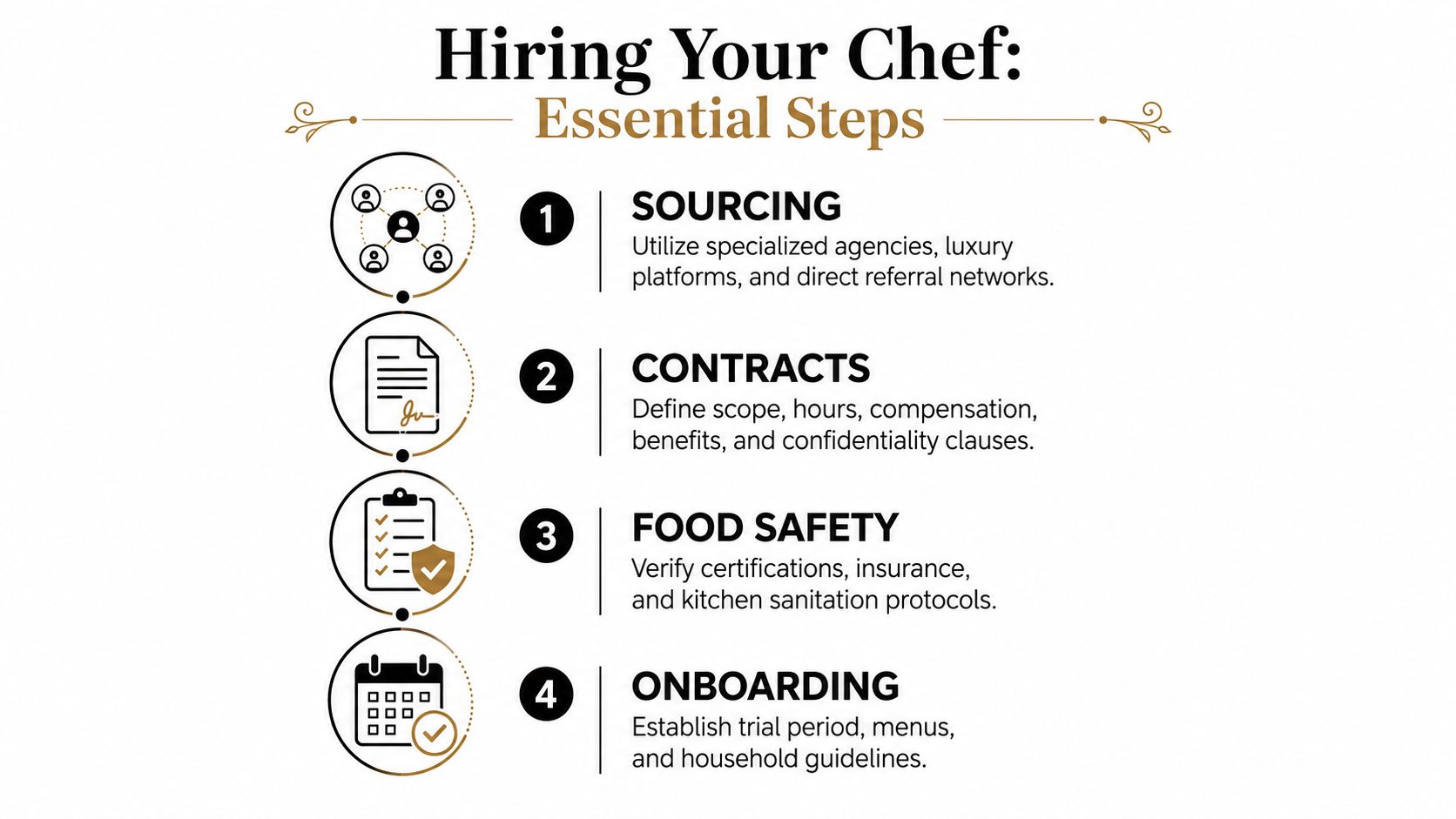
Before signing: If the chef's availability, travel obligations, cancellation terms, and kitchen responsibilities aren't written down, you haven't finished hiring.
The Hybrid Model Reshaping Luxury Households
The personal-versus-private decision isn't always binary. For many affluent households, the practical answer is a private chef for the daily rhythm and a personal chef, or specialist event chef, for moments that require a different repertoire or a larger service team.
Consider a Hamptons estate with a year-round private chef. The resident chef knows the family's preferences, manages weekday meals, keeps children's food consistent, and understands the household's timing. For a weekend gathering, the family might bring in a personal chef who specializes in sushi, plant-forward tasting menus, or another style outside the resident chef's regular rotation.
That arrangement works because each chef has a distinct job. The resident role stabilizes the kitchen. The outside engagement absorbs peak demand, specialty cuisine, and formal entertaining without forcing the resident chef to become every kind of culinary professional at once.
Where the hybrid model earns its keep
A hybrid program is especially useful when:
- Daily needs and event needs differ: The family wants practical meals most days but formal dining for celebrations.
- Travel creates uneven demand: The household needs full support in one residence and short, intensive culinary programs elsewhere.
- Specialty cuisine matters: A visiting chef can add a specific technique or regional style without changing the household's permanent hire.
- Multiple residences complicate staffing: The resident chef can travel selectively while local chefs cover separate villa or estate engagements.
- Events need extra hands: An external brigade can handle service while the private chef protects family continuity.
The trade-off is management overhead. Someone must coordinate menus, purchasing, kitchen access, equipment, staffing, storage, and cleanup standards. The household manager or travel advisor should establish one chain of command, because two chefs receiving separate instructions will create waste and tension.
In practice, agencies such as HauteBlack can structure culinary support across villa programs and member events, where the dining brief changes by destination, guest list, and occasion. The strongest arrangement keeps the resident chef informed without making that person responsible for every outside event.
The market supports this flexible thinking. A 2025 market report identified personal chefs as the largest share of the broader service market at 38.5%, reflecting the importance of recurring household service in the category rather than only event-focused dining, as discussed in the SSRN private dining report. For households with serious culinary demands, the hybrid model is often less about luxury excess than sensible capacity planning.
Which Chef to Choose for Your Situation
Use the engagement pattern as the deciding tool. Don't begin with the chef's title, and don't assume a celebrated event chef can manage a residence. Ask how often you need the person, how much the guest list changes, and whether the chef must remain responsible after the formal dinner ends.
| Scenario | Details | Recommended Chef |
|---|---|---|
| Seven-night villa week in Tuscany | Fixed stay, changing excursions, bespoke dinners, arrival and departure logistics | Personal chef or short-term private event chef |
| Forty-guest milestone dinner | Large guest count, formal service, multiple prep and service stations | Event-focused personal chef with a brigade |
| Multi-property summer residency | Daily meals, travel between homes, family preferences, staff coordination | Private chef |
| Recurring member dinner | Scheduled culinary event, rotating guests, curated menu, defined service window | Personal chef or event chef |
A seven-night villa week
Choose a personal chef when the family wants planned breakfasts, lunches, and dinners across a defined stay, especially if guests will rotate. Confirm travel-day coverage and whether the chef brings assistants. If formal dinners are central, hire for the complete program rather than adding separate cooks at the last moment.
A forty-guest milestone dinner
This is not a solo-cook assignment. Choose an event chef who can present a staffing plan, production schedule, equipment list, dietary process, and service sequence. The chef may be called personal or private by the agency, but the relevant feature is event infrastructure.
A multi-property summer residency
Choose a private chef when the household needs continuity across residences and a person who can work with the broader domestic team. The contract should address travel, lodging, time off, property transitions, inventory, and who has authority over menus and purchasing.
A recurring member dinner
Choose a personal or event chef when each dinner has a clear date, guest profile, and culinary brief. The chef should be comfortable collaborating with an event producer, sommelier, service team, and venue rather than assuming control of a private household kitchen.
The deciding question: Will you need this chef for one defined engagement, or as part of an ongoing household operating rhythm?
Answer that directly. A defined engagement points toward a personal or event chef. An ongoing rhythm points toward a private chef. If both descriptions apply, build the hybrid structure deliberately instead of forcing one person to cover incompatible demands.
HauteBlack coordinates bespoke villa stays, private residences, member events, and culinary experiences with private chefs and celebrated culinary partners. Visit HauteBlack to discuss the chef model, staffing depth, and travel logistics that fit your next property or event.
Explore Our Guides


Signature Experiences