Haute Black Journal
Private Chef Dinners: The Ultimate Guide to Bespoke Dining

Marlene Azeez
Director, HauteBlack
View all articles →
# Private Chef Dinners: The Ultimate Guide to Bespoke Dining
June 29, 2026
Private chef dinners now define serious luxury hospitality. The draw is not status theatre. It is control. Control of the room, the pace, the guest mix, the service style, and the emotional tone of the evening.
That shift matters.
The strongest hosts no longer build memorable dinners around who might notice. They build them around privacy, precision, and authorship. A proper private dining experience feels composed from first arrival to final pour. It does not feel borrowed from restaurant culture, and it certainly does not feel like upscale catering placed in a residence.
Execution is only half the standard. Curation is the ultimate test. The menu should reflect the host's palate, the guests' habits, the cellar, the setting, and the reason the dinner exists in the first place. The table should support that story, including details such as designing durable custom tableware, lighting, florals, and service choreography. Clients who want a bespoke evening should start with a specialist concierge that can coordinate the full experience, such as bespoke private dining experiences.
The next frontier is personalization informed by intelligence, not guesswork. That is where the category is separating. The best providers are using AI to identify preferences, patterns, dietary nuances, travel histories, and entertaining styles, then turning that insight into a dinner that feels uncannily well judged. Haute Black's network is a strong example of this shift. It moves private dining beyond logistics and into calibrated, highly personal hospitality.
It also exposes a truth many providers prefer to blur. The actual quoted chef fee is rarely the full investment. Staffing depth, rentals, ingredient sourcing, travel, last-minute menu revisions, service ware, and site-specific kitchen constraints all shape the total cost. Discerning hosts should expect clarity on those variables from the start.
The New Era of Bespoke Culinary Experiences
Private chef dinners have outgrown the old luxury script. The standard is no longer a talented chef cooking in a beautiful home. The standard is a fully authored evening, shaped with enough precision that every course, every visual cue, and every service decision feels intentional.
That change matters because discerning hosts are judging private dining differently now. They are not buying access to culinary talent alone. They are commissioning atmosphere, discretion, timing, and taste in the broader sense of the word.
The hosts who get this right start long before the first course. They define the point of the evening, who needs to connect, what mood the room should carry, and how the dinner should reflect their identity. The strongest tables often extend that point of view into objects and setting, including designing durable custom tableware, linens, glassware, florals, and lighting that support the menu rather than compete with it.
A private chef dinner succeeds or fails on authorship.
That is also why AI-led personalization now matters. Generic preference forms and a few dietary notes are no longer enough for this tier of client. The best providers use a sharper method. They read patterns across entertaining style, travel history, ingredient preferences, cellar holdings, guest sensitivities, and household routines, then translate that intelligence into an evening that feels uncannily well judged. Haute Black has positioned its private luxury experiences around that standard, using its network to build dinners that feel personally calibrated rather than conventionally customized.
The other shift is financial clarity. Many providers still present the chef fee as if it were the investment. It rarely is. Staffing levels, premium sourcing, rentals, kitchen limitations, travel, equipment transport, service ware, and late revisions often determine the final number. Serious hosts should expect those variables to be surfaced early, priced clearly, and managed without improvisation.
Private dining now sits in a different category from traditional entertaining. It is hospitality as curation, informed by better intelligence and judged by finer standards.
Beyond the Restaurant The Essence of Private Dining
Restaurants, even excellent ones, impose their own logic. Their pacing is built for the room. Their acoustics are built for turnover. Their best version of privacy is usually separation, not seclusion.
Private dining changes the premise.
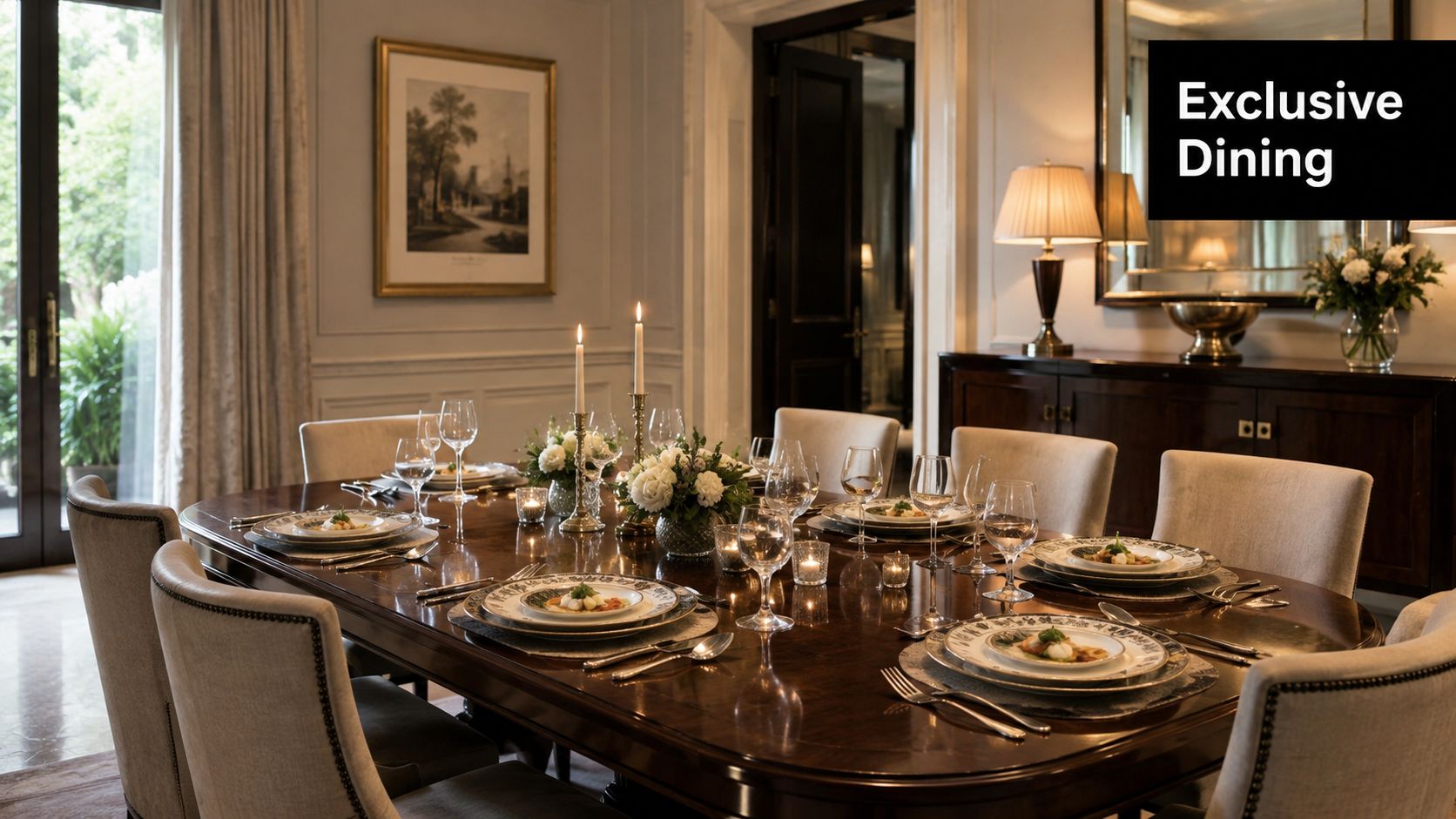
Privacy that's actually private
A restaurant “private room” still sits inside someone else's machine. Staff traffic continues. Adjacent tables exist. Timing slips because another service issue has pulled attention elsewhere.
In a private residence, estate, or villa, the perimeter is yours. That matters more than commonly acknowledged. For family offices, public figures, founders, and guests discussing sensitive matters, real privacy isn't a bonus. It's part of the product.
Customization without the usual limits
Restaurants let you choose from a menu. A private chef lets you define the premise of the evening.
That distinction is everything. You can anchor the dinner around:
- a personal milestone
- a rare wine already in your cellar
- a destination memory from Capri, Kyoto, or Marrakech
- a dietary framework that would be awkward in a traditional dining room
- a guest of honor whose preferences shape the meal
The strongest events also coordinate the room and service style with the food. That means the table setting, floral scale, plating tempo, and staffing standard should all align. If you want a benchmark for premium private dining services and experiences, look at whether the curation goes beyond food into mood, guest flow, and hosting strategy.
Narrative control is the real luxury
The best hosts understand that dinner is narrative. The room opens with an impression, the first course sets tone, the main sequence creates tempo, and dessert either releases or extends the night.
In a restaurant, you inherit someone else's story. In a private chef setting, you write it.
Practical rule: If the evening could be moved into a restaurant private room without losing anything important, it wasn't curated well enough.
That's why I advise clients to think less about “what do we want to eat?” and more about “what should this night feel like?” The second question produces a better answer to the first. It also leads to sharper decisions on service style, guest count, music, wines, and whether the evening should feel ceremonial, relaxed, seductive, or subtly powerful.
The Anatomy of a Flawless Culinary Execution
Elegant private dining is built on operational discipline. If the kitchen plan is weak, no amount of luxury language can rescue the evening.
A professional chef doesn't just arrive and start cooking. According to Blas Dining's behind-the-scenes guide to private chef service, a private chef typically arrives 2–3 hours before the meal and spends 30–60 minutes assessing the kitchen, confirming workspace, and verifying basics such as hobs, ovens, and refrigeration. That standard matters because a polished dinner depends on invisible preparation, not last-minute improvisation.
What the chef is assessing before guests sit down
A serious kitchen assessment covers far more than whether the oven works. The chef needs to understand how the room will function under pressure.
Expect attention on:
- Work zones: prep area, plating area, hot line, cold storage
- Appliance reliability: ovens, burners, refrigeration, and ventilation
- Service movement: how staff enters and exits without interrupting the table
- Storage logic: where ingredients, tools, and finished elements can be held safely
If your home, villa, or yacht galley has limitations, that's not fatal. But it must be identified early. The chef can solve many problems. The chef can't solve surprises well.
Mise en place separates amateurs from professionals
The most important phase of the evening happens before the first guest takes a seat. Ingredients are organized by cooking sequence. Garnishes are portioned. Sauces are stabilized. Serving tools are placed where they'll be needed.
That's why the room can feel calm even while a technically demanding menu is being executed. The visible elegance comes from invisible sequencing.
A flawless private dinner should feel unhurried to the guest and highly structured to the team.
This is also where hosts often underestimate the visual side of execution. Tablescape planning shouldn't be an afterthought assigned to whoever is nearest the candles. If you want inspiration beyond predictable silver-and-white formality, these modern tablescape concepts are useful because they treat the table as design, not decoration.
What a host should have ready
You don't need to micromanage the kitchen. You do need to prepare the environment.
A well-run host setup includes:
1. Clear access: staff must be able to load in without crossing a cocktail crowd.
2. A fully functional kitchen: basic appliances and refrigeration must be available.
3. Service direction: confirm whether the evening is plated, family-style, or tasting format.
4. A point person: one household lead, estate manager, or EA should handle decisions.
When those fundamentals are in place, the chef can focus on what matters. Seasoning, timing, texture, temperature, presentation, and guest experience.
Deciphering the Investment in Culinary Artistry
Most disappointment in private chef dinners doesn't come from the food. It comes from vague quotes.
The market gives a useful baseline. In-home private chef services typically range from $75 to $300+ per person, while grocery costs often add $20 to $60 per person, according to Jason Raffin's private chef pricing guide. That same source notes that 60% of private chef inquiries revolve around confusion over what's included. That figure tracks with what I see in practice. Clients often compare headline pricing when they should be comparing scope.
What you're actually paying for
A quote should separate culinary artistry from event mechanics. If it doesn't, ask for a rewrite.
Consider this perspective:
| Component | Typical Cost Range | Notes |
|---|---|---|
| Chef service fee | $75 to $300+ per person | Usually covers consultation, preparation, cooking, service, and cleanup |
| Groceries | $20 to $60 per person | Often excluded from the initial service quote |
| Staffing | Varies qualitatively | Servers, bartenders, sommeliers, and kitchen assistants may be separate |
| Equipment rentals | Varies qualitatively | Needed when the home lacks plating ware, specialty tools, or extra service pieces |
| Travel or location premium | Varies qualitatively | More common for remote estates, villas, yachts, and destination settings |
| Gratuity | Often 15–20% of service fee | May be expected in addition to the quoted service fee |
The hidden issue is logistics overhead. In private settings, the meal doesn't benefit from a built-in restaurant ecosystem. Every plate, every tray pass, every glass polish, every service path has to be created on site.
Why similar dinners can price very differently
A simple menu executed by a polished local chef can be excellent. A multi-course tasting menu with rare product, high-touch plating, and premium staffing is a different operation entirely.
Costs rise fastest when these variables shift:
- Chef profile: reputation and scarcity matter
- Menu complexity: intricate plating and luxury ingredients add labor and sourcing friction
- Format: plated dinners require more precision than buffet or family-style service
- Location: major luxury markets and remote properties generally command higher rates
- Service ambition: a dinner party with one chef is not the same as a chef-led production with support staff
There's also a useful benchmark from city pricing. In major U.S. markets such as Dallas and Los Angeles, private chef services often range from $50.65 to over $150 per guest, inclusive of groceries, cooking, cleaning, and taxes, with premium items pushing the figure higher, according to Miummium's market pricing example. For a more concrete service comparison, Thumbtack's private chef example notes that a moderately upscale three-course plated meal for 12 guests in Los Angeles costs about $1,400 total or $125 per person, while a standard buffet for 100 guests is about $5,000 total or $50 per person. The plated format costs more because it demands more labor and tighter service coordination.
Ask for an itemized quote before you ask for a discount. Transparency usually matters more than price compression.
That's the right posture for UHNW clients. You're not trying to spend less at any cost. You're trying to know exactly what you're buying.
Curating Your Menu with Culinary Masters
A serious menu shouldn't begin with protein selection. It should begin with intent. The best private chef dinners have a point of view.
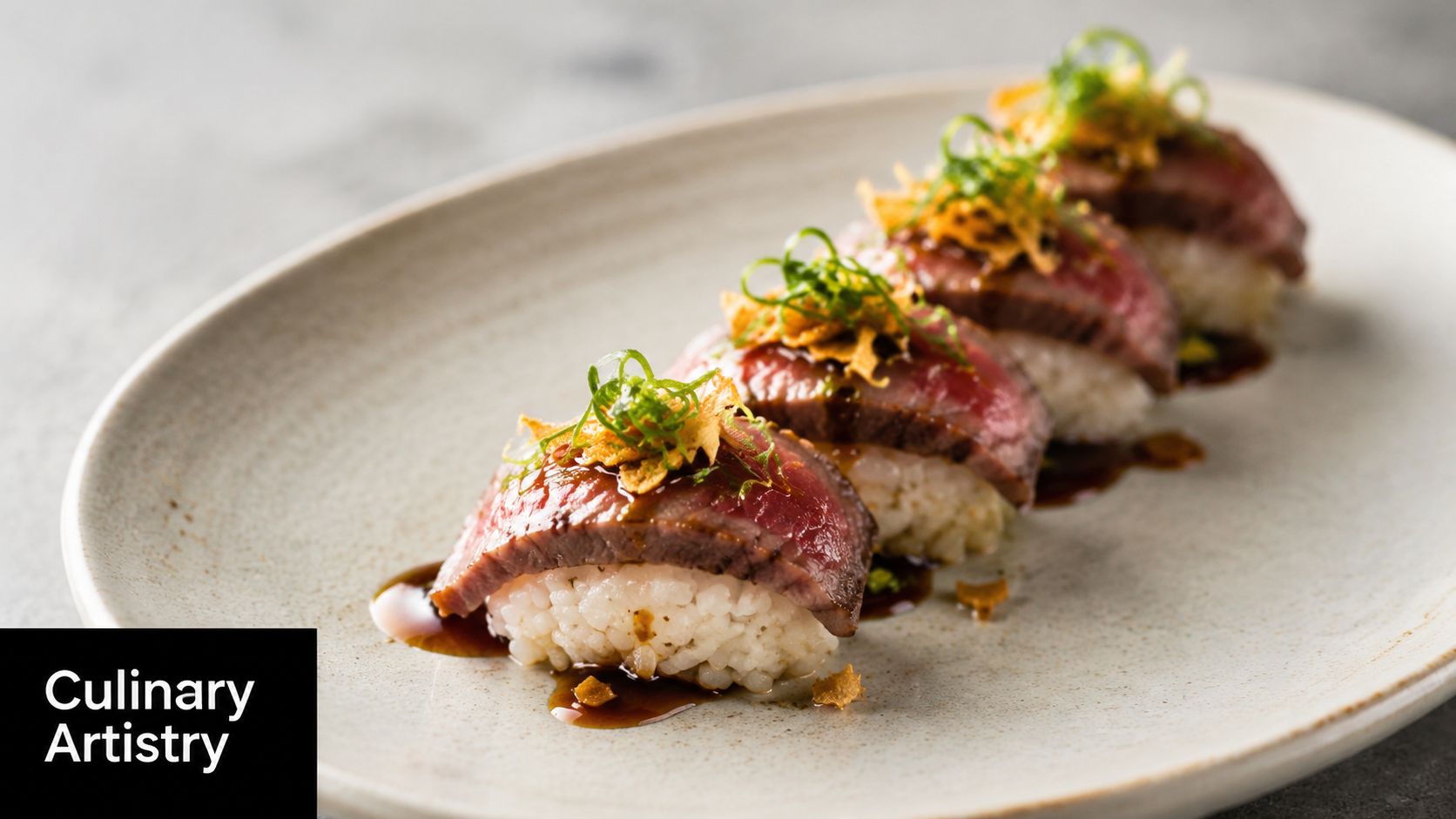
When hosts work with chefs operating at the level of Nobu Matsuhisa, Daniel Boulud, or Thomas Keller, the dinner stops being a collection of dishes and becomes a composed experience. The menu may reference travel, memory, seasonality, or a cellar moment. A Kyoto-inspired progression for a founder's anniversary dinner feels different from a Riviera lunch built around crudo, chilled rosé, and restrained Mediterranean pacing. It should.
Build the menu around a single strong anchor
Most weak menus fail because they try to please everyone equally. Strong menus lead.
A compelling anchor can be:
- A wine-led concept: the meal is designed around a rare Burgundy, Champagne vertical, or a favored producer.
- A personal memory: the chef interprets dishes from a honeymoon, family heritage, or a decisive trip.
- A signature ingredient: truffle, uni, bluefin, wagyu, langoustine, white asparagus, or another product that defines the evening.
- A cultural lens: Japanese omakase discipline, French precision, Levantine abundance, or modern Californian restraint.
That's where culinary masters distinguish themselves. They don't ask what you'd like for starter and main. They translate a brief into an edible narrative.
For a related look at how destination settings shape chef-led dining, this villa with private chef guide offers useful context on how place influences menu curation.
Pairing personality with cuisine
Not every celebrated chef is right for every room. Some excel at theatrical interaction. Others are better when the evening demands discretion and a quieter hand.
I advise matching chef style to guest chemistry:
- A highly social group often enjoys visible chef presence and tableside moments.
- A board-level dinner benefits from precision, restraint, and minimal interruption.
- A family celebration may call for warmth, flexibility, and comfort hidden inside refined technique.
The medium matters too. Some dishes thrill on a tasting spoon and disappear from memory. Others create emotional permanence.
Here's a look at a chef-led dining style that captures that visual precision:
The right menu doesn't impress by excess. It impresses by coherence.
That's the standard. Not more luxury ingredients. Better editorial judgment.
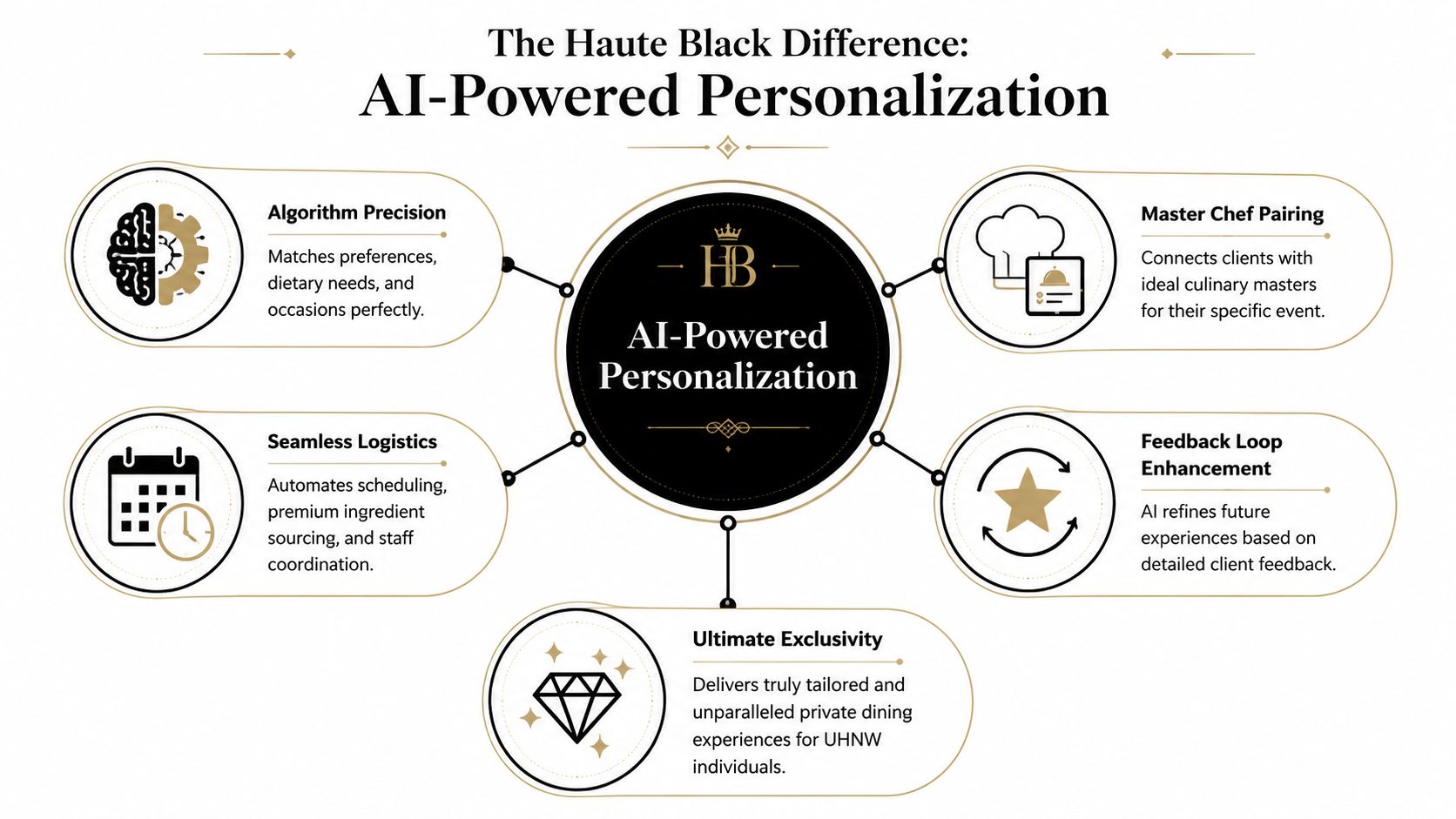
The Haute Black Difference AI-Powered Personalization
The next leap in private chef dinners won't come from flashier ingredients or louder presentation. It will come from smarter personalization.
The strongest signal in the market is no longer simple preference matching. It's adaptive menu intelligence. According to this industry discussion on predictive menu optimization, 38% of UHNW clients now seek menus adjusted to biometric inputs such as stress levels and sleep quality, while fewer than 5% of private chef service providers currently offer AI-driven menu tools. That gap is where the market is heading.
Why static personalization is no longer enough
Traditional customization asks the client a familiar set of questions: allergies, dislikes, favorite cuisines, preferred service style. That's useful, but it's still static. It captures identity, not condition.
A more advanced approach considers that the ideal menu for the same guest changes with context. A recovery-focused wellness weekend, an intimate celebration after long-haul travel, and a high-stakes investor retreat shouldn't all be fed by the same logic.
A modern AI-enabled framework can improve:
- Dietary precision: beyond broad preference into more granular exclusion and tolerance patterns
- Occasion matching: menu energy that suits the purpose of the gathering
- Chef alignment: pairing the right culinary voice with the client brief
- Operational efficiency: reducing friction in planning, sourcing, and service coordination
What sophisticated clients should expect next
Luxury dining starts to look more like a bespoke advisory service than a booking exercise. The future isn't a longer intake form. It's an intelligent system that refines recommendations over time.
That means better questions and better outputs:
1. Dynamic menu planning: what should this client eat tonight, not what do they usually like.
2. Sharper chef matching: culinary style, temperament, discretion level, and event type all matter.
3. Learning from feedback: the system should improve after every dinner, not reset to zero.
Clients already expect this level of precision in wellness, travel, and investing. Dining is catching up.
That's why AI-powered personalization will define the top end of the category. It doesn't replace the chef. It sharpens the brief, improves the match, and removes avoidable guesswork.
Essential Questions on Private Chef Experiences
Clients usually ask the wrong first question. They ask, “What will the chef cook?” A better first question is, “What kind of evening are we building?” Once that's clear, the practical details become much easier.
How should guests interact with the chef
Read the room. Some dinners benefit from chef storytelling and visible interaction. Others require near-total discretion.
If you want chef presence, decide that in advance. Don't force performative table visits into an evening that should feel private and fluid.
What if a dietary restriction appears at the last minute
Tell the chef or your point person immediately. Good teams can often adapt, but last-minute changes are easier when the menu architecture already allows flexibility.
The mistake is minimizing the issue. A “small restriction” can affect sauces, garnishes, cross-contact, and plating.
How much kitchen do you actually need
You need a functional kitchen, not a show kitchen. Working refrigeration, reliable cooking equipment, and enough clear prep space matter far more than aesthetics.
If the property is architecturally beautiful but operationally awkward, tell the chef team early. They can plan around limitations if they know them.
What changes on a villa or yacht booking
Multi-day engagements demand tighter provisioning, clearer staff hierarchy, and stronger communication. The chef isn't only cooking. The chef is managing inventory rhythm, meal transitions, guest mood shifts, and service continuity.
Why is this category growing so quickly
Because affluent clients want more authorship over how they gather. The market reflects that shift. The global personal and private chef services market is forecast to grow at a 6.7% CAGR through 2030, with projections reaching USD 31.5 billion by 2034, according to this private chef market outlook. That growth doesn't come from novelty. It comes from fit. Private dining answers what modern luxury clients increasingly want: personalization, quality, and control.
If you're evaluating options, keep your standards simple:
- Demand itemized pricing
- Prioritize chef fit over celebrity alone
- Treat the room, service, and menu as one composition
- Choose discretion over theatrics unless the event calls for spectacle
If you want a private chef dinner that feels authored rather than arranged, work with Haute Black. The right dinner should reflect your tastes, your guests, and your standards with no visible strain behind the scenes. That level of curation is what separates a pleasant evening from one people talk about for years.
Explore Our Guides


Signature Experiences


