Haute Black Journal
Best Private Jet Guide: How to Choose by Mission

Marlene Azeez
Director, HauteBlack
View all articles →

The most popular advice about the best private jet is usually wrong. Ranking aircraft by cabin size, top speed, or prestige ignores the decision that matters most: whether the aircraft fits the way you travel.
A jet that excels on a long intercontinental mission can be wasteful on regional routes. A smaller aircraft may be the smarter choice for short sectors, smaller airports, and lighter passenger loads. The right answer depends on mission profile, passenger count, airport access, utilization, and access model, not on the most impressive nameplate.
| Your dominant travel pattern | Strongest aircraft direction | Most sensible access model |
|---|---|---|
| Short regional trips with a small group | Light jet | Charter or jet card |
| Cross-country travel with a stand-up cabin | Midsize jet | Charter, card, or fractional |
| Long domestic and shorter international routes | Super-midsize jet | Fractional or charter |
| Frequent intercontinental travel | Long-range jet | Fractional or ownership |
| Nonstop global travel with separate sleeping and living areas | Ultra-long-range jet | Premium charter, fractional, or ownership |
There isn't one universally superior private jet. There is only the aircraft that gives you the right range, cabin, runway performance, and cost structure for the trips you fly.
Why the Best Private Jet Is the One That Matches Your Missions
“Buy the biggest jet you can afford” is marketing advice, not aviation advice. The largest cabin and longest range look attractive on a specification sheet, but they also bring more capital exposure, higher operating complexity, and capabilities you may rarely use.
A Citation Excel might be an excellent choice for a short Aspen trip with a small group. It would be a poor fit for a nonstop New York to Geneva journey. The reverse is also true. An ultra-long-range aircraft can handle the international mission comfortably, but using it for every short domestic flight means paying for range and cabin volume that add little value to the trip.
Three variables decide the aircraft
Start with typical mission range. Your longest annual trip matters, but your average sector matters more. If most flights are short regional hops, choose an aircraft that boards quickly, uses convenient airports, and carries the people and baggage you normally bring. If your calendar contains regular nonstop international sectors, range and fatigue reduction become more important than short-field convenience.
Next, count the usual passenger group, not the largest group you've ever assembled. A jet configured for a large party can become inefficient when most flights carry only a few people. Conversely, squeezing a full executive team into a compact cabin creates constant compromises in seating, baggage, and work space.
Finally, examine runway access at your most-used airports. A jet that requires major-airport infrastructure may undermine the point of private aviation if it forces you to drive farther after landing. Airport choice affects convenience as much as cabin design.
Practical rule: Choose the aircraft that handles your normal missions elegantly, then solve the occasional extreme trip with charter.
The global fleet remains heavily concentrated in the United States. One early 2026 estimate placed about 14,632 of roughly 24,270 private jets in the United States, or about 62.5% of the world fleet, while another estimate placed the U.S. share at roughly 63.4%. These figures, reported by Flycraft's private jet fleet overview, reinforce an operational point: availability, maintenance support, and airport access vary significantly by region.
The two decisions that matter are therefore straightforward. First, decide whether you need charter, a jet card, fractional access, or full ownership. Then choose the category that fits your average mission, while ensuring it can handle the most demanding trip you expect to fly.
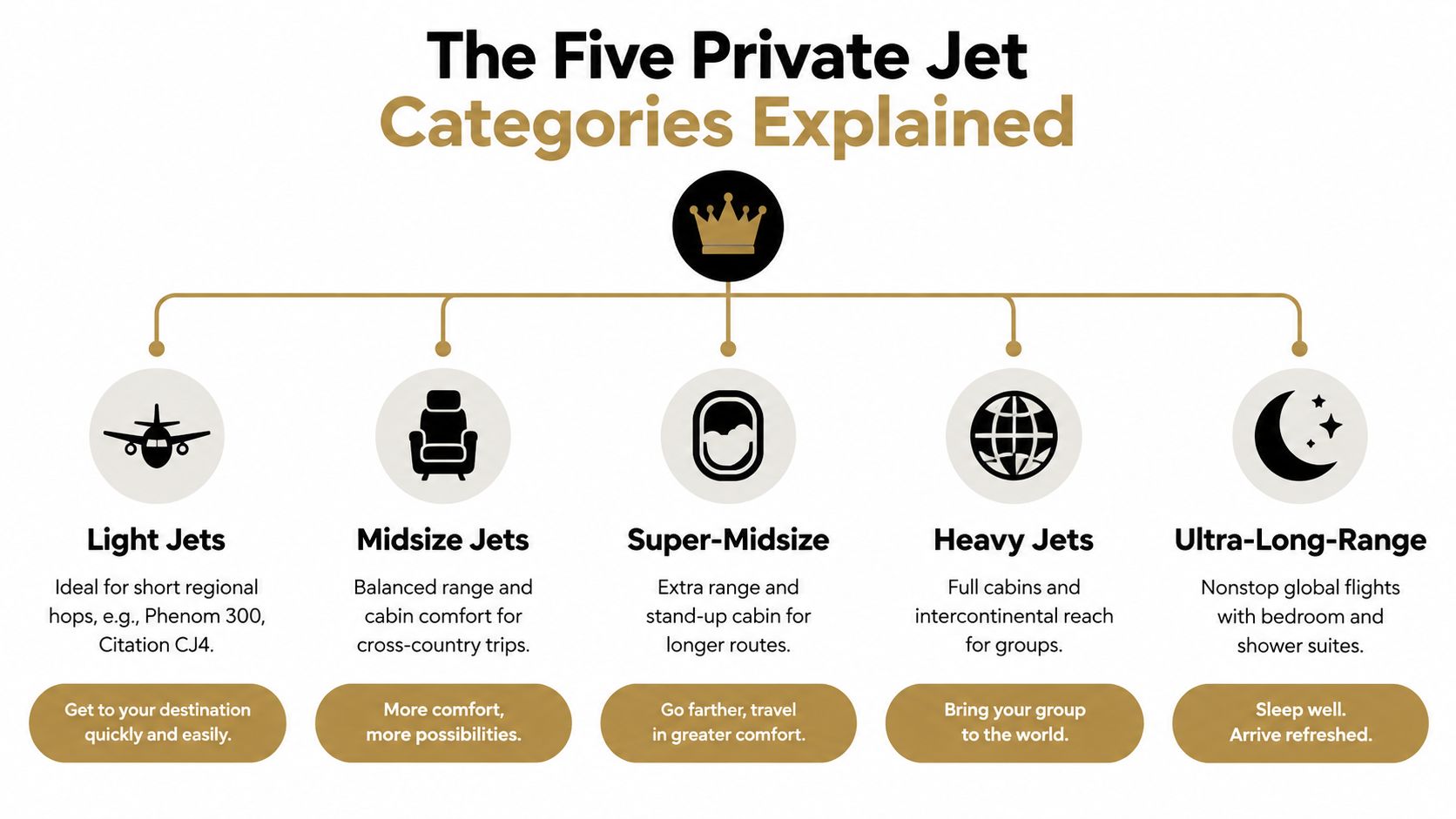
The Five Private Jet Categories Explained
Private jets are easier to evaluate when you stop comparing individual models too early. Begin with the category, then shortlist aircraft that meet your route, passenger, baggage, and airport requirements.
Light jets
Light jets are the practical choice for short regional travel. The Phenom 300 and Citation CJ4 belong on the shortlist when you value quick boarding, broad airport access, and a comfortable cabin for a small group. They suit business hops, ski weekends, and routes where a larger aircraft would add cost without improving the experience.
Their limitation is cabin space. As time aloft increases, passengers notice the narrower interior, reduced storage, and fewer opportunities to move around. Don't choose a light jet because it looks economical if your regular passengers expect to work, dine, or sleep in the cabin.
Midsize jets
Midsize jets, including the Citation Latitude and Learjet 75, add a more usable stand-up cabin and stronger cross-country capability. They're a good fit for travelers who want a meaningful improvement in comfort without moving into the infrastructure and expense of a large-cabin aircraft.
This category often works well for mixed business and leisure use. You can carry a team, bring more luggage, and spend longer in the air without the cabin feeling like a compromise.
Super-midsize jets
Super-midsize jets such as the Challenger 350 and Praetor 600 are the most compelling all-rounders for many private travelers. They combine a full galley, a more spacious cabin, and seating that can support longer sectors with a better balance between comfort and operating discipline.
For many transcontinental missions, this is the category to evaluate first. It usually provides enough cabin for productive travel while avoiding the cost of an aircraft designed for global nonstop flying.
Long-range jets
Long-range jets are built for intercontinental travel and larger groups. The Gulfstream G550, Falcon 2000LXS, and Global 6000 represent different approaches to the category, but the selection should focus on actual city pairs, passenger load, baggage, and airport requirements.
Long-range capability only creates value when you use it. If your schedule regularly includes international trips where a fuel stop would disrupt a meeting or arrival, this category earns serious consideration. If those trips are occasional, chartering may be more rational than owning.
Ultra-long-range jets
Ultra-long-range aircraft are the flagships for nonstop global travel. The Gulfstream G700, Global 7500, and Falcon 8X appeal to travelers who need separate work, dining, relaxation, and sleeping environments on demanding routes.
The Global 7500 remains a benchmark, with a published range of roughly 7,700 to 7,800 nautical miles, a ceiling of 51,000 feet, and a four-zone cabin for up to 17 to 19 passengers, according to Magellan Jets' 2026 private jet guide. That capability is valuable when it removes fuel-stop risk and lets passengers arrive ready to work. It isn't automatically valuable on a short domestic sector.
Comparing Light, Midsize, Super-Midsize, Long-Range, and Ultra-Long-Range Jets
A specification table can narrow the field, but it can't choose the aircraft for you. Published performance changes with payload, winds, reserves, airport elevation, and routing. Range is a planning figure, not a guarantee that every passenger and every bag can fly nonstop.
| Category | Range (nm) | Passengers | Cabin Height (ft) | Baggage (cu ft) | Runway at MTOW (ft) | Hourly Charter (USD) |
|---|---|---|---|---|---|---|
| Light | Short regional missions | Small groups | Compact | Limited to moderate | Strong access at suitable airports | Lower category pricing |
| Midsize | Cross-country missions | Small to medium groups | Stand-up cabin | Moderate | Airport dependent | Mid-market pricing |
| Super-midsize | Transcontinental and shorter international missions | Medium groups | Spacious stand-up cabin | Moderate to generous | Requires careful airport review | Mid-to-high pricing |
| Long-range | Intercontinental missions | Medium to larger groups | Multi-zone potential | Generous | More runway and infrastructure planning | High pricing |
| Ultra-long-range | Nonstop global missions | Larger groups | Multiple living zones | Generous | Airport compatibility is critical | Premium pricing |
For current route planning, HauteBlack's private jet range guide emphasizes the operational variables that determine whether a nonstop trip is realistic, including winds, payload, and reserve fuel. That is the right way to read any aircraft brochure.
What the categories mean in practice
Light jets win on access and simplicity. They make sense when your trips are regional, your passenger count is controlled, and your priority is reaching airports closer to the final destination. They become less attractive when passengers need significant luggage or extended cabin time.
Midsize jets improve the daily experience. Stand-up space changes how passengers work and move, especially on cross-country routes. This category is often a better fit than a light jet when the itinerary includes several sectors in quick succession.
Super-midsize jets are the default shortlist for serious domestic users. They provide the cabin, galley, baggage capacity, and range that many executives need without jumping immediately to a flagship aircraft.
Long-range and ultra-long-range jets earn their cost through repeated use. If you regularly fly nonstop for extended periods, the cabin becomes a productivity and recovery tool. If you only need that capability occasionally, charter gives you access without turning a rare requirement into a permanent fixed cost.
Charter, Jet Card, Fractional, or Full Ownership
The access model determines whether the aircraft serves your travel or becomes a constraint. Choose the model alongside the aircraft category, because a suitable jet under the wrong structure still produces a poor outcome. For a direct comparison of costs, commitments, and flexibility, see HauteBlack's complete comparison of private aviation solutions.
| Model | Hourly Cost | Capital Required | Best For |
|---|---|---|---|
| On-demand charter | Quoted per trip and category | No aircraft capital | Flexible or irregular flying |
| Jet card | Fixed or formula-based category rate | Prepaid flight commitment | Frequent travelers seeking scheduling convenience |
| Fractional | Usage charges plus management obligations | Share purchase and ongoing fees | Regular users wanting structured access |
| Full ownership | Direct operating and fixed costs | Major aircraft acquisition capital | High utilization and demanding control requirements |
Charter
Charter is the strongest choice for variable flying. You select the aircraft category for each mission instead of forcing every trip into one airframe. A light jet can cover a regional weekend, while an ultra-long-range aircraft can handle a demanding international itinerary.
The tradeoff is variable pricing and availability. HauteBlack's 2026 charter pricing article places most private jets in a range of about $2,300 to $17,000 per billable flight hour, while VIP airliners can reach $18,000 to $23,000 per hour. These figures from its charter cost guide are market ranges, not quotes. Positioning, airport charges, crew logistics, and international handling can materially change the final invoice.
Jet cards
A jet card fits travelers who fly frequently enough to value predictable access but do not want to manage an aircraft. You prepay for a defined amount of flying and receive access governed by a category, scheduling process, or service standard.
The commitment deserves close scrutiny. You gain scheduling convenience, but the structure may cost more in flexibility when routes, dates, or passenger loads change. Review expiration rules, peak-day restrictions, service-area limits, and the provider's cancellation terms before committing funds.
Fractional ownership
Fractional ownership occupies the middle ground between charter and full ownership. You purchase an interest in an aircraft program and receive access under the provider's operating rules. It suits regular travelers who need more dependable availability and prefer a consistent operating framework.
Read the contract line by line. Monthly charges, occupied-hour fees, peak scheduling rules, interchange provisions, and exit terms affect the total commitment as much as the aircraft selection. Fractional access works best when your annual flying pattern is steady enough to use the program consistently.
Full ownership
Full ownership fits only a demanding, predictable flying pattern that justifies its fixed burden. Annual ownership can exceed $1 million per aircraft, with fuel often representing around one-third of total cost, according to Forbes' analysis of private aviation economics.
The purchase price starts the financial obligation. Engine overhauls can reach $1.5 million per engine, annual parking in major hubs can reach $450,000, and maintenance plus crew can push running costs well beyond the acquisition price, as reported by Business Jets' private plane news coverage.
Ownership functions as an operating business with an aircraft attached. Choose it for control, customization, schedule authority, and consistently high utilization. Choose charter or a jet card when your aircraft requirements change more often than your calendar suggests. Fractional ownership earns consideration when access must be dependable and your missions repeat, but full ownership would leave too much capital and management responsibility tied to one aircraft.
Matching Real Trip Scenarios to the Right Aircraft
The best private jet becomes obvious when you start with the itinerary instead of the brand.
A Denver to Aspen weekend
Six passengers traveling with ski equipment need convenient airport access, practical baggage handling, and a cabin that works for a short sector. A Citation CJ4 or Phenom 300 can be the sensible answer when the aircraft and airport conditions support the trip.
Book this mission through charter or a jet card. A long-range aircraft would add capability without improving the weekend. The right light or midsize option keeps the travel proportionate to the route and group.
A New York to London business trip
Eight passengers who want to work, rest, and arrive prepared should look beyond a compact cabin. A Challenger 350 or Falcon 2000 may be appropriate depending on payload, routing, airport, and nonstop requirements.
Charter is compelling if this trip is occasional. Fractional access deserves consideration when similar transatlantic missions appear regularly and scheduling reliability carries a high business value. The decision isn't about choosing the most luxurious aircraft. It's about avoiding a cabin that forces passengers to trade comfort for schedule.
A Los Angeles to Tokyo executive mission
A long Asia-Pacific sector demands a different standard. An ultra-long-range jet such as the Global 7500 or G650ER is the appropriate starting point when the objective is a nonstop mission with meaningful rest and work space.
The Global 7500's published range and four-zone layout make it especially relevant for this type of assignment. The Global 8000 is the speed-focused alternative, presented at Mach 0.94 cruise and around Mach 0.95 top speed in BlackJet's business jet overview. That speed premium matters most when the schedule is time-critical.
For occasional executive travel, premium charter or a carefully selected jet card can provide the necessary aircraft without owning a flagship that spends much of its life on shorter routes. Full ownership becomes more defensible when the Asia itinerary is one part of a consistently demanding global schedule.
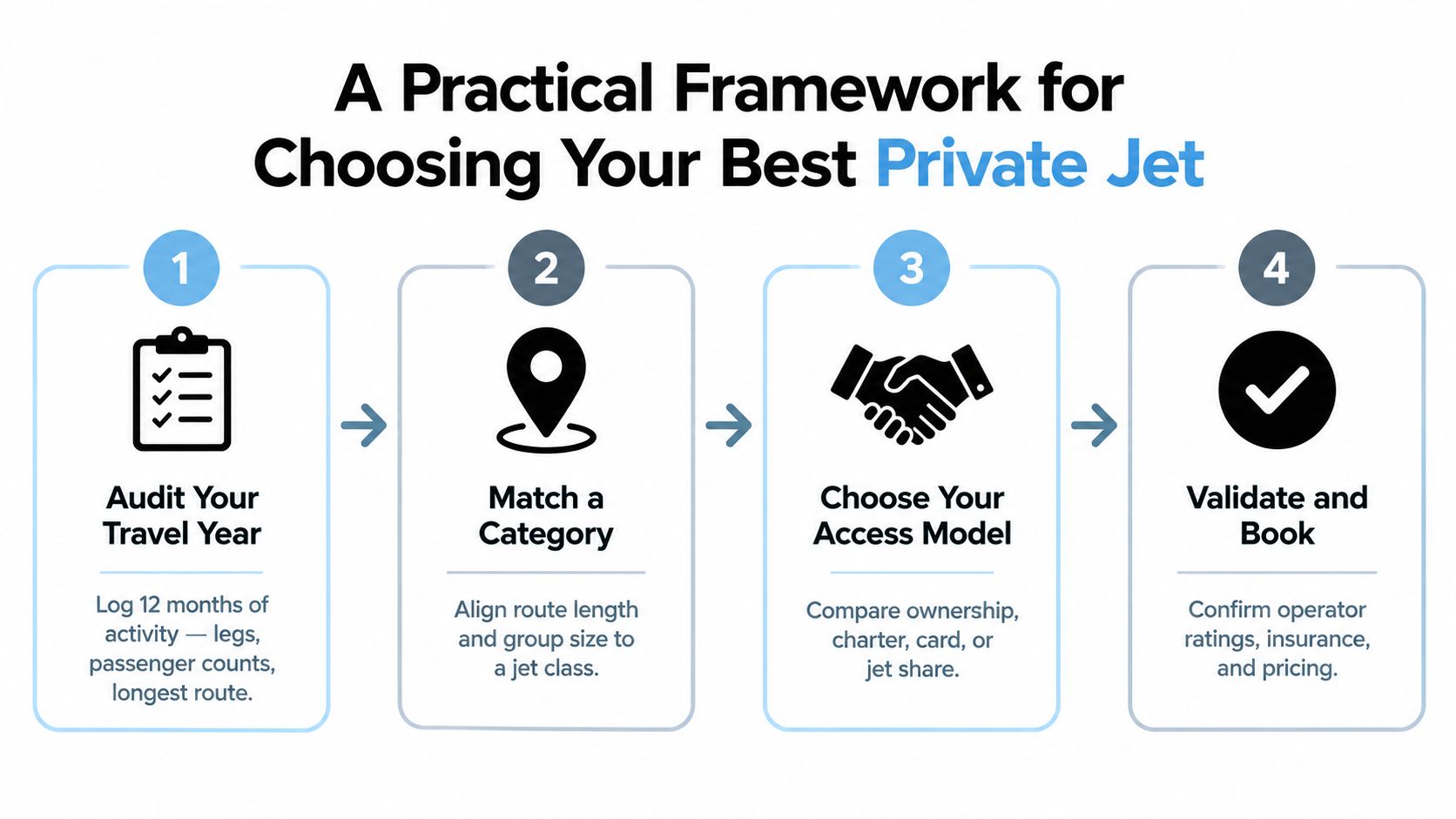
A Practical Framework for Choosing Your Best Private Jet
Use a four-step process before you request a purchase proposal or sign a long-term access agreement.
Step one, audit the travel year
Review the previous year of flying. Record every leg, passenger count, baggage profile, longest sector, preferred airports, and dates when you needed guaranteed access.
Don't rely on memory. A few glamorous long-haul trips can distort your view of the aircraft you need.
Step two, match the category
Classify your normal trips as light, midsize, super-midsize, long-range, or ultra-long-range. Use route length and passenger load together. A long route with two passengers may produce a different answer from a shorter route with a full executive team and heavy luggage.
Step three, choose the access model
Compare charter, jet card, fractional access, and ownership against your utilization and tolerance for fixed obligations. The ownership question should include management, crew, maintenance, parking, insurance, and downtime, not only the purchase price.
Step four, stress-test the hardest mission
Take the trip with the longest stage, largest group, strictest schedule, or most difficult airport. Confirm that your preferred aircraft can handle it without turning the rest of your travel year into an expensive compromise.
Then test the shortlist in actual conditions. Fly candidate aircraft on representative routes and compare noise, boarding, baggage access, seat comfort, and arrival condition. A showroom visit won't tell you how the aircraft feels after a demanding overnight mission.
The best private jet is the aircraft that passes this stress test while remaining efficient on your ordinary trips. If one aircraft handles the hardest mission but is excessive for everything else, use charter to fill the gap rather than allowing the exception to dictate the entire strategy.
Next Steps for Booking and Vetting the Right Operator
A good aircraft choice can still produce a poor trip if the operator review is superficial. Treat the quote process as due diligence, not a shopping exercise.
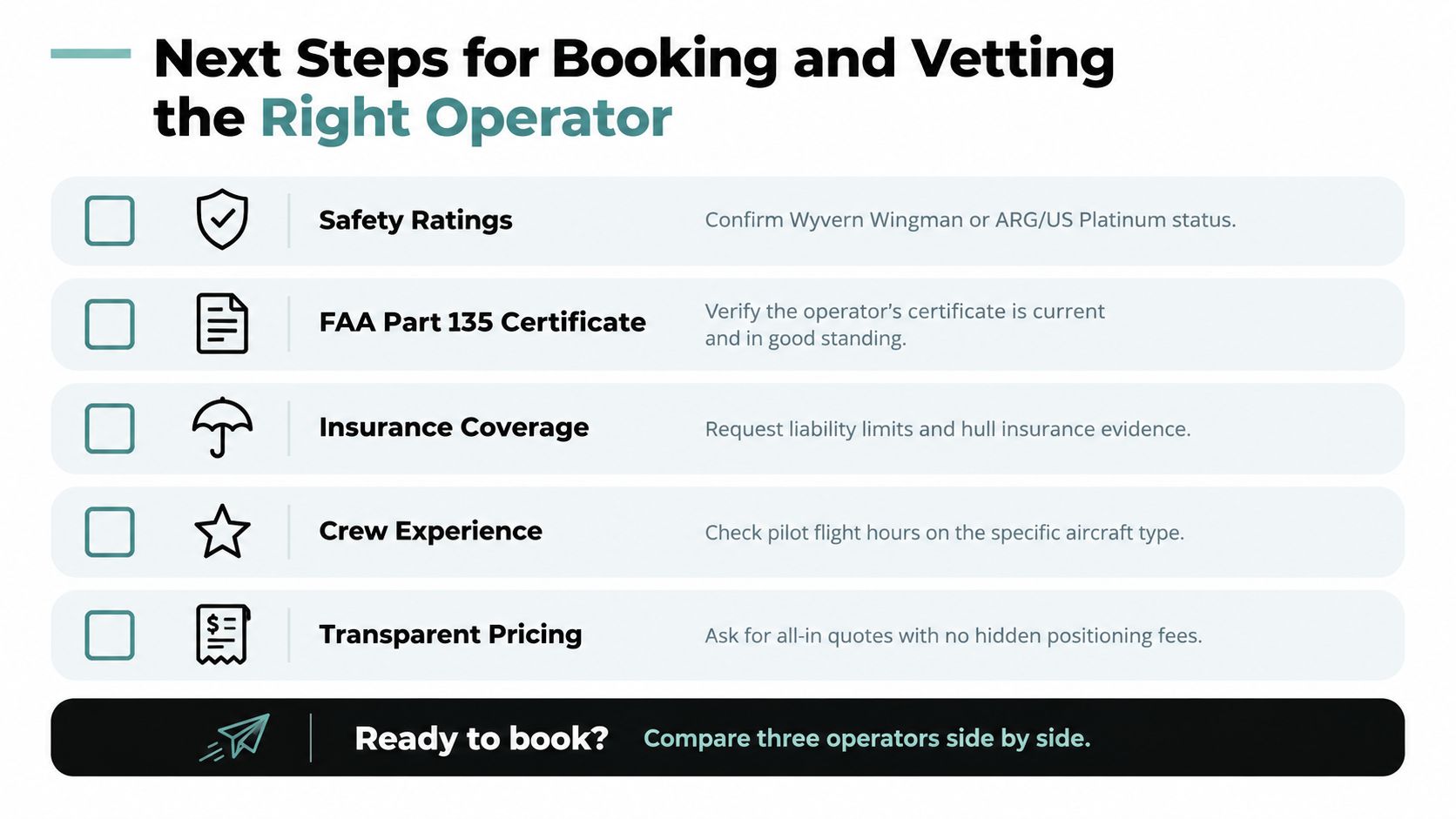
Before booking, verify:
- Safety ratings: Request current Wyvern or ARG/US documentation and confirm what the rating covers.
- FAA Part 135 status: Verify the operator's certificate and operating authority.
- Insurance: Ask for liability limits and evidence of current coverage.
- Safety management: Request relevant safety management system documentation and recent audit information.
- Crew and aircraft: Confirm crew experience, aircraft age, maintenance status, and the specific tail proposed for the trip.
Your quote request should specify dates, departure and arrival airports, passenger names or count, baggage, preferred cabin category, catering, pets, ground transport, and any international permits or handling requirements. Ask each provider to separate the total price from repositioning charges, taxes, airport fees, and optional services.
Use this private jet booking guide when structuring the request. Compare three proposals side by side, paying attention to aircraft age, all-in pricing, positioning fees, fuel surcharge language, crew-day limits, peak-day premiums, and cancellation windows.
A specialist curation service can pre-vet operators, present transparent pricing, and match an aircraft category to the mission profile rather than offering the first available jet.
HauteBlack offers private aviation coordination through Haute Jets, matching travelers with suitable aircraft for short regional trips and intercontinental missions while providing dedicated booking support. Visit HauteBlack to request a customized comparison of aircraft and access models for your actual travel pattern.
Explore Our Guides


Signature Experiences