Haute Black Journal
Private Aviation Solutions: A Complete Comparison

Marlene Azeez
Director, HauteBlack
View all articles →

You're in Aspen on Tuesday morning for an important board call, back in Manhattan before midnight, and scheduled to reach Geneva forty-eight hours later. Commercial aviation can move you between those cities, but it can't reliably give you control over the clock, the aircraft, the airport, or the hand-offs between each destination.
That's the core private aviation decision facing high-net-worth travelers in 2026. It isn't only whether to fly privately. It's whether on-demand charter, a jet card, fractional ownership, a membership program, or a managed aircraft fits the way you travel. The wrong choice creates unnecessary capital exposure, limited aircraft access, or operational friction. The right private aviation solution makes a complicated itinerary feel routine.
The comparison below evaluates each model against real UHNW missions, including multi-city family travel, time-sensitive executive schedules, short-haul business flying, and international routes. It also places Haute Jets in its proper role, as the aviation node within a wider luxury travel system, rather than as an isolated flight-booking product.
The Private Aviation Decision Facing High-Net-Worth Travelers
A principal flying between Aspen, Manhattan, and Geneva doesn't need a generic promise of flexibility. They need an aircraft that fits the route, a departure window that protects the meeting, suitable customs handling, and ground transportation timed to the arrival. They also need someone to manage the consequences when weather, airport restrictions, crew duty limits, or aircraft positioning changes the plan.
That's why the access model matters. A traveler who flies irregularly across several continents has a different requirement from an executive commuting between two domestic offices. A family taking one complex European holiday needs different economics from an owner who spends much of the year in the air.
Advisor's view: Choose the access model around your last twelve months of actual missions, not around the prestige of ownership or the headline hourly rate.
The five models sit on a spectrum:
| Model | What you're buying | Operational strength | Principal weakness |
|---|---|---|---|
| On-demand charter | A flight-by-flight solution | Maximum trip-by-trip flexibility | Aircraft and pricing vary |
| Jet card | Prepaid access to defined aircraft categories | More predictable availability and rates | Restrictions can surface on peak dates |
| Fractional ownership | A share of an aircraft or fleet | Consistent access and operating standards | Capital can be trapped when utilization falls |
| Membership program | Recurring access with hourly charges | Predictable budgeting without ownership | International and multi-stop flexibility may be limited |
| Managed aircraft | Ownership plus professional operation | Maximum control and customization | High fixed commitment and management complexity |
Haute Jets belongs primarily in the curated charter layer. That makes it useful for irregular, multi-leg, or internationally routed travel, including trips where the aircraft must coordinate with hotels, villas, transfers, and private experiences. It can also complement a jet card, fractional arrangement, or managed aircraft when the underlying program doesn't fit a particular mission.
The question is not which product sounds most exclusive. The question is which structure protects your time without forcing you to pay for capacity you don't use.
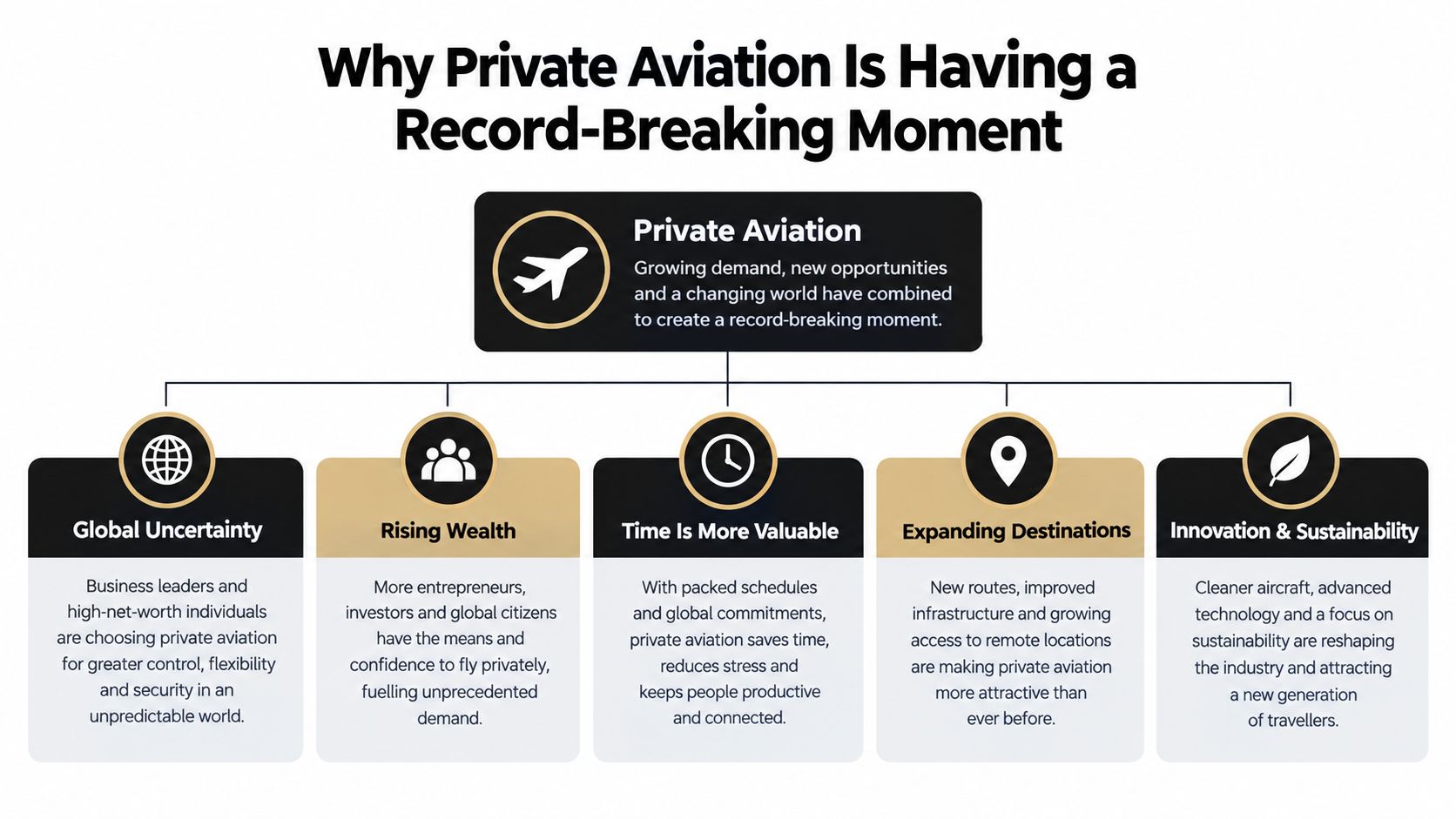
Why Private Aviation Is Having a Record-Breaking Moment
Private aviation has become a broader operating market, not a single luxury product. At one end sits pure pay-as-you-go charter. At the other sits full ownership and aircraft management. Jet cards, fractional shares, and membership programs occupy the middle, each trading some flexibility for greater predictability or access.
Global private jet flights totaled 3,878,836 in 2025, which was 4.6% higher than 2024 and 113,901 flights above the previous record set in 2022, according to Forbes' report on private jet activity. The earlier benchmark of 3,764,935 flights in 2022 had already represented a historic high. The same reporting indicates that the U.S. share of worldwide departures fell from 70.6% in 2019 to 67.9% in the most recent year, a sign that demand is broadening beyond the traditional U.S. center of gravity.
That expansion puts pressure on every access lane. Charter providers must source aircraft across more routes and cabin categories. Fractional operators are refreshing fleets and adding larger-cabin options. Membership providers are targeting travelers whose annual use doesn't justify ownership but who still want a repeatable booking process.
The historical roots of this market reach back to the postwar period, when surplus military aircraft, available pilots and technicians, and rising executive demand accelerated business flying. The National Business Aviation Association's history of business aviation identifies the Lockheed JetStar's first flight in 1957 as a major milestone, followed by the Learjet 23 in 1963, which helped establish private jets as a distinct business-aviation category.
Growth doesn't make the models interchangeable. A jet card may offer better availability on defined terms, while charter offers more freedom to change aircraft and routing. Fractional ownership can deliver consistency, but a share makes little sense if the aircraft sits idle. A managed aircraft gives an owner control, yet it also places responsibility for crew, maintenance, compliance, and utilization on the ownership structure.
The market is crowded because travelers value different things. Capital commitment, peak-day access, international reach, aircraft mix, and operational control remain separate variables. The right answer comes from the mission profile, not the label attached to the product.
The Five Private Aviation Access Models Compared
The cleanest way to assess these models is to ask what happens before, during, and after a difficult trip. Can the provider source the right aircraft? Can it handle an urgent change? Does the financial structure still make sense when your flying pattern changes?
| Model | Entry Cost | Best-Fit Mission | Key Tradeoff |
|---|---|---|---|
| On-demand charter | Lowest commitment | Irregular travel and varied routes | Availability and pricing vary by mission |
| Jet card | Prepaid block of hours | Repeat travel with a defined cabin need | Blackouts, segment rules, and peak restrictions |
| Fractional ownership | Share purchase plus ongoing fees | Consistent annual use and repeat routes | Underutilization and limited resale liquidity |
| Membership program | Recurring fee plus hourly charges | Mid-volume travel with budget predictability | Less flexibility for heavy international use |
| Managed aircraft | Ownership plus management costs | Frequent, complex, highly customized travel | Significant fixed commitment and responsibility |
On-demand charter
On-demand charter has the lowest entry commitment because you pay for the mission you need. It's the strongest fit for irregular flyers, changing routes, mixed passenger counts, and itineraries where a light jet on one leg and a large-cabin aircraft on another make more sense than a standardized fleet.
The cost logic is straightforward. You avoid ownership and prepaid-hour exposure, but every quote reflects aircraft positioning, crew requirements, fuel, airport charges, and market availability. The disqualifying tradeoff is variability. A broker or aviation advisor may source excellent aircraft, but you must evaluate the actual operating carrier, aircraft, crew, and substitution terms for each flight.
Jet cards
Jet cards exchange some flexibility for a more predictable booking experience. You prepay a block of hours, usually by cabin category, and receive defined rates or availability terms.
That structure works well for executives with recurring domestic or regional missions who value speed at the booking stage. It becomes less attractive when travel concentrates around ski season, major sporting events, holidays, or other peak periods. Blackout dates, minimum segment times, peak-day rules, and aircraft-category limitations can matter more than the advertised hourly rate. Read the contract before treating a guarantee as universal.
Fractional ownership
Fractional ownership gives you a share in an aircraft or fleet and a contractual allocation of flight time. The model suits travelers who need consistent access, familiar operating standards, and a recurring annual pattern.
The main risk is underutilization. You pay for access whether your calendar supports it or not, and resale can be less liquid than a conventional investment. Fractional ownership is strongest when the aircraft category matches your normal missions and your travel schedule is stable enough to use the allocation.
For a broader view of how private jets, first-class travel, and helicopter transfers can sit within a premium travel program, review HauteBlack's private jet charter membership guide.
Membership programs
Membership programs combine recurring fees with hourly charges. They're appealing to mid-volume users who want a consistent relationship, simpler budgeting, and access without buying an aircraft share.
They often struggle with heavy international travel, multi-stop days, and highly specific aircraft requirements. A membership can be efficient for repeat missions, but it shouldn't be mistaken for unlimited global flexibility. Confirm where the program operates, how it handles international legs, and what happens when the preferred aircraft category isn't available.
Managed aircraft
Managed aircraft ownership offers the greatest control. You own the aircraft and appoint an operator to manage crew, maintenance, compliance, scheduling, hangar arrangements, and charter utilization where appropriate.
This is the only model that can fully reflect a serial international traveler's preferences for cabin configuration, crew continuity, onboard equipment, and scheduling. It also carries the greatest fixed commitment. Ownership is difficult to justify when annual use is inconsistent, routes require different aircraft types, or the owner values access to a broad global fleet more than control of one airframe.
Haute Jets complements these models as a curated charter layer. That makes it particularly relevant when your core arrangement can't provide the right aircraft, route, or timing for a specific journey.
Matching the Right Model to Your Travel Pattern
Your travel history should decide the model. Marketing categories are secondary.
Consider a traveler who takes short-haul business hops under 600 nautical miles. These missions often reward a light jet or turboprop selected for the individual route. On-demand charter usually wins when the trips are irregular, while a membership or jet card becomes more useful when departures repeat and peak-day availability matters.
A multi-city European family week is different. The aircraft must connect several airports while accommodating luggage, children, pets, villas, restaurant reservations, and ground transfers. A curated charter solution generally offers more useful flexibility than a rigid access program, particularly when the itinerary changes after the first leg.
Transatlantic executive schedules place greater weight on aircraft range, cabin productivity, crew planning, and recovery options. A jet card can work if its large-cabin fleet and international terms match the schedule. A managed aircraft can outperform other models when the traveler flies frequently enough to justify dedicated control and a consistent crew structure.
Irregular leisure bursts are the clearest case for on-demand charter. You may need a different aircraft for a ski trip, a Mediterranean journey, and a family visit. Paying only for each mission avoids committing to a category that doesn't fit the next trip.
| Travel Pattern | Recommended Model | Break-Even Hours/Year | Disqualifying Condition |
|---|---|---|---|
| Short-haul business hops under 600 nm | On-demand charter or membership | Below 15 hours favors charter; around 25 hours can favor fractional economics | Repeated peak-day travel without guaranteed access |
| Multi-city European family weeks | Curated on-demand charter | No universal threshold | Fixed aircraft categories or weak international reach |
| Transatlantic executive schedules | Jet card, fractional, or managed aircraft | Above 150 hours can justify managed-aircraft analysis | Need for several aircraft categories across one itinerary |
| Irregular leisure bursts | On-demand charter | Below 15 hours usually favors charter | Non-negotiable access on peak dates |
| High-frequency international travel | Managed aircraft or hybrid access | Above 150 hours merits serious evaluation | Inconsistent annual utilization |
These thresholds are decision tools, not promises of universal savings. Around 25 hours annually, fractional ownership can begin to outperform jet card spending when access consistency and aircraft continuity matter. Below 15 hours, on-demand charter is usually the more economical structure unless guaranteed peak-day lift is essential.
Above 150 hours, managed aircraft deserves a serious review. That doesn't mean it automatically wins. The aircraft must be used enough, the mission profile must be compatible with its range and cabin, and the owner must value control more than broad fleet access.
For a practical explanation of the variables behind charter pricing, see HauteBlack's guide to private jet charter cost. The question to answer before requesting any quote is simple: What did your last twelve months of actual private flying look like?
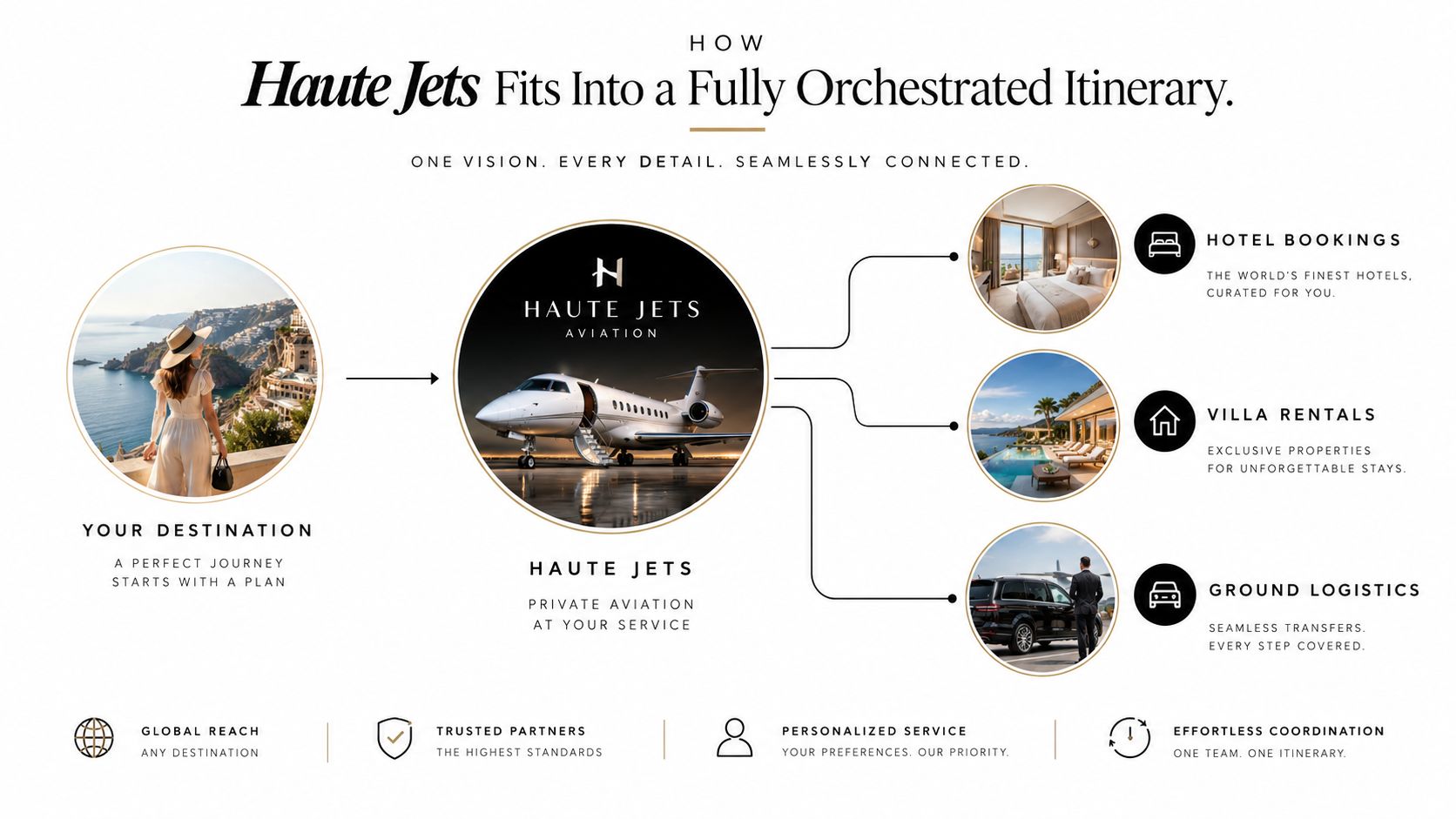
How Haute Jets Fits Into a Fully Orchestrated Itinerary
Private aviation performs best when the aircraft is planned around the day, not when the rest of the itinerary is forced to accommodate the aircraft.
Take a five-stop European journey that begins in Geneva, continues to Capri, then Mykonos, and finishes in Sardinia. The aviation plan shouldn't begin with a jet category. It should begin with the villa check-in windows, yacht embarkation, restaurant reservations, local airport constraints, passport control, luggage, and the traveler's preferred rhythm.
Build the itinerary around hand-offs
The advisor should sequence each hand-off deliberately:
1. Match the aircraft to the route. Passenger count, luggage, pets, runway considerations, range, and cabin comfort determine whether the same aircraft can serve every leg.
2. Protect the arrival window. The aircraft slot must support villa access, yacht transfer timing, and reservations, not merely the earliest available departure.
3. Coordinate customs and baggage. International arrival procedures should be planned alongside the next ground movement, with the baggage plan confirmed before departure.
4. Place the chauffeur at the right point. The vehicle should be waiting at the FBO apron or designated pickup area, with the transfer timed to the actual arrival process.
5. Keep a recovery option ready. Weather, airport restrictions, and aircraft changes require a live operating plan, not a static PDF itinerary.
The advisor negotiates more than the headline charter price. They may need to address block-hour positioning, ferry legs, fuel stops, crew night rest, airport slots, and whether the aircraft can remain available while the traveler moves by yacht or road.
Haute Jets fits into the wider HauteBlack travel system here. HauteBlack's customized travel itineraries and bespoke journeys describe the broader planning principle, one advisor coordinating private aviation, hotels, villas, transfers, and high-touch itinerary details.
A standalone flight booking ends at the destination airport. A fully orchestrated itinerary treats the airport as one point in a chain that runs from home to FBO, aircraft to customs, apron to villa, and villa to the next experience. That coordination is often where the meaningful time savings occur.
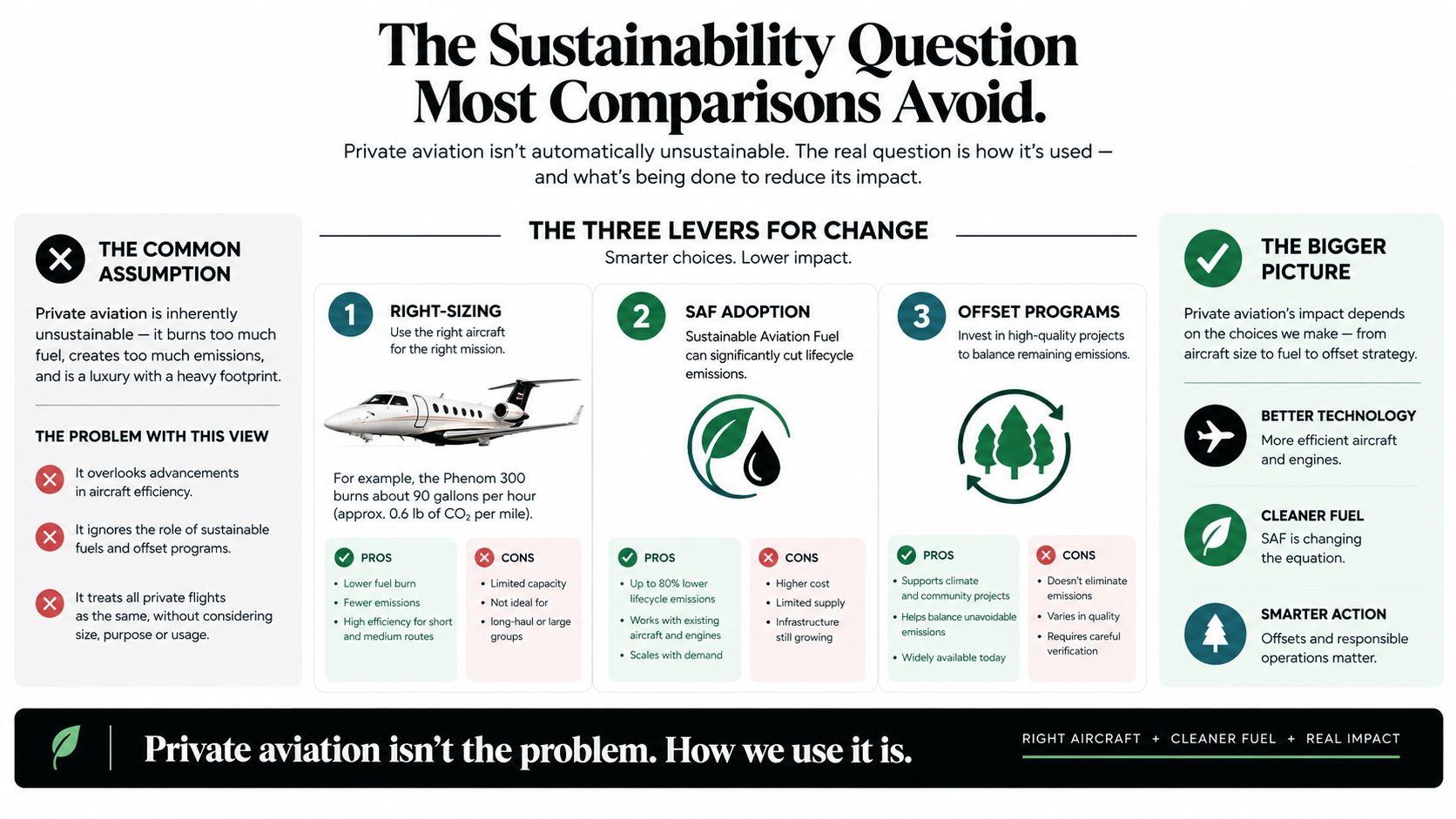
The Sustainability Question Most Comparisons Avoid
Private aviation's sustainability question shouldn't be answered with generic green language. It should be answered by examining the choices an advisor can change.
The first lever is right-sizing. A Phenom 300 burning 90 gallons per hour can be a more rational choice than a Global 7500 burning 500 gallons per hour for a short mission, provided the route, passenger count, luggage, and performance requirements permit it. Those fuel figures come from the operational assumptions supplied for this comparison, not from a general claim that one aircraft is always preferable.
The second lever is utilization. Shared positioning, empty-leg matching, and pooled charter can reduce waste when the aircraft, passengers, and routing align. An efficient flight isn't created by labeling a trip sustainable. It's created by avoiding unnecessary repositioning and selecting capacity that the mission can justify.
The third lever is sustainable aviation fuel procurement. In 2025, global SAF production reached about 634 million gallons, compared with nearly 107 billion gallons of conventional jet fuel, so SAF represented only 0.6% of total aviation fuel use, according to United's sustainable aviation fuel overview. Supply remains constrained, and a simple fuel switch cannot yet carry the entire sustainability burden.
Operators and clients should also measure performance rather than rely on broad fleet averages. IATA's FuelIS platform benchmarks fuel efficiency using operational data from more than 200 airlines worldwide, including fuel burn per RTK or OTK. While private aviation missions require careful comparability, the framework is useful for examining route, dispatch, and ground-operation inefficiencies.
Offsets can support a broader environmental program, but they shouldn't distract from aircraft selection, utilization, routing, and SAF procurement. Sustainability is an itinerary-design discipline. The strongest decision often happens before the aircraft is booked.
Choosing With Clarity
Start with four questions:
- How often do you fly? Below 15 hours, charter generally preserves flexibility and avoids unnecessary commitment. Around 25 hours, compare fractional economics carefully. Above 150 hours, analyze managed aircraft.
- Do you need guaranteed access on peak dates? If yes, a jet card or fractional structure may justify its restrictions. If no, on-demand charter gives you more freedom.
- Do your routes change by trip? If you move between short regional legs, European multi-city journeys, and intercontinental missions, a single standardized program may underperform a hybrid approach.
- Is control more important than fleet breadth? Managed aircraft offers control. A curated charter network offers choice.
Bring precise questions to the advisor conversation:
1. What is the published hourly rate, and what is the true all-in hourly cost?
2. Which blackout dates, peak-day surcharges, and segment minimums apply?
3. How are repositioning and ferry legs charged?
4. What is the fleet age and aircraft substitution policy?
5. Which safety audits and operator qualifications are reviewed?
6. How does the provider handle weather, maintenance disruption, and irregular operations?
7. Can the aircraft, crew, customs plan, luggage, and ground transfers support the entire itinerary?
Haute Jets is the right call for irregular, multi-leg, internationally routed missions where orchestration matters more than guaranteed access to one defined aircraft category. For many principals, a hybrid stack works better than a single model, with a jet card for predictable core routes and on-demand charter for unusual aircraft, peak periods, and complex international travel.

HauteBlack offers bespoke travel planning that combines Haute Jets private aviation with villas, hotels, helicopter transfers, ground logistics, and custom experiences. Visit HauteBlack to discuss your actual travel pattern and build a private aviation solution around the way you move.
Explore Our Guides


Signature Experiences