Haute Black Journal
Adventures in Arabia: Luxury Desert Safaris & Charters

Marlene Azeez
Director, HauteBlack
View all articles →
# Adventures in Arabia: Luxury Desert Safaris & Charters
Published August 1, 2026 by Marlene Azeez
Dubai is the wrong place to start if you want to understand adventures in Arabia. The skyline gets the headlines, but the story is a peninsula of lava fields, high mountains, coral reefs, sacred cities, and empty desert that punishes sloppy planning. If you treat it like a casual beach holiday, you'll waste the best routes, the best weather windows, and the best access.
Luxury here is not about excess for its own sake. It's about sequencing, permissions, timing, and moving with precision through a region that has been explored, mapped, and reinterpreted for centuries, from early scientific expeditions like Carsten Niebuhr's 1761 mission to modern adventure operators working across the Gulf today Ebsco's history of exploration in Arabia, Niebuhr and later expedition milestones, Husaak's company profile. The travelers who do it well don't ask for “a desert safari.” They ask for the right ridge, the right dive window, the right guide, and the right arrival sequence.
A proper plan for Arabia also respects culture, not just terrain. That matters whether you're pairing a camel camp with a private museum evening or choosing an itinerary that flows from mountain air to reef water to a palace hotel. If you're mapping a wider regional journey as well, keep this Best Middle Eastern Perfumes guide in mind as a useful cultural companion, and compare your broader routing against Haute Black's Middle East luxury guide for 2026.
Redefining Arabian Adventure Travel
Arabia gets flattened into two lazy images, Dubai towers and dune bashing. That misses the point and wastes the trip. The peninsula works as a multi-terrain destination, and the strongest itineraries use that range with intent. The region's modern adventure appeal sits beside a long history of exploration and mapping, which is why serious travelers should plan it with the same care they would give any remote luxury expedition.
Arabia rewards precision, not improvisation
The best Arabia trip is built like a private expedition. You decide which zones justify a splurge, which legs belong on a helicopter or private jet, and which transfers should stay slow because the route itself is part of the experience. That is the difference between a polished journey and a holiday assembled from generic stops.
The region also has a sensory depth that standard desert coverage never captures. A dune camp in the Empty Quarter feels nothing like a limestone ridge in Oman, and neither resembles a coral-led Red Sea escape or an after-hours walk through a heritage quarter. Arabia can hold all of that in one itinerary, but only if the routing respects distance, climate, and the order in which each place should be experienced.
Practical rule: if an itinerary promises “Arabia” without naming micro-regions, transfer times, and the reason for each overnight, it is not a luxury plan. It is marketing copy.
There is also the cultural layer, and high-end travel in this region falls apart without it. Arabia is scent, hospitality, architecture, prayer rhythms, and etiquette, all working together. A serious advisor should shape the full atmosphere of the trip, including gifting, fragrance, arrival style, and the way each stay connects to the next. For broader regional context, keep this Best Middle Eastern Perfumes guide in mind, and compare your wider routing with Haute Black's Middle East luxury guide for 2026.
The Four Adventure Zones of the Arabian Peninsula
A serious Arabian itinerary should be built around four distinct zones, because each one asks for a different pace, vehicle, and kind of luxury. Desert, mountain, coast, and culture aren't abstract categories here. They're the difference between a journey that feels coherent and one that feels stitched together by someone who's never moved across the peninsula.
Desert, mountain, coast, and city each deliver a different mood
The Desert Zone is the obvious headliner, but it's more diverse than most travelers realize. The Rub' al Khali rewards scale and silence. Wahiba Sands in Oman is softer, more accessible, and better for travelers who want an elegant camp experience without the sense of total isolation. AlUla adds another layer, with sandstone canyons, heritage weight, and strong options for private sleeping setups that feel intimate rather than theatrical.
The Mountain Zone is where Arabia surprises first-time visitors. Jebel Akhdar and Jebel Shams in Oman bring altitude, sharp air, and hiking that feels more alpine than desert. Saudi's Asir Mountains offer a different texture again, while the Hajar range gives you serious terrain for canyon walks and active days. If you want a trip that alternates between movement and stillness, the mountains are where that rhythm works best.
The Coastal Zone is essential for anyone who wants water in the itinerary. The Red Sea is where diving belongs, while Musandam is the place for fjord-like dhow cruising and dramatic cliff scenery. The Arabian Gulf, by contrast, is the setting for superyacht charter style, with cleaner lines and more social polish.
The Cultural Zone ties the whole peninsula together. Diriyah, Al-Balad, and Muscat's Sultan Qaboos Grand Mosque are not filler stops. They're the spaces where architecture, hospitality, and history give the region context. Skip them and the trip feels shallow.
The smartest route combines all four
The strongest luxury pattern is desert first, mountain second, coast third, city last. That sequencing gives you recovery between active days, a natural shift in climate, and a satisfying crescendo into culture and dining. It also works better for private aviation, because the terrain changes justify the aircraft hops rather than forcing unnecessary road transfers.
A traveler who wants one trip to feel complete should resist the urge to overpack experiences into one geography. Arabia rewards contrast. A morning hike, a late-afternoon reef swim, and a night in a palace-style suite can fit together beautifully if the route is designed for it. They feel random if they're not.
If you're choosing just one zone, pick based on your core personality rather than your Instagram mood. Desert belongs to people who value silence and scale. Mountains suit travelers who want activity with air. Coast is for those who want water and privacy. Cities are for people who care about access, architecture, and dining.
When to Go and Seasonal Timing by Region
Timing is the entire game in Arabia. If you get the month wrong, even a great hotel won't save the experience. The region works best when you think in micro-seasons, not broad annual averages.
Use the calendar, not your instincts
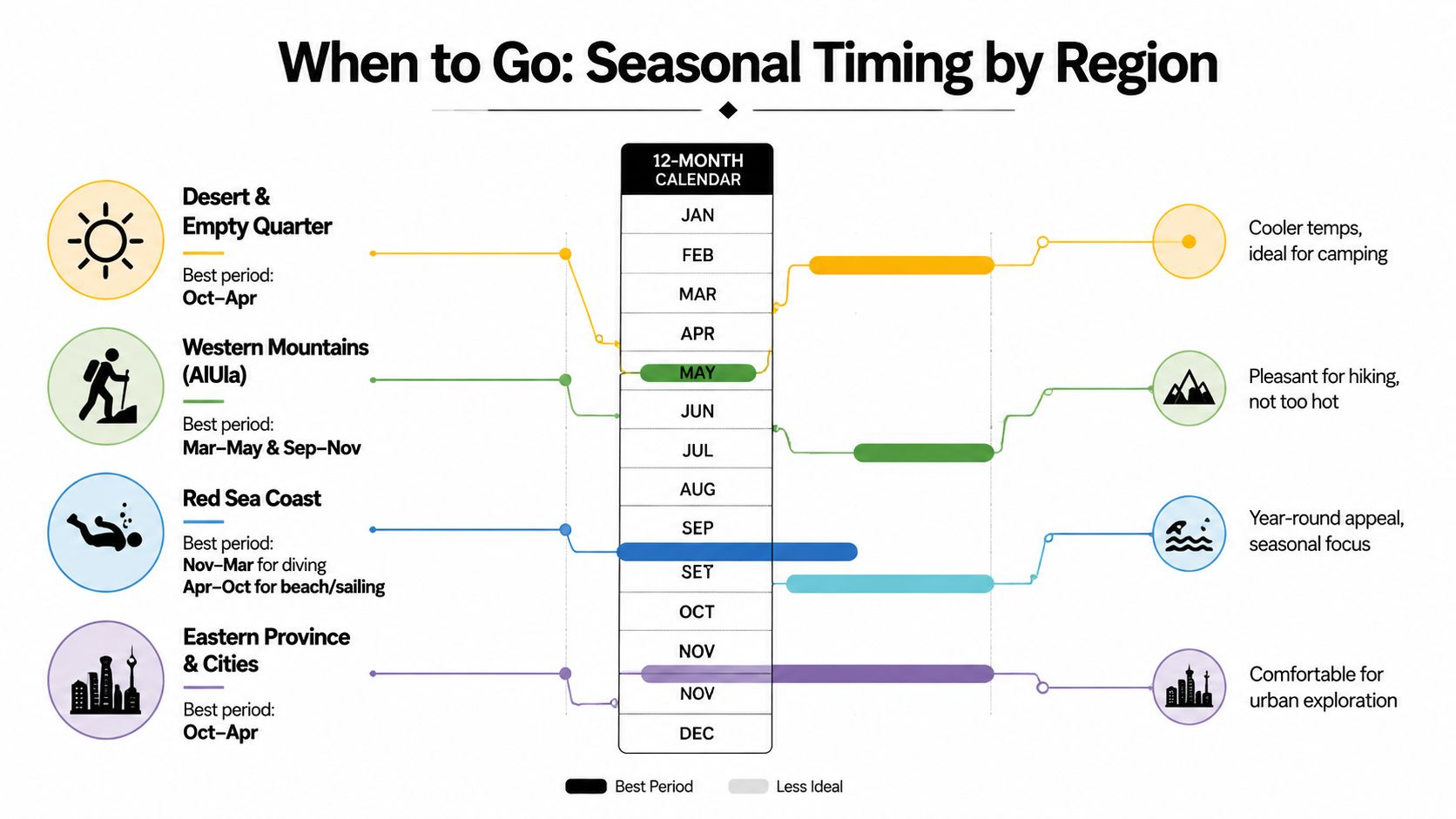
For desert and cultural travel, the sweet spot is generally October through April. That's the window for comfortable overland movement, camp nights, and sightseeing in places where heat can otherwise flatten the day. The infographic above is the right mental model, because the desert and most city programs want the same cooler season.
The Red Sea coast is more flexible. Diving is strongest in the cooler months, while beach and sailing programs also work well in the warmer half of the year if your priorities are sun, water, and a yacht schedule. If your trip is reef-led, keep your focus on the cooler side of the calendar and plan the rest of the itinerary around that anchor.
Oman's mountains deserve their own calendar. The best hiking weather sits in the cooler part of the year, and summer changes the whole country's mood. Dhofar's monsoon season turns the southern coast green in a way that feels almost unreal in the Arabian context, which is exactly why a well-informed traveler can make a very deliberate exception to the usual winter rule.
Do this: choose your overnight locations first, then build the transfer days around their weather windows. In Arabia, the hotel is not the trip. The route is the trip.
Ramadan needs respect, not panic. Dining, activity pacing, and alcohol expectations can all shift, so the right answer is to plan earlier, build flexibility into meal timing, and let a specialist handle the details rather than guessing on the ground. Shoulder season can work beautifully too, especially for travelers who prefer quieter properties and a more private feel.
Bespoke Itineraries for Every Traveler Profile
A real advisor doesn't sell “Arabia.” They build a journey around the traveler. Couples need privacy and atmosphere. Families need movement without friction. Ultra-high-end travelers want access that feels effortless, not advertised.
Couples want intimacy, not busy sightseeing
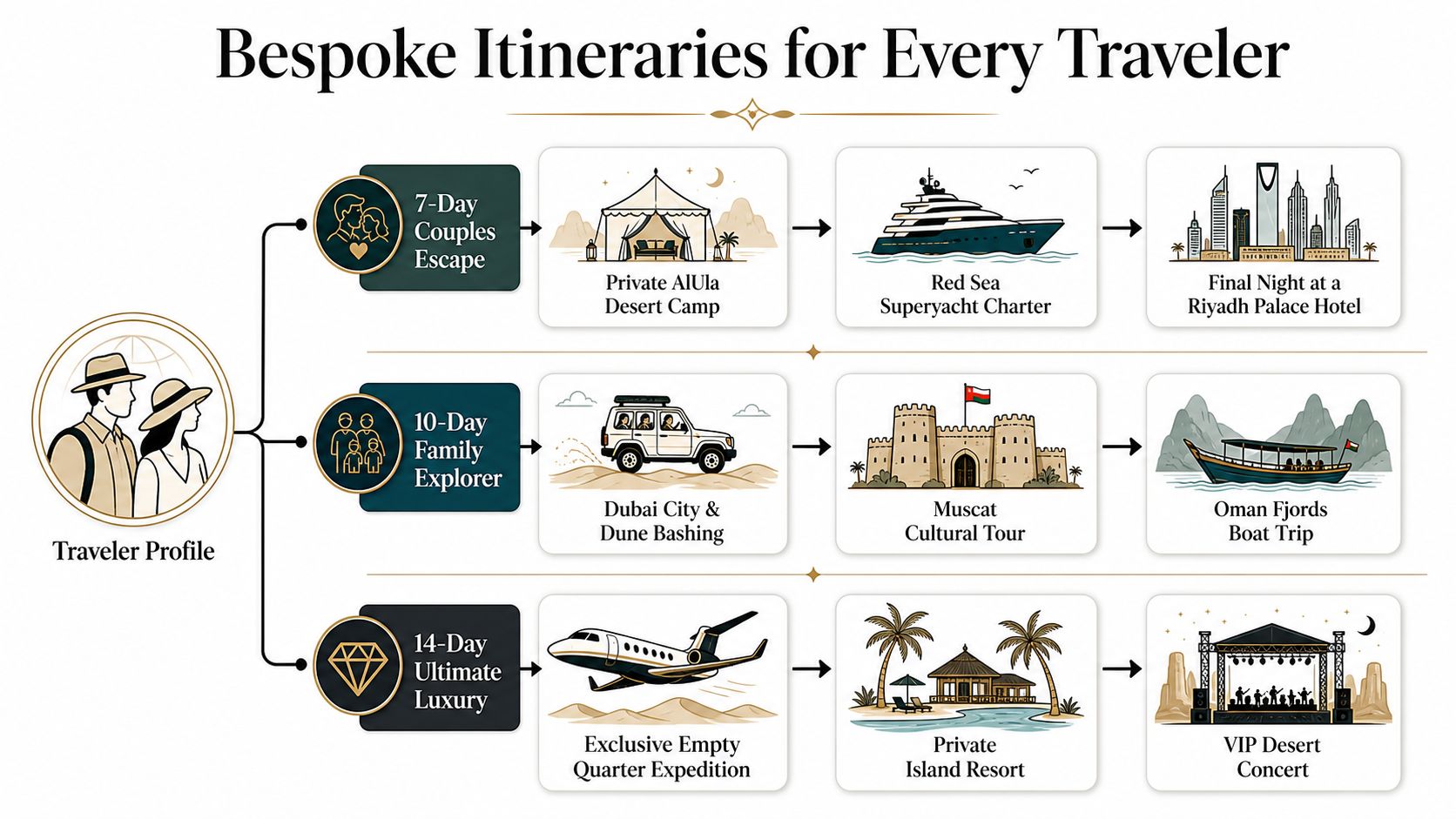
A strong 7-day couples escape starts with a private camp near AlUla, where the scenery does most of the work and the service should stay invisible. From there, shift to a Red Sea superyacht charter so the trip changes texture without losing refinement. End with one polished city night in Riyadh so the journey closes with dinner, shopping, and a proper suite rather than a rushed airport departure.
That sequence works because it moves from stillness to movement to culture. It also avoids one of the most common luxury mistakes, trying to do too much driving in the middle of a romantic trip. Couples should spend their energy on the experience, not on repeated check-ins and road fatigue.
Families need clean logistics and variety
The best 10-day family route is a mix of light adventure and cultural ballast. Start with a city-and-desert combination in the Gulf region if children need an easy first stop, then move into Muscat for a cultural reset, and finish with a Musandam boat trip or similar coastal outing that keeps children engaged without demanding extreme effort. The important thing is not the exact sequence, it's that the trip alternates active mornings with easy afternoons.
Families travel best when every transfer is quiet and predictable. That means private vehicles, clear buffer time, and guides who understand when to talk and when to let the day breathe. If you're traveling with multigenerational guests, skip the temptation to cram in one more site. The better move is a slower lunch and one less transfer.
The longest itineraries should feel like a story
A 14-day luxury journey can comfortably pair volcanic terrain, mountain hiking, a coastal city, and a high-status cultural finale. The key is pacing. Put the hardest walking early, use the coast as recovery, and save the most social city nights for the end. That gives the whole trip a narrative arc rather than a scrapbook feel.
Here's the blunt truth. The best Arabian itineraries are not the ones with the most landmarks. They're the ones where every leg has a purpose.
| Itinerary Type | Best Rhythm | What Must Be Locked In First | Main Trade-off |
|---|---|---|---|
| Couples Escape | Quiet, then movement, then city ease | Private camp and yacht dates | Less spontaneity |
| Family Explorer | Short transfers, mixed activity | Driver, guide, and room layout | More planning time |
| Long Luxury Journey | Varied terrain and strong pacing | Route design and flight blocks | Higher coordination load |
Luxury Accommodation and Exclusive Access
Luxury in Arabia isn't one thing, and travelers who assume otherwise end up overpaying for the wrong style. A camp can be beautiful but too public. A lodge can be perfectly placed but weak on dining. A yacht can be spectacular, but only if the crew understands the water and the route.
Choose the base that matches the terrain
Desert camps are the most romantic when they feel remote. Permanent-style camps with plunge pools and butler service can be excellent, but only if they preserve silence and sightlines. If they feel like a resort dropped into sand, pass.
Mountain lodges in Oman and Saudi are about altitude and access first, design second. You want hiking from the door, good beds, and kitchens that understand a traveler who has come off a long walk. Coastal stays should prioritize direct water access, diver support, or marina convenience, depending on whether the trip is about reef time or yacht time.
City palace hotels matter because they can turn the end of a hard trip into a polished finale. In Riyadh, Jeddah, and Muscat, location and arrival service matter more than flashy public spaces. The room should give you a sense of calm after a day of movement, not more visual noise.
For travelers who want a more structured booking framework, Haute Black also operates as a luxury travel and private membership platform with access across a wide portfolio of properties and experiences, including preferred partner relationships and concierge planning support. That matters when the trip needs both discretion and speed, especially across multiple countries.
Compare the categories before you book
| Category | Best For | Price Range per night | Key Trade-off |
|---|---|---|---|
| Desert camp | Silence, stargazing, romance | Varies by exclusivity | Remote feel versus creature comforts |
| Mountain lodge | Hiking, cool air, active days | Varies by altitude and season | Access versus dining polish |
| Superyacht charter | Water privacy, flexible routing | Varies by vessel and itinerary | Higher crew dependency |
| City palace hotel | Final nights, dining, shopping | Varies by city and suite level | Less wilderness atmosphere |
If you care about hotel recognition, advisor-led booking helps. A Virtuoso-affiliated booking path can deliver preferred-partner benefits at properties like Four Seasons, Aman, Rosewood, and Ritz-Carlton, which is exactly the sort of edge that matters when you're moving between demanding regions and want the stay to feel effortless. For a practical example of how one Gulf property reads at ground level, Haute Black's Rosewood Hotel Jeddah guide is the kind of focused research that saves time.
Bottom line: don't book by brand alone. Book by terrain, service style, and how much privacy the property actually protects.
Logistics and Cultural Etiquette Essentials
Arabia is not difficult if you respect the operating rules. It becomes messy when travelers try to improvise visas, transfers, dress, and timing on the fly. The right approach is simple, direct, and conservative.
Get the paperwork and routing right
Saudi Arabia now works far better for organized luxury travel than it did in the old exploratory era, but you still need the correct entry plan and a route that matches the ground realities. Oman's entry process is also straightforward for many travelers, though the best practice is still to confirm your nationality-specific requirements before buying nonrefundable flights.
Private aviation should be used when it reduces friction, not as a vanity move. It makes sense for multi-stop itineraries that link regions with poor road logic, especially when the day is already packed with hiking or diving. Helicopter transfers can be useful for very short hops or for turning a long overland transfer into a cleaner arrival, but only if the landing point and luggage handling are already sorted.
Hydration is not optional on desert days. Neither is basic altitude awareness in the mountains. Carry technical gear for hikes, reef-safe kit for diving days, and a separate wardrobe that works for mosques, heritage sites, and formal palace settings.
For payment flexibility and cross-border spending, travelers who like digital wallet structures sometimes use NomadCards crypto travel solutions as part of a broader travel-finance setup, but that's a complement, not a substitute, for proper planning and backup cards.
Dress and behavior should be regionally aware
Modest dressing is the safe default in religious and heritage settings. In practical terms, that means no rushed wardrobe decisions on arrival. Keep a polished long-sleeve layer, a scarf, and shoes that work for both walking and respectful site visits.
Photography needs judgment. People, government sites, and religious spaces can all have different expectations, and the polite move is to ask before shooting if there's any ambiguity. Gender dynamics are better handled with calm, unforced respect than with overthinking. A good guide will make that easier.
| Situation | What to do | What to avoid |
|---|---|---|
| Mosque visit | Dress modestly and move quietly | Loud conversation and flash photography |
| Desert camp | Pack layers and hydrate | Assuming the night will stay warm |
| Yacht day | Bring sun protection and soft shoes | Overpacking hard luggage |
| City palace evening | Dress elegantly and conservatively | Treating it like a casual beach dinner |
If you want the trip to feel easy, don't leave these calls to chance. Good logistics are the hidden luxury.
Concierge Add-Ons That Enhance Every Journey
Standard luxury gets you a nice room and a competent driver. Concierge-level planning gets you the moments travelers remember years later. In Arabia, that means private dining, closed-door access, and introductions that set the tone for the whole trip.
Access defines the upgrade
A private chef dinner in a desert courtyard beats a public dining room because the setting, pacing, and conversation belong to you. The same logic applies to after-hours cultural access, whether that is a museum viewing, an archaeological site visit, or a curated art opening without the usual crowd. These are not gimmicks. They are the details that make a trip feel personally engineered.
Sporting access also fits naturally into a broader Arabian itinerary. Jeddah and Abu Dhabi are obvious choices for motorsport-minded travelers, while falconry and private equestrian or polo experiences add a more traditional, high-status layer. Use those add-ons when they create contrast, not when they clutter the schedule.
A strong advisor can also connect travelers to dinners, salons, and private conversations that go beyond tourism. That network matters when the trip blends leisure with introductions or private roundtables.
For travelers who want a more structured route into these arrangements, Haute Black's private membership model and event network are useful because they combine travel planning with access and introductions in one place. If the itinerary needs a helicopter-heavy routing to work, the same logic applies to its private helicopter charter guidance.
My view: if an Arabian trip does not include at least one experience you could not book through a normal hotel concierge, you have left value on the table.
The Future of Arabian Adventure Travel
Arabia is entering a better phase for luxury travelers, not a softer one. Saudi Arabia's Vision 2030 is opening regions that used to be hard to access, while Oman is refining high-end adventure without sanding down its character Saudi adventure tourism context. That's the sweet spot, enough infrastructure to travel cleanly, but not so much development that the destinations lose their edge.
The next wave will be more specialized. Think technical diving, more ambitious mountain access, and mobile luxury camps that can move deeper into the region without sacrificing comfort. The opportunity now is to go before the area feels packaged.
Haute Black builds exactly the kind of logistics-first, high-touch Arabian itinerary that this destination demands, from private aviation and vetted guides to palace hotels, desert camps, and discreet access. If you want a journey through Arabia that feels smooth instead of improvised, visit Haute Black and start with a specialist who can shape the route around your dates, your pace, and your standards.
Explore Our Guides

Signature Experiences